
Written by Sinead Cox, Curator of Engagement & Dialogue
Panic in Ainleyville
“AINLEYVILLE: EXCITING CHASE AFTER A RESURRECTIONIST,” reads an intriguing headline from the May 5, 1864 Huron Signal: “The Miscreant Overhauled and the ‘body’ captured!” After no doubt succeeding in capturing its reader’s full attention, the cheeky tale of the so-called ‘resurrectionist’ (grave robber) unfolds as follows: a group of young men raucously depart an Ainleyville tavern where they had been discussing current politics with whiskey and rye. Passing a burial ground, they spot a suspicious figure carrying a heavy sack, and quickly identify him as a scoundrel and “one of the bloody body snatchers!” The men proceed to pursue and tackle the suspected fiend, and wrestle the sack away from him:
The bag was opened by excited fingers, and what was the sight that met the eyes stretched wide open to take in a horror? Not a mutilated, outraged human body, but a lot of most harmless looking bran, which the supposed resurrectionist had borrowed from a neighbor.
The punchline of the piece is that the vindicated ‘resurrectionist’ promised his assailants not to tell anyone about this embarrassing encounter, “but he made no promise against writing.” (i)
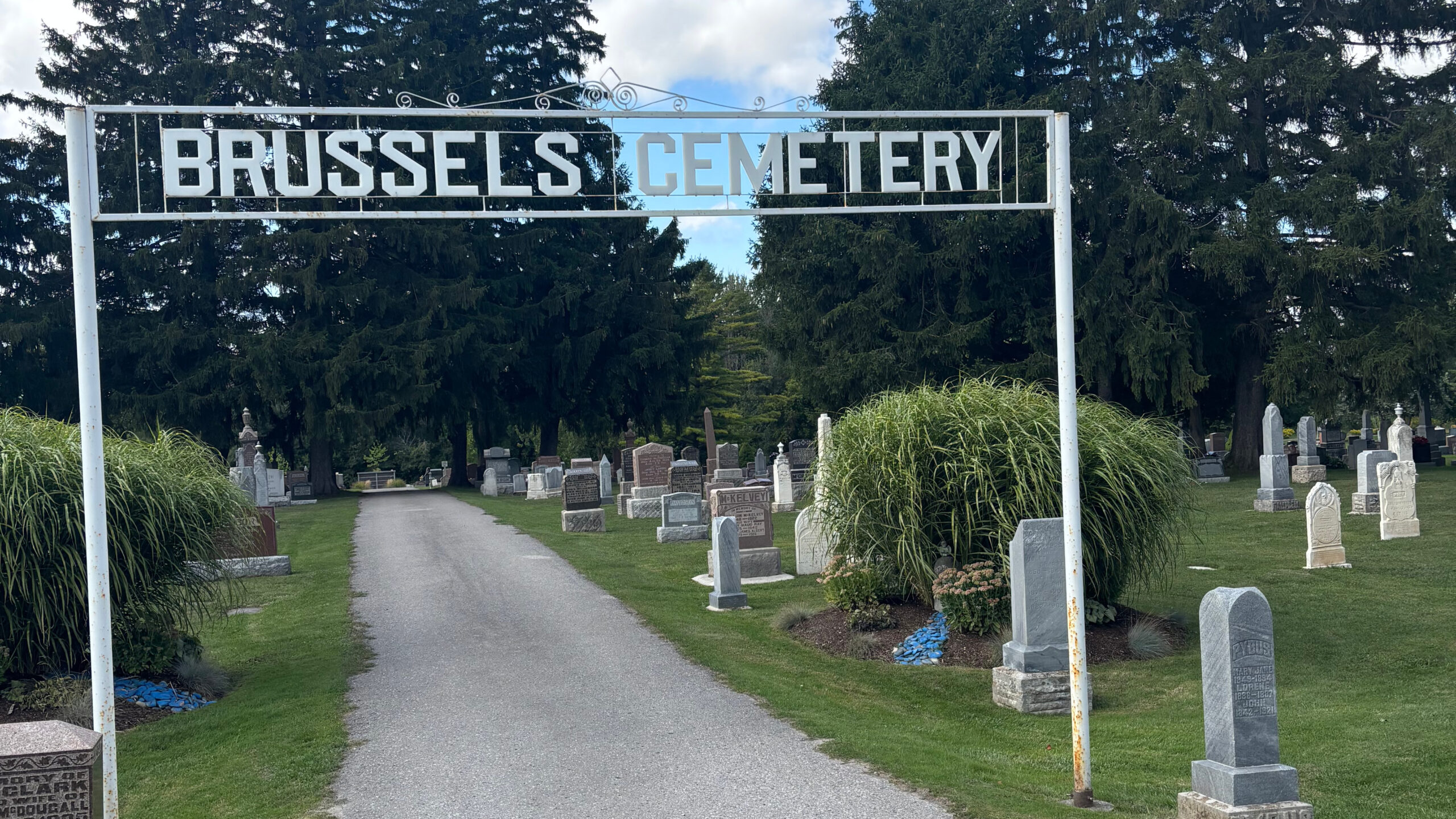
Whether or not this exact sequence of events ever happened, the newspaper’s uncredited account satirizes a perceived preoccupation with “body raising” that afflicted residents of Ainleyville in the spring of 1864: a scare that was not quite as outlandish as the Signal’s mockery may suggest. The story itself acknowledges that before their misadventure, the excitable young men were discussing, “the recent cases of body snatching…very naturally.” Natural because, only a few months prior, a very real ‘body snatcher’ had admitted to illegally disinterring the remains of a young woman from the Methodist New Connexion Cemetery (today Brussels Cemetery).
While the Huron Signal could merrily recount the apprehension of a bran resurrectionist, the same paper had gravely (no pun intended) condemned this actual incident as a “hideous offence.” (ii) The alleged grave robber was 22-year-old Edward Hudson (also spelled Hotson), originally of Markham. (iii) Committed to the Huron Gaol on March 6, 1864, the registry described him as 5 ft 7 inches tall, with blue eyes and dark brown hair. This record mentions only the commonplace crime of “trespass,” but his given profession provides a motive for something more lurid: he was a medical student.
The Progress of Science vs. the Sanctity of the Grave
The Grand Jury at Edward Hudson’s eventual trial would be reminded of the seriousness of his offence, and that “it be might well be for the ‘progress of science,’ but that progress was not to be aided by sacrilege.” (iv) Grave-robbing (either by ‘resurrectionists’ for-hire or medical practitioners themselves) was a longstanding practice in medicine because of a seemingly unresolvable paradox: training doctors to save lives and advances in medical science both required human cadavers, but there was no adequate supply of consenting donors to bequeath those bodies. Prevailing social norms and tradition meant that most 19th-century Canadians (v) preferred prompt burial with religious rites. Two decades before Ainleyville’s body snatching scare, the controversial 1843 Anatomy Bill for the United Canadas set out to provide medical schools with legal cadavers. It allocated the remains of those who died “publicly exposed” or in public institutions like gaols or hospitals if they were not claimed by friends or family. (vi)
Dr. William “Tiger” Dunlop, then Huron’s Member of the Legislative Assembly and himself a medical doctor, argued firmly in favour of the 1843 Bill against those who feared it would deny a ‘decent’ burial to vulnerable groups like new immigrants. He acknowledged that “there is a prejudice all over the world, a strong prejudice in favour of the sanctity of the grave…but he would not have it obstruct the acquisition of anatomical knowledge, for without it even a physician may do more harm than good.” During debates, he also raised the spectre of the notorious Burke & Hare case in Scotland, wherein the perpetrators had resorted to murder to supply valuable corpses. Dunlop viewed the matter pragmatically, arguing that since medical students would always need cadavers to learn, the graves of the poor would be pilfered regardless of any law. He owned that he himself had participated in grave-robbing excursions at least 70 times in the United Kingdom:
A dissecting room was a dirty sight to a stranger, more so because [it] was not under legal protection. The work has to be done by stealth, in a hurry, and by night. [Dr. Dunlop] had carried bodies in baskets and [re]buried them in a ploughed field to escape detection. But place these [medical] schools under law, and these things will cease.
Dr. Dunlop proclaimed he would not object to his own corpse being dissected after death (but any visitor to his tomb at Gairbraid north of Goderich will know this did not happen). (vii)
The passing of the 1843 bill provided medical schools with cadavers in a manner that was conveniently out-of-sight and out-of-mind for those not facing extreme poverty, homelessness or institutionalization. Illegal exhumations persisted in the coming decades, however, confronting wider Canadian society with the fact that the essential paradox of societal needs versus norms had never actually been resolved.
“Men Pretending to be Doctors”
A new and developing settler community, Ainleyville, was still a relatively remote outpost in the 1860s, situated on the border of Morris and Grey Townships. Part of the amalgamated municipality of Huron East today, the village was not officially renamed Brussels until 1872 to align with its train station. A rural community located a great distance from any medical college would seem an unlikely place to encounter a black market for cadavers. When a grisly “trail of blood” leading from a Thornhill churchyard revealed the emptied grave of a man killed in a farm accident in 1861 for example, the York Herald confidently predicted that the culprits would be found in nearby Toronto. (viii) Referring to the 1864 case in Huron County, the Signal lamented that stealing bodies from their graves, “has been too much in vogue in large cities, but is now first heard of here.” (ix)
Although there was no anatomy school in Huron County, the northeast part of the county had several medical men practicing at the time. Ainleyville’s Dr. I. J. Hawks was initially co-accused alongside Edward Hudson for the crime of “disinterring a dead body” in March, 1864, although he was not ultimately jailed. According to newspaper accounts, Hudson lived with Hawks at the time of the crime and worked in his Ainleyville drug store. (x) Remembered as Brussels’ first doctor, Dr. Hawks was also an enterprising businessman. In addition to his services as a physician and surgeon, the County employed him as coroner in the townships of Grey and Morris during the early 1860s, and he owned a general store in Bodmin. (xi) Both Edward Hudson “medical student” and Dr. Isaac J. Hawks, M.D. appear in the 1863/1864 County of Huron gazetteer as professionals in Ainleyville, implying that Hawks provided medical services with a license, and Hudson without. (xii)
A so-called ‘indignation meeting’ at Ainleyville two years earlier had publicly exposed, though, that the credentials of many rural physicians with that reassuring “Dr.” prefix fell short of a completed university degree or medical license. Angry citizens convened in 1862 after Dr. A. Lenders had used his powers as coroner to delay a Morrisdale man’s funeral and burial. (xiii) Lenders insisted on holding an inquest, despite colleagues Dr. Hawks and Dr. Caw’s preceding assessment that it was a straightforward death from natural causes. The assembled residents suspected that Dr. Lenders had callously offended “the feelings of the bereaved” for a petty rivalry. The secretary for the meeting referred to Lenders as a “medical student” and concluded:
The would be Dr. (Lenders) raised the whole excitement in the community because he wished to vent his spleen on the other two medical gentlemen, who unfortunately have no license, and the inconsistency of the thing is, he is said to have none himself…Men pretending to be Doctors have carried the thing too far in this part. We are daily trampled on by charlatans. There is a great need for reform…But we want no more quacks. (xiv)
With the medical education of so many practitioners allegedly incomplete, it is not difficult to imagine that informal lessons in anatomy or surgery were taking place in Morris and Grey Townships, requiring the illicit purchase of cadavers. The questionable legality of medical practice generally around Ainleyville in the 1860s certainly set the scene for the graverobbing scandal to come.
The Queen Vs. Edward Hudson
On the morning of March 3, 1864, the body of Elizabeth Hislop Broadfoot was found to have been “partially exhumed.” (xv) It is unlikely there was any actual grave to rob dug in the frozen grounds of the New Connexion cemetery south of Ainleyville in early March. Cold weather could actually expedite a body snatcher’s work by better preserving remains and necessitating that they be stored in an above-ground mortuary until the spring thaw. Although the available details are few, reference to a partial exhumation suggests that some part of the remains or their coverings were discovered missing: perhaps either because of tampering onsite, or the body had been hastily re-interred after dissection.
Elizabeth had died days before on Feb. 29—1864 being a leap year. Born in Scotland only 25 years earlier, she had emigrated with her family as a child and settled in Grey Township. She lived in a log home about two miles north of Walton with her father, John Hislop, before marrying “respectable” Morris farmer Robert Broadfoot in December, 1862. (xvi) The same month as her tragically short life ended, she had given birth to her only son, John H. Broadfoot.
Maternal mortality was not uncommon in the 19th century, and post-partum complications were very likely responsible for Elizabeth’s demise. During the period many devastating diseases also claimed the lives of young people in Huron County. Diphtheria, scarlet fever, typhoid and meningitis, among other outbreaks, could claim several members of the same family in a manner of days or even hours, necessitating hasty burials. Perhaps any knowledge that Elizabeth had passed away from a post-partum infection or blood loss, rather than contagion, could have also factored into a grave robber’s choice.
Whatever the circumstances of the young woman’s death, the illegal disinterment of her body would have shocked the community, the grieving Hislop and Broadfoot families most of all. Elizabeth’s widower stood before the Justice of the Peace to accuse Dr. I. J. Hawks and Edward Hudson on March 5. Hawks was discharged when this local court failed to find sufficient evidence for the doctor’s involvement in the crime. The young medical student, however, was committed to the gaol at Goderich to await his trial at the higher Quarter Sessions court on March 10 and 11.
Contemporary community gossip in the vicinity of Ainleyville was no doubt consumed by this case. Most locals would have been connected to a victim or alleged perpetrator, as indicated by the more than dozen potential witnesses listed on court documents. Names included not only bereaved husband Robert Broadfoot and his father-in-law John Hislop, but multiple local doctors including Dr. D. B. McCool, Dr. Hawks and Dr. Lenders, and prominent citizens including merchant N. W. Livingston and a son of the village’s namesake Ainley family. (xvii) According to The Mitchell Advocate, a local tailor and a clerk in Livingston’s store were widely known to have assisted Hudson with the crime, but the 22-year-old medical student remained the only one facing legal consequences. (xviii)
Hudson faced two separate indictments: one charge for the larceny of Elizabeth’s shroud and coffin, and another for disinterring a body. The Grand Jury at Goderich determined that there was no proof of larceny, and returned “no true bill” against the defendant. For the charge of body raising, Edward Hudson changed his plea to guilty and the jury did return a true bill. Whether he admitted guilt out of remorse or pragmatism, he was now a confessed and convicted resurrectionist. The resulting sentence was “to be imprisoned for one month in the common Gaol and pay a fine of ten pounds, and remain in Gaol until the same be paid.” (xix) This penalty Hudson must have paid in full, as he walked free on April 13.
My Life with You did not Long Last
Ainleyville’s lingering fear of graverobbing seems to have escalated to something of a brief moral panic, as derided in the Huron Signal’s story about its citizens rescuing a snatched bag of bran. This hypervigilance was not gothic Victorian imaginations run amok, but precipitated by true events that had no doubt sincerely frightened people. The consensus of public opinion was that Hudson had not acted alone, and it is unlikely that he could have moved and dissected a body without help. His shocking arrest would have prodded villagers to contemplate if more undetected disinterments had already taken place, and whether they were still in the company of those responsible. The scandal would have also further broken trust with the region’s dubious ‘doctors,’ if not professional medicine in general.
More than a decade later, Brucefield would similarly face “considerable excitement” when the bones of a long-buried man were reported missing from Tuckersmith’s Friarton Brae cemetery in May,1878. (xx) This panic was short-lived. The man’s widow corrected the spread of false information in a correction to Clinton’s New Era newspaper months later: “the grave was not robbed, but had been disturbed by a horse tramping over it.” (xxi)
After serving his time in gaol, Edward Hudson soon escaped ignominy in Canada West for the United States. Amidst the American Civil War, he enlisted in the U.S. Army at Detroit in September, 1864. Although his erstwhile colleague Dr. Isaac J. Hawks avoided criminal charges, the accusations reportedly damaged the doctor’s reputation: “the prevailing opinion of the country is, that he was quite cognizant of the whole affair.” (xxii) Dr. Hawks was the most generous financial donor to the Ainleyville New Connexion Methodist church in 1865, but he seemingly disappeared from local prominence after the mid 1860s when he and his wife Elvira moved to Brantford and later the United States. (xxiii) After years of already working as physician and surgeon for the rural residents of Huron County, he finally acquired a license to practice medicine on Dec. 20, 1864. (xxiv)
Widower Robert Broadfoot remarried and moved to western Canada and ultimately Kansas. John Hislop continued to occupy the family farm between Walton and Brussels until his own death in 1881, survived by several of his other children.
Although there is little detail known about the short life of Elizabeth Broadfoot, her gravestone still stands in the Brussels Cemetery today as an enduring monument to how much her loved ones cared for her and deeply missed her when she died in the winter of 1864. Her son would sadly never have the chance to know his mother, but the inscription on Elizabeth’s stone includes a poem that made her love for him immortal: “Mourn not for me my life is past/my life with you not long did last/But mercy show and pity take/and love my infant for my sake.”
Graverobbing as Gothic Tale
Sensationalism, tragedy and even humour all co-exist in the history of grave robbing. In 1843, Tiger Dunlop garnered laughter on the floor of the Legislative Assembly when he joked about a false accusation of body snatching received in his Glasgow youth: the doctor was unable to disclose his alibi because he had actually been disinterring a corpse at a different churchyard. (xxv) From the opposite side of the matter two decades later, Elizabeth Broadfoot’s family were rightfully horrified to discover that her body had been illicitly exhumed while they mourned. Public reactions to the crime hint at broader societal discomforts. Laws regarding cadavers required that the most disadvantaged members of Canadian society provide their remains for the benefit of all: an uneasy peace for science versus the sacrosanct. Widely held concepts of “decent” burial discouraged willing donations of bodies. Taboos therefore led to secretive, illegal—and consequently intriguingly lurid—practices. Suspicion of doctors as body snatchers fostered distrust against imperfect, evolving medicine as practiced by imperfect, questionably credentialed people. It is no wonder that the citizens of Ainleyville in 1864 were frightened and appalled, but perhaps also equal parts morbidly fascinated by the news of a resurrectionist in their midst.
Reflecting on Canada’s grave-robbing past, Professor Royce McGillivray notes that contemporary accounts of these crimes served as horror stories that appealed to Victorian readers’ righteous moral outrage, but also simultaneously served as ghoulish entertainment. He argues that graverobbing would thus be remembered with a thrill in the next generation, “just as people delight in Gothic novels and vampire movies.” (xxvi) Both outrage and sensationalism can be recognized in local newspapers’ coverage of the Hudson case. And both impulses were skewered by the Huron Signal’s mocking tale about a bag of resurrected cereal, demonstrating a culture self-aware of its own obsessions, its “eyes stretched wide open to take in a horror.” In digging up this incident from 1864 (pun intended), I don’t claim any modern superiority in my motivations as a reader or storyteller, but a macabre lens on the past does not have to strip these tales of their humanity or their pathos. A bit of ghoulish fascination can be a light that guides us through the darker corners of history, and to better understand something of our attitudes and fixations surrounding death and dying today.
Further Reading
- How to donate your body to science in Ontario today: Whole body donation | ontario.ca
- I Know Where the Bodies are Buried: Deaths at the Huron Jail | Huron County Museum
- Historic Huron Settlements: Ainleyville | Huron County Museum
- Anatomically Incorrect: Bodysnatching in the 19th Century – Canada’s History
- Bodysnatching in Canada – PMC
- Resurrecting the History of Body-Snatching at McGill: Anatomy Act | De re medica
Sources
- i“Ainleyville: Exciting Chase after a Resurrectionist,” The Huron Signal, 1864-05-05. Pg 2. Accessed via Huron County’s Digital newspapers.
- ii The Huron Signal, 1864-03-10, pg 2.
- iii He appears in the transcribed gaol records as “George.” All court and newspaper accounts refer to him as Edward. It is possible he gave a false name or this was an error. George coincidentally was his father’s name. It is unlikely (but not impossible) that this was simply a case of going by a second name, as the 1851 census also shows he had a brother named George. Hotson seems to be the more accurate spelling of his surname, but I have used the “Hudson” spelling to be consistent with Huron court records.
- iv The Huron Signal, 1864-03-10, pg 2.
- v At this time meaning residents of Canada East and Canada West.
- vi The Provincial Statutes of Canada, passed in the year 1843, Kingston: Stewart Derbishire & George Desbarats, 1843. 7 Victoria – Chapter 5 An Act to regulate and facilitate the study of Anatomy, 9th December, 1843. Accessed via British North America Legislative Database; University of New Brunswick.
- vii Canada. Parliament. Legislative Assembly. Debates of the Legislative Assembly of United Canada, 1841-1867, Volume 3, pg 464-467.
- vii York Herald, 1861-12-20, pg 7. Accessed via Richmond Hill Public Library (Our Ontario).
- ix The Huron Signal, 1864-03-10, pg 2.
- x “Ainsleyville,” County of Perth Herald (Stratford), 1864-03-23, pg 3. Accessed via Stratford-Perth Archives.
- xi A bygone Morris Township village with a modest population of 50 in 1864.
- xii County of Huron gazetteer and general business directory for 1863-4, Sutherland Bros Publishers & Printers: Ingersoll (Canada West), 1863, pg 107. Accessed via Canadiana. Appears as “Edward Hotson.”
- xiii His name appears elsewhere as ‘Lander,’ but appears to be the same man working as doctor and coroner in vicinity of Ainleyville. Dr. Hawks’ name appears in records as ‘Hawkes’ also, and is sometime mis-transcribed as “J.J. Hawkes” instead of “I.J.” His name also appears in sources as Dr. Isiah J. Hawkes, but he appears in the 1863/64 gazetteer as Isaac. His full name was likely Dr. Isaiah Jones Hawkes.
- xiv “Indignation Meeting,” The Semi-Weekly Signal, 1862-09-19, pg 4.
- xv County of Perth Herald, 1864-03-23, pg 3.
- xvi Ibid.
- xvii Indictment: The Queen vs. Edward Hudson, Counties of Huron & Bruce, 1864, Box #49, Municipality Court Records 1864, Huron County Archives.
- xviii County of Perth Herald, 1864-03-23, pg 3.
- xix Proceedings of the Quarter Sessions including the Clerk’s transactions for the Huron County Quarter Sessions 1841-1873, Vol 30, pg 153, CA3ONHU3UOU1P76, Box 827, Huron County Archives.
- xx“Grave Robbing,” Huron Expositor, 1878-05-17, pg 8.
- xxi “Correction,” The Clinton New Era, 1878-09-05, pg 8.
- xxii County of Perth Herald, 1864-03-23, pg 3.
- xxiii Report of the Canadian Wesleyan Methodist New Connexion Missionary Society, auxiliary to the Methodist New Connection Missionary Society in England, Wesleyan New Connection Missionary Society: London, Canada West, 1865. Accessed via Canadiana.
- xxiv Licenses, Upper and Lower Canada, Canada East and Canada West and Ontario, 1817-1867 – 3947 C-3947, Library and Archives Canada / Bibliothèque et Archives Canada. Accessed via Canadiana.
- xxv Debates of the Legislative Assembly of United Canada, 1841-1867, Volume 3, pg 464.
- xxvi Royce McGillivray, “Body Snatching in Ontario,” Canadian Bulletin of Medical History Volume 5, Number 1, 1988, pg 58.