About the Project
The Henderson Digitization Project is a one-year, grant-funded project to digitize a collection of images documenting the history of WWII air training in Huron County, Ontario. Project work was completed between April 2013 and March 2014. All photographs featured in this project were taken by Goderich photographer J. Gordon Henderson and represent a small part of the large collection of Henderson’s professional work held at the Archives at the Huron County Museum & Historic Gaol.
By digitizing the collection, publishing it online, and developing educational programs, we aim to increase awareness of J. Gordon Henderson, the Archives at the Huron County Museum, and Huron County’s role in the British Commonwealth Air Training Plan. This project also serves as a model for developing future digital collections at the Huron County Museum & Historic Gaol.
Funding for the Henderson Digitization Project provided by the Government of Ontario. The views expressed by the Henderson Digitization Project are the views of the Huron County Museum & Historic Gaol and do not necessarily reflect those of the Province.
Site Credits
Project Team
- Project Direction
- Meighan Wark, Director, Cultural Services
- Project Management, Cataloguing, Research, and Education Programs
- Jenna Leifso, Archives Research Assistant
- Digitization, Metadata Wrangling, and Website Coordination
- Emily Beliveau, Digital Archives Assistant
- County IT Liaisons
- Marian Doucette
- Mike Mason
- Jacob Stevens
- Site Design and Development
- Conceptual Pathways
Stakeholder Group
- Sinead Cox
- Rhea Hamilton-Seeger
- Carolyn Parks Mintz
- Pat Rowe
- Ted Turner
- Brock and Janis Vodden
- Karen Webster
Special thanks to:
Barbara Hainsworth, for supporting the project and sharing memories of her father, J. Gordon Henderson.
Mike McLean, for sharing extensive and enthusiastic research contributions related to No. 12 EFTS, Sky Harbour.
Reg Thompson and Elaine Blair at the Huron County Library for research support and compiling the annotated entries in Additional Resources.
Jeremy Allin, for creating the audio clips in the Media section.
Education Advisers
- Marion Leifso, OCT
- Amanda Saxton, OCT
- Colleen Caesar, OCT
Text Editors
- Jennifer Zoethout
- Claire Carter
J. Gordon Henderson
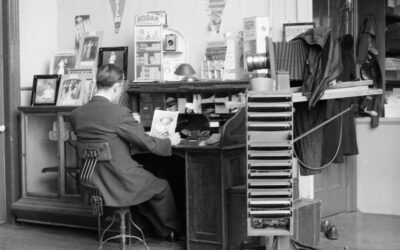
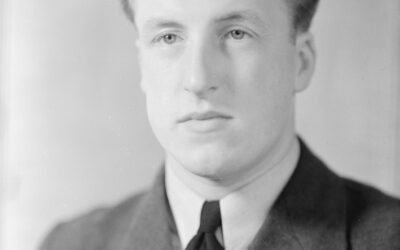
J. Gordon Henderson was born in Brantford, Ontario in 1913. He grew up in Toronto and moved to Goderich, Ontario in 1939, where he purchased J.W. Trussler’s photography business located on the corner of Hamilton Street and the Square. An advertisement appeared in the March 23, 1939 issue of the Goderich Signal Star announcing Henderson’s new business.
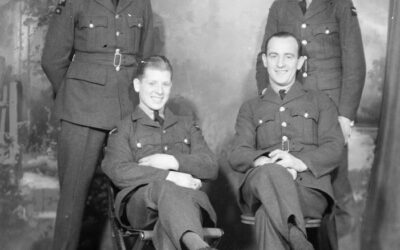
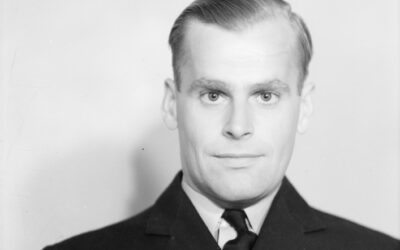
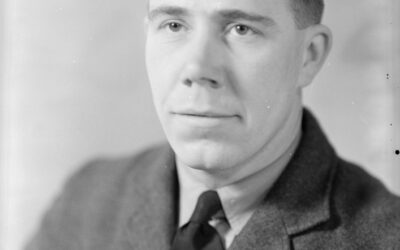
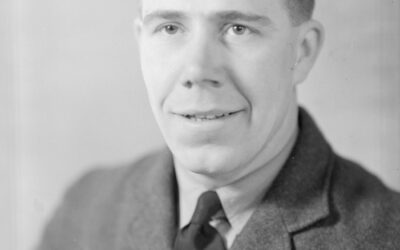
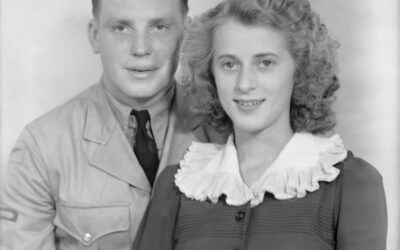
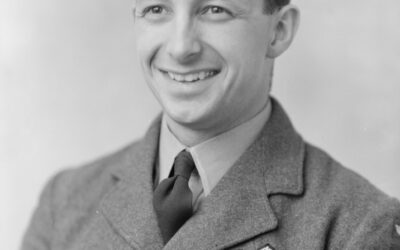
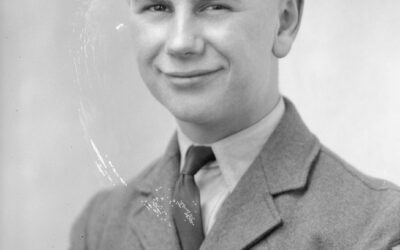
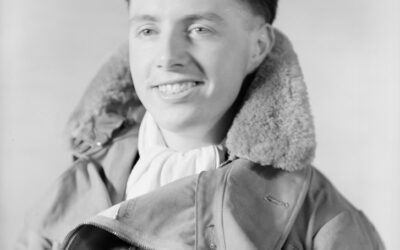
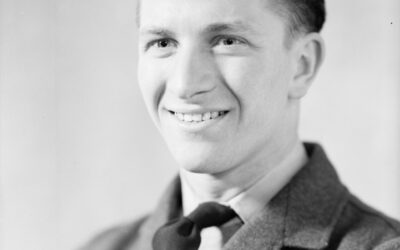
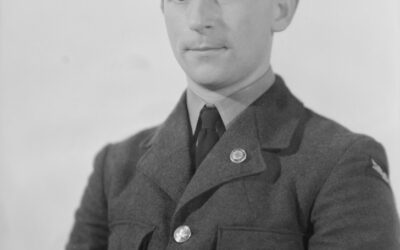
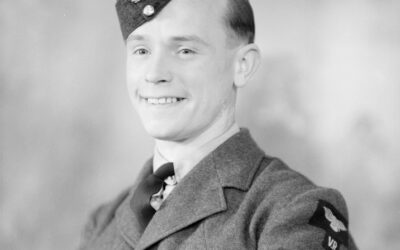
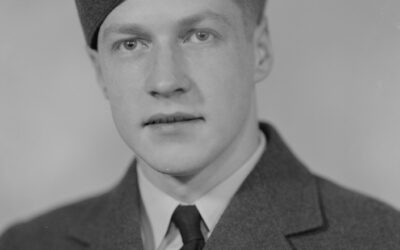
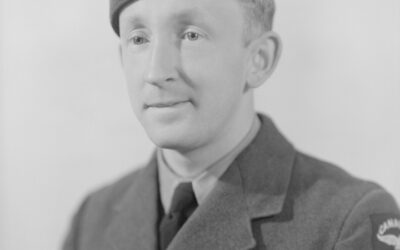
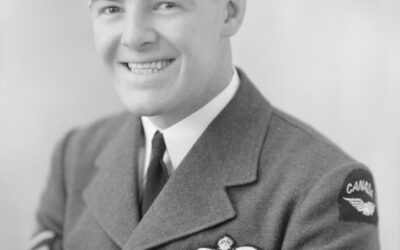
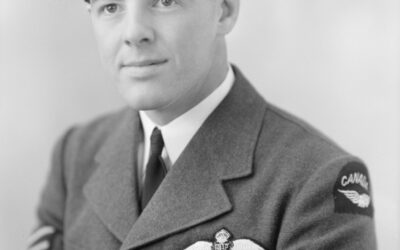
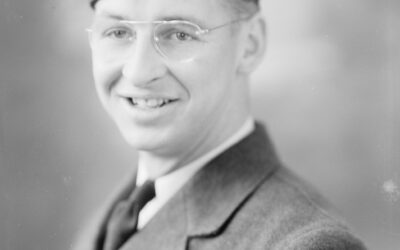
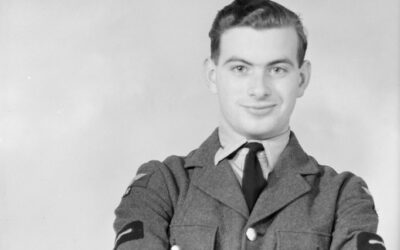
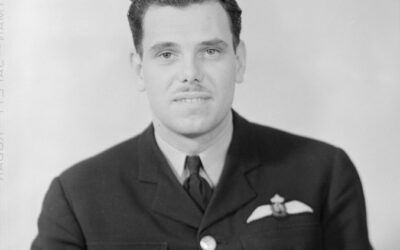
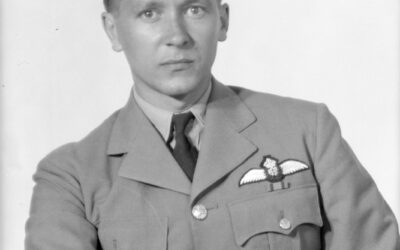
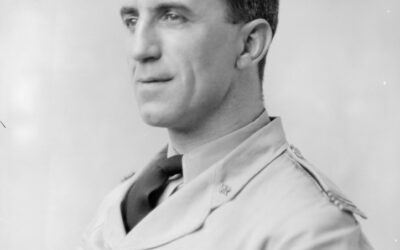
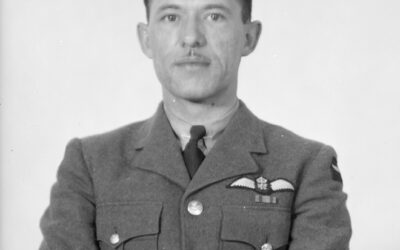
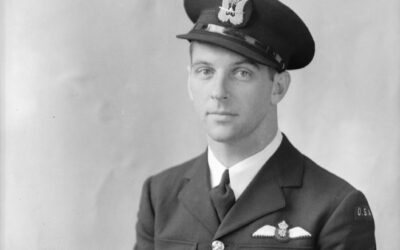
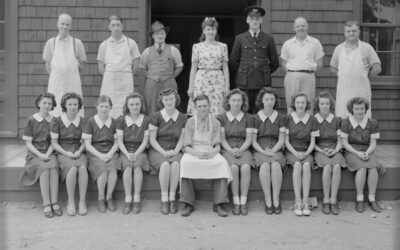
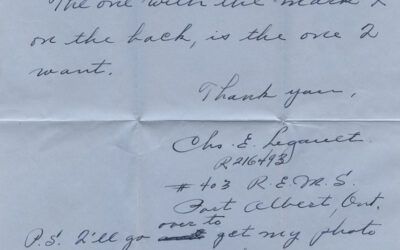
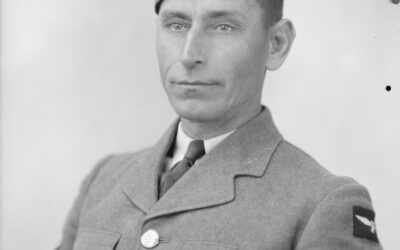
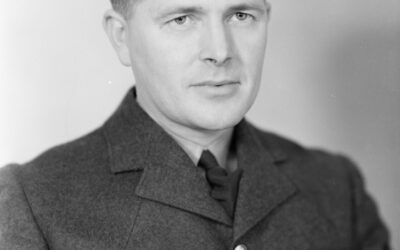
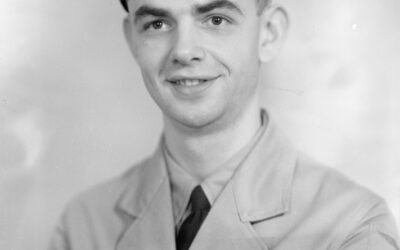
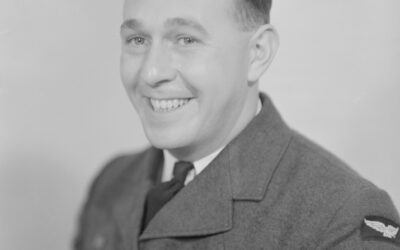
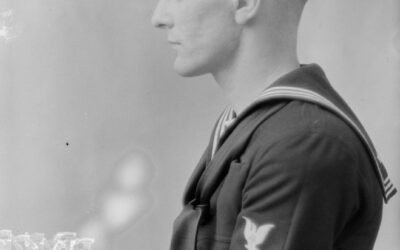
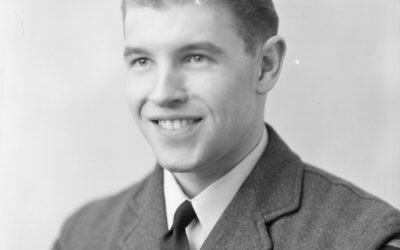
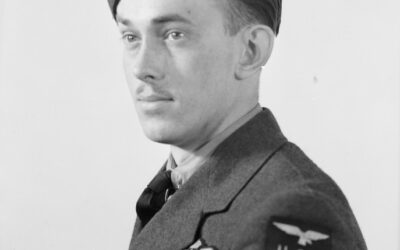
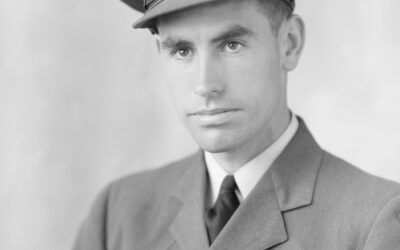
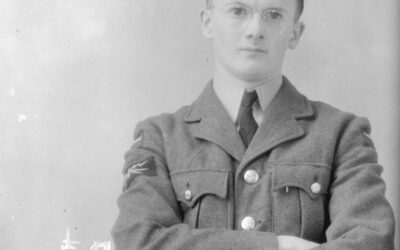
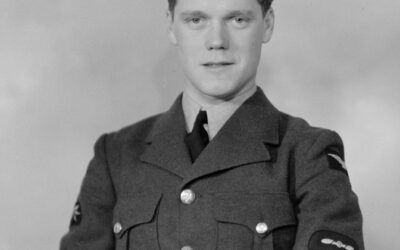
During World War II, he travelled to air training schools in Goderich, Port Albert, and Clinton taking pictures of classes and other base activities. Many airmen came to his studio in Goderich to have their portraits taken to send home to family and friends. The Henderson Collection also includes wedding portraits, candid shots, and correspondence related to WWII air training in Huron County.
Henderson met his wife, Mary McKay, when she came into his studio to have her photo taken as the maid of honour for her best friend’s wedding. They were married on May 8, 1943. Later that year, they opened J.G. Henderson’s Book Store at 4 the Square in Goderich, where Garb and Gear Source for Sports is currently located. Mary worked at the store and assisted with various aspects of the photography business, such as hand tinting the photographs.
While Henderson’s Book Store only operated out of one location throughout its history, Henderson’s photography studio had several locations in Goderich over the years, including 56 the Square, 4 the Square and in his home on Nelson Street. Eventually, the studio moved into the second floor above the bookstore. Most of the portraits taken during WWII were done at the Hamilton Street studio.
After selling his bookstore in 1979, Henderson retired from both businesses on February 28, 1980. For the most part, he stopped taking pictures after he retired. During his career, Henderson took pictures for Sheaffer Pen catalogues, was a photographer for Dominion Roads, and travelled across Southwestern Ontario taking school photographs. Throughout his forty years as a professional photographer in Goderich, Henderson only shot and developed in black and white film, never making the switch to colour film. Ever the professional, Mr. Henderson always wore a tie, even when working in the dark room.
Henderson was involved in the community as a member of Knox Presbyterian Church, Knox Church Chancel Choir, MacKay Choristers and the Goderich Business Men’s Association. He died on June 16, 1989. His family donated his professional work and equipment to the Huron County Museum in 1992.
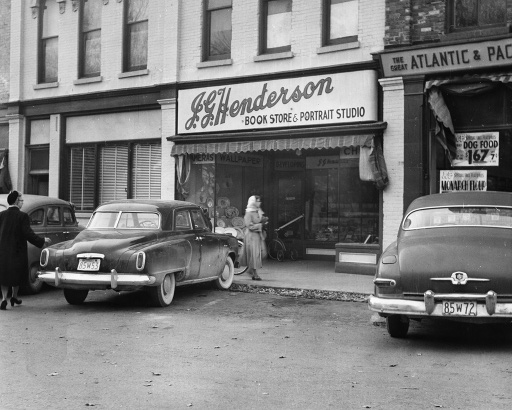
Rights: Copyright J. Gordon Henderson. Used with permission, courtesy of Barbara Hainsworth.
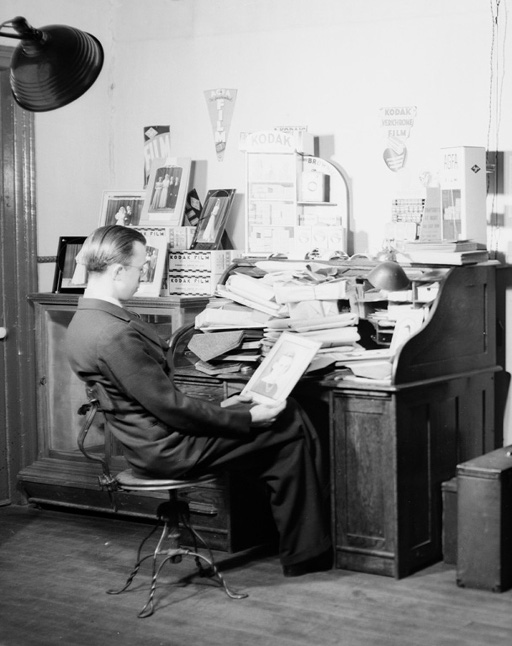
Rights: Public domain.
The Training Schools
British Commonwealth Air Training Plan
During World War II, four training schools were established in Huron County as part of an international agreement called the British Commonwealth Air Training Plan (BCATP). Canada, Great Britain, New Zealand, and Australia signed the agreement on December 17, 1939 with the goal of quickly increasing the number of pilots, navigators, bomb-aimers, wireless operators, air gunners and flight engineers able to fight in the war.
Under the BCATP, over 90 training schools were opened across Canada, graduating more than 130,000 people between 1940 and 1945. In addition, over 100,000 men and women worked as ground support at BCATP facilities.
The BCATP is considered one of the most important contributions to the Allied victory in World War II. President Roosevelt called Canada the "aerodrome of democracy".
Wide-Open Skies
Canada was a prime location to establish training schools due to its closeness to United States supply lines, the abundance of wide open land, and its distance from the front lines of war.
Airmen came to train in Canada from many parts of the world. While half Canada’s BCATP trainees were Canadian, the other half primarily came from Britain, Australia, or New Zealand. Towards the end of the war, there was in increase in trainees coming from Allied countries like Belgium, Czechoslovakia, France, Holland, Norway, and Poland.
Many men who came to train in Canada met and married local women. After the war, some of these airmen returned to Canada to be with their new families, while others had their new wives join them in their home country.
Clayton Knight Committee
Before the United States officially declared war in December 1941, many Americans joined the Royal Canadian Air Force (RCAF) to show their support for the Allied forces. By the time the United States entered the war after the bombing of Pearl Harbour, more than 6000 Americans were serving in the RCAF, half of which were part of the BCATP.
The Clayton Knight Committee was a scheme to recruit Americans into the RCAF. Canadian WWI flying ace Billy Bishop, Homer Smith, and Clayton Knight were tasked with figuring out how to enlist US volunteers into the RCAF without violating American neutrality laws. With Knight serving as coordinator, men could enlist in offices that had been established all over America. Many of the US airmen who came to Canada were experienced flying instructors.
Once the United States entered the war, many Americans transferred back to the United States Army Air Forces.
No. 9 Service Flying Training School
Centralia, Ontario
Service Flying Training Schools (SFTS) were the fourth step in the British Commonwealth Air Training Plan for young men training to become pilots.
Airmen who graduated from an Elementary Flying Training School advanced to a SFTS to gain more experience flying larger aircraft like Ansons and Harvards.
No. 9 SFTS originally opened in Summerside, Prince Edward Island in January 1941. As German U-boats began to approach Canada’s Atlantic Coast, Summerside was converted to a General Reconnaissance School. It was thought that Summerside’s geographic location was better suited to train men for Coastal Command, leading No. 9 SFTS to be relocated to Centralia, Ontario in 1942.
In June 1942, the first officers and personnel from Summerside began arriving at the new school in Centralia. The first official class arrived in August 1942, and the base officially opened that September.
No. 9 SFTS closed on March 30, 1945.
The Henderson Collection does not contain any photographs specifically related to No. 9 SFTS, although many of the men who graduated from No. 12 EFTS in Goderich proceeded to No. 9 SFTS in Centralia to continue training.
No. 12 Elementary Flying Training School
Goderich, Ontario
After attending Manning Depots and Initial Training Schools, the next step for British Commonwealth Air Training Plan (BCATP) recruits was attending Elementary Flying Training School (EFTS).
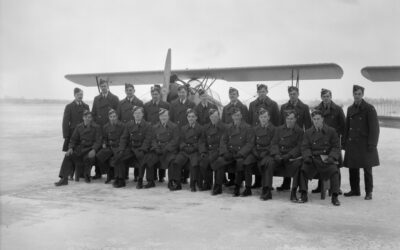
In June 1940, the decision was made to establish an Elementary Flying Training School at Sky Harbour Airport, located just north of Goderich. The school was operated by the Kitchener-Waterloo Flying Club as part of the BCATP.
In October 1940, the first group of 35 students arrived. For many it would be their first time in an airplane. As the war went on, the school continued to expand, and by June 1942 the school could accommodate 240 students. No. 12 EFTS also became the largest industry in Goderich during this time, employing over 500 personnel.
Training
The first EFTS courses lasted 8 weeks. Students attended 126 hours of ground lectures and logged 50 hours of combined flying time under daytime and nighttime conditions. After 8 hours of flying with an instructor, students would start flying solo.
Men who did not pass their courses or flying tests would “washout” and be reassigned to another service in the Air Force, such as Air Navigation or Air Gunners. Men who successfully completed all components of the course graduated to Service Flying Training Schools located across the country.
Royal Navy – Fleet Air Arm
By 1943, the RAF had a surplus of pilots and the demand for new pilots decreased. To continue making use of the school, the Royal Navy’s Fleet Air Arm started training their pilots at No. 12 EFTS.
In July 1944, the school was closed and the site was repurposed as No. 102 Aircraft Holding Unit.
Notable people affiliated with No. 12 EFTS
Marion Orr was hired in 1942 as a control tower operator and left at the end of the year to join the Air Transport Auxiliary, ferrying aircraft to England for the remainder of the war. She is the subject of a Historica Canada Heritage Minute.
Jackie Rae was a vaudeville performer prior to the war. He later became a Canadian and British Television star as host of The Jackie Rae Show, Spot the Tune, and The Golden Shot. For his service during WWII, Rae was given the Distinguished Flying Cross.
David Hornell was the first member of the RCAF to be awarded the Victoria Cross. He received the award posthumously, for “valour and devotion to duty” during a U-boat attack. On June 24, 1944, after sinking a German submarine, Hornell was forced to land his damaged aircraft in the sea. He spent several hours in water waiting to be rescued, succumbing to his injuries shortly after help arrived.
Joe McCarthy, an American who joined the RCAF, was part of the "Dambuster" squadron that attacked Moehne, Eder, and Sorpe dams in Germany. This dangerous mission was the inspiration for the film The Dam Busters. He received a Distinguished Service Order and two Distinguished Flying Crosses.
No. 31 / No. 5 Radio School
Clinton, Ontario
No. 31 Radio School (RAF)
In Spring 1941, Norman Tyndall’s 100 acre farm, located outside of Clinton, was repatriated to use as a training school for the Royal Air Force. A shortage of trained radar technicians motivated Britain to establish a training school in Canada. No. 31 Radio School opened in August 1941 and the first group of students to be trained by Royal Air Force personnel came from the United States Navy and Army. By the end of the war, 6,500 Canadians and 2,325 US Servicemen were trained on radar.
Radio Detection and Ranging (RADAR) was an emerging technology at the time and the training that took place on the base during the war years was kept top secret. The school was the only one of its kind in North America and was considered to be the most sophisticated Radio/Radar and Signals/Code School in the Allied world at the time.
No. 31 Radio School produced about 250 graduates per month. Students were from America, Britain, Canada, Australia, and New Zealand. By the summer of 1943, the school had filled its initial commitment to provide the RAF with 5000 radio technicians.
No. 5 Radio School (RCAF)
With RAF needs met, the Royal Canadian Air Force (RCAF) took command of the base in July 1943, and it was renamed No. 5 Radio School.
Under RCAF command, courses were broadened to include operation and maintenance of radio equipment, in addition to radar.
No. 5 Radio School was closed at the end of the war. It then became a peacetime RCAF Signals School and was integrated into the Canadian Forces in 1966.
No. 31 Air Navigation School
Port Albert, Ontario
No. 31 Air Navigation School (ANS) was originally located in St. Athens, Wales. During the Battle of Britain, frequent aerial bombings from the German Luftwaffe made training in the United Kingdom dangerous. As a result, No. 31 ANS was relocated to Port Albert, Ontario, opening October 1940.
Training
Port Albert, located on the shores of Lake Huron, was an ideal location for navigational training as it gave students experience navigating over land and water. Typically, students at No. 31 Air Navigation School would first learn in a classroom how to read and use the astral compass and how to plot a course using landmarks. Next they would train with the Ground Simulation Trainer. Finally, they would complete daytime and night time navigational flights.
Most graduates were stationed in the United Kingdom and became members of Bomber Command. No. 31 Air Navigation School produced 1,964 student navigators and observers.
The base closed on February 17, 1945.
Education Programs
Grade 6: Social Studies
The World Comes to Huron County: Exploring the British Commonwealth Air Training Plan during World War II
Program Description | Teacher’s Manual
Grade 10: Canadian History since World War I, Canada 1929–1945
Welcome to Canada: The British Commonwealth Air Training Plan and Huron County
Program Description | Teacher’s Manual

Our education programs are licensed under Creative Commons BY-NC.
The World Comes to Huron County:
Exploring the British Commonwealth Air Training Plan during World War II
Grade 6 Program Description
Allow your students to travel the world as they learn about the British Commonwealth Air Training Plan (BCATP) during World War II. The program is designed to have students use an online catalogue of historic photographs to locate people who came from all over the Commonwealth and the United States to Huron County as part of the BCATP. Using a map of the world, students will be asked identify the countries where the men travelled from to attend Huron County’s four training schools. Students will learn about Canada’s interaction with other nations during the Second World War and compare how they may have changed today.
Curriculum Expectations:
Social Studies:
Strand A Heritage and Identity: Communities in Canada, Past and Present
- A2. Inquiry: The Perspectives of Diverse Communities
-
Students will:
- A2.4 interpret and analyse information and evidence relevant to their investigations, using a variety of tools
- A2.6 communicate the results of their inquiries, using appropriate vocabulary
Strand B People & Environments: Canada’s Interactions with the Global Community
- B3. Understanding Context: Canada’s Global Interactions
-
Students will:
- B3.1 identify some of the major ways in which the Canadian government interacts with other nations of the world
- B3.3 describe several groups or organizations through which Canada and Canadians are involved in global issues
- B3.6 identify and locate on a map countries and regions with which Canada has a significant interrelationship, and use longitude and latitude to locate cities in these countries/regions
Welcome to Canada: The British Commonwealth Air Training Plan and Huron County
Grade 10 Program Description – Canadian History since World War I, Canada 1929–1945
Grade 10 Program Description
Immerse your students in the Second World War and let them experience life as a trainee in the British Commonwealth Air Training Plan (BCATP). The program is designed to have students use primary and secondary sources, including an online collection of historic photographs, to learn about the four BCATP schools that were located throughout Huron County. Students, staff, and instructors came from all over the world to attend flying, navigational, and radio school in Canada. Using a variety of techniques, students will be able to assume the persona of a trainee, instructor, or staff member and through a number of creative approaches express their reaction to the war and their experience in Huron County.
Curriculum Expectations:
- A1. Historical Inquiry
-
Students will:
- A1.2 select and organize relevant evidence and information on aspects of Canadian history since 1914 from a variety of primary and secondary sources, ensuring that their sources reflect multiple perspectives
- A1.3 assess the credibility of sources and information relevant to their investigations
- A1.6 evaluate and synthesize their findings to formulate conclusions and/or make informed judgements or predictions about the issues, events, and/or developments they are investigating
- A1.7 communicate their ideas, arguments, and conclusions using various formats and styles, as appropriate for the audience and purpose
- A1.9 use appropriate terminology when communicating the results of their investigations
- C2. Communities, Conflict, and Cooperation
-
Students will:
- C2.2 analyse how some key issues and/or developments affected Canada’s relationships with Great Britain and the United States during this period
- C2.3 explain the main causes of World War II and analyse Canada’s contribution to the war effort
Rights
The Huron County Museum & Historic Gaol respects intellectual property rights as they apply to copyright holders and the public domain. Our use of the material we post is governed by the Canadian Copyright Act and considers both the copyright status of individual works as well as provisions for fair dealing. Your use of the material we post is governed by the same.
The Huron County Museum & Historic Goal holds a large number of records that are still under copyright protection, some of which may appear on this website. In most cases where copyright exists in our collection, we are not the copyright holder, nor do we necessarily know who is.
We will provide information about the copyright status of an item if we know it. As there are many factors involved in determining the length and applicability of copyright protection, this will not always be possible. In all cases, it is up to you, the user, to secure any necessary permissions to use or republish copyrighted material found on this site.
If you can clarify the copyright status of a particular work, or if you believe that your copyright has been violated by material available on this website, please contact us.
Rights Labelling
Wherever possible, the Huron County Museum & Historic Gaol has labeled the content on this site to facilitate reuse. The following list includes all designations currently used on our site. As our online collections grow, so will this list.
Public Domain

Works in the public domain are free to use for any purpose without permission because the copyright has expired, has been forfeited, or is not applicable. We have used this designation to mark works that are free of known copyright restrictions in Canada.
Although there is no legal requirement to do so, we ask that users credit the Huron County Museum & Historic Goal when reproducing public domain content from our site. Giving credit promotes good scholarship, and helps others find the original source material.
An example of a useful credit statement is:
Huron County Museum & Historic Gaol, A992.0003.236a.left
CC0

The Creative Commons Zero Public Domain Dedication (CC0) allows reuse for any purpose.
We have released our collections metadata under a CC0 license to make it clear that we do not consider basic facts about the collection to be copyrightable content.
Although there is no legal requirement to do so, we ask that users credit the Huron County Museum & Historic Goal when using our data. Giving credit promotes good scholarship, and helps others find the original source material.
CC BY-NC

The Creative Commons Attribution-NonCommercial license allows non-commercial use of the work as long as credit is given. We have licensed our research and educational text content in this way to make it easier for teachers, researchers, and other members of the public to use our collections in whatever attributed, non-commercial way they can imagine.
Credit all reuse to the Huron County Museum & Historic Gaol, including any section or document titles, and individual identifiers for images.
An example of a useful credit statement is:
“No. 31 Air Navigation School,” Huron County Museum & Historic Gaol, [url] accessed [date].
© Copyright
This work is protected by copyright. Use of this work beyond the provisions for fair dealing outlined in the Copyright Act requires permission from the copyright holder. Please note this includes most forms of republication.
Copyright Status Unknown
Use of this work beyond the provisions for fair dealing outlined in the Copyright Act may require permission from one or more rights holders. Please note this includes most forms of republication.
Evaluating the copyright status of a particular work relies on information such as the death date of the author and the work’s publication history. In many cases, this information is not readily available.
Additional Resources
Websites
Museums
- Bomber Command Museum of Canada
- Canadian Warplane Heritage Museum
- Commonwealth Air Training Plan Museum
- National Air Force Museum of Canada
- Canadian War Museum – Canada and the Second World War
- Juno Beach Centre – British Commonwealth Air Training Plan
Articles
- The Canadian Encyclopedia – British Commonwealth Air Training Plan
- Canadian Wings: The History & Heritage of the Royal Canadian Air Force
- National Defence and the Canadian Forces – David Earnest Hornell
- Veterans Affairs Canada – The British Commonwealth Air Training Plan
- A Link to Victory by John and Jim Taylor, Vintage Wings of Canada
- We’ll Give All We Know – the Moe Fraser Story by Rob Kostecka, Vintage Wings of Canada
- The Squadron Dog by Dave O’Malley, Vintage Wings of Canada
- Busy Flying and Keeping Warm by Robert “Bob” Kirkpatrick, Vintage Wings of Canada
Videos
-
The Eugene McGee Story: Port Albert Air Navigation Training School
DVD. Kirk Scott (filmmaker), 2011. Running time: 20 mins.McGee grew up on a farm next to one of the British Commonwealth Air Training Plan sites during the Second World War – the No. 31 Air Navigation School in Port Albert. Over several decades, McGee amassed a vast number of clippings, photos, memorabilia and artefacts related to the air base.
Available at the Huron County Library, call number 358.4150971 Sco
Available at the Huron County Museum (reference only)
Books
-
Barris, Ted. Behind the Glory. 1992.
This is Ted Barris’s telling of the unique story of Canada’s largest World War II expenditure — $1.75 billion in a Commonwealth-wide training scheme, based in Canada that supplied the Allied air war with nearly a quarter of a million qualified airmen. Within its five-year life-span, the BCATP supplied a continuous flow of battle-ready pilots, navigators, wireless radio operators, air gunners, flight engineers, riggers and fitters or more commonly known as ground crew, principally for the RCAF and RAF as well as the USAAF.
Available at the Huron County Library, call number 940.544971 Bar
-
Canadian Department of National Defence. The Crucible of War 1939-1945: The Official History of the Royal Canadian Air Force, Volume III, 1994.
Available at the Huron County Library, call number CDN 358.400971 Off v.3
Available at the Huron County Museum (reference only) -
Davidson, Herbert. Airmans Dilemma, 2000.
A first-person account of the World War II British Commonwealth air Training Plan featuring the beginning of operations at #12 E.F.T.S. Sky Harbour, Airport, Goderich, Ontario.
Available at the Huron County Library, call number 358.400971 Dav
Available at the Huron County Museum (reference only) -
Dunmore, Spencer. Wings for Victory: The Remarkable Story of the British Commonwealth Air Training Plan in Canada, 1994.
The proportions of the British Commonwealth Air Training Plan were huge. At its peak, the plan was graduating over 3,000 aircrew a month from 107 training schools across Canada. In total, graduates numbered more than 130,000. This enormous war effort made Canada WWII’s “aerodrome of democracy.”
Full of personal anecdotes, Wings for Victory is the story of the BCATP and of the politicians who negotiated it into existence, of the officers and airmen of the RCAF and the RAF, and of the many civilians who made it work day by day. Above all, it is the story of the young men who entered the scheme as clerks and farmers, students and salesmen, and graduated as pilots, navigators, air gunners, air bombers, and flight engineers.
Available at the Huron County Library, call number 358.4150971 Dun
Available at the Huron County Museum (reference only) -
Gray, Larry. Canada’s World War II Aces: Heroic Pilots & Gunners of the Wartime Skies, 2006
The stories of Canada’s top pilots of World War II continue to amaze and inspire us. From Dick Audet, the only Spitfire pilot to ever claim five kills in a single sortie to Russell Russ Bannock who shot down 19 V-1 rocket bombs in his Mosquito fighter-bomber.
Available at the Huron County Library, call number 940.5440922 Gra
-
Hatch, F. J. Aerodrome of Democracy: Canada & the British Commonwealth Air Training Plan 1939 – 1945, 1983.
Available at the Huron County Museum (reference only)
-
Huron County Historical Society, Huron Historical Notes, 2000
A tribute to our 20th Century Military & Support Personnel, Huron County Historical Society with assistance from the Ontario Ministry of Culture, 2000.
Available at the Huron County Library, periodicals
-
Fydenchuk, W. Peter. Before the Battle: Life on a RCAF Station During World War II, 2005.
This book has been compiled from the recollections of former personnel who served No. 9 Service Flying Training School, Centralia. Life at No. 9 would be typical of other air training schools scattered across Canada. Together these facilities excelled in producing aircrew for the British Commonwealth Air Training Plan.
Available at the Huron County Library, call number 358.4150971 Fyd
Available at the Huron County Museum (reference only) -
Fydenchuk, W. Peter. Immigrants of War: Americans Serving with the Royal Air Force and Royal Canadian Air Force During World War II, 2005.
Available at the Huron County Library, call number 940.544971 Fyd
Available at the Huron County Museum (reference only) -
Macaulay, HR. The military base at Clinton, Ontario: First radar school in North America, 2005.
The history of the military base just south of Clinton that became the centre of radar and communications training for the Canadian Armed Forces.
Available at the Huron County Library, call number 358.410971 Mac
Available at the Huron County Museum (reference only) -
McCaffery, Dan. Battlefields in the Air: Canadians in the Allied Bomber Command, 1995.
Did the Allied bombing of Germany in World War Two needlessly brutalize and decimate a terrified civilian population? Or was it necessary to force the end of the most destructive conflict in history? Dan McCaffery seeks answers to these questions on both sides of the bombsights.
The importance of the bomber command to the Allied victory has always been hotly debated. In Battlefields in the Air, McCaffery sets out to examine the role that bomber command played and to decide if Arthur Harris’s strategy of area bombing was central or incidental to the Allied victory.
Available at the Huron County Library, call number 940.544941 McC
-
McGee, Eugene. History of Port Albert, 1987.
“Over the years I have gathered much memorabilia of the air base from various places as well as clippings from papers, saved from those years. Piecing all this together in book form so that those day may not be lost in history forever.” –Eugene McGee
Available at the Huron County Library, call number 358.4150971
Available at the Huron County Museum (reference only) -
Roberts, Leslie. Canada’s War in the Air, 1943.
The story of the creation, organization and bringing into production of the British Commonwealth air training plan. Advertising section, including Memorandum of agreement between the governments of the United Kingdom, Canada, Australia and New Zealand, relating to training of pilots and aircraft crew in Canada and their subsequent service.
Available at the Huron County Library, call number CDN 940.544 Rob
-
Williams, James N. The Plan, 1984.
History of the thousands of the British and Commonwealth airmen who were trained to fly in Canada under the BCATP, as well as the instructors, ground staff, &c. “This book is not intended to be a historical document, but rather a collection of the thoughts, impressions, and memories of the men and women who were in some way involved with the BCATP.” – James Williams.
Available at the Huron County Library, call number CDN 358.4150971 Wil
-
Veritas, Invino, illustrated by R. E. Rick Jones. The children of SAN: the story of their wanderings and tribulations in the land of KA-NA-DA, 1942.
A brief personal history of No. 31 School of Air Navigation, RAF, in Canada.
Available at the Huron County Library, call number CDN 971.322 Ver
Archival Material
vailable at the Archives at the Huron County Museum (reference only)
-
A.D. (After Duty)
No. 31 Air Navigation School base newspaper, 1943-1944 -
Compass News
No. 31 Air Navigation School newspaper, March 1941 – February 1942 -
Recte Volare
No. 31 Air Navigation School base newspaper, April 1942, October 1942 -
The Tower Review
No. 31 Royal Air Force Radio School/ No. 5 Royal Canadian Air Force Radio School base newspaper, 1942 – 1943 -
Sky Harbour Taurus
No. 12 Elementary Flying Training School newsletter, January 1944 – March 1944 -
The Sky Harbour Wings
No. 12 Elementary Flying Training School newsletter, March 1941 – April 1941 -
Sky Harbour Research Files
-
Edith Baker Collection
No. 5/No. 31 Radio School -
Eugene McGee Collection
No. 31 Air Navigation School