
by Sinead Cox | Dec 22, 2025
Make a Mess returns to the Museum this winter! Drop in each Saturday afternoon for unstructured play for primary-aged children and their families. Create without instructions, colour without lines, and play games without rules! Unstructured play encourages creativity, mixed-age play and independence.
Included with regular admission to the museum or FREE when you show your Huron County Library card or Membership! Children 5 and under always free.
Make a Mess is a great opportunity to get out of the house during the cold winter months for indoor play in a fresh setting! Meet other parents, grandparents and guardians while kids play. Visit your favourite spots in the museum and enjoy our rotating Make a Mess activity stations located throughout the building. Activities change weekly and may include the chance to:
- BUILD with cardboard, blocks, play dough, straw & connectors
- CREATE with craft supplies and upcycled materials
- PLAY and PROBLEM SOLVE with games, loose parts
- IMAGINE with toys, play sets and the Victorian doll house
- CHILL in the quiet corner with books, puzzles, colouring pages, board games, magnet poetry
- DISCOVER with tactile stations like play sand
Free wifi and comfy seating for parents. No registration required. Please be aware that some stations may contain small parts.
Snacks from home can be consumed in designated areas. Allergy Aware: The Huron County Museum is allergy aware! Please help us to create a safe and inclusive space for everyone, by thinking of visitors with food allergies. Peanut and tree nut allergies can cause a more immediate threat to life than other food-related allergies. For the safety of all visitors, the Huron County Museum asks visitors to not consume nut or nut-based products inside the museum or gaol. Please note, however, that the Huron County Museum cannot guarantee that our sites are entirely nut-free, as we are open to the public and snacks offered during programs and special events are prepared at offsite facilities.

by Jacob Stevens | Sep 3, 2025
Ukrainian Canadian Congress | London Branch invites you to a presentation and discussion with excerpts from the film Uprooted.
Guest speakers: Professor Oleksa Drachewych, PhD, with Mr. Dan Ward, MACPRP
Admission is FREE. Please note that seating capacity in the museum theatre is limited. Seats are available on a first come, first serve basis.
About the Speakers:
Oleksa Drachewych is an Assistant Professor of History at Western University, and a lecturer in History at King’s University College. His research interests have focused on Soviet history, modern international relations, and the history of international communism. His current research focuses on connections between the Soviet experience during the Second World War and Russian efforts in Ukraine today. He is also working on a textbook on the global history of totalitarianism. He has also written on the instrumentalization of history in Putin’s Russia, including on Russia’s relations with the Global South, and on the influence of international communism on global anti-imperialism. He is the author of The Communist International, Anti-Imperialism and Racial Equality in British Dominions (Routledge, 2018) and co-editor (with Ian McKay) of Left Transnationalism: The Communist International and the National, Colonial and Racial Questions (McGill-Queen’s University Press, 2020).
Dan Ward is a Registered Psychotherapist who has been working with children and youth in various mental health settings for over 33 years. In his current practice, he employs a wide range of modalities to treat victims of trauma and PTSD: such as Animal and Equine Assisted Therapy, EMDR and Clinical Hypnosis.
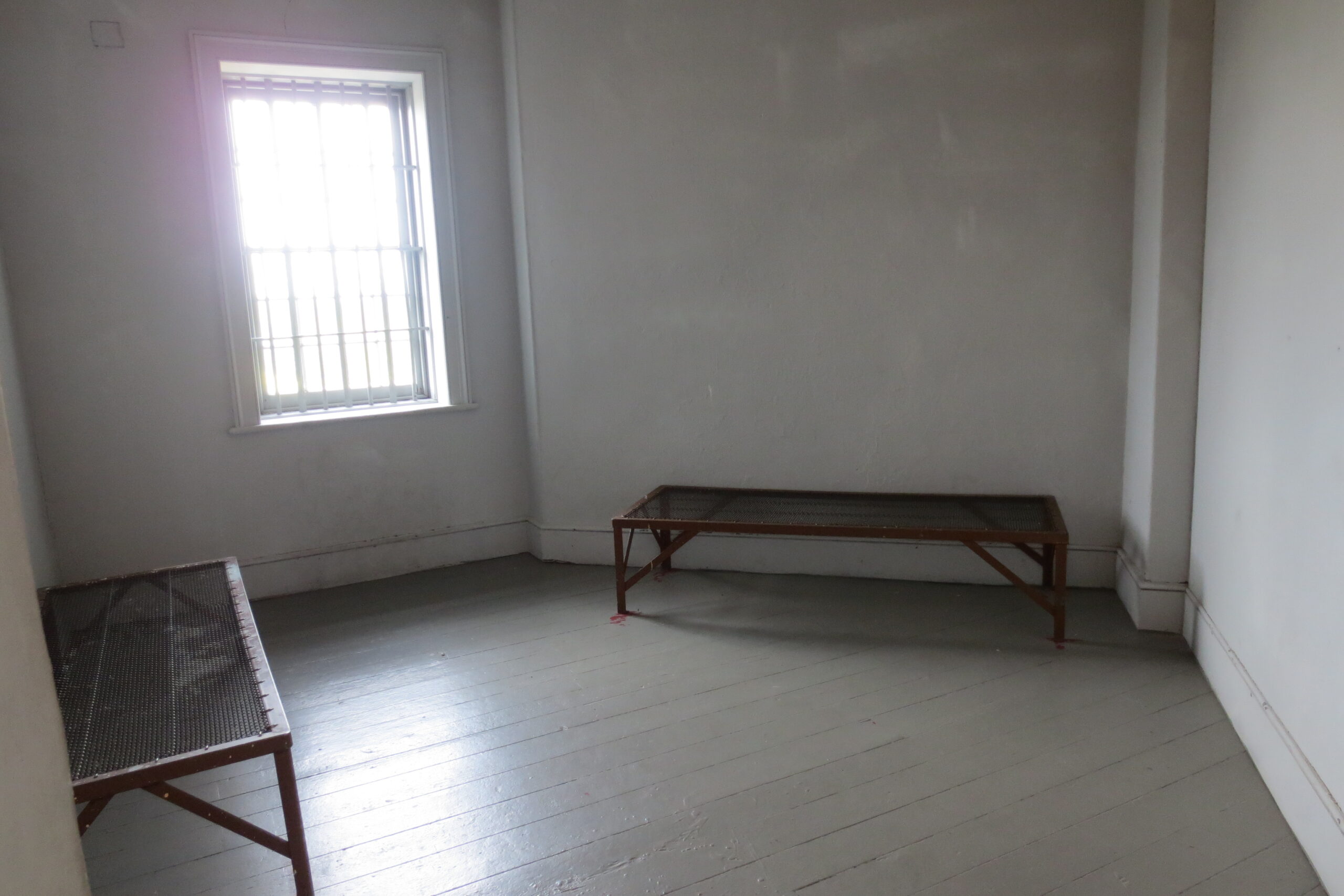
by Sinead Cox | May 18, 2017 | Huron Historic Gaol, Investigating Huron County History
May 18th is International Museum Day! Museums and historic sites across the world are opening their doors for free today. For those whom cannot visit the Huron Historic Gaol in person, Student Museum Assistant Jacob Smith delves into the building’s past to reveal how some of Huron’s youngest prisoners ended up behind bars.
During its operation [1841-1972], hundreds of children were arrested and sent to the Huron Jail. Their crimes ranged from arson and theft to drunkenness and vagrancy. The most common crime that children committed was theft. In total, thefts made up over half of all youth charges between 1841 and 1911. In total, children under the age of 18 made up 7% of the gaol population during that time.*
Occasionally, young people were sent to gaol for serious crimes. In 1870, William Mercer, age 17, was brought to the Huron Gaol and charged with murder. He was sentenced to die and was to be hanged on December 29, 1870. Thankfully for Mercer, his sentence was reduced to life in prison and was sent to a penitentiary. This is an example of an extreme crime for a young offender.
On many occasions, children were sent to gaol because they were petty thieves. Many young people who were committed for these types of crimes would only spend a few days in gaol. If the crime was more severe, children would be transferred from the gaol to a reformatory, usually for three to five years.
The youngest inmates that were charged with a crime were both seven years old. The first, Thomas McGinn, was charged in 1888 for larceny. He was discharged five days later and was sentenced to five years in a reformatory. The second, John Scott, was charged in 1900 for truancy; he was discharged the next day.
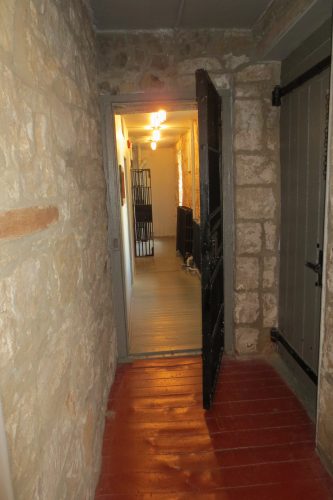
First floor cell block at the Huron Historic Gaol.
Unfortunately, some children were brought into gaol with their families because they were homeless or destitute. An example of this was in 1858, when Margaret Bird, age 8, Marion Bird, 6, and Jane Bird, 2, spent 25 days in gaol with a woman committed for ‘destitution’ (presumably their mother). Some children were also brought to the Huron Jail because their parents committed a crime and they had nowhere else to go while their parents were incarcerated. Samuel Worms, age 7, was sent to gaol with his parents because they were charged with fraud in 1865. He spent one day in the Gaol.
When reading through the Gaol’s registry, it is clear that times have certainly changed for young offenders. Most of the crimes committed by the young prisoners of the past would not receive as serious punishments today.
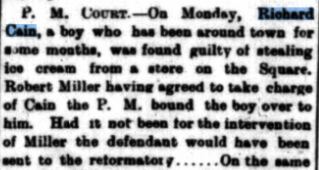
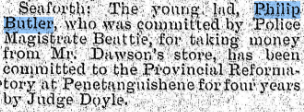
Here are some examples of their crimes in newspapers from around Huron County:
Richard Cain, 16, spent two days in jail.
The Huron Signal, 1896-09-17, pg 5.
Philip Butler, 15, spent eleven days in the Huron Jail.
The Exeter Advocate, 1901-08-29, pg 4.
Sources came from the Gaol’s 1841-1911 registry and Huron County’s digitized newspapers.
*Dates for which the gaol registry is available & transcribed. There were young people in the Huron jail throughout its history, into the twentieth century.