by Sinead Cox | Aug 13, 2026
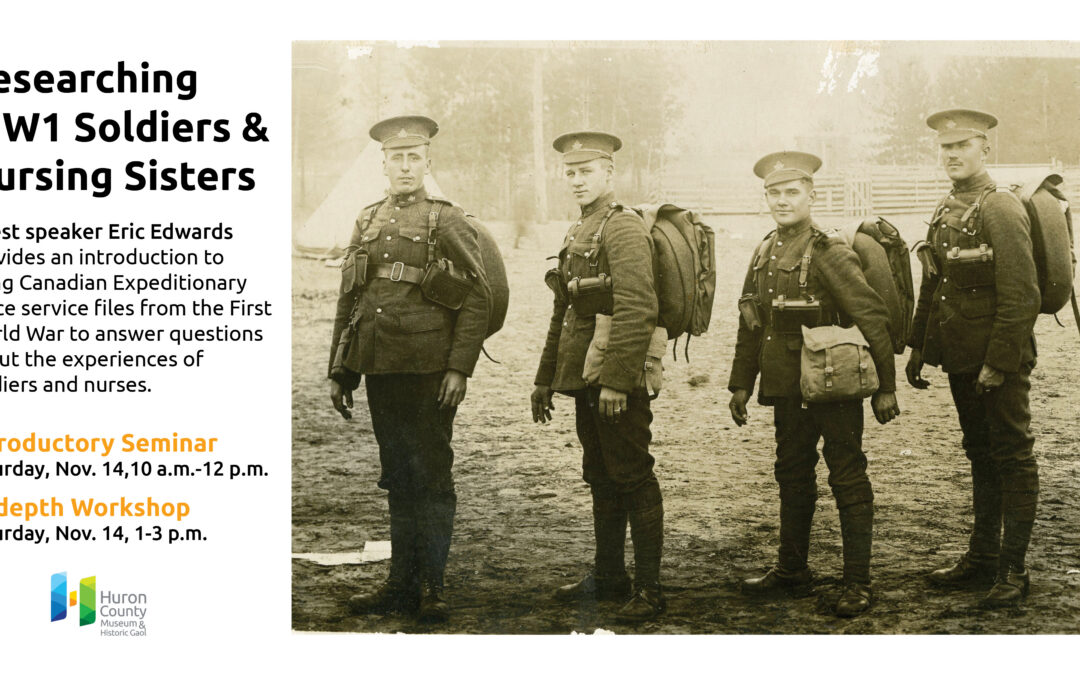
Are you trying to research a Canadian soldier or nursing sister of the First World War, but don’t know where to start? Guest speaker Eric Edwards will provide an introduction to using Canadian Expeditionary Force service files from the First World War to answer questions about the experiences of soldiers and nurses in WWI. Including how to search and access resources, and how to understand what you are reading.
A 2-hour session with a 10 – 15-minute break half-way during the presentation, includes Q&A with the presenter with your research questions. Coffee and tea will be provided during the break.
Attending this seminar in the museum theatre is included with regular admission (FREE with a Huron County library card or museum membership). RSVP to let us know you are coming!
This introductory seminar for a larger audience will be followed by a more in-depth workshop with direct research help and tips at 1 p.m. Attending both sessions is not mandatory. The follow-up workshop is ticketed as spots are limited and pre-registration required.
About the Presenter:
Eric Edwards has been researching and recording the history of the 18th Battalion since 2009. He has transcribed the 18th Battalion War Diary (minus appendices) and recorded these entries at his blog and uploaded a PDF version at Archive.org. He has also recorded approximately 3,700 Soldier’s Pages at his blog, has written hundreds articles relating to the social, economic, political, and military history of the members of the 18th Battalion, and curates a Facebook Group with 500 members, focusing on the 18th Battalion.
by Sinead Cox | Aug 13, 2026
Canadian Expeditionary Force service record(s) are springboard to better understand the context in which the men and women of the Canadian Armed Forces, and a key primary source to learn about an ancestor who served in the First World War. Using real-world examples, the participants will be given a grounding on how to access, read, interpret, and record a Canadian Expeditionary Force service record with guest instructor Eric Edwards.
This 1 p.m. workshop will follow a seminar at 10 a.m. with the same instructor presenting a basic introduction to WWI research. This follow-up workshop will build upon the information in the seminar to help with hands-on research. Workshop participants will learn how to use specific tools and data (service file and other digital resources) applying the knowledge from Part 1 to put this information in a cogent form allowing participants to “fill in the blanks” of the person being researched. This Workshop will be of value to those people interested in exploring and learning about the men and women of the Canadian Expeditionary Forces.
The workshop is ticketed with limited spots. It is recommended participants attend the 10 a.m. seminar before attending Part 2. However, attending both sessions is not mandatory. The morning seminar is open to a larger audience and included with regular admission (FREE with a Huron County library card).
The workshop is $7 + HST to participate (or FREE for Huron County Museum members, not included with regular admission or library cards).
Participants are encouraged to bring their own laptop computer, tablet or other device to follow along and receive live research assistance.
About the Presenter:
Eric Edwards has been researching and recording the history of the 18th Battalion since 2009. He has transcribed the 18th Battalion War Diary (minus appendices) and recorded these entries at his blog and uploaded a PDF version at Archive.org. He has also recorded approximately 3,700 Soldier’s Pages at his blog, has written hundreds articles relating to the social, economic, political, and military history of the members of the 18th Battalion, and curates a Facebook Group with 500 members, focusing on the 18th Battalion.
by Sinead Cox | Oct 11, 2021 | Blog, Collection highlights, Exhibits, For Teachers and Students
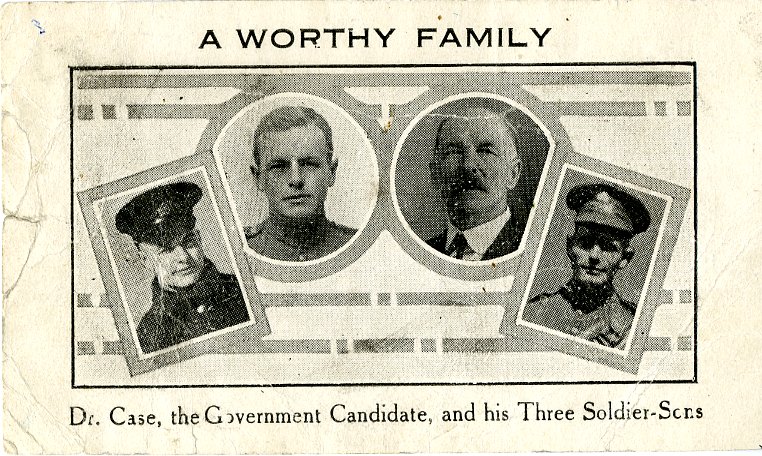
If you are a teacher or student looking for local stories from Huron County for your Remembrance Day lessons or assignments, you can access the Huron County Museum’s collection from home and your classroom through our virtual offerings! These resources speak both to Huron County’s military history and to the home front during the First and Second World Wars.
Videos
Our War: Home Front
Our War: Nursing Sisters
Young Canuckstorians: The Maud Stirling Story
Jack McLaren: A Soldier of Song features a presentation and performance from author and musician Jason Wilson, based on the original works of the Dumbells, a Canadian concert party that entertained the troops on the front lines in World War I and featured Jack McLaren (later a resident of Benmiller).
The History of Drag Makeup Tutorial with Lita explains how drag performers improvised wigs, makeup and clothing at the front lines.
A reading of a WWII letter from R.C.A.F Pilot Officer Alan H. Durnin to Mrs. C. Blake of RR 1 Dungannon
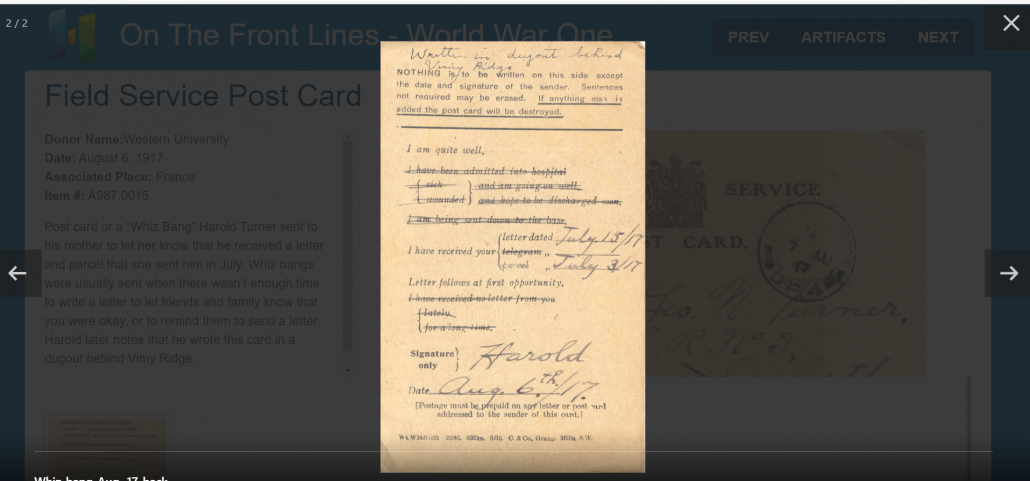
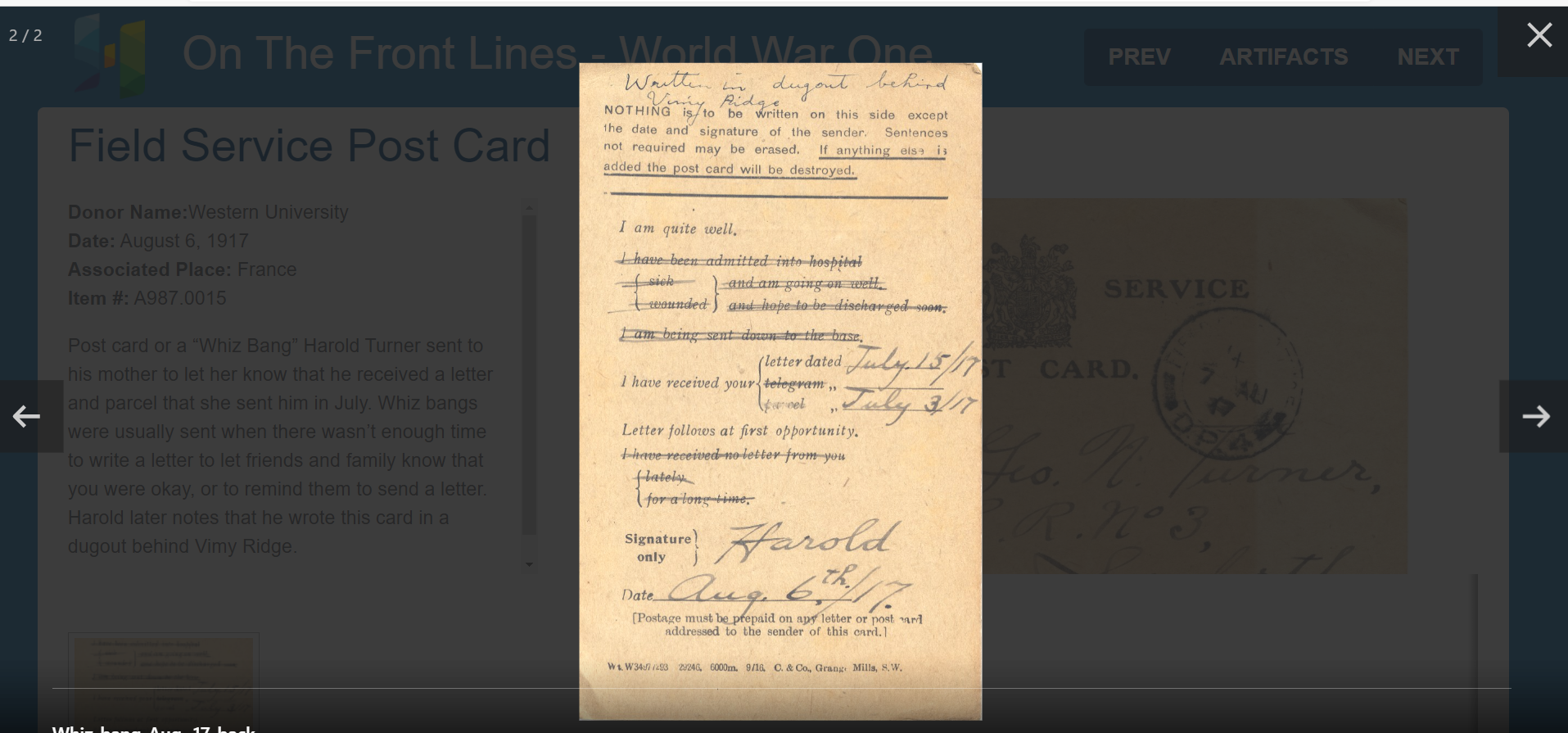
On the Front Lines: Word War One virtual exhibit.
Virtual Exhibits
Part of the museum’s collection of photographs by local photographer J. Gordon Henderson have been digitized. During World War II, he travelled to air training schools in Goderich, Port Albert, and Clinton taking pictures of classes and other base activities. Many airmen came to his studio in Goderich to have their portraits taken to send home to family and friends. The Henderson Collection also includes wedding portraits, candid shots, correspondence and interviews with airmen related to WWII air training in Huron County. Access the virtual Henderson collection by clicking here!
You can also browse more photographs via our Flickr page!
See archival documents from the Huron County Museum’s collection in our Military Gallery virtual exhibits:
On the Front Lines: Word War One
The Home Front: World War One
Prominent artist and Benmiller resident J. W. (Jack) McLaren fought with the Princess Patricia Canadian Light Infantry in WWI, and entertained troops at Ypres Salient, Vimy Ridge and many other locations on the Western Front with the PPCLI Comedy Company and the 3rd Division Dumbells Comedy Troupe. Find out more about Jack and entertaining at the front through the virtual version of our 2020 Reflections exhibit, which was presented in partnership with the Huron Historical Society.
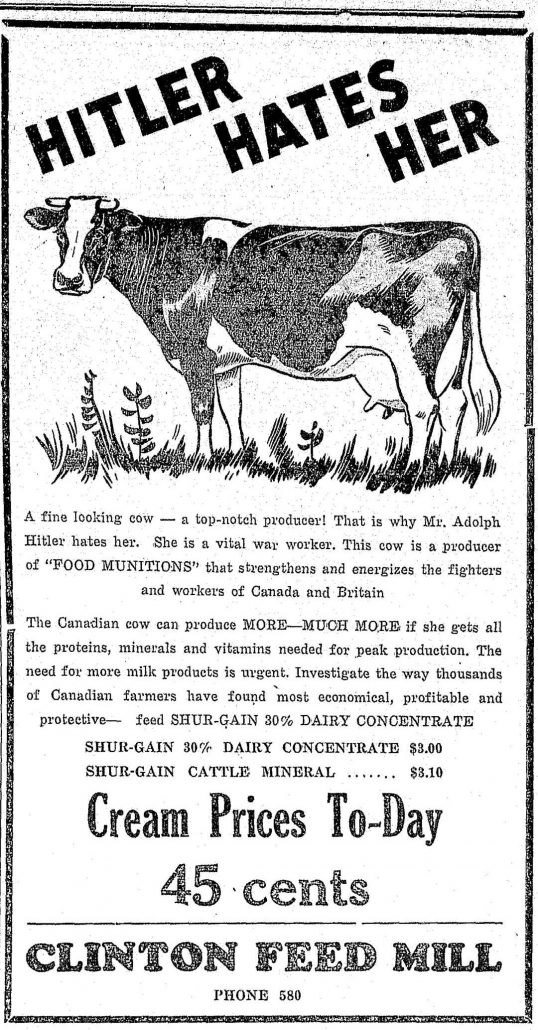
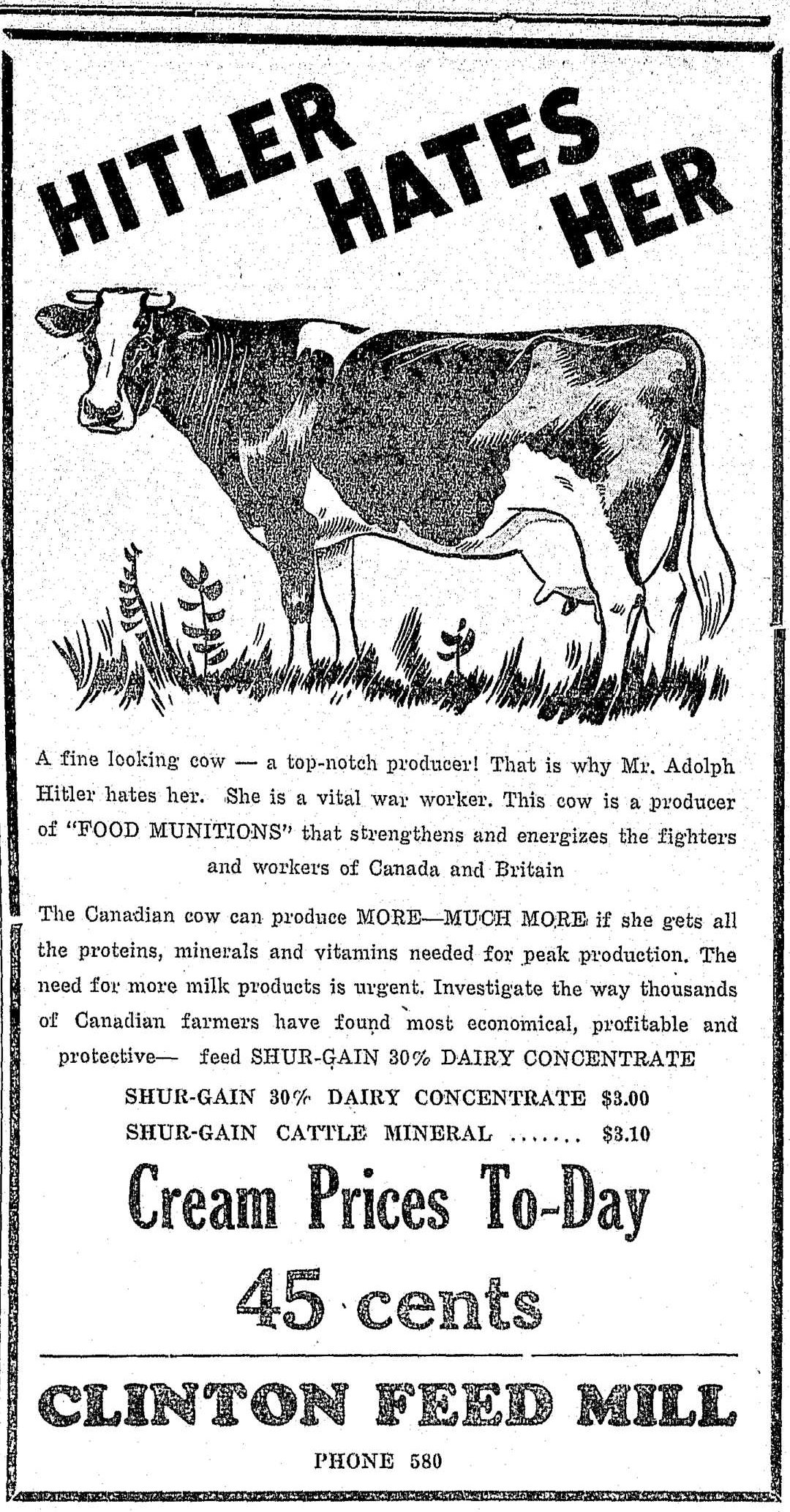
Clipping from Huron County’s digitized newspapers. This ad appeared in the Clinton News-Record in 1942 and 1943.
Articles & Short Posts
A Closer Look: The M4A2E8 Sherman Tank
The Huron Jail & the Second World War Part 2: A STRANGE MUTINY ON THE GREAT LAKES
The Huron Jail & the Second World War Part I: THE ‘DEFENCE OF CANADA’ IN HURON COUNTY
Newspaper Man Enlists: Huron County and the First World War in Black & White
Collection Highlights from Remembrance Day 2014
The Mystery of the 4th Toe on the Left Foot
Local Girl Leaves for the Front
Love is in the Air
Dogs of Air Training (Part 2)
Dogs of Air Training (Part 1)
Education Programs
The Huron County Museum’s ‘Huron County and the World Wars’ program is recommended for grades 5-10, and is offered as both an in-person and virtual field trip. There is also public outreach available by request with our Huron County home front reminiscence kits. Click here to find out more about our Education Programs.
Email museum@huroncounty.ca to inquire about booking an in-person or virtual program.
Research Resources
Click to search more than a century of history via Huron County’s digitized newspapers: free, online and keyword searchable. The newspapers provide a wealth of information on local soldiers and nursing sisters, including casualty reports and letters from the front. You’ll also find detailed information about life and work on the home front, including wartime advertising.
Or Click here to search a selection of the museum’s archives and artifacts via our online collection. Relevant artifacts include uniforms, photographs, medals and memorabilia from British Commonwealth Air Training bases in Huron.
Book List Check out this reading list related to local WW1 and WW2 history, available through the Huron County Library.
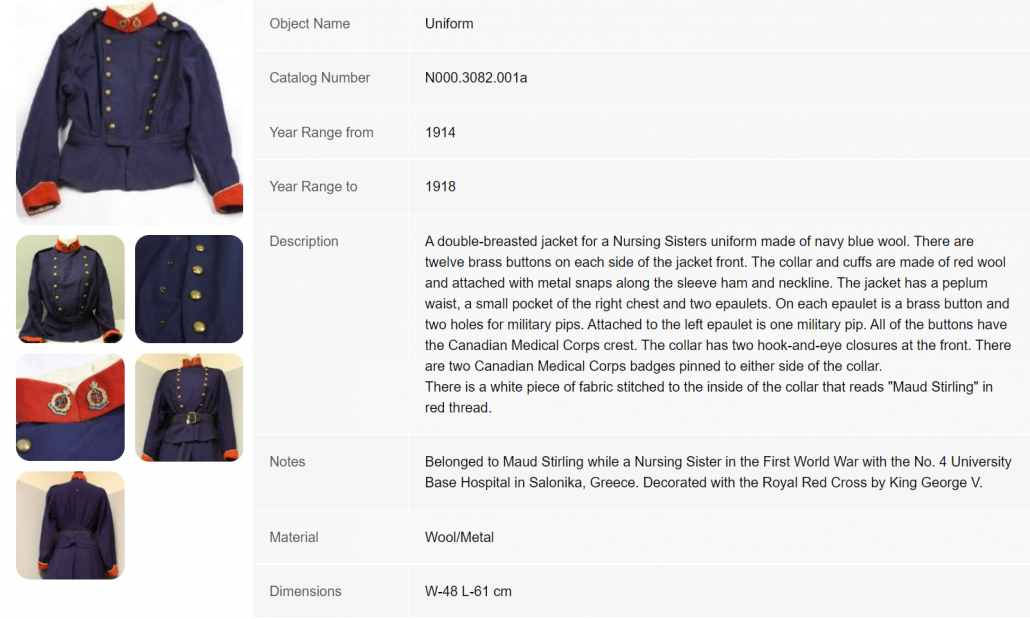
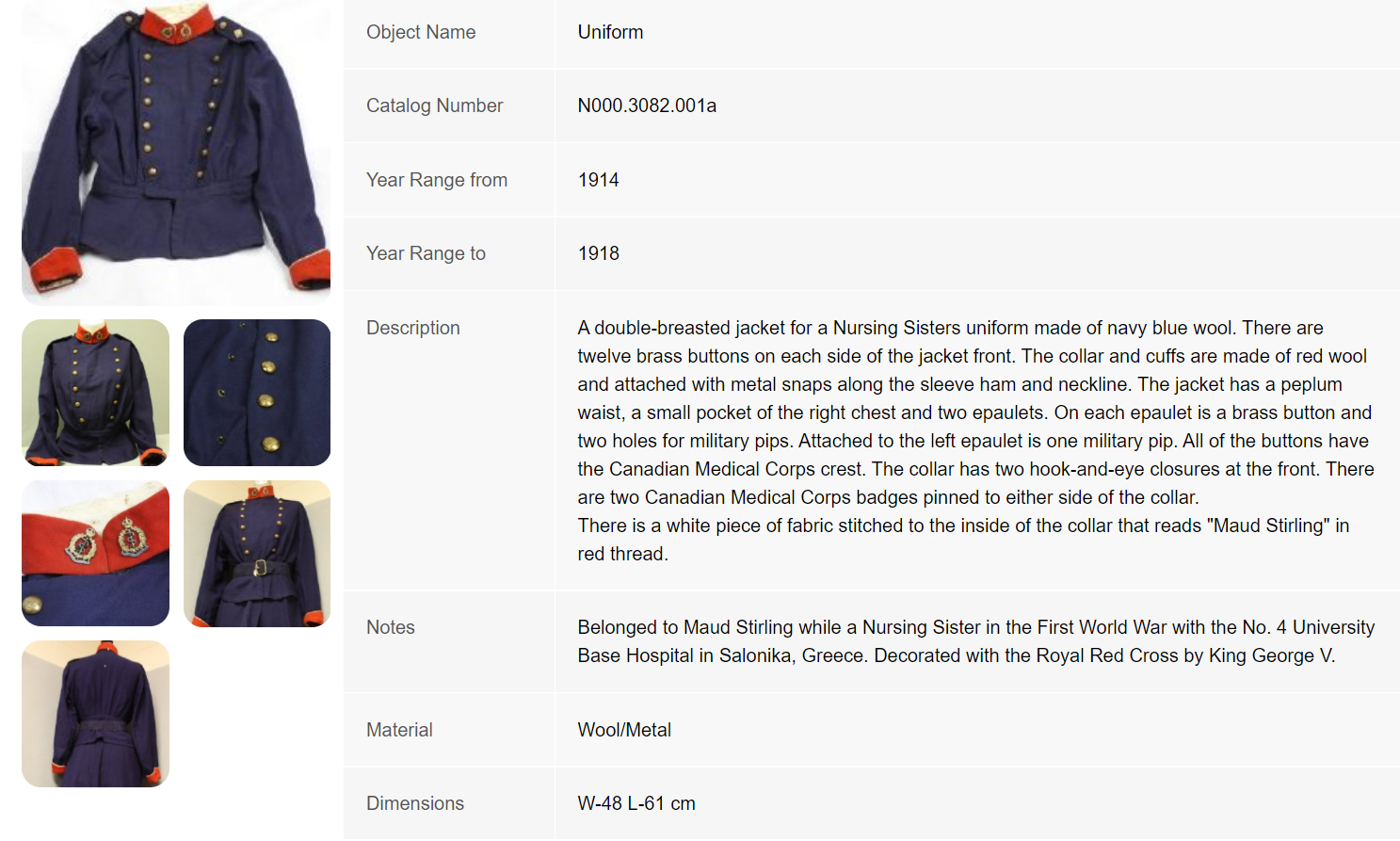
Nursing Sister Maud Stirling’s uniform in the Huron County Museum’s searchable online collection.
by Sinead Cox | Mar 30, 2020 | Artefacts, Collection highlights, Exhibits, For Teachers and Students, Uncategorized
Huron County Museum: Virtual Permanent Galleries
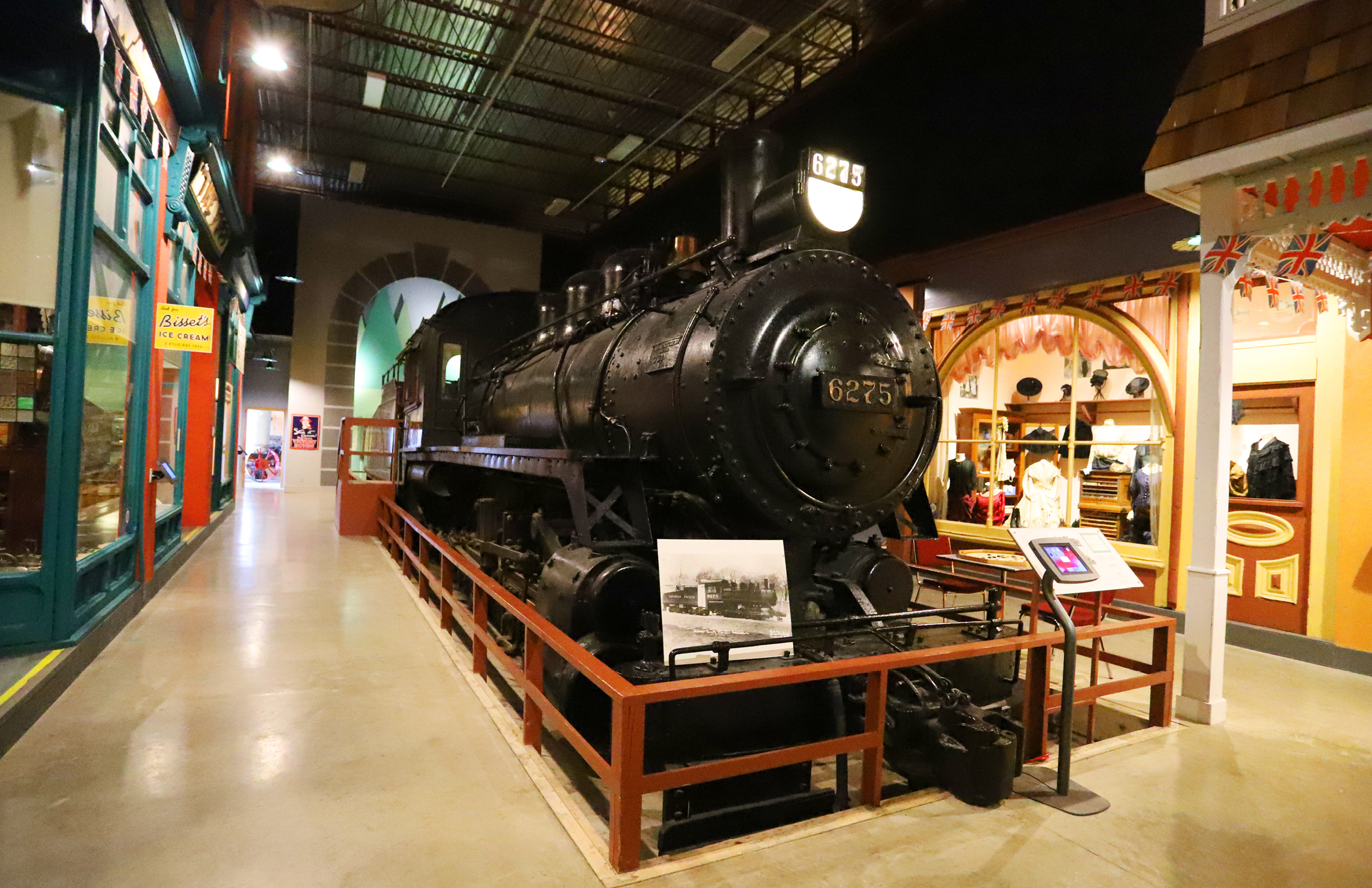
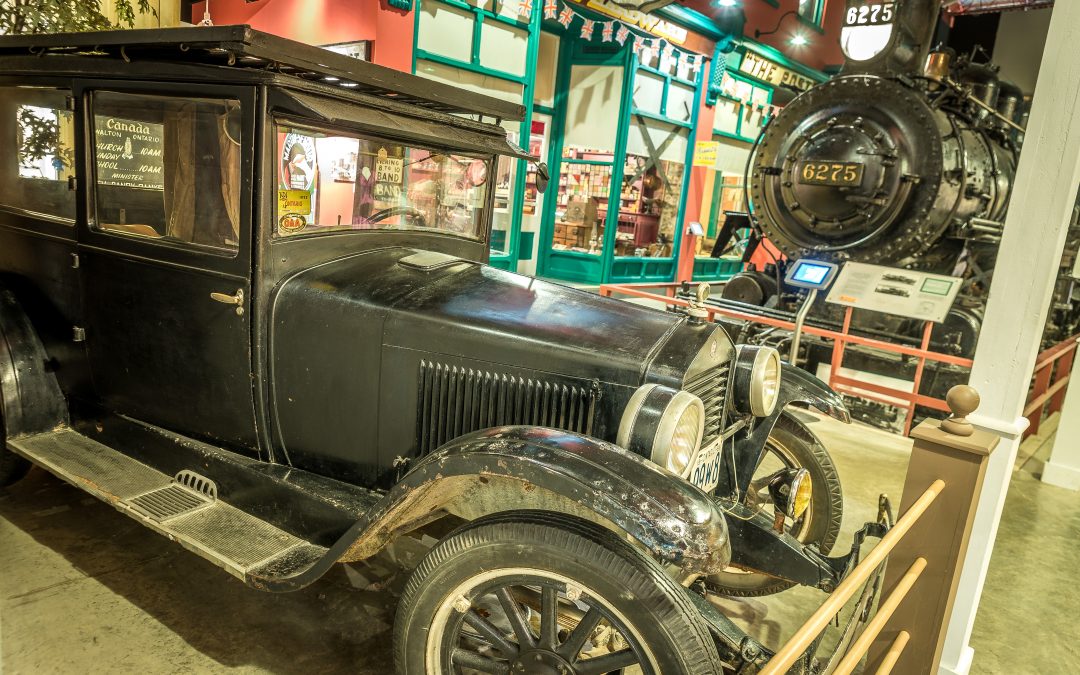
The Huron County Museum’s virtual exhibits grant a close-up glimpse of select artifacts on permanent display in our galleries, as well as information that you can’t guess with just a look. The featured objects represent a small sampling of the thousands of artifacts in the museum’s collection. Updating the online exhibits is an ongoing project; in the future, student employees will be refreshing the images and providing even more information. These exhibits are also available via ipads onsite when the museum is open.
Huron County Main Street
Our Main Street features real storefronts and objects from across the county of Huron.
Click the storefront names to step inside and see artifact highlights!
Military Gallery
Click the titles below to see archival documents and more related to Huron County and the First World War.
Huron County Museum Feature Gallery: Virtual Exhibits
The Huron County Museum rotates exhibits of special interest through the year in our Feature Galleries. Click to explore past temporary exhibits that you may have missed or want to rediscover.
by Elizabeth French-Gibson | Mar 8, 2017 | Archives, Investigating Huron County History, Uncategorized
The list of women from Huron County who served as nursing sisters in the First World War is now up to 50 names! This list includes women who served with the Canadian Army Medical Corps (CAMC), American Army Medical Corps, Red Cross, and Queen Alexandra’s Imperial Military Nursing Service. As more records become available online, we are finding out more about what their lives were like before, during, and after the war.
It can be difficult to find out what happened to a nurse after the war ended for many different reasons. Many women married and changed their name, some moved across the country or the United States, and a lot of records still aren’t available due to privacy legislation. Due to limited resources, it can be very difficult track people down and verify their identity.
One such woman is Mary Agatha Bell, who was born, according to her Attestation Papers, on November 5, 1879 in St. Augustine but lived in Blyth, Ontario. Mary enlisted on April 3, 1917 in London, Ontario, left Canada on May 20, 1917, and arrived in England on May 30, 1917. While overseas, Mary mainly served with the 7th Canadian General Hospital in France. She also did temporary duties with the 6th and 8th Canadian General Hospitals. After the war ended, Mary sailed back to Canada in July 1919 on the S.S. Olympic.

U.S., Border Crossings from Canada to U.S. – Ancestry.ca
It was difficult to track down what happened to Mary Agatha Bell after the war. On October 11, 1925, a birth registration* was issued to a Mary Bridget Bell born on November 5, 1874 in St. Augustine, Ontario. Records show that this Mary Bridget Bell moved to the state of New York on October 22, 1925. A border crossing document from August 1945 states that Mary’s address was 11 Hows Avenue, New Rochelle, New York, where she worked as a registered nurse. The document also states that she is missing the fourth toe on her left foot.

New York, Naturalization Records – Ancestry.ca
This last piece of information was critical in definitively proving that Mary Agatha Bell (born in 1879) is the same person as Mary Bridget Bell (born 1874). According to her service file, Mary starting experiencing problems with her left foot in France, 1918. Notes in her file refer to her problem as a “contracted toe”. The 4th toe on her left foot was eventually amputated when she returned to Toronto in 1919 at St. Andrews Hospital.
It appears that Mary lied about her birth year on her Attestation Paper. This was not uncommon among women enlisting as nursing sisters in WWI. Mary would have been a much more appealing candidate at age 38 than her real age of 43. Why she decided to change her middle name from Agatha to Bridget still remains a mystery…
*Birth registrations were often issued to adults who didn’t have birth certificates