by Sinead Cox | Jun 4, 2020 | Investigating Huron County History
Curator of Engagement and Dialogue Sinead Cox shares the story of a historical quarantine in the summer of 1916.
Although you may have heard (to the point of cliché) that we are living in ‘unprecedented times’ during today’s COVID-19 pandemic, communities across Huron County have seen quarantines and the temporary closure of schools and businesses before. Although usually on a much smaller and localized scale, these actions in the nineteenth and twentieth centuries were in response to contagious illnesses that included influenza, measles, diphtheria, scarlet fever, smallpox, whooping cough and typhoid among others.
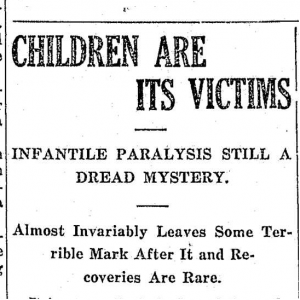
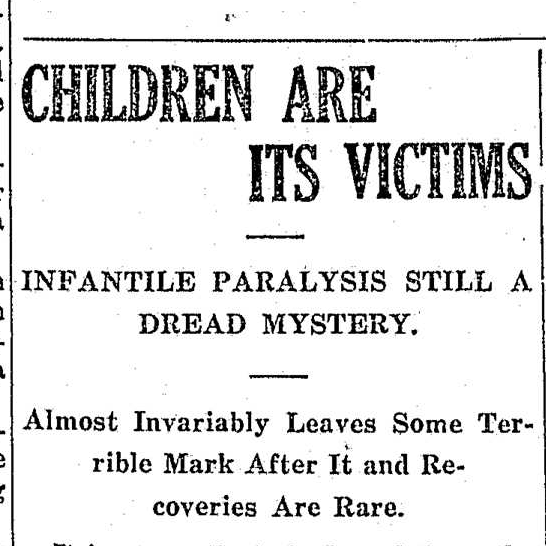
From The Brussels Post, July 27th, 1916.
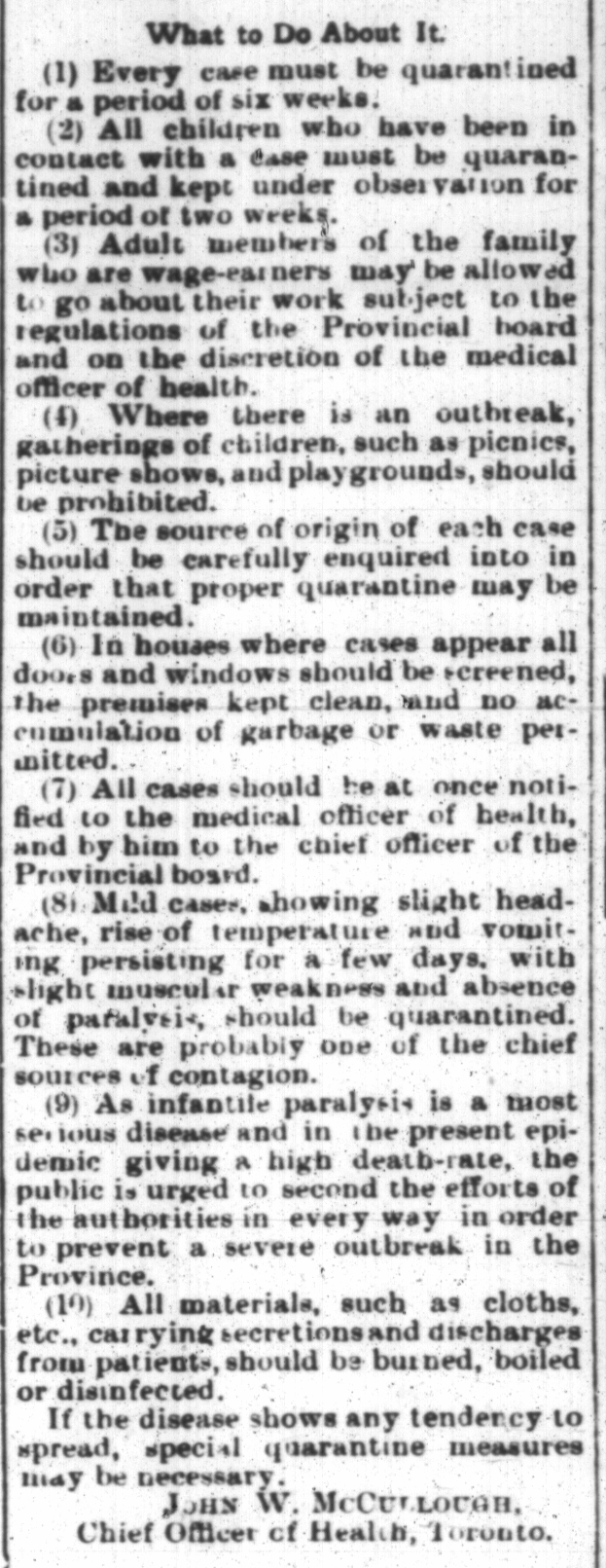
In 1916 an outbreak of infantile paralysis (polio or poliomyelitis) hit North America. The poliovirus is most dangerous to children under five years of age and in serious cases can cause permanent and debilitating nerve and muscle damage to survivors if non-fatal. The 1916 epidemic was particularly devastating in New York and then appeared in Canadian cities like Montreal before eventually arriving in southern Ontario. In Ontario, the provincial Medical Board of Health enacted quarantine regulations and required doctors to report all cases or face prosecution.
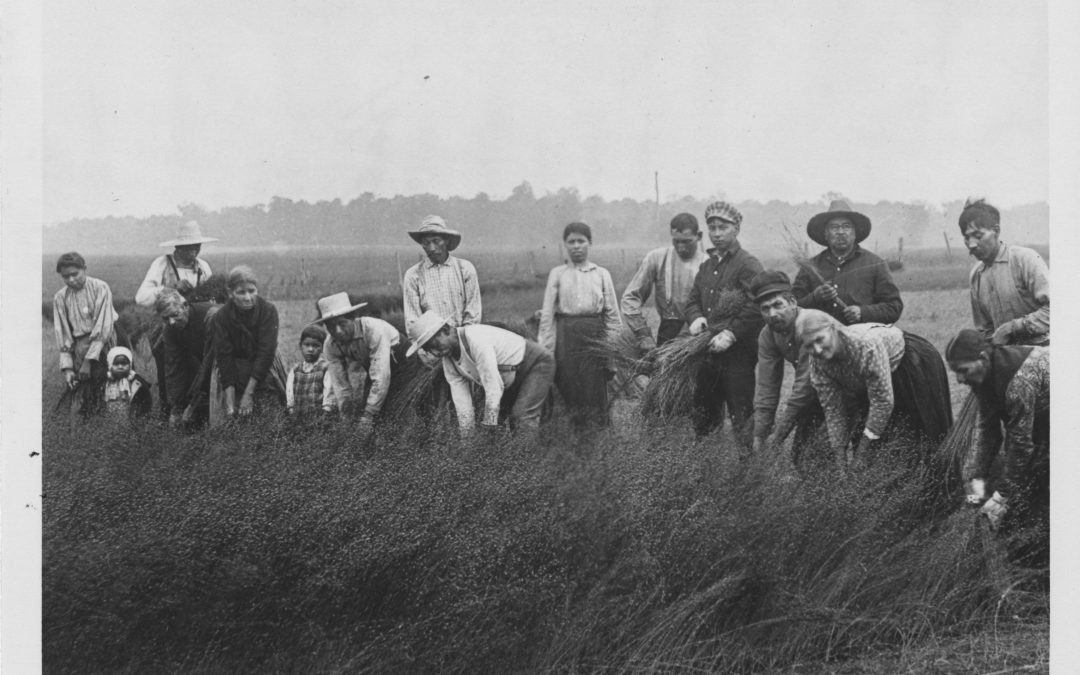
The outbreak had reached Huron County by July, when a fourteen-month-old girl in Varna died: only the second fatal case confirmed in Ontario up to that point. Panic hit the next month when three young children in Hullett Township contracted the much-feared disease. The children had come to live temporarily in Hullett (now part of the Municipality of Central Huron) with their parents during the flax harvest, but their permanent home was reported as ‘Muncey Reserve.’ Indigenous families from Southwestern Ontario reserve communities, including those on the shore of the Thames River south of London and also Saugeen First Nation to the north, were a crucial labour force for annual flax harvests in the early twentieth century. Entire families moved seasonally to pull flax for Huron growers; they worked and lived in close contact with each other, camping alongside their worksites.
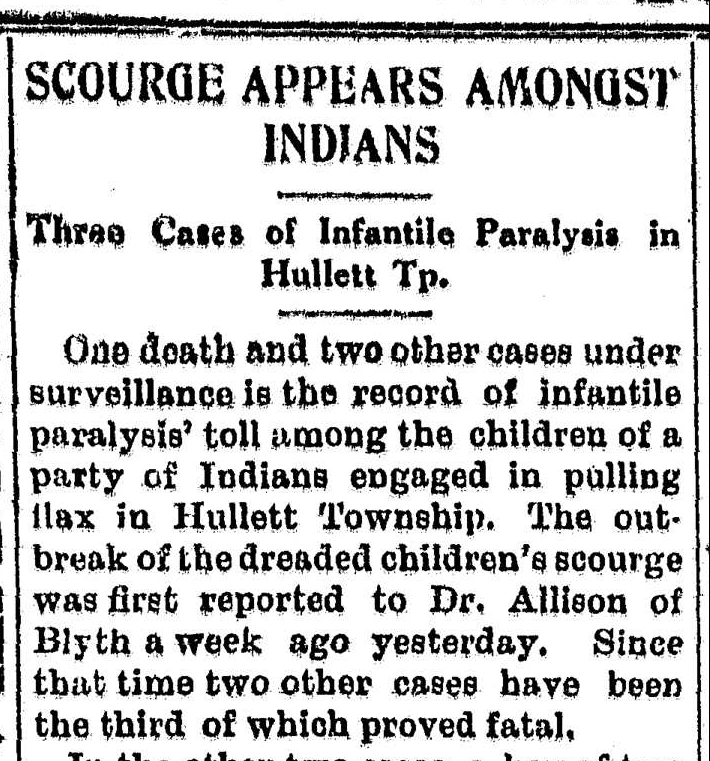
The sick children belonged to a group of about 15 families living in tents roughly six miles from Clinton when the infantile paralysis struck-eventually infecting two five-year-olds and a two-year-old. A local Blyth doctor treated the first cases and told the area newspapers that the farm workers’ living situation presented a challenge for protecting the lives of the other 23 children in the camp: “Isolation and quarantine, so necessary for the treatment of infantile paralysis, are something hard to enforce in any Indian reservation or encampment…We are doing what we can to prevent any spread of the disease, and watching for further symptoms, but it is next to impossible to enforce the requisite isolation.” The vast majority of poliovirus cases are completely asymptomatic. The disease can spread through direct contact or via contamination by human waste.
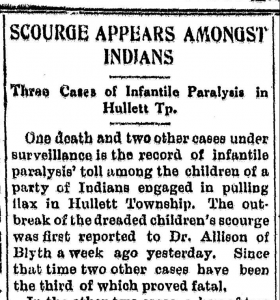
From the Wingham Advance, August 31st, 1916.
For one of the five-year-olds, the virus was tragically fatal on August 25th, but the other two children soon appeared to be recovering. Local newspapers did not identify any of the camp members by name, but a death registration reveals that the little girl who lost her life was Annie Corneolus, the five-year-old daughter of Abram and Elizabeth. She was ill only one day, but the polio had caused lethal ‘paralysis of respiration.’ Her birthplace is recorded as Oneida Reserve (Oneida Nation of the Thames). Annie’s burial took place at Burns Cemetery, Hullett. Local health officials separated the families with sick children from the rest of their neighbours and they proceeded to quarantine at a farmer’s house on the 11th Concession. School Section # 11 at Londesborough cancelled classes for all students as a precaution.
Fortunately, their quarantine appeared successful and there were no further cases reported. The Clinton New Era announced that “the infantile paralysis scare in Hullett Township has pretty well blown over.” When health authorities lifted quarantine the families impacted returned to their reserve community, and the rest of the camp moved on to Blyth to continue their flax-pulling work. The Huron newspapers make no mention of whether or not the surviving children suffered any long-term health effects. Later reports listed the total number of province-wide infantile paralysis cases at 64 for July and August of 1916, with 8 resulting deaths–meaning that 25% of those total polio deaths occurred in Huron County.
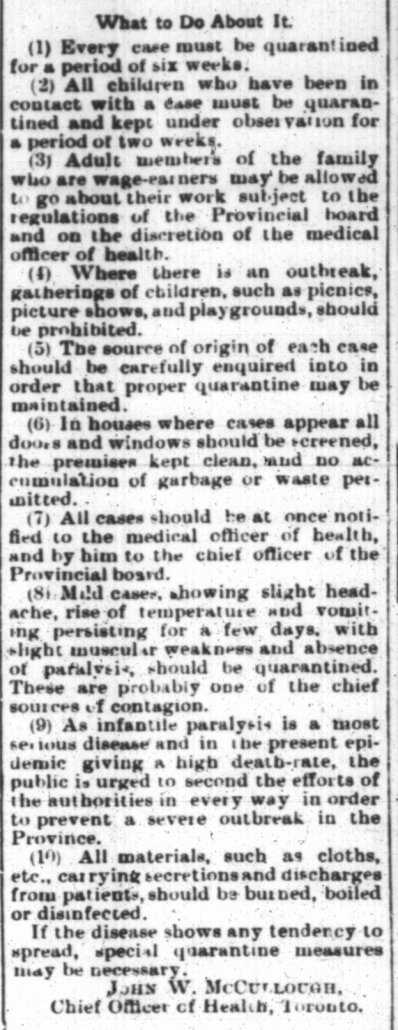
From the Signal (Goderich), July 20th, 1916.
There is no cure for polio, but the Salk vaccine of 1955 would eventually be effective and widely used to prevent the disease; after continuous deadly outbreaks throughout the first half of the twentieth century, childhood vaccinations have eradicated polio in Canada.
The living and working conditions of temporary farm workers in 1916 would have made following advice about precautionary hygiene and social distancing almost impossible to follow-and many people in Canada are facing those same challenges today, without equal housing or opportunities to practice self-isolation under novel coronavirus. Although the 2020 COVID-19 pandemic is not the same as polio, the reality that Indigenous communities continue to be disproportionately impacted by pandemics, and that temporary and migrant workers are at a higher risk because of a lack of resources and opportunities to safely distance is absolutely precedented.
More Info about the history of polio in Canada: https://www.cpha.ca/story-polio
*Note: I wrote this blog post using contemporary newspaper accounts including the Wingham Times, The Wingham Advance, The Lucknow Sentinel, The Clinton New Era, The Clinton News-Record, the Signal (Goderich) and others, all accessed from Huron’s free historical newspaper database: https://www.huroncountymuseum.ca/digitized-newspapers/ Annie’s death documentation was accessed via Ancestry.ca (Archives of Ontario; Toronto, Ontario, Canada; Collection: MS935; Reel: 220). All of these accounts were written from a settler point of view (as is my own), and the newspapers did not include the voices or even the names of the community members impacted. If you have any further information you’d like to share about this outbreak or similar outbreaks in the past contact museum@huroncounty.ca.

by Sinead Cox | May 9, 2016 | Exhibits, Investigating Huron County History
Not every new neighbor throughout Huron County’s history has been welcomed universally by the community; some have faced prejudice and discrimination. Education and Programming Assistant Sinead Cox, who led research for the current Stories of Immigration and Migration Exhibit, writes about the hostility and misconceptions faced by one of these migrant groups.
In 1895, an anonymous East Wawanosh farmer called for an end to the immigration of a despised immigrant group to Canada. Suspected of being untrustworthy and even violent, the farmer lamented to the Daily Mail & Empire that these migrants were “a curse to the country, as a rule.” The dangerous group he was referring to were young, poor, British children.

Article from the Daily Mail and Empire, July 23, 1895.

 Between the 1860s and 1930s, U.K. charity homes sent thousands of urban boys and girls commonly known as ‘home children’ to Australia, South Africa and Canada as farm labourers or domestic servants. These young migrants feared as a threat to the moral character of Canadian society had little say in leaving the country of their birth, or their estrangement from any family they might have still had there. In 2010 the U.K. government officially apologized for the forced emigration of these children, which often involved what charity home founder Dr. Thomas Barnardo termed ‘philanthropic abduction’: sending poor children across the ocean without the knowledge of their still-living parents, siblings or guardians. Without knowing the children might be sent half a world away, caretakers had often placed them in the homes because of a sudden lack of funds to properly care for them, sometimes due to unemployment, insufficient wages, or the death or illness of a parent.
Child Migration was intended to ease urban poverty in the British Isles and agricultural labour shortages in the colonies.Once in Canada, the children were expected to work and attend school, and received infrequent inspection visits to monitor their welfare. Canadian employers tended to treat the young immigrants as hired hands, rather than adopted family members, and many changed homes frequently. Although rural Canada might have provided more employment opportunities than urban England, living among strangers often left the children vulnerable to abuse, neglect or overwork with tragic results. In 1923, Huron County farmer John Benson Cox was convicted of abusing Charles Bulpitt, the sixteen-year-old ‘home boy’ working for him, after Charles died by suicide in his care.

Excerpt from The Montreal Gazette, Feb. 8, 1924
At the time, some Canadians welcomed the cheap farm labour provided by the child migrants, while others feared that these lower class ‘waifs and strays’ must be ‘the offspring of criminals and tramps,’ and therefore inherently bad and dangerous to God-fearing citizens of the Dominion. In Canadian author L.M. Montgomery’s beloved classic, Anne of Green Gables, character Marilla Cuthbert famously dismissed the possibility of welcoming a child from the U.K. charity homes to Green Gables:
At first Matthew suggested getting a Barnardo boy. But I said ‘no’ flat to that. They may be all right—I’m not saying they’re not—but no London Street Arabs for me…I’ll feel easier in my mind and sleep sounder at nights if we get a born Canadian.
Public fears about these ‘street Arabs’ were no doubt influenced by the widespread popularity of the pseudoscientific practice of eugenics at the turn of the twentieth century. Eugenicists erroneously believed that some people were genetically superior to others, and these good traits would be diluted and society damaged by mixing with groups having supposedly inferior genes, including the mentally ill or developmentally challenged. Eugenicist policies were widely touted by many prominent Canadians, including philanthropists and legislators.
At an 1894 federal Select Standing Committee on Agriculture and Colonisation, East Huron Member of Parliament Dr. Peter Macdonald spoke against government subsidies for the immigration of ‘home children.’ His concerns were not based on the welfare and safety of the young immigrants, but on the potential ill effect their introduction would have on Canadian society, particularly because of their eventual intermarriage with existing Canadian settler families:

August 13, 1906 Globe and Mail article describing the arrival of 200 Barnardo Home boys, which included Bernard Brown.
Those children are dumped on Canadian soil, who, in my opinion, should not be allowed to come here at all. It is just the same as if garbage were thrown into your backyard and allowed to remain there. We find from the testimony of disinterested parties in this country, that a large number of these children have turned out bad, and are poisoning our population by intermarrying with them…I think myself this committee should unite in an expression of opinion that no such $2 a head should be paid by this government to bring such a refuse of the old country civilization, and pour it in here among our people. We take more means to purify our cattle than to purify our population?
Despite objectors like Macdonald, charity homes sent more than 100,000 British children to Canada, and today likely millions of Canadians are the descendants of these children who, despite the hardships of forced migration and separation from loved ones in childhood, often survived and persevered to earn a living and raise a family of their own. Although they had essentially been exiled by the British Empire, a huge proportion of ‘home boys’ also later volunteered to serve in the first and second world wars as young men.

Bernard Brown in his military uniform. He enlisted with the 161st Regiment of the Canadian Expeditionary Forces in January 1916. Photo courtesy of Brown Family.
One such child migrant, Bernard Brown (1896-1918), came to Huron County at ten years old. Bernard’s journey from a poor, struggling family in Northern Ireland that could not afford to feed all of their children, to an English charity home, to a Tuckersmith Township farm, and finally to the battlefields of France, was featured in the Huron County Museum’s Stories of Immigration and Migration, a temporary exhibit that tracks the narratives of seven families who came to our county between 1840 and 2007.
Similarly to many refugee families today, child migrants like Bernard Brown did not choose Huron County as their ultimate destination, but were matched there. When Bernard was placed with a couple in Tuckersmith, he was separated from his younger brother Edward whom Barnardo’s sent to Ripley, Bruce County. In hindsight, cases of mistreatment and neglect indicate that these young people an ocean away from loved ones, unable to return home and at the mercy of strangers, ultimately had much more to fear from Canadians than Canadians had to fear from them. The eventual success and resilience of those who survived childhood and the millions among us who can today claim a ‘home child’ as an ancestor are a testament to the fact that although the U.K and Canadian governments may have tragically failed them, the ‘home children’ contributed immeasurably to our communities rather than ‘poisoned’ them.
To find out more about the experience of one home child in Huron County, see Bernard’s story when you visit Stories of Immigration and Migration, on display in the Temporary Gallery at the Huron County Museum until October 15th, 2016. Are you descended from a home child? Share your family’s story with us tagged #homeinhuron or add it to the visitor-submitted stories in the exhibit. 



 Between the 1860s and 1930s, U.K. charity homes sent thousands of urban boys and girls commonly known as ‘home children’ to Australia, South Africa and Canada as farm labourers or domestic servants. These young migrants feared as a threat to the moral character of Canadian society had little say in leaving the country of their birth, or their estrangement from any family they might have still had there. In 2010 the U.K. government officially apologized for the forced emigration of these children, which often involved what charity home founder Dr. Thomas Barnardo termed ‘philanthropic abduction’: sending poor children across the ocean without the knowledge of their still-living parents, siblings or guardians. Without knowing the children might be sent half a world away, caretakers had often placed them in the homes because of a sudden lack of funds to properly care for them, sometimes due to unemployment, insufficient wages, or the death or illness of a parent.


