by Amy Zoethout | Dec 8, 2025
“Once you overcome the one inch tall barrier of subtitles, you will be introduced to so many more amazing films” -Director Bong Joon Ho
Multilingual Movie Nights celebrate the many languages spoken in Huron County with a film and free refreshments!
All films to be screened in their original language(s) with English subtitles. Multilingual Movie Nights are the third Thursday of each month in the museum theatre this winter and spring! Movies are screened with a light snack and a hot or cold drink. Please RSVP to help us know the quantities of snacks needed! No purchase is required beforehand. Upon arrival, movie nights are included with paying regular admission to the museum, free for museum members, or free/by-donation with your Huron County Library card. Walk-ins are still welcome as capacity allows!
Snacks served at 6:45 p.m. Movie to begin promptly at 7 p.m. Refreshments available while they last! Please note that films may not be appropriate for all audiences. A rating has been provided when possible. Films should be assumed to be for a mature audience.
Jan. 15: In the Fire of War (2024) – Two teenagers are forced to take control of their own destiny amid the chaos of New Zealand’s first land wars in 1864.
- Runtime: 1 hr, 55 minutes
- Country: New Zealand
- Language(s): Māori
- Rated: not rated
Feb. 19: Sir (2018) – A Mumbai man falls in love with his house help, a widow with the dream of becoming a tailor.
- Runtime: 1 hr, 39 minutes
- Country: India
- Language(s): Hindi & English
- Rated: PG
March 19: Perro Bomba (2019) – Perro Steevens is a young Haitian immigrant living Chile. The stability of his life is disrupted when a childhood friend arrives.
- Runtime: 1 hr, 23 minutes.
- Country: Chile
- Language(s): Spanish
- Rated: unrated
April 16: Peak Everything / Amour Apocalypse (2025) – To help combat his eco-anxiety, kennel owner Adam orders a therapeutic solar lamp and falls in love with the woman at the other end of the technical support phone line.
- Runtime: 1 hr, 40 minutes
- Country: Canada
- Language(s): French
- Rated: 13+ (Quebec)
May 21: It was Just an Accident (2025) – An Azerbaijani auto mechanic, was once imprisoned by Iranian authorities, thinks he recognizes one of his former torturers.
- Runtime: 1 hr, 43 minutes
- Country: Iran
- Language(s): Persian (Farsi)
- Rated: PG
June 18: Rafiki (2018)
Despite a political rivalry between their families, love blossoms between close friends Kena and Ziki, and they are forced to choose between happiness and safety in a conservative society.
- Runtime: 1 hr, 22 minutes
- Country: Kenya
- Language(s): Swahili
- Rated: PG
by Amy Zoethout | Dec 8, 2025
“Once you overcome the one inch tall barrier of subtitles, you will be introduced to so many more amazing films” -Director Bong Joon Ho
Multilingual Movie Nights celebrate the many languages spoken in Huron County with a film and free refreshments!
All films to be screened in their original language(s) with English subtitles. Multilingual Movie Nights are the third Thursday of each month in the museum theatre this winter and spring! Movies are screened with a light snack and a hot or cold drink. Please RSVP to help us know the quantities of snacks needed! No purchase is required beforehand. Upon arrival, movie nights are included with paying regular admission to the museum, free for museum members, or free/by-donation with your Huron County Library card. Walk-ins are still welcome as capacity allows!
Snacks served at 6:45 p.m. Movie to begin promptly at 7 p.m. Refreshments available while they last! Please note that films may not be appropriate for all audiences. A rating has been provided when possible. Films should be assumed to be for a mature audience.
Jan. 15: In the Fire of War (2024) – Two teenagers are forced to take control of their own destiny amid the chaos of New Zealand’s first land wars in 1864.
- Runtime: 1 hr, 55 minutes
- Country: New Zealand
- Language(s): Māori
- Rated: not rated
Feb. 19: Sir (2018) – A Mumbai man falls in love with his house help, a widow with the dream of becoming a tailor.
- Runtime: 1 hr, 39 minutes
- Country: India
- Language(s): Hindi & English
- Rated: PG
March 19: Perro Bomba (2019) – Perro Steevens is a young Haitian immigrant living Chile. The stability of his life is disrupted when a childhood friend arrives.
- Runtime: 1 hr, 23 minutes.
- Country: Chile
- Language(s): Spanish
- Rated: unrated
April 16: Peak Everything / Amour Apocalypse (2025) – To help combat his eco-anxiety, kennel owner Adam orders a therapeutic solar lamp and falls in love with the woman at the other end of the technical support phone line.
- Runtime: 1 hr, 40 minutes
- Country: Canada
- Language(s): French
- Rated: 13+ (Quebec)
May 21: It was Just an Accident (2025) – An Azerbaijani auto mechanic, was once imprisoned by Iranian authorities, thinks he recognizes one of his former torturers.
- Runtime: 1 hr, 43 minutes
- Country: Iran
- Language(s): Persian (Farsi)
- Rated: PG
June 18: Rafiki (2018)
Despite a political rivalry between their families, love blossoms between close friends Kena and Ziki, and they are forced to choose between happiness and safety in a conservative society.
- Runtime: 1 hr, 22 minutes
- Country: Kenya
- Language(s): Swahili
- Rated: PG
by Amy Zoethout | Sep 28, 2025
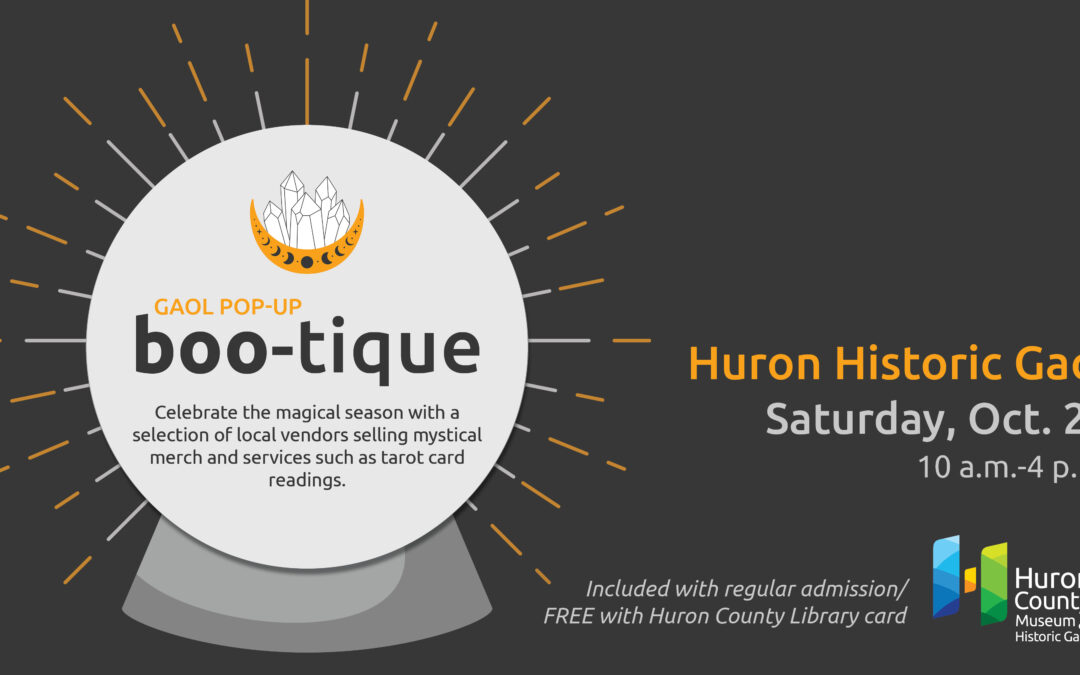
Celebrate the magical season by dropping into the Huron Historic Gaol on Saturday, Oct. 25, for our second annual Pop-up Boo-tique featuring local vendors selling mystical merch and services including astrology and tarot card readings. Access is included with regular admission or FREE with a
Museum membership or
Huron County Library card.
We are thrilled to welcome the following vendors:
- Indigo Soul Cat from Wonky Frog Studio
- Through the Veil
- Crystal Eden
- JMR Collections
- Kelly Stevenson
- The Crows Key
- Penelope’s Glow
Please note: The Huron County Museum is not responsible for the results of astrology or tarot card readings provided as part of the Gaol Pop-Up Boo-tique program.

by Jacob Stevens | Sep 3, 2025
Ukrainian Canadian Congress | London Branch invites you to a presentation and discussion with excerpts from the film Uprooted.
Guest speakers: Professor Oleksa Drachewych, PhD, with Mr. Dan Ward, MACPRP
Admission is FREE. Please note that seating capacity in the museum theatre is limited. Seats are available on a first come, first serve basis.
About the Speakers:
Oleksa Drachewych is an Assistant Professor of History at Western University, and a lecturer in History at King’s University College. His research interests have focused on Soviet history, modern international relations, and the history of international communism. His current research focuses on connections between the Soviet experience during the Second World War and Russian efforts in Ukraine today. He is also working on a textbook on the global history of totalitarianism. He has also written on the instrumentalization of history in Putin’s Russia, including on Russia’s relations with the Global South, and on the influence of international communism on global anti-imperialism. He is the author of The Communist International, Anti-Imperialism and Racial Equality in British Dominions (Routledge, 2018) and co-editor (with Ian McKay) of Left Transnationalism: The Communist International and the National, Colonial and Racial Questions (McGill-Queen’s University Press, 2020).
Dan Ward is a Registered Psychotherapist who has been working with children and youth in various mental health settings for over 33 years. In his current practice, he employs a wide range of modalities to treat victims of trauma and PTSD: such as Animal and Equine Assisted Therapy, EMDR and Clinical Hypnosis.