by Amy Zoethout | Oct 7, 2021 | Blog
If you’re out touring County Roads this fall, you may notice some new brown and white heritage signs marking Huron County’s historic settlements. The project was initiated by the County’s Public Works Department as a way to remember these communities that once existed in Huron. To date, 23 signs have been erected, including three signs marking communities that still exist, but under a different name. Our student Maddy Gilbert explores the history of some of these settlements.
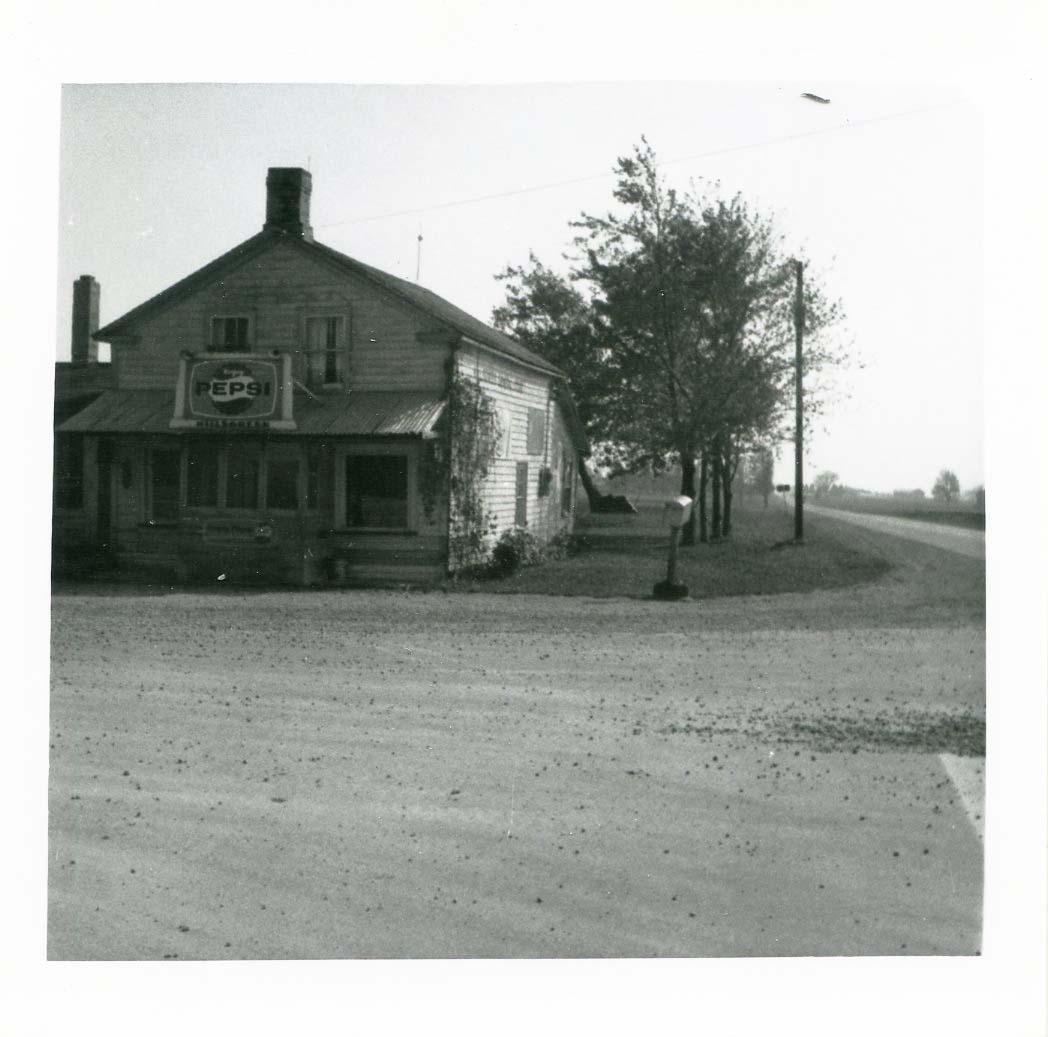
Black and white photograph of a two story general store with wooden siding. Written on the back of the photo is: “Hillsgreen Store North Boundary Pt. Lot 11.”
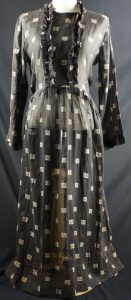
Lady’s dress worn by Catherine (Clausius) Reichert, Hillsgreen, ON. M981.0027.001
Hillsgreen, which has also been spelled as two words, was located at the crossroads of Parr Line (County Road 31) and Kippen Road. It is on the route from Seaforth to Highway 21 and Lake Huron.
Hillsgreen was settled by the Hills family, and the hamlet kept the family’s name. The settlement had a population of 50 people by 1876, and was the community centre up until the advent of rural mail delivery.
Sir John Wilson was the most famous one-time resident of Hillsgreen, leaving to become the Chief Editor of the Toronto Globe. Sir John was knighted by His Majesty King George V in 1913, and received an honourary degree from Queen’s University.
The reason for the settlement’s decline came as the residents of Stephen and Hay Townships no longer needed to travel all the way to Hillsgreen to pick up their mail. With the ease of automobile travel, residents could pass Hillsgreen on the way to it’s larger neighbours, Dashwood, Zurich, Hensall, and Exeter.
Hillsgreen is just an intersection now, with nothing to show what once was, except for the historic sign to remember its past.
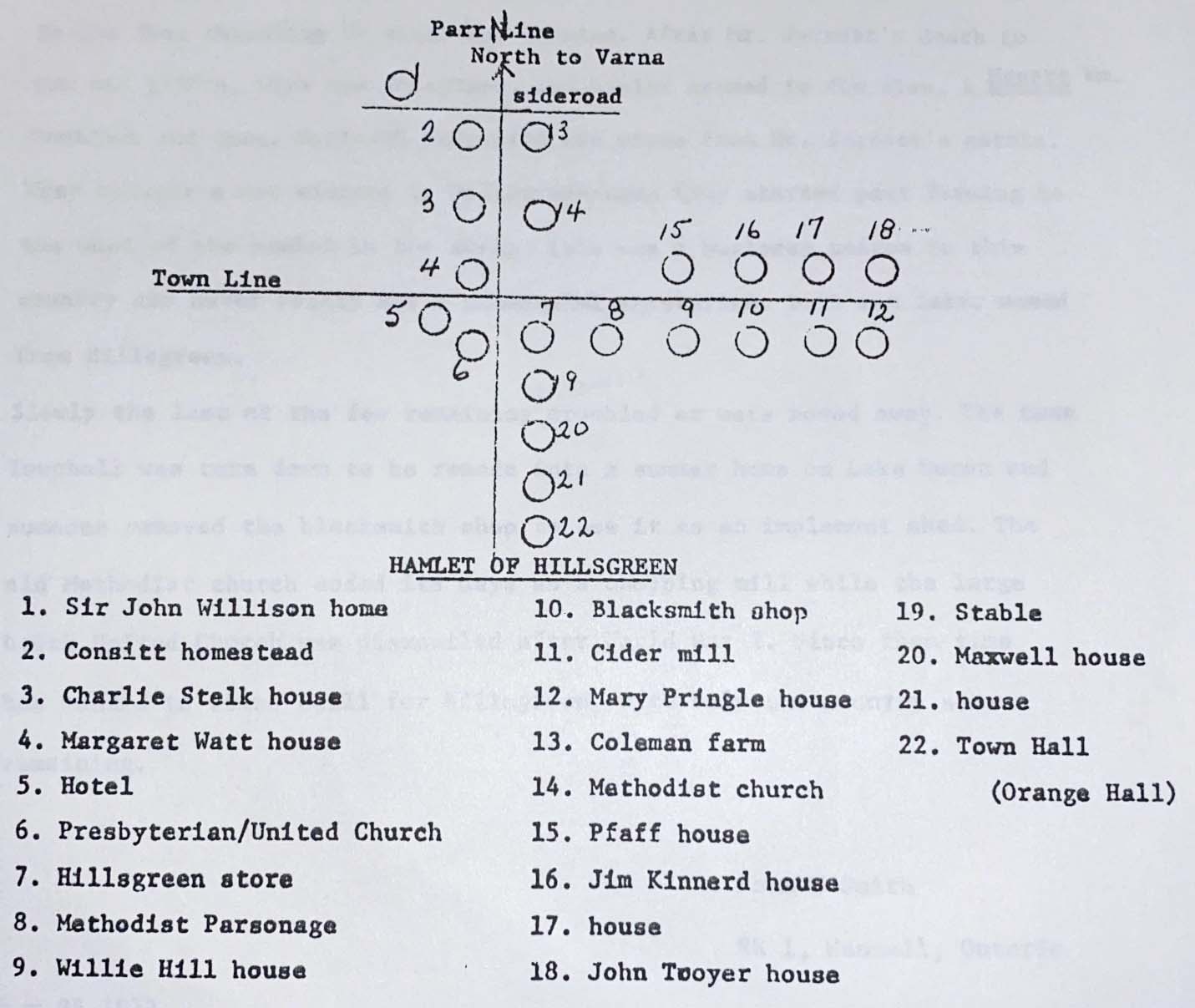
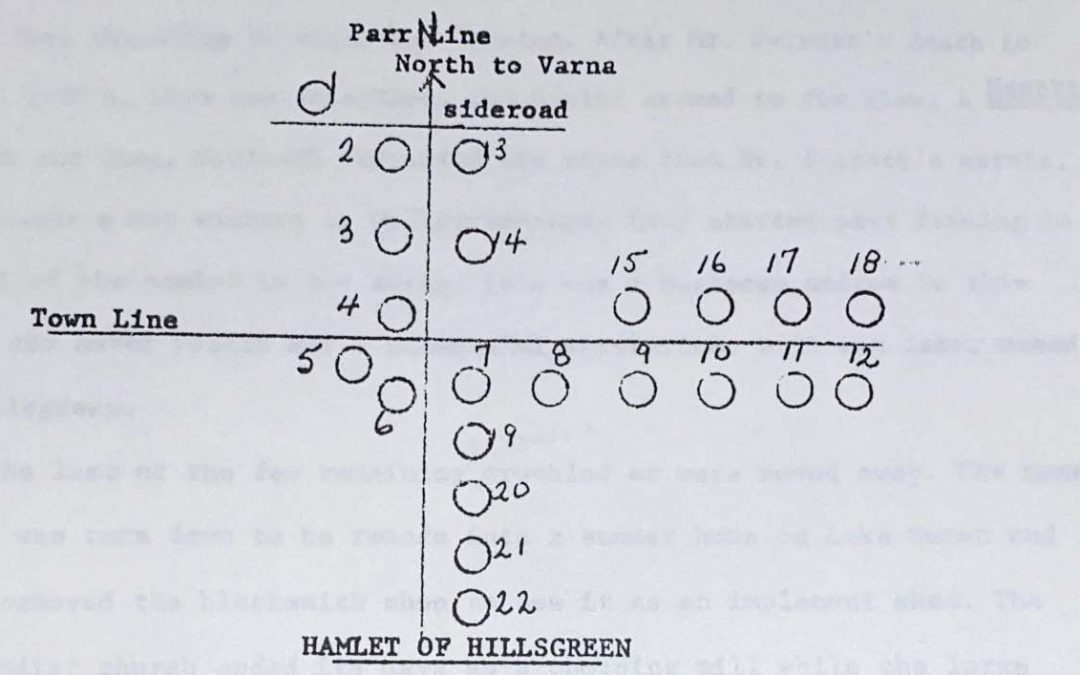
This Hillsgreen Town Plan was made by John W Smith, with help from Annie Consitt in 1973.
Sources:
- Hillsgreen Research from Jack Smith, May 1973. Kept in the Huron County Museum Archival Collection, 110 North St., Goderich, ON.
- Gibb, Alice. “Hillsgreen May Be Tiny, but It Had a Lively Store.” The Huron Expositor , 19 July 1971. From the Digitized Newspaper Collection at the Huron County Museum
by Amy Zoethout | Sep 9, 2021 | Archives, Blog, Investigating Huron County History
Kyle Pritchard, Special Project Coordinator for Huron’s digitized newspaper project, examines the types of content newspapers produced and how it changed over time to reflect the needs and demands of a growing community. You can search the newspapers yourself for free at https://www.huroncountymuseum.ca/digitized-newspapers/
In the age before smartphones and flat screens, newspapers served an important role in the functioning of communities. The Huron County Digitized Newspaper Collection began as Project Silas in 2014 to improve access to the enormous volume of local newspaper content previously only available on microfilm and in their physical format. Today, the digitized collection holds over 350,000 newspaper pages, which preserves a century and a half of local history. The papers were scanned and made searchable using OCR (optical character recognition) technology to assist researchers of all kinds to advance our understanding of the history of Huron County. Each of the newspapers in the digitized collection captures a unique vantage point of the past and is an invaluable tool for researchers in topics as wide-ranging as political, social, cultural and genealogical history.
Many newspapers have come and gone from Huron County, and only a handful have modern counterparts which have survived until today. Many publishers shut down, relocated, or merged with other news agencies to stay afloat. Those that lasted did so by pivoting to new audiences and revenue streams to keep the presses printing. By doing so, editors expanded the roster of sections their newspapers offered to retain their relevance and competitiveness.
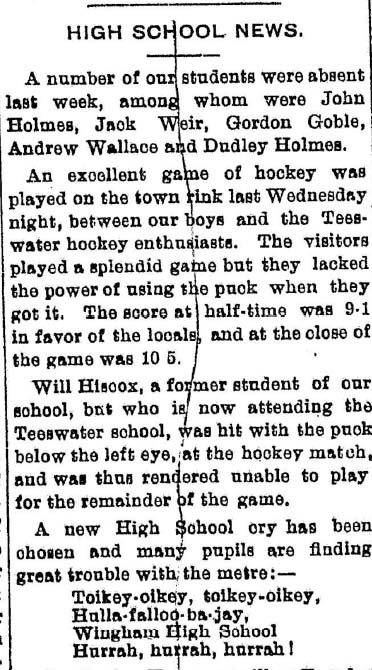
High School News published in the Wingham Times, Feb. 11, 1909.
Local newspapers strove to build a sense of communal identity. Farmers and merchants relied on newspapers extensively for everything from rural news, to exhibition schedules, to weather forecasts. Business was so central to early newspapers that a review of local businessmen and their storefronts in the Brussels Post in 1893 filled the entire front page. (Brussels Post, Oct. 20, 1893, pg. 1). The personals column documented locals’ travel arrangements in and out of the county and informed them of visitors returning home. A defense of personals columns was reprinted in the Clinton News Record from the Listowel Banner after the editor received complaints that “they are silly and that they are not read.” They responded by referring to the personals in their own paper as being “one of the most interesting developments in modern journalism,” (Clinton News Record, Aug. 8, 1935, pg. 3).
By the turn of the 20th century, sections on politics, business and industry within newspapers were condensed to increase the space available for larger advertisements and new columns. This trend increased as newspaper readership grew more slowly over the course of the world wars with competition from radio and television. In response, editors endeavored to expand the reach of their newspapers to new audiences. Fashion, recipe and lifestyle sections were introduced in hopes of appealing to women, and cartoons and high school news were aimed at stimulating the interest and involvement of young people. Readers who perused The Seaforth News in 1962 could discover the new culinary marvel of pancake houses which were taking the United States by storm and try their hand at “African banana pancakes” and “New Orleans kabob hot cakes”. (The Seaforth News, March 22, 1962, pg. 2) Or, depending on the decade, they might serve their families an unsavory recipe for depression-era oyster stuffing. (The Wingham Advance-Times, Dec. 19, 1935, pg. 7) Just like readers in the past, these kinds of recipes are preserved today in the digitized newspapers just waiting for savvy or unsuspecting chefs to test them out in their own kitchens.
Newspapers were also an important medium for local teens to keep a record of events, communicate, and share high school gossip. Yet, it might be surprising to know that the oldest high school news column in Huron County started in 1909 in the Wingham Times. It was not really until after the Second World War that young people really established a presence in news reporting. (Wingham Times, Feb. 11, 1909, pg. 1) Introduced to fill some of the space left by wartime commentary, high school journalism was forward-thinking and allowed the opportunity for newspapers to attract and engage with a younger audience. The results of games played by local sports teams and club activities were a major highlight of these sections, which eventually came to fill a whole sheet in the newspaper. (Lucknow Sentinel, Dec. 18, 1947, pg. 3)

The Horrorscope as published in the Exeter Times-Advocate, Oct. 23, 1969.
 Even small editorial changes which found room for community announcements, movie showtimes, advice columns and crossword puzzles were intended to position local news so that papers provided little bouts of day-to-day wisdom, small-town gossip and casual distraction. In an October edition of the Exeter Times-Advocate published in 1969, readers were treated to a horrorscope, an inverted horoscope which only offered bad advice. Pisces were told that “Long trips are not advised today. Neither are short trips. It might be well to stay in the house. Try not to think,” whereas Capricorns were reminded it was “A good day to pay off your bills, if you only had the money. Be thankful you have a roof over your head,” (Exeter Times-Advocate, Oct. 23, 1969, pg. 9)
The Digitized Newspaper collection is constantly expanding to include more local historical content. The database is free, searchable and easy to use. So, what are you waiting for? Whether a traditional, or not so traditional, recipe, a photograph of your high school sports team, or the latest in 1970s fashion, head on over to the Huron County Museum website and start exploring! Who knows what you might find?
by Amy Zoethout | Sep 1, 2021 | Blog
If you’re out touring County Roads this summer, you may notice some new brown and white heritage signs marking Huron County’s historic settlements. The project was initiated by the County’s Public Works Department as a way to remember these communities that once existed in Huron. To date, 23 signs have been erected, including three signs marking communities that still exist, but under a different name. These signs have the word ‘historic’ added to show their historic name, like Manchester, which is still a thriving community now known today as Auburn.This summer, our student Maddy Gilbert will explore the history of some of these settlements.
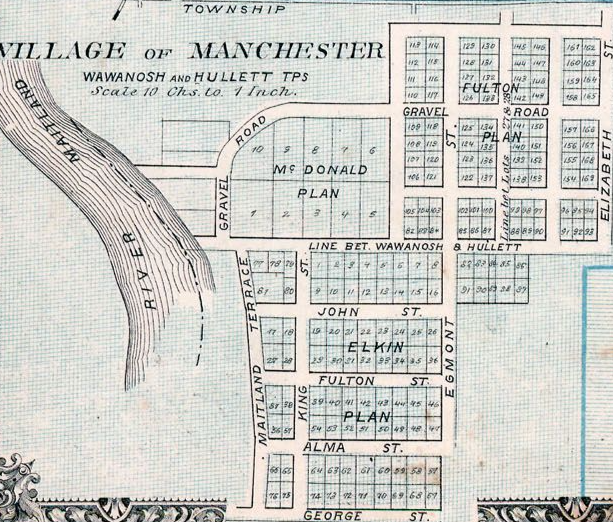
The Village of Manchester was founded in 1854 on the edge of the Maitland River where the Village of Auburn now sits. It was listed on a map from the 1860s as Manchester, but by 1879, a map of Huron County lists the village as both Manchester and Auburn. As recent as 1979, the official name for the community was the Police Village of Manchester, while Auburn was the name of the post office. But by February 1979, Manchester was no more as the village trustees voted to keep Auburn as the one and only name for the village. Since there was another Manchester located in Ontario, the change came to avoid confusion between the two communities.
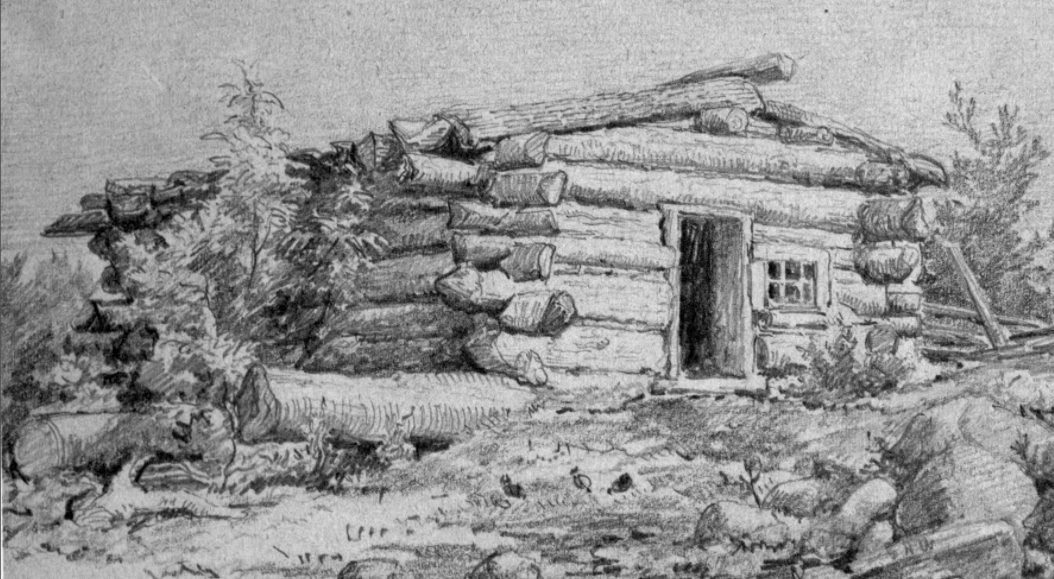
This is an example of a log shanty, much like the one Eneas Elkin would have lived in.
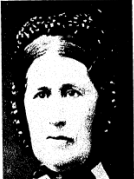
Isabel Elkin, wife of Eneas Elkin
Eneas Elkin was the first settler to Manchester. He walked all the way from the City of Hamilton and built a log shanty. George Elkin, son of Eneas and Isabel Elkin, was the first baby born in Manchester on April 13, 1850. The first wedding in the village was credited to be between Anne (nee McDonald) and Joseph Tewsley. Annie passed away after only one year.
For the first two years after Mrs. Elkin joined her husband Eneas in Manchester, there was only a track between Goderich and Manchester, until the Canada Company opened what is now Huron County Road #25 in 1851. Until a bridge was built, Elkin ran a ferry across the Maitland River. The first two bridges crossing the Maitland were constructed out of wood and washed away in spring floods. The third bridge was constructed partly out of steel, until the concrete bridge was constructed a few yards upstream in 1954.
Eneas Elkin surveyed Hullett Township, which was amalgamated into the Municipality of Central Huron in 2001.
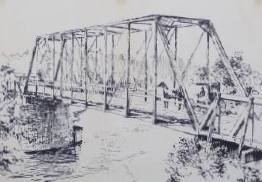
1975 Ink Print of the Auburn Bridge done by Jim Marlatt, a local artist. This bridge was in use until the new, concrete bridge was completed upstream in 1954.
By 1866, Manchester had a flour mill which shipped goods as far as Montreal. There was also a saw mill erected by John Cullis after he purchased the flour mill. The saw mill produced lumber from the logs that were cleared, to be sold as lumber for the barns being erected throughout the area. Cullis’ saw mill was destroyed by fire in 1893, and Cullis rebuilt a short distance away. The second mill was also victim to fire.
The Village had power by 1896 leading to the installation of electric powered street lamps. A.E. Cullis, who ran the grist mill, installed a direct current generator on his property and supplied power from dusk until 11 p.m. at the rate of two cents per light per night. Most villagers kept their costs down by attaching one light to a very long cord that they could move from room to room.
The Auburn CPR Station opened in 1907 with the delivery of a car-load of salt to W.T. Riddell. One delivery was a cow from Bracebridge. The station closed in 1979 and any deliveries made by train for people living in the village would have been left at the Blyth CPR Station.
The first brick bank in Manchester was the Sterling Bank of Canada, which eventually became a CIBC branch. On Nov. 14, 1930, Manchester suffered a terrible fire, which destroyed the hardware store that was located beside the bank. Mr. and Mrs. Carter were the first to notice the fire, and Mrs. Carter ran into the street yelling “fire!”. Mrs. Carter could have been the one who saved the lives of Mr. A.M. Rice and family, who resided above the CIBC, where Mr. Rice was manager.
Today, the Village of Auburn sits southeast of the intersection of Huron County Road 25 (Blyth Road) and Huron County Road 8 (Base Line). Auburn lies 20 km east from Goderich, 20 km north from Clinton, and 10 km west from Blyth.
Sources
Belden, H. “Map of Morris Township.” Illustrated Historical Atlas of the County of Huron, Ont., H. Belden, 1879.
Gropp, Bonnie, editor. “Police Village of Auburn: Settlement of Manchester Grows out of Wilderness.” The Citizen, 29 Dec. 1999. From the Digitized Newspaper collection at the Huron County Museum
Johnston, Tom. The Blyth Standard, 27 June 1979. From the Digitized Newspaper collection at the Huron County Museum
Bradnock, Eleanor. “Manchester No More.” The Blyth Standard, 27 June 1979. From the Digitized Newspaper collection at the Huron County Museum
“Craigs Took Over Sawmill in 46 .” The Blyth Standard, 27 June 1979. From the Digitized Newspaper collection at the Huron County Museum
“Eneas Elkin Walked from Hamilton to Establish Auburn.” The Blyth Standard, 27 June 1979. From the Digitized Newspaper collection at the Huron County Museum
“Isabel Elkin.” The Blyth Standard, 1979. From the Digitized Newspaper collection at the Huron County Museum
by Amy Zoethout | Aug 16, 2021 | Archives, Blog
Livia Picado Swan, Huron County Archives assistant, is working on the Henderson Collection this summer and highlighting some of the stories and images from the collection.
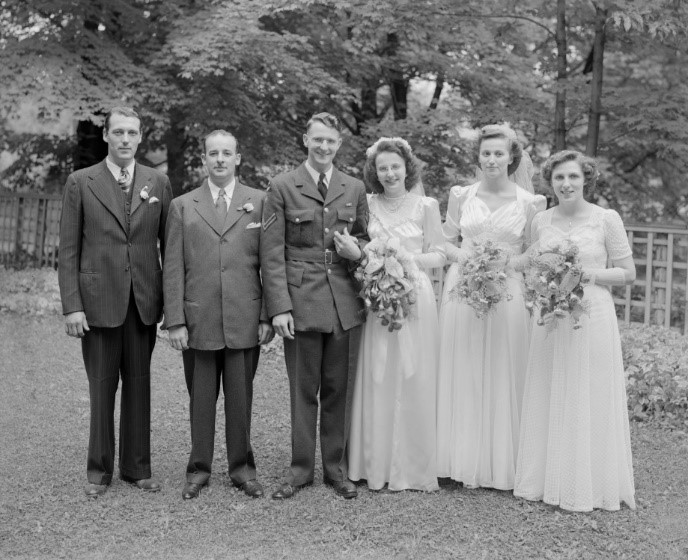
In keeping with our August theme of making lemonade from lemons, we take a look at some of the wedding photos taken by Gordon J. Henderson during the Second World War. The photographs highlight some of the men and women of the Royal Canadian Air Force who celebrated their marriages while stationed at one of Huron County’s air training schools. So far, staff know of 18 different weddings that Henderson photographed, which are all available to be viewed online.
During the Second World War, Henderson, travelled to air training schools in Goderich, Port Albert, and Clinton taking pictures of classes and other base activities. Many airmen came to his studio in Goderich to have their portraits taken to send home to family and friends. The Henderson Collection also includes wedding portraits, candid shots, and correspondence related to WWII air training in Huron County.
Haddy wedding – A992.0003.202a
Fannie Lavis and Cpl. Wesley F. Haddy, from Seaforth, were married on Aug. 6, 1945. Miss Lavis had two parties hosted for her by her friends before her wedding, including a crystal shower, according to the Huron Expositor, as found in our online collection of Huron Historic Newspapers.
Holmes Wedding – A992.0003.179a
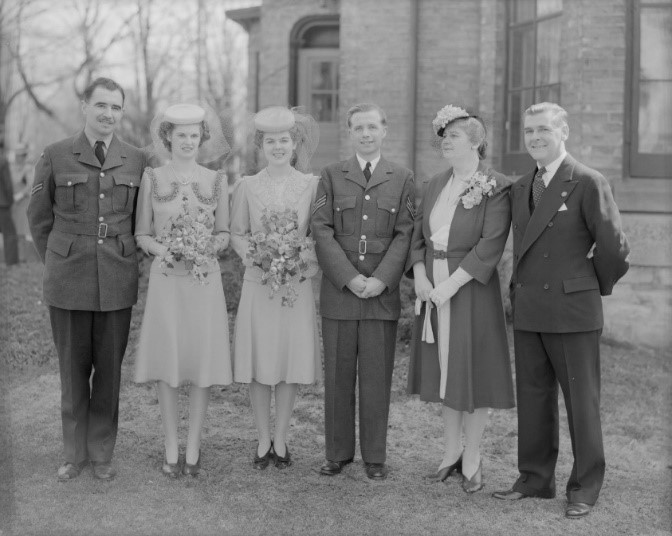
Sgt. Cecil R. Holmes married Lorraine Eleanor Atkinson on June 10, 1944. Their wedding was held in the Dundas Central United Church in London, and the Clinton News Record reported on the event. During the 1940s, newspapers would describe the clothing, decorations, and events at the ceremony for their readers.
“The Church was attractive with Peonies, Ferns, and Palms, and was lighted with tapers held in candelabras. C.E. Wheeler was at the organ and the soloist was Miss Edna Parsons, who sang ‘Because’. The bride was given in marriage by her Uncle. A.G. Atkinson of Detroit. She was dressed in a filmy white net with panels of brocaded net adored with bows of white velvet and orange blossoms in the full skirt, which ended in a slight train. The dress was fashioned with sweetheart neckline and long sleeves. An illusion veil fell in three lengths from a flowered Headdress and she carried American beauty roses, “ (As published in the Clinton News Record, 1944-06-15, pg. 8, from our online collection of Huron Historic Newspapers)
Note that the dress in the description doesn’t match the image. It’s likely that Mrs. Holmes wore a different gown for her wedding than she did her wedding pictures. Wedding dresses during the Second World War were often shared or passed between women to aid in the war efforts and to avoid using excess fabric when rations were in place. Other women would simply wear a fine dress from their closet instead of a dress specifically meant for the ceremony.
Wagner Wedding – A992.0003.178a
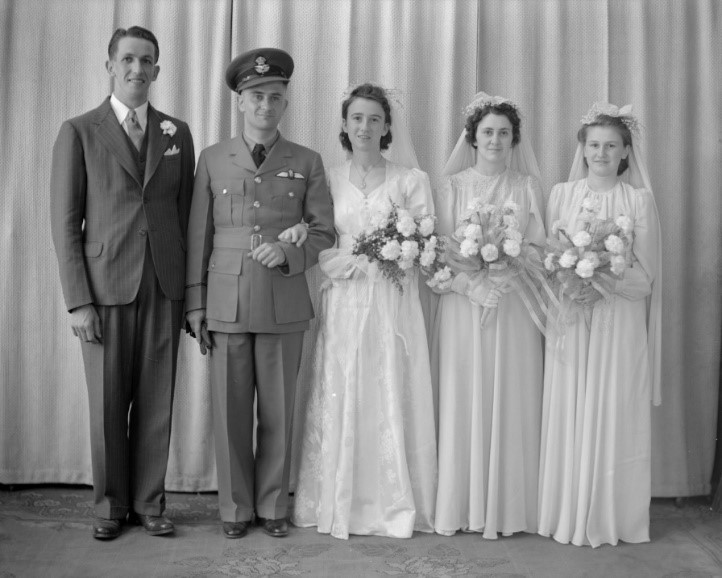
Helen Marguerite Miller and Roy Wagner were married on June 5th of 1945, at Wesley Willis United Church in Clinton, ON. They went to the home of the bride’s family for a buffet lunch and reception.
“The bride, given in marriage by her father, wore a floor length gown of white brocaded satin, fashioned on princess lines with a sweetheart neckline. Her embroidered floor length veil was caught with orange blossoms and lily of the valley, and she carried a bouquet of white carnations, bouvardia, and lily of the valley.” (As published in the Clinton News Record, 1943-06-10, from our online collection of Huron Historic Newspapers)
As the Huron County Museum continues to digitize more images from the Henderson Collection, perhaps we will find more weddings celebrated by the men and women of the RCAF army bases in Huron County. There were many weddings held without a notice in the paper, making it a bit harder to find public information about the ceremony. I hope that the descriptions that do exist, and the smiling faces of the wedding parties, will let you imagine these beautiful times of joy during such a difficult era.
by Amy Zoethout | Jul 27, 2021 | Blog
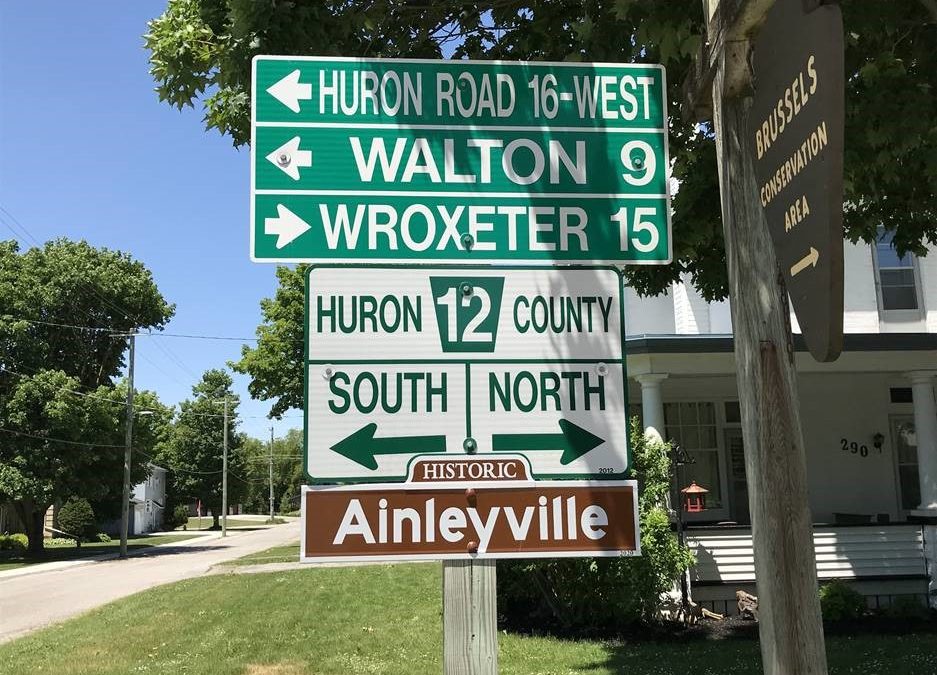
If you’re out touring County Roads this summer, you may notice some new brown and white heritage signs marking Huron County’s historic settlements. The project was initiated by the County’s Public Works Department as a way to remember these communities that once existed in Huron. To date, 23 signs have been erected, including three signs marking communities that still exist, but under a different name. These signs have the word ‘historic’ added to show their historic name, like Ainleyville, which is still a thriving community now known today as Brussels. This summer, our student Maddy Gilbert will explore the history of some of these settlements.
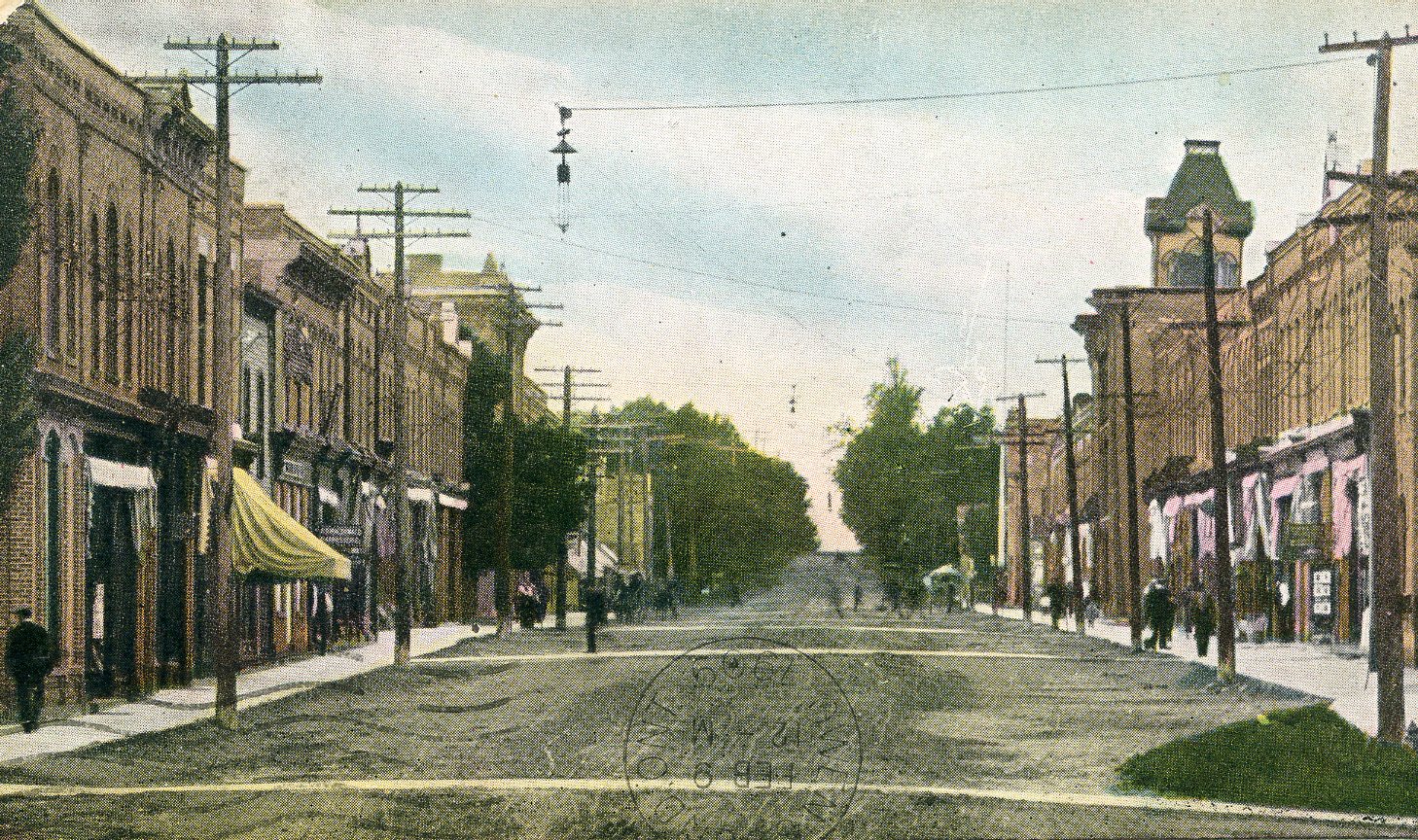
Postcard of Main Street Brussels, postmarked 1909. Source: Archival Collection of the Huron County Museum
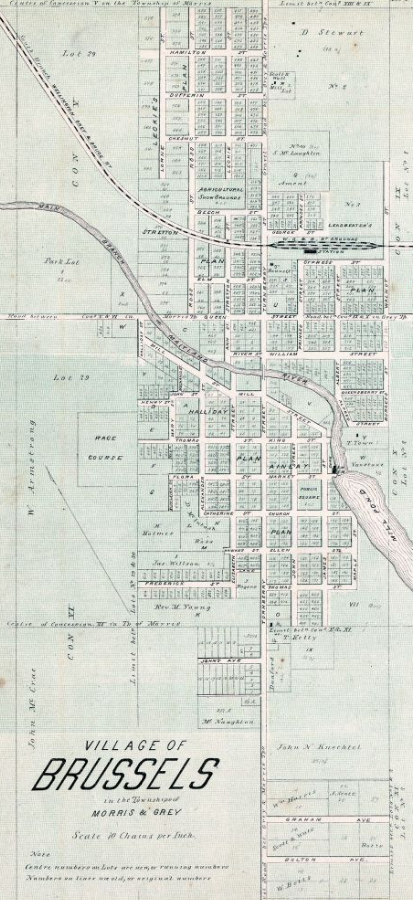
This 1879 map shows the village as “Brussels.”
Brussels found its beginnings in 1854, when William Ainley bought 200 acres of land on the Maitland River. In 1855, he laid out a town plot and named it Ainleyville, after himself. On April 1, 1856, he sold all of his land to J.N. Knechtel. Between 1860 and 1875, three fires completely destroyed the main street. Ainley donated land that was to be used for a market square, but it was converted into a park.
The Wellington, Grey and Bruce Railroad opened a line off of their Palmerston to Kincardine line, officially linking Ainleyville to a railroad. When the railway opened in 1874, there were three different names credited to the same place. Ainleyville was the name given to the village itself, Brussels was the name of the train station, and Dingle was the name of the post office.
One reason credited for settling on the name Brussels, was that railway workers were given the option to name the new train station. As many of the railway workers were of European descent, they chose Brussels after the capital of Belgium. Brussels was accepted as the official name for the village on Dec. 24, 1872, when it became Huron County’s first incorporated village.
Brussels sits at the intersections of Huron County Road 12 (Brussels Line) and Huron County Road 16 (Newry Road.) Brussels is 25 km southeast of Wingham, 25 km northwest of Seaforth, and 16km south of Wroxeter. Brussels was amalgamated into the Municipality of Huron East in 2001.
Learn more: