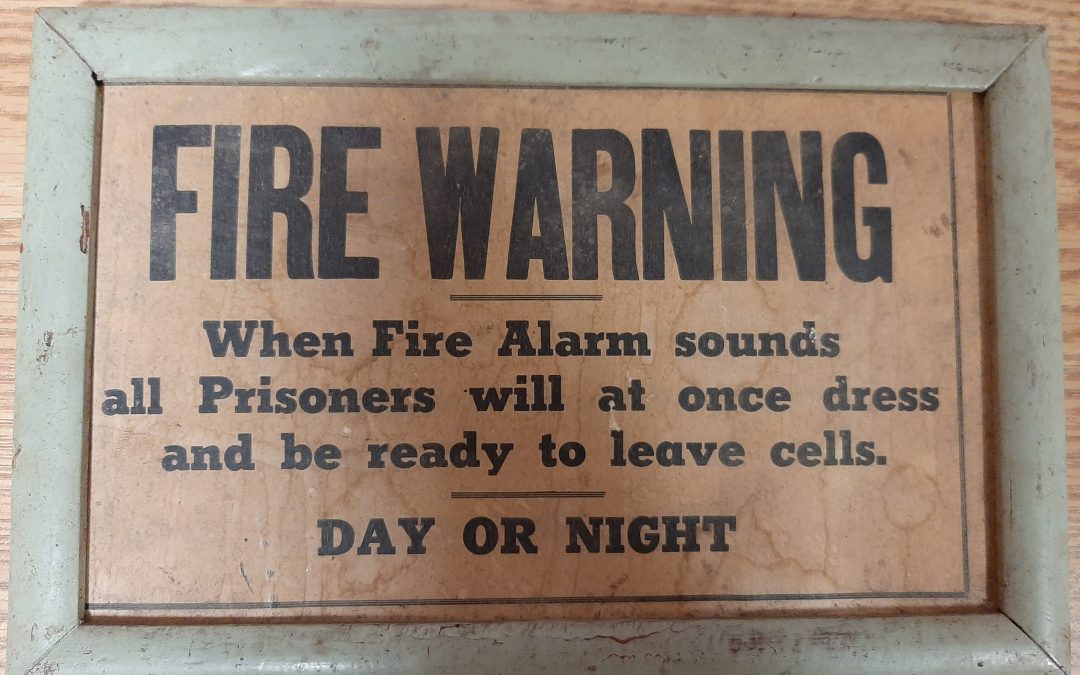
“No Possible Escape”: A Short History of Fire at the Huron Gaol

“No Possible Escape”: A Short History of Fire at the Huron Gaol

“No Possible Escape” sounds positive when it comes to jailbreaks, but less so in the case of emergency. Curator of Engagement & Dialogue Sinead Cox looks back at fire and fire safety at the Huron Historic Gaol.

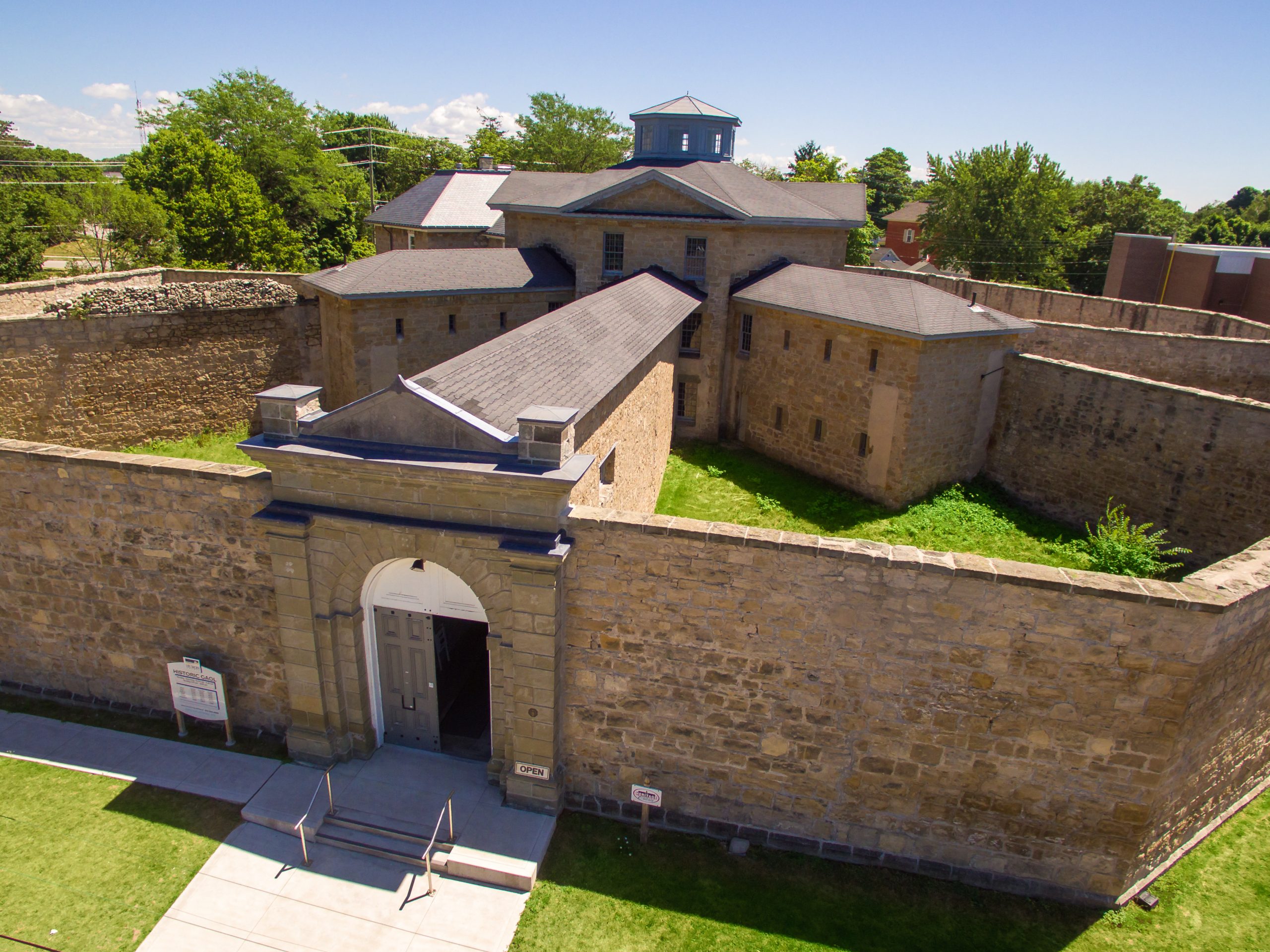
The Huron Historic Gaol is one of the most recognizable, historically significant and architecturally unique buildings in Huron County. Today it stands as a venue for visitors to hear the stories of the prisoners and staff who walked its halls, and considering the number of times the building has caught fire over its 180+ year history, this is nothing less than a small miracle.

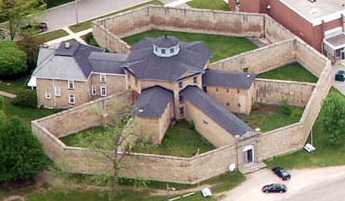
Although the outer walls may give the impression that it is solid stone, the construction of the gaol interior is actually significantly timber. The unique octagonal layout of rooms and yards around a central spiral staircase are designed to keep prisoners in, with perhaps less architectural forethought when it comes to allowing people to quickly get out, should the upper floors become engulfed in flames.

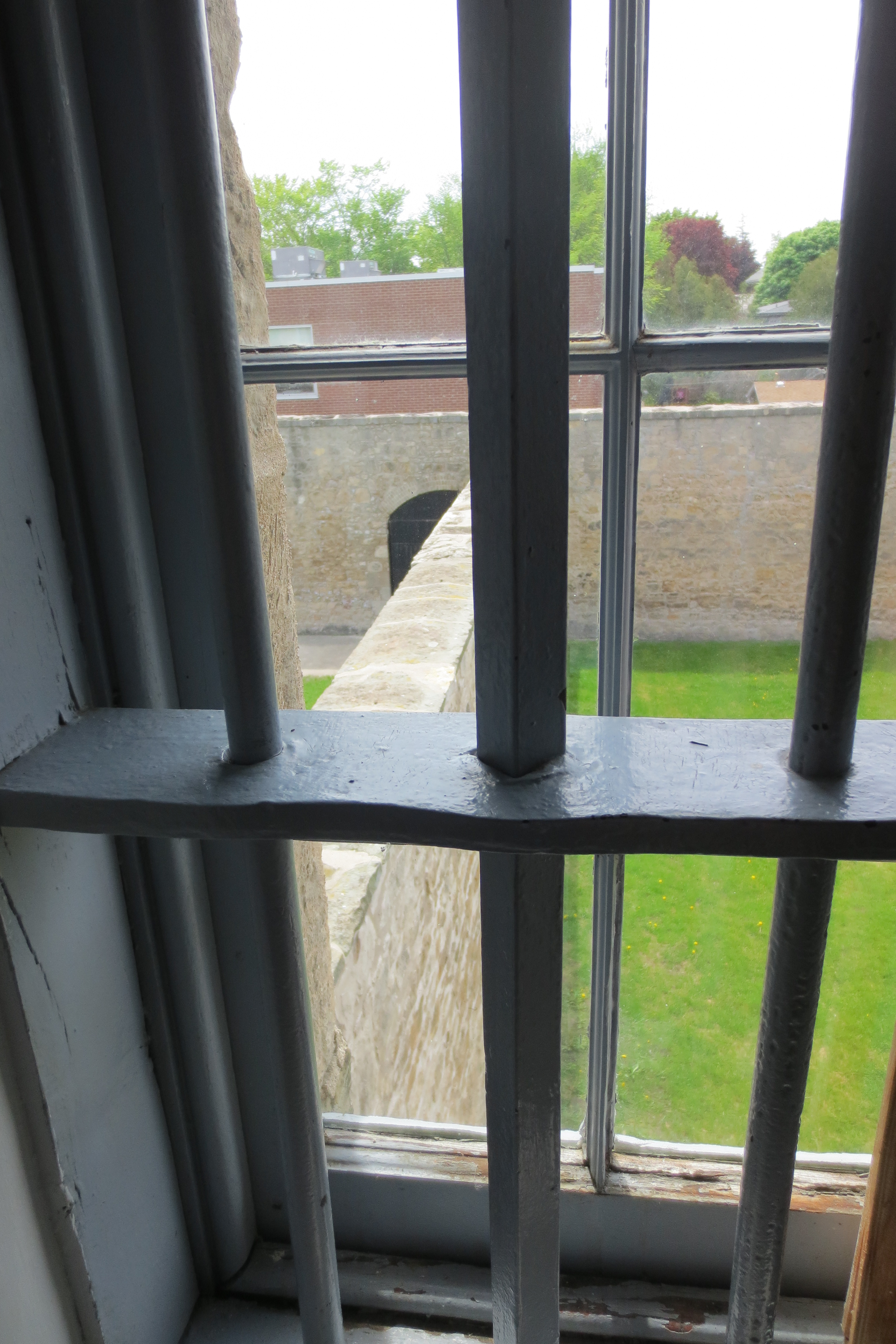
In 1851, when the building was only a decade old and served the United Counties of Huron, Perth and Bruce, an errant chimney spark caused the first known fire of significance. Fortunately, the only harm sustained in that instance was damage to the building’s roof. Afterwards, the Gaol Inspector recommended covering the roof with metal, and that the county purchase a new ladder tall enough to actually enable water to be carried high enough to fight a fire (staff presumably having discovered the inadequacies of the previous ladder during the emergency). No ladder would have been very useful as a means of rescue for prisoners, however, as all of the windows on the gaol’s upper floors were barred to prevent escape.

In the 1860s the County of Huron replaced the tin-covered roof with slate, later swapped for asphalt shingles about a century later. When reverting to slate in 2021, roofers discovered lumber inside the cupola still bore blackened scorch marks from historic fires. The cupola, or central tower, has been struck by lightning at least twice: in 1892 and 1929. Torrential rain prevented fire in the first case, but the second strike “set the tower ablaze” just after one a.m.  According to The Clinton News Record, “a terrific electric storm was in progress and firemen had difficulty at first in plying streams of water on the tower, owing to its height. Some of the firemen climbed on to the slate roof, slippery with rain, and fought the flames from perilous positions.” The newspaper claimed that despite the late hour and extreme weather, a crowd of people gathered outside the gaol’s walls to watch their efforts. While firefighters risked their lives to stop the fire from spreading to the lower floors, a constable escorted the seven prisoners currently committed to the Huron Gaol to an outside courtyard, still confined within the 18 ft walls. Thankfully, the fire was successfully contained within the cupola and extinguished, but the flames and the water employed to douse them had caused more than $1,000 in damages (equal to just over $16,500 today). The county enlisted prisoner labour to help with the subsequent clean-up and repairs.
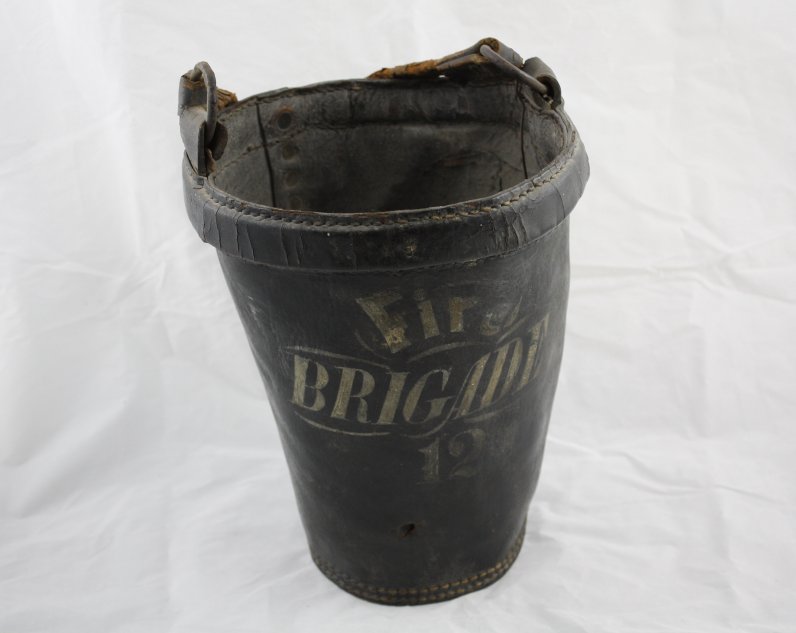
Black bucket with 'Fire Brigade' written on it.

Fire bucket. M951.0732.001

Photograph of firefighters, vehicles and animals in front of fire station.
Illustration of a young woman being accused of witchcraft

Huron Historic Gaol, Goderich Ontario
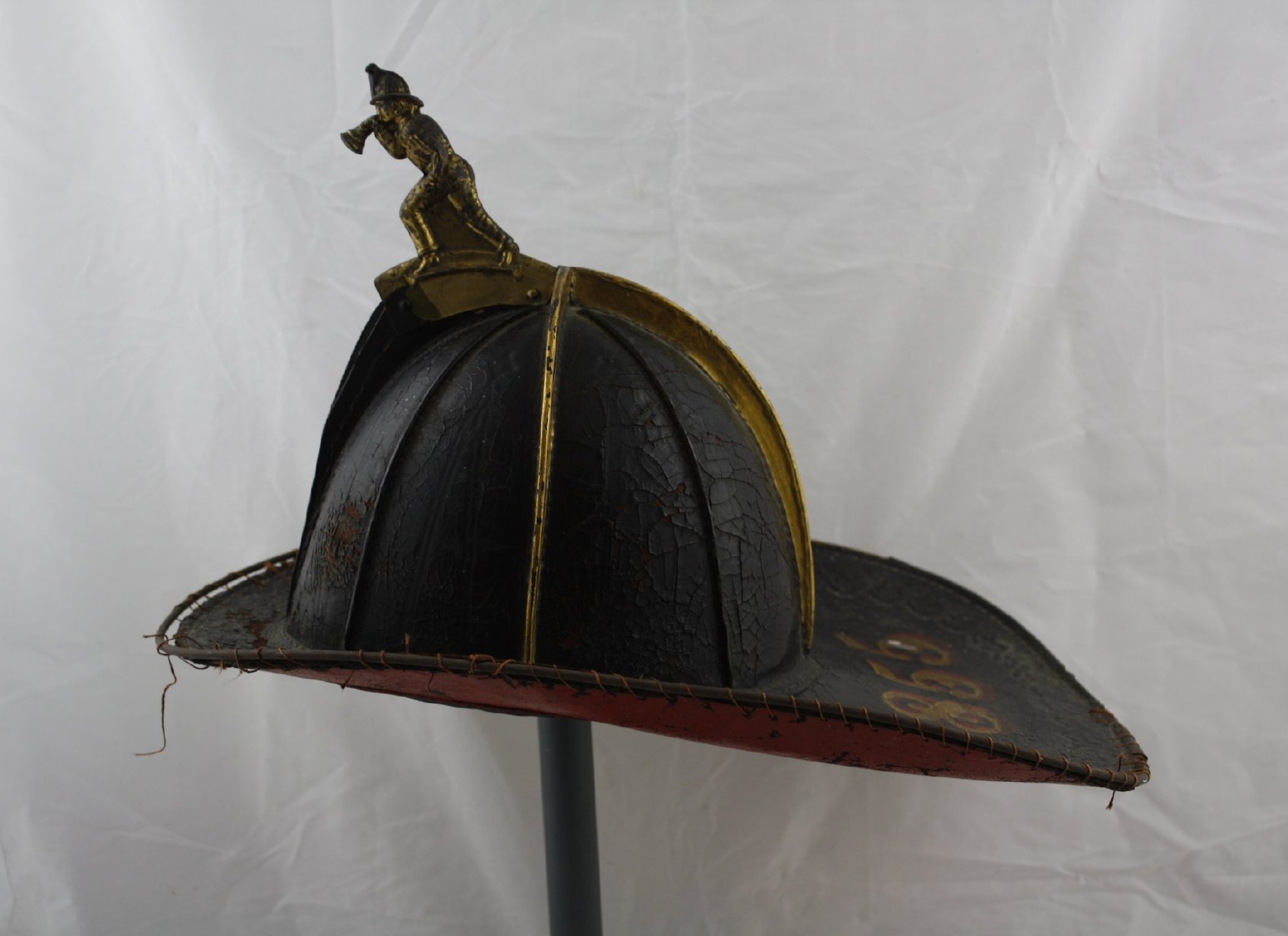
 black fireman's helmet hat with red underneath and a gold figure of a man blowing a fire horn.

1855 Fireman’s helmet donated by Town of Goderich. M951.0734.001. 
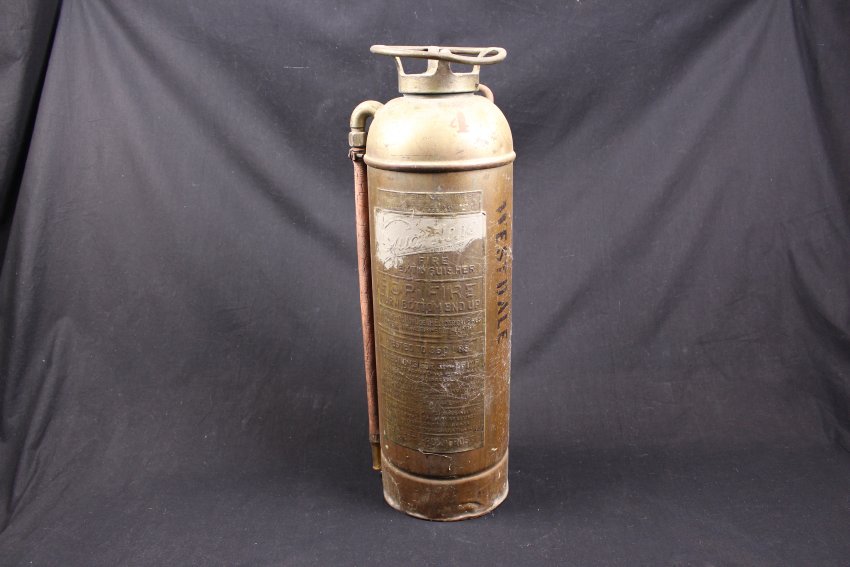
large brass fire extiguisher --  2 1/2 galloncylindrical with red rubber hose that has cracked and hardened;  stenciled in black on side is "WESTDALE". Instructions on side.  "Guardene Extinguisher"

Fire Extinguisher. 2017.0024.003. 

large brass fire extiguisher --  2 1/2 galloncylindrical with red rubber hose that has cracked and hardened;  stenciled in black on side is "WESTDALE". Instructions on side.  "Guardene Extinguisher"

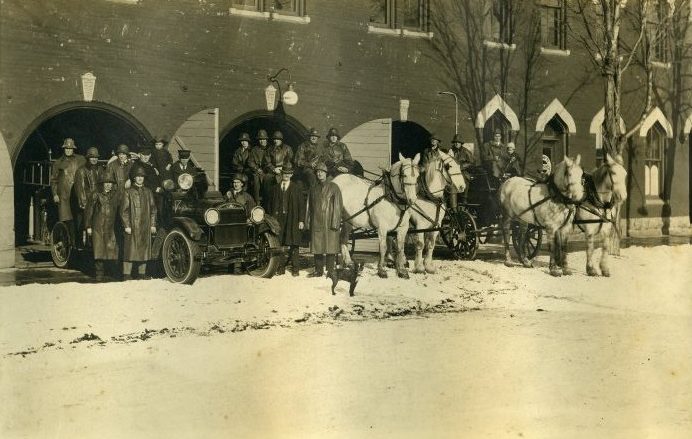
A950.1976.001. Fire crew at former Goderich Fire Station located on East Street, 1925. 

The cupola caught fire again in 1944, this time from burning leaves, either carried from the ground by a strong wind or ignited in the eaves by a spark. Although this fire burned only briefly, it caused destruction and water damage similar or worse than the 1929 blaze: costs duly submitted to the county’s insurer.

Officials and staff recognized the inadequacies of the gaol’s design very early in its operation: the lack of fire exits was one of the reasons that District Council and the courts complained about meeting there before the construction of a separate courthouse in 1856. Despite the general awareness of the threat, safety measures provided by the county did not always meet the needs of staff or emergency responders. After the 1892 lightning strike, Gaoler William Dickson found that the gaol’s fire hose was faulty, and burst in multiple places when tested with pressure.  As early as 1882, after yet another recent narrow escape from flames, local newspaper editorials from the Goderich Star and Clinton New Era condemned the gaol as an outdated fire trap. The Era argued for replacing the gaol and courthouse  with new, modern municipal buildings in a more central location. The Gaol and Court House Committee instead recommended “that a Babcock Fire Extinguisher for the gaol be furnished, also that a suitable water tank be built in the gaol yard,  owing to the inflammable and unsafe condition of the gaol stairs, there is no possible escape for the inmates in case of fire.”
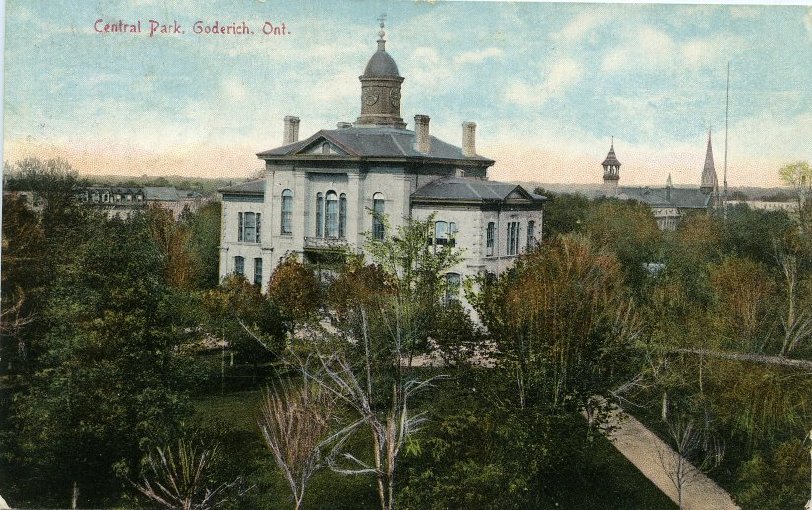
Colour postcard of Huron County Courthouse located in Goderich Square, surrounded by trees. Nineteenth century.

Postcard of courthouse at “Central Park” or Square, Goderich. Built 1856. This courthouse was destroyed by fire and replaced in 1954. 2008.0032.083. 

In the 1890s, Huron County Council acknowledged the aging heating stoves in each cell block’s dayroom as another serious danger and replaced them. Prior to electric lights, staff also had to contend with mandatory corridor lamps, burning day and night at the risk of overheating. Gaoler Dickson lamented to County Council in 1896 that, “twice [a lamp has exploded] during the almost 32 years I have been in your employ. The last time it was towards morning and fortunately my subordinate was awake and succeeded in extinguishing the fire at the cost of the bedding of two beds.” Dickson credited the turnkey’s quick action in preventing what was nearly a terrible tragedy: “At the time of the explosion there were 18 prisoners under lock and key, besides 5 members of my own family who were sleeping on the second floor. Had the flames caught the stair, all on the upper floors would have been entirely cut off from escape. In view of this danger to life and property, I would respectfully ask that you place one incandescent in said hallway.” The gaoler’s lobbying successfully resulted in the installation of incandescent lights at the gaol, but the issue of the single exit remained unaddressed. It’s easy to imagine that if the fire had spread beyond the smothering power of gaol blankets, that a quick decision may have been made to prioritize the evacuation staff and family before the overcrowded inmates sleeping behind multiple locked doors.

The close-call fires at the gaol over the decades were all seemingly accidental, with the exception of one incident during the holiday season in 1943. The gaol’s annual Christmas celebrations included a special meal for the prisoners with treats donated by the community, and that year they also enjoyed a decorated Christmas tree. On December 27th,  the dry boughs of the tree caught fire in one of the cell blocks, spreading to the woodwork and choking that ward with thick smoke. The Goderich fire department responded to gaol staff’s call for help, and successfully extinguished the flames in a manner of minutes. A follow-up investigation found that the cell block’s three resident inmates had intentionally started the fire to create a distraction for escape.  Convicted forger Floyd McCullough admitted to helping his teenaged cellmates, Angus Trudeau and Lorne Derevere, in devising how to ignite the Christmas tree remnants. The two younger men, committed for robbing Bayfield-area cottages, ultimately also pled guilty to the arson. No opportunity for jailbreak had ever actually materialized as planned; the trio were simply evacuated to another part of the gaol to avoid the smoke inhalation that may have endangered their lives if not for a turnkey’s quick arrival on the scene. All three faced added time behind bars for the conspiracy.
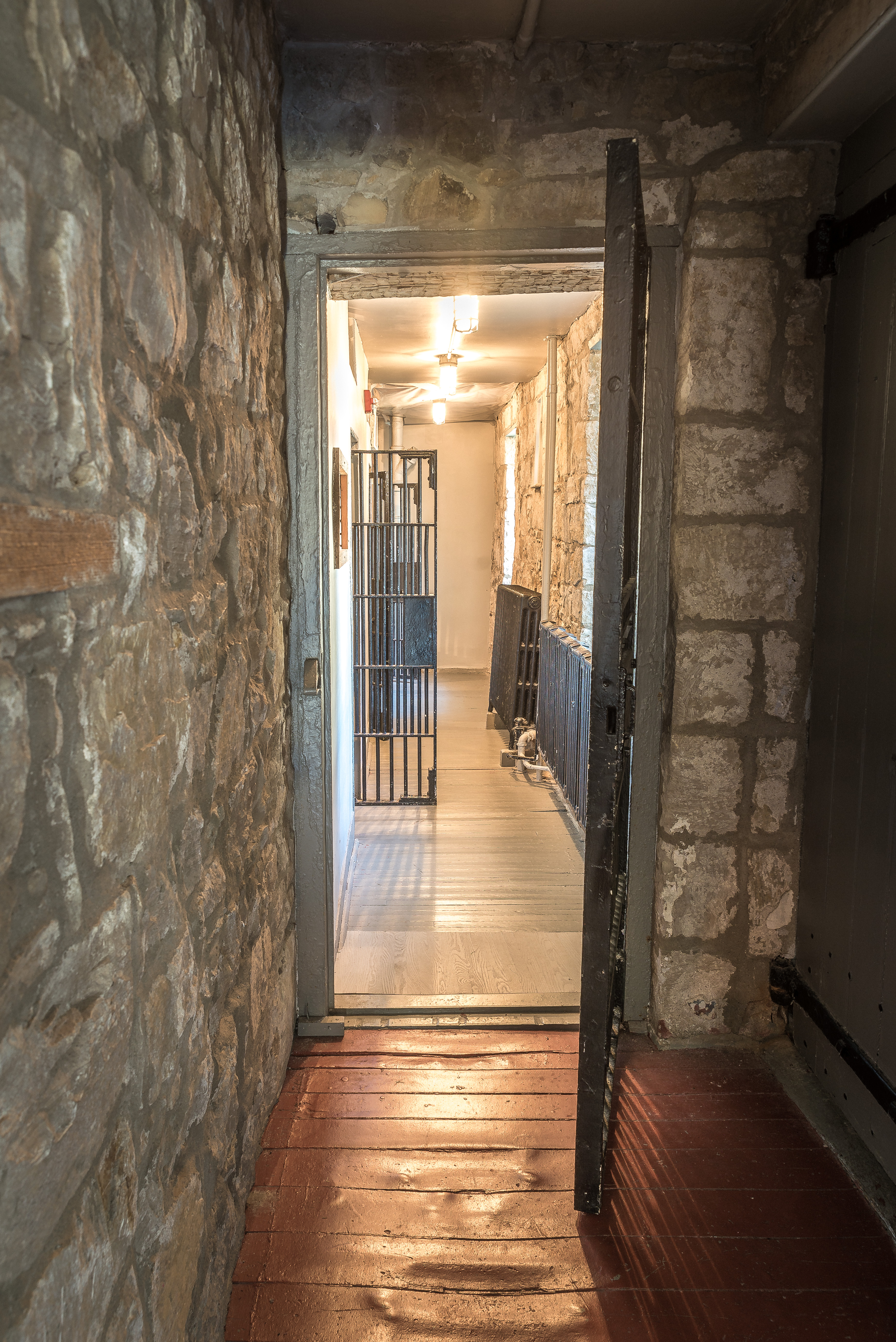
Cell Block

 The aging building’s vulnerability to fire remained a concern throughout the twentieth century, resulting in a fire-proof coating applied to the cells in 1939, various furnace installations and upgrades, and an alarm system installed by the 1950s. Jurisdiction over Ontario’s county correctional facilities transferred to the Province in 1964, and in 1972 the Ontario Department of Correctional Services decided to close the Huron Gaol. From 1974, the gaol opened its doors as a historic site and museum, originally managed by the Historic Jail Board– the County of Huron retained responsibility for fire insurance. The County resumed direct control of the building in the 1990s.

The Huron Historic Gaol would pass its 175th  birthday before finally gaining a fire escape and new fire exits on the second and third floors of the gaol after major upgrades in 2018. The work was undertaken with care to protect the site’s historical appearance and architecture.  As a historic site, fire safety could be addressed to meet contemporary standards without concerns about compromising security.  Today, the spectre of potential disaster by fire need not haunt staff and visitors to the degree it once did generations of prisoners and gaol employees. The gaol’s countless near misses with destruction are a reminder of the importance of adequate preparations and equipment to combat fire, as well as the need for strict safety regulations for public buildings.  It is only a mixture of ad hoc precautions, the quick actions of the gaol’s small staff, the intervention of local firefighters and also simple luck, that has successfully preserved this one-of-a-kind building and the lives of those who have lived and worked within its walls over three separate centuries. 

Find out More!

The Save the Jail Society: How the Huron Historic Gaol Dodged Demolition

The Save the Jail Society: How the Huron Historic Gaol Dodged Demolition

Kyra Lewis, Huron Historic Gaol outreach and engagement assistant, explores how the Gaol dodged demolition.

Huron Historic Gaol

Construction of the Huron Gaol began in 1839 in the Town of Goderich making it Huron County’s first municipal building. This once essential government building served as both a prison and a courthouse once its construction was completed, with the first documented prisoner committed on Dec. 3, 1841. The Gaol held significant value to the people of Huron County, as it represented their newfound independence from London District. The Gaol served as a focal point of justice and was where the Huron District Council held its first meeting on Feb. 8, 1842.

As time went on, the Gaol’s role began to shift; when the new courthouse was constructed in the centre of Market Square Goderich, in 1856, the Gaol’s sole purpose became holding prisoners. However, not all residents of the Gaol were criminals. Many who stayed at the Gaol were homeless, or mentally or physically ill. Drunkards, thieves, debtors and murderers lived alongside the homeless, and children as young as nine years old before Huron County Council constructed a House of Refuge in 1895. As time went on, numbers began to dwindle in the Gaol.

In 1968, The Children’s Aid Society moved into the Governor’s house after the last Governor moved out in 1967. The organization had outgrown their previously occupied space in the basement of the Courthouse located downtown Goderich. During the Children’s Aid Society’s time in the Governor’s house, they witnessed the closure of the Gaol in 1972 after the final prisoner was transferred out. However, prior to the Gaol even being closed as a facility, there was a proposal presented to the Huron County Council in September, 1971, to remove two of the Gaol’s walls adjacent to Napier Street to build a parking lot to accommodate the expanding services of the Children’s Aid Society and the Gaol’s neighbour, the Huron-Perth Regional Assessment Office. On Nov. 26, 1971, County Council received a formal approval from the Provincial Department for the demolition of certain walls at the County Gaol.

This decision provoked a massive response from the community and press, especially from Goderich and the surrounding areas. Many articles began appearing in the local newspapers concerning the possible preservation of the facility, as well as public rejection of the decision to tear the Gaol walls down.

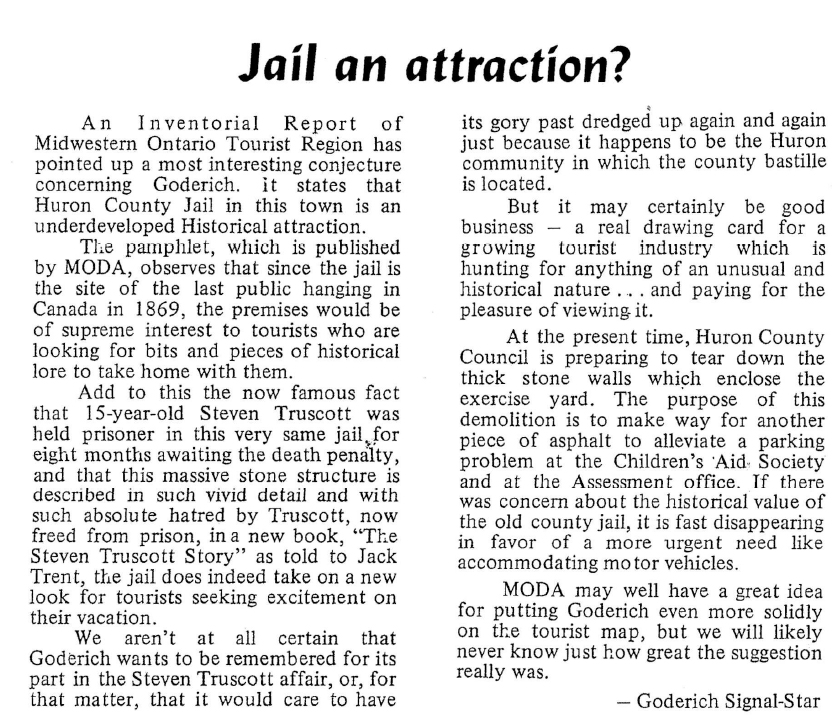
Editorial about saving the Gaol

Editorial as published in the Exeter Times-Advocate, Nov. 25, 1971

The papers referred to the old facility as an “underdeveloped historical attraction”, and “a real drawing card for a growing tourist industry”. However, Council at the time had no intention of utilizing the space as a Museum of Penology. Some councillors did not condone the county spending the money to restore the building, as it was projected the restoration would cost around $25,000. Other councillors believed that if they had that much money to spend, it should be allocated around the county, and not just in Goderich. Another drawback that was suggested was the glorification of previous inmates whose actions were heavily frowned upon. The potential of immortalizing the darker aspects of Huron County’s past was a genuine concern amongst officials.

The Property Committee eventually presented the County Council with another report on Dec. 8, 1972, which detailed the idea of the old Gaol becoming a “Museum of Penology”. However, in the same report they also put forth a recommendation to construct a parking lot and an extension for the Assessment Office, costing a projected $150,000. In January, 1973, Huron County Council approved the removal of three walls at the Gaol, after considering both the Children’s Aid office and the Assessment Office’s needs. The Gaol was unfortunately placed back on the chopping block, now set to lose another wall.

When citizens caught wind of the verdict, they were none too pleased with the potential defacement of such an iconic local building. More articles and letters to the editor began showing up in the papers and a small group of concerned citizens came together to fight to save the historic building. If the Gaol walls were to be torn down, it would completely ruin the integrity of the building’s design. As the Gaol’s architect, Toronto-born Thomas Young had been inspired by famed English philosopher and prison reformist Jeremy Bentham. Thus, the loss of the Gaol walls would compromise both the value and history of the structure, as they added an irreplaceable element to the significance of its layout and design. The goal of this growing group of local politicians, historians and volunteers was to pressure the Council into reassessing their decision to tear down the walls. Their arguments were intended to bring to light the necessity of the architectural, historical and cultural conservancy of the building. And so, the Save the Jail Society was born!

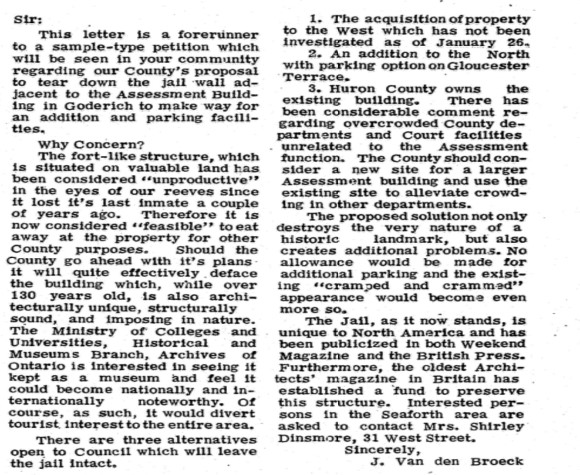
Newspaper clipping of letter to the editor Save the Jail

Letter to the Editor written by Joan Van den Broeck published in the Goderich Signal-Star.

With their objectives set, the group of dedicated members wrote letters to the newspaper, educating the public on their cause. A brilliant letter addressed to the editor of the Goderich Signal-Star was written by Save the Jail Society activist Mrs. Joan Van den Broeck. She advocated for the preservation of the Gaol, stating the uniqueness of the architecture as being one-of-a-kind, as well as miraculously structurally sound despite being around 130 years old, predating confederation. She also spoke of the building’s national and international notoriety, which would only enhance the tourist experience in Huron County. Van den Broeck, along with Goderich Reeve Paul Carroll and their fellow Save the Jail Society members, sought to change the fate of the iconic building.

The Save the Jail Society was extremely vocal and visible within the community, organizing campaigns at Goderich District Collegiate Institute and compiling a petition, as well as fundraising and rallies. There was a song written to commemorate the Gaol, which was written by Wingham entertainer Earl Heywood. The song was sung to the tune of Battle Hymn of the Republic, and was sung at events and rallies. They presented a petition to Huron County Council, as well as an architect’s revised plan for the parking lot to be built on the north side of the building. The group also threatened to pursue legal action if the demolition was to move forward.

One of the group’s most engaging events was an open house held at the Gaol on Feb. 19, 1973, which was initiated to motivate and engage the community in the cause to save the building. This event amassed a crowd of over 2,000 people who were all curious to explore the historic building and to find out what the big deal was about the Gaol. This event is what Save the Jail Society members would later reflect upon as a tide turner in terms of popular support. This event also made a massive impression from County Council’s perspective, as they were now aware of the appreciation the community held for the building.

Goderich Town Council met on April 12, 1973, in response to a letter issued from the County. This letter was a revision of the previous parking lot proposal designed by Nick Hill, which would allow for the Gaol walls to remain untouched. Finally, on April 26, 1973, Huron County Council agreed to the proposal by Goderich Town Council. This acceptance meant that the Save the Jail Society’s goal of saving the Gaol had been realized!

Once the safety of the Gaol had been ensured, the Save the Jail Society began to create an administration to govern the historic building. On May 1, 1974, the “Huron Historic Jail Board” was created. The Jail Board leased the building from the County for $1 per year for it to be incorporated as a Museum and Cultural Centre; it was opened to the public on June 29, 1974. The Jail board was finally legally incorporated on Oct. 13 of the same year. The Gaol was finally a Museum of Penology!

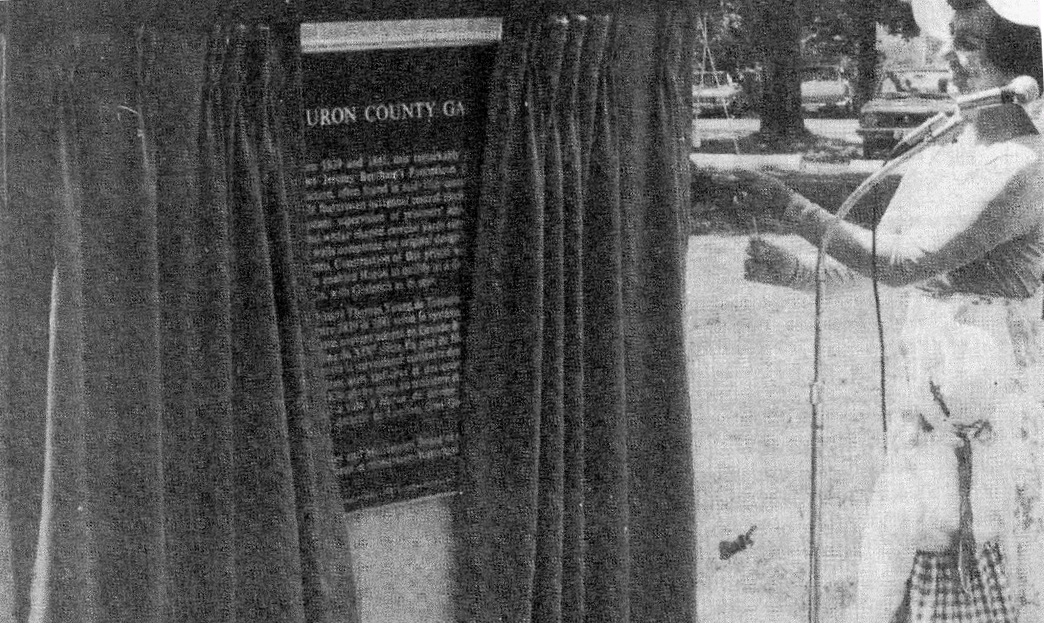
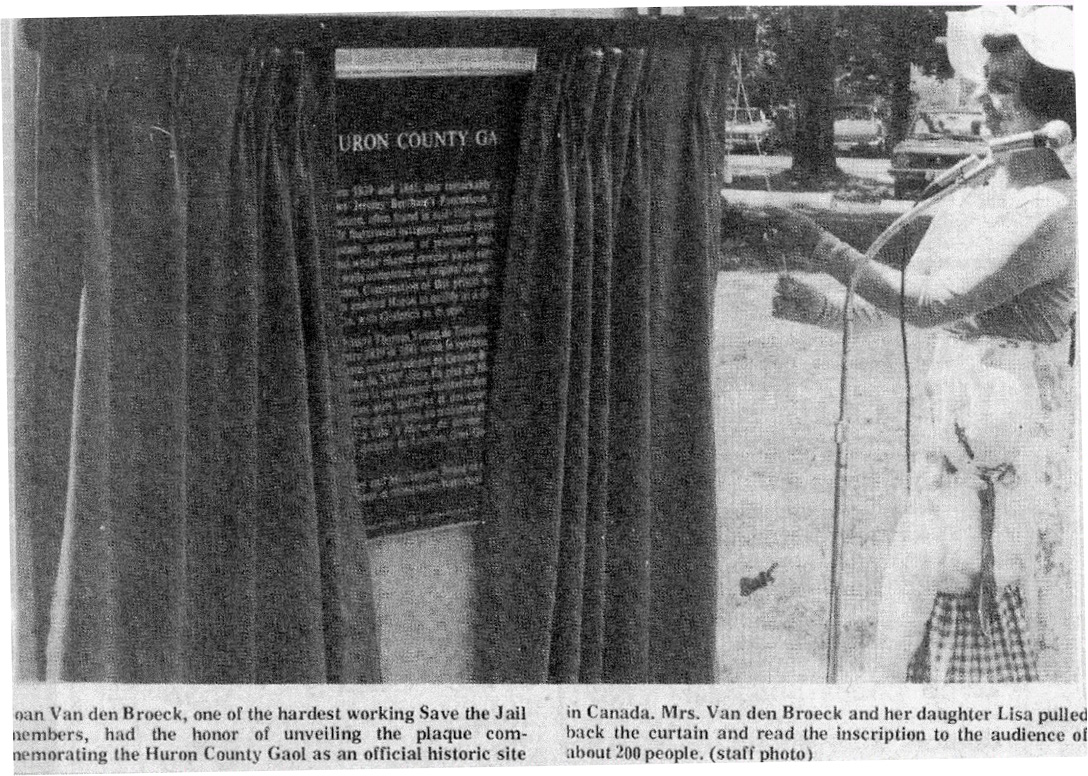
Newspaper clipping of plaque unveiling designating Huron Historic Gaol as a National Historic SiteThis great victory for the Save the Jail Society (now the Jail Board), was only the beginning for the Huron Gaol. On July 5, 1975, a massive celebration was held at the Gaol in Goderich to acknowledge the Gaol becoming designated a National Historic Site. The ribbon was cut to officially acknowledge the opening of the Huron Historic Gaol by Huron County Warden Mr. A. McKinley. The plaque detailing the Gaol’s historical significance was unveiled by none other than dedicated member Joan Van den Broeck.

The reason the Huron Historic Gaol stands to this day is not simply because of its historical value. This building is a symbol of the strength and dedication of the people of Huron County. Despite being sentenced to be destroyed, the Gaol was saved by the efforts of ordinary Huron County citizens who fought to preserve their history. The Gaol is not only a building which represents law and order within the County, but a reminder of how the County was incorporated and achieved its own independent settler municipal government and identity. Huron County was created by strength and unity, it seems only fitting its history was also saved by it.

Sources

Explore these sources through the online collection of Huron Historic Newspaper.

  • “Jail an Attraction?”, The Exeter Times-Advocate, Nov. 25, 1971, pg 4.
  • “Save Jail Wall”, The Brussels Post, Jan. 31, 1973.
  • “And the Walls Came Down…Maybe”, The Exeter Times-Advocate, Feb. 8, 1972, pg 4.
  • “Huron Council Clears Removal of Jail Wall”, The Huron Expositor, March 1, 1973, pg 1.
  • “Letters to the Editor by Mrs. D. W. Collier Komoka”, Clinton News Record, March 15, 1973, pg 7.
  • The Huron Expositor, April 12, 1973, pg 19.
  • “Huron Reeves Vote to Save”, The Brussels Post, May 2, 1973, pg 9.
  • “At County Council: Reeves Vote to Preserve Huron’s Historic Jail”, The Huron Expositor, May 3, 1973. Pg 1.
  • “Jail House Blues Still Bother County”, Clinton News Record, June 7, 1973, pg 3.
  • “Reeves Reject Bid for Use of Huron County Jail”, The Brussels Post, July 4, 1973, pg 13.
  • “Tenders Let for Office”, The Blyth Standard, July 18, 1973, pg 1.
  • “The Huron Gaol”, The Huron Expositor, June 1, 1978, pg 13.

Archival Material

  • “Commemoration of Huron County Gaol”, July 5, 1975, pg 1-2.