An Unconquered Crime: Infanticide in Huron County

An Unconquered Crime: Infanticide in Huron County

According to the Criminal Code of Canada, “a female person commits infanticide when by a wilful act or omission she causes the death of her newly-born child.” Using local resources, student Kevin den Dunnen explores local cases of infanticide in the late 19th and 20th century (the period for which Gaol records are readily available), and the contemporary attitudes towards this act at home and abroad.

Through the 19th and 20th centuries, Huron County newspapers printed cases of infanticide, or the act of killing an infant, allegedly taking place in other countries and cultures. These articles often framed this the context of the supposed inferiority of cultures without the influence of Western Christianity. (1) However, the prevalence of infanticide in Huron County and surrounding areas during this same time period disproves any claims of cultural immunity to infanticide in southwestern Ontario’s Christian-dominated communities.

There are many social factors that contributed to the infanticides that occurred in Huron County. In the 19th and 20th centuries, a birth outside wedlock threatened an unmarried woman’s status in society. Many known infanticide cases in Huron County involved these young, unmarried women. Contributing to the devastating decision to commit infanticide was the lack of local social services available to single women needing help to provide for their child. As such, infanticide has been present in Huron County for much of its history.

The story of a Huron County woman called Catherine and her child exemplifies many of these themes. Catherine was a 30-year-old servant and unmarried woman working in Goderich Township in 1870. She had gone to her doctor that year claiming her body was swelling. The doctor suspected that she might be pregnant, but Catherine did not agree. Later on, her employer came home to find some of her work unfinished and could not find her. Upon searching, they found her sitting in a privy. After telling her to leave the privy several times, Catherine went to the house. Upon inspection of the privy the next morning, the house-owner and a doctor found a dead child in the privy vault covered by paper and a board. In his subsequent report, the coroner believed that the baby was born alive. (2) Upon first reading, this story appears to be a cold-blooded case of infanticide, but the reality of the society around Catherine makes the situation far more complex.

Turn of the 20th century newspapers in Huron County printed or reprinted articles from larger news agencies about non-Christian societies in India, China, and Hawaii and touted their supposed propensity of infanticide. These stories promoted the positive influence of Christian conversion outside of Canada, even though infanticide was also a local issue. Figure 1 is one such article from The Exeter Times, published on Feb. 1, 1894. This article states that the work of missionaries converting foreign societies to Christianity would “introduce the mercy of the Gospel among the down-trodden of heathenism.” The uncredited author claimed non-Christian cultures frequently committed infanticide but stopped when they converted to Christianity. (3) There is an apparent hypocrisy in these newspapers portraying other societies as uncivilized while the same issues were happing contemporaneously in their own Ontario communities. Figure 2 shows an article from The Brussels Post, dated Nov. 20, 1902. In this article, the author argues the need for laws restricting the distribution of alcohol. They state that such opportunities to change society are “the call of God” whose influence had already “conquered great evils, such as infanticide.” Yet, infanticide still occurred in the paper’s own region.

How prevalent an issue infanticide was throughout Huron County’s history is difficult to know, because many cases likely went unreported. A large proportion of the known cases involved single mothers of illegitimate children. However, some scholars suggest that more cases of undocumented infanticide frequently occurred in Western societies. These theories argue that hidden infanticide by married couples might partly explain changing gender ratios in select western societies. They claim this was a way of tailoring gender to fit family needs, like wanting males to help with farming. (4) Single women living and working away from their families would face greater difficulties concealing a birth without detection. Hidden infanticide drew attention from journals like the Upper Canada Journal of Medical, Surgical and Physical Science in 1852. This journal argued that women should have to register their children immediately after birth to lessen the chance of hidden infanticide. (5) This call for registration suggests that the journal suspected or knew of infanticide cases where the mother did not register their child to hide its birth. This research indicates that communities like Huron County could have many cases of infanticide that county records do not include.

One record that is available for study is the “Huron County Gaol Registry.” The portion of the Registry currently available for research includes entries for every person who stayed at the Gaol from 1841-1922. There are at least 12 cases that list infanticide, concealment of birth, child exposure, or a related charge as the reason for committal (Figure 3 and 4). While not a staggeringly high number, these records only include the people sentenced to gaol for allegedly killing their infant or related crimes. If they were not apprehended or not committed to jail, they would not appear in the registry. Additional cases do appear in the local newspaper accounts (Figure 5) and coroner’s inquest records , including Catherine’s story .  The registry shows that the first prisoner committed for infanticide came to the Gaol in 1846 and that a prisoner was committed for procuring drugs for an illegal abortion in 1920. While not demonstrating frequency with complete accuracy, the registry clearly does indicate that infanticide and other crimes resulting from unwanted pregnancies occurred in Huron County throughout the entire period documented from 1841-1922. These instances of infanticide would increase when including the records of nearby counties like Middlesex, Bruce, and Perth, which also had reported infanticide cases during the same period. There was therefore no reason to look to other countries to find the circumstances that fostered infanticide: Huron County residents could see the evidence in their own towns and the surrounding counties.
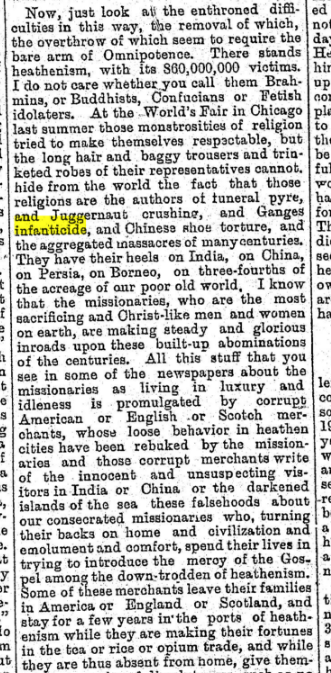
image of a newspaper clipping

Figure 1: “The Safe Arm of God,” The Exeter Times, 1894-2-1, Page 6 
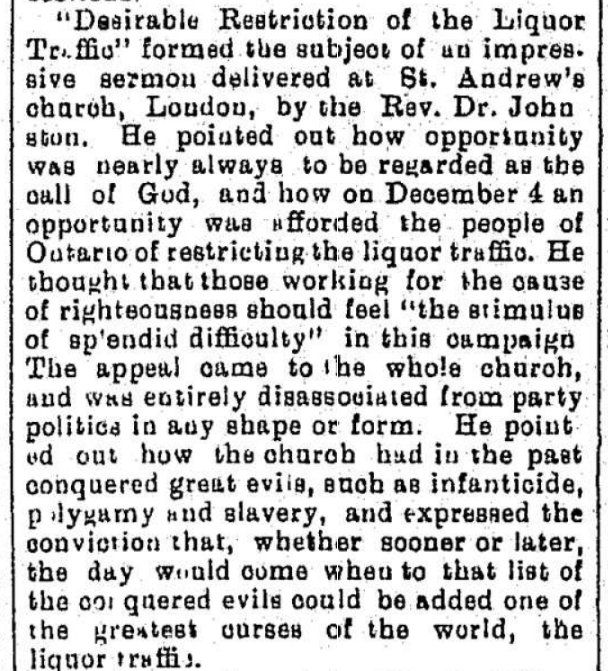
Image of figure 2 - newspaper clipping from Brussels Post

Figure 2: “Prohibition Notes,” The Brussels Post, 1902-11-20, Page 4
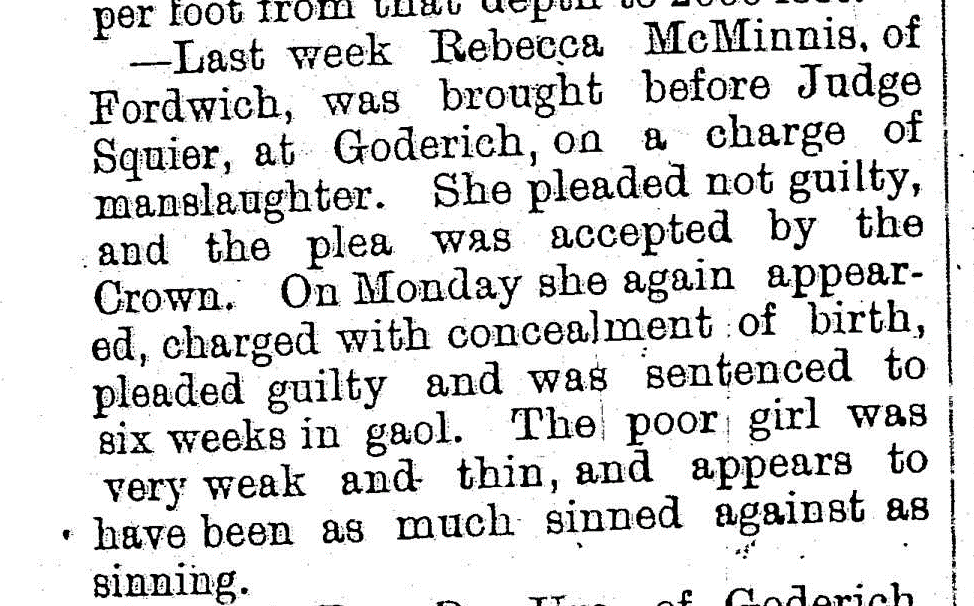
Figure 3: Newspaper clipping from The Huron Expositor, 07-22-1881, pg 5.
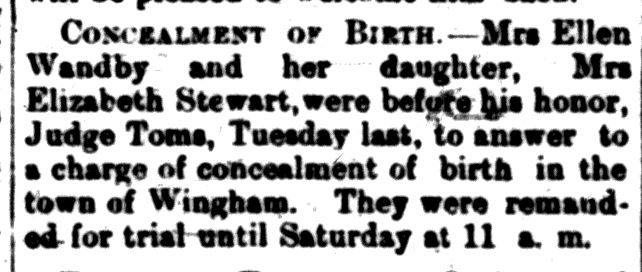
Figure 3: The Huron Expositor, 07-22-1881, pg 5.

Newspaper clipping: "Concealment of a Birth" Mrs. Ellen Wandby and her daughter, Mrs. Elizabeth Stewart, were before his honour Judge Toms, Tuesday last, to answer to a charge of concealment of birth in the town of Wingham.

Figure 4:The Huron Signal, 06-10-1887, pg 4.
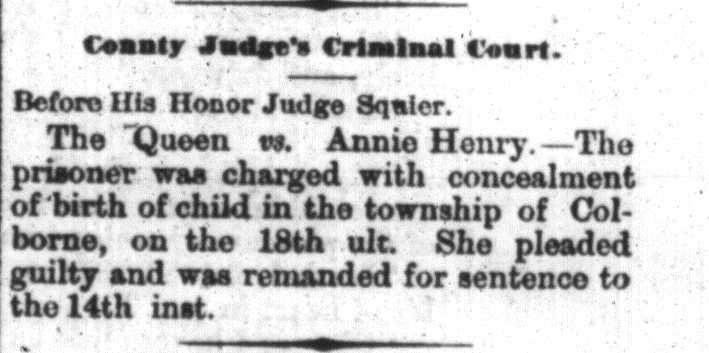
Figure 3: Newspaper clipping from The Huron Expositor, 07-22-1881, pg 5.

Figure 5: The Huron Signal, 12-10-1880, pg 1.
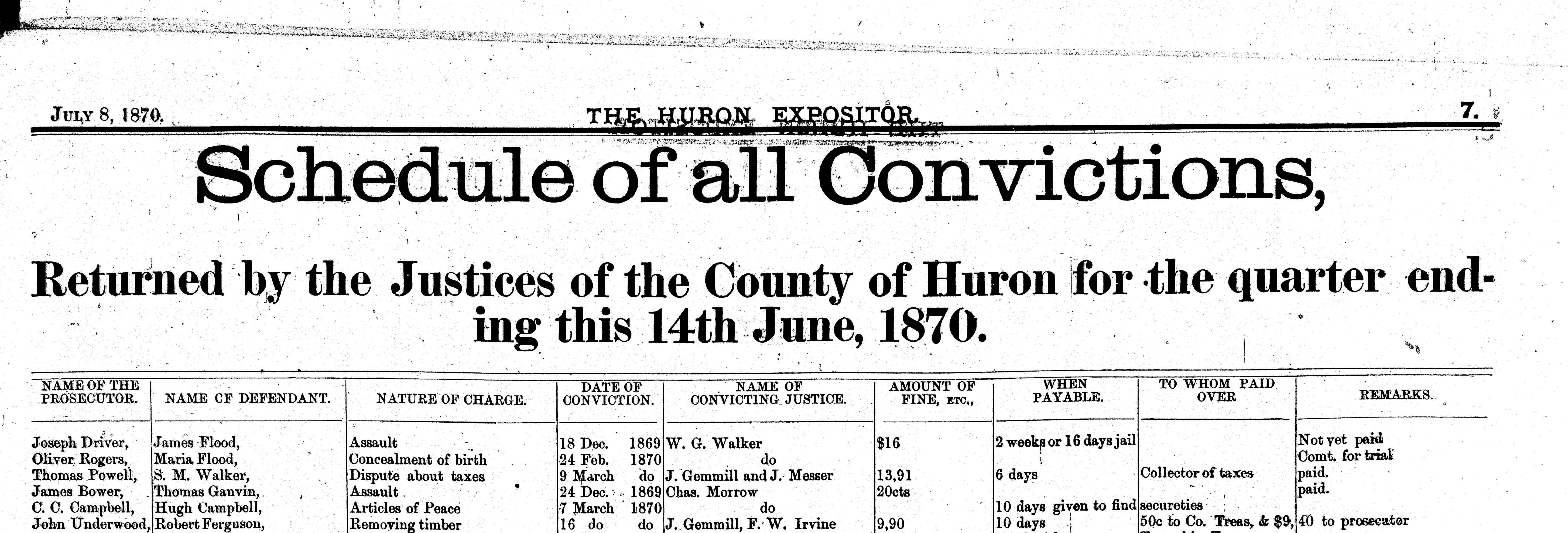
Image of newspaper clipping from 1870 Schedule of Convictions featuring prosecution of Maria Flood for “concealment of birth.” The Huron Expositor, 07/08/1870, pg 1.

Mothers faced most of the blame for infanticide from the legal system and contemporary journalists for reported cases. However, this viewpoint often neglects to consider both the devastating judgements placed upon these women for their unwanted pregnancies, and the lack of support available to help struggling mothers. Of the cases involving infanticide, concealment of birth, or abortion found in the Huron County newspapers and Gaol records, a large number involve young women under 25 years old and illegitimate children (the offspring of a couple not married to each other).  For example, a case from 1864 involves a 15-year-old unmarried female servant; a case from 1877 involves a 22-year-old single female servant; a case from 1880 involves a 17-year-old female servant. As servants, these women were dependent on wage labour. With the birth of a child, the woman would have to give up employment to care for the baby, as without the security of legal marriage the father would often refuse any support. Her ability to care for herself, let alone the child, declined greatly after giving birth. In addition, women faced religious and societal pressures to remain chaste until marriage. Bearing an illegitimate child proved to society that a woman was unchaste. (6) Women who gave birth to illegitimate children, no matter the circumstances of their conception, would face harsh judgement from their communities, which could impact their ability to find new work or to be married. These women with illegitimate children immediately became outcasts. This happened because Christian societies at the time judged much of a single woman’s morality and value according to her chastity. (7) As such, women of this period faced significant social judgement if they had an illegitimate child. The idea of concealing the child’s birth may have appeared to be the only choice for single mothers hoping to retain their ability to earn a living, maintain their place in society and avoid becoming an outcast, which could lead to cases of infanticide and child abandonment. 

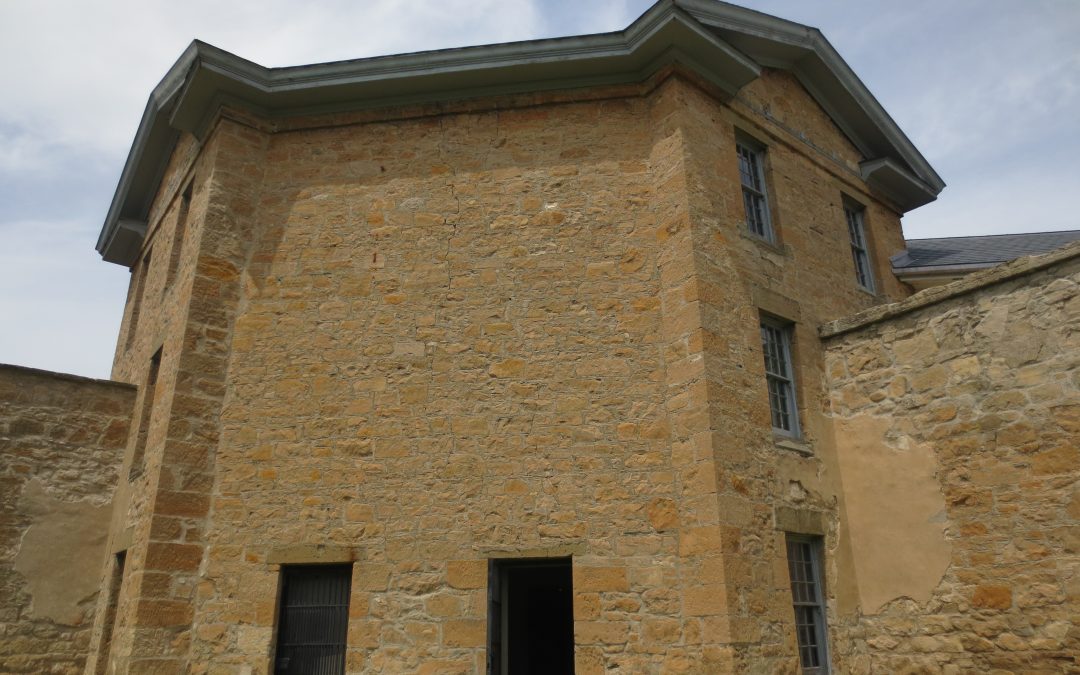
The lack of available social services in Huron County before the 20th century could also factor into these cases of infanticide. Before Huron County’s House of Refuge opened near Clinton in 1895, the only municipal building available for social services was the Huron County Gaol. There was no local lying-in hospital or home for unwed mothers. During this period, the Gaol often housed the elderly, destitute, and sick. Some lower tier municipalities made the choice to commit unwed mothers to gaol to give birth, and multiple women would have their babies behind bars at the Huron Gaol. This was an inexpensive way to house the mother and child until such a time she could return to the labour market. A young woman faced with the birth of an illegitimate child in Huron County would therefore have little support and few options available should she struggle to care and provide for her baby, and may have to bear the stigma of being committed to gaol regardless of committing a crime.

While newspapers like The Exeter Times and Lucknow Sentinel reprinted articles featuring infanticide as a cautionary tale to criticize and condemn outside cultures and to promote the positive influence of western Christianity, infanticide remained prevalent in their own communities. Stories like that of Catherine demonstrate the difficult circumstances that sometimes drove women to commit infanticide. Having an illegitimate child immediately lessened the perceived status and life options of a young woman in respectable Christian Southwestern Ontario society. Also contributing to the devastating decision by some of these young women to commit infanticide was the lack of social services available to help them provide for a child. As such, infanticide was not a conquered issue for the residents of Huron County in the 19th and early 20th century.

Sources:

  • (1) Nicola Goc, Women, Infanticide, and the Press, 1822-1922: News Narratives in England and Australia (New York, NY: Routledge, 2016), 28.
  • (2) Coroner’s Report #365 Huron County Archives,  Unnamed baby of  Catherine J.  
  • (3 “The Safe Arm of God,” The Exeter Times, February 1, 1894, p. 6.
  • (4) Gregory Hanlon, “Routine Infanticide in the West 1500-1800,” History Compass 14, no. 11 (2016): pp. 535-548, https://doi.org/10.1111/hic3.12361, 537. 
  • (5) Kirsten Johnson Kramar, Unwilling Mothers, Unwanted Babies: Infanticide in Canada (Vancouver, BC: UBC Press, 2006), 97.
  • (6) Nicolá, Women, Infanticide, and the Press, 21.
  • (7) Nicolá, Women, Infanticide, and the Press, 21.

Further Reading

Find an index of coroner’s inquests on our Archives page (scroll to the bottom to find indexes and finding aids).

Find more stories from Huron’s past through a search of Huron County’s historical newspapers online!
Paper Cuts: The SIGNAL versus The GAZETTE

Paper Cuts: The SIGNAL versus The GAZETTE

Beth Knazook, Special Project Coordinator for Huron’s digitized newspaper project reviews the bitter rivalry between Huron’s first newspaper editors. You can search the newspapers yourself for free at https://www.huroncountymuseum.ca/digitized-newspapers/

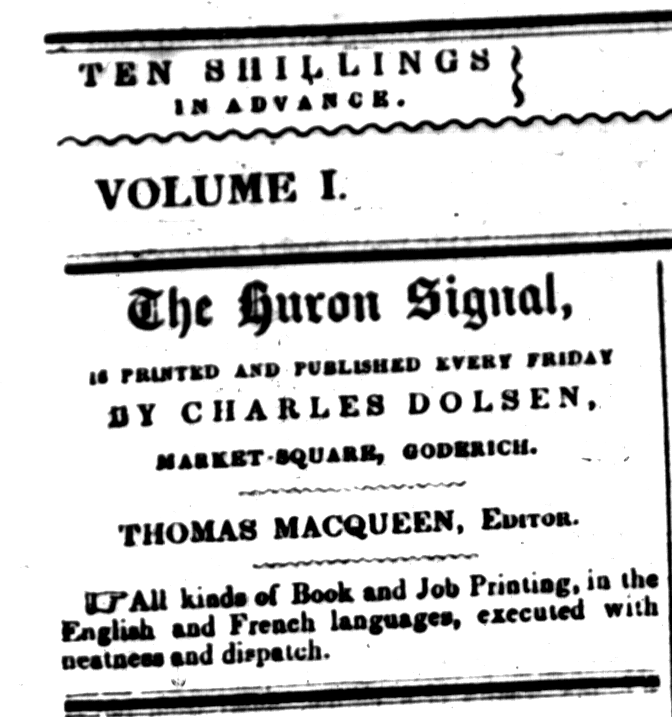
The Signal was the first newspaper printed in Huron County, beginning on February 4, 1848. Published in Goderich by Charles Dolsen, and edited by Thomas Macqueen (or “McQueen”), it promised to deliver “as many Essays and as much knowledge on all subjects of practical importance, as our space and time will reasonably allow,” Huron Signal (February 4, 1848), 2.

Macqueen was born in Ayrshire, Scotland, where he gained some fame as a poet and an accomplished lecturer. He immigrated to Canada and lived with his sister in Renfrew, Ontario, where he worked briefly as editor of The Bathurst Courier (Perth) before moving to Goderich to take up the position of editor for the Huron Signal. Instead of focusing only on local news, Macqueen brought literature, political, and cultural news from afar to the Western frontier of Canada. In its first issue, he ran articles detailing the history of Cortez’s conquest of Mexico, a travel account of Smyrna, and tales of “The Bushman” living in the Australian outback. He covered scientific news as well, re-printing snippets from other papers containing new information about exciting discoveries like electricity. He also included his own poetry, and encouraged others to contribute poems and songs.

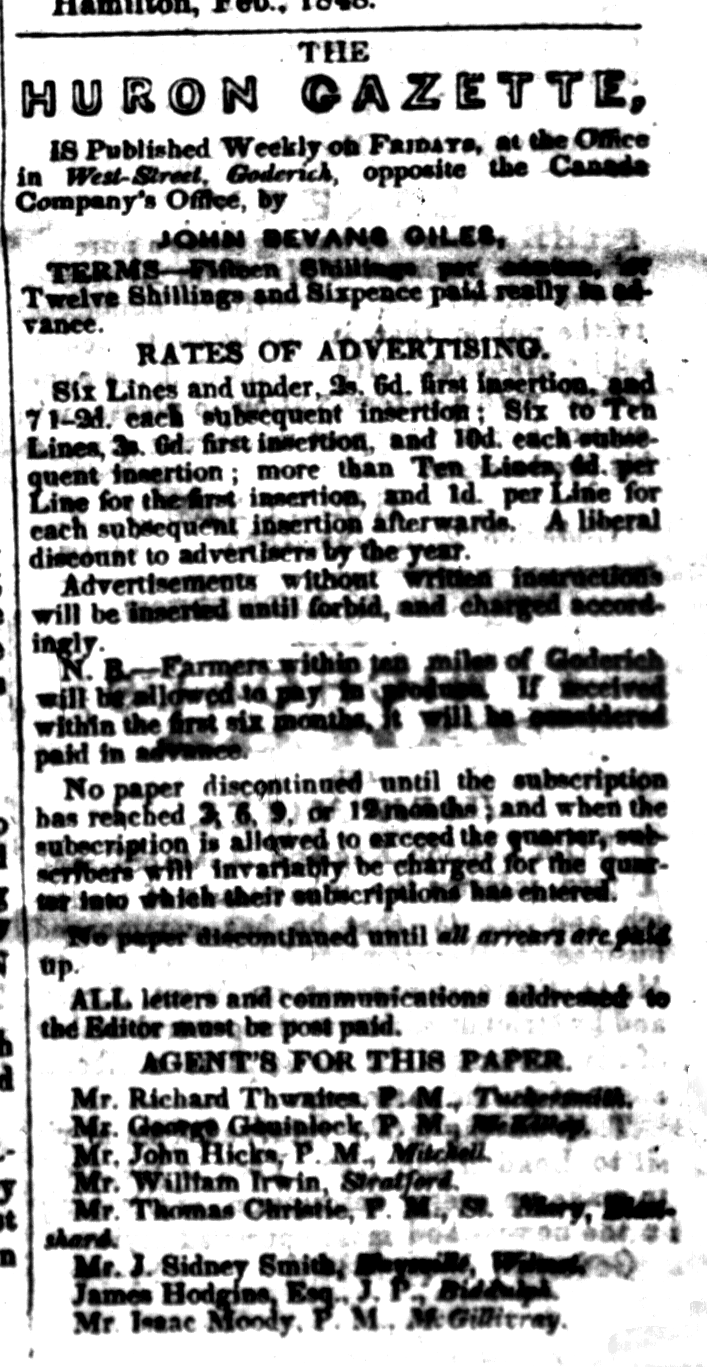
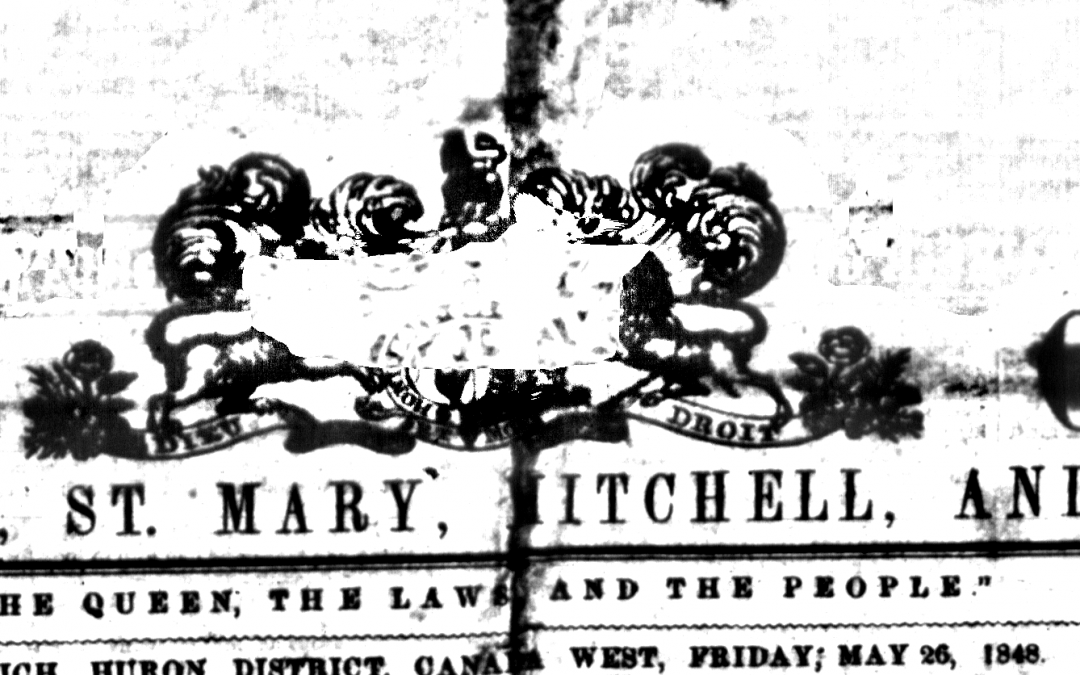
The Huron Gazette began publishing a few weeks later, on February 25, 1848, offering a conservative counterpoint to the Huron Signal’s liberal voice. There are fewer surviving copies of the Gazette from which to piece together the history and contents of the paper, but it seems to have been more practical in its aims. Local advertisements appeared alongside snippets of home and foreign news, dispatches from British Parliament, and editorials – with some entertaining fictional stories thrown in the mix. By late May, the paper had become so popular that editor John Beverley Giles considered either using larger paper sheets or going to a semi-weekly delivery to fit in more content. “We thank our kind supports for the patronage that has demanded from us this alteration, and we think it will evidence to the Province in general the enterprise and intelligence of the Huron Tract,” Huron Gazette (May 26, 1848), 2.

Perhaps a rivalry between the editors of these two papers was inevitable given their political leanings, but Mr. Giles appears to have had a particular talent for provoking the Signal’s Thomas Macqueen. His commentary in the Gazette frequently took the form of very personal attacks, which in turn provoked exasperated and increasingly angry responses in the Signal. Accusations made about the conduct of Mr. Macqueen on the occasion of the annual Agricultural Society’s Show in 1848 prompted several surprised and supportive letters to the editor condemning the malicious gossip in the Gazette.

Thomas Macqueen’s frustration with the Gazette seems to have reached its limit when he declared “We think Mr. Giles is unfortunate in every thing he takes in hand, and still more unfortunate when he tries the pen. His paper will soon be unable to contain his answers to the remonstrances of those he has offended by his impudence. We think he should give it up, —or if not, he should cease to be guided or counselled by those reckless inexperienced characters who are driving him to misery and disgrace for their own vain and selfish purposes, and who lately forced him to insult the respectable community of Goderich under the designation of ‘bare-footed boys and slip-shod girls,’” Huron Signal (May 12, 1849), 2.

Not many issues of the Huron Gazette have survived to explain Mr. Giles’ side of the story, but we do know that in June of 1849, Mr. Macqueen’s predictions about the Gazette’s impending doom were proven right. Mr. Giles abandoned the editorship of the Gazette, although the paper survived a little while longer under editor(s) who seem to have wanted to keep their names hidden. The Huron Signal reported at one point that “nobody is the Editor of it, and nobody will take the responsibility of it. It is not read by 50 men in the District of Huron, and of that fifty, there are not five who attach the slightest credit to any of its statements,” Huron Signal (June 22, 1849), 2. When the Gazette ceased publication in 1849, Mr. Giles left town – but not the newspaper business. He would take up the editorship of the St. Catharines Constitutional, hopefully with better results.

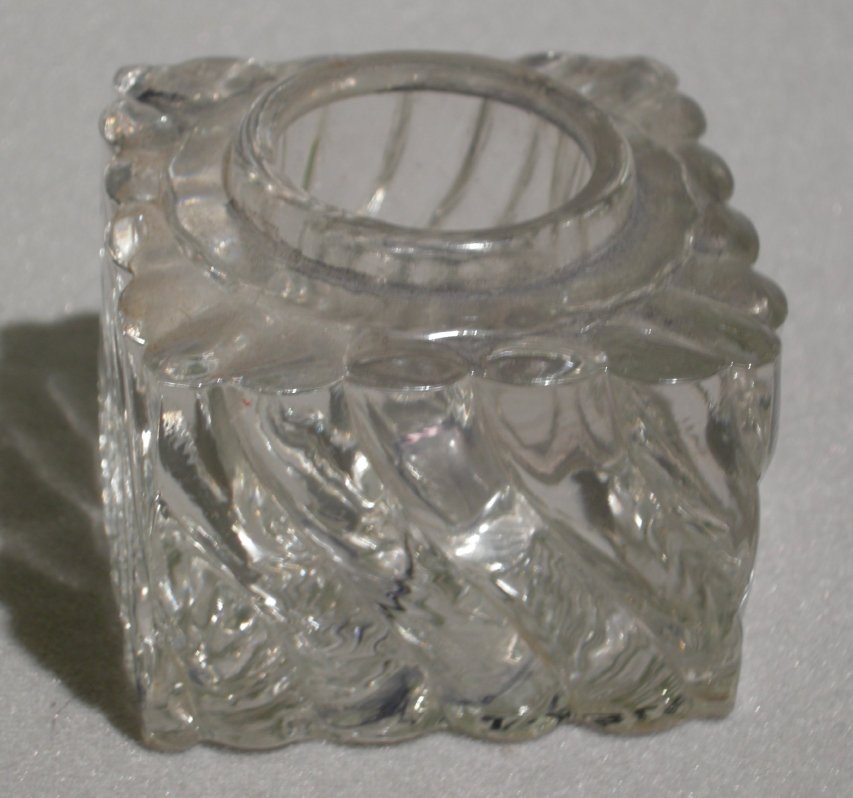
Inkwell used by Thomas McQueen. 1978.10.1. Collection of the Huron County Museum.

Macqueen edited the Signal until his death in 1861 at the age of 57, at which point J.W. Miller took over as editor while the publishing side was managed by Macqueen’s son-in-law, T. J. Moorhouse. The paper was then sold to William T. Cox, who ran it until 1870, and from there it changed hands many more times over the years. The Huron Signal survives today in the form of the Goderich Signal Star. Over the course of the paper’s long history, there has been a lot more (friendly) competition in the Huron County weekly news business.

Newspaper Man Enlists:  Huron County and the First World War in Black & White

Newspaper Man Enlists: Huron County and the First World War in Black & White

From Nov. 21st, 2017 to March 2018, the museum’s temporary Hot off the Press: Seen in the County Papers exhibit will look behind the headlines to the men, women and changing technologies that have brought Huron’s weekly papers to press for over almost 175 years. In this Remembrance Day post, Sinead Cox, Curator of Engagement & Dialogue and curator of the upcoming exhibit, examines the life of one Huron newsman who was also a veteran of the First World War, and follows the story of his return from service via mentions in the local weekly papers.

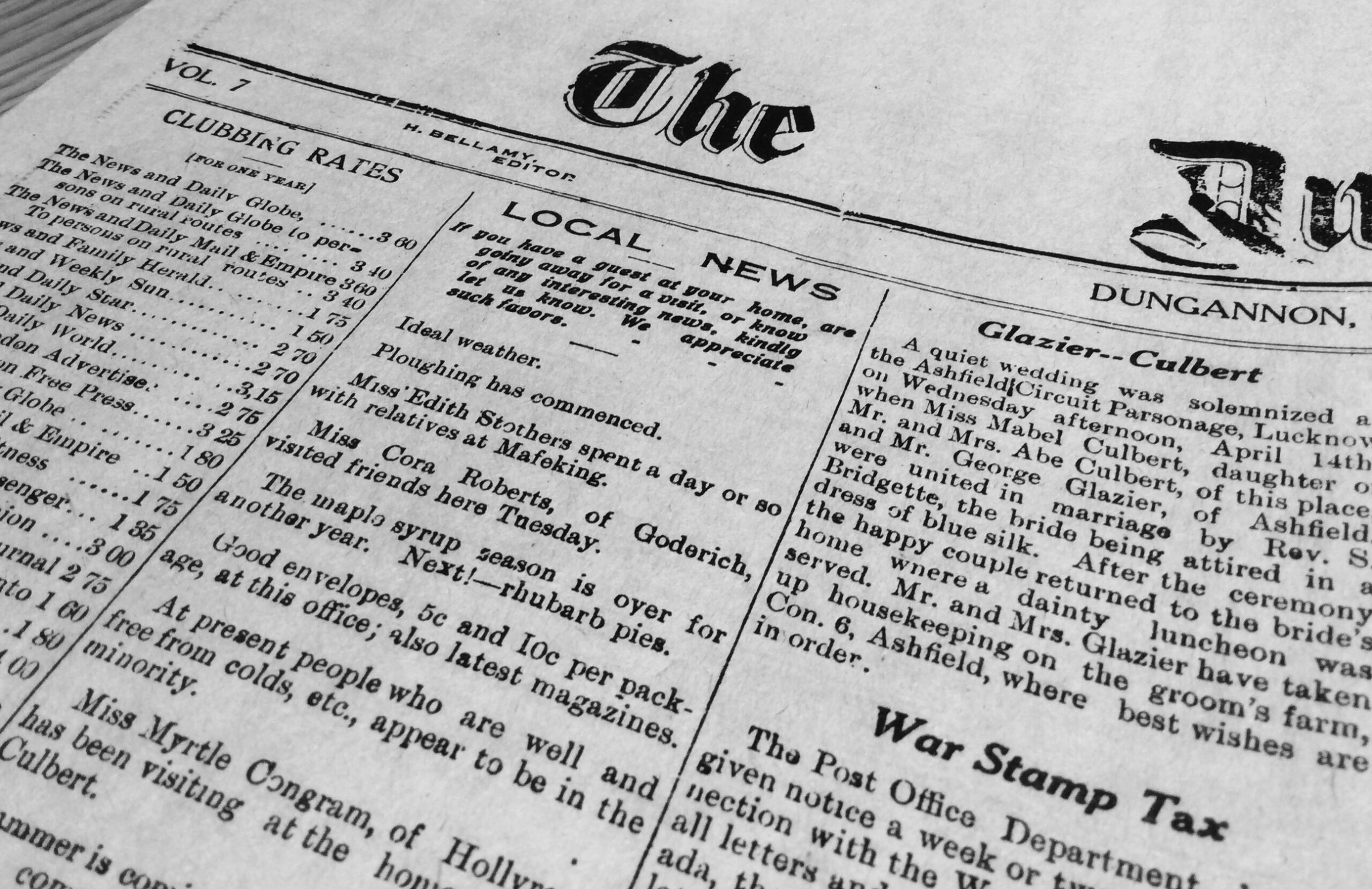
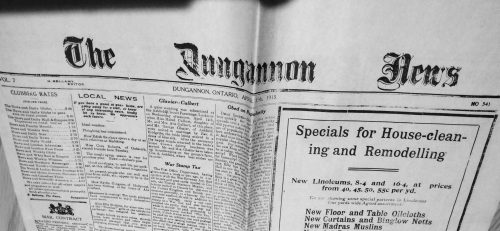
The Dungannon News, 1915-04-15

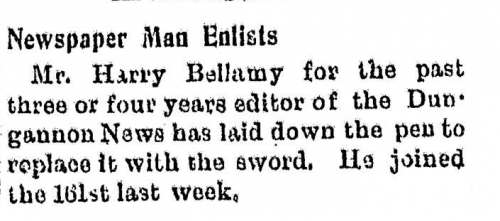
From my research into Huron County’s newspapers, it’s clear that a lot of effort, long hours and personal sacrifice often went into putting a paper to press and ensuring the latest edition reached local subscribers’ doorsteps on time. There were few excuses that could justify a late paper on the part of its proprietors: perhaps broken equipment, the precedence of a contracted print job (ie printing election ballots), adverse weather, public holidays, or even the rare editor’s vacation. One of the most notable reasons to stop the presses, however, occurred in 1916 when The Dungannon News ceased publication entirely because its editor enlisted to serve overseas with Huron’s 161st Battalion.

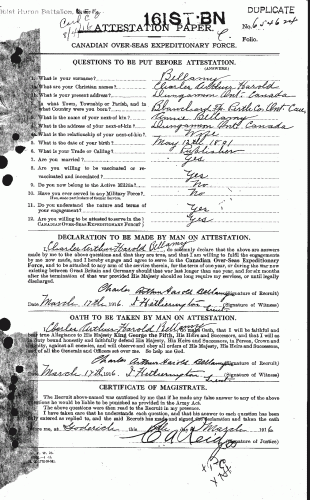
Pte. Bellamy’s attestation paper. You can access his full personnel file at: http://www.bac-lac.gc.ca/

Born in 1891 in Blanshard Township, Perth County, Charles Arthur Harold “Harry” Bellamy had moved to Huron by 1908 when his step-father, Leslie S. Palmer–a former staffer at the St. Marys Journal and owner of the Wroxeter Star–founded The Dungannon News. His sisters, Amelia and Luella Bellamy, also worked locally as operators for the Dungannon telephone office. When his mother and step-father moved to Goderich in 1914, Harry became both editor and publisher of the News while still in his early twenties.

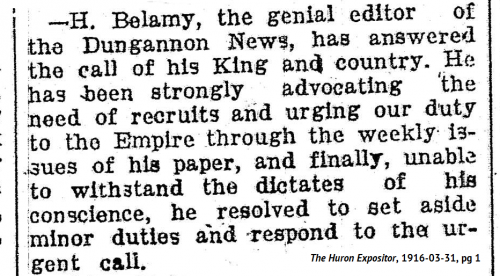
As editor, H. Bellamy strongly supported Canada’s involvement in the Great War within the pages of his publication, and by March of 1916 had decided to enlist himself. At only 24 years old, and a newlywed of less than two years with his wife, Annie Pentland of Ashfield Township, Editor Bellamy signed up to serve with the Canadian Expeditionary Forces at Goderich. With the departure of its proprietor, The Dungannon News merged with Goderich’s Tory weekly, The Star, and the newsman became the news as fellow editors praised Harry Bellamy’s decision in the columns of their papers.

The Wingham Advance, 1916-03-23, pg 5

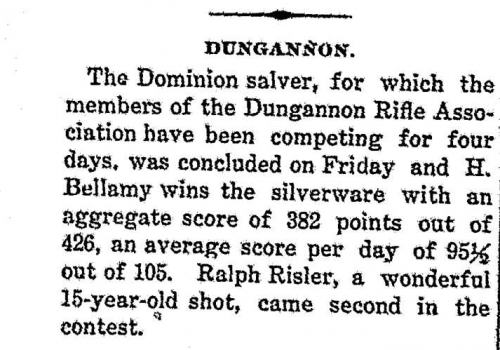
Assigned to the 58th Battalion in Europe, Pte. Bellamy appeared once again in the pages of the local weeklies through his letters from the front. Stationed “somewhere in France” on Dec. 26th, 1916, Harry wrote to his friend F. Ross of how his “three or four days’ trench life” had begun with digging out a trench collapsed by shell-fire; he had become accustomed to ducking down for enemy fire “no matter how deep the mud and water is.” While evading sniper bullets in a no man’s land crater, Bellamy says he pretended he was at home, practicing with friends at the Dungannon Rifle Association.

The Wingham Times, 1911-12-28, pg 4

Imagining away the conditions he described would have no doubt been difficult: “We sleep and rest in the dugouts, which are twenty to twenty-five feet underground. After splashing, crawling and wading through trench mud for hours at a time, we find it quite a relief to get down in these underground quarters.” On Christmas day he witnessed “a fierce bombardment…It was a magnificent sight to see the green and red flames and the shells with their tails of fire flying…The noise and din of the various kinds of explosives in use was deafening.” In the same letter, which Goderich’s The Signal printed on its front page, he claimed that the brutal lifestyle had not dampened the soldiers’ spirits: “we never worry over here. We content ourselves with singing, ‘Pack all your troubles in your old kit bag and smile, smile, smile.’”

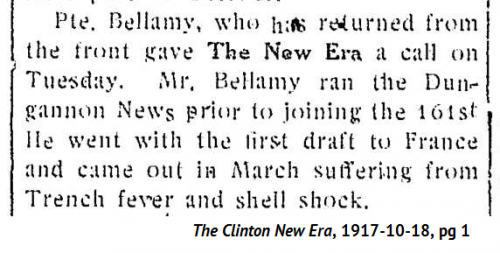
Although he was writing for the local papers, Pte. Bellamy was not able to regularly read them in Europe, and complained that the delays in mail also prevented him from keeping up-to-date with happenings in Huron County. According to his service records, a year after he had enlisted at Goderich, Harry fell ill with trench fever–an infectious disease carried by body lice. He left France for treatment in the U.K., and after complaining of pain in his limbs at York County Hospital, doctors at the King’s Red Cross Canadian Convalescent diagnosed him with myalgia (joint pain) and an abnormally fast pulse.

The Huron Expositor, 1917-10-12, pg 5

In articles subsequently written for the Goderich Star, Pte. Bellamy did not detail his failing health, instead returning to his pen to share his experiences sightseeing on leave in Scotland and Ireland in August, 1917. Ever a committed imperialist, he enjoyed witnessing the Glorious Twelfth celebrations in Belfast, but reported caring less for his time in southern Ireland, since “there is no love lost between those in khaki and the Irish rebels.” He felt wistfulness upon the end of his holiday, but Pte. Bellamy’s belief in the righteousness of the war had not wavered; he used his Star articles to rally homefront sentiments against peace until the enemy could be decisively defeated: “let…every one of us, as Canadians, recapture the heroic mood in which we entered the war.”

The Signal, 1917-12-06, pg 6

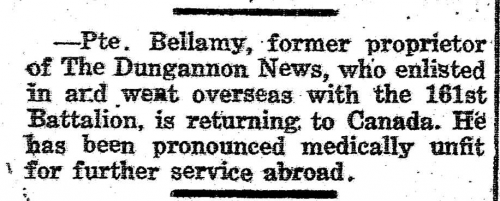
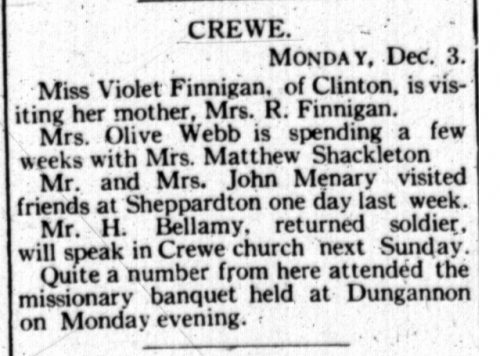
Unable to resume his duties as a soldier, Pte. Bellamy returned to Canada, where in addition to his persistent trench fever, he received a diagnosis of neurasthenia–a contemporary term broadly used for nervous disorders. After his homecoming, he reappeared frequently in the local news columns, usually receiving mention for promoting the war effort at local patriotic events or canvassing for Victory Loans.

Other brief news items hint, however, that although Pte. Harry Bellamy had returned home to Dungannon, he had not left the trenches entirely behind. He received treatment at a London hospital in early 1918 according to The Signal. Following a social call from former editor Bellamy, the Clinton New Era classified his nervous illness as ‘shell shock’: a mental and emotional disorder common to returning soldiers, which today would probably be understood as post traumatic stress disorder.
In April 1918, a medical board at Guelph honourably discharged Harry as medically unfit due to illness contracted on active service. His records list a ‘nervous debility,’ as well as trench fever as the causes for his dismissal, and note that “this man would not be able to do more than one quarter of a days [sic] work.” The listed symptoms in his medical records include dizzy spells, light headedness, restlessness, hand tremors, headaches, and an irregular heartbeat. The Board determined that the probable duration of his debility was “impossible to state.”

The Wingham Advance, 1918-06-13, pg 5

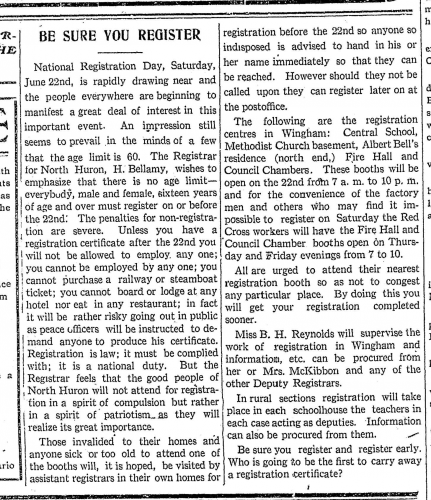
Despite experts’ doubts about his ability to cope with a full-time job, Harry received a temporary government position as North Huron’s Registrar for 1918’s National Registration Day effort. The federal government intended this wartime “man and woman power census” to identify available labour forces for the homefront and overseas by requiring all Canadians over sixteen to register.

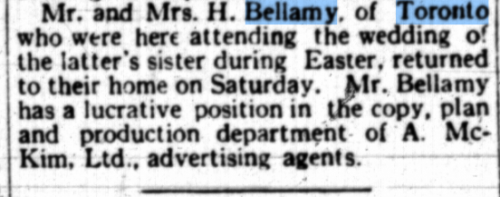
Nothing in the newspapers suggests that Harry Bellamy returned to printing or publishing on a full-time basis in Dungannon. After the war was over in 1919, Ashfield accepted Harry’s application for the township’s annual printing contract with special consideration to him as a “returned soldier,” but according to an item in The Wingham Advance he later declined the work for the pay offered. There was evidently a vocation that Harry Bellamy now felt more passionately for than journalism, because in May of that year the New Era records that he moved to Toronto to accept a bureaucratic position “in connection with the re-establishment of soldiers.” In 1921, Harry ultimately sold The Dungannon News printing equipment to a buyer from Meaford, and he and wife Annie settled permanently in Toronto.They didn’t entirely disappear from print, however, as local news columns over the next decade continued to note the couple’s visits to friends and family in Huron County.

The Signal, 1921-3-31, pg 4

Following Pte. Bellamy’s story via short items in the county papers certainly does not provide a full picture of his life, nor the toll of his experiences in the trenches of France. The information gleaned, though, does speak to the value of these local weeklies as historical resources, and that comparing them against other records–in this case Pte. Bellamy’s military personnel files– can help us to read between the lines. It’s also a pertinent reminder that both historical and news sources are better understood if we know a little about the context and perspective of the people creating them. What emerged in this case was the story of a man whose politics on the page never changed, whose service to the Canadian government continued beyond the battlefield and loyalty to the British empire never faltered, but who nevertheless could not quite pack the personal consequences of war away in an “old kit bag and smile, smile, smile.”

Hot off the Press: Seen in the County Papers opens Nov. 21st at the Huron County Museum! Visit the exhibit to learn more about the stories behind Huron’s historic headlines. You can browse the newspaper collection from the comfort of home at dev.huroncountymuseum.ca/digitized-newspapers. Information for this blog post came from Huron County’s digitized newspapers and Library and Archives Canada’s digitized service records.

Old News is Good News: All About ‘Project Silas’

Old News is Good News: All About ‘Project Silas’

What discoveries await you in Huron’s newly digitized historical newspapers? Special Project Coordinator Jeremy Dechert introduces Project Silas! Stay tuned for more updates, search tips and highlights.

From The Brussels Post, Nov. 18, 1898.

The Huron County Library, in partnership with the Huron County Museum, has been digitizing, OCRing (optical character recognition technology which reads and transcribes images) and publishing historical newspapers from communities across Huron County. Codenamed Project Silas, this initiative is aimed at assisting both academic and casual researchers in their quest for knowledge of Huron County’s past. Local newspapers are robust sources of historical information due to their consistent and specific reporting on particular persons, events, and places. Digitizing newspapers which were previously on microfilm and allowing them to be text searchable further democratizes public information and saves researchers countless hours of work and frustration by making multiple papers available from the comfort of your own home.

Cultural Services staff at the County of Huron have worked diligently to both build the project structure and process and post newspapers from the towns and villages of Blyth, Exeter, Goderich, and Wingham so far. I took over the project at the beginning of this month, and have recently added papers from Brussels to the website. Papers from Clinton and Seaforth are soon to follow. By the end of 2017 we hope to have additional papers from Zurich, Gorrie, Wroxeter, and Goderich on the website as well.


Stay up-to-date on the progress of Project Silas by…

Visit our website: http://dev.huroncountymuseum.ca/digitized-newspapers/

Liking our Facebook page Huron County Museum

Following us on Twitter @hcmuseum