“No Possible Escape”: A Short History of Fire at the Huron Gaol

“No Possible Escape”: A Short History of Fire at the Huron Gaol

“No Possible Escape” sounds positive when it comes to jailbreaks, but less so in the case of emergency. Curator of Engagement & Dialogue Sinead Cox looks back at fire and fire safety at the Huron Historic Gaol.

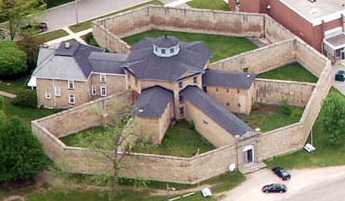
The Huron Historic Gaol is one of the most recognizable, historically significant and architecturally unique buildings in Huron County. Today it stands as a venue for visitors to hear the stories of the prisoners and staff who walked its halls, and considering the number of times the building has caught fire over its 180+ year history, this is nothing less than a small miracle.

Although the outer walls may give the impression that it is solid stone, the construction of the gaol interior is actually significantly timber. The unique octagonal layout of rooms and yards around a central spiral staircase are designed to keep prisoners in, with perhaps less architectural forethought when it comes to allowing people to quickly get out, should the upper floors become engulfed in flames.

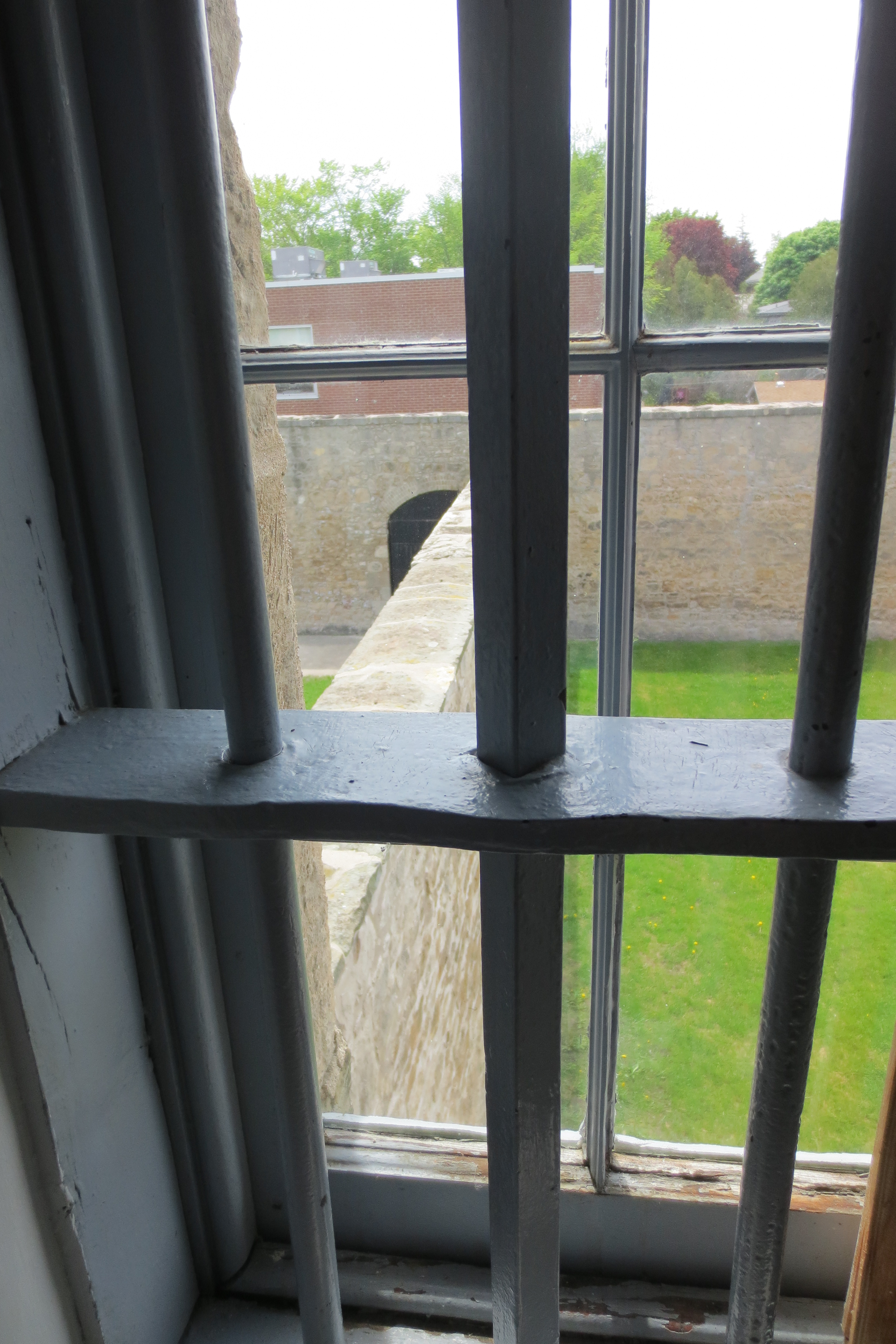
In 1851, when the building was only a decade old and served the United Counties of Huron, Perth and Bruce, an errant chimney spark caused the first known fire of significance. Fortunately, the only harm sustained in that instance was damage to the building’s roof. Afterwards, the Gaol Inspector recommended covering the roof with metal, and that the county purchase a new ladder tall enough to actually enable water to be carried high enough to fight a fire (staff presumably having discovered the inadequacies of the previous ladder during the emergency). No ladder would have been very useful as a means of rescue for prisoners, however, as all of the windows on the gaol’s upper floors were barred to prevent escape.

In the 1860s the County of Huron replaced the tin-covered roof with slate, later swapped for asphalt shingles about a century later. When reverting to slate in 2021, roofers discovered lumber inside the cupola still bore blackened scorch marks from historic fires. The cupola, or central tower, has been struck by lightning at least twice: in 1892 and 1929. Torrential rain prevented fire in the first case, but the second strike “set the tower ablaze” just after one a.m.  According to The Clinton News Record, “a terrific electric storm was in progress and firemen had difficulty at first in plying streams of water on the tower, owing to its height. Some of the firemen climbed on to the slate roof, slippery with rain, and fought the flames from perilous positions.” The newspaper claimed that despite the late hour and extreme weather, a crowd of people gathered outside the gaol’s walls to watch their efforts. While firefighters risked their lives to stop the fire from spreading to the lower floors, a constable escorted the seven prisoners currently committed to the Huron Gaol to an outside courtyard, still confined within the 18 ft walls. Thankfully, the fire was successfully contained within the cupola and extinguished, but the flames and the water employed to douse them had caused more than $1,000 in damages (equal to just over $16,500 today). The county enlisted prisoner labour to help with the subsequent clean-up and repairs.
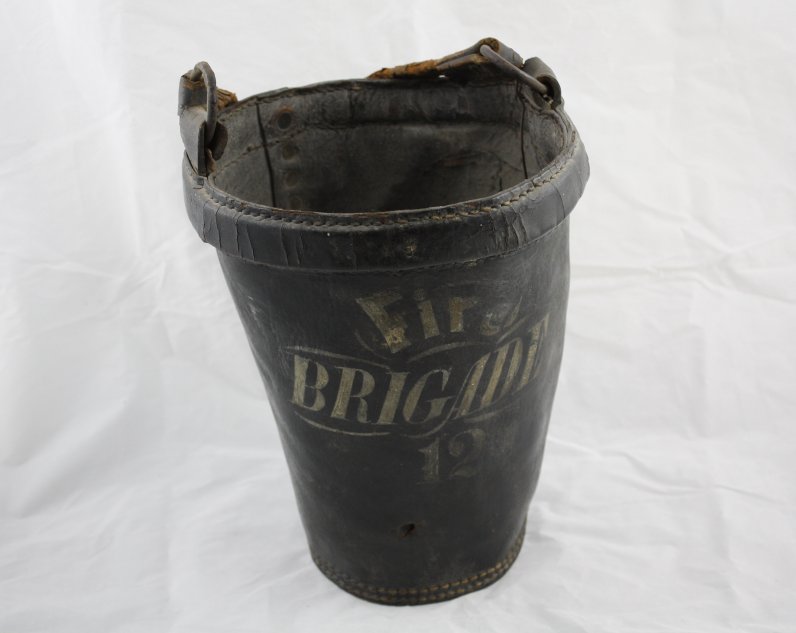
Black bucket with 'Fire Brigade' written on it.

Fire bucket. M951.0732.001

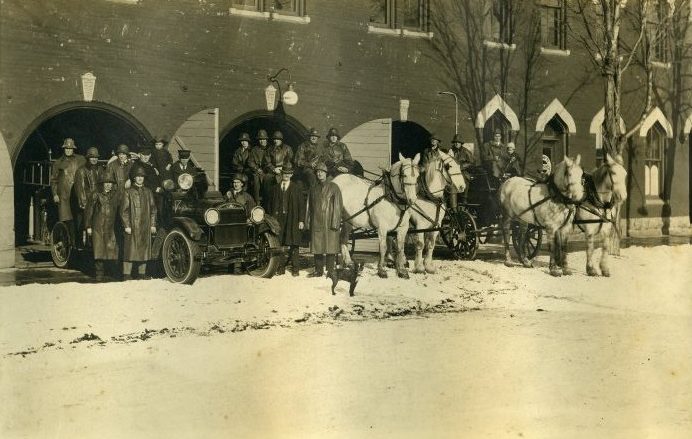
Photograph of firefighters, vehicles and animals in front of fire station.
Illustration of a young woman being accused of witchcraft

Huron Historic Gaol, Goderich Ontario
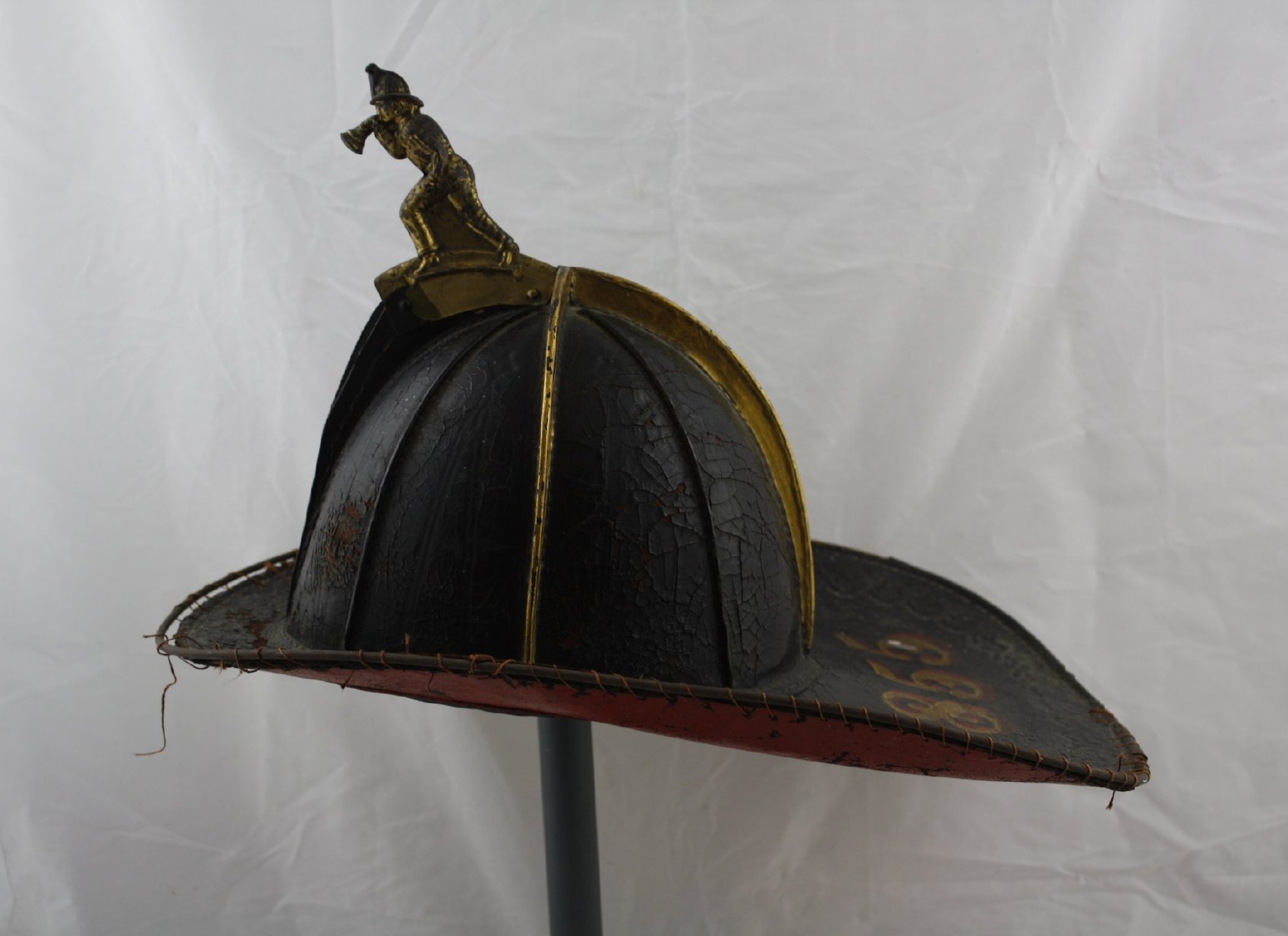
 black fireman's helmet hat with red underneath and a gold figure of a man blowing a fire horn.

1855 Fireman’s helmet donated by Town of Goderich. M951.0734.001. 
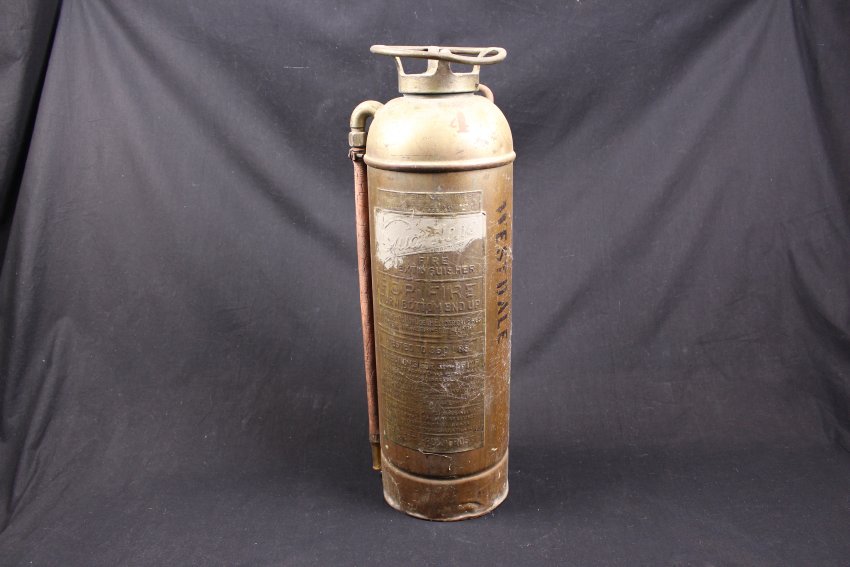
large brass fire extiguisher --  2 1/2 galloncylindrical with red rubber hose that has cracked and hardened;  stenciled in black on side is "WESTDALE". Instructions on side.  "Guardene Extinguisher"

Fire Extinguisher. 2017.0024.003. 

large brass fire extiguisher --  2 1/2 galloncylindrical with red rubber hose that has cracked and hardened;  stenciled in black on side is "WESTDALE". Instructions on side.  "Guardene Extinguisher"

A950.1976.001. Fire crew at former Goderich Fire Station located on East Street, 1925. 

The cupola caught fire again in 1944, this time from burning leaves, either carried from the ground by a strong wind or ignited in the eaves by a spark. Although this fire burned only briefly, it caused destruction and water damage similar or worse than the 1929 blaze: costs duly submitted to the county’s insurer.

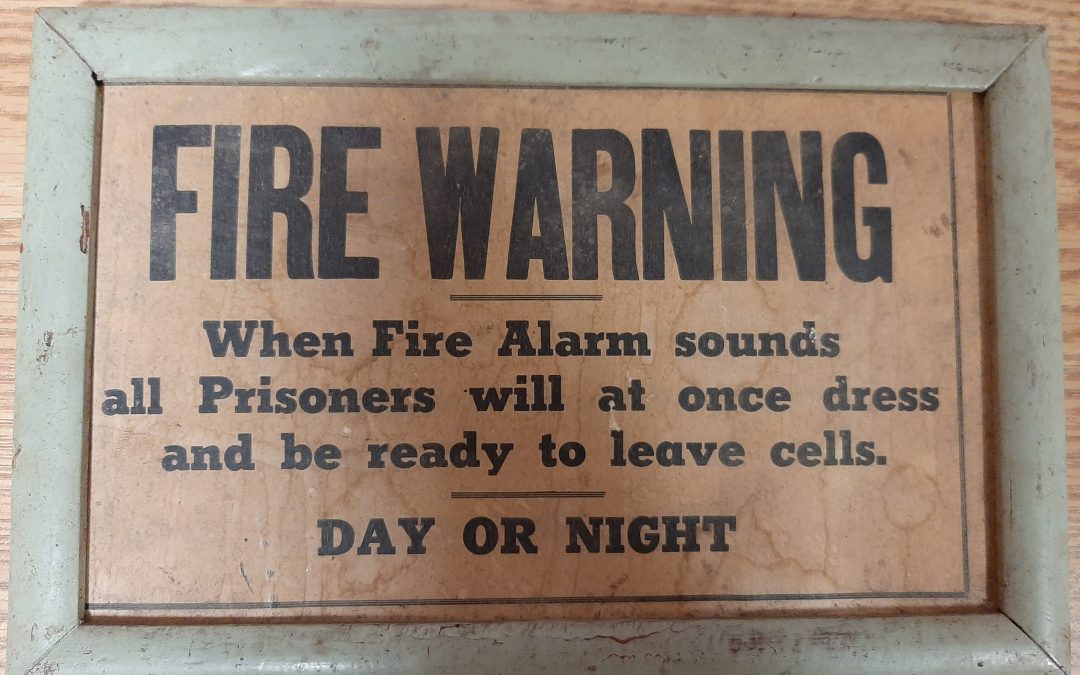
Officials and staff recognized the inadequacies of the gaol’s design very early in its operation: the lack of fire exits was one of the reasons that District Council and the courts complained about meeting there before the construction of a separate courthouse in 1856. Despite the general awareness of the threat, safety measures provided by the county did not always meet the needs of staff or emergency responders. After the 1892 lightning strike, Gaoler William Dickson found that the gaol’s fire hose was faulty, and burst in multiple places when tested with pressure.  As early as 1882, after yet another recent narrow escape from flames, local newspaper editorials from the Goderich Star and Clinton New Era condemned the gaol as an outdated fire trap. The Era argued for replacing the gaol and courthouse  with new, modern municipal buildings in a more central location. The Gaol and Court House Committee instead recommended “that a Babcock Fire Extinguisher for the gaol be furnished, also that a suitable water tank be built in the gaol yard,  owing to the inflammable and unsafe condition of the gaol stairs, there is no possible escape for the inmates in case of fire.”
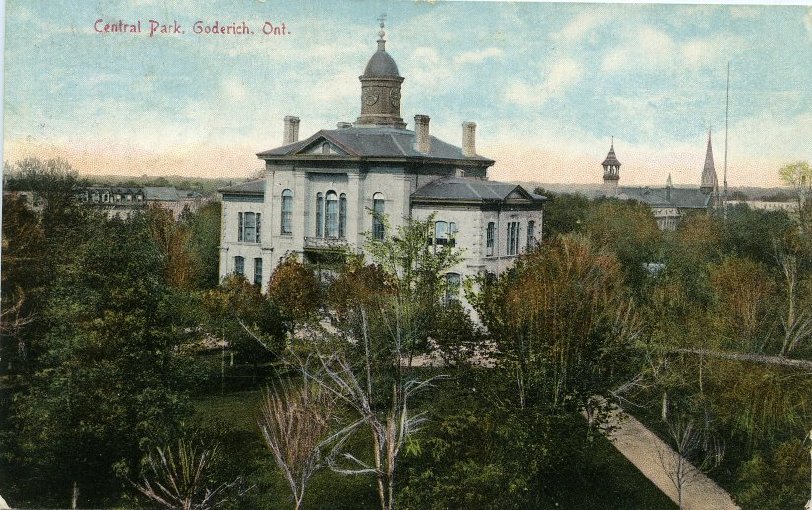
Colour postcard of Huron County Courthouse located in Goderich Square, surrounded by trees. Nineteenth century.

Postcard of courthouse at “Central Park” or Square, Goderich. Built 1856. This courthouse was destroyed by fire and replaced in 1954. 2008.0032.083. 

In the 1890s, Huron County Council acknowledged the aging heating stoves in each cell block’s dayroom as another serious danger and replaced them. Prior to electric lights, staff also had to contend with mandatory corridor lamps, burning day and night at the risk of overheating. Gaoler Dickson lamented to County Council in 1896 that, “twice [a lamp has exploded] during the almost 32 years I have been in your employ. The last time it was towards morning and fortunately my subordinate was awake and succeeded in extinguishing the fire at the cost of the bedding of two beds.” Dickson credited the turnkey’s quick action in preventing what was nearly a terrible tragedy: “At the time of the explosion there were 18 prisoners under lock and key, besides 5 members of my own family who were sleeping on the second floor. Had the flames caught the stair, all on the upper floors would have been entirely cut off from escape. In view of this danger to life and property, I would respectfully ask that you place one incandescent in said hallway.” The gaoler’s lobbying successfully resulted in the installation of incandescent lights at the gaol, but the issue of the single exit remained unaddressed. It’s easy to imagine that if the fire had spread beyond the smothering power of gaol blankets, that a quick decision may have been made to prioritize the evacuation staff and family before the overcrowded inmates sleeping behind multiple locked doors.

The close-call fires at the gaol over the decades were all seemingly accidental, with the exception of one incident during the holiday season in 1943. The gaol’s annual Christmas celebrations included a special meal for the prisoners with treats donated by the community, and that year they also enjoyed a decorated Christmas tree. On December 27th,  the dry boughs of the tree caught fire in one of the cell blocks, spreading to the woodwork and choking that ward with thick smoke. The Goderich fire department responded to gaol staff’s call for help, and successfully extinguished the flames in a manner of minutes. A follow-up investigation found that the cell block’s three resident inmates had intentionally started the fire to create a distraction for escape.  Convicted forger Floyd McCullough admitted to helping his teenaged cellmates, Angus Trudeau and Lorne Derevere, in devising how to ignite the Christmas tree remnants. The two younger men, committed for robbing Bayfield-area cottages, ultimately also pled guilty to the arson. No opportunity for jailbreak had ever actually materialized as planned; the trio were simply evacuated to another part of the gaol to avoid the smoke inhalation that may have endangered their lives if not for a turnkey’s quick arrival on the scene. All three faced added time behind bars for the conspiracy.
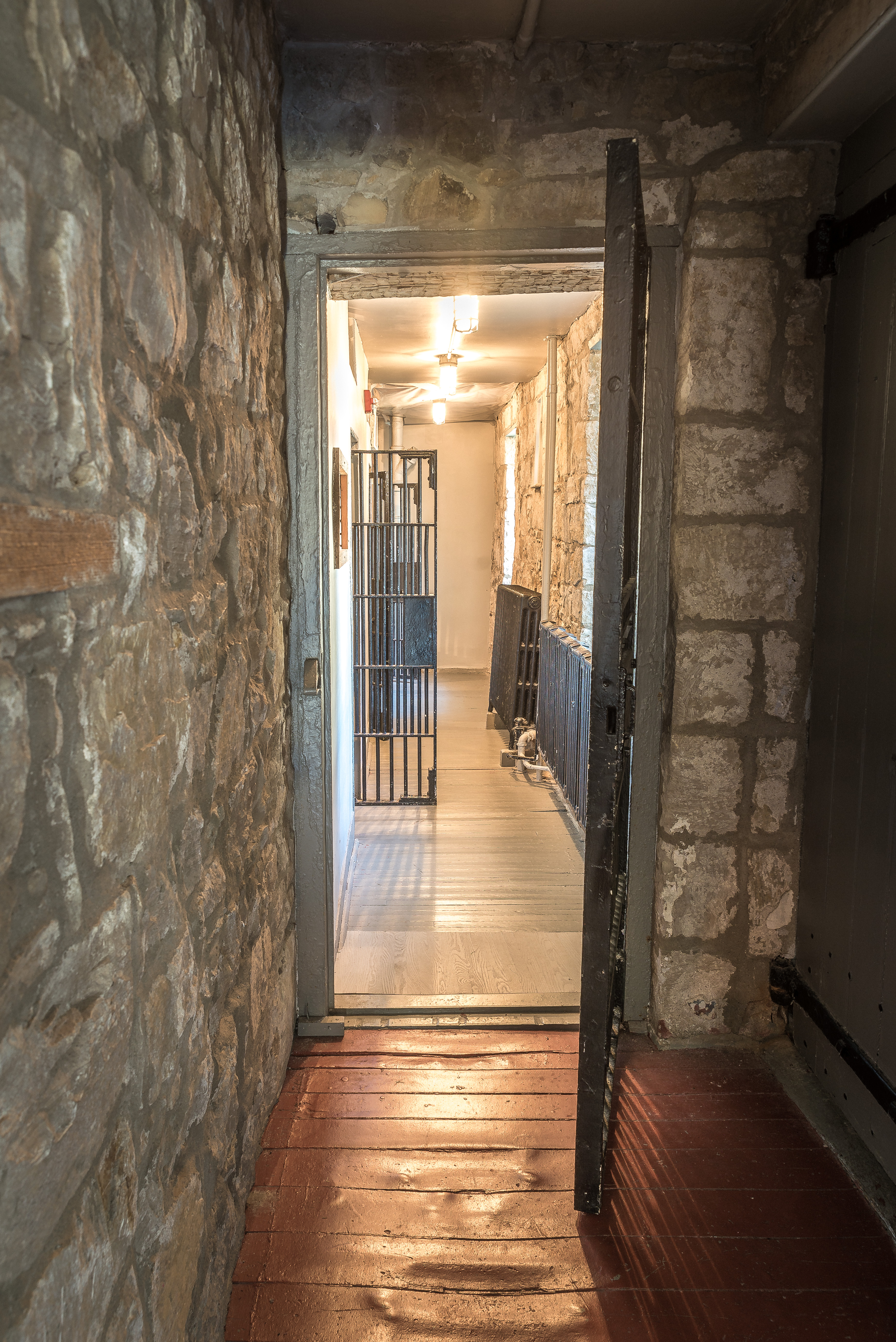
Cell Block

 The aging building’s vulnerability to fire remained a concern throughout the twentieth century, resulting in a fire-proof coating applied to the cells in 1939, various furnace installations and upgrades, and an alarm system installed by the 1950s. Jurisdiction over Ontario’s county correctional facilities transferred to the Province in 1964, and in 1972 the Ontario Department of Correctional Services decided to close the Huron Gaol. From 1974, the gaol opened its doors as a historic site and museum, originally managed by the Historic Jail Board– the County of Huron retained responsibility for fire insurance. The County resumed direct control of the building in the 1990s.

The Huron Historic Gaol would pass its 175th  birthday before finally gaining a fire escape and new fire exits on the second and third floors of the gaol after major upgrades in 2018. The work was undertaken with care to protect the site’s historical appearance and architecture.  As a historic site, fire safety could be addressed to meet contemporary standards without concerns about compromising security.  Today, the spectre of potential disaster by fire need not haunt staff and visitors to the degree it once did generations of prisoners and gaol employees. The gaol’s countless near misses with destruction are a reminder of the importance of adequate preparations and equipment to combat fire, as well as the need for strict safety regulations for public buildings.  It is only a mixture of ad hoc precautions, the quick actions of the gaol’s small staff, the intervention of local firefighters and also simple luck, that has successfully preserved this one-of-a-kind building and the lives of those who have lived and worked within its walls over three separate centuries. 

Find out More!

I Know Where the Bodies are Buried: Deaths at the Huron Jail

I Know Where the Bodies are Buried: Deaths at the Huron Jail

“Is this place haunted?”: it’s one of the most common questions fielded by front desk staff at the Huron Historic Gaol. I’ve never set eyes on a ghost myself, but at least fifty-eight prisoners at the Huron Gaol died during their imprisonment. The jail’s four-cell-block design was intended for short stays—prisoners with multi-year sentences received transfers to larger institutions like Kingston Penitentiary—but for some Huron County inmates, theirs was indeed a death sentence in practice. Whether or not prisoners choose to revisit the grounds as ghosts, the recently launched online repository of Huron County newspapers has made it a little easier to research and shed light on their lives and deaths inside the Huron jail.

Edward Jardine-Hanging

The Signal, 1911-6-15, pg 1

Infamously, three men—all under the age of thirty—hanged for murder at the Huron jail in Goderich: William Mahon in 1861, Nicholas Melady in 1869 (Canada’s final public hanging) and Edward Jardine in 1911. Although these are perhaps the best remembered demises at the jail, executions were rare and not representative of the fifty-eight known inmate deaths that took place here before 1913, the vast majority of which were the result of natural causes like old age and disease. The average age of deceased prisoners was sixty-three. The oldest inmate to die in the jail with a recorded age—often merely an estimate by the gaoler or gaol surgeon—was approximately ninety; the youngest fatality was a two-month old infant named Robert Vanhorn who had been committed with his young, unmarried mother in 1879.

List of Crimes

The Signal, 1884-2-29, pg 2

Most of the inmates who died in the jail were in fact not criminals at all, but elderly persons committed as ‘vagrants’ because they were homeless, or too frail and sick to provide for themselves.  Some were itinerants, but many were long-term Huron County residents without friends and family able to support them in their old age. Unmarried, widowed or childless labourers and domestics were especially vulnerable, as well as early settlers whose closest relatives still remained in the old country. When Seaforth servant Margaret Ainley died in the jail of typhoid fever in 1883, The Huron Signal reported that “her relatives live in England.” Eighty-one-year-old Matthew Shepherd, a native of Scotland and a veteran non-commissioned officer of Her Majesty’s 93rd Foot, had seen service in the West Indies as well as British North America; the veteran soldier was a resident of Ashfield Township for three decades when he died in jail, but “had no direct relatives in this country” according to a June, 1891 obituary in The Signal. Both Ainley and Shepherd’s committals had been for vagrancy.

Other prisoners suffered from mental illness, dementia or serious health problems that their families could not cope with. Seventeen-year-old Patrick Kelleher, for example, had exhibited symptoms of mental illness or developmental issues since his childhood. His parents were newly arrived Irish emigrants in the summer of 1883, when the strain of caring for him evidently became too difficult and he was committed to the Huron jail for insanity. Patrick died there of a seizure in January, 1884 while still awaiting transfer to the Provincial Asylum.

Old Woman

The Exeter Times, 1875-12-30, pg 1

Without a safety net of organized social services, responsibility for Ontario’s rural poor fell to local municipalities in the nineteenth century. Sometimes the needy received assistance in their own communities and homes, but the gaol was one of the earliest municipal buildings with a full-time staff, and provided a convenient location for local governments to clothe, feed and supervise these ‘wards of the county.’

Starting in the late 1870s, Joseph “Big Joe” Williamson faced repeated committals to the Huron jail for vagrancy-a common pattern for homeless prisoners who had nowhere to go when their sentences ended. A Huron Tract ‘pioneer,’ seventy-four-year-old Williamson was a former contractor and once-prominent figure in local politics—so gifted at storytelling that he was called ‘Huron’s bard’. He petitioned County Council’s gaol & courthouse committee to transfer him to a hospital in December, 1883. The committee subsequently recommended that he be removed to the Middlesex County Poor House, but instead “Big Joe” died of heart disease at the Huron Jail on January 14th, 1884. The Huron Signal’s obituary deemed Williamson’s fate a “misspent life…after a tendency to drink and a liking for conviviality brought him down to penury.”

paupers die off

The Huron Signal, 1884-3-21, pg 4

In the absence of a House of Refuge in Huron County, the jail became a de facto poorhouse, hospital, lying-in-hospital for unwed mothers and long-term care home.  The jail staff*—consisting in the nineteenth-century of the gaoler, the matron (his wife or eldest daughter), the turnkey, gaol surgeon, and any servants or family members who lived on site—provided frontline care to the old and sick in addition to their duties of managing the gaol and guarding actual criminals. In 1884, when William Burgess, an inmate from Brussels with cancer in his leg, lay slowly dying in his jail cell, Jailor William Dickson and turnkey Robert Henderson took turns keeping a nightly vigil on the ward he occupied with another sick inmate. This cell-mate, Johnny Moosehead, had actually helped to nurse Burgess himself before he became too ill with erysipelas. Fellow inmates quite often helped the gaol staff provide the constant care needed for elderly or dying prisoners. In the case of George Whittaker, a seventy-year-old Brussels ‘lunatic’ who died in July 1881 of self-inflicted injuries, the gaoler also charged the man’s ward-mates to help provide vigilance against self-harm—unfortunately to little avail.

A formal coroner’s inquest with a jury of prisoners and citizens was mandatory for every inmate death.  After the death of ninety-year-old ‘indigent’ Hugh Hall in April 1887, friends of his from the Clinton area sent a hearse to Goderich to claim the body for a proper funeral, but a holiday delayed the inquest and the hearse had to return to Clinton empty until the coroner and jury could be assembled. The ‘usual verdict’ of these inquests was ‘natural causes’; over a dozen inmates had their cause of death simply recorded as some variation of ‘old age’ or ‘senile decay’. Testimony at these inquests, however, afforded the gaol staff, including the gaoler, matron and gaol surgeon, an opportunity to decry the gaol’s tragic inadequacy as a home for the insane or terminally ill.

John Morrow

The Signal, 1891-10-16, pg 1

Mary BradyJohn McCann

The plight of the jail’s long-term residents did not go completely unnoticed or forgotten by the rest of the county, as gaol staff, inquest juries, newspaper editors, and successive jail and courthouse committees demanded better care for Huron’s poor. Public reports of the Gaol and Court House Committee had recommended transferring both Matthew Shepherd and William Burgess to a poor house before their deaths. An 1884 editorial in the Huron Signal called for County Council to be ‘indicted for murder’ for neglecting to build a House of Refuge to shelter the poor in Huron County after decades of discussion. In October, 1891 the same newspaper ran an exposé on the lives of the old and sick inside the jail, describing the circumstances of each individual inmate, and lamenting the injustice that these individuals would soon perish in jail. For at least three of the prisoners profiled in that piece, this sad prophecy swiftly came to pass: octogenarian Mary Brady would die after being bedridden with a broken arm only a few months later, the blind and ill John McCann would pass away in less than a year, and John Morrow—committed 25 times for vagrancy before his death—died of heart failure exacerbated by choking in 1893.

The Signal article pronounced that the vagrants of the Huron County Jail were doomed to a ‘criminal’s funeral’-but what this entailed varied case by case. Although their fates may have been sadly predictable, the final resting place of the jail’s dead is sometimes unclear. Some, like Hugh Hall, had friends, neighbours, clubs or family members who claimed their loved ones’ bodies and paid funeral expenses; this appears to be the case for all three executed men. Despite reported rumours that victim Lizzie Anderson’s mother had asked for his body to inter beside her daughter’s, hanged murderer Edward Jardine, for example, received burial at Colborne Cemetery per his request. If no claimants came forward for a deceased ‘vagrant’, however, interment became more uncertain. The Exeter Times reported at least one prisoner, James Stinson of Hay Township, as being buried in a ‘Potter’s field’ in 1878-referring to an unmarked grave or ‘pauper’ section of a cemetery.

Inspector of Anatomy

The Huron Signal, 1887-06-03, pg 4

By the 1880s regional Anatomy Inspectors were responsible for ensuring that unclaimed bodies were not buried at all, but instead sent to medical colleges for dissection and research. In 1895, Colborne Township’s Elizabeth Sheppard perished at the jail of ‘senile decay’; according to the Wingham Times, Goderich undertaker and county Anatomy Inspector William Brophey was preparing Sheppard’s body for conveyance “to Toronto for some use in the colleges,” when at the last moment a brother materialised to retrieve her for burial in Goderich.

The Exeter Advocate, 1894-06-07, pg 8

The Exeter Advocate, 1894-06-07, pg 8

Instances of cadavers from the Huron County Jail successfully reaching Toronto medical students are unconfirmed***, but this would have followed the law. Huron County finally successfully constructed a House of Refuge in Tuckersmith Township in the 1890s, which has since evolved into the Huronview home for the aged. Today there is a monument to the residents buried there, but at the turn-of-the-century these interments at the House’s farm property were actually in conflict with legislation. By 1903, Keeper Daniel French had to be publicly reminded of the laws respecting the disposal of bodies at government institutions—all cadavers were supposed to be transferred to the regional Inspector of Anatomy within twenty-four hours if no ‘bona fide friends’ appeared to claim a corpse. French was liable for a $20 fine, but the current Huron County Warden advised him to continue burials. Local jailers, however, may have been more law-abiding.

Knowing that most deaths at the Huron Historic Gaol were due to long and lonely incarcerations caused by old age and infirmity, it’s hard to imagine many of these men and women returning to haunt the narrow corridors.  They served virtual life sentences as an unfortunate consequence of poverty and isolation, and any added time in the afterlife seems undeserved. I don’t know if you can find the ghosts of the likes of Mary Brady or William Burgess stalking the courtyards after dark, but the reports of inmate interments we do have indicate that you can find the jail’s dead in cemeteries across Huron County, including those located in Hensall, Clinton, Seaforth, Brucefield, St. Columban, Goderich, Blyth, Dungannon, and Colborne. At the very least, the jail provides another place to remember and reflect upon the lives of the others, whose graves are unmarked and unknown.


*Living onsite meant that gaoler, matron and family members also sometimes breathed their last on site, including former matron Ann Robertson, Gaoler Edward Campaigne, and two young daughters of Jailer Joseph Griffin

***Since this post was published, further research using The Brussels Post newspapers has confirmed that at least two Huron inmates were sent to medical colleges for study: Mary Brady and William Shaw. Shaw’s son had requested that his father be buried in Howick Township, but couldn’t provide the funds himself.


Research for this blog post used historical newspapers made available via Huron County’s Newspaper Digitization project, as well as the gaol registry 1841-1911 and transcribed coroner’s reports available at the Huron County Archives Reading Room, Huron County Museum.

Start searching through online historical newspapers today to learn more secrets of Huron’s past!