by Sinead Cox | Feb 8, 2016 | Collection highlights, Exhibits
Both on & off display, the Huron County Museum houses an incredible collection of objects donated by our community. Staff collect and research as much information as possible about artefacts and their significance to Huron County history when they arrive at our doors, but there’s always more to be added to these objects’ stories, and their significance to the people who made, owned, used or donated them. As wonderfully demonstrated by our recent Community Curators exhibit, fresh perspectives on interpreting artefacts enhance their context and value. Sometimes only after having an artefact in our collection for years does special knowledge from the public allow staff to identify the people in a black & white photograph, or translate German postcards sent to a Dashwood family. A growing and changing understanding of these objects ensures that they remain dynamic and connected to the community, rather than accumulating dust.

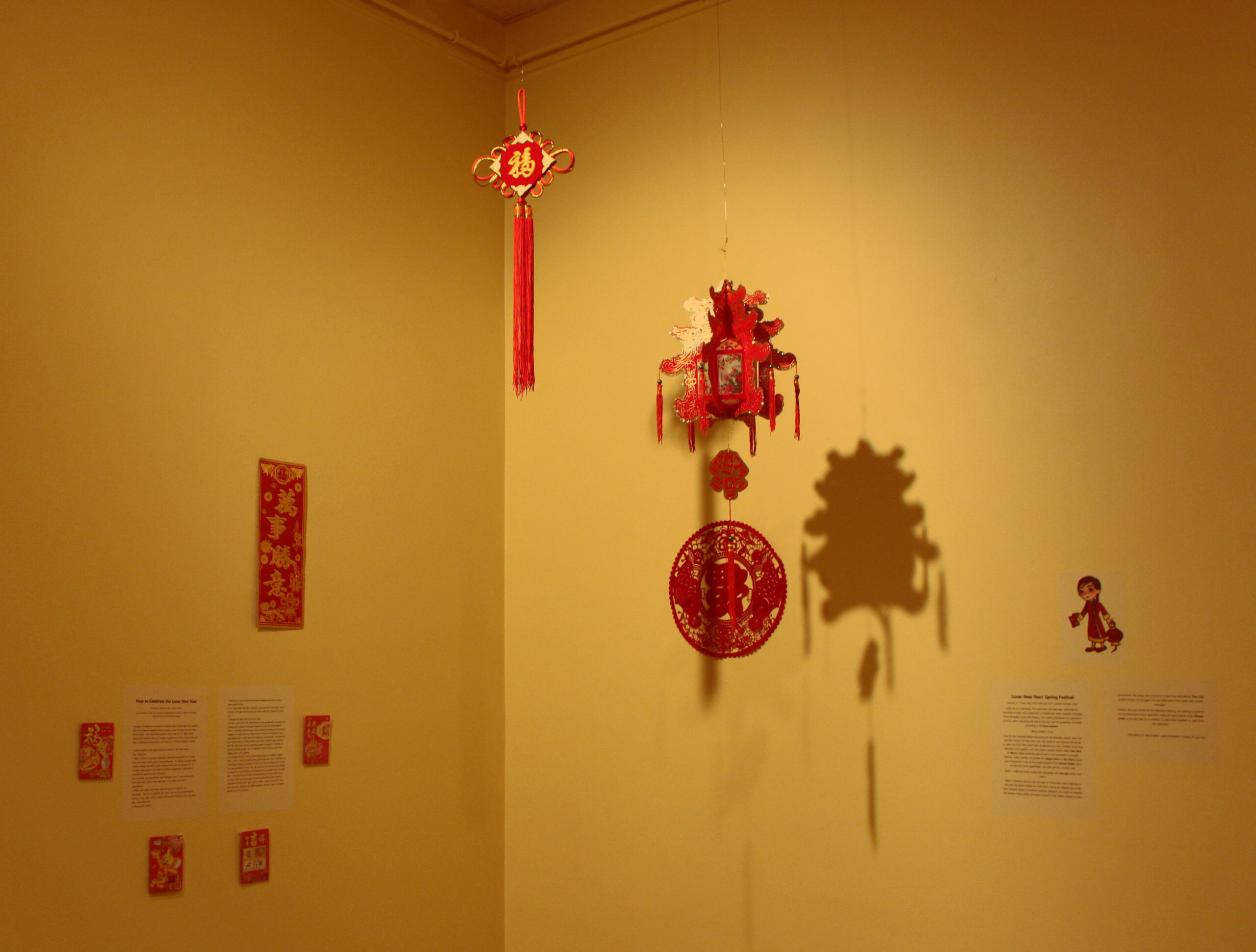
Celebrations Exhibit, Temporary Gallery, Huron County Museum.
A recent revelation about artefacts came this fall when staff were planning Celebrations, the Temporary Gallery’s winter exhibit dedicated to favourite holidays from October to March: Diwali to St. Patrick’s Day. The displays are a combination of artefacts from the museum’s collection and objects on-loan from individuals and families who celebrate each holiday. Lynn Zhu of Toronto, whose husband is from Clinton, shared her memories of celebrating Lunar New Year both in China during her early childhood, and afterwards when she and her parents moved to Canada. Lynn also lent the exhibit a selection of decorations and “red pocket” cash envelopes from past Lunar New Year occasions, providing translations for the Mandarin words.

Ceremonial Chinese sword donated by E. Townsend Family, M970.20.10
While Lynn was translating the decorations, I asked her take a look at a couple of red silk hangings in the museum’s collection, guessing their lettering might also be Mandarin. The banners are part of a collection of objects from China donated by the E. Townsend family in 1970. Elisha Townsend, born near Londesborough, was a Methodist missionary to China in the first half of the twentieth century.
Very generously, Lynn agreed to view photos of the banners, and provide translations. She explained,
The hanging banners you found are in Chinese, and are an example of a duìlían 对联. They should be hung on either side of a door…They usually describe some well wish in a rhyming matching-syllables way. The particular ones you have are so interesting because they are about God…There are many churches and Christians in China, but they’re not as obvious as here. So religious duìlían are not common at all…[T]hey likely were used inside the home or a church. Also, likely they were displayed all year round. (People often leave the duìlían up all year, so they get shabby looking, and get new ones before the New Year celebrations.[The first banner] says: “God is my herder.” [The second banner] (使我不至窮乏) says: “Let me not be poor and needy.” After some googling, it’s actually the translation of Psalm 23:1. “God is my shepherd, I shall not want/I lack nothing.”

Wall hanging donated by E. Townsend Family, M970.20.2

Red satin wall hanging donated by E. Townsend Family, M970.20.1
Thanks to Lynn’s translation more than forty-five years after the Townsend family’s original donation, museum staff can now understand the banners and better appreciate their significance to Elisha Townsend’s missionary work
Lunar New Year begins today, Monday February 8th! You can see the decorations loaned for #HCMCelebrations now through March Break in the Temporary Gallery. Admission next Monday, February 15th, 2016 is FREE for Family Day.
Can you help with the museum’s current historical mysteries? We’re looking for any extant image of Goderich Township pioneer Agnes (Johnston) McIlwain for our upcoming Migration Stories exhibit in April.
by Elizabeth French-Gibson | Jan 26, 2015 | Archives, Exhibits
By Jenna Leifso, Archivist

A Winsch back type postcard imprint
When was the last time you received a postcard in the mail? As more people switch to electronic forms of communication, it can be nice to receive something in the mail that isn’t a bill. Postcards became a popular mode of communication in the 1890s. In Canada, the period from 1901 to 1913 is often referred to as The Golden Age of Postcards. Right now we have a selection of some of our favourites from the collection on display at the Museum.
Perhaps you have some postcards in your collection that you want to find out more about. Here are some of the resources we used in our exhibit.
Metropolitan Postcard Club of New York City is an informative site that includes a very detailed history of the evolution of postcards and also a very comprehensive guide to postcard publishers from all over the world.
Picture Postcards from the Great War 1914-1918 explores the propaganda behind the cards. Can you image sending a postcard back home about trench lice?
Did you know that prior to the First World War, most postcards were printed in Germany? The Postcard Album has more information about German printed postcards, including the popular “John Winsch”.
For information related to Canadian postcards try the Toronto Postcard Club’s website. Their annual show is being held next month on February 22nd.
by Elizabeth French-Gibson | Sep 29, 2014 | Archives, Exhibits
By Emily Beliveau, Digital Project Assistant
Twenty-five years ago, on 30 September 1989, the newly redeveloped Huron County Museum officially opened to the public. Just a few years earlier, the fate of the Museum was in question after part of the main building was closed due to structural problems. Seven years later, the Huron County Museum was reborn for a new era with the completion of a $4 million dollar renovation delivered on time and on budget.

Museum exterior before the 1988-1989 renovation
Originally housed in the 1856 Central Schoolhouse building, the museum first opened to the public in 1951. From there its footprint gradually grew as other buildings were constructed to house additional exhibits, most notably the 1913 CPR shunting locomotive purchased in 1958.
In the photo below, you can see the locomotive in its permanent home covered by orange tarpaulins while the new museum building goes up around it. The train is now the central feature of the History Hall gallery, a streetscape of town life from around Huron County in the early 1900s. The redevelopment gave the museum the ability to showcase old and new by building a modern facility around the schoolhouse–itself a historic artefact.

Aerial view of museum construction during redevelopment
From the museum’s Archives, here is a rare glimpse of the empty upper hallway in the schoolhouse while it was being restored as well as a view of the exhibits before redevelopment. The redeveloped museum purposely retained some of the character of our original curator’s displays while also using modern display techniques to tell the story of Huron County.

Empty second floor hallway during restoration of the schoolhouse, circa 1989, Huron County Museum

Displays in the second floor schoolhouse hallway before restoration, c. 1986
If you visit the museum today, you will find a mix of old favorites and new things to discover. You can still turn the handles on Mr. Neill’s wooden models, see the two-headed calves and ring the train bell, but you can also learn something new from a temporary exhibit or do something new at a special event. Twenty-five years later, our new building might not be so new anymore, but it serves us well as we continue to share the evolving history of Huron County in new and old ways.
by Elizabeth French-Gibson | Sep 8, 2014 | Exhibits
By Emily Beliveau, Digital Project Assistant
Our temporary exhibit Noteworthy: Musical Instruments closes Sunday, 14 September 2014. Last week, Assistant Curator Elizabeth French-Gibson recounted the memories of her childhood music lessons as she described the many beautiful instruments that are on display from the Museum’s collection. Accompanying those instruments are photographs from our Archival collection showing the people who made and played instruments in Huron County’s history. Here are a few of the images on display in the Temporary Gallery until the end of the week:

Goderich Citizen Band, 1927, Object ID: 1950.1761.001. Winners of 3rd Prize in Class C1, Bank contest at the Canadian National Exhibition, Toronto. Back Row (left to right) – Sidney Palmer, W. Johnson, Clyde Carter, Frank McIllwain. Centre Row – Reg Newcombe, A. Rollinson, H. L. Watson, H. Fowler, H. E. Jenner, H. Witmer, T. Walters, F. McArthur, Robert Henry. Front Row – J. Huckins, Givin Young, G. Inglis, George Jenner, George James, C. A.R. Wilkinson, C. Tweedie, E. Jenner, Charles Rance, Harvey McGee, Walter Newcombe, Harold Newcombe.

Detail from image “90 Pianos A Week”, Doherty Organ Factory Employees, Clinton, Ontario. Object ID: A990.0013.002. Note the ghostly figure in the flag, the result of movement during a long exposure.

Piano Recital Group, 1949, Object ID: A999.0007.014. Left to right: Evelyn Breckow, Irene Milne, Mollie Bissett, Eunice Milne, Mary Pridham, May Henry, Joan Scott, Marilyn Butler, Rose Marie Hartman, Cathee Butt, Gloria Palmer, Helen Willis, ___________, Marietta Stingal, Mary Anne Erksine, Barbara Henry.

Jubilee Brass Band, 1897, Zurich, Object ID: A990.0013.002. Back Row (left to right) – W. G. Hess, J. Schuettler, F. W. Hess, M. Wurm, A. Moritz, G. Stenback, EO. Zeller. Front Row – AIF. Faust, Dan Bennett, L. Weber, P. Sipple.
by Elizabeth French-Gibson | Aug 29, 2014 | Artefacts, Collection highlights, Exhibits
By Emily Beliveau, Digital Project Assistant

A mounted passenger pigeon (Ectopistes migratorius) from the Huron County Museum collection, Object ID: N000.1713.
In 1914, the passenger pigeon became extinct. The last known survivor of the species was a female named Martha (after Martha Washington), who died at the Cincinnati Zoo on September 1, 1914 at 1:00pm. Only 50 years earlier, passenger pigeons were so abundant that giant flocks darkened the sky for hours at a time as they passed overhead. How did the most populous bird in North America become extinct? The short answer: humans. The destruction of forest habitat along with unrestricted commercial hunting annihilated the species over the course of several decades.
The passenger pigeon was a species of pigeon most closely related to the mourning dove, with a nesting range around the Great Lakes and a migration range from central Ontario, Quebec, and Nova Scotia in the north, to the uppermost parts of Texas, Louisiana, Alabama, Georgia, and Florida in the south. Communal in nature and capable of flying at 60 miles per hour, huge colonies of passenger pigeons travelling and nesting were a noisy, messy spectacle. An 1866 account from southern Ontario described a migrating flock that was 1.5 km wide and 500 km long and took 14 hours to pass through the sky. Nesting groups could easily cover 100 square kilometers, with 500 birds per tree.
Imagine the scene. Birds several deep on the branches, a constant roar of wings as birds take off and land, the smell of droppings and of the pigeons themselves—people say you could smell the passing flocks—the crack of branches. So many birds that a man in Ohio could remember firing a 12-gauge pistol into a bush in the dark and bringing down 18 pigeons with the shot. And every hawk, owl, crow, raven, vulture, fox, raccoon, and weasel within miles getting fat feeding on eggs, unfortunate nestlings, and awkward squabs fresh from the nest.
–From “The Passenger Pigeon: Once There Were Billions,” an essay from Hunting for Frogs on Elston, and Other Tales from Field & Street by Jerry Sullivan

News item from The Essex Record (Windsor, ON), April 2, 1875, p.2
Because the birds were so plentiful, the passenger pigeon was an important food source, first for the indigenous population of North America, and later for colonial settlers. When commercial hunters began selling large numbers of birds at city markets in the early 1800s, the decline in population first became noticeable. By the time legislators starting passing laws to restrict hunting the birds, it was too late for the population to recover. Deforestation, wholesale slaughter, a low reproductive rate (one egg per season), and an inability to survive in small colonies all contributed to the irreversible decline of the species. By the late 1890s, wild passenger pigeons were exceedingly rare, and despite large sums offered for live captures to use for breeding, no rewards were ever claimed.
The Huron County Museum is extremely fortunate to have a taxidermied specimen in its collection, which is on exhibit in the upper Mezzanine this fall to commemorate the 100th anniversary of the passenger pigeon’s extinction and efforts to prevent future human-related species decline.
References and further reading:
Project Passenger Pigeon
The Passenger Pigeon, Encyclopedia Smithsonian
by Elizabeth French-Gibson | Aug 22, 2014 | Exhibits
By Elizabeth French-Gibson, Assistant Curator

“Empress” Goderich Organ & Stool, an early 1900s model pump organ manufactured by the Goderich Organ Company, Goderich, Ontario, which produced organs from 1889 to 1930. Object ID 2006.0038.001
Like many children, for me growing up included music lessons. My piano teacher was a wonderful lady who could actually play the piano with her hands behind her back. My mother arranged to buy a used piano which still sits in our family’s living room. Weekly visits to my piano teacher’s home, daily practice sessions at home, and yearly recitals were all a part of my growing years. And like many people I soon forgot all my lessons and can barely play Twinkle Twinkle Little Star anymore. Never more than now have I wished that I had practiced more and could still play.
Each day when I step into the exhibit “Noteworthy: Musical Instruments” at the Huron County Museum I wish that I could step up to those beautiful pianos and organs and play a beautiful tune. Not that I would! It wouldn’t be smart for the Assistant Curator to break the golden rule of Don’t Touch the Artifacts! But I still wonder, what did each sound like when these were the centers of homes and churches throughout our County?

A partial view of the exhibit Noteworthy: Musical Instruments in the temporary gallery at the Huron County Museum, on display until September 14, 2014.
Unplayable, the beauty of these instruments now resides in their design. Each piece in the exhibit is individual – tall, wide, stationary, portable, inlaid or carved. I try to imagine looking through the Eaton’s Catalogue and choosing the Empress Organ designed, built and sold by the Goderich Organ Factory. I imagine meeting a sales representative from the Doherty Organ Factory in Clinton to order an organ to be used in my church each Sunday morning. I imagine requesting that the company design a special portable organ to be carried to schools throughout the district by the music teacher. Each order would have led to the inevitable anticipation of the music, sounds and joy the instrument would bring. The many employees at our Huron County Organ factories took pride in manufacturing these pieces that were sent around the across Canada and internationally.
Beyond the pianos and organs, the exhibit also includes smaller instruments such as violins, accordions, autoharps, harmonicas, and even a serpent horn. Yes a serpent horn – an instrument that looks like a snake! Put them all together and the room has a feeling of warmth and mystery as you imagine the fingers that coaxed the music from each one.

Display case with an auto harp, drum, and serpent horn.
You can enjoy the beauty of these musical instruments at the Huron County Museum until September 14th in our Temporary Exhibit Gallery. And if you still remember your childhood music lessons there is one piano at the Museum on display that was donated with the permission and hopes that it still be played. Believe me, it is a beautiful sound when the notes drift through the exhibit halls and offices as a visitor takes the time to play this piano. And each time that happens I wish a little more that I remembered how to play too.
This article also appeared in the 27 August 2014 edition of the Goderich Signal-Star.