by Amy Zoethout | May 30, 2022 | Huron Historic Gaol
By Kyra Lewis, Behind the Bars programming coordinator
Want to spend your summer behind bars? The Huron Historic Gaol is currently seeking volunteer actors for the long-awaited return of Behind the Bars starting July 12.
Behind the Bars is an immersive tour experience that gives visitors the opportunity to learn more about life at the Huron Historic Gaol. Volunteers will step back in time to portray real life inmates and staff from the Gaol’s past, sharing highlights of their characters’ stories with visitors. Volunteers help us create a captivating and educational experience for visitors, giving them a firsthand look into the experiences of those who lived and worked at this National Historic Site.
Evening tours begin on Tuesday, July 12 and continue every Tuesday and Thursday until Aug. 30. Scheduling can be flexible based on volunteer availability. Call 519-524-6971 or email klewis@huroncounty.ca for more details!
Inspiration:
- Visit our YouTube channel to watch videos if our incredible volunteers over the years
- Check out these titles from the Huron County Library that describe Gaol history and share stories of famous prisoners in more detail
by Amy Zoethout | Jul 21, 2021 | Blog, Huron Historic Gaol, Investigating Huron County History, Uncategorized
Kyra Lewis, Huron Historic Gaol outreach and engagement assistant, explores the architectural history of the Huron Historic Gaol.
The Huron Historic Gaol is a one of a kind building: predating Confederation, this anomaly has stood for over 181 years. Despite being made of predominantly stone and lumber, it has survived fires, being struck by lightning twice, and a tornado. However, its survival is not the only thing which stuns visitors about this incredible building. The Gaol’s architecture is one of the only of its kind in Canada standing today. This blog post will explore the architectural history of the Historic Gaol, and how and why its structural significance is honoured 181 years later.
Settlement began in Goderich as a result of the development of the Huron Tract in the 1830s; at the time, Goderich and the surrounding area were part of the London District. However, residents in the area felt disconnected from the district government and their affairs. Back then, in order to qualify as a County, you must possess a local government, and to do that, you had to have both a Courthouse and a Gaol. So in 1839, a contractor named William Geary began clearing land allocated by the Canada Company to build a Courthouse and Gaol, with the grand objective of establishing a local government for the County of Huron. The location was decided based on the fact that, at the time, the Gaol was situated outside the town. The location of the Gaol was considered ideal as it was distant enough to host undesirable residents, but still close enough to town for the convenience of court officials.
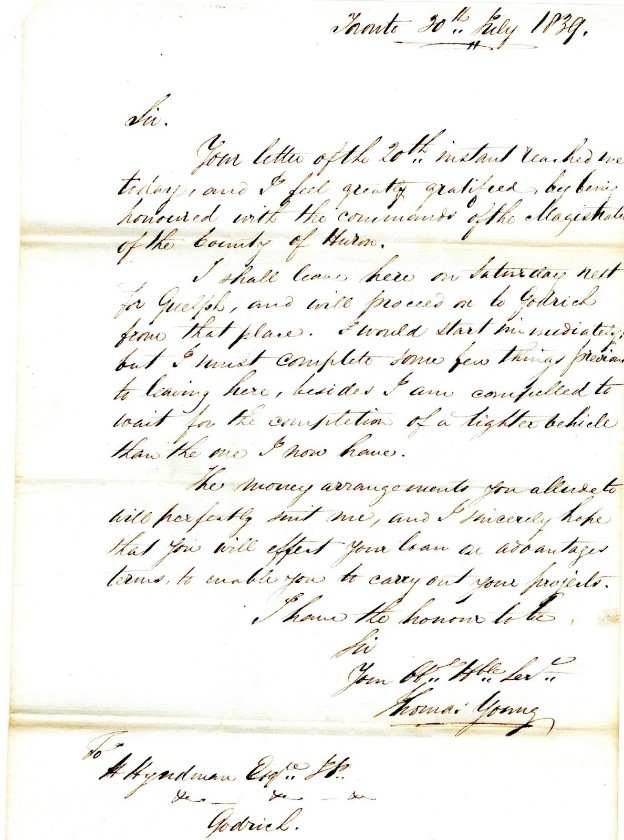
Letter from Thomas Young expressing his opinion and pleasure to take on the Gaol contract for Huron County.
The project was given to Toronto architect Thomas Young. Young was born in England and had emigrated to Canada by 1834; until 1839 he was a drawing master at Upper Canada College. He received many commissions, one of which was to design King’s College in Toronto, which was completed in 1845. Young also received several other commissions between 1839-1844 to design, including the Wellington District Gaol and Courthouse, the Simcoe District Gaol, the Guelph Courthouse, and the Huron District Gaol. Many of Young’s designs were inspired by historic architecture, paying homage to neoclassical styles he utilized as an artist. This style consists of grandeur and symmetrical designs, similar to that of Roman and Greek buildings such as the Pantheon, located in Rome. Neoclassicalism became extremely popular in Italy and France in the mid 18th century, and was a very prominent influence in Young’s architectural designs and drawings.
Building materials for the Huron Gaol were sourced locally or imported via schooner from Michigan. A public posting requested “400 Cords of Stone – District of Huron Contract”, it was stated that the stone could be no less than “12 inches thick for the building of walls 2 feet thick”. This local stone came from the Maitland River, which flows through Huron County just to the north of the building. While local stone was used to construct the walls of the Huron Gaol, “coping and flagging” stone, which was predominantly used around the windows of the Gaol, was brought in from Michigan. Many other tenders were let for the project, such as 4,500 board feet of hewn timber, as well as blacksmith work and plastering.
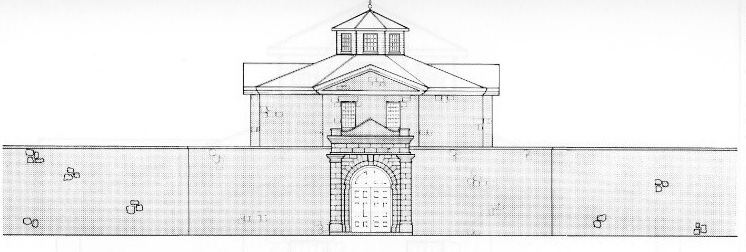
Drawing of the Huron Historic Gaol from Nick Hill’s report Huron Historic Gaol Goderich: A plan for restoration
PRISON REFORMATION
Young’s design for the Huron Gaol was inspired by Jeremy Bentham, an English philosopher. Bentham was devoted to reformation and rehabilitation and was curious about how prison design could contribute to the reform of criminals. Bentham popularized the panopticon, meaning “all seeing,” which precisely reflects the intention of the architecture. Panopticon designs allowed Gaol staff to observe prisoners from a centralized point, without the prisoners knowing when and if they are being observed. This structure was created to enforce compliance on prisoners, as they always had to act as though they were being watched. Due to the threat of constant surveillance, the theory of this design suggested that prisoners would then behave and conform to ideal behaviour. The invasiveness of always being able to be seen was stressful for prisoners, and thus they were more likely to comply with reformed behaviour. This was the intent of prison reformists such as Bentham, as their main objective was to create functional prisons that ran on limited manpower, but generated successful results concerning rehabilitation. Bentham believed that learning skills and completing tasks accurately and effectively while in a panopticon prison would ultimately contribute to their rehabilitation and readmittance into society as a better person.
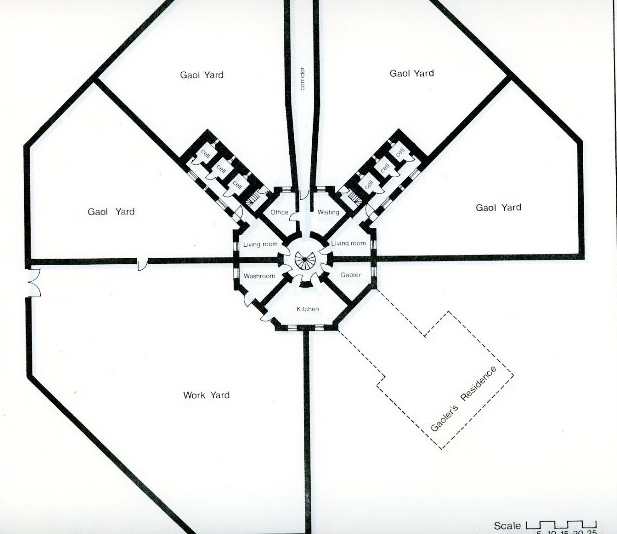
Drawing from report Huron Historic Gaol Goderich: A plan for restoration, by Nicholas Hill.
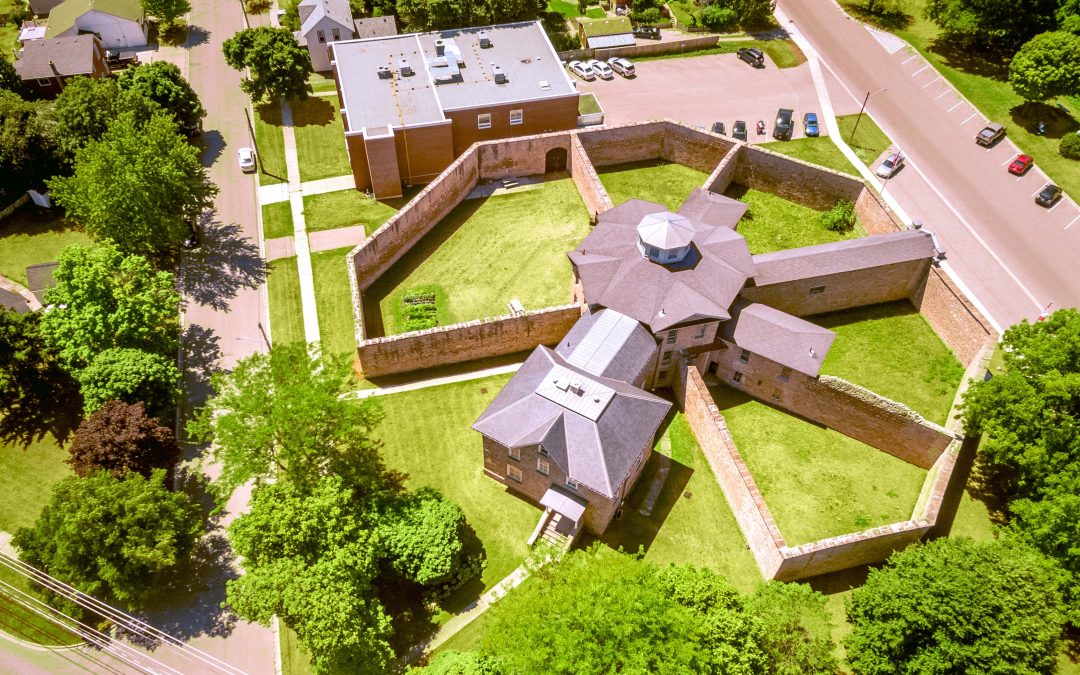
The panopticon was very prominent in the Gaol’s original design, as the Gaol itself has a centre building, with walls jutting out like spokes on a wheel. This was obviously intentional, as the third floor cupola allowed for staff to see each courtyard from one centralized point. Prisoners in the yards were therefore always observable, so there was an immense amount of pressure to behave. However, the cupola was not utilized nearly to the extent it would in a classical panopticon structure. The building’s courtyards were the only instance where panopticon design was implemented, as the rest of the building used a separate system. For this reason, the architecture still allowed for prisoners to have some sense of privacy and independence when in their cells. Thus Bentham’s ideology was not entirely encapsulated within Thomas Young’s design of the Huron Gaol, as only one aspect of the Gaol operated with this level of surveillance. Architect Nick Hill regarded this in his 1973 report to Huron County Council, mentioning that the design had “remarkable geometric clarity and functional arrangement based on the octagon”.
Another systematic influence that was used in the Huron Gaol’s design, was the separate system. This concept, oddly enough, was actually a contrast to the panopticon design. It enforces that prisoners stay isolated from one another, and can only be seen by guards when they enter the individual prison blocks. While the panopticon design was utilized in the structural elements of the courtyard, the separate system was incorporated within the Gaol’s cells. The act of keeping prisoners separate was significant as the Gaol was particularly small. This method ensured there would be fewer issues concerning fights and other conflicts amongst the prisoners. Solitude was also a major influence in many forms of prison reform around the 19th century. This form of confinement was designed to make prisoners easily controlled. Maintaining a sense of loneliness and isolation allowed for prisoners to feel more vulnerable and thus more compliant to the whims of the system they were incarcerated in. Eliminating that sense of unity and togetherness with other prisoners, in theory, would alleviate the possibility of revolts and violence as well.
The Huron Gaol implemented this in its cell design. There are four different cell blocks, with corresponding day rooms. Blocks one and two are on the first floor, with blocks three and four located on the second floor. The third floor, where the courtroom stands, has four individual holding cells. Every cell is oriented facing one direction, so other prisoners within the same block cannot see each other when in their individual cells. Historically, women and men were separated into different blocks, as mentioned in the Rules and Regulations of the Huron District Gaol detailed in 1846. This document stated that male and female prisoners were to be “confined in separate cells, or parts of the prison…as far as the dimensions, plan, and accommodations may allow”. At this point in time, prisoners were also separated into “classes” which were generally not permitted to intermix. For example: “1st. Prisoners convicted of felony. 2nd. Persons convicted of misdemeanors and vagrants. 3rd. Persons committed on charge or suspicion of felony. 4th. Persons committed on charge or suspicion of misdemeanors, or for what sureties; and in cases where necessity may require it, and circumstances admit, the sheriff may confine female prisoners in the rooms set apart for debtors. 5th. Debtors and persons confined for contempt of court on civil process.” The distance between each cell block also provided a sense of seclusion to ensure the safety of inmates.
The Gaol was a significant building for many reasons, however one of the most significant was the newly implemented techniques centred around prison reform. Prior to Jeremy Bentham and other incredible architects, sociologists, and philosophers, prisons were not based around reform. Prisons prior to the influence of such forward thinkers, were incredibly inhumane, as the concepts of rehabilitation and amelioration were relatively modern concepts in the early 1800s. There were a few gaols that implemented this philosophy, such as the Eastern State Penitentiary in Philadelphia, Auburn in New York State, as well as one in California. Thus, when Thomas Young utilized Bentham’s ideologies, it was one of the very first prisons existing at the time to be influenced by the new age philosophies of rehabilitation. Despite the Huron Gaol being of a much smaller scale, its design was truly revolutionary and ground breaking for its time.
Architect Nick Hill observed these concepts when he reflected on the Gaol’s structural uniqueness in the 20th century. Hill evaluated the significance of Bentham’s efforts of reform; “They engendered an attitude towards prisoners which saw the conclusion of exile, flogging, branding, maiming, the stocks and pillory, drawing and quartering.” The social changes these prisons inflicted on society were no small feat, as it signaled changing preconceived norms surrounding prisoners and criminal punishment.
Despite the Gaol’s incredible advancements in prison reform, there were several instances during its long history when councillors approved improvements be made to the Gaol to ensure functionality and proper treatment of prisoners. As there were no facilities for the elderly or the homeless until 1895 when the House of Refuge was constructed in Huron County, the Huron Gaol became a place of refuge for many. At its highest capacity, the Gaol held over 20 people, despite only having 12 cells and four holding cells. Its expansion became a necessity in order to ensure the Gaol was capable of executing the needs of all its inhabitants. For example, in July of 1853, the walls of the Gaol were deemed “insufficient for security” by the Grand Jurors. Despite this topic being brought to the Council’s attention in 1853, the Gaol walls were not expanded until July of 1861.
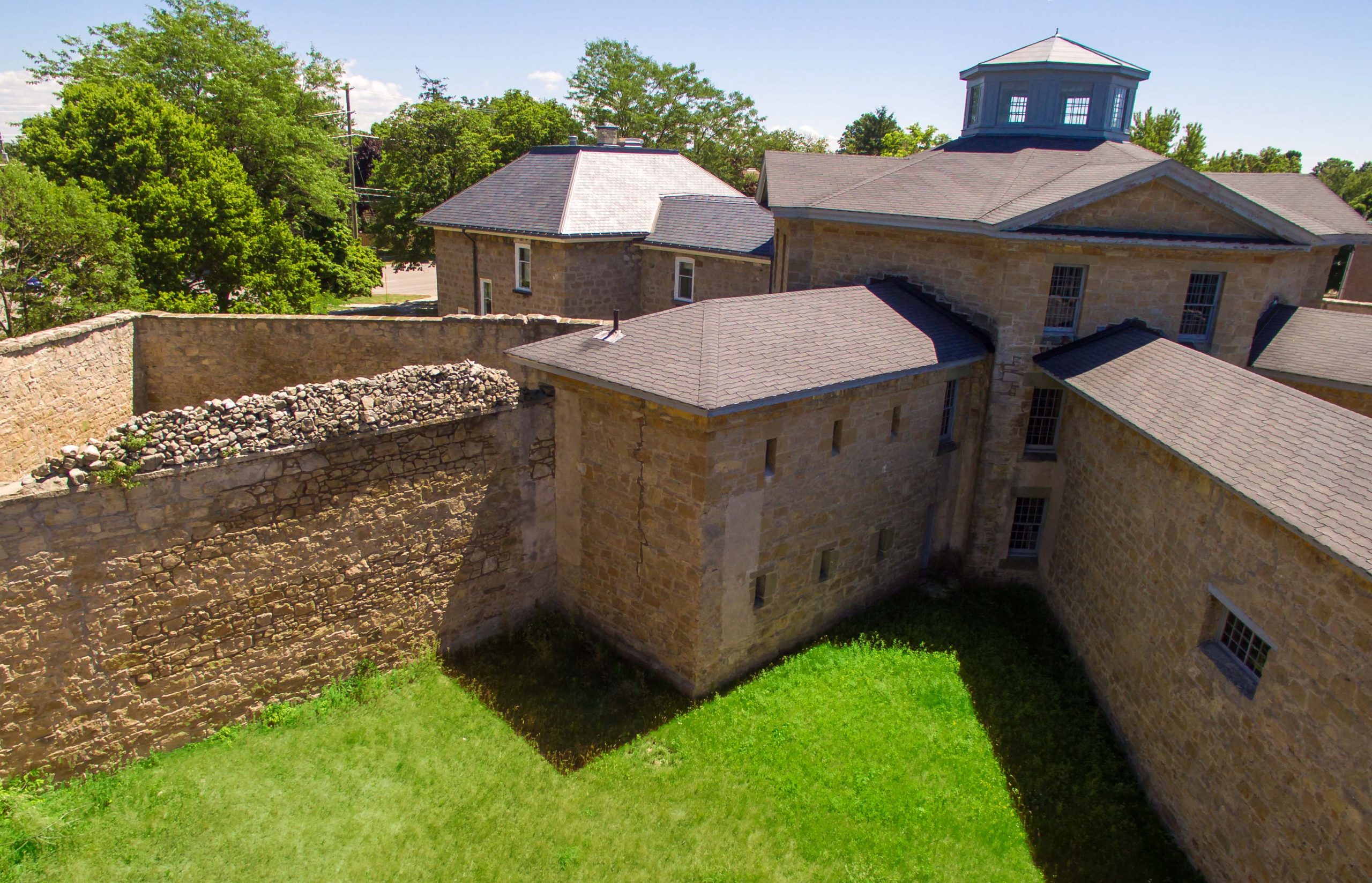
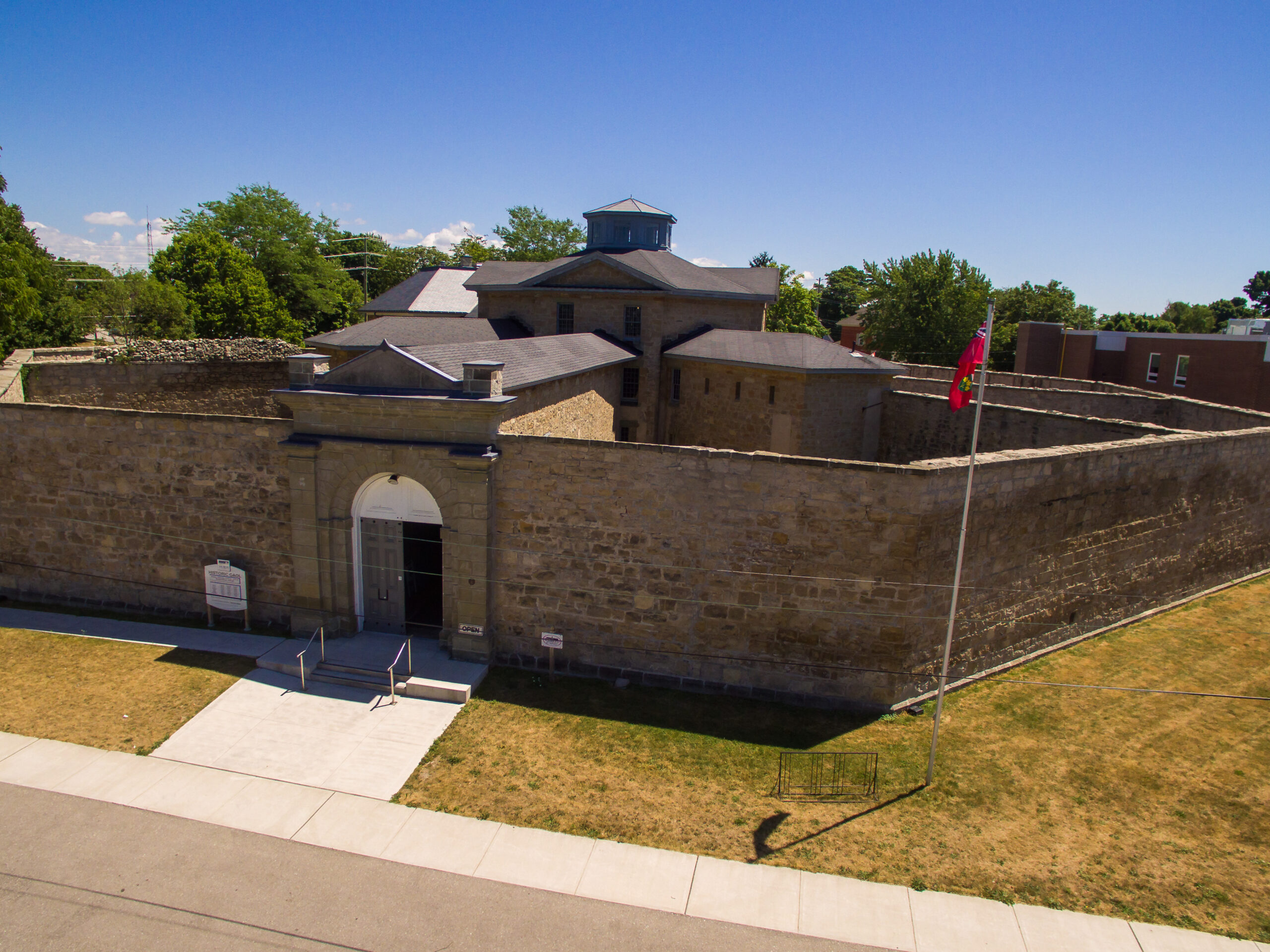
Aerial view of the Huron Historic Gaol showing walls as they stand today.
The renovation to the walls was undertaken after the Canada Company formally transferred the Gaol land to the County of Huron. Recommendations arising in 1856, following concerns around escapes from the Gaol, led to the walls being extended by two feet in height with loose stones being installed at the top of each wall. These stones were meant to come loose if a prisoner attempted to escape, causing them to fall to the ground when they grabbed a loose stone. William Hyslop was hired as contractor to renovate the walls, and was paid 27 pounds, 12 shillings, and 6 pence for “repairs to the Gaol wall”, as documented in council minutes from 1855. In the 1862 council minutes, William Hyslop is recompensed again for his efforts on the Gaol walls, after the County purchased the surrounding land to extend the walls outward, expanding the yard. The walls, as they stand today, are 18ft high and 2ft underground to ensure no prisoner could go over them or tunnel beneath. Other major improvements of the Gaol included the installation of a slate roof, as well as a bathtub in 1869. The original wooden bathtub was upgraded to copper in 1895 and a flush toilet was also installed. These changes were made for the health and well-being of the inmates, as health and hygiene were only recently being regarded as a necessity. Especially to avoid sickness and disease spreading through the relatively small facility.
The Huron Gaol has had an incredible 181 years of history in the County, and its captivating architecture represents incredible structural and architectural innovation for its time. The Huron Gaol is not only an incredible piece of history, but an amazing representation of the evolution of prison reform, rehabilitation and human rights.
Online Sources:
Primary Sources:
- H. Belden & Co. “Illustrated Historical Atlas of The County of Huron ONT: Compiled Drawn and Published from Personal Examinations and Surveys”. Toronto: 1879.
- Lizars, Daniel. “Rules and Regulations for the Huron Gaol 1846”. Rowsells and Thompson Printers. Toronto: July 24th 1846.
- Hill, Nicholas. Huron Historic Gaol Goderich: A plan for restoration prepared by Nicholas Hill. Undated.
by Amy Zoethout | Jun 23, 2021 | Blog, Huron Historic Gaol, Investigating Huron County History
Kyra Lewis, Huron Historic Gaol outreach and engagement assistant, explores how the Gaol dodged demolition.
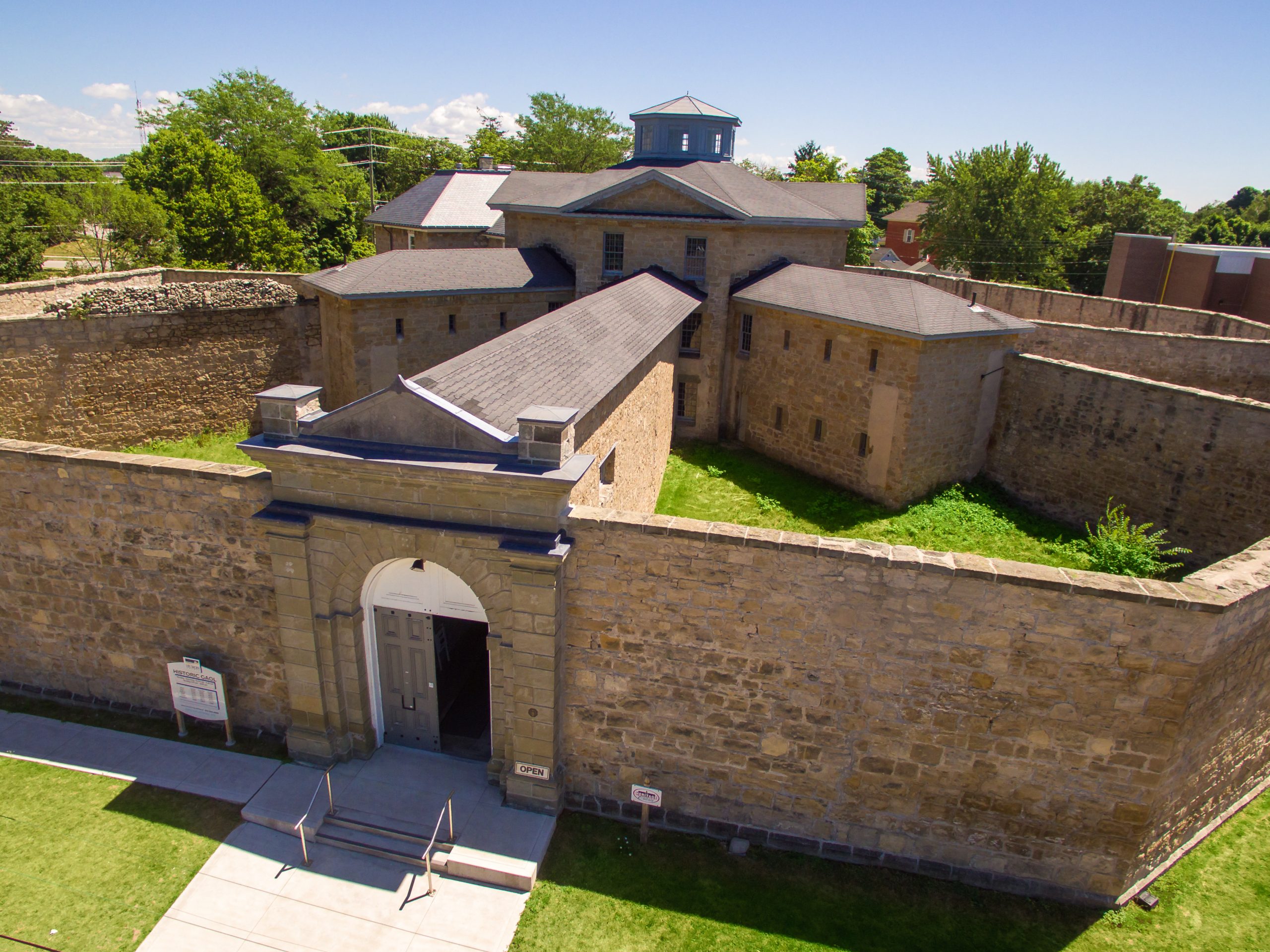
Construction of the Huron Gaol began in 1839 in the Town of Goderich making it Huron County’s first municipal building. This once essential government building served as both a prison and a courthouse once its construction was completed, with the first documented prisoner committed on Dec. 3, 1841. The Gaol held significant value to the people of Huron County, as it represented their newfound independence from London District. The Gaol served as a focal point of justice and was where the Huron District Council held its first meeting on Feb. 8, 1842.
As time went on, the Gaol’s role began to shift; when the new courthouse was constructed in the centre of Market Square Goderich, in 1856, the Gaol’s sole purpose became holding prisoners. However, not all residents of the Gaol were criminals. Many who stayed at the Gaol were homeless, or mentally or physically ill. Drunkards, thieves, debtors and murderers lived alongside the homeless, and children as young as nine years old before Huron County Council constructed a House of Refuge in 1895. As time went on, numbers began to dwindle in the Gaol.
In 1968, The Children’s Aid Society moved into the Governor’s house after the last Governor moved out in 1967. The organization had outgrown their previously occupied space in the basement of the Courthouse located downtown Goderich. During the Children’s Aid Society’s time in the Governor’s house, they witnessed the closure of the Gaol in 1972 after the final prisoner was transferred out. However, prior to the Gaol even being closed as a facility, there was a proposal presented to the Huron County Council in September, 1971, to remove two of the Gaol’s walls adjacent to Napier Street to build a parking lot to accommodate the expanding services of the Children’s Aid Society and the Gaol’s neighbour, the Huron-Perth Regional Assessment Office. On Nov. 26, 1971, County Council received a formal approval from the Provincial Department for the demolition of certain walls at the County Gaol.
This decision provoked a massive response from the community and press, especially from Goderich and the surrounding areas. Many articles began appearing in the local newspapers concerning the possible preservation of the facility, as well as public rejection of the decision to tear the Gaol walls down.
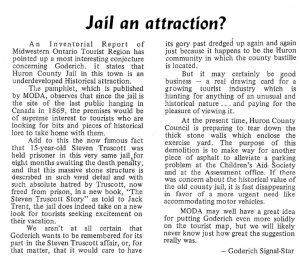
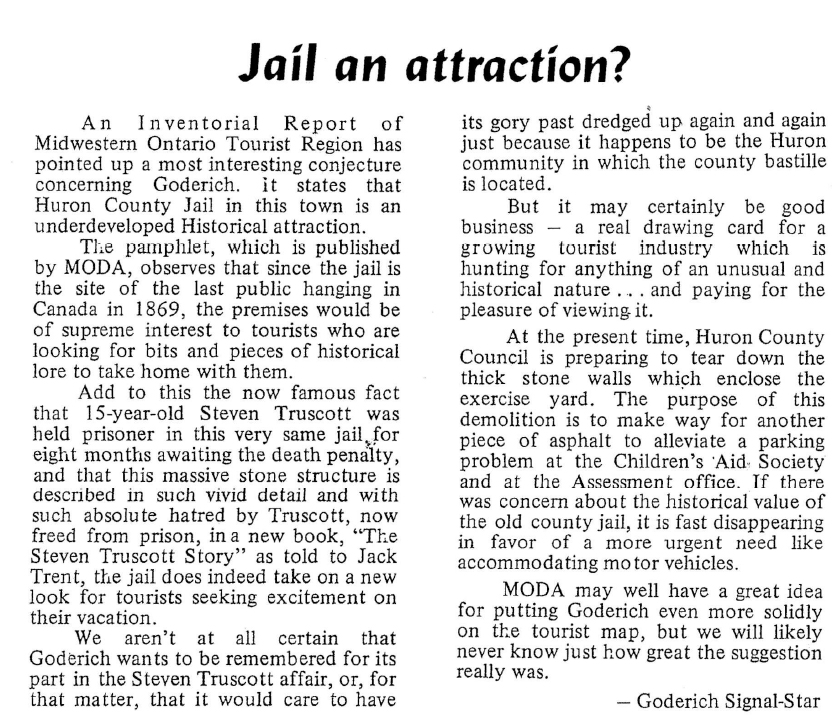
Editorial as published in the Exeter Times-Advocate, Nov. 25, 1971
The papers referred to the old facility as an “underdeveloped historical attraction”, and “a real drawing card for a growing tourist industry”. However, Council at the time had no intention of utilizing the space as a Museum of Penology. Some councillors did not condone the county spending the money to restore the building, as it was projected the restoration would cost around $25,000. Other councillors believed that if they had that much money to spend, it should be allocated around the county, and not just in Goderich. Another drawback that was suggested was the glorification of previous inmates whose actions were heavily frowned upon. The potential of immortalizing the darker aspects of Huron County’s past was a genuine concern amongst officials.
The Property Committee eventually presented the County Council with another report on Dec. 8, 1972, which detailed the idea of the old Gaol becoming a “Museum of Penology”. However, in the same report they also put forth a recommendation to construct a parking lot and an extension for the Assessment Office, costing a projected $150,000. In January, 1973, Huron County Council approved the removal of three walls at the Gaol, after considering both the Children’s Aid office and the Assessment Office’s needs. The Gaol was unfortunately placed back on the chopping block, now set to lose another wall.
When citizens caught wind of the verdict, they were none too pleased with the potential defacement of such an iconic local building. More articles and letters to the editor began showing up in the papers and a small group of concerned citizens came together to fight to save the historic building. If the Gaol walls were to be torn down, it would completely ruin the integrity of the building’s design. As the Gaol’s architect, Toronto-born Thomas Young had been inspired by famed English philosopher and prison reformist Jeremy Bentham. Thus, the loss of the Gaol walls would compromise both the value and history of the structure, as they added an irreplaceable element to the significance of its layout and design. The goal of this growing group of local politicians, historians and volunteers was to pressure the Council into reassessing their decision to tear down the walls. Their arguments were intended to bring to light the necessity of the architectural, historical and cultural conservancy of the building. And so, the Save the Jail Society was born!
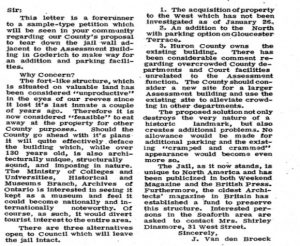
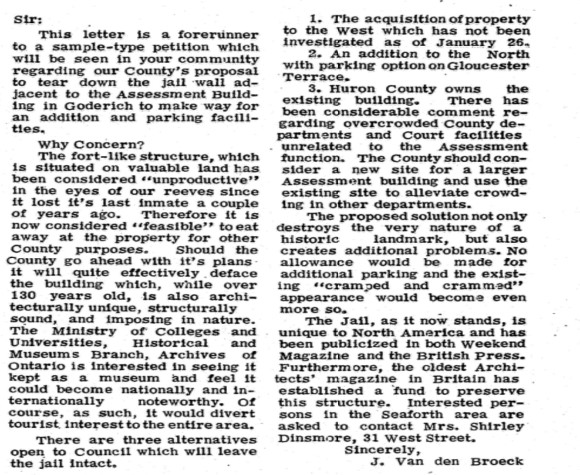
Letter to the Editor written by Joan Van den Broeck published in the Goderich Signal-Star.
With their objectives set, the group of dedicated members wrote letters to the newspaper, educating the public on their cause. A brilliant letter addressed to the editor of the Goderich Signal-Star was written by Save the Jail Society activist Mrs. Joan Van den Broeck. She advocated for the preservation of the Gaol, stating the uniqueness of the architecture as being one-of-a-kind, as well as miraculously structurally sound despite being around 130 years old, predating confederation. She also spoke of the building’s national and international notoriety, which would only enhance the tourist experience in Huron County. Van den Broeck, along with Goderich Reeve Paul Carroll and their fellow Save the Jail Society members, sought to change the fate of the iconic building.
The Save the Jail Society was extremely vocal and visible within the community, organizing campaigns at Goderich District Collegiate Institute and compiling a petition, as well as fundraising and rallies. There was a song written to commemorate the Gaol, which was written by Wingham entertainer Earl Heywood. The song was sung to the tune of Battle Hymn of the Republic, and was sung at events and rallies. They presented a petition to Huron County Council, as well as an architect’s revised plan for the parking lot to be built on the north side of the building. The group also threatened to pursue legal action if the demolition was to move forward.
One of the group’s most engaging events was an open house held at the Gaol on Feb. 19, 1973, which was initiated to motivate and engage the community in the cause to save the building. This event amassed a crowd of over 2,000 people who were all curious to explore the historic building and to find out what the big deal was about the Gaol. This event is what Save the Jail Society members would later reflect upon as a tide turner in terms of popular support. This event also made a massive impression from County Council’s perspective, as they were now aware of the appreciation the community held for the building.
Goderich Town Council met on April 12, 1973, in response to a letter issued from the County. This letter was a revision of the previous parking lot proposal designed by Nick Hill, which would allow for the Gaol walls to remain untouched. Finally, on April 26, 1973, Huron County Council agreed to the proposal by Goderich Town Council. This acceptance meant that the Save the Jail Society’s goal of saving the Gaol had been realized!
Once the safety of the Gaol had been ensured, the Save the Jail Society began to create an administration to govern the historic building. On May 1, 1974, the “Huron Historic Jail Board” was created. The Jail Board leased the building from the County for $1 per year for it to be incorporated as a Museum and Cultural Centre; it was opened to the public on June 29, 1974. The Jail board was finally legally incorporated on Oct. 13 of the same year. The Gaol was finally a Museum of Penology!
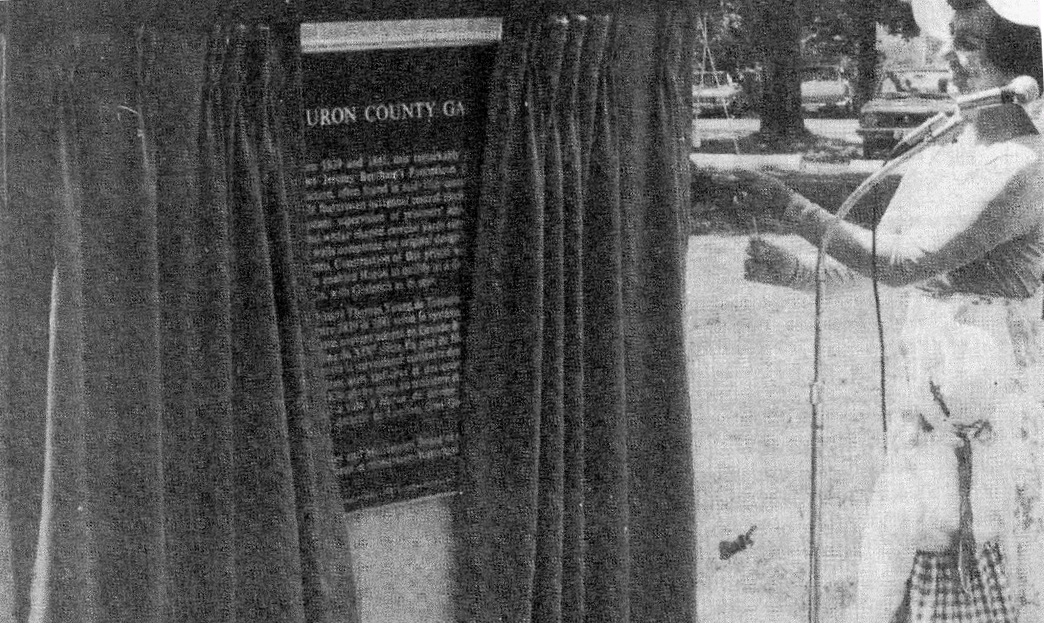
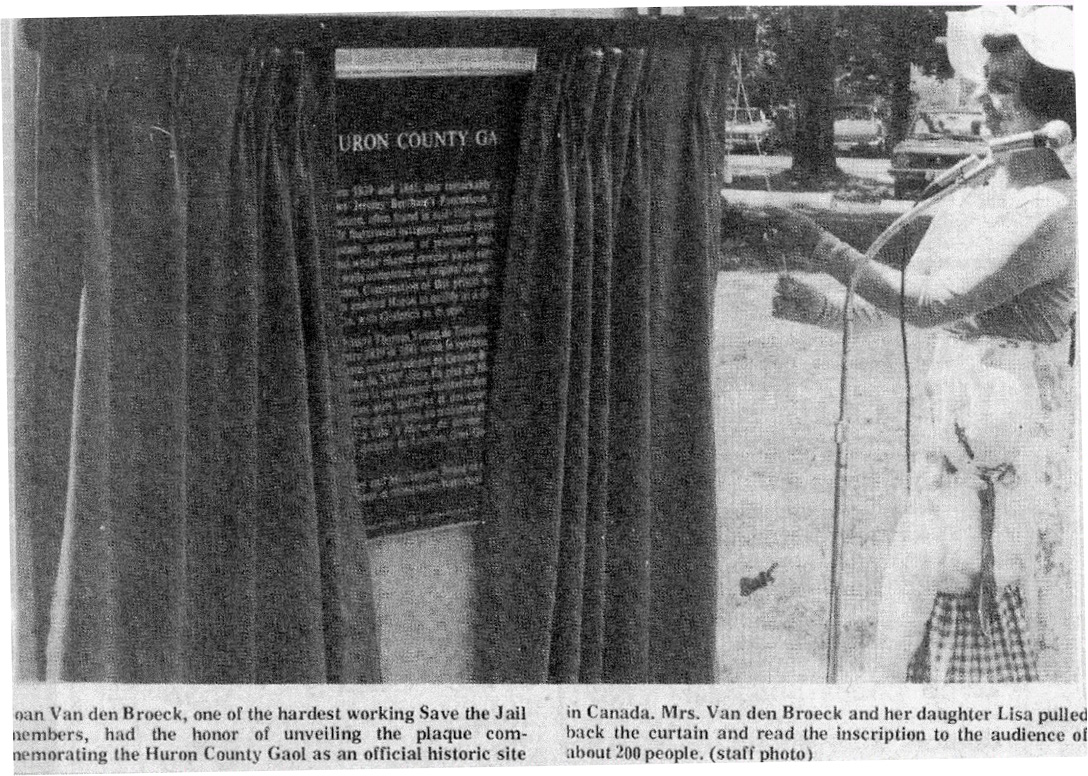 This great victory for the Save the Jail Society (now the Jail Board), was only the beginning for the Huron Gaol. On July 5, 1975, a massive celebration was held at the Gaol in Goderich to acknowledge the Gaol becoming designated a National Historic Site. The ribbon was cut to officially acknowledge the opening of the Huron Historic Gaol by Huron County Warden Mr. A. McKinley. The plaque detailing the Gaol’s historical significance was unveiled by none other than dedicated member Joan Van den Broeck.
The reason the Huron Historic Gaol stands to this day is not simply because of its historical value. This building is a symbol of the strength and dedication of the people of Huron County. Despite being sentenced to be destroyed, the Gaol was saved by the efforts of ordinary Huron County citizens who fought to preserve their history. The Gaol is not only a building which represents law and order within the County, but a reminder of how the County was incorporated and achieved its own independent settler municipal government and identity. Huron County was created by strength and unity, it seems only fitting its history was also saved by it.
Sources
Explore these sources through the online collection of Huron Historic Newspaper.
- “Jail an Attraction?”, The Exeter Times-Advocate, Nov. 25, 1971, pg 4.
- “Save Jail Wall”, The Brussels Post, Jan. 31, 1973.
- “And the Walls Came Down…Maybe”, The Exeter Times-Advocate, Feb. 8, 1972, pg 4.
- “Huron Council Clears Removal of Jail Wall”, The Huron Expositor, March 1, 1973, pg 1.
- “Letters to the Editor by Mrs. D. W. Collier Komoka”, Clinton News Record, March 15, 1973, pg 7.
- The Huron Expositor, April 12, 1973, pg 19.
- “Huron Reeves Vote to Save”, The Brussels Post, May 2, 1973, pg 9.
- “At County Council: Reeves Vote to Preserve Huron’s Historic Jail”, The Huron Expositor, May 3, 1973. Pg 1.
- “Jail House Blues Still Bother County”, Clinton News Record, June 7, 1973, pg 3.
- “Reeves Reject Bid for Use of Huron County Jail”, The Brussels Post, July 4, 1973, pg 13.
- “Tenders Let for Office”, The Blyth Standard, July 18, 1973, pg 1.
- “The Huron Gaol”, The Huron Expositor, June 1, 1978, pg 13.
Archival Material
- “Commemoration of Huron County Gaol”, July 5, 1975, pg 1-2.

by Sinead Cox | May 16, 2020 | Collection highlights, Exhibits, For Teachers and Students, Huron Historic Gaol, Uncategorized
Looking for a way to remotely visit the Huron County Museum or the Historic Gaol with your family or class? Here are some activities you can try using our virtual resources! Have questions about what you see and how it was used? Email museum@huroncounty.ca to talk to an expert!
HURON COUNTY MAIN STREET at the Huron County Museum
Click to visit our virtual exhibits, including Huron County Main Street! Can you find everything? Pick a favourite object that isn’t on the list, and ask others to find it!
360 TOUR at the Huron Historic Gaol
Go to the Huron Historic Gaol’s page and scroll to the bottom to find our 360 degree tour! Use the arrows and Level 1, Level 2, and Level 3 buttons to explore in all directions. Keep clicking to go inside the rooms, including a cell block. Found everything on the list? Play I spy with my little eye!

by Sinead Cox | May 15, 2020 | Huron Historic Gaol, Investigating Huron County History
In this two-part series, Curator of Engagement & Dialogue Sinead Cox illuminates how the Second World War entered the walls of the Huron Historic Gaol. Click here for Part One: The ‘Defence of Canada’ in Huron County.
In the summer of 1940, when the Netherlands fell to Nazi Germany, a ripple effect extending to the Great Lakes would unexpectedly commit thirteen “alien seamen” to the Huron Jail.*
At the outset of the Second World War in 1939, the Oranje Line, also known in Dutch as Maatschappij Zeetransport N.V, was a relatively new Dutch-owned transport company that serviced Great Lakes routes. The Line had only commenced operations in 1937, and its fifth vessel in the Great Lakes, the 2,800 ton diesel freighter Prins Willem III was the first deep sea motor ship to come inland; she embarked on her maiden voyage in September, 1939.
On May 9th, 1940 the Prins Willem III departed neutral Antwerp, Belgium on a routine commercial journey under Captain W. P. C. Helsdingen. In the course of one day, the ship’s professional routine would be abruptly shattered. The Prins Willem III was off the coast of Flushing when a German bomb hit the water about 200 yards from the ship and caused a huge explosion and towering pillar of water. Germany had invaded the Netherlands. Planes were flying high and out of sight, but the crew could hear the whining sound of bombs as they fell nearby. Targeted by a machine gun onslaught from Nazi fighter planes, the ship escaped via the English channel. After narrowly surviving with their lives and the boat intact to reach England, the Dutch crew would soon learn that the formerly neutral Netherlands had capitulated and their home country was now occupied by Nazi Germany.
The ship continued on its planned journey to North American waters, docking at Montreal, Duluth, Milwaukee and finally Chicago on June 25th , successfully delivering a cargo of seeds and twine. At Chicago, the crew awaited orders regarding their next destination. Meanwhile, members of the Dutch government, including Queen Wilhelmina, had fled to London, England. The government in exile required all Dutch merchant vessels abroad to now sail under the British Merchant marines, and to report to an allied port to join the war effort: which could include transporting provisions or armaments. Canada being the closest allied country, the Netherlands Shipping Commission ordered the Prins Willem III to return to Montreal and “then embark for some unnamed foreign port,” according to the Chicago Daily Tribune. 17 out of the 19 crew members refused the orders.
The crew’s actions seemed to defy easy categorization as conscientious objection or mutiny. Captain Helsdingen assured the Chicago press that the men were neither striking, mutinous, nor even refusing to do their assigned jobs aboard the ship, but the crew would not leave the neutral waters of the United States (which would not enter the war until after the bombing of Pearl Harbor in December, 1941). After their ordeal at the mercy of German bombs and guns, reluctance to return to a war zone aboard a ship that was not armed, and would not be provided an armed convoy, is hardly surprising. The Tribune quoted the crew as telling the captain, “If we cannot have weapons, we would rather spend our time in a United States jail than on the ocean.” They also feared for their families in a Nazi-occupied country and whether there could be reprisals against them—extending to arrests and transportation to concentration camps—for helping the allied cause by transporting munitions. According to the captain, the crew of the Prins Willem III feared Germany more than England.
The crew’s ‘sitdown strike’ left Commonwealth, Dutch and American authorities with no easy solutions. The standstill left most of the crew trapped on the ship, with only Captain Helsdingen legally permitted to go ashore. The crewmembers had no immigration documents to legally enter the United States, and because of the ongoing occupation of the Netherlands, the U.S. would not have been easily able to deport the sailors: thus Immigration authorities and the Coast Guard kept a close watch on the ship. The Captain could not take on an American crew to move the ship because of U.S. neutrality, and thus the Prins Willem III remained anchored unmoving at Navy Pier.
American newspaper reports emphasize that, rather than any assumed violent mutiny, the crewmembers were largely friendly and cheerful in their refusal to budge. During their months of isolation on board, the crew busied themselves cleaning, stripping and painting the masts, booms and deck, oiling “everything in sight, from door handles to winches,” and polishing every “spot of brass on the boat to glisten.” The Tribune declared when it finally left Navy Pier the Prins Willem III would probably be “the best painted, best oiled and best polished ship that ever left this port.” By September the crew’s plight had gained the sympathies of Dutch Chicagoans, who organized a committee to deliver care packages to the crew from pleasure boats.
The Dutch government-in-exile, the Oranje Line and Canadian authorities finally devised a solution in October: the Prins Willem III would take on a Canadian crew recruited from Montreal. Ten private police from the Pinkerton Detective Agency in the United States were hired to come aboard the ship with the fourteen Canadian crew-members to prevent resistance or sabotage, and the ship was escorted by the U.S. Coast Guard during its departure from Chicago. There was ultimately no violence from the crew confined below deck; according to Time Magazine, “internment in Canada looked better to the bored, sequestered Dutch than gazing at the Chicago skyline all day.” Their initial stop according to the American reports was to be an “unannounced Canadian destination,” later specified as an “Ontario Port.” That port was Goderich.
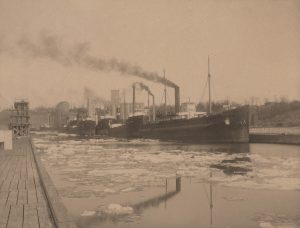
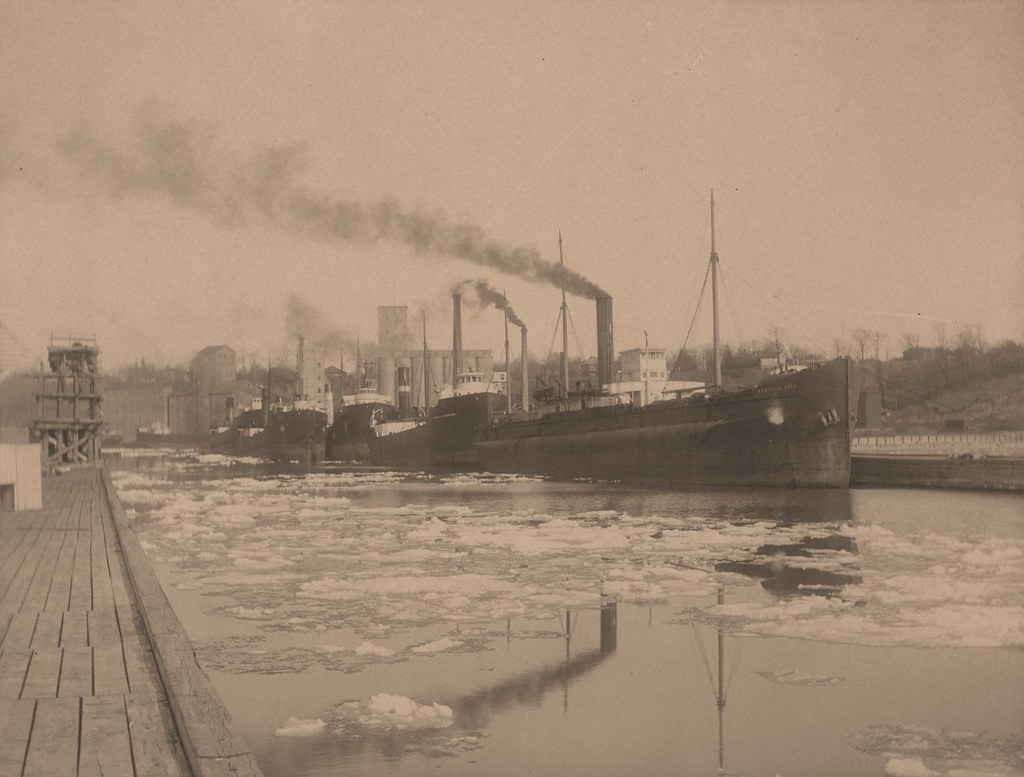
Ships in Goderich harbour, date unknown Photographer: Reuben R. Sallows (1855 – 1937)
On October 16th, 1940 the Prins Willem III—presumably painted, oiled and polished to perfection—arrived in the Goderich harbour. The secrecy surrounding the chosen port for the uncooperative crew’s disembarkment meant local customs workers were completely surprised by the ship’s unscheduled arrival, and began a tentative dialogue with Captain Helsdingen regarding next steps while further instructions from Ottawa were awaited. Again, the original crewmembers of the Prins Willem III were stuck in limbo on board, and again they made the most of it: according to the Clinton News-Record they came on deck “under the watchful eye of two [Pinkerton] detectives…getting great enjoyment out of perch fishing from the stern of the ship while they whistled modern American airs.” A local crowd of curious onlookers gathered at the harbour to gawk at the ship from a distance, and a host of exaggerated rumors quickly travelled throughout the community, including that the crew were held in irons and guarded by machine gun-wielding “G-men.”
Three days later, thirteen crew members quietly disembarked from the ship during the night, escorted by the RCMP in batches of no more than two men at a time.** Police vehicles delivered these men to the Huron Jail. The remaining crew changed their minds and agreed to sail with Captain Helsdingen and the Canadians. The Prins Willem III had vanished from the Goderich harbour by the next morning, and the Pinkerton Detectives caught a train back to Chicago.
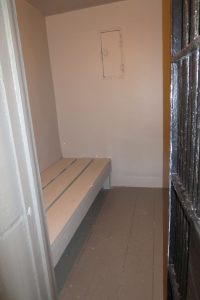
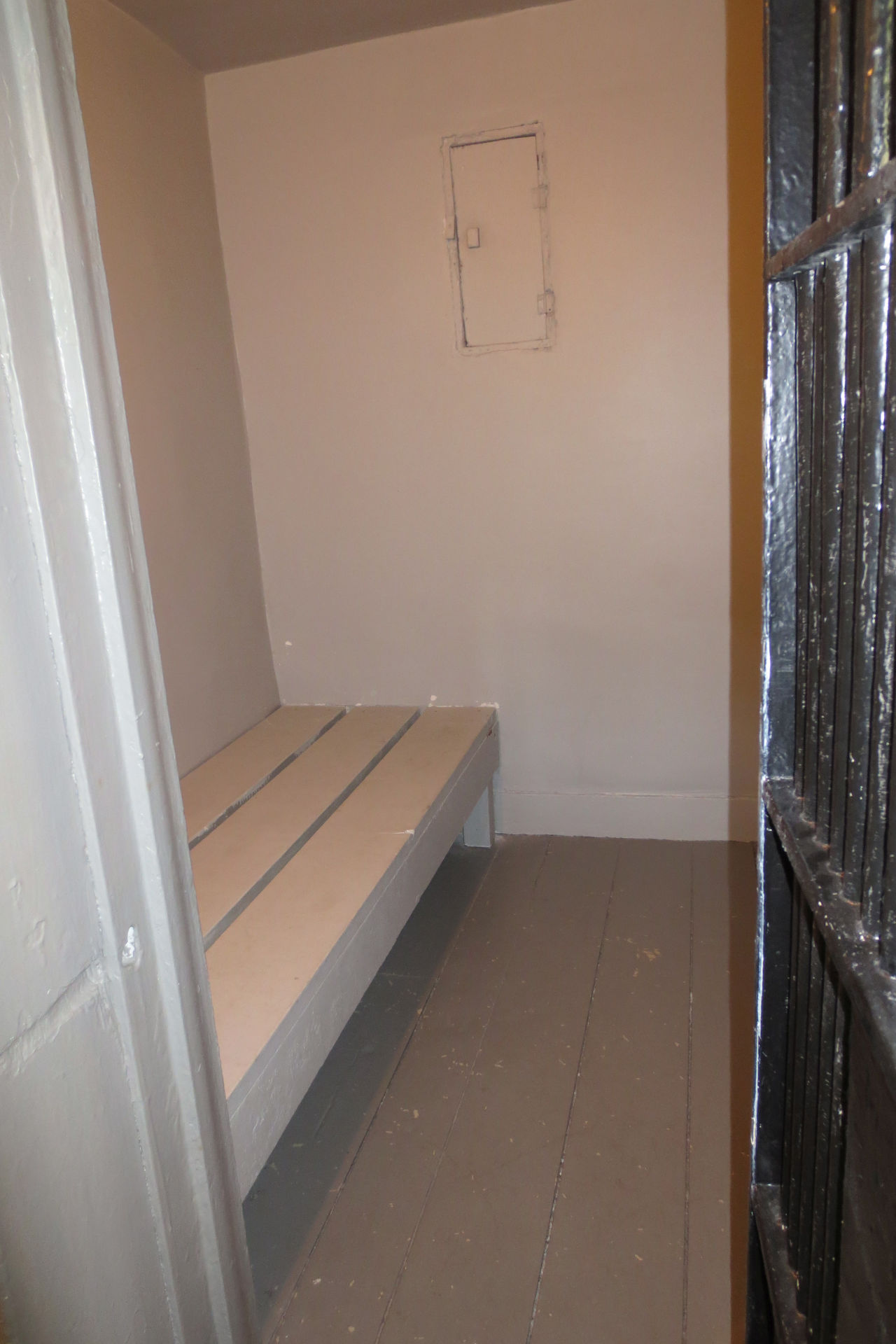
Cell in the Huron Historic Gaol.
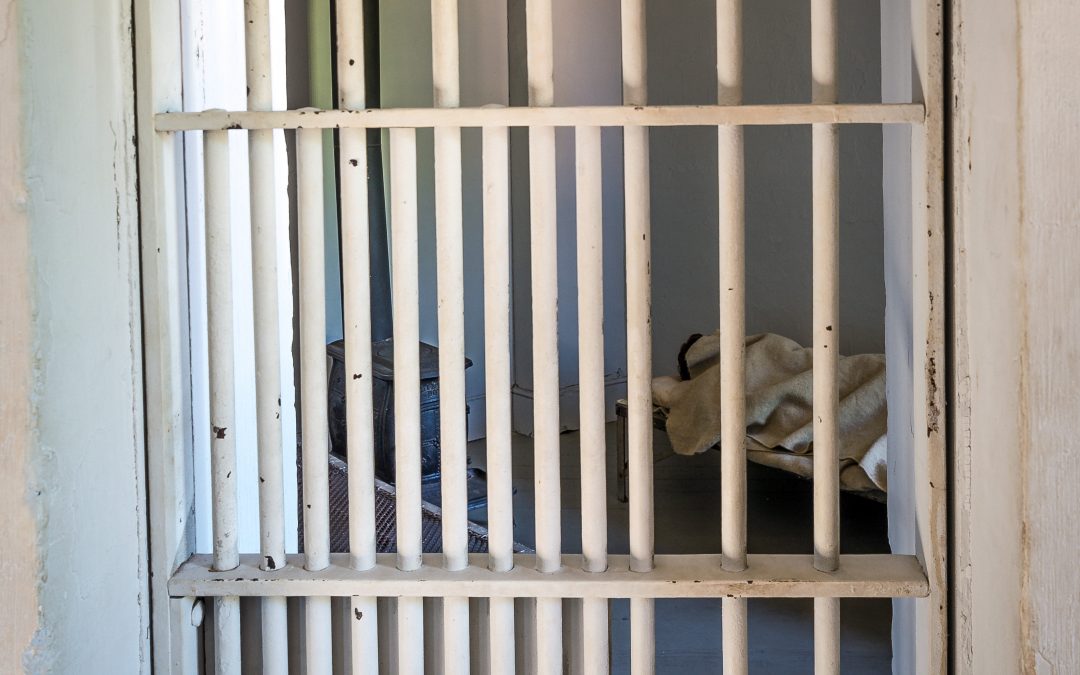
The crew’s confines on land might have been somewhat tighter and less comfortable than their previous situation on board the Prins Willem III. Detailed inmate records are not accessible from the 1940s, but regardless of how many prisoners were already ‘guests of the county’ at the time, the arrival of thirteen ‘alien seamen’ would have left the Huron Jail, which has only twelve cells, over-capacity and somewhat crowded. The crew, who may not have all spoken fluent English, would have received daily food rations worth 13 ¼ cents per inmate and would only be able to take fresh air from inside the jail’s walled courtyards.
The thirteen Dutchmen remained in jail for three weeks, until removed under RCMP guard on the afternoon of Saturday, November 9th; they left Goderich by rail. Their destination upon leaving Huron County was once again a mystery to the media and the public, but widely assumed to be a Canadian internment camp, where POWs, Jewish refugees from Europe, and civilian ‘enemy aliens’ of differing loyalties could be forced to cohabitate.
Captain Helsdingen and the Prins Willem III continued on to Montreal to enter into the service of the allies as originally ordered by the Dutch government-in-exile so many months earlier. The temporary Canadian replacements would eventually be relieved by a Dutch crew, and the boat outfitted with anti-aircraft guns and machine guns, but the Captain was to face continued refusals of work from his crew throughout the war. Confirming the original crew’s fears, an aerial torpedo struck the Prins Willem III off the coast of Algiers in March, 1943; the ship later capsized and sank, resulting in eleven deaths. None of the original crew from the Chicago sojourn were amongst the lives lost.
The international incident caused by the Prins Willem III in the Great Lakes may be largely forgotten today, but the plight of its crew demonstrates that the North American homefront was not always as peaceful or untouched by the conflict in Europe as we might imagine. Overnight, the capitulation of the Netherlands had left the crew of the Prins Willem III in a precarious situation after enduring a surely traumatizing ordeal during the Nazi invasion on May 10th, 1940. Facing uncertainty in the custody of North American authorities, versus what they might have deemed as an almost certain death re-entering a war zone without adequate protections, they took action (or rather inaction) that stymied multiple governments and brought the repercussions of the Second World War to an ‘Ontario Port’ as apparently nondescript as ours.
*A note on spelling: Jail & gaol are alternative spellings of the same word, pronounced identically. Both spellings were used throughout the history of the Huron Historic Gaol fairly interchangeably. Although as a historic site the Huron Historic Gaol uses the ‘G’ spelling more common to the nineteenth century, for this article I have chosen to employ the ‘J’ spelling that appeared more consistently in the 1940s.
** Newspaper reports record 16 crew members jailed, but the Jailer’s Report to Council for 1940 recorded 13 “alien seamen,” and this is also the number given by Martine van der Wielen-de Goede, who reviewed crewmembers’ testimonies later in London (see sources below).
Special thanks to Alana Toulin & Christina Williamson for research assistance that made this blog post possible!
Further Reading
Internment in Canada via the Canadian Encyclopedia: https://thecanadianencyclopedia.ca/en/article/internment
Internment resources from Library and Archives Canada: https://www.bac-lac.gc.ca/eng/discover/politics-government/Pages/thematic-guides-internment-camps.aspx
Secondary Sources
Gillham, Skip, “The Oranje Line,” Telescope, Volume XXX, No. 5. (Sept-Oct 1981), pg 116-117.
Malcolm, Ian M, Shipping Losses of the Second World War, (Brinscombe Port Stroud: The History Press, 2013).
van der Wielen-de Goede, Martine, “Varen of brommen Vier maanden verzet tegen de vaarplicht op de Prins Willem III, zomer 1940,” Tijdschrift voor Zeegeschiedenis, No. 1 (Jan. 2008) Via https://docplayer.nl/173449011-Ten-geleide-tijdschrift-voor-zeegeschiedenis.html
Sources: Articles
“At Sea: Open Lanes.” Time Magazine, October 21, 1940, pg 29.
“Canada Jails 16 Dutch Seamen After Mutiny.” Chicago Daily Tribune, October 11, 1940.
“Dutch Crew Jailed.” The Wingham Advance-Times, October 17, 1940.
“Dutch Sailors Removed.” Huron Expositor, November 15, 1940.
“Dutch Sailors to Jail.” Clinton News-Record, October 24, 1940.
“Dutch Freighter Arrives in Goderich.” Clinton News-Record, October 17, 1940.
“Escapes Bombing; Reaches Chicago: Unloads Seeds, Twine.” Chicago Daily Tribune, June 27, 1940.
“Explains Dutch Sailors’ ‘strike’: They Fear Nazis.” Chicago Daily Tribune, July 28, 1940.
“Members of Crew Interned.” The Seaforth News, October 17, 1940.
“Sitdown Strike Strands Dutch Ship in Chicago.” Chicago Daily Tribune, July 26, 1940.
“Stranded Dutch Ship Sails with Canadian Crew: Idle Force Lets Sailors Aboard Quietly.” Chicago Daily Tribune, October 8, 1940.
“Strikers Mark Time.” Chicago Daily Tribune, July 27, 1940.
Wilson, Edward. “Aye, There’s Rub to Life Aboard Dutch Freighter: Crew Keeps Busy Polishing and Painting Ship.” Chicago Daily Tribune, September 7, 1940.
by Sinead Cox | May 7, 2020 | Huron Historic Gaol, Investigating Huron County History
In this two-part series, Curator of Engagement & Dialogue Sinead Cox illuminates how the Second World War impacted Huron County in unexpected ways at home, and even entered the walls of the Huron Historic Gaol. Click for Part Two, and the strange tale of how Dutch sailors became wartime prisoners in Huron’s jail.
During the Second World War, Canada revived the War Measures Act: a statute from the First World War that granted the federal government extended authority, including controlling and eliminating perceived homegrown threats. The Defence of Canada Regulations implemented on September 3, 1939 increased censorship; banned particular cultural, political and religious groups outright; gave extended detainment powers to the Ministry of Justice and limited free expression. In Huron County, far from any overseas battlefields, these changes to law and order would bring the Second World War closer to home.
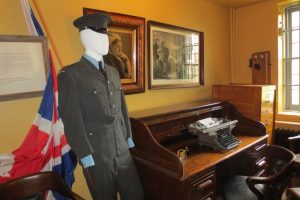 Regulations required Italian and German-born Canadians naturalized as citizens after 1929 (expanded to 1922 the following year) to formally register as ‘enemy aliens’ and report once a month. In Huron County, jail Governor James B. Reynolds accepted the appointment of ‘Registrar of Enemy Aliens’ in the autumn of 1939, and the registration office was to operate from the jail in Goderich. There were also offices in Wingham, Seaforth and Exeter managed by the local chief constables of the police force.
In addition to its novel function as the alien registration office, the Huron Jail also housed any prisoners charged criminally under the temporary wartime laws. Inmate records from the time period of the Second World War cannot be accessed, but Reynolds’ annual reports submitted to Huron County Council indicate that one local prisoner was committed to jail under the ‘Defence of Canada Act’ in 1939, and there were an additional four such inmates in 1940. The most common charges landing inmates behind bars during those years were still typical for the county: thefts, traffic violations, vagrancy and violations of the Liquor Control Act (Huron County being a ‘dry’ county).
Frank Edward Eickemier, the lone individual jailed under the War Measures Act’s Defence of Canada regulations in 1939, was no ‘alien,’ but the Canadian-born son of a farm family in neighbouring Perth County. Nineteen-year-old Eickemier pled guilty to ‘seditious utterances’ spoken during the Seaforth Fall Fair, and received a fine of $200 and thirty days in jail (plus an additional six months if he defaulted on the fine). The same month the Defence of Canada regulations took effect, Eickemier had publicly proclaimed that Adolph Hitler’s Nazi Germany was undefeatable, and that if it were possible to travel to Europe he would join the German military. He fled the scene when constables arrived, but was soon pursued and arrested for “statements likely to cause disaffection to His Majesty [King George VI] or interfere with the success of His Majesty’s forces.” His crime was not necessarily his political views, but his disloyalty. The prosecuting Crown Attorney conceded, “A man in this country is entitled to his own opinion, but when a country is at war you can’t go around making statements like that.”
Bruce County law enforcement prosecuted a similar case in July of 1940 against Martin Duckhorn, a Mildmay-area farm worker employed in Howick Township, and alleged Nazi sympathizer. Duckhorn had been born in Germany, and as an ‘enemy alien’ his rights were essentially suspended under the War Measures Act, and he thus received an even harsher punishment than Eickemier: to be “detained in an Ontario internment camp for the duration of the war.”
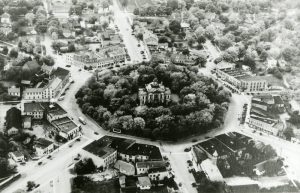
Huron County Courthouse & Courthouse Square, Goderich c1941. A991.0051.005
In July of 1940, the Canadian wartime restrictions extended to making membership in the Jehovah’s Witnesses illegal. The inmates recorded as jailed under the ‘Defence of Canada Act’ in Huron that year were likely all observers of that faith, which holds a refusal to bear arms as one its tenets, as well as discouraging patriotic behaviours. That summer, two Jehovah’s Witnesses arrested at Bluevale and brought to jail at Goderich ultimately received fines of $10 or 13 days in jail for having church publications in their possession. Four others accused of visiting Goderich Township homes to discourage the occupants from taking “any side in the war” had their charges dismissed—due to a lack of witnesses. In 1943, the RCMP and provincial police collaborated to arrest another three Jehovah’s Witnesses in Goderich Township for refusing to submit to medical examinations or report their current addresses (therefore avoiding possible conscription); the courts sentenced the three charged to twenty-one days in the jail, afterwards to be escorted by police to “the nearest mobilization centre.”
By August of 1940, an item in the Exeter Times-Advocate claimed that RCMP officers were present in the area to ‘look up’ those individuals who had failed to comply with the law and promptly register as enemy aliens. A few weeks later, the first Huron County resident fined for his failure to register appeared in Police Court. The ‘enemy alien’ was Charles Keller, a 72-year-old Hay Township farmer who had lived in Canada for 58 years, emigrating from Germany as a teenager in 1882. According to his 1949 obituary in the Zurich Herald, Keller was the father of nine surviving children, a member of the local Lutheran church, and had retired to Dashwood around 1929. His punishment for neglecting to register was not jail time, but the fine of $10 and costs (about $172.00 today according to the Bank of Canada’s inflation calculator).
Although incidences of prosecution under the ‘Defense of Canada Act’ in Huron County were few, the increased scrutiny and restrictions would have been felt in the wider community, especially for those minority groups and conscientious objectors directly impacted. Huron had a notable number of families with German origins, especially in areas like Hay Township where you can still see the tombstones of many early settlers written in German. The Judge who sentenced Frank Edward Eickemier for his public support of the Nazi regime in 1939 made a point of accusing him of casting a ‘slur’ on his ‘people’ and all German Canadians: the actions of the individual conflated with a much larger and diverse German community by a representative of the law. His case indicates that pro-fascist and pro-Nazi sentiment certainly did exist close to home, but a person’s place of birth or their religion was not the crucial evidence that could define who was or was not an ‘enemy.’
Next Week: Click for Part Two, and the strange tale of how stranded Dutch sailors ended up prisoners in the Huron County Jail during the Second World War.
*A note on spelling: Jail & gaol are alternative spellings of the same word, pronounced identically. Both spellings were used throughout the history of the Huron Historic Gaol fairly interchangeably. Although as a historic site the Huron Historic Gaol uses the ‘G’ spelling more common to the nineteenth century, for this article I have chosen to employ the ‘J’ spelling that appeared more consistently in the 1940s.
Further Reading
The War Measures Act via the Canadian Encyclopedia
Sources
Research for this blog post was conducted largely via Huron’s digitized historical newspapers.
“Faces Trial on Charge of Making Disloyal Remark.” Seaforth News, September 28, 1939.
“German Sympathizer Interned.” The Wingham-Advance Times, July 25, 1940.
“In Police Court.” Seaforth News, August 29, 1940.
“Jehovah’s Witnesses Charged.” Zurich Herald, October 21, 1943.
“Jehovah’s Witnesses Fined at Goderich.” The Wingham-Advance Times, August 22, 1940.
“Jehovah’s Witnesses Refused Bail.” The Wingham Advance-Times, July 18, 1940.
“Looking Up Aliens Who Failed to Register.” The Exeter Times-Advocate, August 1, 1940.
“Police Arrest ‘Jehovah’s Witnesses.’” Seaforth News, June 27, 1940.
“Statement He Would Fight for Hitler Proves Costly.” The Wingham-Advance Times, October 5, 1939.
“To Register German Aliens.” The Seaforth News, October 12, 1939.
“Twenty-One Days.” The Lucknow Sentinel, October 28, 1943.
“Would Fight for Hitler-Arrested.” The Wingham Advance-Times, September 28, 1939.