Forgotten Faces of Huron Remembered
The Huron County Museum’s temporary exhibit Forgotten: People and Portraits of the County features unidentified portraits captured by Huron County photographers. In addition to the onsite exhibit, photos are shared in an online exhibit and Facebook group in hopes that some of these ‘Forgotten’ faces will remembered and named. Curator of Engagement & Dialogue Sinead Cox shares highlights of the exhibit’s remembering efforts so far.
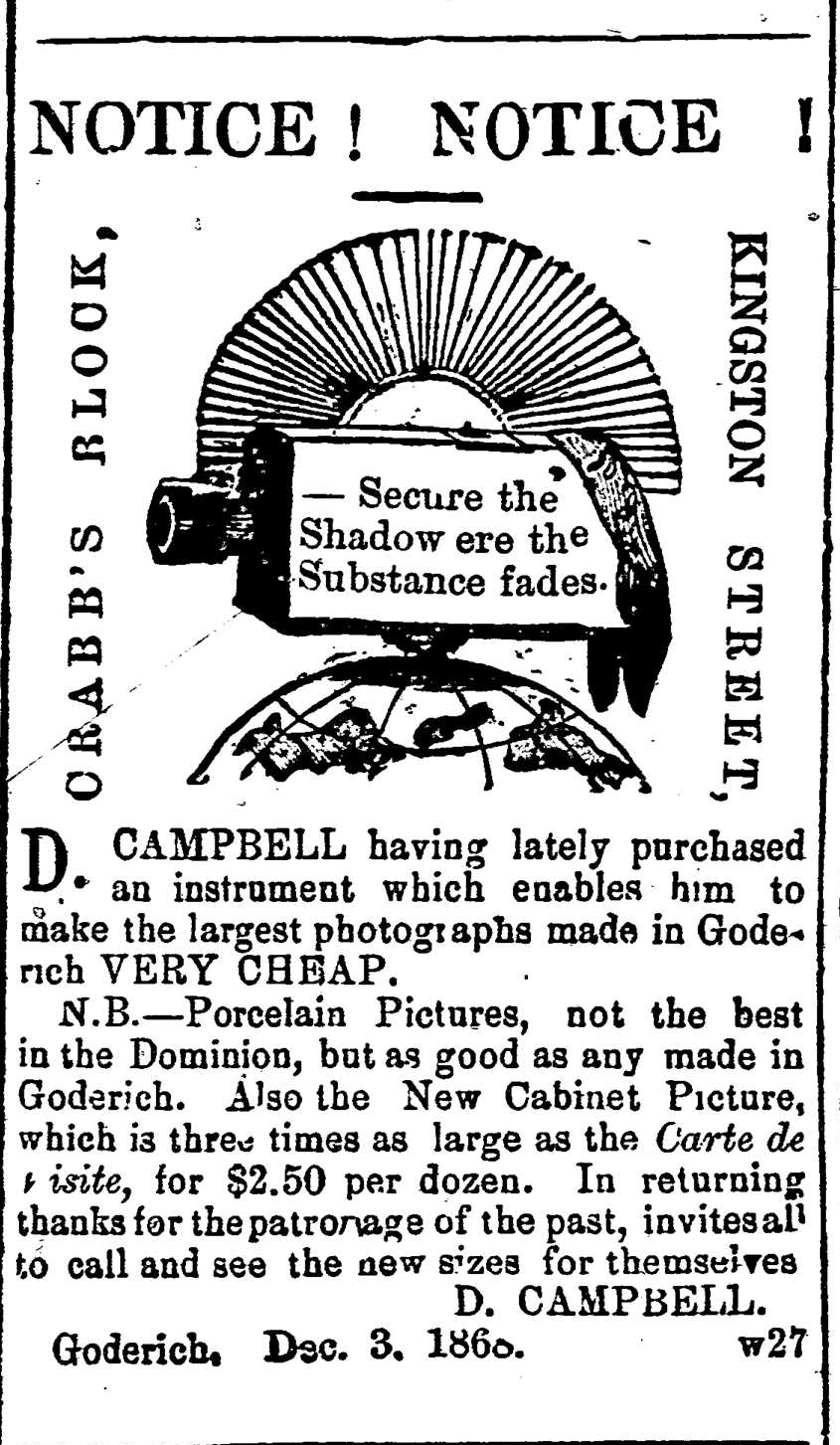
Semi-Weekly Signal, (Goderich) 07-27-1869 pg 2
The Huron County Museum has an incredible collection of photographs in its Archives – especially studio portraits from commercial photographers within Huron County (spanning the county from Senior Studio in Exeter, Zurbrigg in Wingham, and everywhere in between). Not all of these photographs came with identifying information for their subjects, or even known donors or photographers. The Forgotten exhibit has provided an opportunity to delve deeper into the clues that can be present in everything from associated family trees to fashion styles, photographer’s marks, and photography methods that can provide more context, narrow timelines, or even lead to the re-discovery of names. I am especially grateful for the enthusiastic participation we have already had from photo detectives from the public who have contributed to remembering Huron County’s ‘Forgotten’ faces. Hopefully this is just the beginning of adding value to our collection.
Professional studio photographs were often (and still are!) sent as gifts to family and friends. Local photographers saved negatives to sell reprints at a later date, and these negatives were also sometimes inherited when a studio changed hands. It’s very possible your own family photo collection contains the duplicate of a photo that exists in the possession of an archive or a distant relation somewhere else in the world. Finding matches between the faces in those photos is one way to solve photographic mysteries, and why a shared space to upload and comment on photos, like the Forgotten Facebook group, has the potential to put names to faces even after more than a century has passed since the camera flash!
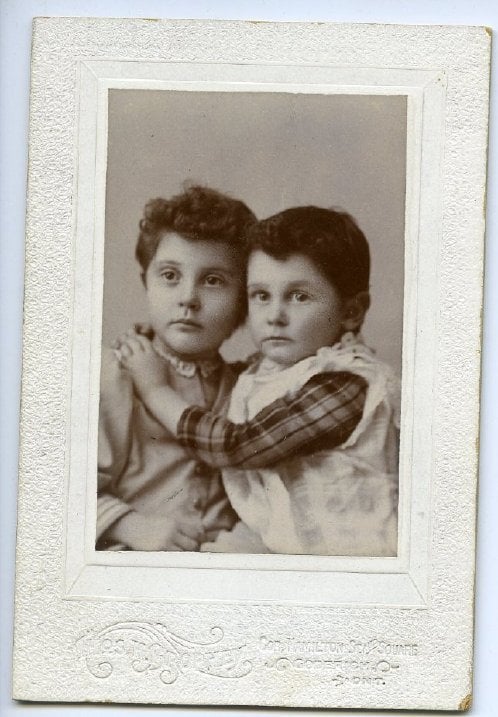
2011.0013.020. Photograph
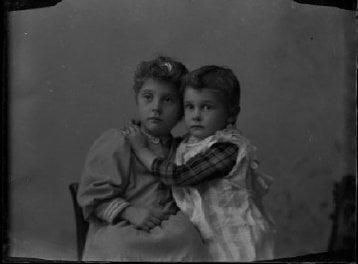
2017.0013.011. Glass negative
During preparation for the exhibit, staff recognized that a photograph and a glass negative from unrelated donations depicted the same image of a pair of children (their nervous expressions at having their photo taken were difficult to miss). The photo and negative came to the museum from different donors, six years apart. Information provided with the donation of the photograph indicates that these children may be related to the McCarthy and Hussey families of Ashfield Twp and Goderich area; the studio mark for Thos. H. Brophey is also visible on its cardboard mount, dating the image approximately between 1896 and 1904. The matching negative came from a collection related to Edward Norman Lewis, barrister, judge and MP from Goderich. The shared connection between the donations provides one more clue to help identify the unnamed children, and gives the negative meaning and value (through a place, time and potential family connection) it didn’t previously have without the photograph’s added context. You can see both the photograph and the negative on display in the temporary Forgotten exhibit, which is on at the Museum until fall 2022.
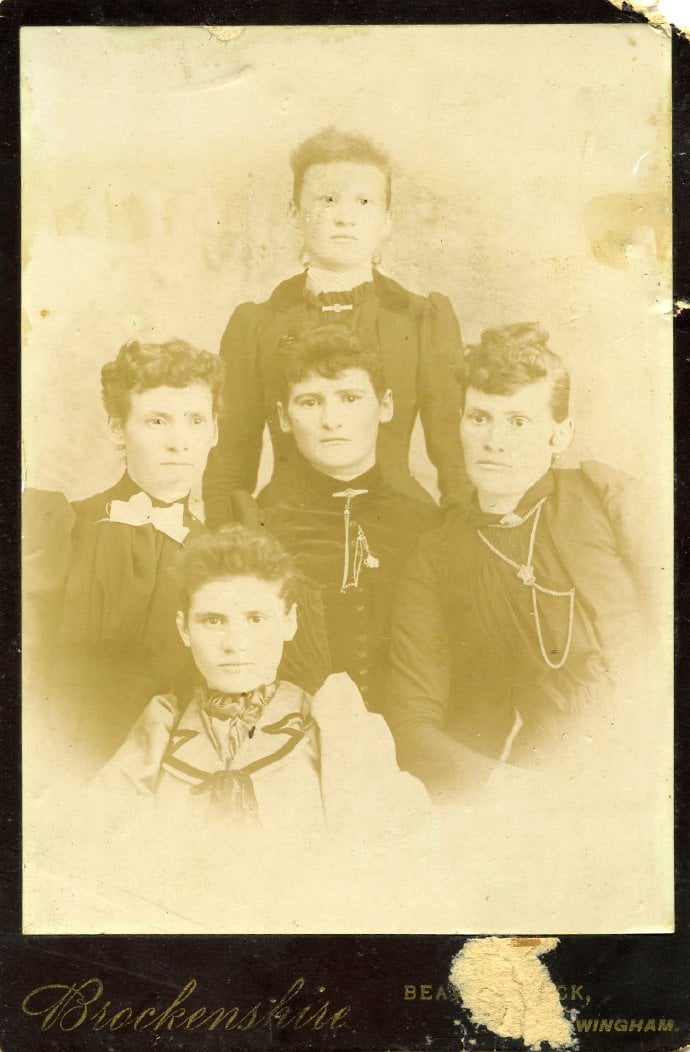
2021.0053.006. The “Garniss sisters”: Sarah Ann, Elizabeth, Eliza Maria Ida, Jemima, Mary Lillian. Can you help us identify which sister is which?
Sometimes photographs arrive to the collection with partial identifications or known connections to a certain family, even when individual names are missing. In those cases, knowledge of family histories can help pinpoint who’s who. Members of the Facebook group were recently able to name all five Morris Township women identified as only the “Garniss sisters” on the back of a photo from Brockenshire Studio, Wingham.
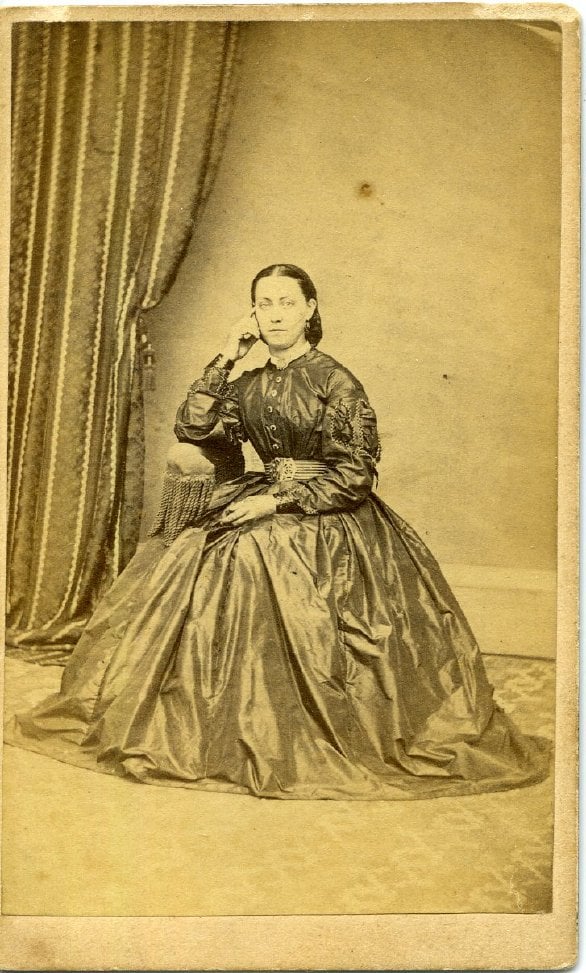
A996.001.095
Patterns tend to emerge with access to larger collections from the same location or time period. Although studio photographers later in the 19th century prided themselves on offering a large selection of backdrops, photos from local studios in the 1860s and 1870s often show a more simple set-up. In posting the ‘Forgotten’ photos online, I noticed that the studio space of Goderich photographer D. Campbell can be recognized by the consistent presence of a striped curtain in the background (and more often than not the same tassel-adorned chair) and a distinctive pattern on the floor, as seen in both the photos above and below. This helped identify additional photographs as Campbell’s work, and therefore place them in Goderich circa 1866-1870 , even when a photographer’s mark or name was absent from they physical photo.
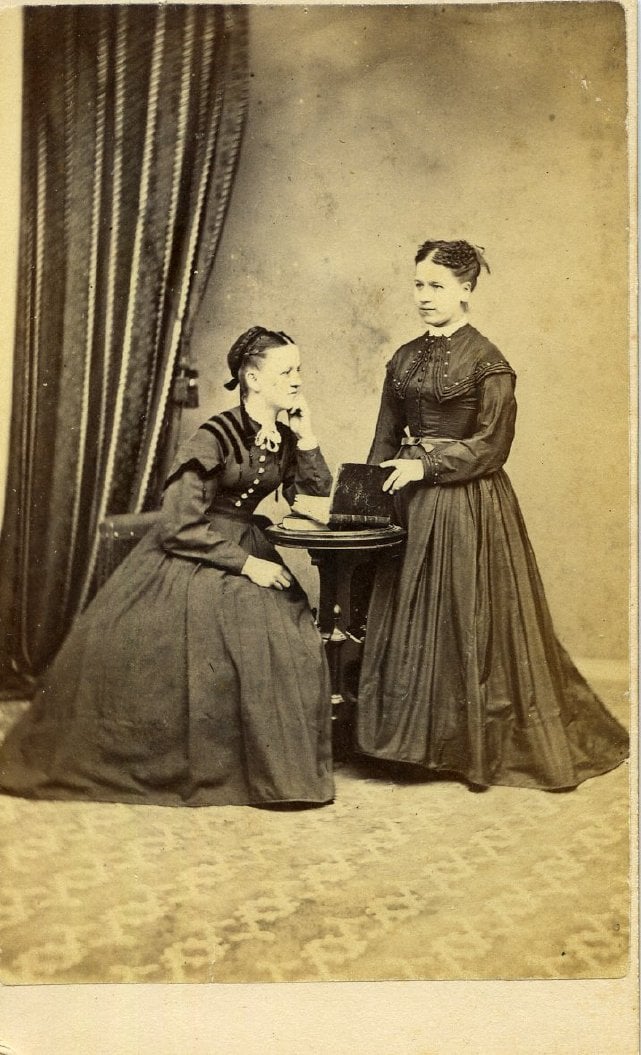
A996.001.071. This photograph is labelled as “the Miss Henrys.” Do you have any information that might reveal their first names?
Crowdsourcing information through the online exhibit and group has allowed fresh pairs of eyes to notice detail previously missed in some of the museum’s photos, even when the evidence was captured by the staff doing the scanning and cataloguing work. In November, the Facebook group spotlighted unidentified soldiers, and one of the members pointed out a photographer’s mark embossed on the bottom right corner of a group photo. Staff were able to look at the original photo to get a clearer look to confirm the studio was identified as “G. West & Sons, Godalming.” Godalming is a town in Surrey, England near Witley Commons, which hosted many Canadian soldiers during the First and Second World Wars.
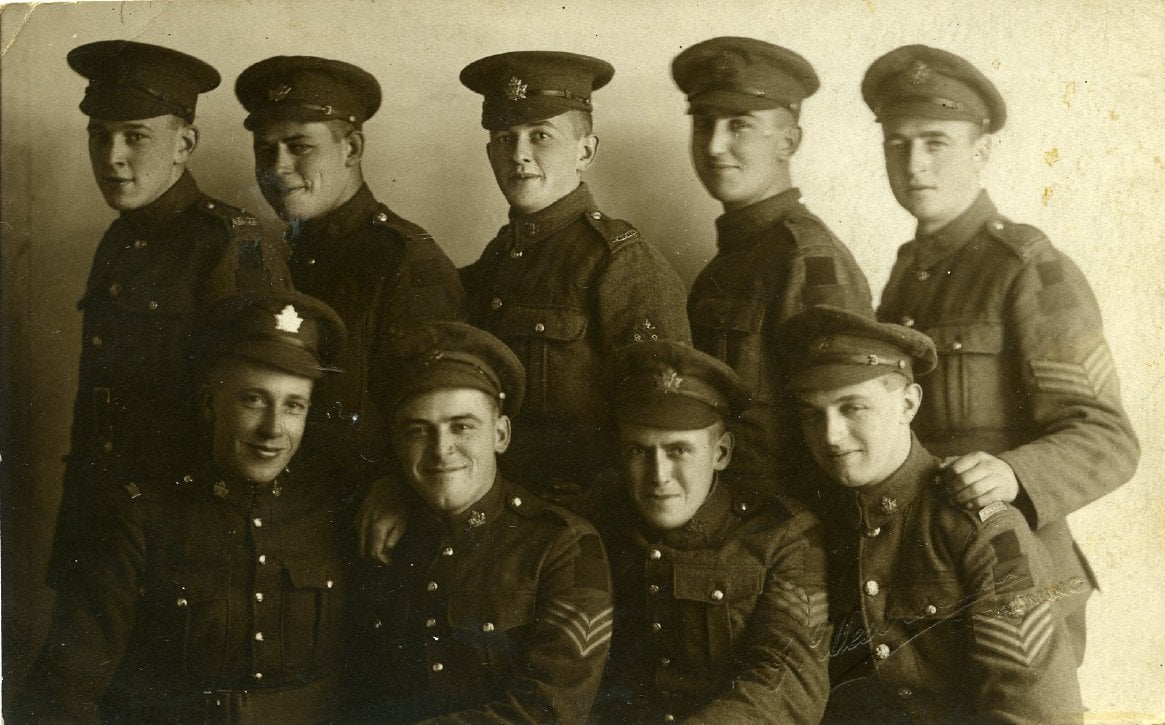
2004.0044.005. Photographer: G. West & Sons, Godalming, Surrey, U.K.
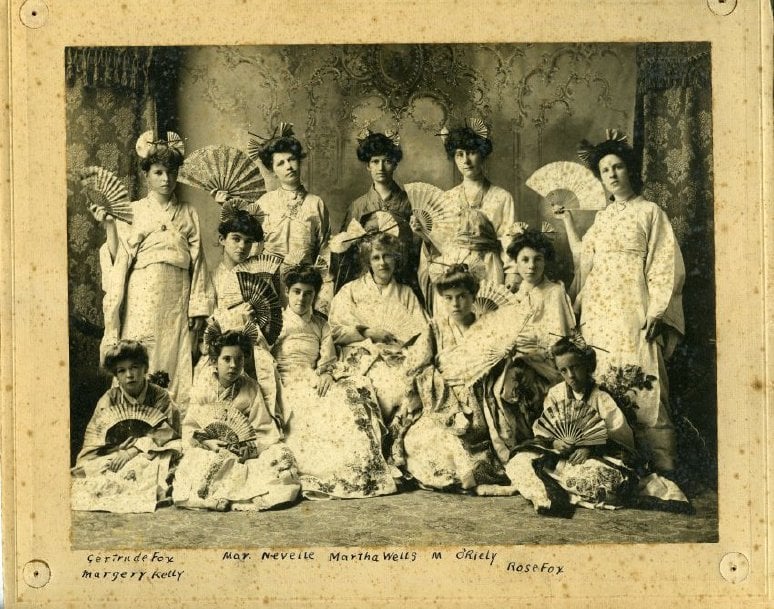
A950.1740.001
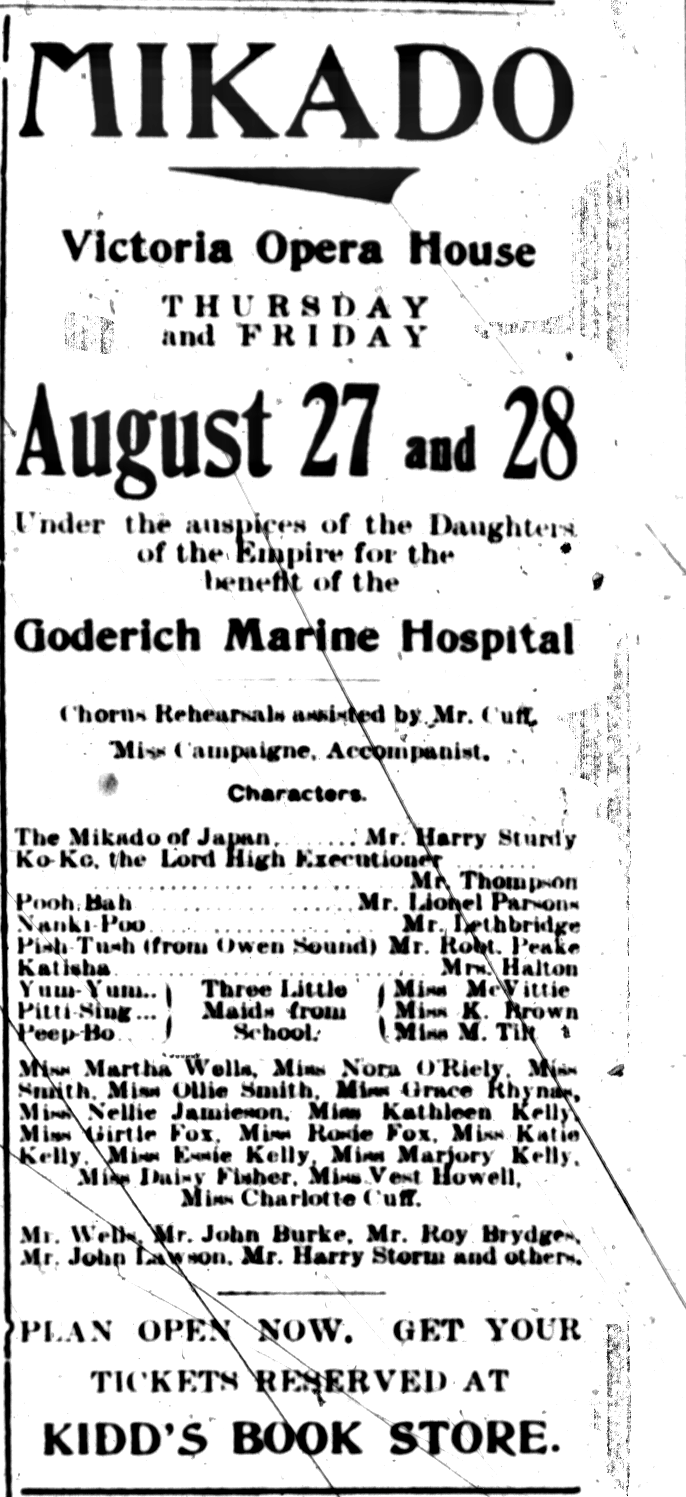
The Signal 08-27-1903 pg 8.
Comparing photographs with other readily available local historical resources like Huron’s digitized newspapers can also help provide new insight. Partial identifications on a group photo of young women in theatrical costumes without a location allowed a group member to link it to a 1903 Goderich production of Gilbert & Sullivan’s The Mikado. Further research in the newspapers provided a full list of the names of the participating cast and more information about the production, which toured Huron County. This information is now attached to the photograph’s catalogue record to benefit future researchers.
Although many historical photos may be ‘Forgotten’, if they are preserved and housed they are not lost. They still retain the potential for remembering , and to be re-connected to descendants and communities through extant clues and the growing possibilities of digitization and online sharing. For more highlights from the exhibit and tips for identifying mystery subjects photos or caring for your own collections, join is Feb. 9, 2022 for the second webinar in our exhibit series: Forgotten in the Archives.
If you can help identify a ‘Forgotten’ face, email us at museum@huroncounty.ca!
For more on the Forgotten: People & Portraits of the County exhibit and related coming events: