The Huron County Museum and Historic Gaol’s Museum Technician Assistant Dana Lumby shares how she created the museum’s donation box.
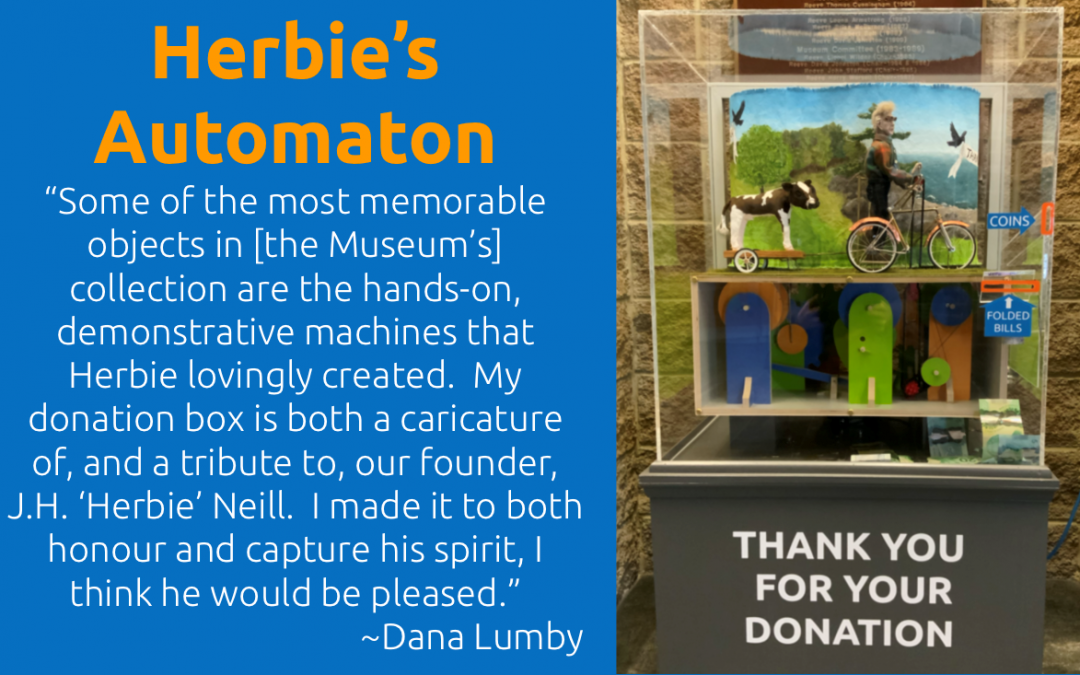
Creating the museum’s donation box has been one of my favourite projects. I was tasked to make an interactive donation box that would provide some sort of visual “reward” in exchange for a donation. I did not have to look very far to find inspiration. As many of you will already know, our founding Curator J.H. “Herbie” Neill was a maker and a tinkerer. He left us with a collection of handmade, hands-on, demonstrative machines that visitors have been encouraged to animate since the Museum opened in 1951. (Unfortunately, given the current pandemic, visitors are temporarily unable to touch Mr. Neill’s machines, as these artifacts cannot be sanitized.) The donation box features a miniature Herbie Neill pedaling his custom, hand-pedaled bicycle through the countryside while towing our unofficial mascot, the two-headed calf. Depositing a coin, or a folded bill, in the respective slot starts the mechanism and also triggers a recording of our orchestral regina.
Herbie’s articulated body was carved from basswood and his face and hands were sculpted using polymer clay. I painted the clay to give him a realistic skin tone, added a gloss varnish to his eyes, and created a miniature wig out of rabbit fur, then gave him a tiny haircut. I created the special glasses, with copper and solder, to replicate the ones that Mr. Neill modified to protect his eyes. He suffered from sensitivity to light and added the metal shade to his glasses to help. You can see Mr. Neill’s actual modified glasses on display in the Neill Gallery at the Huron County Museum. I made his clothing from upcycled fabrics, including a pair of my own jeans.
Because Mr. Neill suffered from mobility issues, he fabricated a special hand-pedaled bicycle for himself using bike parts and repurposed metal objects. I recreated his vehicle in miniature, working from a photograph. The wheels were made with a slice of 4” pvc piping, stainless steel wire, black electrical wire, epoxy and sugru – which is a moldable glue that remains flexible when cured. The body of the bicycle was made with various dimensions of miniature brass tubing.
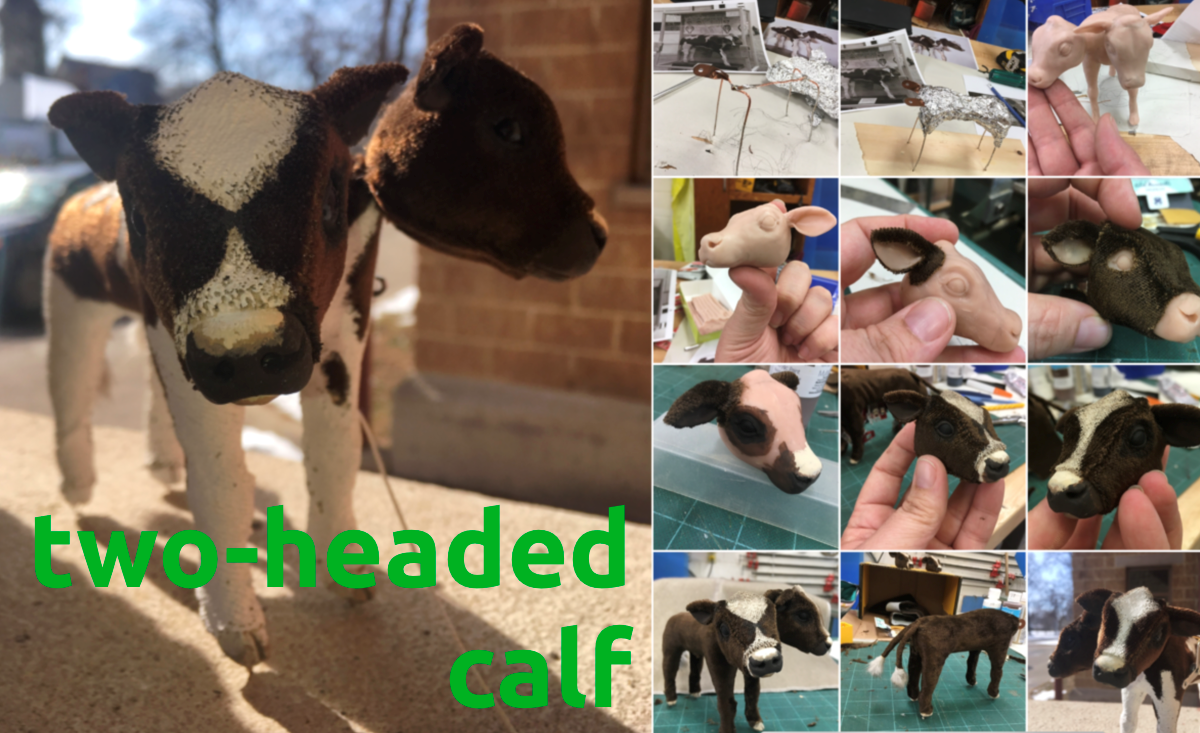
The two-headed calves were made of polymer clay on a metal armature. I covered them with a velvet fabric to mimic fur and painted the uncovered bits. I modeled the painted markings after one of our two-headed calves. When animated, one calf nods yes and the other no. I affectionately refer to them as Beau and Vinnie.
Once the models of Mr. Neill, the calves and the bicycle were finished, I set to work creating a set of wooden gears and cogs that would set them in motion. There was a lot of trial and error, taking apart and putting back together, and one very messy workbench, but I eventually figured it out. “Herbie” pedaled, the bike and trailer wheels turned, the calves disagreed with one another, and the hand-painted background scrolled by, all with the turning of a single crank.
Once the mechanics of getting everything moving had been figured out, I had to find a way to pair the contraption with some circuitry so the action would be triggered each time a donation was made. I knew I wanted it to work when either a coin or a bill were inserted, so I decided to use two different switches. I chose an infrared interrupt switch (which senses a break in its infrared beam when something passes through it) for the bills*, and a mechanical coinswitch (not unlike what you would find in a pinball machine) to sense the coins. I wrote a simple program using Arduino that plays an MP3, and powers the motor for a set amount of time when either of the switches are triggered. I had never used Arduino before, but it was relatively easy to teach myself using the resources on the Arduino website, and the forums and tutorials on the sparkfun website. Sparkfun has lots of information, great components and reasonable prices, but they are an American company so I sourced their products via these Canadian distributors: Digi-Key and Elmwood
*Fun Fact: Canadian polymer bills are not quite opaque enough to block an infrared beam, which is why you are asked to fold your bill before inserting.
Here is a video of the donation box in action, or come and see the real thing in the front lobby of the museum! Click here for information about visiting the museum.
What discoveries await you in Huron’s newly digitized historical newspapers? Special Project Coordinator Jeremy Dechert introduces Project Silas! Stay tuned for more updates, search tips and highlights.
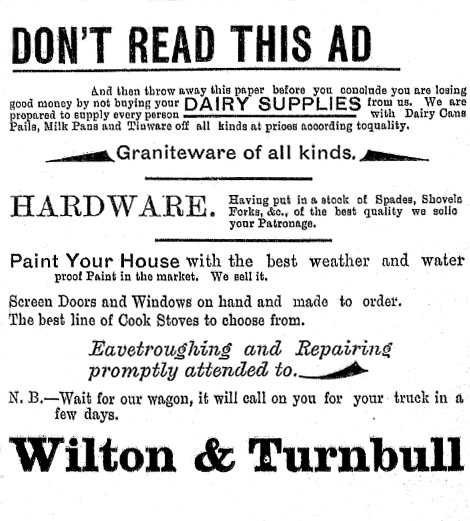
From The Brussels Post, Nov. 18, 1898.
The Huron County Library, in partnership with the Huron County Museum, has been digitizing, OCRing (optical character recognition technology which reads and transcribes images) and publishing historical newspapers from communities across Huron County. Codenamed Project Silas, this initiative is aimed at assisting both academic and casual researchers in their quest for knowledge of Huron County’s past. Local newspapers are robust sources of historical information due to their consistent and specific reporting on particular persons, events, and places. Digitizing newspapers which were previously on microfilm and allowing them to be text searchable further democratizes public information and saves researchers countless hours of work and frustration by making multiple papers available from the comfort of your own home.
Cultural Services staff at the County of Huron have worked diligently to both build the project structure and process and post newspapers from the towns and villages of Blyth, Exeter, Goderich, and Wingham so far. I took over the project at the beginning of this month, and have recently added papers from Brussels to the website. Papers from Clinton and Seaforth are soon to follow. By the end of 2017 we hope to have additional papers from Zurich, Gorrie, Wroxeter, and Goderich on the website as well.
Stay up-to-date on the progress of Project Silas by…
Late last autumn, the Huron County Museum was fortunate enough to receive funding from the Federal Government to produce, among other things, two films about Huron County during the First World War.
Maud Stirling was originally from Bayfield.
One film was about Huron County on the Home Front (watch here!) and the other was supposed to be about Maud Stirling, a nurse from Bayfield who was awarded the Royal Red Cross, 2nd Class. While doing background research for the films, I thought it would be interesting to see how many other women from Huron County enlisted as nursing sisters during the war, thinking I would only find a dozen or so more names. As of November 2016, 48 women with ties to Huron County have been identified as WWI nurses, with several other names on the “maybe” list. More research still needs to be done!
The list of names so far:
Mary Agatha Bell
Ellie Elizabeth Love
Mary Agnes Best
Marjorie Kelly
Mary Ann Buchanan
Clara Evelyn Malloy
Martha Verity Carling
Mary Mason
Olive Maud Coad
Jean McGilvray
Muriel Gwendoline Colborne
Beatrice McNair
Lillian Mabel Cudmore
Mary Wilson Miller
Alma Naomi Dancey
Anna Edith Forest Neelin
Gertrude Donaldson (Petty)
Bertha Broadfoot Robb
Mary Edna Dow
Barbara Argo Ross
Lillian Beatrice Dowdell
Katherine Scott
Elizabeth Dulmage
Ella Dora Sherritt
Annie Isabel Elliott
Jeanette Simpson
Frances M. Evans
Emmaline Smillie
Annie Mae Ferguson
Annie Evelyn Spafford
Clara Ferguson
Annie Maud Stirling
Jean Molyneaux Ferguson
Helen Caton Strang
Margaret Main Fortune
Vera Edith Sotheran
Anna Ethel Gardiner
Mabel Tom
Florence Graham
Cora Washington (married name Buchanan)
Irene May Handford
Annie Whitely (Hennings)
Bessie Maud Hanna
Ann Webster Wilson
Ruth Johnson Hays
Harriet Edith Wilson
Clara Hood
Jessie Wilson
Florence Graham was originally from Goderich, She was a nurse in the United States Army. She was killed in a car accident in France on May 27, 1919.
I learned that many women enlisted not just with the Canadian Army Medical Corps but also with the American or British Army. Here are just some of the resources I’ve used to help track down the nursing sisters and their stories:
Library and Archives Canada: for digitized personnel records, including Attestation Papers and service files
The UK National Archives: for British Army nurses’ service records (caution – the records aren’t free)
Ancestry.ca: a number of different resources are useful on this site, including Imperial War Gratuities, 1919-1921 and New York, Abstracts of World War I Military Service, 1917-1919. You need a subscription to access Ancestry or you can visit your local Huron County Library branch for free access!
Digitized Newspapers: Huron County’s newspaper have be one of the most useful resources for tracking down names of nursing sisters
There are many more women and stories to discover and I am looking forward to continuing on with this intriguing research project. Stay tuned for some of my discoveries!
“Is this place haunted?”: it’s one of the most common questions fielded by front desk staff at the Huron Historic Gaol. I’ve never set eyes on a ghost myself, but at least fifty-eight prisoners at the Huron Gaol died during their imprisonment. The jail’s four-cell-block design was intended for short stays—prisoners with multi-year sentences received transfers to larger institutions like Kingston Penitentiary—but for some Huron County inmates, theirs was indeed a death sentence in practice. Whether or not prisoners choose to revisit the grounds as ghosts, the recently launched online repository of Huron County newspapers has made it a little easier to research and shed light on their lives and deaths inside the Huron jail.
The Signal, 1911-6-15, pg 1
Infamously, three men—all under the age of thirty—hanged for murder at the Huron jail in Goderich: William Mahon in 1861, Nicholas Melady in 1869 (Canada’s final public hanging) and Edward Jardine in 1911. Although these are perhaps the best remembered demises at the jail, executions were rare and not representative of the fifty-eight known inmate deaths that took place here before 1913, the vast majority of which were the result of natural causes like old age and disease. The average age of deceased prisoners was sixty-three. The oldest inmate to die in the jail with a recorded age—often merely an estimate by the gaoler or gaol surgeon—was approximately ninety; the youngest fatality was a two-month old infant named Robert Vanhorn who had been committed with his young, unmarried mother in 1879.
The Signal, 1884-2-29, pg 2
Most of the inmates who died in the jail were in fact not criminals at all, but elderly persons committed as ‘vagrants’ because they were homeless, or too frail and sick to provide for themselves. Some were itinerants, but many were long-term Huron County residents without friends and family able to support them in their old age. Unmarried, widowed or childless labourers and domestics were especially vulnerable, as well as early settlers whose closest relatives still remained in the old country. When Seaforth servant Margaret Ainley died in the jail of typhoid fever in 1883, The Huron Signal reported that “her relatives live in England.” Eighty-one-year-old Matthew Shepherd, a native of Scotland and a veteran non-commissioned officer of Her Majesty’s 93rd Foot, had seen service in the West Indies as well as British North America; the veteran soldier was a resident of Ashfield Township for three decades when he died in jail, but “had no direct relatives in this country” according to a June, 1891 obituary in The Signal. Both Ainley and Shepherd’s committals had been for vagrancy.
Other prisoners suffered from mental illness, dementia or serious health problems that their families could not cope with. Seventeen-year-old Patrick Kelleher, for example, had exhibited symptoms of mental illness or developmental issues since his childhood. His parents were newly arrived Irish emigrants in the summer of 1883, when the strain of caring for him evidently became too difficult and he was committed to the Huron jail for insanity. Patrick died there of a seizure in January, 1884 while still awaiting transfer to the Provincial Asylum.
The Exeter Times, 1875-12-30, pg 1
Without a safety net of organized social services, responsibility for Ontario’s rural poor fell to local municipalities in the nineteenth century. Sometimes the needy received assistance in their own communities and homes, but the gaol was one of the earliest municipal buildings with a full-time staff, and provided a convenient location for local governments to clothe, feed and supervise these ‘wards of the county.’
Starting in the late 1870s, Joseph “Big Joe” Williamson faced repeated committals to the Huron jail for vagrancy-a common pattern for homeless prisoners who had nowhere to go when their sentences ended. A Huron Tract ‘pioneer,’ seventy-four-year-old Williamson was a former contractor and once-prominent figure in local politics—so gifted at storytelling that he was called ‘Huron’s bard’. He petitioned County Council’s gaol & courthouse committee to transfer him to a hospital in December, 1883. The committee subsequently recommended that he be removed to the Middlesex County Poor House, but instead “Big Joe” died of heart disease at the Huron Jail on January 14th, 1884. The Huron Signal’s obituary deemed Williamson’s fate a “misspent life…after a tendency to drink and a liking for conviviality brought him down to penury.”
The Huron Signal, 1884-3-21, pg 4
In the absence of a House of Refuge in Huron County, the jail became a de facto poorhouse, hospital, lying-in-hospital for unwed mothers and long-term care home. The jail staff*—consisting in the nineteenth-century of the gaoler, the matron (his wife or eldest daughter), the turnkey, gaol surgeon, and any servants or family members who lived on site—provided frontline care to the old and sick in addition to their duties of managing the gaol and guarding actual criminals. In 1884, when William Burgess, an inmate from Brussels with cancer in his leg, lay slowly dying in his jail cell, Jailor William Dickson and turnkey Robert Henderson took turns keeping a nightly vigil on the ward he occupied with another sick inmate. This cell-mate, Johnny Moosehead, had actually helped to nurse Burgess himself before he became too ill with erysipelas. Fellow inmates quite often helped the gaol staff provide the constant care needed for elderly or dying prisoners. In the case of George Whittaker, a seventy-year-old Brussels ‘lunatic’ who died in July 1881 of self-inflicted injuries, the gaoler also charged the man’s ward-mates to help provide vigilance against self-harm—unfortunately to little avail.
A formal coroner’s inquest with a jury of prisoners and citizens was mandatory for every inmate death. After the death of ninety-year-old ‘indigent’ Hugh Hall in April 1887, friends of his from the Clinton area sent a hearse to Goderich to claim the body for a proper funeral, but a holiday delayed the inquest and the hearse had to return to Clinton empty until the coroner and jury could be assembled. The ‘usual verdict’ of these inquests was ‘natural causes’; over a dozen inmates had their cause of death simply recorded as some variation of ‘old age’ or ‘senile decay’. Testimony at these inquests, however, afforded the gaol staff, including the gaoler, matron and gaol surgeon, an opportunity to decry the gaol’s tragic inadequacy as a home for the insane or terminally ill.
The Signal, 1891-10-16, pg 1
The plight of the jail’s long-term residents did not go completely unnoticed or forgotten by the rest of the county, as gaol staff, inquest juries, newspaper editors, and successive jail and courthouse committees demanded better care for Huron’s poor. Public reports of the Gaol and Court House Committee had recommended transferring both Matthew Shepherd and William Burgess to a poor house before their deaths. An 1884 editorial in the Huron Signal called for County Council to be ‘indicted for murder’ for neglecting to build a House of Refuge to shelter the poor in Huron County after decades of discussion. In October, 1891 the same newspaper ran an exposé on the lives of the old and sick inside the jail, describing the circumstances of each individual inmate, and lamenting the injustice that these individuals would soon perish in jail. For at least three of the prisoners profiled in that piece, this sad prophecy swiftly came to pass: octogenarian Mary Brady would die after being bedridden with a broken arm only a few months later, the blind and ill John McCann would pass away in less than a year, and John Morrow—committed 25 times for vagrancy before his death—died of heart failure exacerbated by choking in 1893.
The Signal article pronounced that the vagrants of the Huron County Jail were doomed to a ‘criminal’s funeral’-but what this entailed varied case by case. Although their fates may have been sadly predictable, the final resting place of the jail’s dead is sometimes unclear. Some, like Hugh Hall, had friends, neighbours, clubs or family members who claimed their loved ones’ bodies and paid funeral expenses; this appears to be the case for all three executed men. Despite reported rumours that victim Lizzie Anderson’s mother had asked for his body to inter beside her daughter’s, hanged murderer Edward Jardine, for example, received burial at Colborne Cemetery per his request. If no claimants came forward for a deceased ‘vagrant’, however, interment became more uncertain. The Exeter Times reported at least one prisoner, James Stinson of Hay Township, as being buried in a ‘Potter’s field’ in 1878-referring to an unmarked grave or ‘pauper’ section of a cemetery.
The Huron Signal, 1887-06-03, pg 4
By the 1880s regional Anatomy Inspectors were responsible for ensuring that unclaimed bodies were not buried at all, but instead sent to medical colleges for dissection and research. In 1895, Colborne Township’s Elizabeth Sheppard perished at the jail of ‘senile decay’; according to the Wingham Times, Goderich undertaker and county Anatomy Inspector William Brophey was preparing Sheppard’s body for conveyance “to Toronto for some use in the colleges,” when at the last moment a brother materialised to retrieve her for burial in Goderich.
The Exeter Advocate, 1894-06-07, pg 8
Instances of cadavers from the Huron County Jail successfully reaching Toronto medical students are unconfirmed***, but this would have followed the law. Huron County finally successfully constructed a House of Refuge in Tuckersmith Township in the 1890s, which has since evolved into the Huronview home for the aged. Today there is a monument to the residents buried there, but at the turn-of-the-century these interments at the House’s farm property were actually in conflict with legislation. By 1903, Keeper Daniel French had to be publicly reminded of the laws respecting the disposal of bodies at government institutions—all cadavers were supposed to be transferred to the regional Inspector of Anatomy within twenty-four hours if no ‘bona fide friends’ appeared to claim a corpse. French was liable for a $20 fine, but the current Huron County Warden advised him to continue burials. Local jailers, however, may have been more law-abiding.
Knowing that most deaths at the Huron Historic Gaol were due to long and lonely incarcerations caused by old age and infirmity, it’s hard to imagine many of these men and women returning to haunt the narrow corridors. They served virtual life sentences as an unfortunate consequence of poverty and isolation, and any added time in the afterlife seems undeserved. I don’t know if you can find the ghosts of the likes of Mary Brady or William Burgess stalking the courtyards after dark, but the reports of inmate interments we do have indicate that you can find the jail’s dead in cemeteries across Huron County, including those located in Hensall, Clinton, Seaforth, Brucefield, St. Columban, Goderich, Blyth, Dungannon, and Colborne. At the very least, the jail provides another place to remember and reflect upon the lives of the others, whose graves are unmarked and unknown.
*Living onsite meant that gaoler, matron and family members also sometimes breathed their last on site, including former matron Ann Robertson, Gaoler Edward Campaigne, and two young daughters of Jailer Joseph Griffin
***Since this post was published, further research using The Brussels Post newspapers has confirmed that at least two Huron inmates were sent to medical colleges for study: Mary Brady and William Shaw. Shaw’s son had requested that his father be buried in Howick Township, but couldn’t provide the funds himself.
Research for this blog post used historical newspapers made available via Huron County’s Newspaper Digitization project, as well as the gaol registry 1841-1911 and transcribed coroner’s reports available at the Huron County Archives Reading Room, Huron County Museum.
Not every new neighbor throughout Huron County’s history has been welcomed universally by the community; some have faced prejudice and discrimination. Education and Programming Assistant Sinead Cox, who led research for the current Stories of Immigration and Migration Exhibit, writes about the hostility and misconceptions faced by one of these migrant groups.
In 1895, an anonymous East Wawanosh farmer called for an end to the immigration of a despised immigrant group to Canada. Suspected of being untrustworthy and even violent, the farmer lamented to the Daily Mail & Empire that these migrants were “a curse to the country, as a rule.” The dangerous group he was referring to were young, poor, British children.
Article from the Daily Mail and Empire, July 23, 1895.
Between the 1860s and 1930s, U.K. charity homes sent thousands of urban boys and girls commonly known as ‘home children’ to Australia, South Africa and Canada as farm labourers or domestic servants. These young migrants feared as a threat to the moral character of Canadian society had little say in leaving the country of their birth, or their estrangement from any family they might have still had there. In 2010 the U.K. government officially apologized for the forced emigration of these children, which often involved what charity home founder Dr. Thomas Barnardo termed ‘philanthropic abduction’: sending poor children across the ocean without the knowledge of their still-living parents, siblings or guardians. Without knowing the children might be sent half a world away, caretakers had often placed them in the homes because of a sudden lack of funds to properly care for them, sometimes due to unemployment, insufficient wages, or the death or illness of a parent.
Child Migration was intended to ease urban poverty in the British Isles and agricultural labour shortages in the colonies.Once in Canada, the children were expected to work and attend school, and received infrequent inspection visits to monitor their welfare. Canadian employers tended to treat the young immigrants as hired hands, rather than adopted family members, and many changed homes frequently. Although rural Canada might have provided more employment opportunities than urban England, living among strangers often left the children vulnerable to abuse, neglect or overwork with tragic results. In 1923, Huron County farmer John Benson Cox was convicted of abusing Charles Bulpitt, the sixteen-year-old ‘home boy’ working for him, after Charles died by suicide in his care.
Excerpt from The Montreal Gazette, Feb. 8, 1924
At the time, some Canadians welcomed the cheap farm labour provided by the child migrants, while others feared that these lower class ‘waifs and strays’ must be ‘the offspring of criminals and tramps,’ and therefore inherently bad and dangerous to God-fearing citizens of the Dominion. In Canadian author L.M. Montgomery’s beloved classic, Anne of Green Gables, character Marilla Cuthbert famously dismissed the possibility of welcoming a child from the U.K. charity homes to Green Gables:
At first Matthew suggested getting a Barnardo boy. But I said ‘no’ flat to that. They may be all right—I’m not saying they’re not—but no London Street Arabs for me…I’ll feel easier in my mind and sleep sounder at nights if we get a born Canadian.
Public fears about these ‘street Arabs’ were no doubt influenced by the widespread popularity of the pseudoscientific practice of eugenics at the turn of the twentieth century. Eugenicists erroneously believed that some people were genetically superior to others, and these good traits would be diluted and society damaged by mixing with groups having supposedly inferior genes, including the mentally ill or developmentally challenged. Eugenicist policies were widely touted by many prominent Canadians, including philanthropists and legislators.
At an 1894 federal Select Standing Committee on Agriculture and Colonisation, East Huron Member of Parliament Dr. Peter Macdonald spoke against government subsidies for the immigration of ‘home children.’ His concerns were not based on the welfare and safety of the young immigrants, but on the potential ill effect their introduction would have on Canadian society, particularly because of their eventual intermarriage with existing Canadian settler families:
August 13, 1906 Globe and Mail article describing the arrival of 200 Barnardo Home boys, which included Bernard Brown.
Those children are dumped on Canadian soil, who, in my opinion, should not be allowed to come here at all. It is just the same as if garbage were thrown into your backyard and allowed to remain there. We find from the testimony of disinterested parties in this country, that a large number of these children have turned out bad, and are poisoning our population by intermarrying with them…I think myself this committee should unite in an expression of opinion that no such $2 a head should be paid by this government to bring such a refuse of the old country civilization, and pour it in here among our people. We take more means to purify our cattle than to purify our population?
Despite objectors like Macdonald, charity homes sent more than 100,000 British children to Canada, and today likely millions of Canadians are the descendants of these children who, despite the hardships of forced migration and separation from loved ones in childhood, often survived and persevered to earn a living and raise a family of their own. Although they had essentially been exiled by the British Empire, a huge proportion of ‘home boys’ also later volunteered to serve in the first and second world wars as young men.
Bernard Brown in his military uniform. He enlisted with the 161st Regiment of the Canadian Expeditionary Forces in January 1916. Photo courtesy of Brown Family.
One such child migrant, Bernard Brown (1896-1918), came to Huron County at ten years old. Bernard’s journey from a poor, struggling family in Northern Ireland that could not afford to feed all of their children, to an English charity home, to a Tuckersmith Township farm, and finally to the battlefields of France, was featured in the Huron County Museum’s Stories of Immigration and Migration, a temporary exhibit that tracks the narratives of seven families who came to our county between 1840 and 2007.
Similarly to many refugee families today, child migrants like Bernard Brown did not choose Huron County as their ultimate destination, but were matched there. When Bernard was placed with a couple in Tuckersmith, he was separated from his younger brother Edward whom Barnardo’s sent to Ripley, Bruce County. In hindsight, cases of mistreatment and neglect indicate that these young people an ocean away from loved ones, unable to return home and at the mercy of strangers, ultimately had much more to fear from Canadians than Canadians had to fear from them. The eventual success and resilience of those who survived childhood and the millions among us who can today claim a ‘home child’ as an ancestor are a testament to the fact that although the U.K and Canadian governments may have tragically failed them, the ‘home children’ contributed immeasurably to our communities rather than ‘poisoned’ them.
To find out more about the experience of one home child in Huron County, see Bernard’s story when you visit Stories of Immigration and Migration, on display in the Temporary Gallery at the Huron County Museum until October 15th, 2016. Are you descended from a home child? Share your family’s story with us tagged #homeinhuron or add it to the visitor-submitted stories in the exhibit.












 Between the 1860s and 1930s, U.K. charity homes sent thousands of urban boys and girls commonly known as ‘home children’ to Australia, South Africa and Canada as farm labourers or domestic servants. These young migrants feared as a threat to the moral character of Canadian society had little say in leaving the country of their birth, or their estrangement from any family they might have still had there. In 2010 the U.K. government officially apologized for the forced emigration of these children, which often involved what charity home founder Dr. Thomas Barnardo termed ‘philanthropic abduction’: sending poor children across the ocean without the knowledge of their still-living parents, siblings or guardians. Without knowing the children might be sent half a world away, caretakers had often placed them in the homes because of a sudden lack of funds to properly care for them, sometimes due to unemployment, insufficient wages, or the death or illness of a parent.


