by Amy Zoethout | Jun 23, 2021 | Blog, Huron Historic Gaol, Investigating Huron County History
Kyra Lewis, Huron Historic Gaol outreach and engagement assistant, explores how the Gaol dodged demolition.
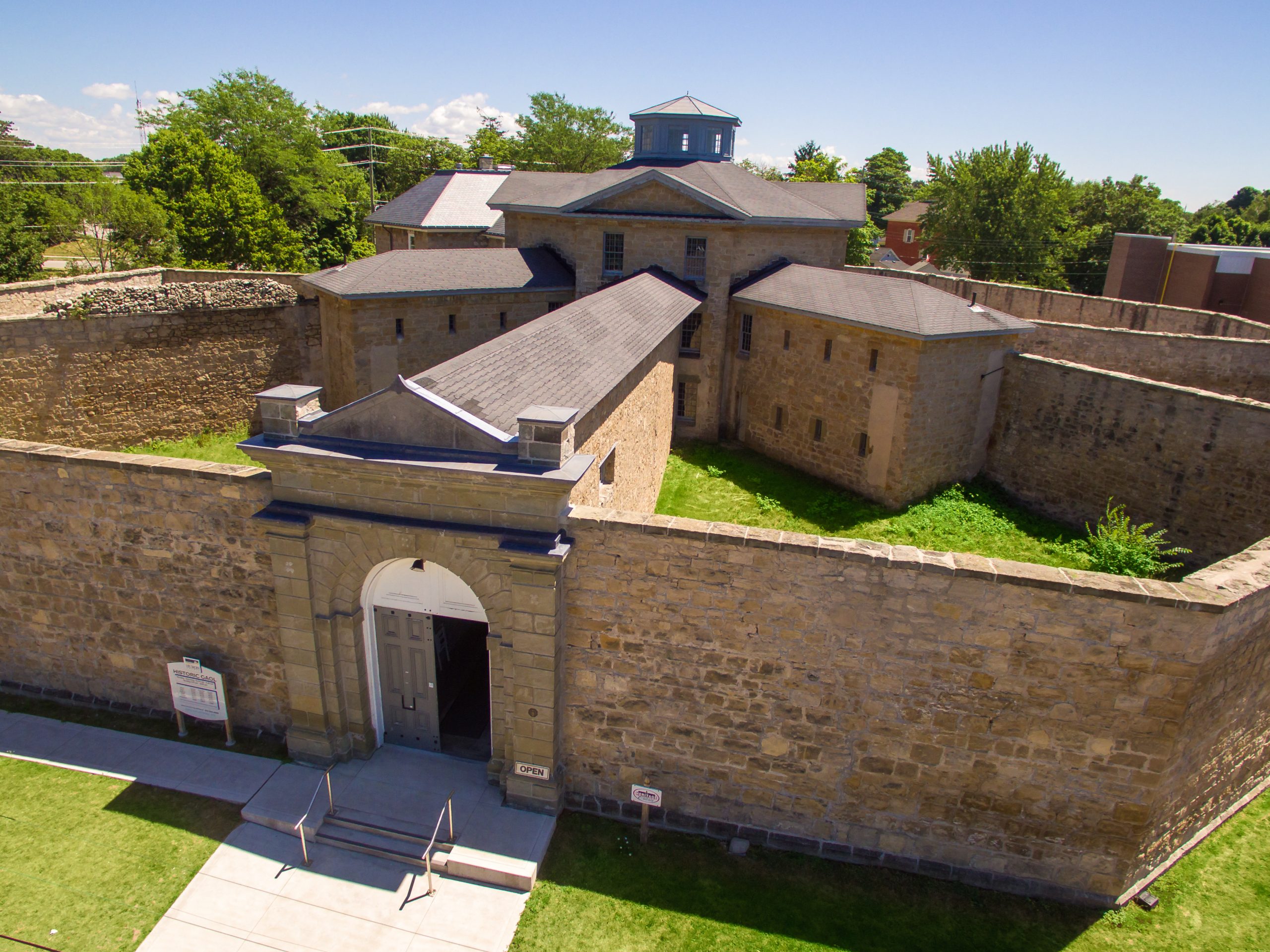
Construction of the Huron Gaol began in 1839 in the Town of Goderich making it Huron County’s first municipal building. This once essential government building served as both a prison and a courthouse once its construction was completed, with the first documented prisoner committed on Dec. 3, 1841. The Gaol held significant value to the people of Huron County, as it represented their newfound independence from London District. The Gaol served as a focal point of justice and was where the Huron District Council held its first meeting on Feb. 8, 1842.
As time went on, the Gaol’s role began to shift; when the new courthouse was constructed in the centre of Market Square Goderich, in 1856, the Gaol’s sole purpose became holding prisoners. However, not all residents of the Gaol were criminals. Many who stayed at the Gaol were homeless, or mentally or physically ill. Drunkards, thieves, debtors and murderers lived alongside the homeless, and children as young as nine years old before Huron County Council constructed a House of Refuge in 1895. As time went on, numbers began to dwindle in the Gaol.
In 1968, The Children’s Aid Society moved into the Governor’s house after the last Governor moved out in 1967. The organization had outgrown their previously occupied space in the basement of the Courthouse located downtown Goderich. During the Children’s Aid Society’s time in the Governor’s house, they witnessed the closure of the Gaol in 1972 after the final prisoner was transferred out. However, prior to the Gaol even being closed as a facility, there was a proposal presented to the Huron County Council in September, 1971, to remove two of the Gaol’s walls adjacent to Napier Street to build a parking lot to accommodate the expanding services of the Children’s Aid Society and the Gaol’s neighbour, the Huron-Perth Regional Assessment Office. On Nov. 26, 1971, County Council received a formal approval from the Provincial Department for the demolition of certain walls at the County Gaol.
This decision provoked a massive response from the community and press, especially from Goderich and the surrounding areas. Many articles began appearing in the local newspapers concerning the possible preservation of the facility, as well as public rejection of the decision to tear the Gaol walls down.
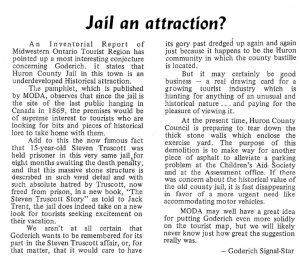
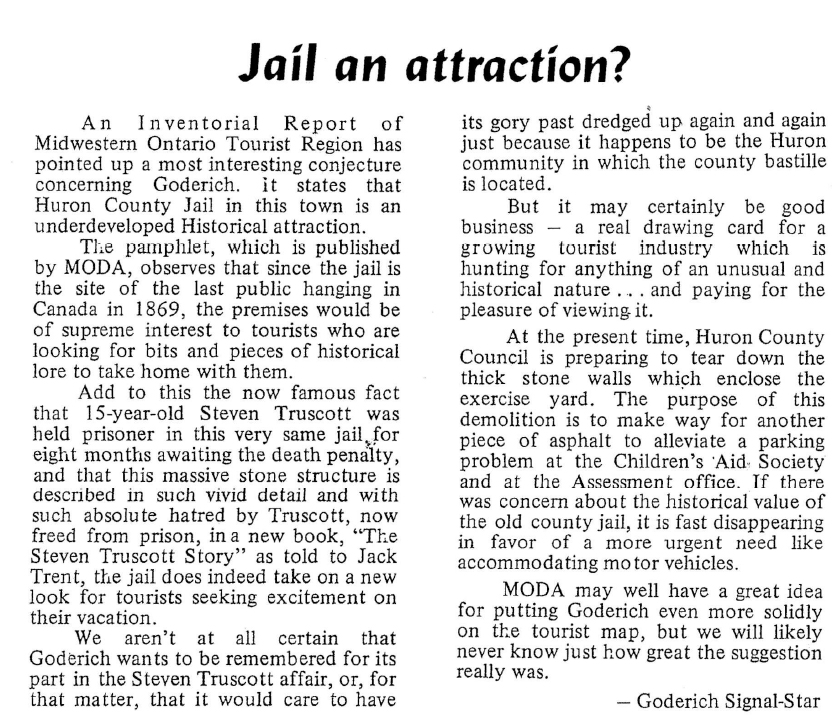
Editorial as published in the Exeter Times-Advocate, Nov. 25, 1971
The papers referred to the old facility as an “underdeveloped historical attraction”, and “a real drawing card for a growing tourist industry”. However, Council at the time had no intention of utilizing the space as a Museum of Penology. Some councillors did not condone the county spending the money to restore the building, as it was projected the restoration would cost around $25,000. Other councillors believed that if they had that much money to spend, it should be allocated around the county, and not just in Goderich. Another drawback that was suggested was the glorification of previous inmates whose actions were heavily frowned upon. The potential of immortalizing the darker aspects of Huron County’s past was a genuine concern amongst officials.
The Property Committee eventually presented the County Council with another report on Dec. 8, 1972, which detailed the idea of the old Gaol becoming a “Museum of Penology”. However, in the same report they also put forth a recommendation to construct a parking lot and an extension for the Assessment Office, costing a projected $150,000. In January, 1973, Huron County Council approved the removal of three walls at the Gaol, after considering both the Children’s Aid office and the Assessment Office’s needs. The Gaol was unfortunately placed back on the chopping block, now set to lose another wall.
When citizens caught wind of the verdict, they were none too pleased with the potential defacement of such an iconic local building. More articles and letters to the editor began showing up in the papers and a small group of concerned citizens came together to fight to save the historic building. If the Gaol walls were to be torn down, it would completely ruin the integrity of the building’s design. As the Gaol’s architect, Toronto-born Thomas Young had been inspired by famed English philosopher and prison reformist Jeremy Bentham. Thus, the loss of the Gaol walls would compromise both the value and history of the structure, as they added an irreplaceable element to the significance of its layout and design. The goal of this growing group of local politicians, historians and volunteers was to pressure the Council into reassessing their decision to tear down the walls. Their arguments were intended to bring to light the necessity of the architectural, historical and cultural conservancy of the building. And so, the Save the Jail Society was born!
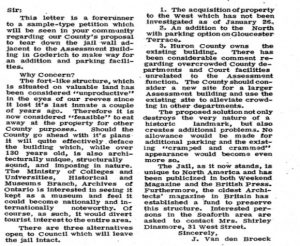
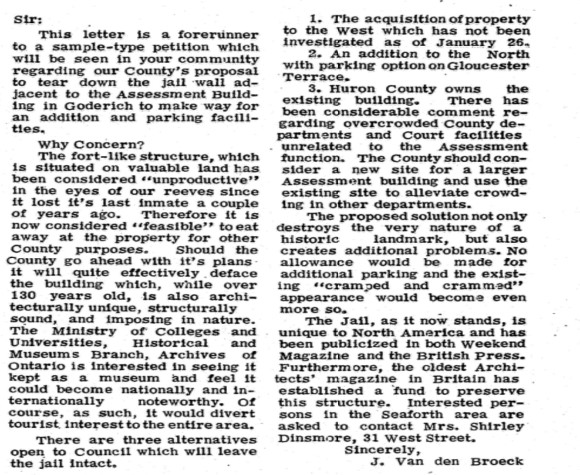
Letter to the Editor written by Joan Van den Broeck published in the Goderich Signal-Star.
With their objectives set, the group of dedicated members wrote letters to the newspaper, educating the public on their cause. A brilliant letter addressed to the editor of the Goderich Signal-Star was written by Save the Jail Society activist Mrs. Joan Van den Broeck. She advocated for the preservation of the Gaol, stating the uniqueness of the architecture as being one-of-a-kind, as well as miraculously structurally sound despite being around 130 years old, predating confederation. She also spoke of the building’s national and international notoriety, which would only enhance the tourist experience in Huron County. Van den Broeck, along with Goderich Reeve Paul Carroll and their fellow Save the Jail Society members, sought to change the fate of the iconic building.
The Save the Jail Society was extremely vocal and visible within the community, organizing campaigns at Goderich District Collegiate Institute and compiling a petition, as well as fundraising and rallies. There was a song written to commemorate the Gaol, which was written by Wingham entertainer Earl Heywood. The song was sung to the tune of Battle Hymn of the Republic, and was sung at events and rallies. They presented a petition to Huron County Council, as well as an architect’s revised plan for the parking lot to be built on the north side of the building. The group also threatened to pursue legal action if the demolition was to move forward.
One of the group’s most engaging events was an open house held at the Gaol on Feb. 19, 1973, which was initiated to motivate and engage the community in the cause to save the building. This event amassed a crowd of over 2,000 people who were all curious to explore the historic building and to find out what the big deal was about the Gaol. This event is what Save the Jail Society members would later reflect upon as a tide turner in terms of popular support. This event also made a massive impression from County Council’s perspective, as they were now aware of the appreciation the community held for the building.
Goderich Town Council met on April 12, 1973, in response to a letter issued from the County. This letter was a revision of the previous parking lot proposal designed by Nick Hill, which would allow for the Gaol walls to remain untouched. Finally, on April 26, 1973, Huron County Council agreed to the proposal by Goderich Town Council. This acceptance meant that the Save the Jail Society’s goal of saving the Gaol had been realized!
Once the safety of the Gaol had been ensured, the Save the Jail Society began to create an administration to govern the historic building. On May 1, 1974, the “Huron Historic Jail Board” was created. The Jail Board leased the building from the County for $1 per year for it to be incorporated as a Museum and Cultural Centre; it was opened to the public on June 29, 1974. The Jail board was finally legally incorporated on Oct. 13 of the same year. The Gaol was finally a Museum of Penology!
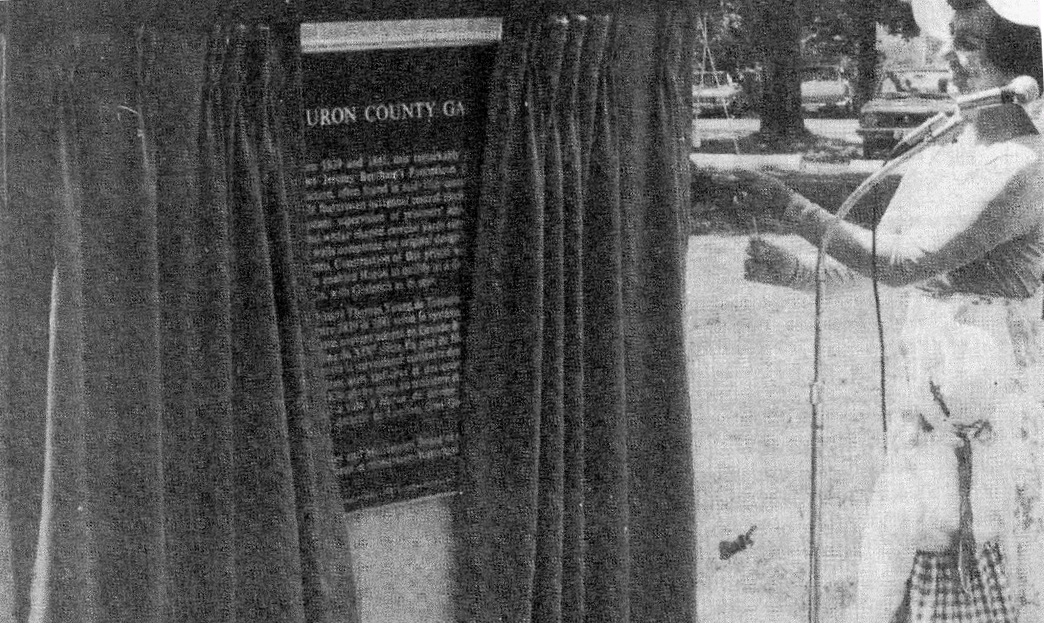
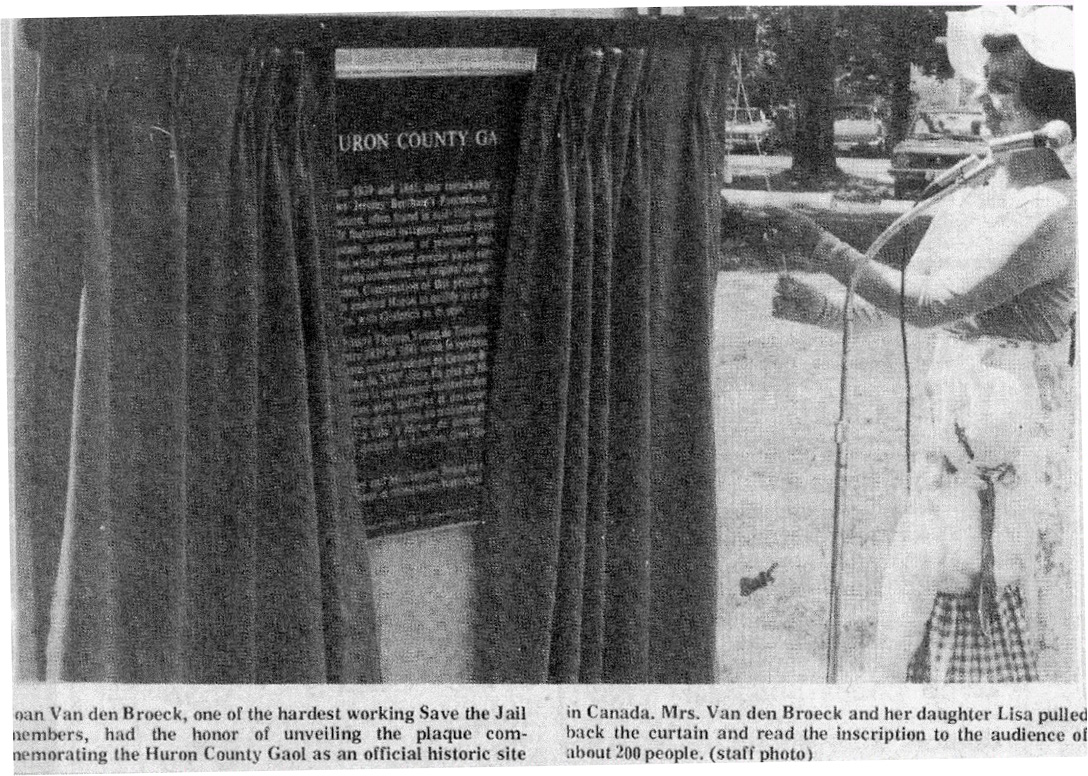 This great victory for the Save the Jail Society (now the Jail Board), was only the beginning for the Huron Gaol. On July 5, 1975, a massive celebration was held at the Gaol in Goderich to acknowledge the Gaol becoming designated a National Historic Site. The ribbon was cut to officially acknowledge the opening of the Huron Historic Gaol by Huron County Warden Mr. A. McKinley. The plaque detailing the Gaol’s historical significance was unveiled by none other than dedicated member Joan Van den Broeck.
The reason the Huron Historic Gaol stands to this day is not simply because of its historical value. This building is a symbol of the strength and dedication of the people of Huron County. Despite being sentenced to be destroyed, the Gaol was saved by the efforts of ordinary Huron County citizens who fought to preserve their history. The Gaol is not only a building which represents law and order within the County, but a reminder of how the County was incorporated and achieved its own independent settler municipal government and identity. Huron County was created by strength and unity, it seems only fitting its history was also saved by it.
Sources
Explore these sources through the online collection of Huron Historic Newspaper.
- “Jail an Attraction?”, The Exeter Times-Advocate, Nov. 25, 1971, pg 4.
- “Save Jail Wall”, The Brussels Post, Jan. 31, 1973.
- “And the Walls Came Down…Maybe”, The Exeter Times-Advocate, Feb. 8, 1972, pg 4.
- “Huron Council Clears Removal of Jail Wall”, The Huron Expositor, March 1, 1973, pg 1.
- “Letters to the Editor by Mrs. D. W. Collier Komoka”, Clinton News Record, March 15, 1973, pg 7.
- The Huron Expositor, April 12, 1973, pg 19.
- “Huron Reeves Vote to Save”, The Brussels Post, May 2, 1973, pg 9.
- “At County Council: Reeves Vote to Preserve Huron’s Historic Jail”, The Huron Expositor, May 3, 1973. Pg 1.
- “Jail House Blues Still Bother County”, Clinton News Record, June 7, 1973, pg 3.
- “Reeves Reject Bid for Use of Huron County Jail”, The Brussels Post, July 4, 1973, pg 13.
- “Tenders Let for Office”, The Blyth Standard, July 18, 1973, pg 1.
- “The Huron Gaol”, The Huron Expositor, June 1, 1978, pg 13.
Archival Material
- “Commemoration of Huron County Gaol”, July 5, 1975, pg 1-2.

by Amy Zoethout | May 26, 2021 | Media Releases/Announcements
Residents interested in helping to preserve and shape how local history is presented for the future can now make their voice heard. By joining the Museum’s Collection Committee, interested individuals will have a say in how the Huron County Museum & Historic Gaol grows, expands and diversifies the stories shared through the Museum’s unique collection.
The County of Huron invites applications for open position(s) on the Huron County Museum & Historic Gaol’s Collections Committee. The positions are for volunteer community members from Huron County. The committee welcomes applicants that represent different communities, backgrounds, age groups, and cultures across Huron County, including newcomers and generational residents. Volunteer terms are for one, two, or three years with the potential of two consecutive terms.
The Huron County Museum’s collection is built from community donations from people, homes and businesses across Huron, following a collections policy and mandate.
“This is a great opportunity for those who are passionate about Huron County’s ongoing history and heritage.” said Acting Director of Cultural Services Elizabeth French-Gibson “If you love material culture, and want to engage others with the memories, stories and community ties that can be evoked so powerfully by objects from the past then this is a great opportunity for you!”
The Collections Committee presents a volunteer opportunity that is short on time-commitment, but makes a long-term impact on how our community recognizes, prioritizes and preserves history close to home.
The purpose of the Collections Committee is to advise County Council with respect to matters pertaining to the Huron County Museum and Historic Gaol collection. Recommendations include review of short and long-term planning regarding collections, site policies in relation to collection development, and requirements of the Ministry of Heritage, Sport, Tourism and Culture Industries’ Museum standards.
“When I was a child, a visit to the pioneer museum, which is what we called it then, was a confirmation that you don’t throw anything out; there was a story or use to every item,” said Collections Committee member Rhea Hamilton-Seeger, who shared what this volunteer experience has taught her. “As a member of the Collections Committee, I now get to learn more of the stories and appreciate what people collect and donate. One of the criteria for items to be in the Collection is that they relate to our [Huron County] history. While I would like to keep everything, there are some unique pieces that simply don’t relate. The staff of the Huron County Museum and this committee work hard to ensure a home is secured where these items do relate. A very interesting committee to be a part of and I have been able to share some of the stories with friends and better understand my local museum and how it teaches us, and reminds us, of our history.”
Be an active part of the Huron County Museum and Historic Gaol’s mission to engage our community in preserving, sharing, and fostering Huron County culture! The time commitment for volunteering is limited to attendance at committee meetings held every third month, generally on Tuesday mornings as scheduled by the Committee.
Those interested in applying for the volunteer position of Huron County Museum Collections Committee Member can submit a written application by Monday, June 28, 2021 to:
Acting Senior Curator
Huron County Museum & Historic Gaol
110 North St., Goderich, ON, N7A 2T8
museum [@] huroncounty.ca
To learn more about the Huron County Museum & Historic Gaol’s collections:
by Amy Zoethout | Jan 13, 2021 | Media Releases/Announcements, Uncategorized
The County of Huron invites applications for an open position on the Huron County Museum & Historic Gaol’s Collections Committee. The position is for a volunteer community member from Huron County. Terms are for one year, two years, or three years with the potential of two consecutive terms.
The purpose of the Committee is to advise County Council with respect to matters pertaining to the Huron County Museum and Historic Gaol. Recommendations include review of short and long term planning regarding collections, site policies in relation to collection development, and requirements of the Ministry of Tourism, Culture and Sport’s Museum standards.
Meetings are held every third month, generally on Tuesday mornings as scheduled by the Committee.
The Huron County Museum and Historic Gaol engage our community in preserving, sharing, and fostering Huron County culture.
Please submit a written application by March 19, 2021 to:
Acting Senior Curator
Huron County Museum & Historic Gaol
110 North St., Goderich, ON, N7A 2T8
museum@huroncounty.ca
by Sinead Cox | May 15, 2020 | Huron Historic Gaol, Investigating Huron County History
In this two-part series, Curator of Engagement & Dialogue Sinead Cox illuminates how the Second World War entered the walls of the Huron Historic Gaol. Click here for Part One: The ‘Defence of Canada’ in Huron County.
In the summer of 1940, when the Netherlands fell to Nazi Germany, a ripple effect extending to the Great Lakes would unexpectedly commit thirteen “alien seamen” to the Huron Jail.*
At the outset of the Second World War in 1939, the Oranje Line, also known in Dutch as Maatschappij Zeetransport N.V, was a relatively new Dutch-owned transport company that serviced Great Lakes routes. The Line had only commenced operations in 1937, and its fifth vessel in the Great Lakes, the 2,800 ton diesel freighter Prins Willem III was the first deep sea motor ship to come inland; she embarked on her maiden voyage in September, 1939.
On May 9th, 1940 the Prins Willem III departed neutral Antwerp, Belgium on a routine commercial journey under Captain W. P. C. Helsdingen. In the course of one day, the ship’s professional routine would be abruptly shattered. The Prins Willem III was off the coast of Flushing when a German bomb hit the water about 200 yards from the ship and caused a huge explosion and towering pillar of water. Germany had invaded the Netherlands. Planes were flying high and out of sight, but the crew could hear the whining sound of bombs as they fell nearby. Targeted by a machine gun onslaught from Nazi fighter planes, the ship escaped via the English channel. After narrowly surviving with their lives and the boat intact to reach England, the Dutch crew would soon learn that the formerly neutral Netherlands had capitulated and their home country was now occupied by Nazi Germany.
The ship continued on its planned journey to North American waters, docking at Montreal, Duluth, Milwaukee and finally Chicago on June 25th , successfully delivering a cargo of seeds and twine. At Chicago, the crew awaited orders regarding their next destination. Meanwhile, members of the Dutch government, including Queen Wilhelmina, had fled to London, England. The government in exile required all Dutch merchant vessels abroad to now sail under the British Merchant marines, and to report to an allied port to join the war effort: which could include transporting provisions or armaments. Canada being the closest allied country, the Netherlands Shipping Commission ordered the Prins Willem III to return to Montreal and “then embark for some unnamed foreign port,” according to the Chicago Daily Tribune. 17 out of the 19 crew members refused the orders.
The crew’s actions seemed to defy easy categorization as conscientious objection or mutiny. Captain Helsdingen assured the Chicago press that the men were neither striking, mutinous, nor even refusing to do their assigned jobs aboard the ship, but the crew would not leave the neutral waters of the United States (which would not enter the war until after the bombing of Pearl Harbor in December, 1941). After their ordeal at the mercy of German bombs and guns, reluctance to return to a war zone aboard a ship that was not armed, and would not be provided an armed convoy, is hardly surprising. The Tribune quoted the crew as telling the captain, “If we cannot have weapons, we would rather spend our time in a United States jail than on the ocean.” They also feared for their families in a Nazi-occupied country and whether there could be reprisals against them—extending to arrests and transportation to concentration camps—for helping the allied cause by transporting munitions. According to the captain, the crew of the Prins Willem III feared Germany more than England.
The crew’s ‘sitdown strike’ left Commonwealth, Dutch and American authorities with no easy solutions. The standstill left most of the crew trapped on the ship, with only Captain Helsdingen legally permitted to go ashore. The crewmembers had no immigration documents to legally enter the United States, and because of the ongoing occupation of the Netherlands, the U.S. would not have been easily able to deport the sailors: thus Immigration authorities and the Coast Guard kept a close watch on the ship. The Captain could not take on an American crew to move the ship because of U.S. neutrality, and thus the Prins Willem III remained anchored unmoving at Navy Pier.
American newspaper reports emphasize that, rather than any assumed violent mutiny, the crewmembers were largely friendly and cheerful in their refusal to budge. During their months of isolation on board, the crew busied themselves cleaning, stripping and painting the masts, booms and deck, oiling “everything in sight, from door handles to winches,” and polishing every “spot of brass on the boat to glisten.” The Tribune declared when it finally left Navy Pier the Prins Willem III would probably be “the best painted, best oiled and best polished ship that ever left this port.” By September the crew’s plight had gained the sympathies of Dutch Chicagoans, who organized a committee to deliver care packages to the crew from pleasure boats.
The Dutch government-in-exile, the Oranje Line and Canadian authorities finally devised a solution in October: the Prins Willem III would take on a Canadian crew recruited from Montreal. Ten private police from the Pinkerton Detective Agency in the United States were hired to come aboard the ship with the fourteen Canadian crew-members to prevent resistance or sabotage, and the ship was escorted by the U.S. Coast Guard during its departure from Chicago. There was ultimately no violence from the crew confined below deck; according to Time Magazine, “internment in Canada looked better to the bored, sequestered Dutch than gazing at the Chicago skyline all day.” Their initial stop according to the American reports was to be an “unannounced Canadian destination,” later specified as an “Ontario Port.” That port was Goderich.
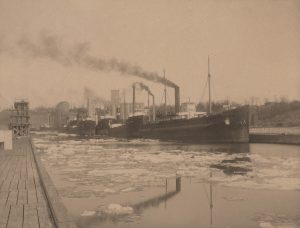
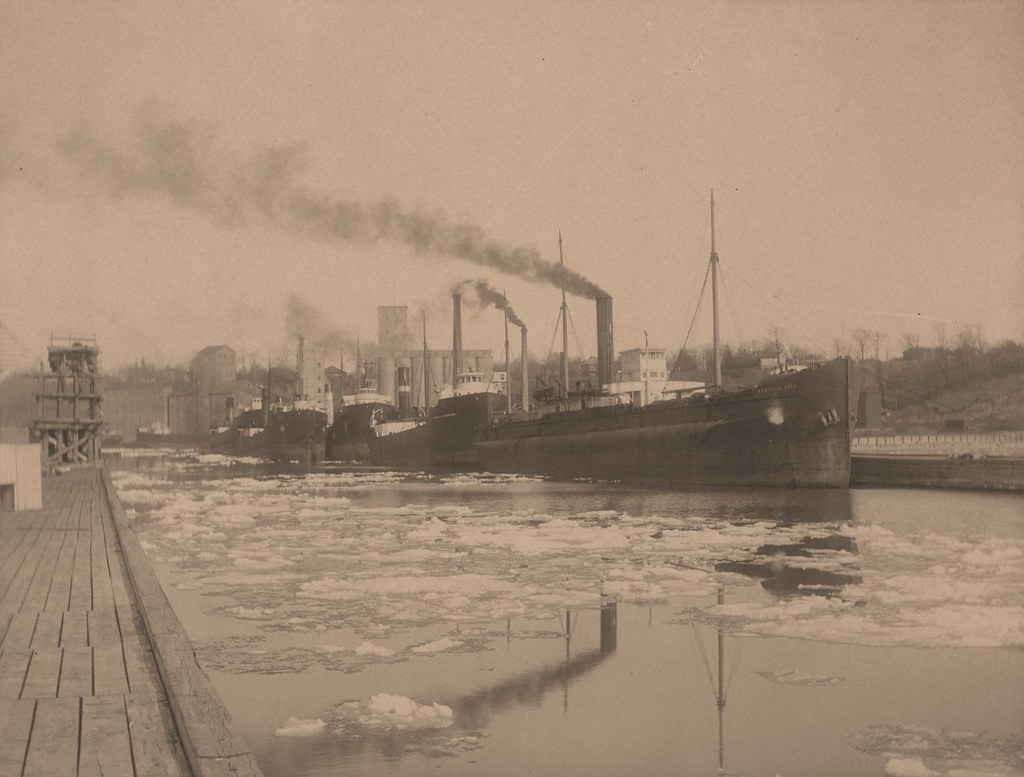
Ships in Goderich harbour, date unknown Photographer: Reuben R. Sallows (1855 – 1937)
On October 16th, 1940 the Prins Willem III—presumably painted, oiled and polished to perfection—arrived in the Goderich harbour. The secrecy surrounding the chosen port for the uncooperative crew’s disembarkment meant local customs workers were completely surprised by the ship’s unscheduled arrival, and began a tentative dialogue with Captain Helsdingen regarding next steps while further instructions from Ottawa were awaited. Again, the original crewmembers of the Prins Willem III were stuck in limbo on board, and again they made the most of it: according to the Clinton News-Record they came on deck “under the watchful eye of two [Pinkerton] detectives…getting great enjoyment out of perch fishing from the stern of the ship while they whistled modern American airs.” A local crowd of curious onlookers gathered at the harbour to gawk at the ship from a distance, and a host of exaggerated rumors quickly travelled throughout the community, including that the crew were held in irons and guarded by machine gun-wielding “G-men.”
Three days later, thirteen crew members quietly disembarked from the ship during the night, escorted by the RCMP in batches of no more than two men at a time.** Police vehicles delivered these men to the Huron Jail. The remaining crew changed their minds and agreed to sail with Captain Helsdingen and the Canadians. The Prins Willem III had vanished from the Goderich harbour by the next morning, and the Pinkerton Detectives caught a train back to Chicago.
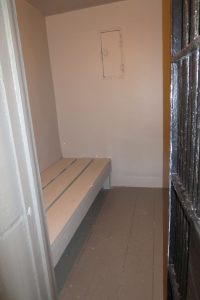
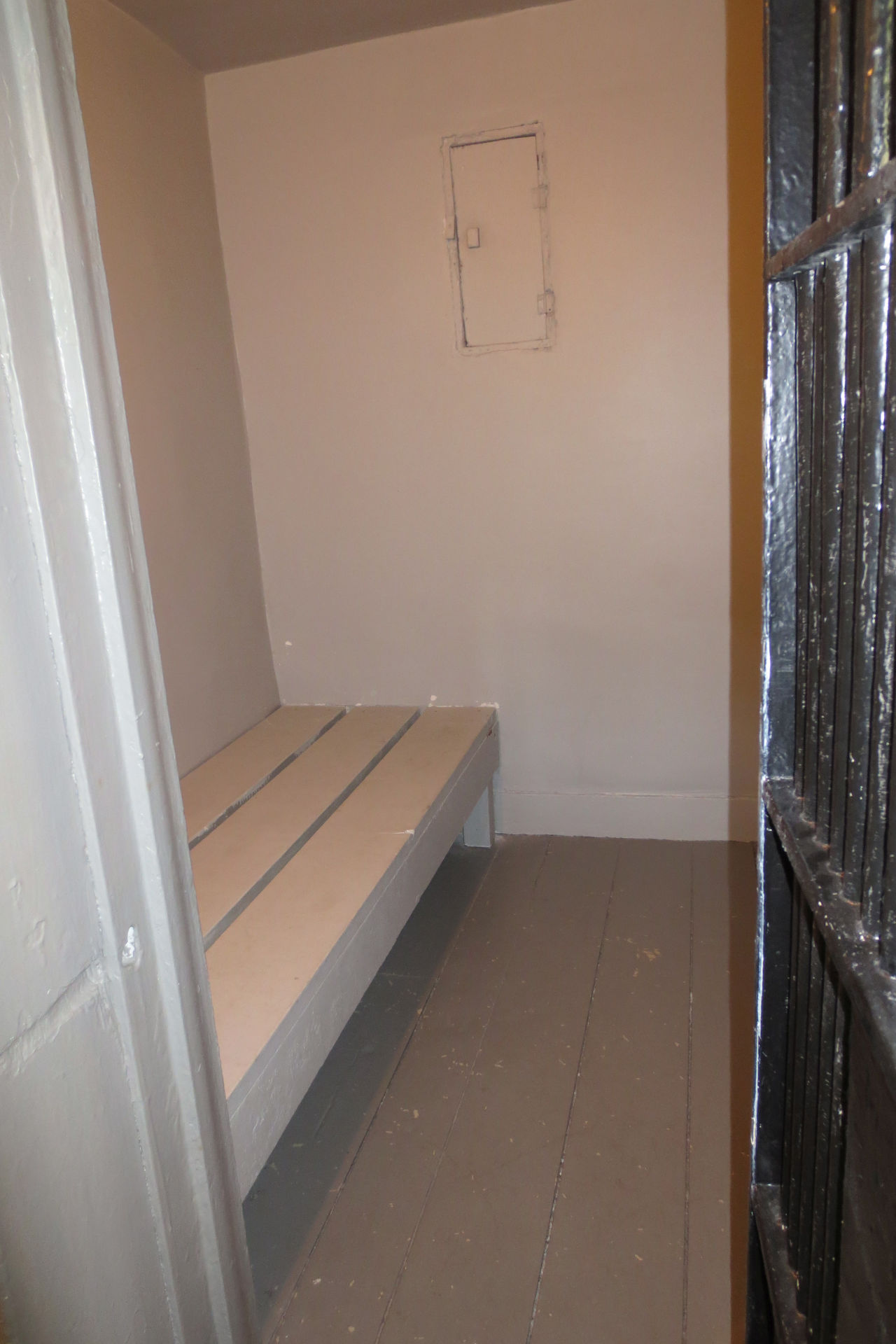
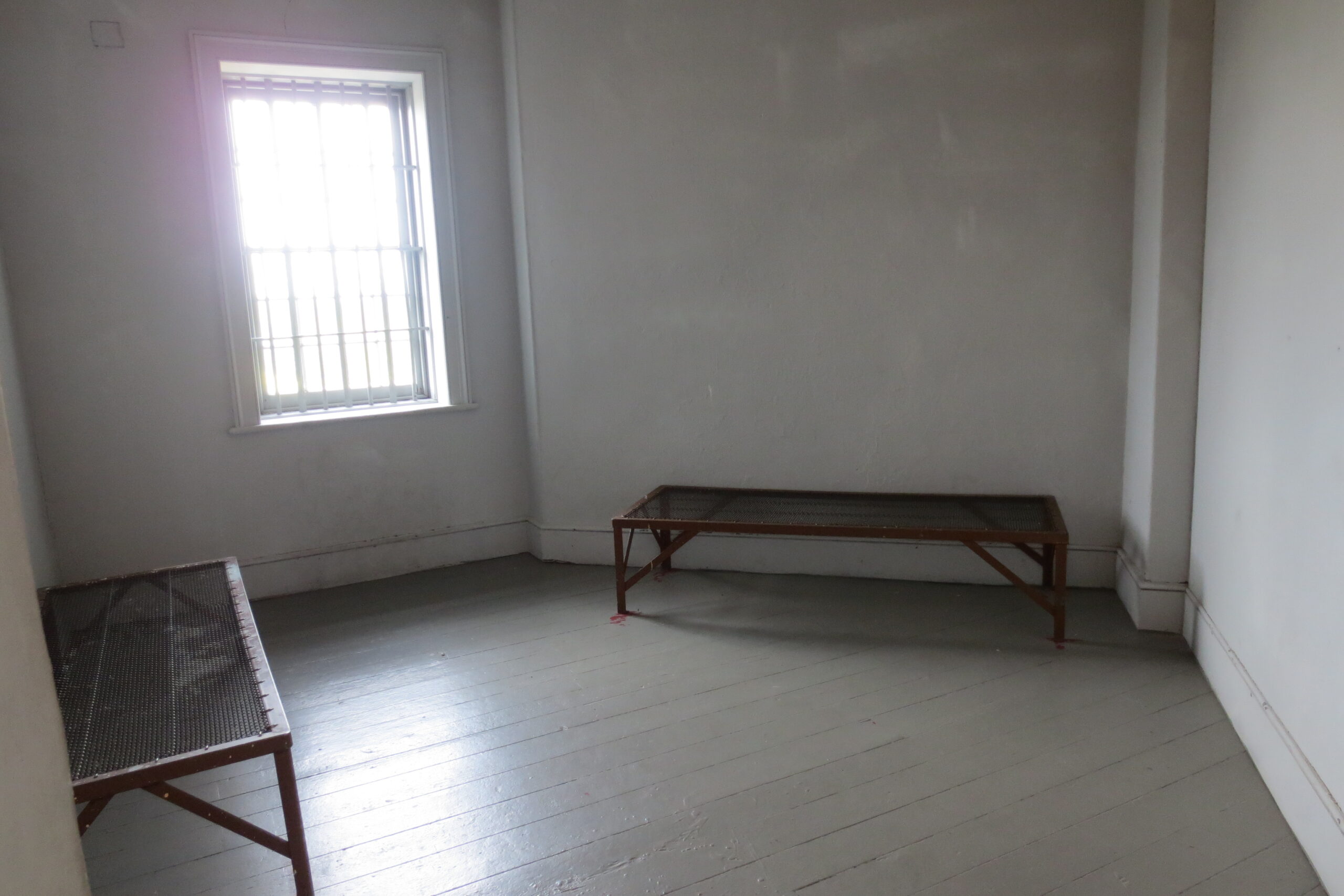
Cell in the Huron Historic Gaol.
The crew’s confines on land might have been somewhat tighter and less comfortable than their previous situation on board the Prins Willem III. Detailed inmate records are not accessible from the 1940s, but regardless of how many prisoners were already ‘guests of the county’ at the time, the arrival of thirteen ‘alien seamen’ would have left the Huron Jail, which has only twelve cells, over-capacity and somewhat crowded. The crew, who may not have all spoken fluent English, would have received daily food rations worth 13 ¼ cents per inmate and would only be able to take fresh air from inside the jail’s walled courtyards.
The thirteen Dutchmen remained in jail for three weeks, until removed under RCMP guard on the afternoon of Saturday, November 9th; they left Goderich by rail. Their destination upon leaving Huron County was once again a mystery to the media and the public, but widely assumed to be a Canadian internment camp, where POWs, Jewish refugees from Europe, and civilian ‘enemy aliens’ of differing loyalties could be forced to cohabitate.
Captain Helsdingen and the Prins Willem III continued on to Montreal to enter into the service of the allies as originally ordered by the Dutch government-in-exile so many months earlier. The temporary Canadian replacements would eventually be relieved by a Dutch crew, and the boat outfitted with anti-aircraft guns and machine guns, but the Captain was to face continued refusals of work from his crew throughout the war. Confirming the original crew’s fears, an aerial torpedo struck the Prins Willem III off the coast of Algiers in March, 1943; the ship later capsized and sank, resulting in eleven deaths. None of the original crew from the Chicago sojourn were amongst the lives lost.
The international incident caused by the Prins Willem III in the Great Lakes may be largely forgotten today, but the plight of its crew demonstrates that the North American homefront was not always as peaceful or untouched by the conflict in Europe as we might imagine. Overnight, the capitulation of the Netherlands had left the crew of the Prins Willem III in a precarious situation after enduring a surely traumatizing ordeal during the Nazi invasion on May 10th, 1940. Facing uncertainty in the custody of North American authorities, versus what they might have deemed as an almost certain death re-entering a war zone without adequate protections, they took action (or rather inaction) that stymied multiple governments and brought the repercussions of the Second World War to an ‘Ontario Port’ as apparently nondescript as ours.
*A note on spelling: Jail & gaol are alternative spellings of the same word, pronounced identically. Both spellings were used throughout the history of the Huron Historic Gaol fairly interchangeably. Although as a historic site the Huron Historic Gaol uses the ‘G’ spelling more common to the nineteenth century, for this article I have chosen to employ the ‘J’ spelling that appeared more consistently in the 1940s.
** Newspaper reports record 16 crew members jailed, but the Jailer’s Report to Council for 1940 recorded 13 “alien seamen,” and this is also the number given by Martine van der Wielen-de Goede, who reviewed crewmembers’ testimonies later in London (see sources below).
Special thanks to Alana Toulin & Christina Williamson for research assistance that made this blog post possible!
Further Reading
Internment in Canada via the Canadian Encyclopedia: https://thecanadianencyclopedia.ca/en/article/internment
Internment resources from Library and Archives Canada: https://www.bac-lac.gc.ca/eng/discover/politics-government/Pages/thematic-guides-internment-camps.aspx
Secondary Sources
Gillham, Skip, “The Oranje Line,” Telescope, Volume XXX, No. 5. (Sept-Oct 1981), pg 116-117.
Malcolm, Ian M, Shipping Losses of the Second World War, (Brinscombe Port Stroud: The History Press, 2013).
van der Wielen-de Goede, Martine, “Varen of brommen Vier maanden verzet tegen de vaarplicht op de Prins Willem III, zomer 1940,” Tijdschrift voor Zeegeschiedenis, No. 1 (Jan. 2008) Via https://docplayer.nl/173449011-Ten-geleide-tijdschrift-voor-zeegeschiedenis.html
Sources: Articles
“At Sea: Open Lanes.” Time Magazine, October 21, 1940, pg 29.
“Canada Jails 16 Dutch Seamen After Mutiny.” Chicago Daily Tribune, October 11, 1940.
“Dutch Crew Jailed.” The Wingham Advance-Times, October 17, 1940.
“Dutch Sailors Removed.” Huron Expositor, November 15, 1940.
“Dutch Sailors to Jail.” Clinton News-Record, October 24, 1940.
“Dutch Freighter Arrives in Goderich.” Clinton News-Record, October 17, 1940.
“Escapes Bombing; Reaches Chicago: Unloads Seeds, Twine.” Chicago Daily Tribune, June 27, 1940.
“Explains Dutch Sailors’ ‘strike’: They Fear Nazis.” Chicago Daily Tribune, July 28, 1940.
“Members of Crew Interned.” The Seaforth News, October 17, 1940.
“Sitdown Strike Strands Dutch Ship in Chicago.” Chicago Daily Tribune, July 26, 1940.
“Stranded Dutch Ship Sails with Canadian Crew: Idle Force Lets Sailors Aboard Quietly.” Chicago Daily Tribune, October 8, 1940.
“Strikers Mark Time.” Chicago Daily Tribune, July 27, 1940.
Wilson, Edward. “Aye, There’s Rub to Life Aboard Dutch Freighter: Crew Keeps Busy Polishing and Painting Ship.” Chicago Daily Tribune, September 7, 1940.
by Sinead Cox | May 18, 2017 | Huron Historic Gaol, Investigating Huron County History
May 18th is International Museum Day! Museums and historic sites across the world are opening their doors for free today. For those whom cannot visit the Huron Historic Gaol in person, Student Museum Assistant Jacob Smith delves into the building’s past to reveal how some of Huron’s youngest prisoners ended up behind bars.
During its operation [1841-1972], hundreds of children were arrested and sent to the Huron Jail. Their crimes ranged from arson and theft to drunkenness and vagrancy. The most common crime that children committed was theft. In total, thefts made up over half of all youth charges between 1841 and 1911. In total, children under the age of 18 made up 7% of the gaol population during that time.*
Occasionally, young people were sent to gaol for serious crimes. In 1870, William Mercer, age 17, was brought to the Huron Gaol and charged with murder. He was sentenced to die and was to be hanged on December 29, 1870. Thankfully for Mercer, his sentence was reduced to life in prison and was sent to a penitentiary. This is an example of an extreme crime for a young offender.
On many occasions, children were sent to gaol because they were petty thieves. Many young people who were committed for these types of crimes would only spend a few days in gaol. If the crime was more severe, children would be transferred from the gaol to a reformatory, usually for three to five years.
The youngest inmates that were charged with a crime were both seven years old. The first, Thomas McGinn, was charged in 1888 for larceny. He was discharged five days later and was sentenced to five years in a reformatory. The second, John Scott, was charged in 1900 for truancy; he was discharged the next day.
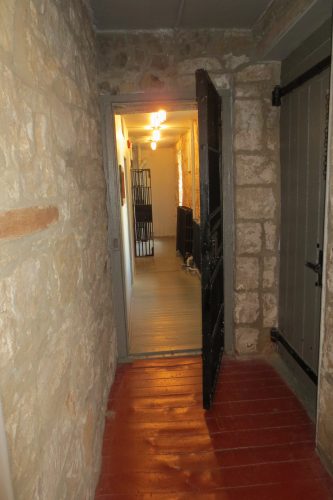
First floor cell block at the Huron Historic Gaol.
Unfortunately, some children were brought into gaol with their families because they were homeless or destitute. An example of this was in 1858, when Margaret Bird, age 8, Marion Bird, 6, and Jane Bird, 2, spent 25 days in gaol with a woman committed for ‘destitution’ (presumably their mother). Some children were also brought to the Huron Jail because their parents committed a crime and they had nowhere else to go while their parents were incarcerated. Samuel Worms, age 7, was sent to gaol with his parents because they were charged with fraud in 1865. He spent one day in the Gaol.
When reading through the Gaol’s registry, it is clear that times have certainly changed for young offenders. Most of the crimes committed by the young prisoners of the past would not receive as serious punishments today.
Here are some examples of their crimes in newspapers from around Huron County:
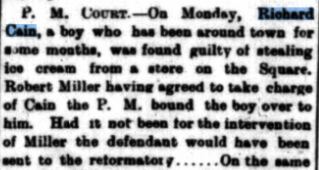
Richard Cain, 16, spent two days in jail.
The Huron Signal, 1896-09-17, pg 5.
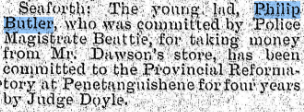
Philip Butler, 15, spent eleven days in the Huron Jail.
The Exeter Advocate, 1901-08-29, pg 4.
Sources came from the Gaol’s 1841-1911 registry and Huron County’s digitized newspapers.
*Dates for which the gaol registry is available & transcribed. There were young people in the Huron jail throughout its history, into the twentieth century.