“No Possible Escape”: A Short History of Fire at the Huron Gaol

“No Possible Escape”: A Short History of Fire at the Huron Gaol

“No Possible Escape” sounds positive when it comes to jailbreaks, but less so in the case of emergency. Curator of Engagement & Dialogue Sinead Cox looks back at fire and fire safety at the Huron Historic Gaol.

The Huron Historic Gaol is one of the most recognizable, historically significant and architecturally unique buildings in Huron County. Today it stands as a venue for visitors to hear the stories of the prisoners and staff who walked its halls, and considering the number of times the building has caught fire over its 180+ year history, this is nothing less than a small miracle.

Although the outer walls may give the impression that it is solid stone, the construction of the gaol interior is actually significantly timber. The unique octagonal layout of rooms and yards around a central spiral staircase are designed to keep prisoners in, with perhaps less architectural forethought when it comes to allowing people to quickly get out, should the upper floors become engulfed in flames.

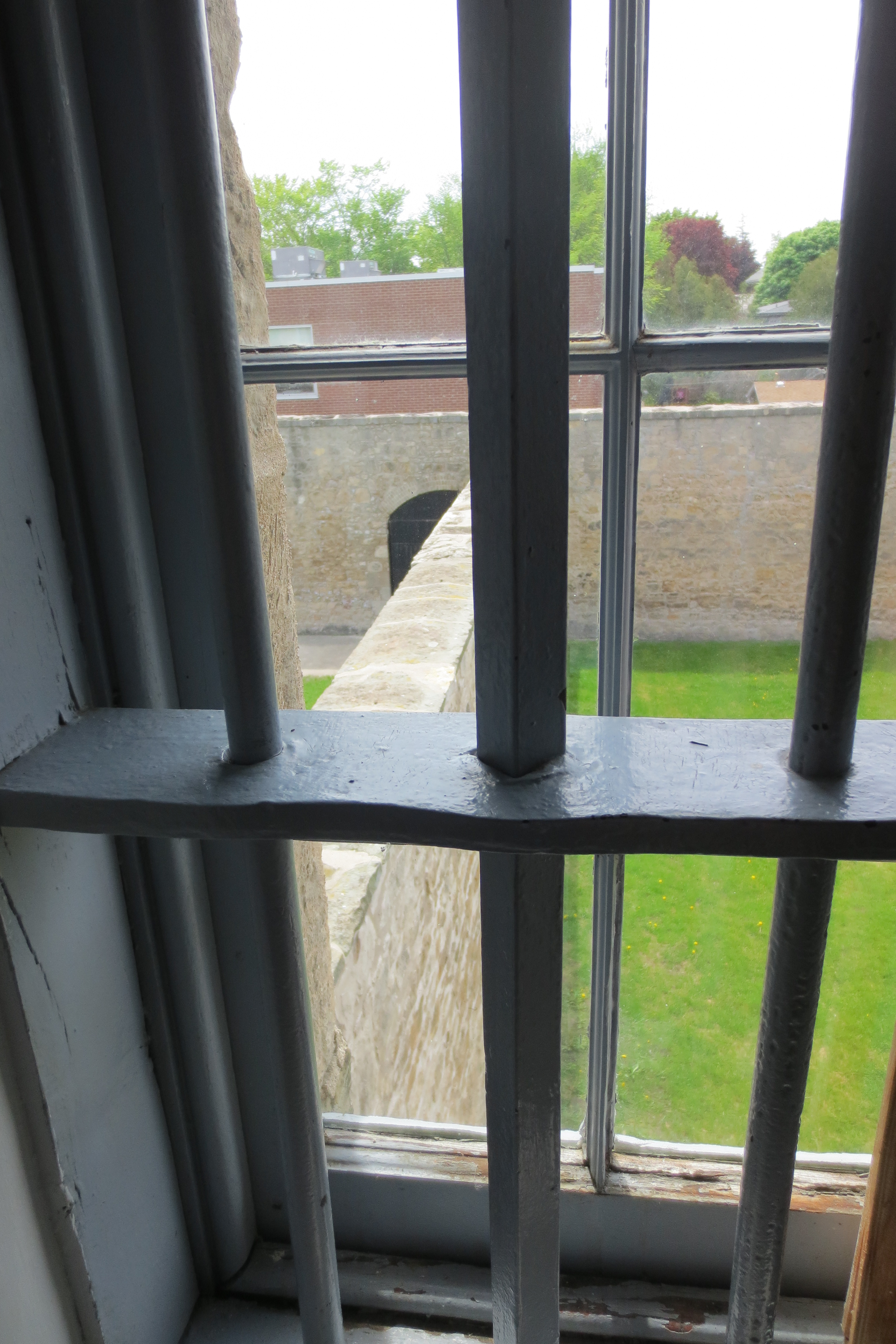
In 1851, when the building was only a decade old and served the United Counties of Huron, Perth and Bruce, an errant chimney spark caused the first known fire of significance. Fortunately, the only harm sustained in that instance was damage to the building’s roof. Afterwards, the Gaol Inspector recommended covering the roof with metal, and that the county purchase a new ladder tall enough to actually enable water to be carried high enough to fight a fire (staff presumably having discovered the inadequacies of the previous ladder during the emergency). No ladder would have been very useful as a means of rescue for prisoners, however, as all of the windows on the gaol’s upper floors were barred to prevent escape.

In the 1860s the County of Huron replaced the tin-covered roof with slate, later swapped for asphalt shingles about a century later. When reverting to slate in 2021, roofers discovered lumber inside the cupola still bore blackened scorch marks from historic fires. The cupola, or central tower, has been struck by lightning at least twice: in 1892 and 1929. Torrential rain prevented fire in the first case, but the second strike “set the tower ablaze” just after one a.m.  According to The Clinton News Record, “a terrific electric storm was in progress and firemen had difficulty at first in plying streams of water on the tower, owing to its height. Some of the firemen climbed on to the slate roof, slippery with rain, and fought the flames from perilous positions.” The newspaper claimed that despite the late hour and extreme weather, a crowd of people gathered outside the gaol’s walls to watch their efforts. While firefighters risked their lives to stop the fire from spreading to the lower floors, a constable escorted the seven prisoners currently committed to the Huron Gaol to an outside courtyard, still confined within the 18 ft walls. Thankfully, the fire was successfully contained within the cupola and extinguished, but the flames and the water employed to douse them had caused more than $1,000 in damages (equal to just over $16,500 today). The county enlisted prisoner labour to help with the subsequent clean-up and repairs.

Black bucket with 'Fire Brigade' written on it.

Fire bucket. M951.0732.001

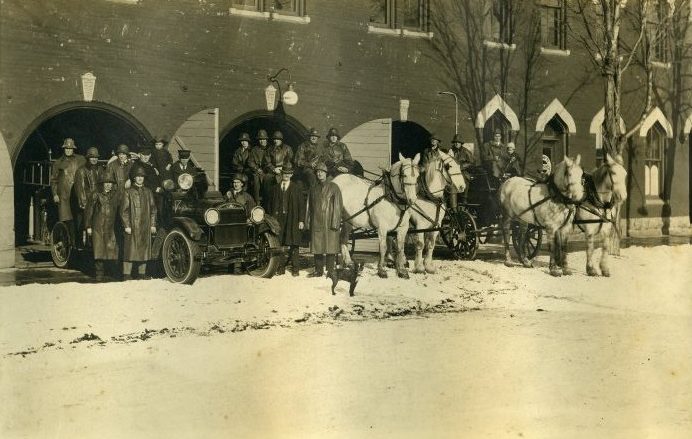
Photograph of firefighters, vehicles and animals in front of fire station.
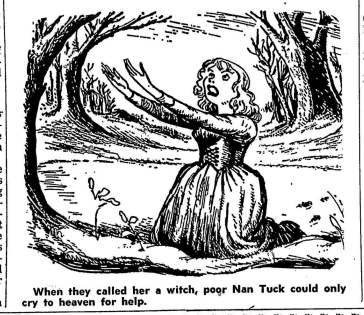
Illustration of a young woman being accused of witchcraft

Huron Historic Gaol, Goderich Ontario

 black fireman's helmet hat with red underneath and a gold figure of a man blowing a fire horn.

1855 Fireman’s helmet donated by Town of Goderich. M951.0734.001. 

large brass fire extiguisher --  2 1/2 galloncylindrical with red rubber hose that has cracked and hardened;  stenciled in black on side is "WESTDALE". Instructions on side.  "Guardene Extinguisher"

Fire Extinguisher. 2017.0024.003. 

large brass fire extiguisher --  2 1/2 galloncylindrical with red rubber hose that has cracked and hardened;  stenciled in black on side is "WESTDALE". Instructions on side.  "Guardene Extinguisher"

A950.1976.001. Fire crew at former Goderich Fire Station located on East Street, 1925. 

The cupola caught fire again in 1944, this time from burning leaves, either carried from the ground by a strong wind or ignited in the eaves by a spark. Although this fire burned only briefly, it caused destruction and water damage similar or worse than the 1929 blaze: costs duly submitted to the county’s insurer.

Officials and staff recognized the inadequacies of the gaol’s design very early in its operation: the lack of fire exits was one of the reasons that District Council and the courts complained about meeting there before the construction of a separate courthouse in 1856. Despite the general awareness of the threat, safety measures provided by the county did not always meet the needs of staff or emergency responders. After the 1892 lightning strike, Gaoler William Dickson found that the gaol’s fire hose was faulty, and burst in multiple places when tested with pressure.  As early as 1882, after yet another recent narrow escape from flames, local newspaper editorials from the Goderich Star and Clinton New Era condemned the gaol as an outdated fire trap. The Era argued for replacing the gaol and courthouse  with new, modern municipal buildings in a more central location. The Gaol and Court House Committee instead recommended “that a Babcock Fire Extinguisher for the gaol be furnished, also that a suitable water tank be built in the gaol yard,  owing to the inflammable and unsafe condition of the gaol stairs, there is no possible escape for the inmates in case of fire.”
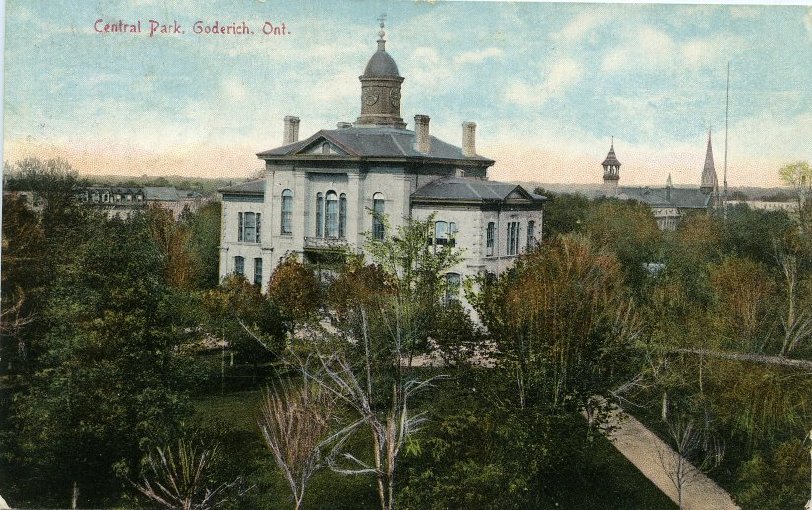
Colour postcard of Huron County Courthouse located in Goderich Square, surrounded by trees. Nineteenth century.

Postcard of courthouse at “Central Park” or Square, Goderich. Built 1856. This courthouse was destroyed by fire and replaced in 1954. 2008.0032.083. 

In the 1890s, Huron County Council acknowledged the aging heating stoves in each cell block’s dayroom as another serious danger and replaced them. Prior to electric lights, staff also had to contend with mandatory corridor lamps, burning day and night at the risk of overheating. Gaoler Dickson lamented to County Council in 1896 that, “twice [a lamp has exploded] during the almost 32 years I have been in your employ. The last time it was towards morning and fortunately my subordinate was awake and succeeded in extinguishing the fire at the cost of the bedding of two beds.” Dickson credited the turnkey’s quick action in preventing what was nearly a terrible tragedy: “At the time of the explosion there were 18 prisoners under lock and key, besides 5 members of my own family who were sleeping on the second floor. Had the flames caught the stair, all on the upper floors would have been entirely cut off from escape. In view of this danger to life and property, I would respectfully ask that you place one incandescent in said hallway.” The gaoler’s lobbying successfully resulted in the installation of incandescent lights at the gaol, but the issue of the single exit remained unaddressed. It’s easy to imagine that if the fire had spread beyond the smothering power of gaol blankets, that a quick decision may have been made to prioritize the evacuation staff and family before the overcrowded inmates sleeping behind multiple locked doors.

The close-call fires at the gaol over the decades were all seemingly accidental, with the exception of one incident during the holiday season in 1943. The gaol’s annual Christmas celebrations included a special meal for the prisoners with treats donated by the community, and that year they also enjoyed a decorated Christmas tree. On December 27th,  the dry boughs of the tree caught fire in one of the cell blocks, spreading to the woodwork and choking that ward with thick smoke. The Goderich fire department responded to gaol staff’s call for help, and successfully extinguished the flames in a manner of minutes. A follow-up investigation found that the cell block’s three resident inmates had intentionally started the fire to create a distraction for escape.  Convicted forger Floyd McCullough admitted to helping his teenaged cellmates, Angus Trudeau and Lorne Derevere, in devising how to ignite the Christmas tree remnants. The two younger men, committed for robbing Bayfield-area cottages, ultimately also pled guilty to the arson. No opportunity for jailbreak had ever actually materialized as planned; the trio were simply evacuated to another part of the gaol to avoid the smoke inhalation that may have endangered their lives if not for a turnkey’s quick arrival on the scene. All three faced added time behind bars for the conspiracy.

Cell Block

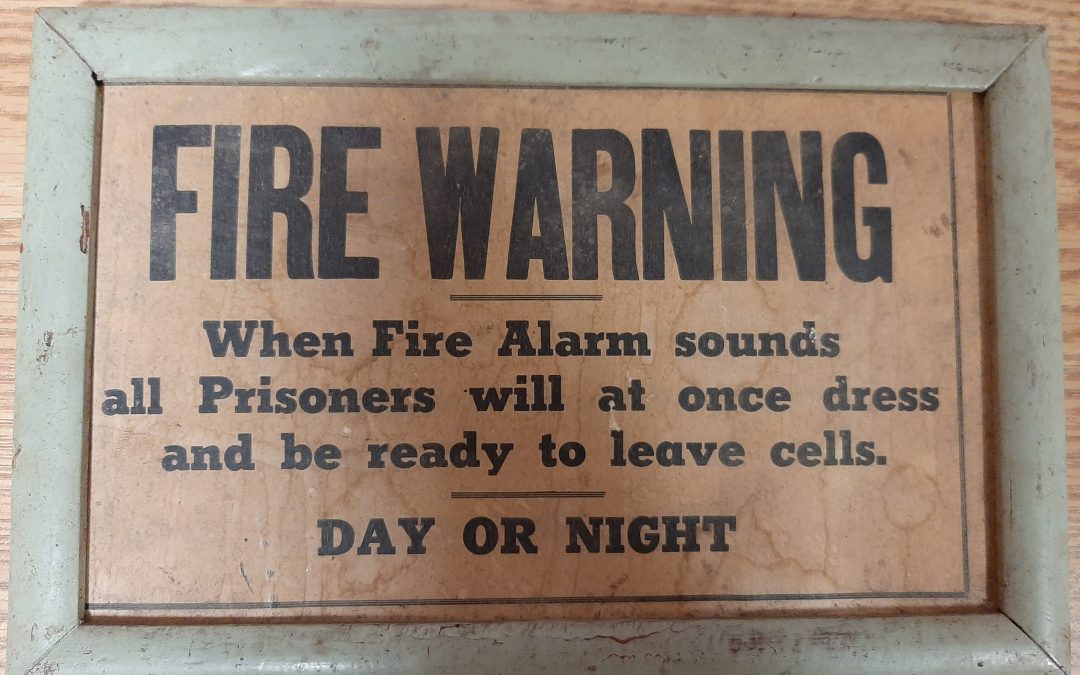
 The aging building’s vulnerability to fire remained a concern throughout the twentieth century, resulting in a fire-proof coating applied to the cells in 1939, various furnace installations and upgrades, and an alarm system installed by the 1950s. Jurisdiction over Ontario’s county correctional facilities transferred to the Province in 1964, and in 1972 the Ontario Department of Correctional Services decided to close the Huron Gaol. From 1974, the gaol opened its doors as a historic site and museum, originally managed by the Historic Jail Board– the County of Huron retained responsibility for fire insurance. The County resumed direct control of the building in the 1990s.

The Huron Historic Gaol would pass its 175th  birthday before finally gaining a fire escape and new fire exits on the second and third floors of the gaol after major upgrades in 2018. The work was undertaken with care to protect the site’s historical appearance and architecture.  As a historic site, fire safety could be addressed to meet contemporary standards without concerns about compromising security.  Today, the spectre of potential disaster by fire need not haunt staff and visitors to the degree it once did generations of prisoners and gaol employees. The gaol’s countless near misses with destruction are a reminder of the importance of adequate preparations and equipment to combat fire, as well as the need for strict safety regulations for public buildings.  It is only a mixture of ad hoc precautions, the quick actions of the gaol’s small staff, the intervention of local firefighters and also simple luck, that has successfully preserved this one-of-a-kind building and the lives of those who have lived and worked within its walls over three separate centuries. 

Find out More!

Can you Escape the Huron Historic Gaol? : Virtual Escape Room

Can you Escape the Huron Historic Gaol? : Virtual Escape Room

Can You Escape the Huron County Gaol?

Our new interactive and educational escape room “Escape The Huron County Gaol” will let you explore the gaol even when the site isn’t open. 

Navigate your way through the Huron HIstoric Gaol using the Google 360 walkthrough on the Huron County Museum Website and learn historical facts about this fascinating national heritage site as you attempt to escape its iconic walls. 

This activity is recommended for ages 7+ and younger children may require adult assistance to read the clues and navigate the 360 tour.

This interactive uses the Google 360 walkthrough of the Huron County Historic Gaol. Open the escape room form, and then open the Google 360 on another tab or device. To find the Google 360 walkthrough of the Gaol, scroll to the bottom of the linked page. 

If you would like to book a virtual program with staff guiding the escape room and providing extra information  and interpretation for your classroom or group, email museum@huroncounty.ca 


Image of cupola/tower inside gaol courtroom.
An Unconquered Crime: Infanticide in Huron County

An Unconquered Crime: Infanticide in Huron County

According to the Criminal Code of Canada, “a female person commits infanticide when by a wilful act or omission she causes the death of her newly-born child.” Using local resources, student Kevin den Dunnen explores local cases of infanticide in the late 19th and 20th century (the period for which Gaol records are readily available), and the contemporary attitudes towards this act at home and abroad.

Through the 19th and 20th centuries, Huron County newspapers printed cases of infanticide, or the act of killing an infant, allegedly taking place in other countries and cultures. These articles often framed this the context of the supposed inferiority of cultures without the influence of Western Christianity. (1) However, the prevalence of infanticide in Huron County and surrounding areas during this same time period disproves any claims of cultural immunity to infanticide in southwestern Ontario’s Christian-dominated communities.

There are many social factors that contributed to the infanticides that occurred in Huron County. In the 19th and 20th centuries, a birth outside wedlock threatened an unmarried woman’s status in society. Many known infanticide cases in Huron County involved these young, unmarried women. Contributing to the devastating decision to commit infanticide was the lack of local social services available to single women needing help to provide for their child. As such, infanticide has been present in Huron County for much of its history.

The story of a Huron County woman called Catherine and her child exemplifies many of these themes. Catherine was a 30-year-old servant and unmarried woman working in Goderich Township in 1870. She had gone to her doctor that year claiming her body was swelling. The doctor suspected that she might be pregnant, but Catherine did not agree. Later on, her employer came home to find some of her work unfinished and could not find her. Upon searching, they found her sitting in a privy. After telling her to leave the privy several times, Catherine went to the house. Upon inspection of the privy the next morning, the house-owner and a doctor found a dead child in the privy vault covered by paper and a board. In his subsequent report, the coroner believed that the baby was born alive. (2) Upon first reading, this story appears to be a cold-blooded case of infanticide, but the reality of the society around Catherine makes the situation far more complex.

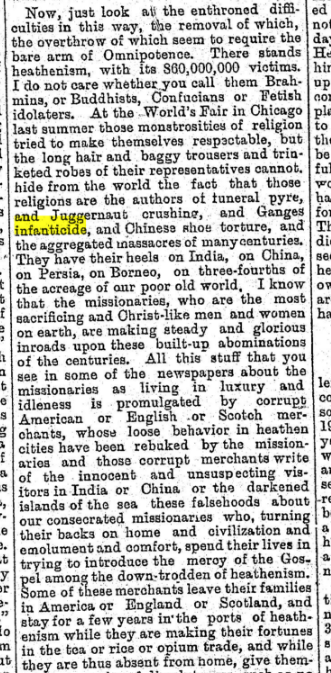
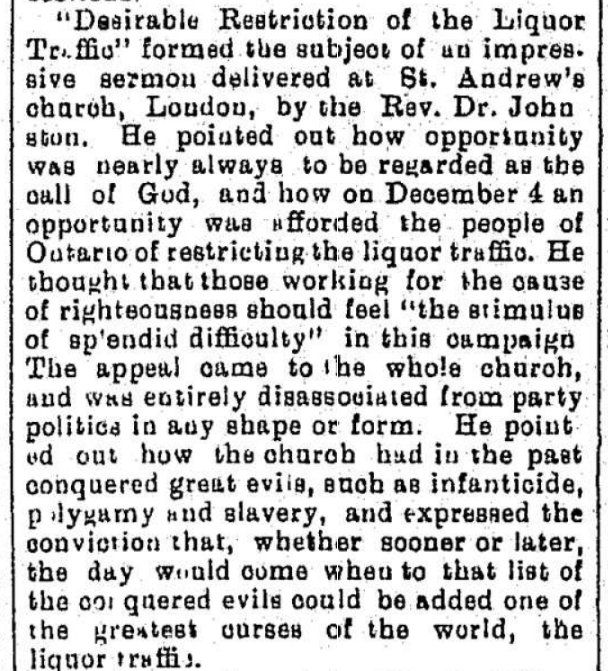
Turn of the 20th century newspapers in Huron County printed or reprinted articles from larger news agencies about non-Christian societies in India, China, and Hawaii and touted their supposed propensity of infanticide. These stories promoted the positive influence of Christian conversion outside of Canada, even though infanticide was also a local issue. Figure 1 is one such article from The Exeter Times, published on Feb. 1, 1894. This article states that the work of missionaries converting foreign societies to Christianity would “introduce the mercy of the Gospel among the down-trodden of heathenism.” The uncredited author claimed non-Christian cultures frequently committed infanticide but stopped when they converted to Christianity. (3) There is an apparent hypocrisy in these newspapers portraying other societies as uncivilized while the same issues were happing contemporaneously in their own Ontario communities. Figure 2 shows an article from The Brussels Post, dated Nov. 20, 1902. In this article, the author argues the need for laws restricting the distribution of alcohol. They state that such opportunities to change society are “the call of God” whose influence had already “conquered great evils, such as infanticide.” Yet, infanticide still occurred in the paper’s own region.

How prevalent an issue infanticide was throughout Huron County’s history is difficult to know, because many cases likely went unreported. A large proportion of the known cases involved single mothers of illegitimate children. However, some scholars suggest that more cases of undocumented infanticide frequently occurred in Western societies. These theories argue that hidden infanticide by married couples might partly explain changing gender ratios in select western societies. They claim this was a way of tailoring gender to fit family needs, like wanting males to help with farming. (4) Single women living and working away from their families would face greater difficulties concealing a birth without detection. Hidden infanticide drew attention from journals like the Upper Canada Journal of Medical, Surgical and Physical Science in 1852. This journal argued that women should have to register their children immediately after birth to lessen the chance of hidden infanticide. (5) This call for registration suggests that the journal suspected or knew of infanticide cases where the mother did not register their child to hide its birth. This research indicates that communities like Huron County could have many cases of infanticide that county records do not include.

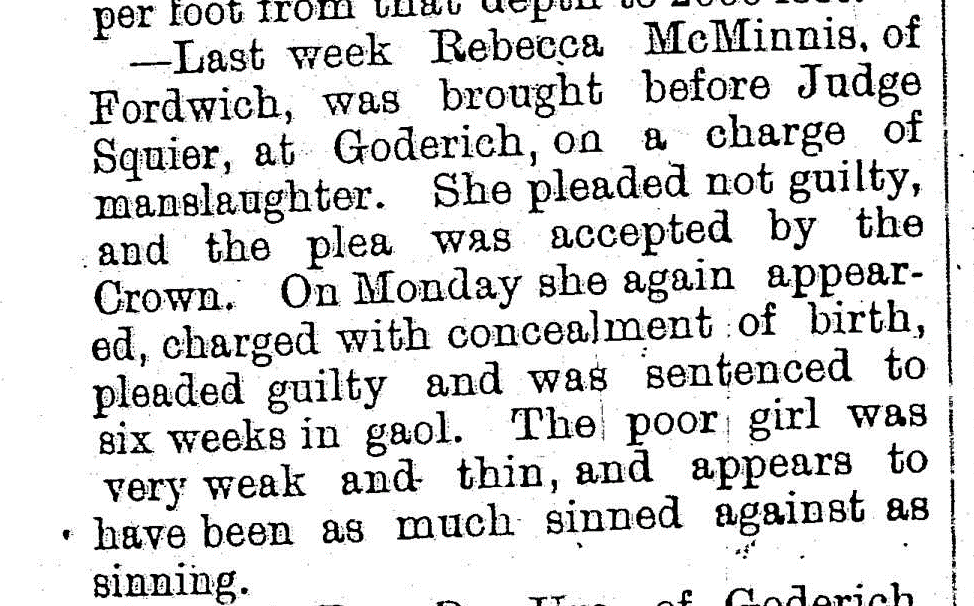
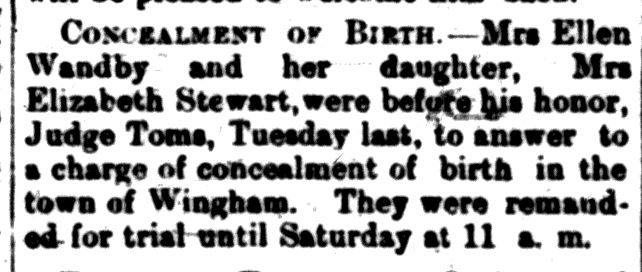
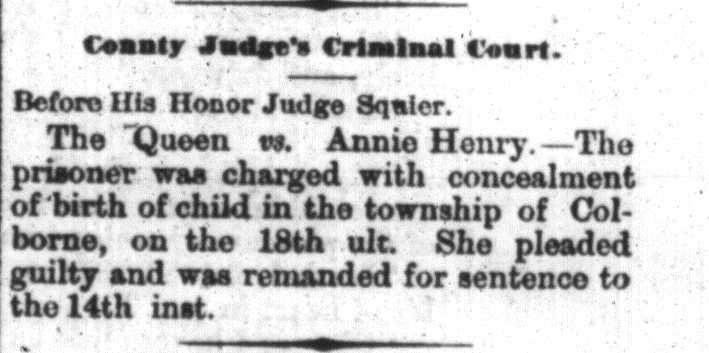
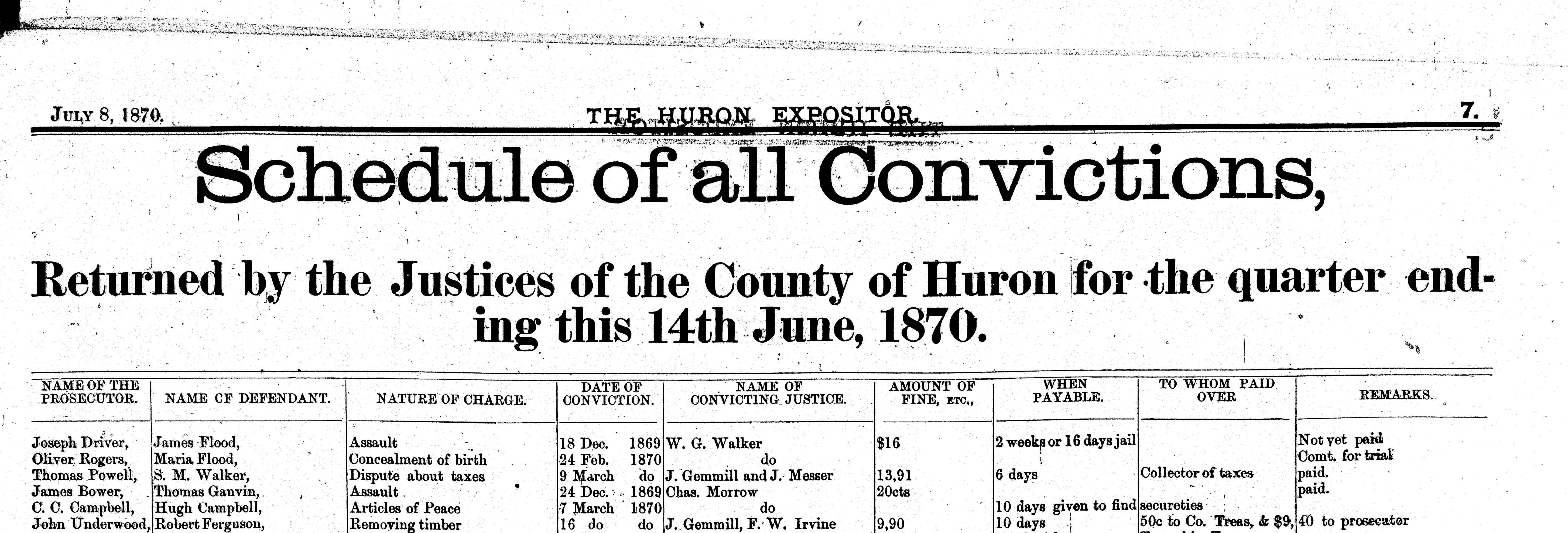
One record that is available for study is the “Huron County Gaol Registry.” The portion of the Registry currently available for research includes entries for every person who stayed at the Gaol from 1841-1922. There are at least 12 cases that list infanticide, concealment of birth, child exposure, or a related charge as the reason for committal (Figure 3 and 4). While not a staggeringly high number, these records only include the people sentenced to gaol for allegedly killing their infant or related crimes. If they were not apprehended or not committed to jail, they would not appear in the registry. Additional cases do appear in the local newspaper accounts (Figure 5) and coroner’s inquest records , including Catherine’s story .  The registry shows that the first prisoner committed for infanticide came to the Gaol in 1846 and that a prisoner was committed for procuring drugs for an illegal abortion in 1920. While not demonstrating frequency with complete accuracy, the registry clearly does indicate that infanticide and other crimes resulting from unwanted pregnancies occurred in Huron County throughout the entire period documented from 1841-1922. These instances of infanticide would increase when including the records of nearby counties like Middlesex, Bruce, and Perth, which also had reported infanticide cases during the same period. There was therefore no reason to look to other countries to find the circumstances that fostered infanticide: Huron County residents could see the evidence in their own towns and the surrounding counties.

image of a newspaper clipping

Figure 1: “The Safe Arm of God,” The Exeter Times, 1894-2-1, Page 6 

Image of figure 2 - newspaper clipping from Brussels Post

Figure 2: “Prohibition Notes,” The Brussels Post, 1902-11-20, Page 4

Figure 3: Newspaper clipping from The Huron Expositor, 07-22-1881, pg 5.

Figure 3: The Huron Expositor, 07-22-1881, pg 5.

Newspaper clipping: "Concealment of a Birth" Mrs. Ellen Wandby and her daughter, Mrs. Elizabeth Stewart, were before his honour Judge Toms, Tuesday last, to answer to a charge of concealment of birth in the town of Wingham.

Figure 4:The Huron Signal, 06-10-1887, pg 4.

Figure 3: Newspaper clipping from The Huron Expositor, 07-22-1881, pg 5.

Figure 5: The Huron Signal, 12-10-1880, pg 1.

Image of newspaper clipping from 1870 Schedule of Convictions featuring prosecution of Maria Flood for “concealment of birth.” The Huron Expositor, 07/08/1870, pg 1.

Mothers faced most of the blame for infanticide from the legal system and contemporary journalists for reported cases. However, this viewpoint often neglects to consider both the devastating judgements placed upon these women for their unwanted pregnancies, and the lack of support available to help struggling mothers. Of the cases involving infanticide, concealment of birth, or abortion found in the Huron County newspapers and Gaol records, a large number involve young women under 25 years old and illegitimate children (the offspring of a couple not married to each other).  For example, a case from 1864 involves a 15-year-old unmarried female servant; a case from 1877 involves a 22-year-old single female servant; a case from 1880 involves a 17-year-old female servant. As servants, these women were dependent on wage labour. With the birth of a child, the woman would have to give up employment to care for the baby, as without the security of legal marriage the father would often refuse any support. Her ability to care for herself, let alone the child, declined greatly after giving birth. In addition, women faced religious and societal pressures to remain chaste until marriage. Bearing an illegitimate child proved to society that a woman was unchaste. (6) Women who gave birth to illegitimate children, no matter the circumstances of their conception, would face harsh judgement from their communities, which could impact their ability to find new work or to be married. These women with illegitimate children immediately became outcasts. This happened because Christian societies at the time judged much of a single woman’s morality and value according to her chastity. (7) As such, women of this period faced significant social judgement if they had an illegitimate child. The idea of concealing the child’s birth may have appeared to be the only choice for single mothers hoping to retain their ability to earn a living, maintain their place in society and avoid becoming an outcast, which could lead to cases of infanticide and child abandonment. 

The lack of available social services in Huron County before the 20th century could also factor into these cases of infanticide. Before Huron County’s House of Refuge opened near Clinton in 1895, the only municipal building available for social services was the Huron County Gaol. There was no local lying-in hospital or home for unwed mothers. During this period, the Gaol often housed the elderly, destitute, and sick. Some lower tier municipalities made the choice to commit unwed mothers to gaol to give birth, and multiple women would have their babies behind bars at the Huron Gaol. This was an inexpensive way to house the mother and child until such a time she could return to the labour market. A young woman faced with the birth of an illegitimate child in Huron County would therefore have little support and few options available should she struggle to care and provide for her baby, and may have to bear the stigma of being committed to gaol regardless of committing a crime.

While newspapers like The Exeter Times and Lucknow Sentinel reprinted articles featuring infanticide as a cautionary tale to criticize and condemn outside cultures and to promote the positive influence of western Christianity, infanticide remained prevalent in their own communities. Stories like that of Catherine demonstrate the difficult circumstances that sometimes drove women to commit infanticide. Having an illegitimate child immediately lessened the perceived status and life options of a young woman in respectable Christian Southwestern Ontario society. Also contributing to the devastating decision by some of these young women to commit infanticide was the lack of social services available to help them provide for a child. As such, infanticide was not a conquered issue for the residents of Huron County in the 19th and early 20th century.

Sources:

  • (1) Nicola Goc, Women, Infanticide, and the Press, 1822-1922: News Narratives in England and Australia (New York, NY: Routledge, 2016), 28.
  • (2) Coroner’s Report #365 Huron County Archives,  Unnamed baby of  Catherine J.  
  • (3 “The Safe Arm of God,” The Exeter Times, February 1, 1894, p. 6.
  • (4) Gregory Hanlon, “Routine Infanticide in the West 1500-1800,” History Compass 14, no. 11 (2016): pp. 535-548, https://doi.org/10.1111/hic3.12361, 537. 
  • (5) Kirsten Johnson Kramar, Unwilling Mothers, Unwanted Babies: Infanticide in Canada (Vancouver, BC: UBC Press, 2006), 97.
  • (6) Nicolá, Women, Infanticide, and the Press, 21.
  • (7) Nicolá, Women, Infanticide, and the Press, 21.

Further Reading

Find an index of coroner’s inquests on our Archives page (scroll to the bottom to find indexes and finding aids).

Find more stories from Huron’s past through a search of Huron County’s historical newspapers online!

Double, Double Toil and Trouble: The Tale of Maggie Pollock and the Huron County Witch Trial

Double, Double Toil and Trouble: The Tale of Maggie Pollock and the Huron County Witch Trial

In time for Halloween, students Kyra Lewis & Mary Murdoch share the history of witches in North America and Huron County’s own witchcraft case: “the weirdest [case] that has come before the Ontario Courts in many years”.

Today, popular culture often suggests that the legal pursuit of witches was something that began and ended with the infamous Salem Witch Trials in Salem, MA, in the 1690s. However, that was far from the beginning or end of the story. In fact, Huron County had its own witchcraft case as recently as the 1920s: the case of Maggie Pollock of Morris Township.

Background: The History of Witchcraft Law in North America

The history of prosecuting witchcraft as a crime has a long history in North America preceding Miss Pollock’s case. Historic Haudenosaunee society viewed witchcraft as very serious offence. Because witchcraft could endanger anyone in the community, people took accusations of witchcraft very seriously. Practicing witchcraft also went against the core principles of unity and peace found in “The Great Law”. The Great Law refers to the guiding principles of life in the Haudenosaunee Confederacy. The first step was to determine if the person was guilty. If the Council found the accused to be guilty, the punishment was death. If the accused promised to change their ways, they would always be forgiven and spared.

By the time Europeans began settling in North America, widespread panic surrounding witchcraft had decreased in Europe. However, in the 13 American colonies, settlers were still paranoid about the possibility of witches living in their midst. Not Salem, but Windsor, CT, was actually the first place in the US where an execution of a person charged with witchcraft took place. In total, Connecticut accused 46 people of witchcraft between 1647 and 1697. Of the 46 accused, 11 were executed. There were also witchcraft trials in Virginia between 1626 and 1730, but no executions.

Massachusetts’ Salem Witch Trials began in June of 1692. Residents of Salem accused 150 men and women of witchcraft. Over a period of 11 months, the residents of Salem killed 19 people by hanging and tortured one man to death. Of the 20 people killed, six were men. Five more people would die in prison before the end of the trials.

In Canada, pretending to practice witchcraft was illegal until 2018 under section 365 of the Criminal Code of Canada. This section read:

Pretending to practise witchcraft, etc.

365 Every one who fraudulently

  • (a) pretends to exercise or to use any kind of witchcraft, sorcery, enchantment or conjuration,
  • (b) undertakes, for a consideration, to tell fortunes, or
  • (c) pretends from his skill in or knowledge of an occult or crafty science to discover where or in what manner anything that is supposed to have been stolen or lost may be found, is guilty of an offence punishable on summary conviction.

Note that the crime in question was pretending to practice witchcraft. The Criminal Code of Canada did not mention the practice of witchcraft itself. The law was implemented in 1892 and was based off of a previous 1735 British Statute which condemned “fraudulent” claims of occult powers. The statute attempted to remove earlier religious rhetoric prior to the 18th century, which presumed and enforced that witches were indeed a very justifiable and dangerous threat to humanity. Instead, the 1735 Statute suggested that claiming occult powers was inherently fraudulent, thus upholding the notion that witches were not real. Logistically it was intended to limit fraud, and preying on the naive and desperate, but much like earlier witchcraft laws it could be used to prosecute vulnerable or marginalized women.

Although not commonly used in the 20th and 21st centuries, the law against pretending to practice witchcraft remained in effect until 2018.  Maggie Pollock, a Huron County woman, was charged under the law in 1919 in “the weirdest [case] that has come before the Ontario Courts in many years”.

Illustration of a young woman being accused of witchcraft

The Huron Expositor, 1963

Newspaper clipping from WIngham Advance

The Wingham Advance, 1920-04-29

newspaper clipping from Wingham Advance Times

Wingham Advance Times, 1930-09-11

Morris Township’s Gifted Lady

Margaret Pollock, more often referred to as “Maggie” or “Miss Pollock”, was a woman born in Huron County on May 11, 1879.

She was of Irish descent and lived and worked on her brother’s farm as a housekeeper in Morris Township, near Blyth. Maggie claimed to be “possessed with a peculiar occult gift” that she used on several occasions to help neighbors locate lost or stolen items and property. Following a peculiar court case, Maggie’s “gifts” would earn her sudden celebrity not only in Huron County, but across the country.

From a young age, Maggie knew that she had a special gift. At 16, she realized that she had an ability to see and to hear things that others could not. While visiting a friend’s house in Boston, Maggie realized that she had seen the house and an elderly woman who lived there before. Around the turn of the century, Maggie experienced visions of two strange machines. The first Maggie thought was a chariot of angels at first glance, but then she noticed that the machine had wheels. It shocked Maggie when she saw the machine in the sky land right beside her and saw regular people disembark from it. Maggie saw the second strange machine when she was driving down the road and turned around to see a machine that ran like a train without a track behind her. This vision puzzled Maggie. It wasn’t until many years later that Maggie realized that she had seen an airplane and a car many years before the modern version of either was invented. While some might label Maggie’s gift as relating to the occult, Maggie claimed that her abilities were completely natural, without witchcraft or trickery involved. When Maggie’s neighbours came to her for help, Maggie never guaranteed results, but rather promised to do the best that she could to help them. When questioned about the things she saw, Maggie claimed that she had no powers of her own, but that her visions and insights were a God-given gift which she felt compelled to share when they came to her.

Huron County’s Witchcraft Case

On June 30, 1919, Maggie was brought to the Huron County Gaol after she was accused of “Telling Fortunes,” which was illegal under section 365 of the Canadian Criminal Code. In Goderich, a farmer had testified that he had given Maggie 50 cents for a séance. He did this in an attempt to locate oats and grain which someone had stolen from him. It wasn’t revealed in court whether Maggie’s premonition actually resulted in recovering the oats and grain, but she saw a vision of the thief and was able to describe his horse. She appeared before Goderich Judge Henry Dickson, and the court decided that; “she did unlawfully pretend from her skill and knowledge in an occult and crafty science to discover when and in what manner certain goods and chattels, to wit, certain grain and oats, supposed to have been stolen from one, John Lienhardt.”

On Oct. 13, 1920, Maggie’s case was appealed to Osgoode Hall, one of the oldest and most distinguished legal associations in the country, by her counsel, Mr. C. Garrow. Osgoode upheld Judge Dickson’s conviction. According to the contemporary account of the Clinton News Record, “The judge admonished her that the practice must cease and has bound her over in bonds of $200 from herself and from her brother to refrain from pretensions of occult power and from practicing the occult science.” The court gave Maggie permission to offer her opinion about lost items, but not to claim that she had any special powers.

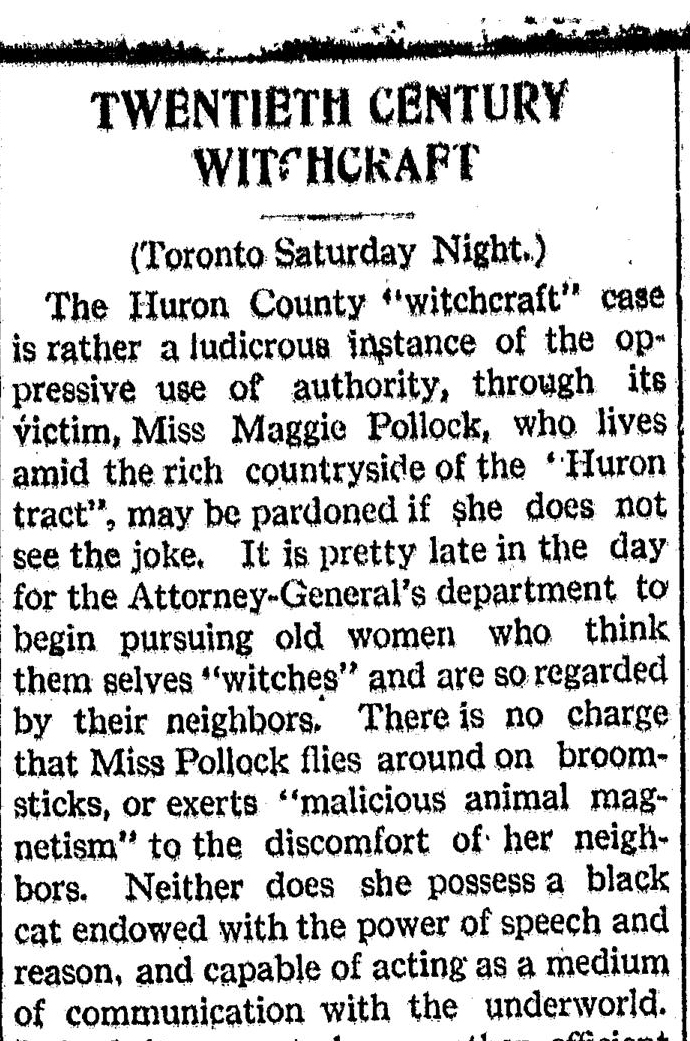
Members of the local community continued to support Maggie during her conviction and appeal, and her supporters were upset with her treatment in the legal system. The Toronto Saturday Night chastised the judges and those involved with the case for, “harrying a poor old woman.” A neighbour, Mrs. Sinclair, also testified at Osgoode Hall to corroborate the effectiveness of Maggie’s “gifts”. She stated that Maggie had successfully helped her to find a lost diamond ring. Maggie had claimed to do this by speaking with Sinclair’s deceased mother, and told Mrs. Sinclair that she had thrown out the ring with some dust. Maggie added that Mrs. Sinclair would find the ring when the snow melted. Despite this advice, Mrs. Sinclair and her husband decided to melt the snow. When this did not work, she sent a letter to Maggie detailing what she had done, and that she had not found the ring. Maggie replied that Mrs. Sinclair needed to be patient. Sure enough, the snow thawed weeks later, and the ring was there.

The Legend of Miss Maggie Pollock 

Considering a continued public fascination with witchcraft and the occult, it is no surprise that Maggie’s legal battle gained widespread recognition in 1920. It was notable to some that an older woman from Huron County could perform such “miracles,” while others were shocked that she could be accused of something as archaic as witchcraft. The Toronto Daily Star questioned the wisdom of the verdict: “There is a fairly widespread belief in the occult. It is growing. Why not cope with this sort of thing more intelligently than by merely putting the ban of the law upon it?” The same article suggested that rather than legal prosecution, a public test to determine the validity of Maggie’s gifts would be the superior solution: her powers could simply be disproved or verified to harmlessly help with more cases of missing valuables.

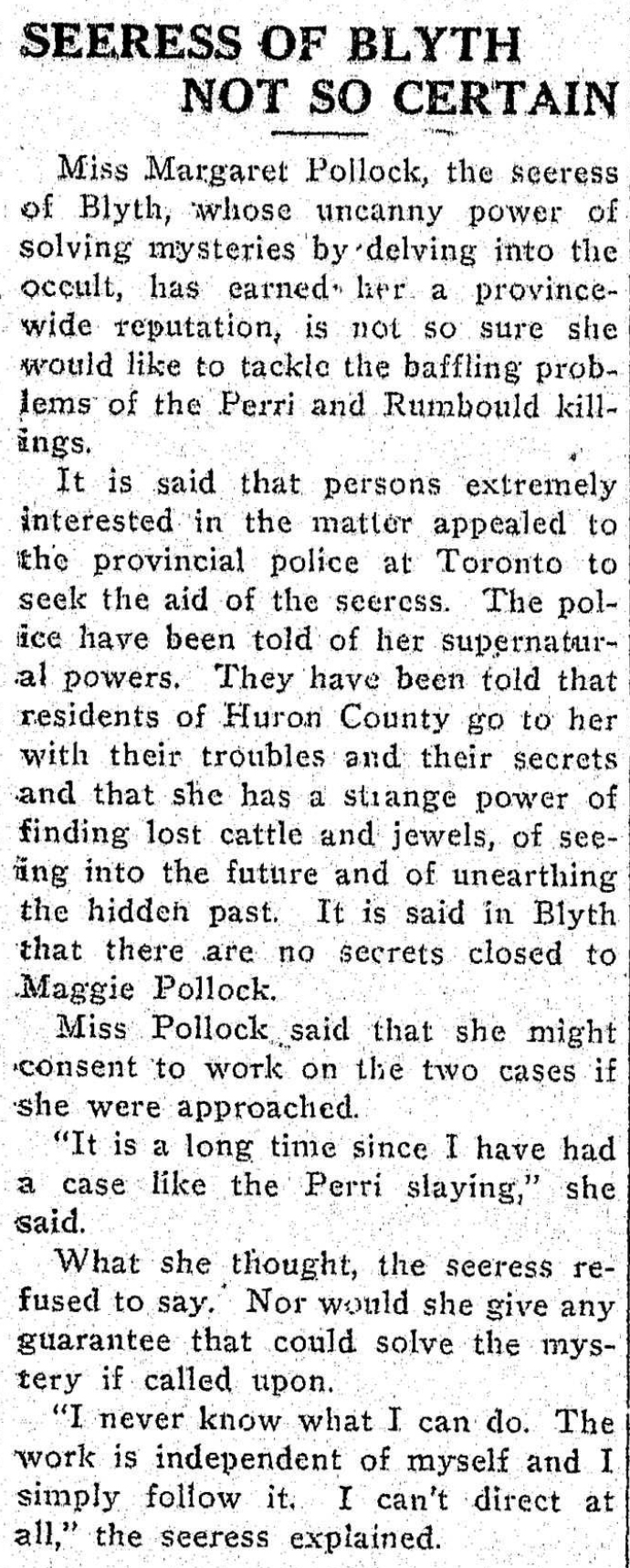
A large number of supporters did not doubt Maggie’s abilities. She received many visitors and letters from people as far away as Florida, Texas, Missouri, Nebraska, California and Vancouver. Her skills were also allegedly sought-after on the other side of the law. The police asked her to locate missing bodies of drowned persons several times: including a young boy who had drowned in Wingham and a man who fell through ice in New Hamburg. The Seaforth News reported that Maggie was also paid a visit by High Constable A.J. Wharton of London to discuss the escape of two murderers from London Jail in 1927.  

Maggie Pollock passed away in August of 1931, in her 70th year. The Seaforth News said of her, “[She] has honour in her own country, because her neighbours have always had the upmost faith in her and can relate scores of interesting stories.” She was fondly remembered as, “a well-known and highly respected resident of Morris Township.” Despite the verdict of the witchcraft case, Maggie was able to continue to help others with her gifts as she had wanted. Whether those gifts were real is still something up for debate. One thing is certain, Miss Maggie Pollock was one magical woman, one way or another.

Sources Consulted & Links to Learn More!

Behind the Bars

Behind the Bars

Behind the Bars makes its return to the Huron Historic Gaol this summer, running each Tuesday and Thursday evening starting July 12. Doors open at 7 p.m. and the last tour begins at 8 p.m.

Behind the Bars is an immersive tour experience that gives visitors the opportunity to learn more about life at the Gaol. Interact with actors portraying past inmates and staff who lived and worked at the Gaol between 1841 and 1911.

Tickets available online until one hour before the event, or at the door after doors open at 7 p.m. Purchasing tickets ahead of time online or at the Gaol (during regular daytime hours) guarantees entry and reduces wait times. Capacity in the building is limited. No need to bring paper copies of your tickets – just state the name of your party to the employee at the door to gain entry.

ADMISSION:$10 for adults, $5 for children, $30 for families
FREE: For Museum members and children under 5
TICKETS: https://www.eventbrite.ca/e/behind-the-bars-2022-tickets-364219248577