
Researching Canada’s ‘Last Public Hanging’

Researching Canada’s ‘Last Public Hanging’

The following blog posts were originally published by Carling Marshall-Luymes on her personal blog while she was an intern for the Huron County Museum & Huron Historic Gaol in 2007. You can see the exhibit on the history of capital punishment on permanent display in Cell Block 1 when you visit the Huron Historic Gaol today.

The Executioner

I’ve begun my internship at the Huron County Museum and Historic Gaol and I’m currently researching public hangings in (Upper and Lower) Canada for an upcoming exhibit. Three men were hanged at the Gaol in Goderich (1861, 1861 and 1911), all for murder; the first two were public hangings. I’ve set out to answer, among other things, why people were hanged, why such large crowds of spectators came out to watch hangings and why public hangings. These began as easy questions, to which I expected to find straight forward answers, but their answers are proving less simple than I had anticipated and I intend to shift the nature of my blog by writing about my research.

I work where Steven Truscott was incarcerated at age 14 during his 1959 trial for the rape and murder of schoolmate, 12 year old Lynne Harper, and became the youngest Canadian sentenced to death before his sentence was commuted to life imprisonment. Thinking about Steven Truscott everyday and seeing the emotional response visitors have to his case, my assumption was that capital punishment (both public and behind prison walls) was abolished on the basis of humanity towards the convicted; but my research as opened my eyes to a lot of arguments for the abolishment of capital punishment.

John Radclive, Canada’s first professional hangman was appointed in 1892 after carrying out several successful hangings for various Ontario sheriffs. Most career hangmen were destroyed by their profession and Radclive was no exception. During his career Radclive began a ritual of finishing a full bottle of brandy after each execution; he drank excessively both before and after hangings. In a Star interview in Dec. 1906, Radclive spoke of himself: “I am a sick man, too sick to talk,” he said. “I have been sick a long time, very sick.” He died in February 1911, at 55, of cirrhosis of the liver at home in Toronto.

There seems to be some similarity between Radclive and the hangman hired by the Huron District gaol governor {William] Robertson [in 1861] – alcoholism. In a telegram discussing the hangman’s journey from Toronto to Goderich, Robertson is warned that the hangman is an unreliable drunkard, and a turn-key is thus being sent with him.

In an interview with psychologist Rachel MacNair, Radclive described his internal torment:
“Now at night when I lie down,” he said, “I start up with a roar as victim after victim comes up before me. I can see them on the trap, waiting a second before they meet their Maker. They haunt me and taunt me until I am nearly crazy with an unearthly fear.”

Public attitudes towards the hangman must have furthered his torment. In 1900 the Star wrote of Radclive: “If he were a man of delicate sensibilities he would not be the hangman. He is a necessity in our system, but he should be treated as if he is the hole in the floor of the gallows.” At the same time, a 1910 Globe editorial wrote on the role of the hangman: “It is an unpleasant subject, but it is a public question, and it is a public function for which all are reposnsible.” At a time when the population supported capital punishment I find it ironic that the they were so repulsed by the man carrying out their will. Countless people have to be involved in an execution by the state, directly or indirectly and in addition to the hangman, and I’ve realized the significance of acknowledging the psychological stress on these men and women as part of the case against capital punishment.

– – – – – – – – – – – – – – — – – – — – – – – – – – — – – – – – – – – – – – –

The agony of the executioner; How a Parkdale man became our first official hangman and was destroyed by it. By Patrick Cain; [ONT Edition]
PATRICK CAIN Patrick Cain. Toronto Star. Toronto, Ont.: May 20, 2007. pg. D.4

Capital Punishment in Canada. Department of Justice http://www.justice.gc.ca/en/news/fs/2003/doc_30896.html

Canada's Last Public Hanging?

Where was Canada’s last public hanging? This is a question I’ve been trying to answer for our upcoming exhibit; but the answer has proven less straight forward than I anticipated. Yesterday, I was excited to find an An Order-in-Council, signed by John A MacDonald legislating the end of public hangings in Canada. Though hangings continued behind prison walls until 1962, was Canada’s last public hanging at our Huron County Gaol?

The hanging of Patrick Whelan at the Carleton County Jail on February 11 1869 for the assassination of MP and Father of Confederation D’Arcy McGee [left] is mistakenly claimed to be the last public hanging in Canada. Ten months later, on December 7, 1869, Nicholas Melady was hanged in Goderich at the Huron District Gaol for the murder of his father and step-mother. A recently published book detailing the crime and hanging, by Melady’s descendant John Melady, is titled Double Trap: Canada’s Last Public Hanging.

However – in 1869, Canada only included the provinces of Ontario, Quebec, Nova Scotia and New Brunswick. Hangings continued in public in areas that had not yet entered Confederation, such as the prairie provinces and BC.

While hangings were performed behind prison walls, the public was often still able to watch.

  • The Sheriff could and often did invite interested spectators and newspaper reporters.
  • Spectators were known to climb any nearby structure that would allow them to see into the yard. At the Montreal execution of Timothy Candy in 1910, dozens of people viewed the hanging from the roofs of adjoining houses. In this photo of the 1904 execution of Stanislau Lacroix in Hull, you can see the crowds on the nearby rooftops and telephone poles.
  • Crowds of excited spectators were hard to stop. In March 1899, 2,000 uninvited guests stormed a Montreal gaol to witness a hanging, joining the 200 witnesses already inside the prison yard.
  • The law was not always followed.
  • The hanging scaffold was sometimes built taller than the prison walls to allow for public viewing.

An elderly museum patron noted several years earlier that he recalls watching gallows being built in public in Hamilton while riding the streetcar. Was this a case where the gallows were built higher than the prison walls to allow curious spectators a view? or was the law simply ignored? I’m not sure I can claim for certain that the hanging of Melady in Dec. 1869 was the last public hanging even in the provinces within Confederation at the time.

Legislating the End to Public Hanging...A Clarification

A clarification on the legislation abolishing public hanging in Canada… I initially made the same error that John Melady makes in Double Trap and attributed the move of hangings behind prison walls to Order-in-Council 1021. Upon a careful reading of the Order-In-Council, which, after I came to understand the nature of Orders-In-Council more clearly, was in accordance with an act of Parliament, “Act 32-33 Victoria c. 29,” I realized that the Order-In-Council was only supplementing the legislation by creating additional rules and regulations related to hanging, including:

  • Executions were to be carried out within the walls oft he prison in which the offender was confined at the time of execution
  • Executions should take place at 8 am
  • Hanging should continue to be the mode of execution
  • A black flag was to be raised after an execution and remain up for one hour
  • The prison bell (or the bell of a neighbouring church) was to ring for 15 minutes before and 15 minutes after an execution

After receiving a copy of “Act 32-33 Victoria c. 29” from the Library of Parliament it’s clear that Section 109 of the Act, which went into effect 1 January 1870, is actually the legislation ending public hanging, declaring:

“Judgment of death to be executed on any prisoner after the coming into force of this Act, shall be carried into effect within the walls of the prison in which the offender is confined at the time of execution.”

Why did Canada abolish public hanging?

Between the years of 1850 and 1870, public executions ended in countries such as the German states, the Netherlands, Austria, and Spain, as well as England and Canada.

The end of public hangings in Canada under Act 32-33 Victoria chapter 29 brought relief to the general public but I was surprised to find that this was not because they disagreed with the death penalty (though some did), but largely because of the crowds that came to watch the executions.

People argued that public hangings should end for many reasons, and the ‘hanging crowd’ was a significant reason. People complained about rowdy crowds that showed up to watch hangings. When public hangings ended in England, the Times of London reported:

We shall not in the future have to read how, the night before the execution, thousands of the worst characters in England, abandoned women and brutal men, met beneath the gallows to pass the night in drinking in buffoonery, in ruffianly swagger and obscene jest.

Many polite Victorians felt that ending public hangings would advance civilization and they themselves felt uncomfortable watching hangings; at the same time they found the rowdy crowds’ fascination with death, obscene language and gestures, and disrespect for authority embarrassing.

Many also felt that death wasn’t solemn enough: the carnival-like atmosphere among the crowds that watched the executions prevented people from being deterred to commit crimes. It was also argued that by watching hangings, people were familiar with death and would no longer value human life or feel compassion towards others.

What I was most surprised to find that was by ending public hangings, the perpetuation of the death penalty was actually ensured. If people did not have to deal with the crowd, they would no longer have a reason to protest hangings. By making the hangings private, the death penalty could continue.

Capital punishment: Huron County opinion in 1869

Jesse Imeson was formally charged yesterday at the Goderich courthouse, about a two blocks away from where I was working at the Historic Gaol. By my lunch break, which I took at a shady picnic table on the courthouse grounds, the media circus had died down. Later, listening to the news, I was surprised to hear not that a crowd had gathered that morning by the courthouse, but that they had shouted at him and called out to reinstate the death penalty.

While researching the exhibit on public hanging, I was curious about what Huron County residents felt about the death penalty then, and I was surprised by a 11 Dec 1869 editorial in the Seaforth Expositor we had in our archives. The editor argued that public execution wasn’t an effective deterrent against crime, and crude and rowdy crowds had become hardened by watching public executions.

On the Melady hanging, he wrote:

We hope in the name of God – in the name of humanity – that capital punishment may soon be abolished in this ‘our Canada,’ and placed where it ought to be, with the grim relics of barbarous times.

I was hoping for a variety of letters to the editor in response, but as they were uncommon in this paper at the time, there was only one that seems to favour the death penalty:

The man that violates the law is a criminal, and is a scoundrel of whom we should get rid of in the most available way.

Semi-public? - The Hoag Hanging, Walkerton - 1868

As legislation mandating that executions move behind gaol walls came into effect 1 January 1870, I was researching under the assumption that most hangings before this date were outside gaol walls. I was interested to find The Globe article describing the 1868 hanging of John Hoag at the Walkerton gaol (Bruce County had only recently separated from Huron County, therefore this execution wasn’t in Goderich), where the scaffold seems to have been built higher than the walls, but not allowing to see the convicted after he had dropped:

The Sheriff then examined the fatal apparatus; the masked executioner did his work; and the body dropped within the gaol wall, depriving the gaping and motley crowd, some of them women with children in their arms, of the awful spectacle of the body quivering on the rope for a few minutes, perhaps five or six. A number of people were inside the wall and saw the whole [The Globe, 16 December 1868].

At this point I was concerned that perhaps the Melady hanging at our Huron County gaol may have also only been ‘semi-public’ and maybe not the last officially public hanging. I was found The Globe article on the Melady hanging [though blurry to read], which states that Melady was taken from ” the northern exit of the prison, ascended a temporary staircase, and took his position on the scaffold, which was on a level with the prison wall” and suggests that the hanging was entirely public.

However, there is always the possibility that though Melady ascended the stairs to the gallows publicly, because the scaffold was level with the prison wall, the trap could have been on the opposite side of the wall, and he could have dropped out of public view. It seems unlikely however that, as I mentioned in a previous post, both the Seaforth Expositor and The Globe would have made reference to it as the last public hanging if it was only ‘semi-public’ like the Hoag hanging.
‘Photographs of Distinction’: The Career of Photographer Irene Burgess

‘Photographs of Distinction’: The Career of Photographer Irene Burgess

In anticipation of the Huron County Museum’s in-development exhibit Forgotten: People & Portraits of the County, volunteer Kevin den Dunnen takes an in-depth look at one of the many studio photographers to work in Huron County, and traces the professional and personal journey of Irene Burgess.

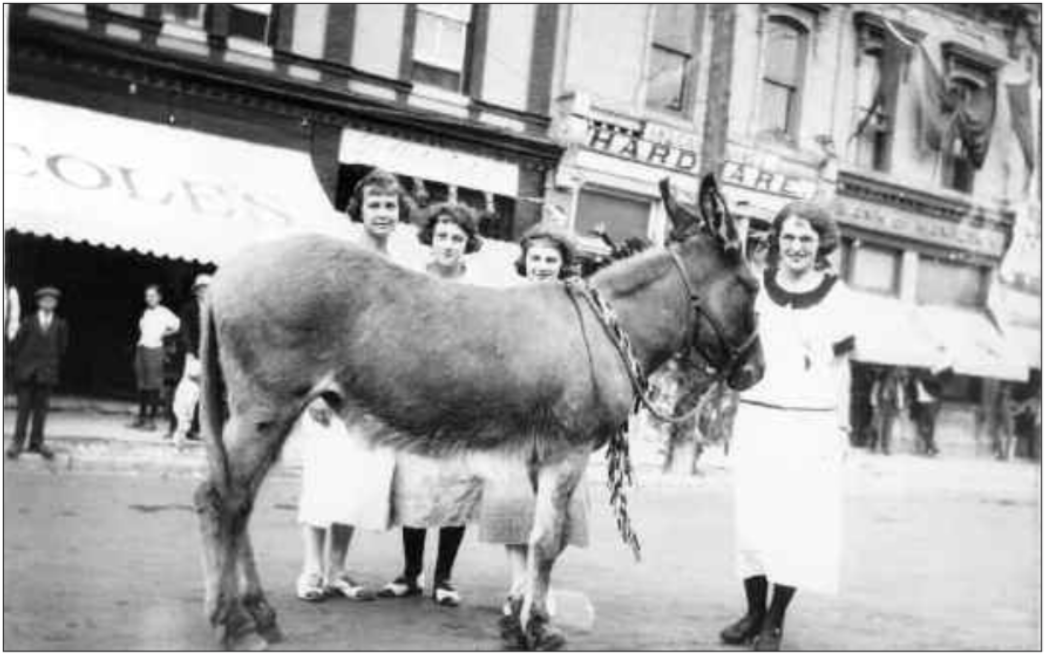
Summer of 1923 “old home week” in Mitchell, Ontario. Irene is the farthest left of the four. Image courtesy of the Stratford-Perth Archives.

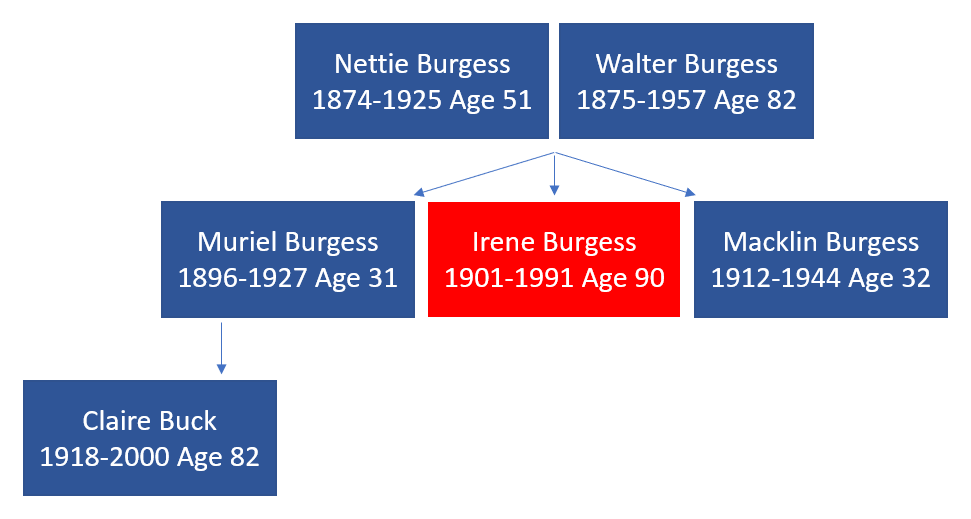
Hiding within the Huron County Museum’s online and free-to-use newspaper archives are an unlimited number of stories like the one of Miss Irene Burgess. Irene Burgess was a woman that defied societal norms. In a time where women were rarely given the freedom to pursue a chosen career, Irene managed her own photography studio. While many women were expected to marry and have families, Irene stayed single. She was also faced with many tragedies in her life. Neither of her two siblings lived past 32. Her mother passed away at 51. Her niece nearly died at the age of 6. She lost the photography studio after an explosion. Through all of this, the communities of Perth and Huron Counties rose to support her.

Personal Life

Nettie Irene Burgess was born September 20, 1901, in Mitchell, Ontario. Her parents were Nettie and Walter Burgess. She had two siblings – an older sister named Muriel, born in 1896, and a younger brother named Macklin, born in 1912. Her father, Walter, was a long-time photographer in Mitchell and owner of W.W. Burgess Studio. Growing up around photography gave Irene plenty of exposure to the business. This experience would prove to be important in her adult life.

A brief family tree of the Burgess family. Of note, it only contains the names of family members included in this article.

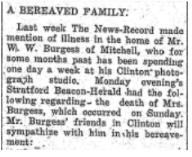
Excerpt from the November 26, 1925, edition of The Clinton News-Record detailing the passing of Irene’s mother Mrs. Nettie Burgess.

Irene experienced several tragedies throughout her life. By her 43rd birthday, only she and her father survived from their family of five. The first to pass was Irene’s mother, Nettie Helena Burgess, on November 22, 1925, at the age of 51. Irene’s sister, Mrs. D.F. Buck ( née Muriel Burgess) and her 6-year-old daughter Claire had been staying with her parents Walter and Nettie Burgess; Mrs. Buck had been ill for some time. During their stay, Claire became ill with pleuro-pneumonia. On the brink of death for several days, she began to recover with the help of her grandmother, Nettie. While caring for Claire, Nettie contracted pneumonia. Less than six days later, Nettie passed away in the presence of her family and nurse. 6-year-old Claire would live for another 75 years thanks to the care of her grandmother.

The next member of Irene’s family to pass would be her sister Muriel. Muriel was married to D.F. Buck, a photographer from Seaforth. They had three children, a daughter named Claire, and two sons named Craig and Keith.  On March 24, 1926, an update in the Mitchell Advocate indicated that Irene would be visiting her sister, Mrs. D.F. Buck, at the Byron Sanitorium. According to the update, Mrs. Buck was “progressing favourably” but had been in poor health for some time. Almost fourteen months later on May 12, 1927, The Seaforth News wrote about the death of Mrs. D. F. Buck occurring the past Friday. While not mentioning the cause, the obituary described her as being “in poor health for a considerable period.”

On July 18, 1944, the Clinton News Record posted an obituary for Irene’s brother Macklin Burgess who passed away from a long-time illness at the age of 32. Macklin was in the photography and radio business. He left behind his wife, Elizabeth May, and three children, David, Nancy, and Dixie.
The next of Irene’s family to pass would be her father, Walter Burgess, in 1957 at the age of 82.

An interesting note in the life of Miss Irene Burgess is that she never married. In the Dominion Franchise Act List of Electors, 1935, Irene (age 34) is listed as a spinster (meaning a woman that is unmarried past the age considered typical for marriage). Whenever Irene is referenced in a newspaper, her title is Miss Irene Burgess. Irene would live until 1991.

The Clinton Studio

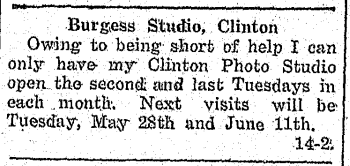
A notice posted by Walter Burgess in the May 23, 1929, edition of The Clinton News-Record

Walter Burgess operated a Clinton studio throughout the 1920s. The November 26th, 1925 edition of The Clinton News-Record mentions that Walter had only been spending one day a week at his Clinton Studio being “short of help.” A notice posted in The Clinton News-Record on May 23 1929 by Walter Burgess stated that his Clinton studio would only be open “the second and last Tuesdays in each month.” On October 1 of 1931, Walter announced that his newly-renovated Clinton studio would be open every weekday. His daughter, Miss Irene Burgess, would now be in charge of the location. Walter proclaimed Irene as “well experienced in Photography” and having “long experience with her father.” Not long after Irene became manager, Clinton residents would see the name Burgess Studios much more often in their newspapers.

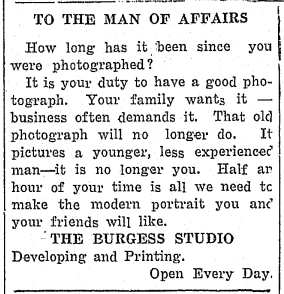
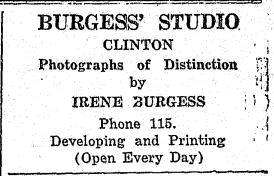
When Irene began managing the Clinton Studio in 1931, advertisements for the business began increasing. The slogan “Photographs of Distinction” appeared in advertisements from 1937 until the week of the fire. These ads were brief, only including the business name, slogan, Irene’s name, and the services provided. Earlier advertisements include one from 1933: “It is your duty to have a good photograph. Your family wants it – business often demands it.” Another example from 1932 reads, “You have plenty of leisure time to get that portrait of [the] family group taken.” The Clinton studio began under the leadership of Walter W. Burgess, but Irene would soon grow the business larger than her father had the time for– that is, until the explosion.

Advertisement posted in the January 26, 1933, edition of The Clinton News-Record.

The Explosion

On the afternoon of Monday, November 24, 1941, an explosion set fire to the second story of the J. E. Hovey Drug Store sweeping the entire business block. This was the place of business for Burgess Studio, Clinton. The fire swept through the building and damaged several businesses including R. H. Johnson Jewelry Store, Charles Lockwood Barber Shop, and Mrs. A MacDonald’s Millinery and Ladies Wear Shop. Irene was not in the studio when the fire started and did not call the authorities. Instead, the fire was discovered by Police Constable Elliot who identified smoke around the second-story window of the J. E. Hovey Drug Store Building. The fire was well covered in local newspapers. Featured on the second page of the Seaforth News more than a week after the incident, it was reported that the fire almost reached the “main business section of the town.” On its front page the week of the accident, The Clinton News-Record described the fire as “one of the most dangerous Clinton firemen have fought for years.” Unfortunately, Irene did not have insurance and was forced to close her business in Clinton. An update written on November 27, 1941 in The Clinton News-Record mentioned Irene’s departure for Mitchell to stay with her father for an “indefinite time.” A week later, on December 4, 1941, Irene posted a notice in the News-Record reading that, “owing to the recent fire damaging my equipment and Studio, I will be unable to continue operation.” She suggested that customers could mail their orders to the new studio. Additionally, customers could drive to her father’s studio in Mitchell and have their travel expenses paid. While this time must have been devastating for Irene, the community came together to show their support for her.

Community Support

Excerpt from the December 12, 1941, edition of the Huron Expositor describing an even held in Irene Burgess’ honour.

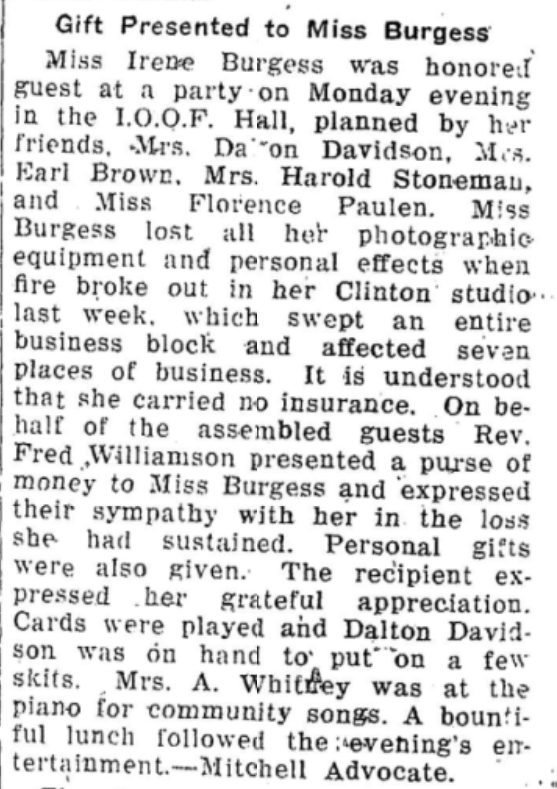
Two weeks after the explosion, the Mitchell Advocate reported about an event held at the I.O.O.F. Hall where Irene was the “honoured guest.” The event was planned by Irene’s friends Mrs. Dalton Davidson, Mrs. Earl Brown, Mrs. Harold Stoneman, and Miss Florence Paulen. Entertainment included skits, piano music by Mrs. A. Whitney, cards, and a “bountiful lunch.” Irene received a “purse of money” and personal gifts from her friends along with their condolences. The rallying support for Irene shows the positive impact she had in the communities of Clinton, Seaforth, and Mitchell. An uplifting end to an otherwise sad story.

Conclusion

Aside from her brother’s passing in 1944, Miss Irene Burgess was seemingly never mentioned again in the Huron County Newspapers accessible through the digital newspaper portal. She would live until 1991 in St. Marys, Ontario.

Huron County’s digitized newspaper collection is a vast historical database where you can find historical stories from our own county. While performing research for the upcoming exhibit “Forgotten: People & Portraits of the County,” I came across this story which piqued my interest. Without access to the digitized newspaper collection, the story of Irene’s remarkable journey would never have been found. This post was compiled using newspaper articles between the years of 1925 and 1944. Birth and death dates were found within newspapers and using external resources.

If you have a photograph by a Huron County photographer you would like to donate or share, please contact the Museum’s archivist by calling 519-524-2686, ext. 2201 or email mmolnar@huroncounty.ca. To learn more about the Huron County Archives & Reading Room, visit: https://www.huroncountymuseum.ca/huron-county-archives/

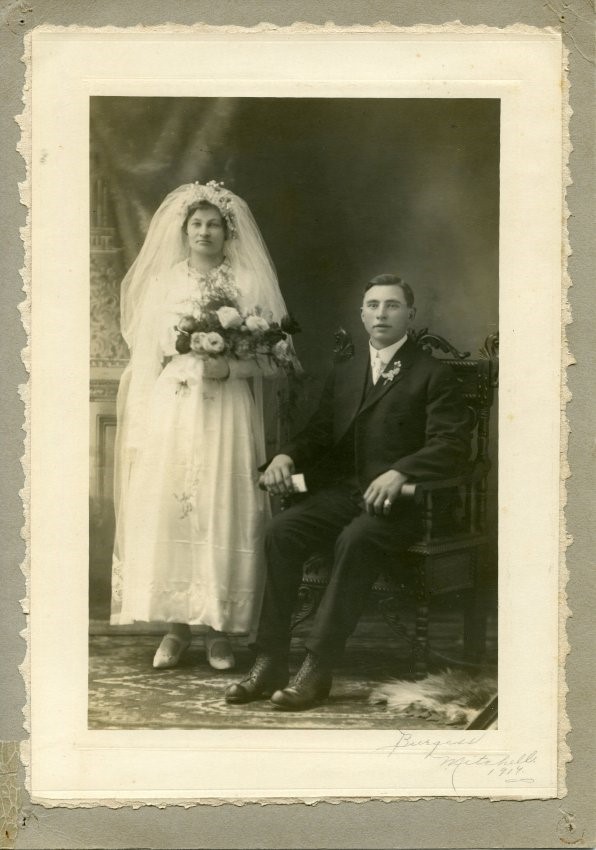
A950.1857.001 A photograph taken by Burgess Studio Mitchell in 1914. If you have a photograph from Burgess’ Studio, Clinton you would like to donate, please consider contacting the Huron County Museum.


The Huron Jail & the Second World War Part I: THE ‘DEFENCE OF CANADA’ IN HURON COUNTY

The Huron Jail & the Second World War Part I: THE ‘DEFENCE OF CANADA’ IN HURON COUNTY

In this two-part series, Curator of Engagement & Dialogue Sinead Cox illuminates how the Second World War impacted Huron County in unexpected ways at home, and even entered the walls of the Huron Historic Gaol. Click for Part Two, and the strange tale of how Dutch sailors became  wartime prisoners in Huron’s jail.

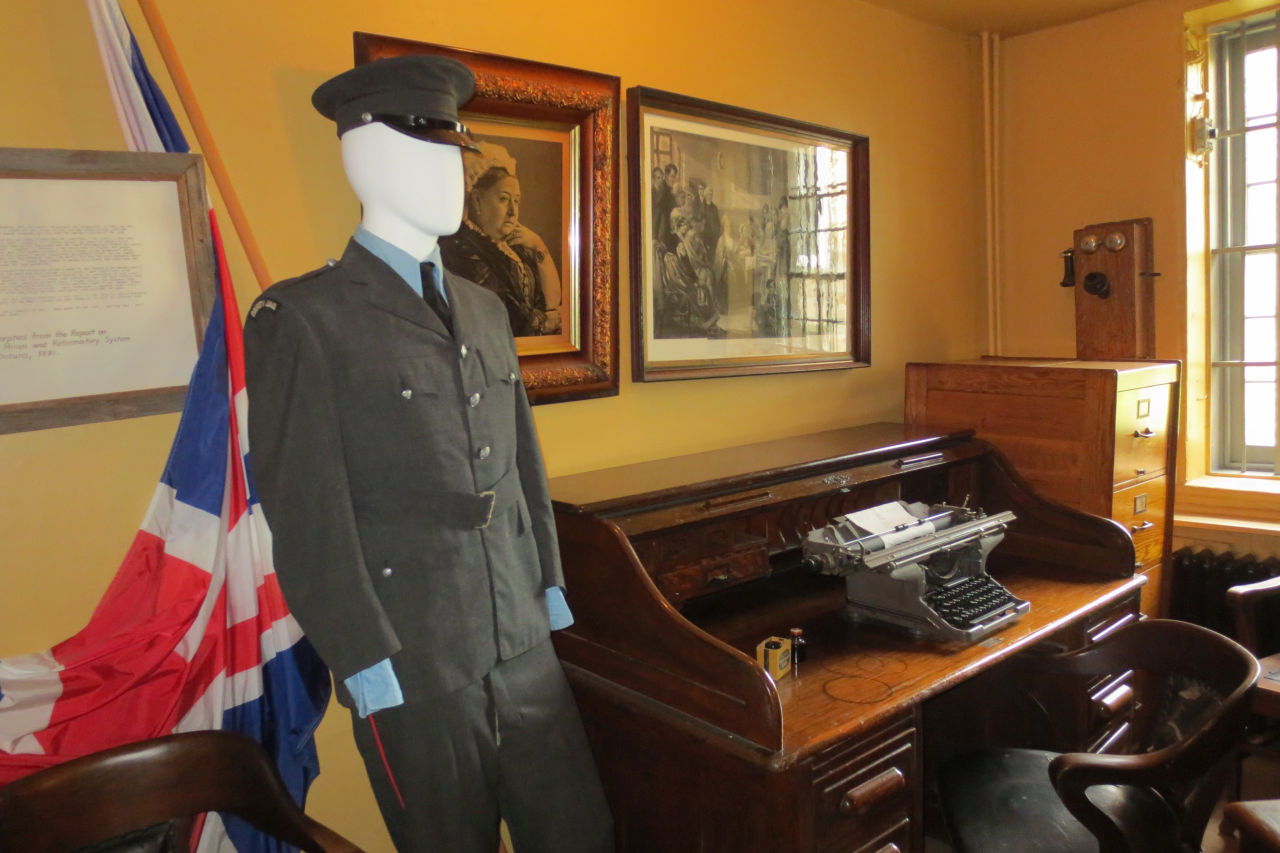
During the Second World War, Canada revived the War Measures Act: a statute from the First World War that granted the federal government extended authority, including controlling and eliminating perceived homegrown threats. The Defence of Canada Regulations implemented on September 3, 1939 increased censorship; banned particular cultural, political and religious groups outright; gave extended detainment powers to the Ministry of Justice and limited free expression. In Huron County, far from any overseas battlefields, these changes to law and order would bring the Second World War closer to home.

Regulations required Italian and German-born Canadians naturalized as citizens after 1929 (expanded to 1922 the following year) to formally register as ‘enemy aliens’ and report once a month. In Huron County, jail Governor James B. Reynolds accepted the appointment of ‘Registrar of Enemy Aliens’ in the autumn of 1939, and the registration office was to operate from the jail in Goderich. There were also offices in Wingham, Seaforth and Exeter managed by the local chief constables of the police force.

In addition to its novel function as the alien registration office, the Huron Jail also housed any prisoners charged criminally under the temporary wartime laws. Inmate records from the time period of the Second World War cannot be accessed, but Reynolds’ annual reports submitted to Huron County Council indicate that one local prisoner was committed to jail under the ‘Defence of Canada Act’ in 1939, and there were an additional four such inmates in 1940. The most common charges landing inmates behind bars during those years were still typical for the county: thefts, traffic violations, vagrancy and violations of the Liquor Control Act (Huron County being a ‘dry’ county).

Frank Edward Eickemier, the lone individual jailed under the War Measures Act’s Defence of Canada regulations in 1939, was no ‘alien,’ but the Canadian-born son of a farm family in neighbouring Perth County. Nineteen-year-old Eickemier pled guilty to ‘seditious utterances’ spoken during the Seaforth Fall Fair, and received a fine of $200 and thirty days in jail (plus an additional six months if he defaulted on the fine). The same month the Defence of Canada regulations took effect, Eickemier had publicly proclaimed that Adolph Hitler’s Nazi Germany was undefeatable, and that if it were possible to travel to Europe he would join the German military. He fled the scene when constables arrived, but was soon pursued and arrested for “statements likely to cause disaffection to His Majesty [King George VI] or interfere with the success of His Majesty’s forces.” His crime was not necessarily his political views, but his disloyalty. The prosecuting Crown Attorney conceded, “A man in this country is entitled to his own opinion, but when a country is at war you can’t go around making statements like that.”

Bruce County law enforcement prosecuted a similar case in July of 1940 against Martin Duckhorn, a Mildmay-area farm worker employed in Howick Township, and alleged Nazi sympathizer. Duckhorn had been born in Germany, and as an ‘enemy alien’ his rights were essentially suspended under the War Measures Act, and he thus received an even harsher punishment than Eickemier: to be “detained in an Ontario internment camp for the duration of the war.”

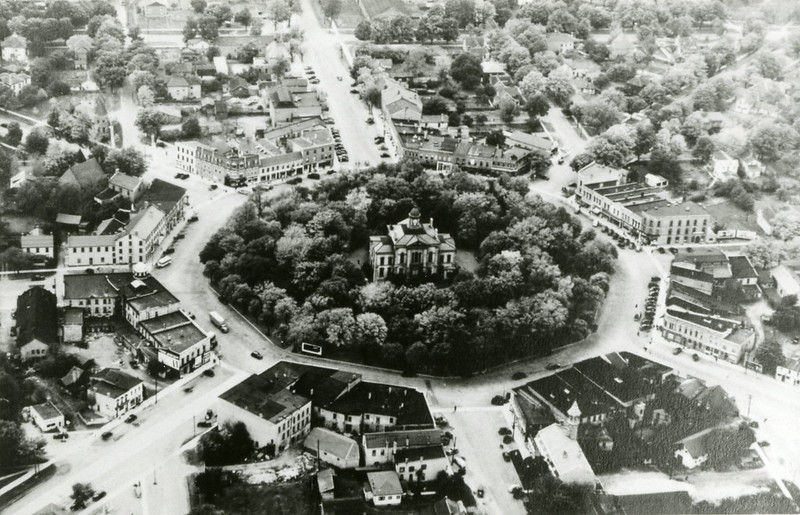
Huron County Courthouse & Courthouse Square, Goderich c1941. A991.0051.005

In July of 1940, the Canadian wartime restrictions extended to making membership in the Jehovah’s Witnesses illegal. The inmates recorded as jailed under the ‘Defence of Canada Act’ in Huron that year were likely all observers of that faith, which holds a refusal to bear arms as one its tenets, as well as discouraging patriotic behaviours.  That summer, two Jehovah’s Witnesses arrested at Bluevale and brought to jail at Goderich ultimately received fines of $10 or 13 days in jail for having church publications in their possession. Four others accused of visiting Goderich Township homes to discourage the occupants from taking “any side in the war” had their charges dismissed—due to a lack of witnesses.  In 1943, the RCMP and provincial police collaborated to arrest another three Jehovah’s Witnesses in Goderich Township for refusing to submit to medical examinations or report their current addresses (therefore avoiding possible conscription); the courts sentenced the three charged to twenty-one days in the jail, afterwards to be escorted by police to “the nearest mobilization centre.”

By August of 1940, an item in the Exeter Times-Advocate claimed that RCMP officers were present in the area to ‘look up’ those individuals who had failed to comply with the law and promptly register as enemy aliens. A few weeks later, the first Huron County resident fined for his failure to register appeared in Police Court. The ‘enemy alien’ was Charles Keller, a 72-year-old Hay Township farmer who had lived in Canada for 58 years, emigrating from Germany as a teenager in 1882. According to his 1949 obituary in the Zurich Herald, Keller was the father of nine surviving children, a member of the local Lutheran church, and had retired to Dashwood around 1929. His punishment for neglecting to register was not jail time, but the fine of $10 and costs (about $172.00 today according to the Bank of Canada’s inflation calculator).

Although incidences of prosecution under the ‘Defense of Canada Act’ in Huron County were few, the increased scrutiny and restrictions would have been felt in the wider community, especially for those minority groups and conscientious objectors directly impacted. Huron had a notable number of families with German origins, especially in areas like Hay Township where you can still see the tombstones of many early settlers written in German. The Judge who sentenced Frank Edward Eickemier for his public support of the Nazi regime in 1939 made a point of accusing him of casting a ‘slur’ on his ‘people’ and all German Canadians: the actions of the individual conflated with a much larger and diverse German community by a representative of the law. His case indicates that pro-fascist and pro-Nazi sentiment certainly did exist close to home, but a person’s place of birth or their religion was not the crucial evidence that could define who was or was not an ‘enemy.’

Next Week: Click for Part Two, and the strange tale of how stranded Dutch sailors ended up prisoners in the Huron County Jail during the Second World War.

*A note on spelling: Jail & gaol are alternative spellings of the same word, pronounced identically. Both spellings were used throughout the history of the Huron Historic Gaol fairly interchangeably. Although as a historic site the Huron Historic Gaol uses the ‘G’ spelling more common to the nineteenth century, for this article I have chosen to employ the ‘J’ spelling that appeared more consistently in the 1940s.

Further Reading
The War Measures Act via the Canadian Encyclopedia

Sources
Research for this blog post was conducted largely via Huron’s digitized historical newspapers.
“Faces Trial on Charge of Making Disloyal Remark.” Seaforth News, September 28, 1939.
“German Sympathizer Interned.” The Wingham-Advance Times, July 25, 1940.
“In Police Court.” Seaforth News, August 29, 1940.
“Jehovah’s Witnesses Charged.” Zurich Herald, October 21, 1943.
“Jehovah’s Witnesses Fined at Goderich.” The Wingham-Advance Times, August 22, 1940.
“Jehovah’s Witnesses Refused Bail.” The Wingham Advance-Times, July 18, 1940.
“Looking Up Aliens Who Failed to Register.” The Exeter Times-Advocate, August 1, 1940.
“Police Arrest ‘Jehovah’s Witnesses.’” Seaforth News, June 27, 1940.
“Statement He Would Fight for Hitler Proves Costly.” The Wingham-Advance Times, October 5, 1939.
“To Register German Aliens.” The Seaforth News, October 12, 1939.
“Twenty-One Days.” The Lucknow Sentinel, October 28, 1943.
“Would Fight for Hitler-Arrested.” The Wingham Advance-Times, September 28, 1939.

Children in the Huron Jail

Children in the Huron Jail

May 18th is International Museum Day! Museums and historic sites across the world are opening their doors for free today. For those whom cannot visit the Huron Historic Gaol in person, Student Museum Assistant Jacob Smith delves into the building’s past to reveal how some of Huron’s youngest prisoners ended up behind bars. 

During its operation [1841-1972], hundreds of children were arrested and sent to the Huron Jail. Their crimes ranged from arson and theft to drunkenness and vagrancy. The most common crime that children committed was theft. In total, thefts made up over half of all youth charges between 1841 and 1911. In total, children under the age of 18 made up 7% of the gaol population during that time.*

 
Occasionally, young people were sent to gaol for serious crimes. In 1870, William Mercer, age 17, was brought to the Huron Gaol and charged with murder. He was sentenced to die and was to be hanged on December 29, 1870. Thankfully for Mercer, his sentence was reduced to life in prison and was sent to a penitentiary. This is an example of an extreme crime for a young offender.

On many occasions, children were sent to gaol because they were petty thieves. Many young people who were committed for these types of crimes would only spend a few days in gaol. If the crime was more severe, children would be transferred from the gaol to a reformatory, usually for three to five years.

The youngest inmates that were charged with a crime were both seven years old. The first, Thomas McGinn, was charged in 1888 for larceny. He was discharged five days later and was sentenced to five years in a reformatory. The second, John Scott, was charged in 1900 for truancy; he was discharged the next day.

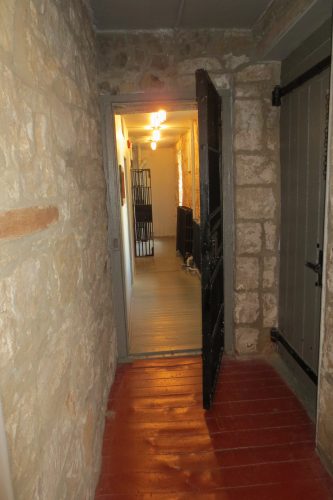
First floor cell block at the Huron Historic Gaol.

Unfortunately, some children were brought into gaol with their families because they were homeless or destitute. An example of this was in 1858, when Margaret Bird, age 8, Marion Bird, 6, and Jane Bird, 2, spent 25 days in gaol with a woman committed for ‘destitution’ (presumably their mother). Some children were also brought to the Huron Jail because their parents committed a crime and they had nowhere else to go while their parents were incarcerated. Samuel Worms, age 7, was sent to gaol with his parents because they were charged with fraud in 1865. He spent one day in the Gaol.

When reading through the Gaol’s registry, it is clear that times have certainly changed for young offenders. Most of the crimes committed by the young prisoners of the past would not receive as serious punishments today.

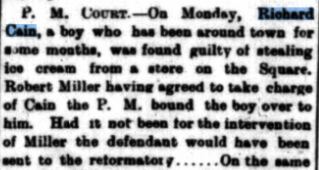
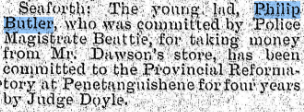
Here are some examples of their crimes in newspapers from around Huron County:

Richard Cain, 16, spent two days in jail.
The Huron Signal, 1896-09-17, pg 5.


Philip Butler, 15, spent eleven days in the Huron Jail.
The Exeter Advocate, 1901-08-29, pg 4.

Sources came from the Gaol’s 1841-1911 registry and Huron County’s digitized newspapers.

*Dates for which the gaol registry is available & transcribed. There were young people in the Huron jail throughout its history, into the twentieth century.