Industry Gallery Redevelopment

Industry Gallery Redevelopment

As the Huron County Museum prepares to undergo renovations to its Industry Gallery, Senior Curator Elizabeth French-Gibson shares details about this exciting new project.

When you are visiting the Huron County Museum over the coming months, you will certainly see some changes to our exhibit spaces. We are excited about these changes and we hope you will be too! While we always strive to present a variety of Huron County stories in our temporary exhibit galleries each year, these changes are coming to our permanent exhibit spaces.

Beginning in 2019, the Museum’s Strategic Plan included a strategic direction to create dynamic exhibits that generate interest and attention. Hopefully you have already noticed some additions and changes to text panels, further graphics, updated colours, and display changes.

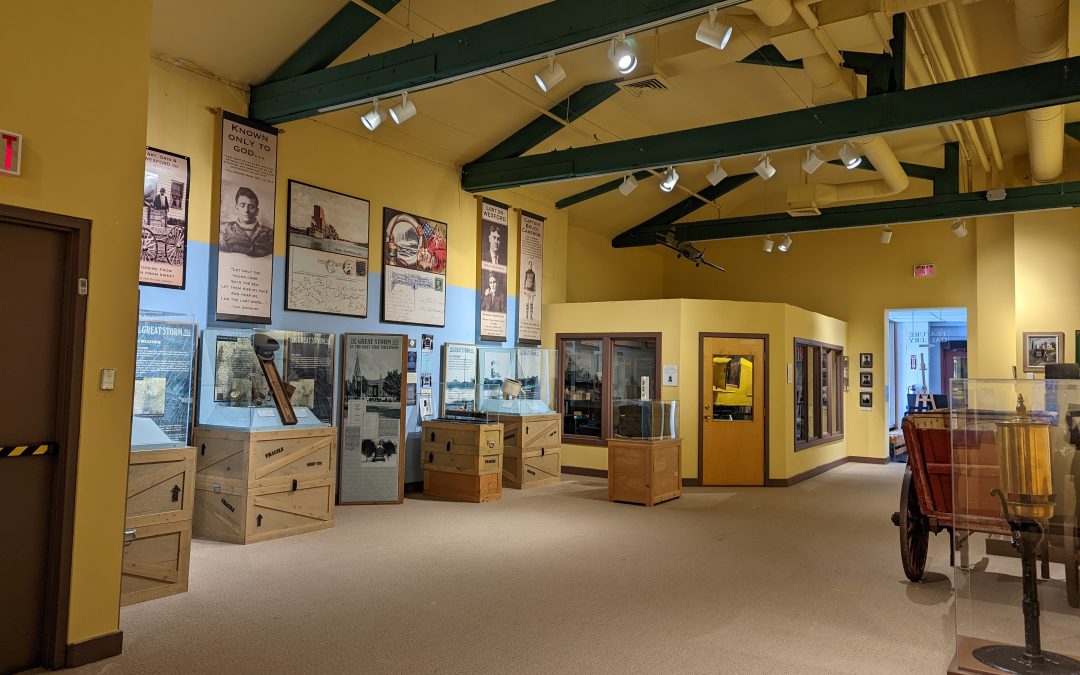
Throughout 2021 and 2022, staff have been in the process of planning a major redevelopment of one of our exhibition spaces, the Northwest/Industry Gallery, to better reflect the stories of industry from across Huron County.  This exhibit space is currently located on the upper floor of the old schoolhouse portion of the Museum. Some of you may remember that this is the exhibit gallery that was focused primarily on salt mining and the Great Storm of 1913.  It’s time for new and more diverse stories to be included in the space.

And these changes have started! The Northwest Gallery is currently closed to the public and is in the process of being fully dismantled. Construction work will begin in early December with the walls, ceiling, electrical, and flooring being completely refurbished. This work is expected to be completed in early 2023. Museum staff will then carry out the installation of a full new exhibit focusing on industries from across Huron County.

The “Big Idea” for the exhibit gallery will be “Places and Processes of Transformation!” The exhibit will focus on how the dynamic nature of industry has transformed Huron County and its people in many ways.

The final proposed interpretive plan for the proposed Industry Exhibit Gallery includes the following topics with thematic areas including clusters of 3D and 2D spaces, exhibits and activity sections:

  • The Lake and Harbour Industries – depicting human and environmental changes brought on by industry at Lake Huron.
  • Salt – depicting impact of Salt Industries in Huron County.
  • Natural Resources, Food and Drink – representing different relationships between Huron Industry and the natural environment
  • Industrial Diversity – showcasing the number and different types of industry in Huron County.
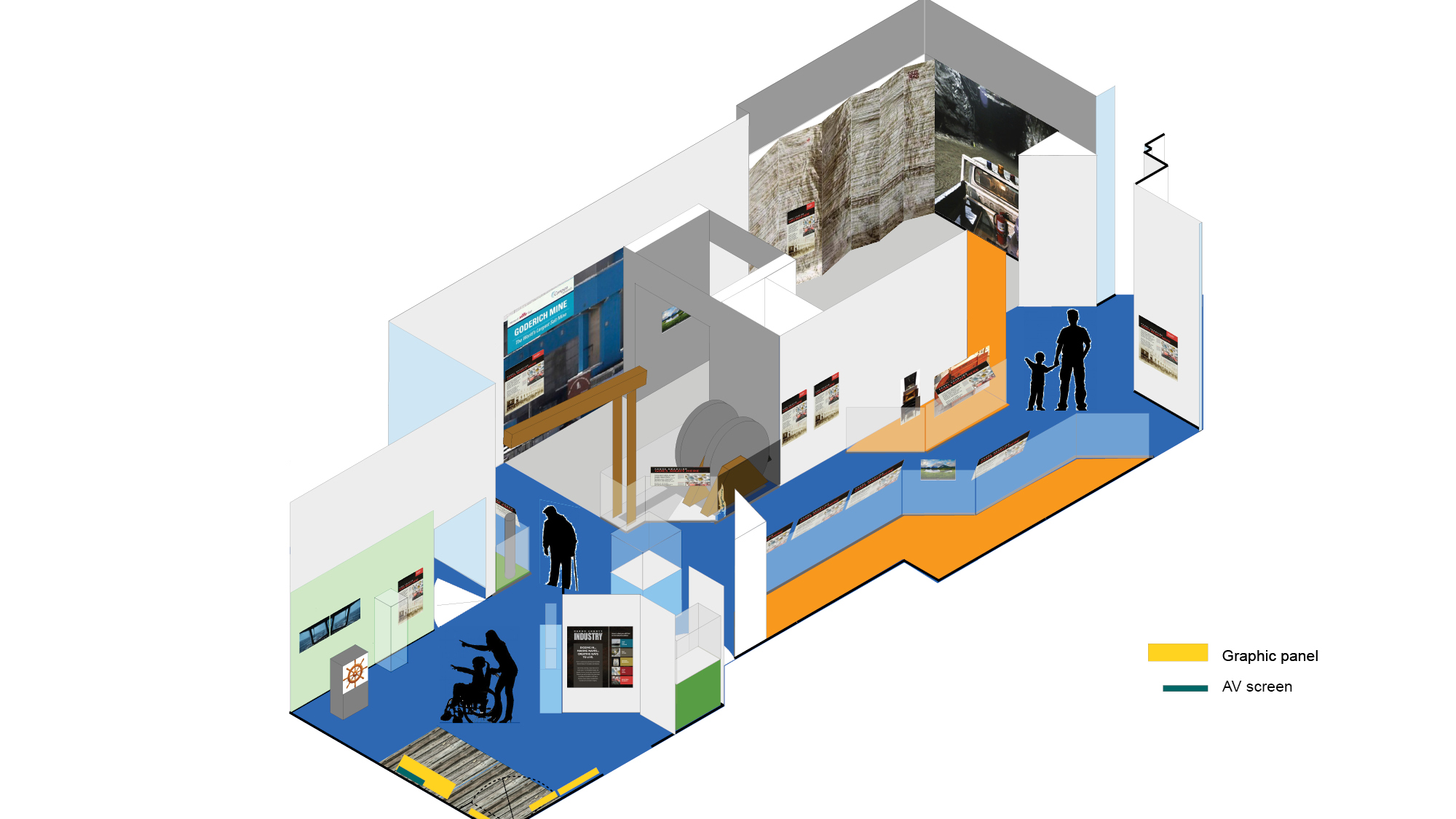
Illustration of the proposed redesign of the Museum's Industry Gallery

We have lots of planning left to do but the space design is complete, as shown in the illustration above, and work continues on the details that will go into the overall interpretive plan. So many industries, artifacts and photographs to choose from!

Artifacts and stories that were removed from the Gallery during the first stages of this redevelopment will be on display in the gallery across the hall upstairs to give visitors a final look at these stories over the coming months. During this time, staff will also be working on plans for rehousing these artifacts. They have had their time on display and will be moved to our main storage area for a well-deserved rest. While these stories were enjoyed by many visitors in the past, the new exhibit will provide a more diverse, county-wide story of our industrial history.

If you would like to be part of this exciting redevelopment and diversification, we encourage you to donate to this project. Your support will be allocated to our exhibitions and will enable the Museum to tell these expanded stories through a variety of interpretive methods in this space. Completing this project is an exciting next step for the Museum.

Donations can be made at the Huron County Museum during our regular business hours by cash, cheque or credit card.   More information on sponsorship opportunities can be found on the Museum’s website.  This Giving Tuesday, Nov. 29, the Museum’s Senior Curator would be happy to show you the work so far and how your donation will help.


Can you Escape the Huron Historic Gaol? : Virtual Escape Room

Can you Escape the Huron Historic Gaol? : Virtual Escape Room

Can You Escape the Huron County Gaol?

Our new interactive and educational escape room “Escape The Huron County Gaol” will let you explore the gaol even when the site isn’t open. 

Navigate your way through the Huron HIstoric Gaol using the Google 360 walkthrough on the Huron County Museum Website and learn historical facts about this fascinating national heritage site as you attempt to escape its iconic walls. 

This activity is recommended for ages 7+ and younger children may require adult assistance to read the clues and navigate the 360 tour.

This interactive uses the Google 360 walkthrough of the Huron County Historic Gaol. Open the escape room form, and then open the Google 360 on another tab or device. To find the Google 360 walkthrough of the Gaol, scroll to the bottom of the linked page. 

If you would like to book a virtual program with staff guiding the escape room and providing extra information  and interpretation for your classroom or group, email museum@huroncounty.ca 


Image of cupola/tower inside gaol courtroom.
An Unconquered Crime: Infanticide in Huron County

An Unconquered Crime: Infanticide in Huron County

According to the Criminal Code of Canada, “a female person commits infanticide when by a wilful act or omission she causes the death of her newly-born child.” Using local resources, student Kevin den Dunnen explores local cases of infanticide in the late 19th and 20th century (the period for which Gaol records are readily available), and the contemporary attitudes towards this act at home and abroad.

Through the 19th and 20th centuries, Huron County newspapers printed cases of infanticide, or the act of killing an infant, allegedly taking place in other countries and cultures. These articles often framed this the context of the supposed inferiority of cultures without the influence of Western Christianity. (1) However, the prevalence of infanticide in Huron County and surrounding areas during this same time period disproves any claims of cultural immunity to infanticide in southwestern Ontario’s Christian-dominated communities.

There are many social factors that contributed to the infanticides that occurred in Huron County. In the 19th and 20th centuries, a birth outside wedlock threatened an unmarried woman’s status in society. Many known infanticide cases in Huron County involved these young, unmarried women. Contributing to the devastating decision to commit infanticide was the lack of local social services available to single women needing help to provide for their child. As such, infanticide has been present in Huron County for much of its history.

The story of a Huron County woman called Catherine and her child exemplifies many of these themes. Catherine was a 30-year-old servant and unmarried woman working in Goderich Township in 1870. She had gone to her doctor that year claiming her body was swelling. The doctor suspected that she might be pregnant, but Catherine did not agree. Later on, her employer came home to find some of her work unfinished and could not find her. Upon searching, they found her sitting in a privy. After telling her to leave the privy several times, Catherine went to the house. Upon inspection of the privy the next morning, the house-owner and a doctor found a dead child in the privy vault covered by paper and a board. In his subsequent report, the coroner believed that the baby was born alive. (2) Upon first reading, this story appears to be a cold-blooded case of infanticide, but the reality of the society around Catherine makes the situation far more complex.

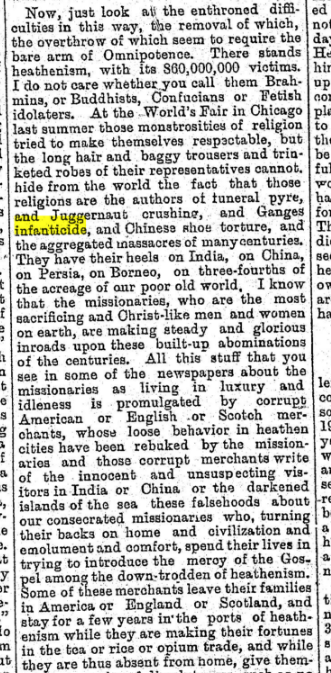
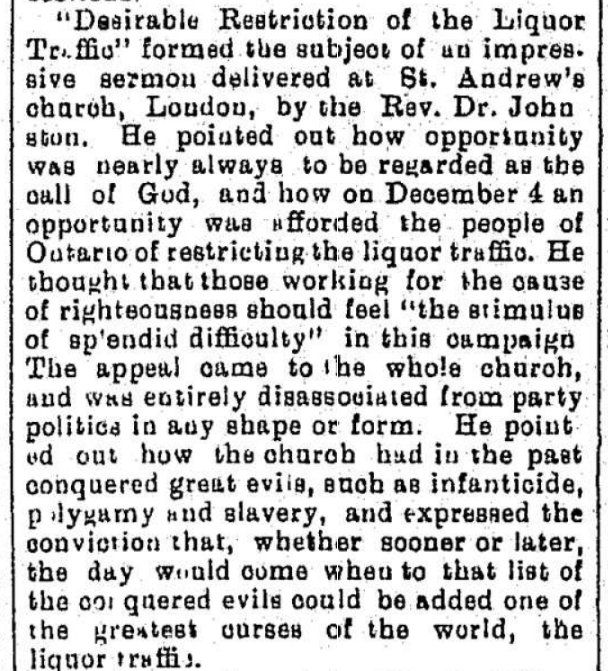
Turn of the 20th century newspapers in Huron County printed or reprinted articles from larger news agencies about non-Christian societies in India, China, and Hawaii and touted their supposed propensity of infanticide. These stories promoted the positive influence of Christian conversion outside of Canada, even though infanticide was also a local issue. Figure 1 is one such article from The Exeter Times, published on Feb. 1, 1894. This article states that the work of missionaries converting foreign societies to Christianity would “introduce the mercy of the Gospel among the down-trodden of heathenism.” The uncredited author claimed non-Christian cultures frequently committed infanticide but stopped when they converted to Christianity. (3) There is an apparent hypocrisy in these newspapers portraying other societies as uncivilized while the same issues were happing contemporaneously in their own Ontario communities. Figure 2 shows an article from The Brussels Post, dated Nov. 20, 1902. In this article, the author argues the need for laws restricting the distribution of alcohol. They state that such opportunities to change society are “the call of God” whose influence had already “conquered great evils, such as infanticide.” Yet, infanticide still occurred in the paper’s own region.

How prevalent an issue infanticide was throughout Huron County’s history is difficult to know, because many cases likely went unreported. A large proportion of the known cases involved single mothers of illegitimate children. However, some scholars suggest that more cases of undocumented infanticide frequently occurred in Western societies. These theories argue that hidden infanticide by married couples might partly explain changing gender ratios in select western societies. They claim this was a way of tailoring gender to fit family needs, like wanting males to help with farming. (4) Single women living and working away from their families would face greater difficulties concealing a birth without detection. Hidden infanticide drew attention from journals like the Upper Canada Journal of Medical, Surgical and Physical Science in 1852. This journal argued that women should have to register their children immediately after birth to lessen the chance of hidden infanticide. (5) This call for registration suggests that the journal suspected or knew of infanticide cases where the mother did not register their child to hide its birth. This research indicates that communities like Huron County could have many cases of infanticide that county records do not include.

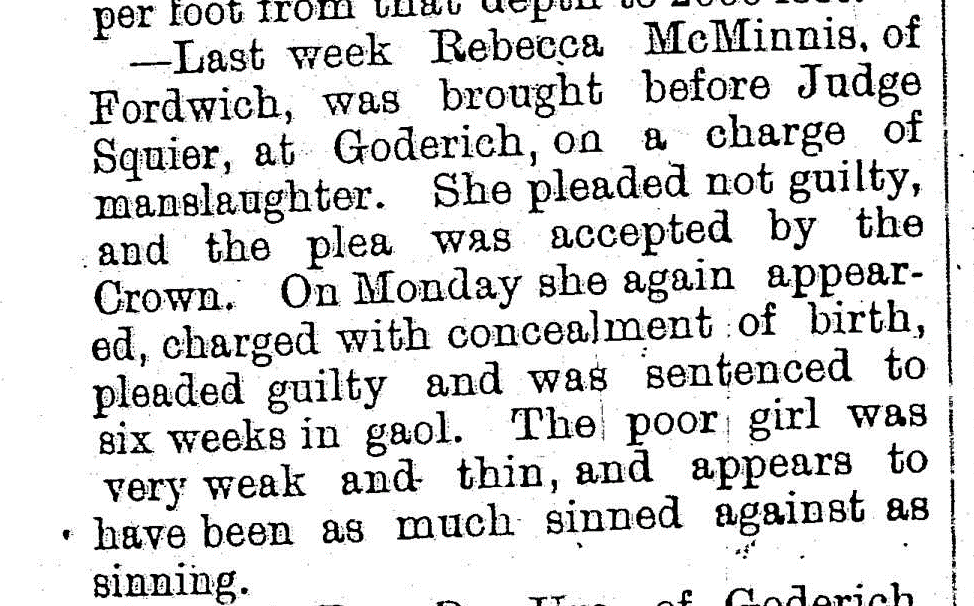
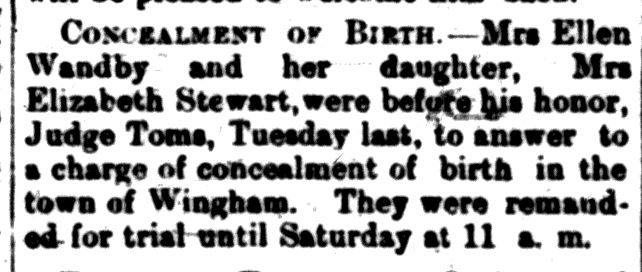
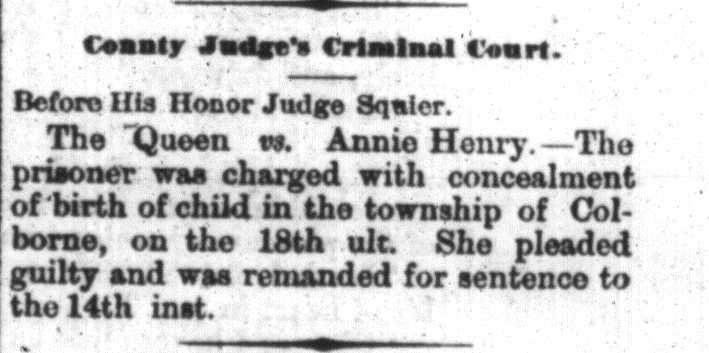
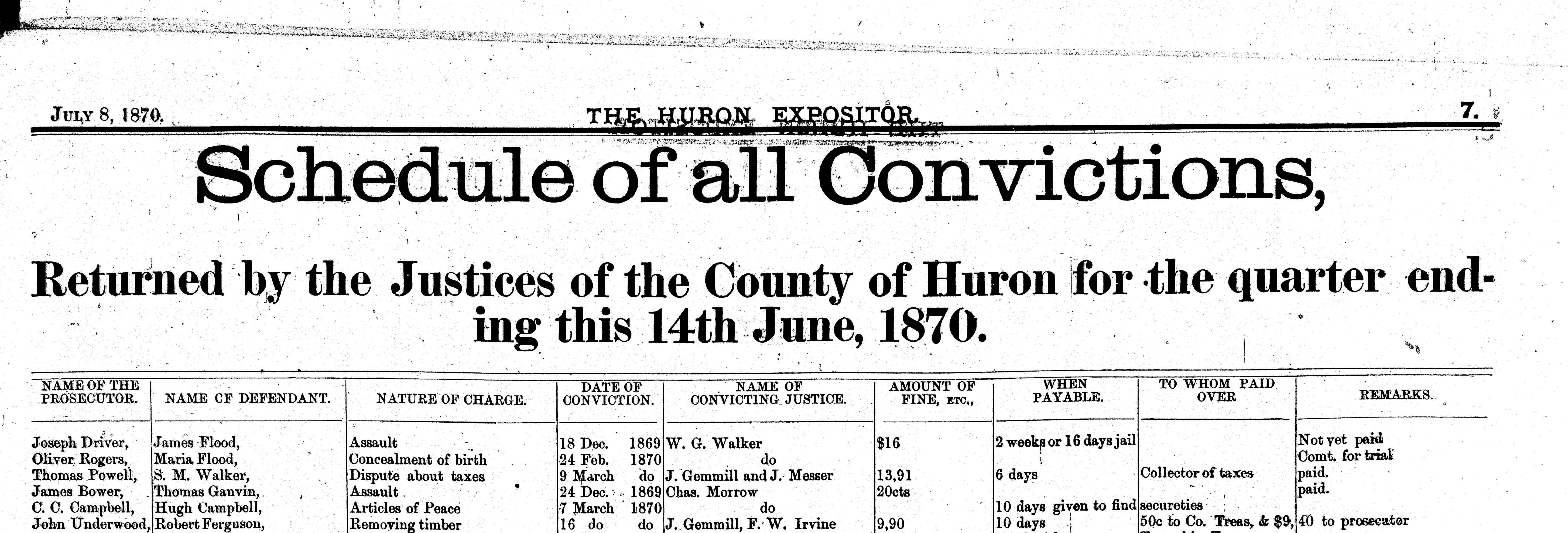
One record that is available for study is the “Huron County Gaol Registry.” The portion of the Registry currently available for research includes entries for every person who stayed at the Gaol from 1841-1922. There are at least 12 cases that list infanticide, concealment of birth, child exposure, or a related charge as the reason for committal (Figure 3 and 4). While not a staggeringly high number, these records only include the people sentenced to gaol for allegedly killing their infant or related crimes. If they were not apprehended or not committed to jail, they would not appear in the registry. Additional cases do appear in the local newspaper accounts (Figure 5) and coroner’s inquest records , including Catherine’s story .  The registry shows that the first prisoner committed for infanticide came to the Gaol in 1846 and that a prisoner was committed for procuring drugs for an illegal abortion in 1920. While not demonstrating frequency with complete accuracy, the registry clearly does indicate that infanticide and other crimes resulting from unwanted pregnancies occurred in Huron County throughout the entire period documented from 1841-1922. These instances of infanticide would increase when including the records of nearby counties like Middlesex, Bruce, and Perth, which also had reported infanticide cases during the same period. There was therefore no reason to look to other countries to find the circumstances that fostered infanticide: Huron County residents could see the evidence in their own towns and the surrounding counties.

image of a newspaper clipping

Figure 1: “The Safe Arm of God,” The Exeter Times, 1894-2-1, Page 6 

Image of figure 2 - newspaper clipping from Brussels Post

Figure 2: “Prohibition Notes,” The Brussels Post, 1902-11-20, Page 4

Figure 3: Newspaper clipping from The Huron Expositor, 07-22-1881, pg 5.

Figure 3: The Huron Expositor, 07-22-1881, pg 5.

Newspaper clipping: "Concealment of a Birth" Mrs. Ellen Wandby and her daughter, Mrs. Elizabeth Stewart, were before his honour Judge Toms, Tuesday last, to answer to a charge of concealment of birth in the town of Wingham.

Figure 4:The Huron Signal, 06-10-1887, pg 4.

Figure 3: Newspaper clipping from The Huron Expositor, 07-22-1881, pg 5.

Figure 5: The Huron Signal, 12-10-1880, pg 1.

Image of newspaper clipping from 1870 Schedule of Convictions featuring prosecution of Maria Flood for “concealment of birth.” The Huron Expositor, 07/08/1870, pg 1.

Mothers faced most of the blame for infanticide from the legal system and contemporary journalists for reported cases. However, this viewpoint often neglects to consider both the devastating judgements placed upon these women for their unwanted pregnancies, and the lack of support available to help struggling mothers. Of the cases involving infanticide, concealment of birth, or abortion found in the Huron County newspapers and Gaol records, a large number involve young women under 25 years old and illegitimate children (the offspring of a couple not married to each other).  For example, a case from 1864 involves a 15-year-old unmarried female servant; a case from 1877 involves a 22-year-old single female servant; a case from 1880 involves a 17-year-old female servant. As servants, these women were dependent on wage labour. With the birth of a child, the woman would have to give up employment to care for the baby, as without the security of legal marriage the father would often refuse any support. Her ability to care for herself, let alone the child, declined greatly after giving birth. In addition, women faced religious and societal pressures to remain chaste until marriage. Bearing an illegitimate child proved to society that a woman was unchaste. (6) Women who gave birth to illegitimate children, no matter the circumstances of their conception, would face harsh judgement from their communities, which could impact their ability to find new work or to be married. These women with illegitimate children immediately became outcasts. This happened because Christian societies at the time judged much of a single woman’s morality and value according to her chastity. (7) As such, women of this period faced significant social judgement if they had an illegitimate child. The idea of concealing the child’s birth may have appeared to be the only choice for single mothers hoping to retain their ability to earn a living, maintain their place in society and avoid becoming an outcast, which could lead to cases of infanticide and child abandonment. 

The lack of available social services in Huron County before the 20th century could also factor into these cases of infanticide. Before Huron County’s House of Refuge opened near Clinton in 1895, the only municipal building available for social services was the Huron County Gaol. There was no local lying-in hospital or home for unwed mothers. During this period, the Gaol often housed the elderly, destitute, and sick. Some lower tier municipalities made the choice to commit unwed mothers to gaol to give birth, and multiple women would have their babies behind bars at the Huron Gaol. This was an inexpensive way to house the mother and child until such a time she could return to the labour market. A young woman faced with the birth of an illegitimate child in Huron County would therefore have little support and few options available should she struggle to care and provide for her baby, and may have to bear the stigma of being committed to gaol regardless of committing a crime.

While newspapers like The Exeter Times and Lucknow Sentinel reprinted articles featuring infanticide as a cautionary tale to criticize and condemn outside cultures and to promote the positive influence of western Christianity, infanticide remained prevalent in their own communities. Stories like that of Catherine demonstrate the difficult circumstances that sometimes drove women to commit infanticide. Having an illegitimate child immediately lessened the perceived status and life options of a young woman in respectable Christian Southwestern Ontario society. Also contributing to the devastating decision by some of these young women to commit infanticide was the lack of social services available to help them provide for a child. As such, infanticide was not a conquered issue for the residents of Huron County in the 19th and early 20th century.

Sources:

  • (1) Nicola Goc, Women, Infanticide, and the Press, 1822-1922: News Narratives in England and Australia (New York, NY: Routledge, 2016), 28.
  • (2) Coroner’s Report #365 Huron County Archives,  Unnamed baby of  Catherine J.  
  • (3 “The Safe Arm of God,” The Exeter Times, February 1, 1894, p. 6.
  • (4) Gregory Hanlon, “Routine Infanticide in the West 1500-1800,” History Compass 14, no. 11 (2016): pp. 535-548, https://doi.org/10.1111/hic3.12361, 537. 
  • (5) Kirsten Johnson Kramar, Unwilling Mothers, Unwanted Babies: Infanticide in Canada (Vancouver, BC: UBC Press, 2006), 97.
  • (6) Nicolá, Women, Infanticide, and the Press, 21.
  • (7) Nicolá, Women, Infanticide, and the Press, 21.

Further Reading

Find an index of coroner’s inquests on our Archives page (scroll to the bottom to find indexes and finding aids).

Find more stories from Huron’s past through a search of Huron County’s historical newspapers online!