by Sinead Cox | Nov 10, 2022 | Archives, Blog, Investigating Huron County History
According to the Criminal Code of Canada, “a female person commits infanticide when by a wilful act or omission she causes the death of her newly-born child.” Using local resources, student Kevin den Dunnen explores local cases of infanticide in the late 19th and 20th century (the period for which Gaol records are readily available), and the contemporary attitudes towards this act at home and abroad.
Through the 19th and 20th centuries, Huron County newspapers printed cases of infanticide, or the act of killing an infant, allegedly taking place in other countries and cultures. These articles often framed this the context of the supposed inferiority of cultures without the influence of Western Christianity. (1) However, the prevalence of infanticide in Huron County and surrounding areas during this same time period disproves any claims of cultural immunity to infanticide in southwestern Ontario’s Christian-dominated communities.
There are many social factors that contributed to the infanticides that occurred in Huron County. In the 19th and 20th centuries, a birth outside wedlock threatened an unmarried woman’s status in society. Many known infanticide cases in Huron County involved these young, unmarried women. Contributing to the devastating decision to commit infanticide was the lack of local social services available to single women needing help to provide for their child. As such, infanticide has been present in Huron County for much of its history.
The story of a Huron County woman called Catherine and her child exemplifies many of these themes. Catherine was a 30-year-old servant and unmarried woman working in Goderich Township in 1870. She had gone to her doctor that year claiming her body was swelling. The doctor suspected that she might be pregnant, but Catherine did not agree. Later on, her employer came home to find some of her work unfinished and could not find her. Upon searching, they found her sitting in a privy. After telling her to leave the privy several times, Catherine went to the house. Upon inspection of the privy the next morning, the house-owner and a doctor found a dead child in the privy vault covered by paper and a board. In his subsequent report, the coroner believed that the baby was born alive. (2) Upon first reading, this story appears to be a cold-blooded case of infanticide, but the reality of the society around Catherine makes the situation far more complex.
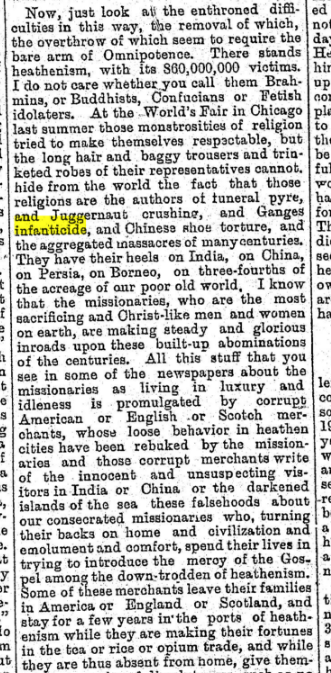
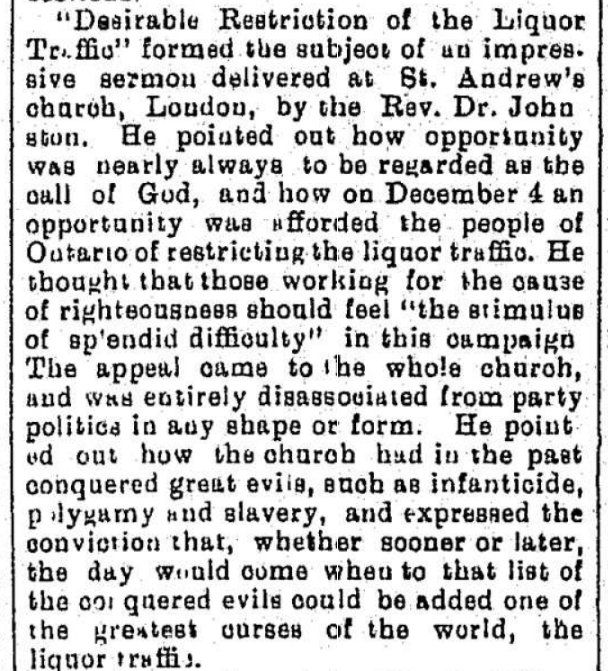
Turn of the 20th century newspapers in Huron County printed or reprinted articles from larger news agencies about non-Christian societies in India, China, and Hawaii and touted their supposed propensity of infanticide. These stories promoted the positive influence of Christian conversion outside of Canada, even though infanticide was also a local issue. Figure 1 is one such article from The Exeter Times, published on Feb. 1, 1894. This article states that the work of missionaries converting foreign societies to Christianity would “introduce the mercy of the Gospel among the down-trodden of heathenism.” The uncredited author claimed non-Christian cultures frequently committed infanticide but stopped when they converted to Christianity. (3) There is an apparent hypocrisy in these newspapers portraying other societies as uncivilized while the same issues were happing contemporaneously in their own Ontario communities. Figure 2 shows an article from The Brussels Post, dated Nov. 20, 1902. In this article, the author argues the need for laws restricting the distribution of alcohol. They state that such opportunities to change society are “the call of God” whose influence had already “conquered great evils, such as infanticide.” Yet, infanticide still occurred in the paper’s own region.
How prevalent an issue infanticide was throughout Huron County’s history is difficult to know, because many cases likely went unreported. A large proportion of the known cases involved single mothers of illegitimate children. However, some scholars suggest that more cases of undocumented infanticide frequently occurred in Western societies. These theories argue that hidden infanticide by married couples might partly explain changing gender ratios in select western societies. They claim this was a way of tailoring gender to fit family needs, like wanting males to help with farming. (4) Single women living and working away from their families would face greater difficulties concealing a birth without detection. Hidden infanticide drew attention from journals like the Upper Canada Journal of Medical, Surgical and Physical Science in 1852. This journal argued that women should have to register their children immediately after birth to lessen the chance of hidden infanticide. (5) This call for registration suggests that the journal suspected or knew of infanticide cases where the mother did not register their child to hide its birth. This research indicates that communities like Huron County could have many cases of infanticide that county records do not include.
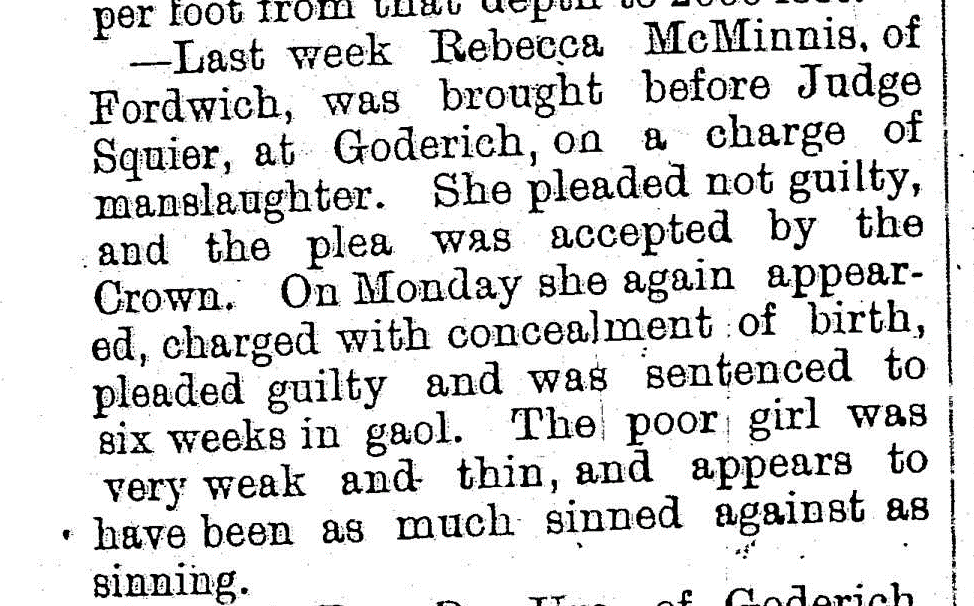
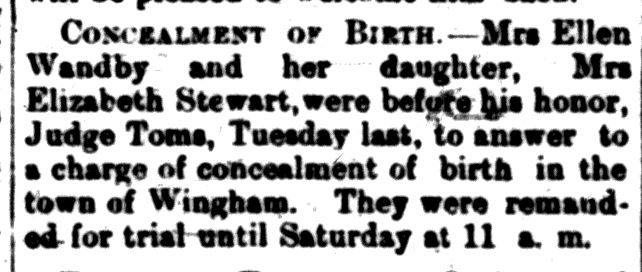
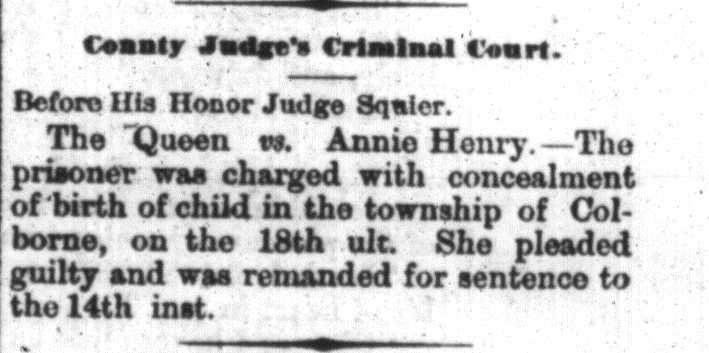
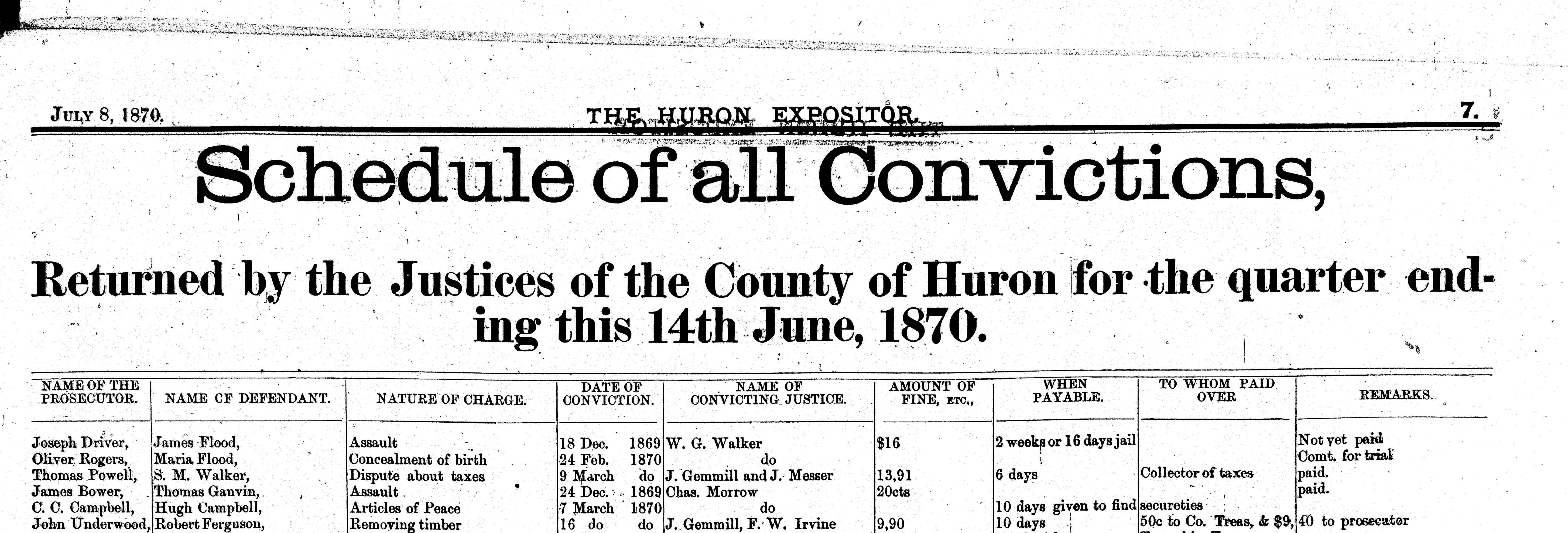
One record that is available for study is the “Huron County Gaol Registry.” The portion of the Registry currently available for research includes entries for every person who stayed at the Gaol from 1841-1922. There are at least 12 cases that list infanticide, concealment of birth, child exposure, or a related charge as the reason for committal (Figure 3 and 4). While not a staggeringly high number, these records only include the people sentenced to gaol for allegedly killing their infant or related crimes. If they were not apprehended or not committed to jail, they would not appear in the registry. Additional cases do appear in the local newspaper accounts (Figure 5) and coroner’s inquest records , including Catherine’s story . The registry shows that the first prisoner committed for infanticide came to the Gaol in 1846 and that a prisoner was committed for procuring drugs for an illegal abortion in 1920. While not demonstrating frequency with complete accuracy, the registry clearly does indicate that infanticide and other crimes resulting from unwanted pregnancies occurred in Huron County throughout the entire period documented from 1841-1922. These instances of infanticide would increase when including the records of nearby counties like Middlesex, Bruce, and Perth, which also had reported infanticide cases during the same period. There was therefore no reason to look to other countries to find the circumstances that fostered infanticide: Huron County residents could see the evidence in their own towns and the surrounding counties.
Figure 1: “The Safe Arm of God,” The Exeter Times, 1894-2-1, Page 6
Figure 2: “Prohibition Notes,” The Brussels Post, 1902-11-20, Page 4
Figure 3: The Huron Expositor, 07-22-1881, pg 5.
Figure 4:The Huron Signal, 06-10-1887, pg 4.
Figure 5: The Huron Signal, 12-10-1880, pg 1.
Mothers faced most of the blame for infanticide from the legal system and contemporary journalists for reported cases. However, this viewpoint often neglects to consider both the devastating judgements placed upon these women for their unwanted pregnancies, and the lack of support available to help struggling mothers. Of the cases involving infanticide, concealment of birth, or abortion found in the Huron County newspapers and Gaol records, a large number involve young women under 25 years old and illegitimate children (the offspring of a couple not married to each other). For example, a case from 1864 involves a 15-year-old unmarried female servant; a case from 1877 involves a 22-year-old single female servant; a case from 1880 involves a 17-year-old female servant. As servants, these women were dependent on wage labour. With the birth of a child, the woman would have to give up employment to care for the baby, as without the security of legal marriage the father would often refuse any support. Her ability to care for herself, let alone the child, declined greatly after giving birth. In addition, women faced religious and societal pressures to remain chaste until marriage. Bearing an illegitimate child proved to society that a woman was unchaste. (6) Women who gave birth to illegitimate children, no matter the circumstances of their conception, would face harsh judgement from their communities, which could impact their ability to find new work or to be married. These women with illegitimate children immediately became outcasts. This happened because Christian societies at the time judged much of a single woman’s morality and value according to her chastity. (7) As such, women of this period faced significant social judgement if they had an illegitimate child. The idea of concealing the child’s birth may have appeared to be the only choice for single mothers hoping to retain their ability to earn a living, maintain their place in society and avoid becoming an outcast, which could lead to cases of infanticide and child abandonment.
The lack of available social services in Huron County before the 20th century could also factor into these cases of infanticide. Before Huron County’s House of Refuge opened near Clinton in 1895, the only municipal building available for social services was the Huron County Gaol. There was no local lying-in hospital or home for unwed mothers. During this period, the Gaol often housed the elderly, destitute, and sick. Some lower tier municipalities made the choice to commit unwed mothers to gaol to give birth, and multiple women would have their babies behind bars at the Huron Gaol. This was an inexpensive way to house the mother and child until such a time she could return to the labour market. A young woman faced with the birth of an illegitimate child in Huron County would therefore have little support and few options available should she struggle to care and provide for her baby, and may have to bear the stigma of being committed to gaol regardless of committing a crime.
While newspapers like The Exeter Times and Lucknow Sentinel reprinted articles featuring infanticide as a cautionary tale to criticize and condemn outside cultures and to promote the positive influence of western Christianity, infanticide remained prevalent in their own communities. Stories like that of Catherine demonstrate the difficult circumstances that sometimes drove women to commit infanticide. Having an illegitimate child immediately lessened the perceived status and life options of a young woman in respectable Christian Southwestern Ontario society. Also contributing to the devastating decision by some of these young women to commit infanticide was the lack of social services available to help them provide for a child. As such, infanticide was not a conquered issue for the residents of Huron County in the 19th and early 20th century.
Sources:
- (1) Nicola Goc, Women, Infanticide, and the Press, 1822-1922: News Narratives in England and Australia (New York, NY: Routledge, 2016), 28.
- (2) Coroner’s Report #365 Huron County Archives, Unnamed baby of Catherine J.
- (3 “The Safe Arm of God,” The Exeter Times, February 1, 1894, p. 6.
- (4) Gregory Hanlon, “Routine Infanticide in the West 1500-1800,” History Compass 14, no. 11 (2016): pp. 535-548, https://doi.org/10.1111/hic3.12361, 537.
- (5) Kirsten Johnson Kramar, Unwilling Mothers, Unwanted Babies: Infanticide in Canada (Vancouver, BC: UBC Press, 2006), 97.
- (6) Nicolá, Women, Infanticide, and the Press, 21.
- (7) Nicolá, Women, Infanticide, and the Press, 21.
Further Reading
Find an index of coroner’s inquests on our Archives page (scroll to the bottom to find indexes and finding aids).
Find more stories from Huron’s past through a search of Huron County’s historical newspapers online!
by Sinead Cox | Jan 25, 2022 | Archives, Exhibits, Image highlights
The Huron County Museum’s temporary exhibit Forgotten: People and Portraits of the County features unidentified portraits captured by Huron County photographers. In addition to the onsite exhibit, photos are shared in an online exhibit and Facebook group in hopes that some of these ‘Forgotten’ faces will remembered and named. Curator of Engagement & Dialogue Sinead Cox shares highlights of the exhibit’s remembering efforts so far.
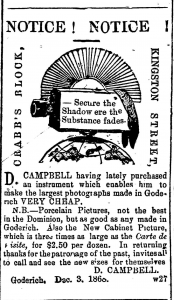
Semi-Weekly Signal, (Goderich) 07-27-1869 pg 2
The Huron County Museum has an incredible collection of photographs in its Archives – especially studio portraits from commercial photographers within Huron County (spanning the county from Senior Studio in Exeter, Zurbrigg in Wingham, and everywhere in between). Not all of these photographs came with identifying information for their subjects, or even known donors or photographers. The Forgotten exhibit has provided an opportunity to delve deeper into the clues that can be present in everything from associated family trees to fashion styles, photographer’s marks, and photography methods that can provide more context, narrow timelines, or even lead to the re-discovery of names. I am especially grateful for the enthusiastic participation we have already had from photo detectives from the public who have contributed to remembering Huron County’s ‘Forgotten’ faces. Hopefully this is just the beginning of adding value to our collection.
Professional studio photographs were often (and still are!) sent as gifts to family and friends. Local photographers saved negatives to sell reprints at a later date, and these negatives were also sometimes inherited when a studio changed hands. It’s very possible your own family photo collection contains the duplicate of a photo that exists in the possession of an archive or a distant relation somewhere else in the world. Finding matches between the faces in those photos is one way to solve photographic mysteries, and why a shared space to upload and comment on photos, like the Forgotten Facebook group, has the potential to put names to faces even after more than a century has passed since the camera flash!
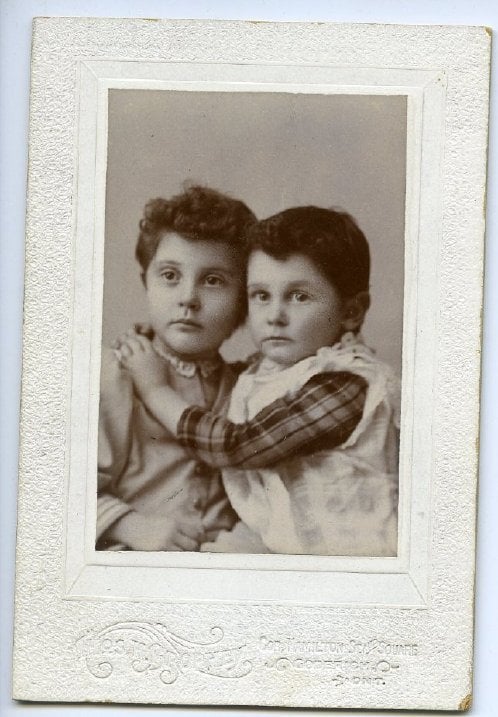
2011.0013.020. Photograph
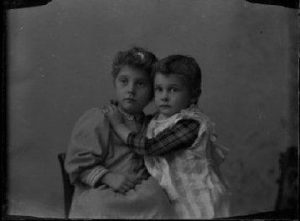
2017.0013.011. Glass negative
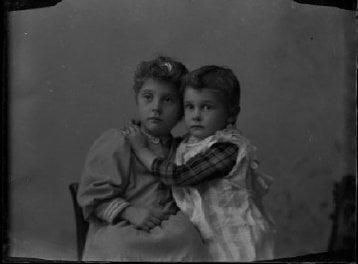
During preparation for the exhibit, staff recognized that a photograph and a glass negative from unrelated donations depicted the same image of a pair of children (their nervous expressions at having their photo taken were difficult to miss). The photo and negative came to the museum from different donors, six years apart. Information provided with the donation of the photograph indicates that these children may be related to the McCarthy and Hussey families of Ashfield Twp and Goderich area; the studio mark for Thos. H. Brophey is also visible on its cardboard mount, dating the image approximately between 1896 and 1904. The matching negative came from a collection related to Edward Norman Lewis, barrister, judge and MP from Goderich. The shared connection between the donations provides one more clue to help identify the unnamed children, and gives the negative meaning and value (through a place, time and potential family connection) it didn’t previously have without the photograph’s added context. You can see both the photograph and the negative on display in the temporary Forgotten exhibit, which is on at the Museum until fall 2022.
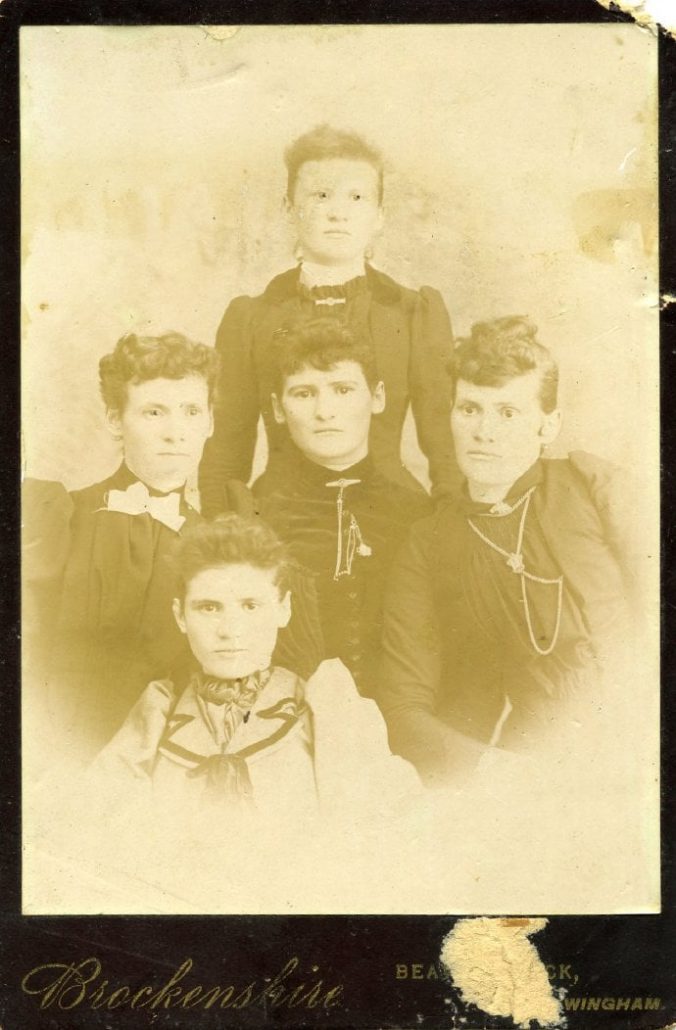
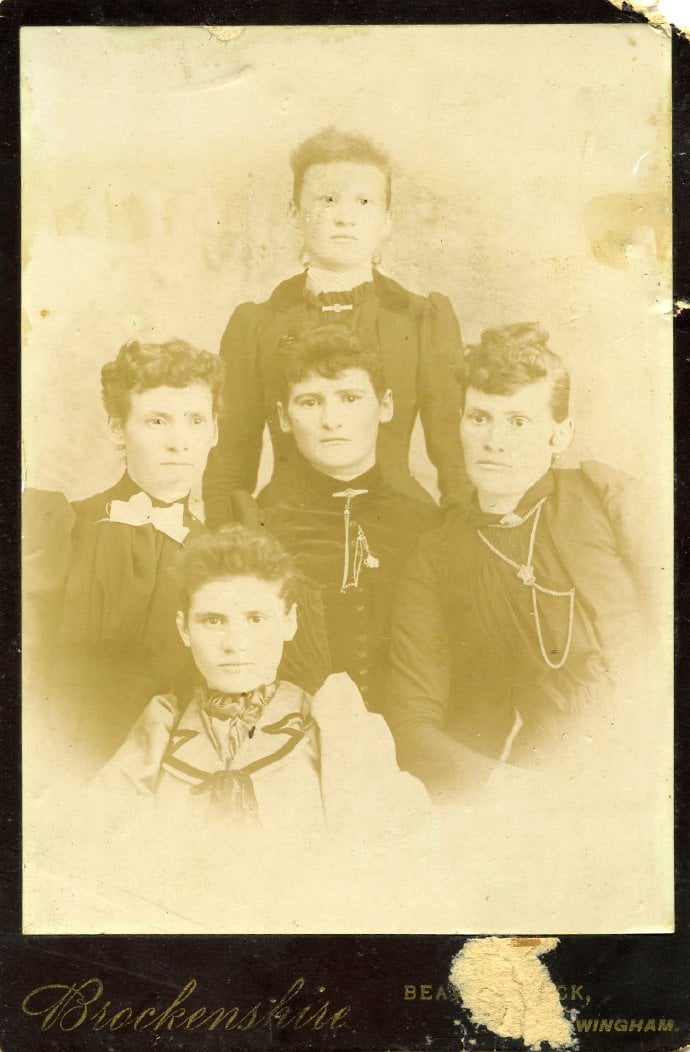
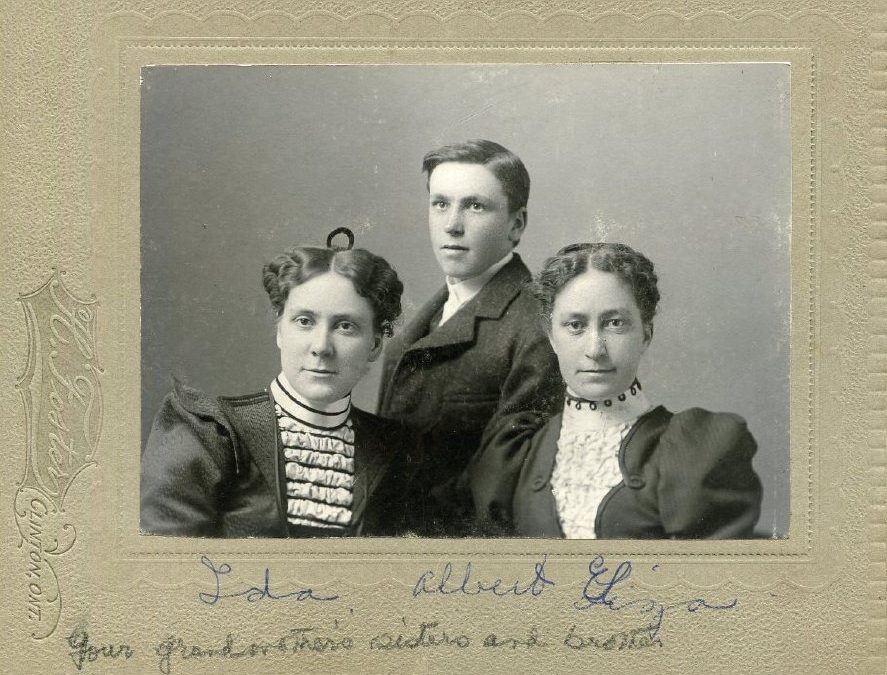
2021.0053.006. The “Garniss sisters”: Sarah Ann, Elizabeth, Eliza Maria Ida, Jemima, Mary Lillian. Can you help us identify which sister is which?
Sometimes photographs arrive to the collection with partial identifications or known connections to a certain family, even when individual names are missing. In those cases, knowledge of family histories can help pinpoint who’s who. Members of the Facebook group were recently able to name all five Morris Township women identified as only the “Garniss sisters” on the back of a photo from Brockenshire Studio, Wingham.
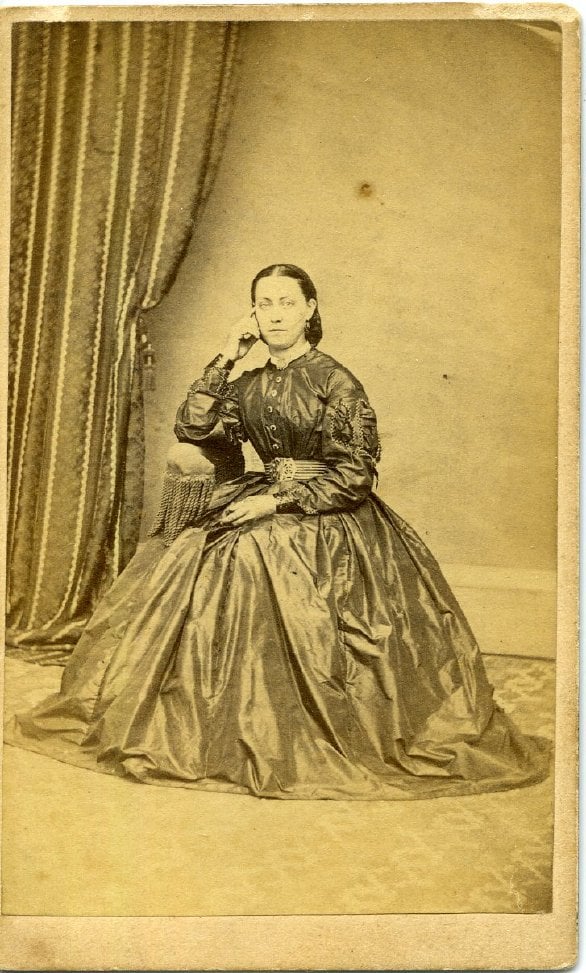
A996.001.095
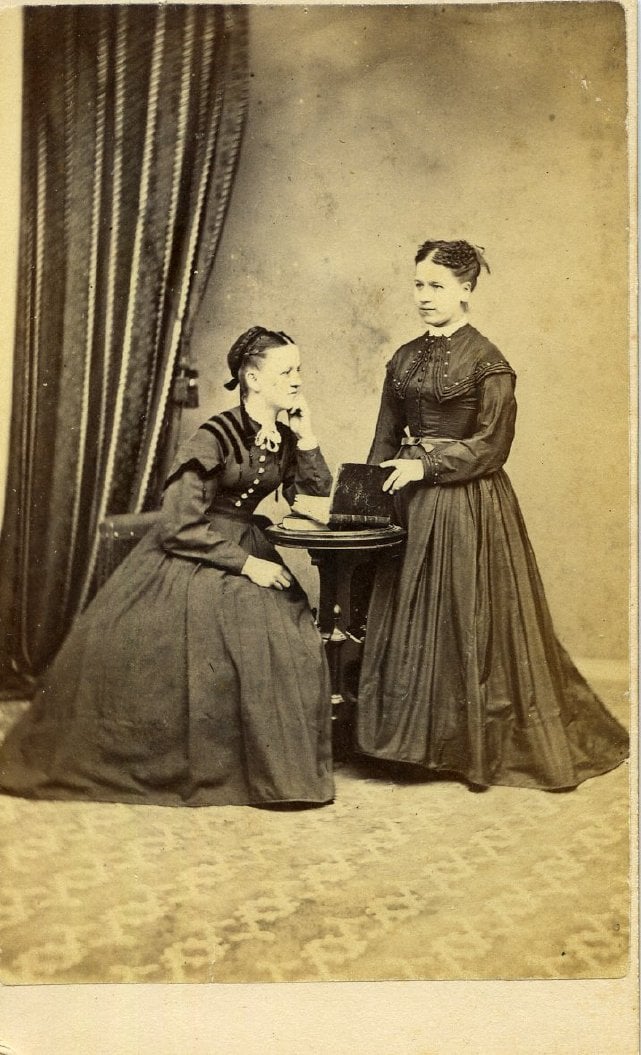
Patterns tend to emerge with access to larger collections from the same location or time period. Although studio photographers later in the 19th century prided themselves on offering a large selection of backdrops, photos from local studios in the 1860s and 1870s often show a more simple set-up. In posting the ‘Forgotten’ photos online, I noticed that the studio space of Goderich photographer D. Campbell can be recognized by the consistent presence of a striped curtain in the background (and more often than not the same tassel-adorned chair) and a distinctive pattern on the floor, as seen in both the photos above and below. This helped identify additional photographs as Campbell’s work, and therefore place them in Goderich circa 1866-1870 , even when a photographer’s mark or name was absent from they physical photo.
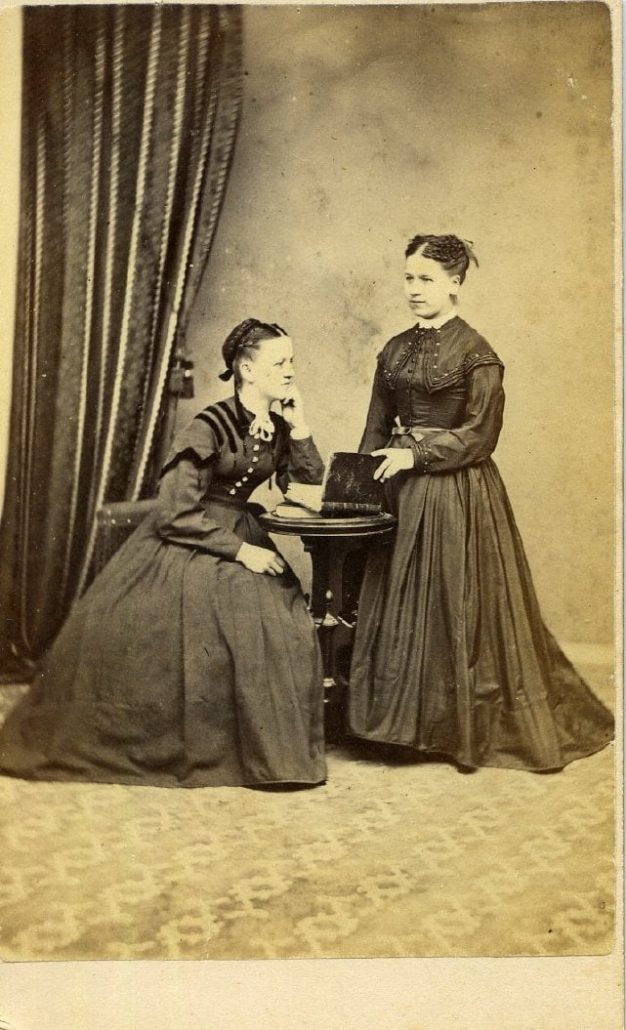
A996.001.071. This photograph is labelled as “the Miss Henrys.” Do you have any information that might reveal their first names?
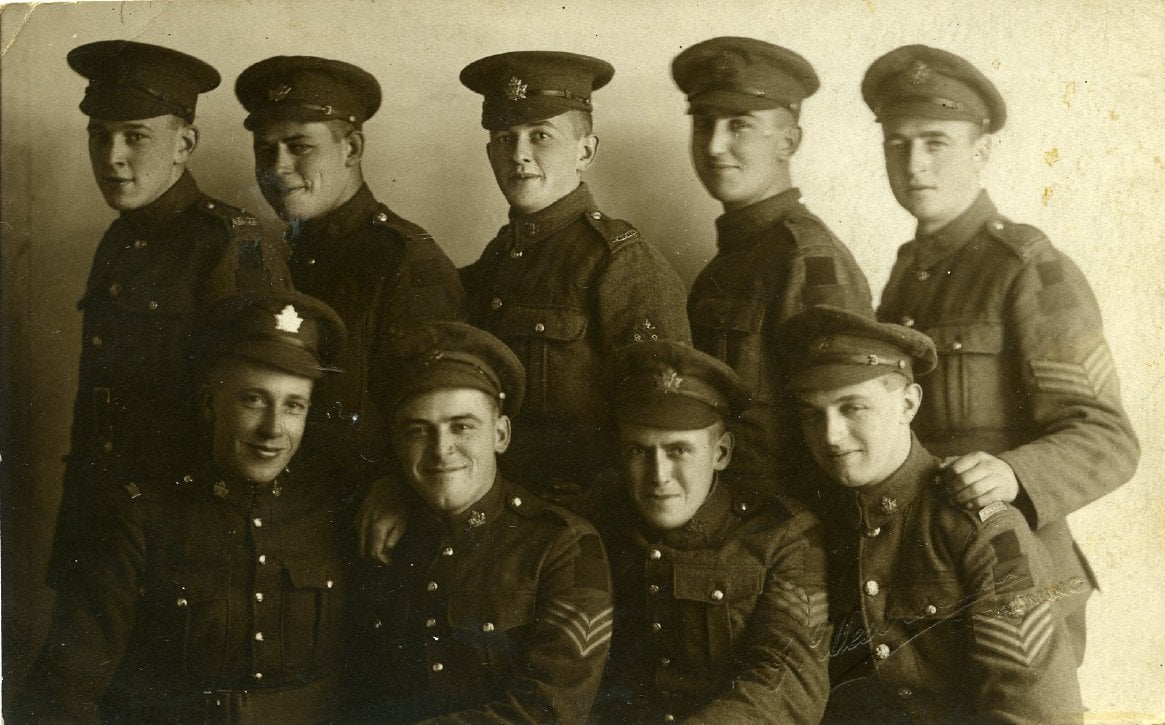
Crowdsourcing information through the online exhibit and group has allowed fresh pairs of eyes to notice detail previously missed in some of the museum’s photos, even when the evidence was captured by the staff doing the scanning and cataloguing work. In November, the Facebook group spotlighted unidentified soldiers, and one of the members pointed out a photographer’s mark embossed on the bottom right corner of a group photo. Staff were able to look at the original photo to get a clearer look to confirm the studio was identified as “G. West & Sons, Godalming.” Godalming is a town in Surrey, England near Witley Commons, which hosted many Canadian soldiers during the First and Second World Wars.
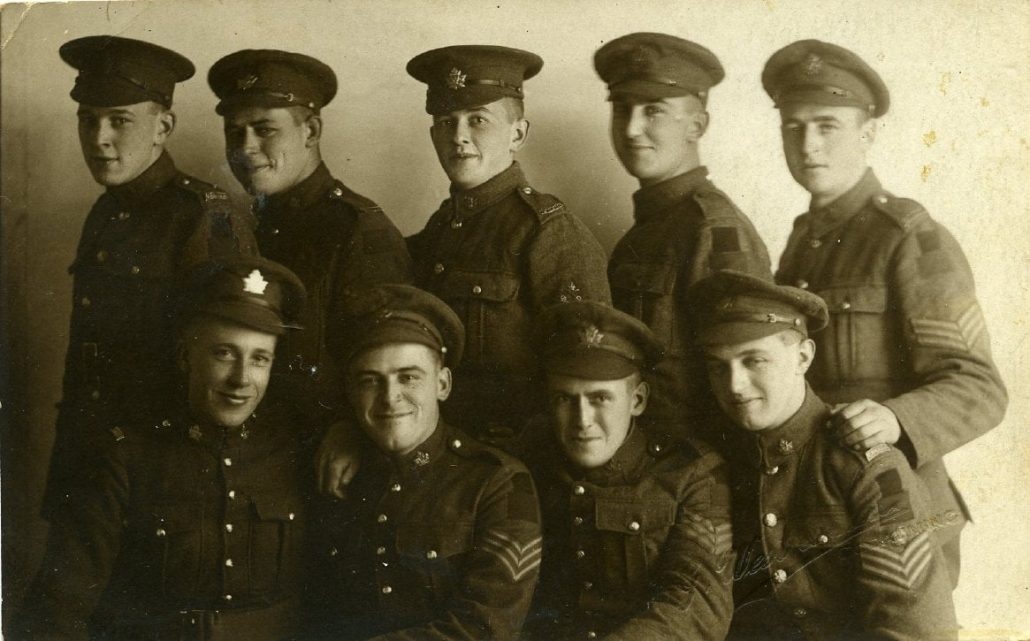
2004.0044.005. Photographer: G. West & Sons, Godalming, Surrey, U.K.
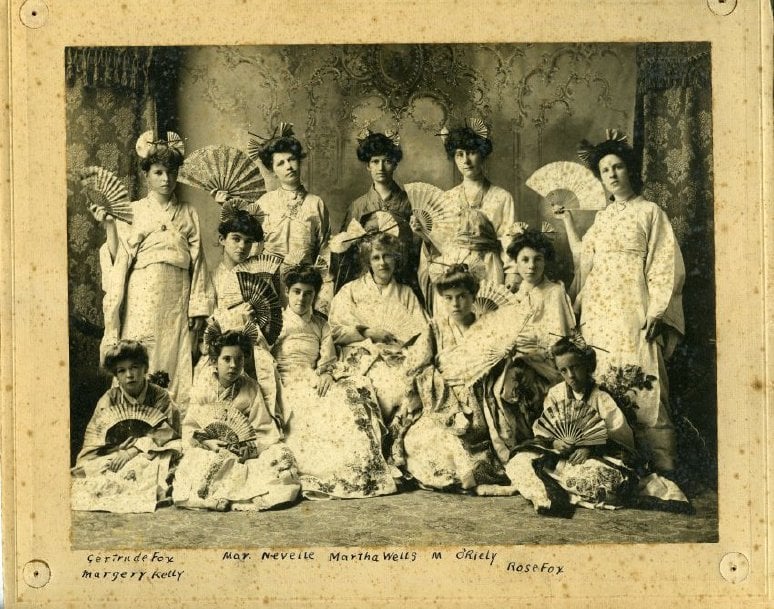
A950.1740.001
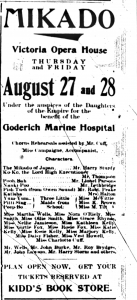
The Signal 08-27-1903 pg 8.
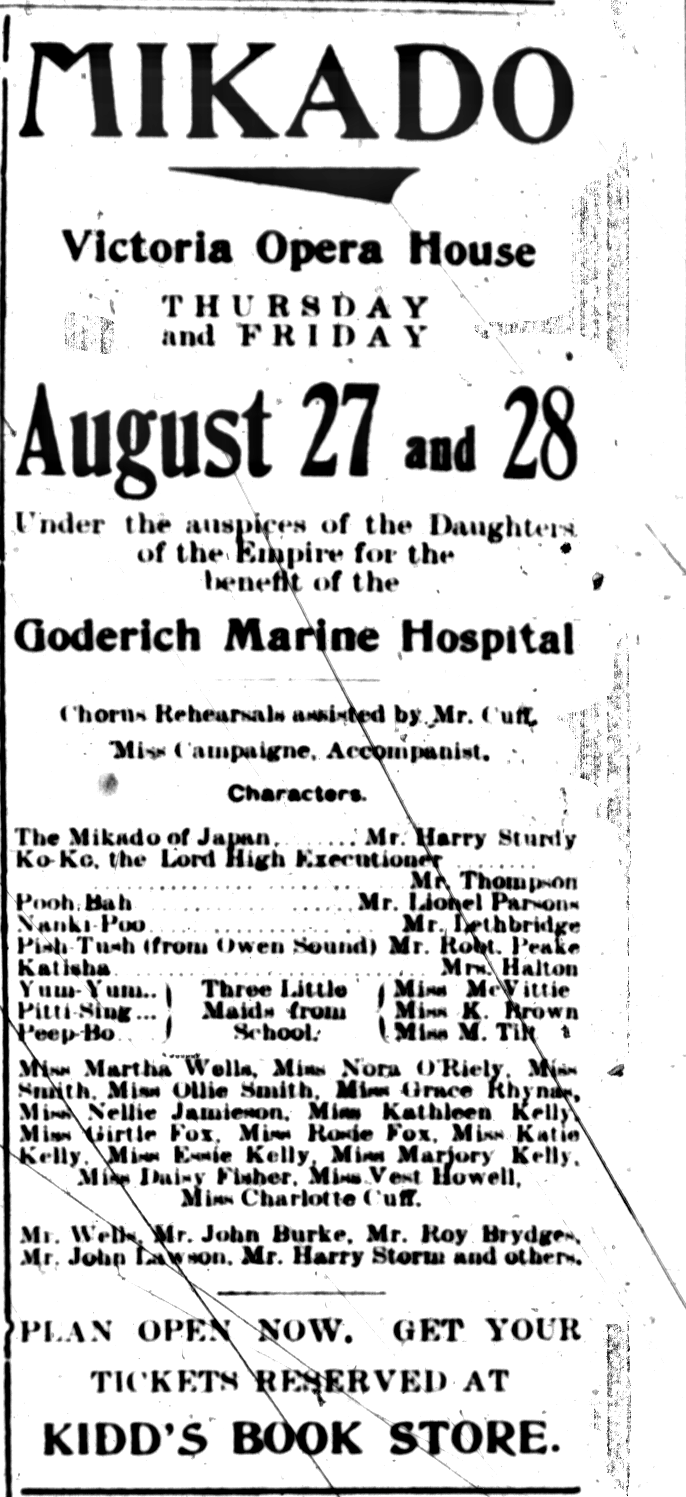
Comparing photographs with other readily available local historical resources like Huron’s digitized newspapers can also help provide new insight. Partial identifications on a group photo of young women in theatrical costumes without a location allowed a group member to link it to a 1903 Goderich production of Gilbert & Sullivan’s The Mikado. Further research in the newspapers provided a full list of the names of the participating cast and more information about the production, which toured Huron County. This information is now attached to the photograph’s catalogue record to benefit future researchers.
Although many historical photos may be ‘Forgotten’, if they are preserved and housed they are not lost. They still retain the potential for remembering , and to be re-connected to descendants and communities through extant clues and the growing possibilities of digitization and online sharing. For more highlights from the exhibit and tips for identifying mystery subjects photos or caring for your own collections, join is Feb. 9, 2022 for the second webinar in our exhibit series: Forgotten in the Archives.
If you can help identify a ‘Forgotten’ face, email us at museum@huroncounty.ca!
For more on the Forgotten: People & Portraits of the County exhibit and related coming events:
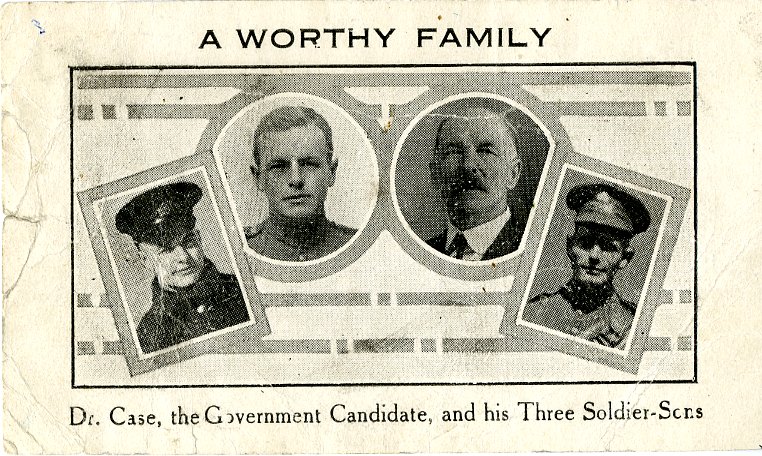
by Sinead Cox | Oct 11, 2021 | Blog, Collection highlights, Exhibits, For Teachers and Students
If you are a teacher or student looking for local stories from Huron County for your Remembrance Day lessons or assignments, you can access the Huron County Museum’s collection from home and your classroom through our virtual offerings! These resources speak both to Huron County’s military history and to the home front during the First and Second World Wars.
Videos
Our War: Home Front
Our War: Nursing Sisters
Young Canuckstorians: The Maud Stirling Story
Jack McLaren: A Soldier of Song features a presentation and performance from author and musician Jason Wilson, based on the original works of the Dumbells, a Canadian concert party that entertained the troops on the front lines in World War I and featured Jack McLaren (later a resident of Benmiller).
The History of Drag Makeup Tutorial with Lita explains how drag performers improvised wigs, makeup and clothing at the front lines.
A reading of a WWII letter from R.C.A.F Pilot Officer Alan H. Durnin to Mrs. C. Blake of RR 1 Dungannon
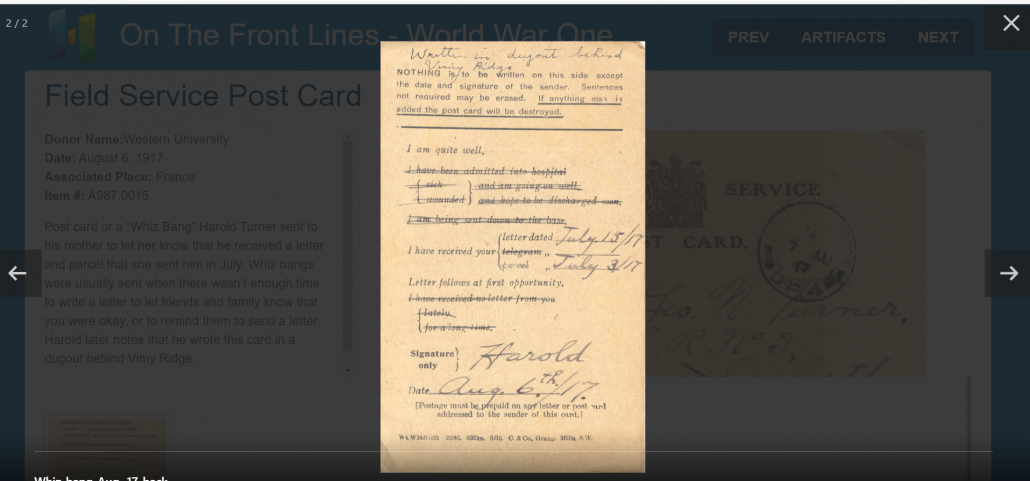
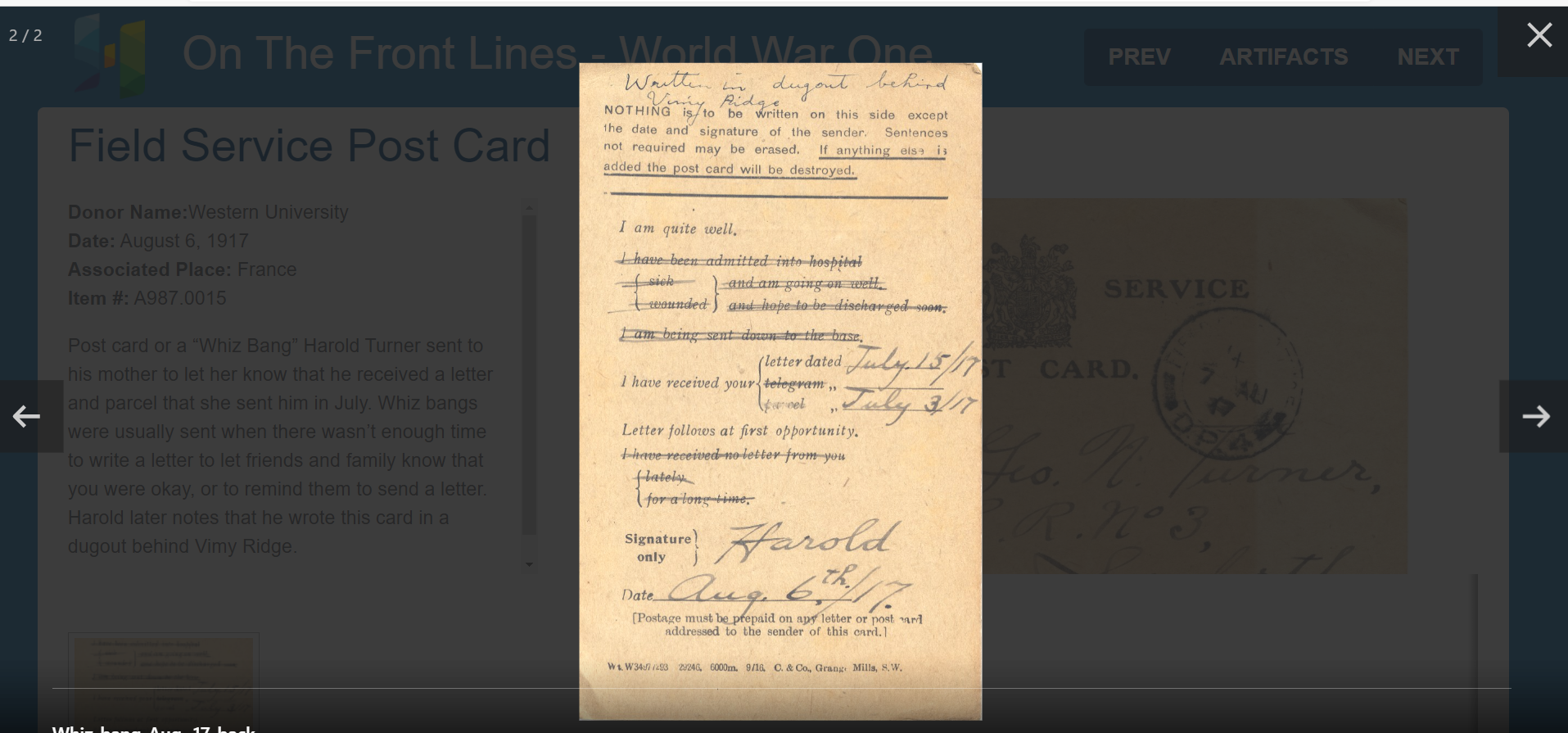
On the Front Lines: Word War One virtual exhibit.
Virtual Exhibits
Part of the museum’s collection of photographs by local photographer J. Gordon Henderson have been digitized. During World War II, he travelled to air training schools in Goderich, Port Albert, and Clinton taking pictures of classes and other base activities. Many airmen came to his studio in Goderich to have their portraits taken to send home to family and friends. The Henderson Collection also includes wedding portraits, candid shots, correspondence and interviews with airmen related to WWII air training in Huron County. Access the virtual Henderson collection by clicking here!
You can also browse more photographs via our Flickr page!
See archival documents from the Huron County Museum’s collection in our Military Gallery virtual exhibits:
On the Front Lines: Word War One
The Home Front: World War One
Prominent artist and Benmiller resident J. W. (Jack) McLaren fought with the Princess Patricia Canadian Light Infantry in WWI, and entertained troops at Ypres Salient, Vimy Ridge and many other locations on the Western Front with the PPCLI Comedy Company and the 3rd Division Dumbells Comedy Troupe. Find out more about Jack and entertaining at the front through the virtual version of our 2020 Reflections exhibit, which was presented in partnership with the Huron Historical Society.
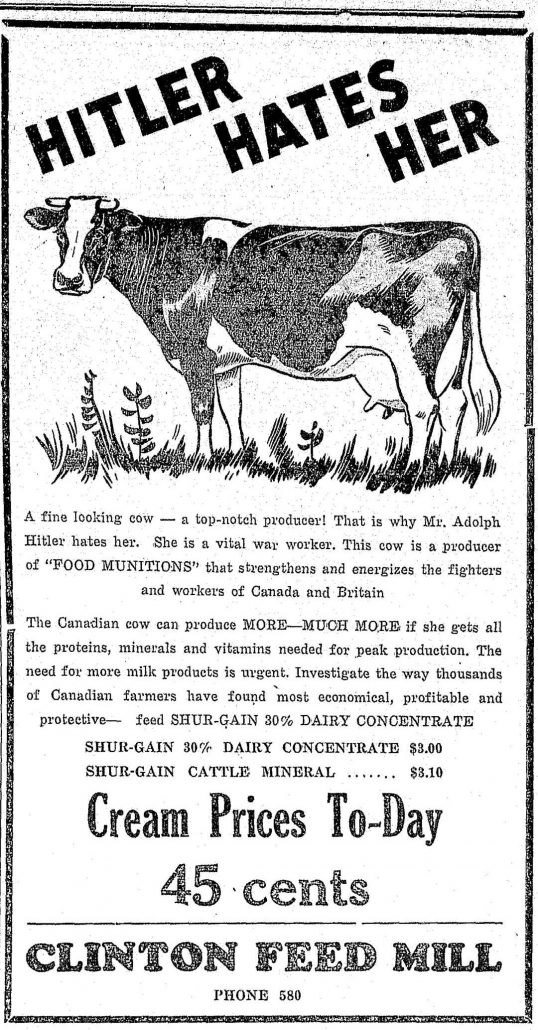
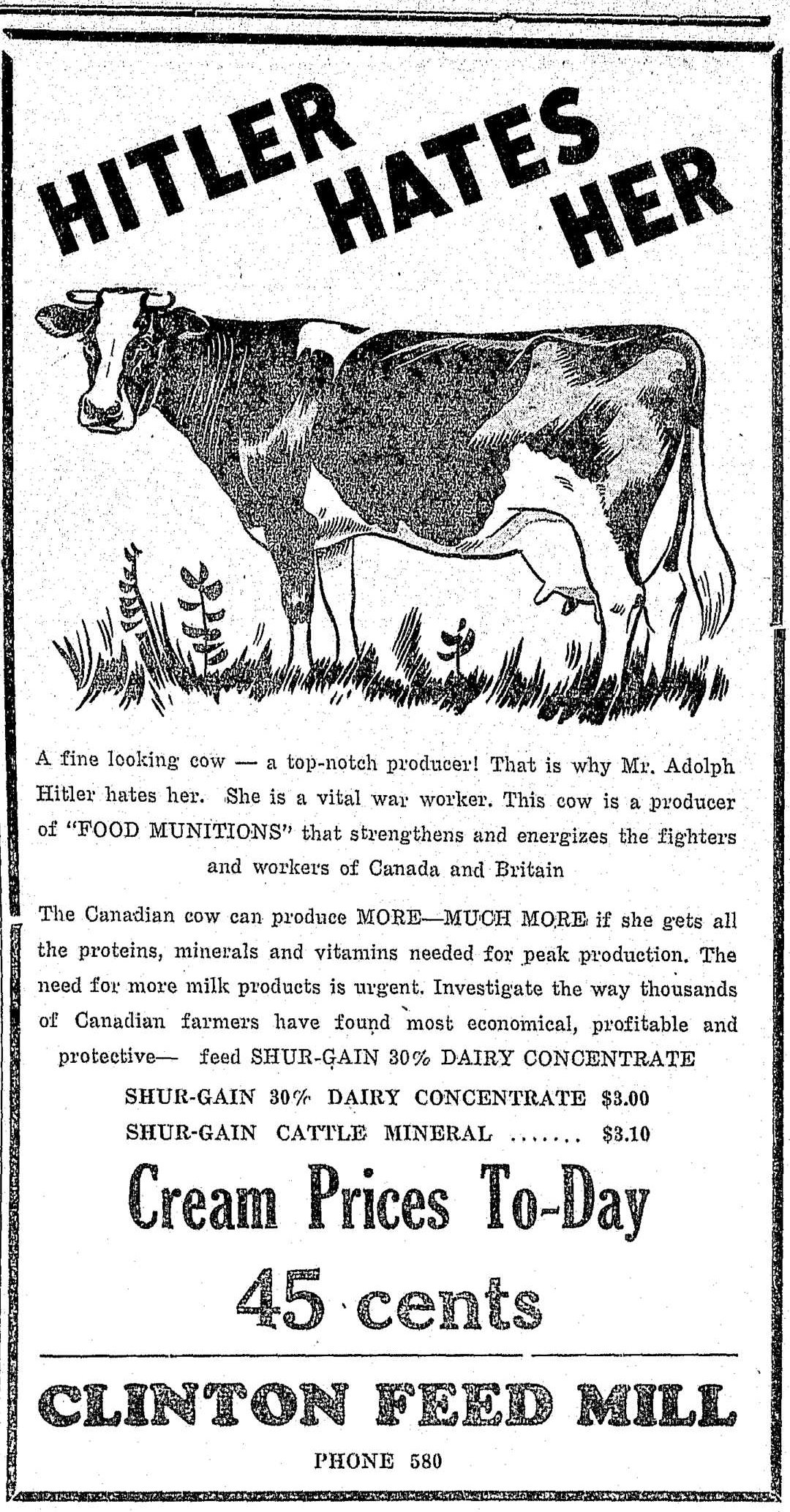
Clipping from Huron County’s digitized newspapers. This ad appeared in the Clinton News-Record in 1942 and 1943.
Articles & Short Posts
A Closer Look: The M4A2E8 Sherman Tank
The Huron Jail & the Second World War Part 2: A STRANGE MUTINY ON THE GREAT LAKES
The Huron Jail & the Second World War Part I: THE ‘DEFENCE OF CANADA’ IN HURON COUNTY
Newspaper Man Enlists: Huron County and the First World War in Black & White
Collection Highlights from Remembrance Day 2014
The Mystery of the 4th Toe on the Left Foot
Local Girl Leaves for the Front
Love is in the Air
Dogs of Air Training (Part 2)
Dogs of Air Training (Part 1)
Education Programs
The Huron County Museum’s ‘Huron County and the World Wars’ program is recommended for grades 5-10, and is offered as both an in-person and virtual field trip. There is also public outreach available by request with our Huron County home front reminiscence kits. Click here to find out more about our Education Programs.
Email museum@huroncounty.ca to inquire about booking an in-person or virtual program.
Research Resources
Click to search more than a century of history via Huron County’s digitized newspapers: free, online and keyword searchable. The newspapers provide a wealth of information on local soldiers and nursing sisters, including casualty reports and letters from the front. You’ll also find detailed information about life and work on the home front, including wartime advertising.
Or Click here to search a selection of the museum’s archives and artifacts via our online collection. Relevant artifacts include uniforms, photographs, medals and memorabilia from British Commonwealth Air Training bases in Huron.
Book List Check out this reading list related to local WW1 and WW2 history, available through the Huron County Library.
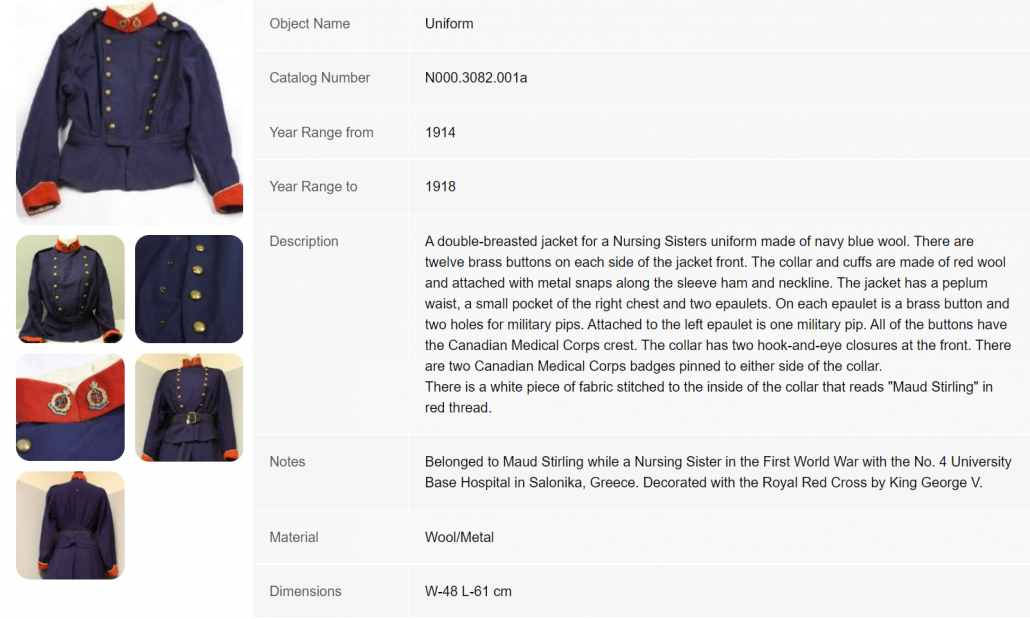
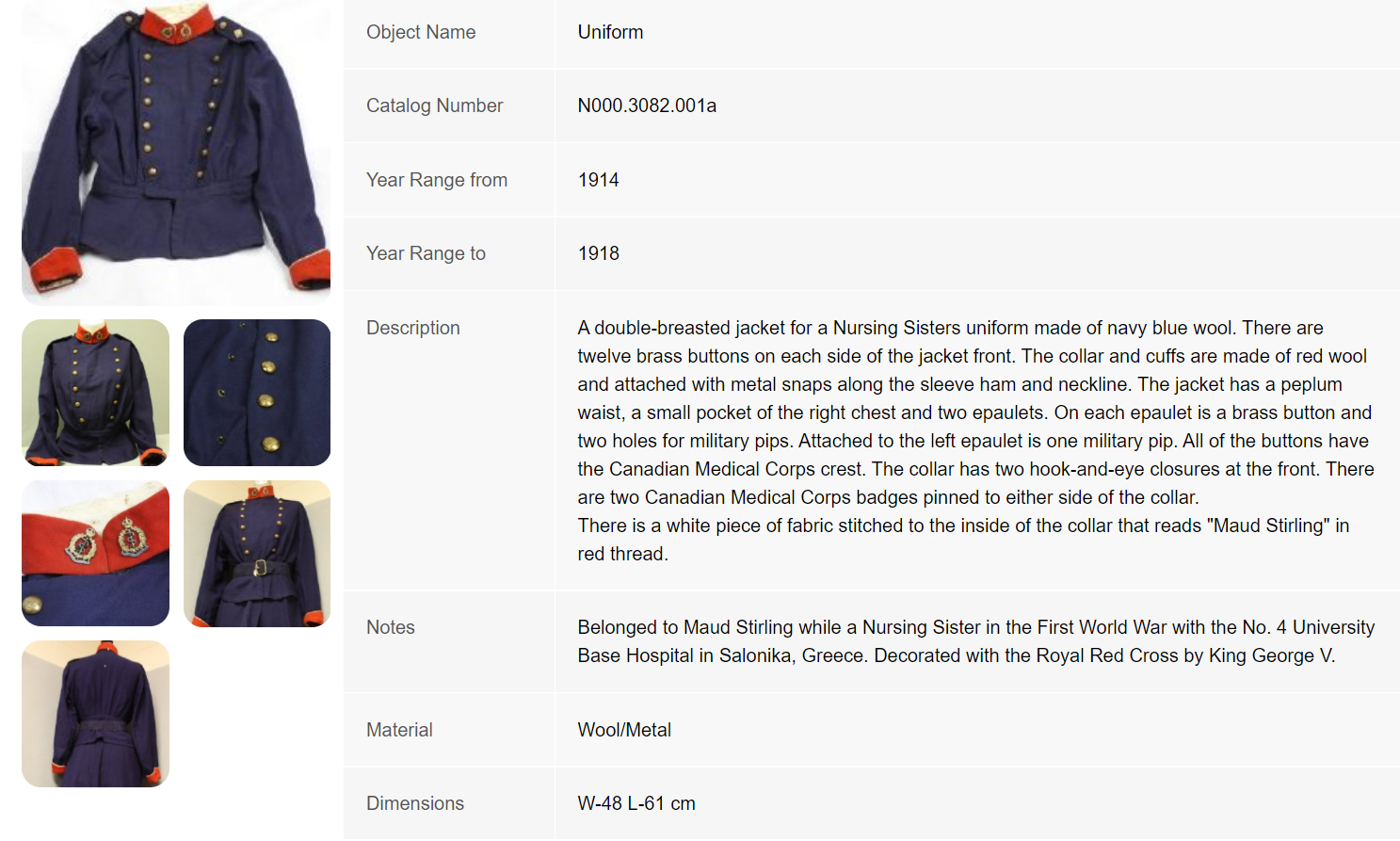
Nursing Sister Maud Stirling’s uniform in the Huron County Museum’s searchable online collection.
by Sinead Cox | Mar 3, 2021 | Artefacts
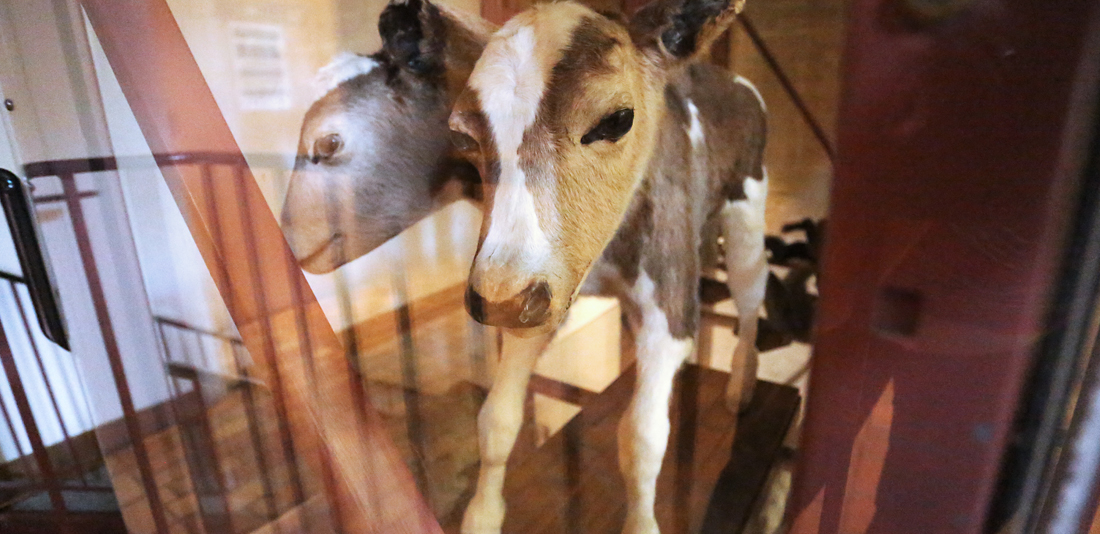
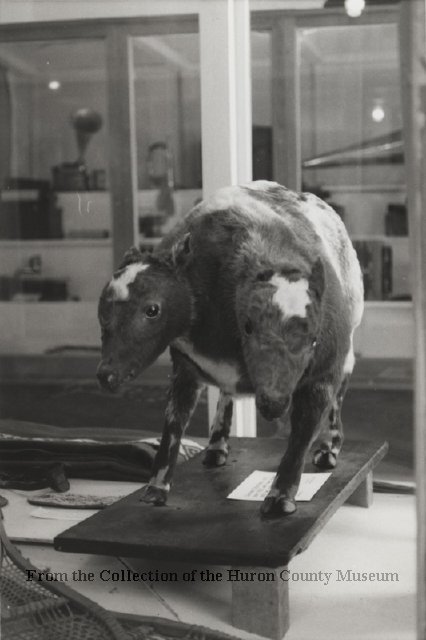
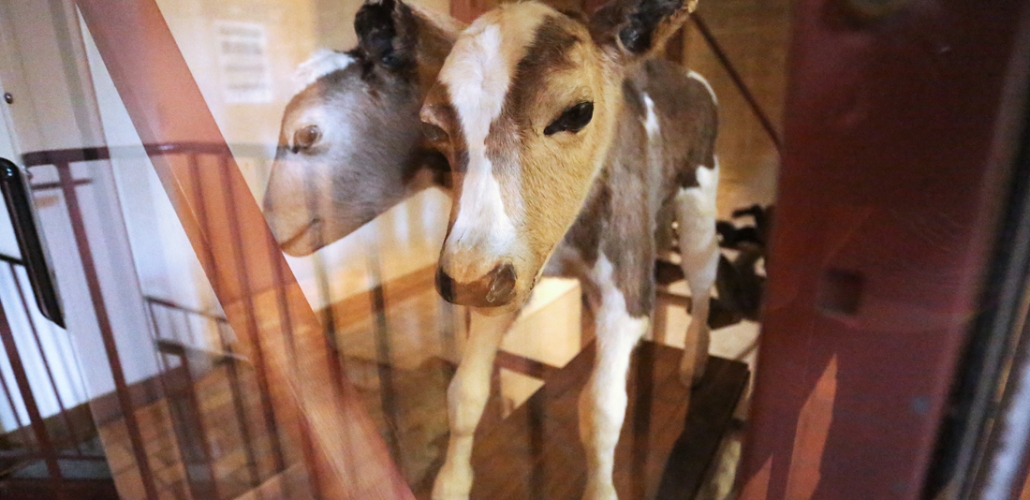
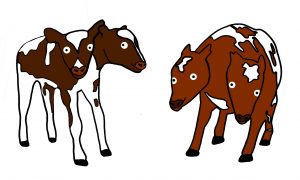
Take a closer look at the Huron County Museum & Historic Gaol and its collections as staff share stories about some well-known and some not-so-well-known features, artifacts, and more. The Huron County Museum’s two-headed calves are perhaps our most recognizable artifacts, and attract a lot of questions from visitors.
Although familiar with the two-headed calves’ history, Acting Senior Curator Sinead Cox wanted to know more about the genetic causes of polycephaly: the condition of a single animal having more than one head. How and why does this rare phenomenon happen?
Sinead talked to veterinarian Dr. Alaina Macdonald to find out more from an expert on animal health.
Sinead Cox: Can you share a little bit about yourself and your professional background?

Dr. Alaina Macdonald
Dr. Alaina Macdonald: I graduated from the Ontario Veterinary College in 2019 and have worked in mixed animal practice since graduation. I have always carried an appreciation for agriculture, and love being able to help animals and their humans live healthy lives. My newest interest is learning how to incorporate aspects of human, animal and environmental health in problem solving of worldwide issues.
SC: The Huron County Museum has two taxidermied calves in our collection with two heads and two tails. How on earth does an animal end up having two heads?
AM: The rare development of two-headed offspring is directly related to the formation of identical twin embryos early in the pregnancy. This phenomenon is seen in reptiles, birds, amphibians, and mammals (including humans). In fact, much of what we know about two-headed animals can be better understood by studying human conjoined twins, as it is a very similar process! When an egg becomes fertilized, a tiny embryo is formed. Occasionally, the embryo divides in a way which produces a second embryo with the same genetic material. This process must occur in a very delicate and specific balance of gene expression and the correct environmental conditions. Most often, it occurs before day 10 of gestation, and the result is two identical twins. Rarely, this process occurs late (around day 13-14), and the process of mitosis (cell division) is interrupted, resulting in two identical embryos which did not fully divide. Some literature indicates that polycephaly is due to a disruption of the primitive streak, which is an organized embryonic structure of cells present towards the second week of gestation.
SC: Could there be environmental factors that would cause this?
AM: No one knows the exact mechanism behind the abnormal splitting of the embryo. Trace mineral deficiencies and environmental factors such as increasing water temperatures and toxin exposure have been implicated in some species, but there are likely many causes. Anything that disrupts that delicate timing of gene expression (including random chance) can cause abnormalities in embryonic development.
SC: How often does this happen?
AM: There is no way to truly know how often this occurs, as this event would generally result in the early loss of pregnancy, and those pregnancies often are undetected. Indeed, it is exceptionally rare for the embryo to develop into a full-term fetus, and to survive the length of the gestation. It is not considered an inherited trait, because the offspring almost never live to reproductive age. In humans, development of identical twins is not considered genetic, which would also indicate that polycephaly in animals and conjoined twins in humans is a “chance” event with possible implications for environmental factors.
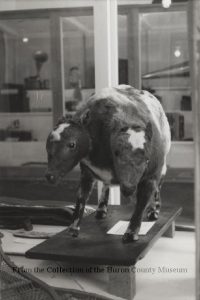 SC: Wow. That really puts into perspective how rare and special these calves are. Both of the calves at the museum were born in the early twentieth century. Is polycephaly more likely to happen now than in the past?
AM: Interestingly, fossil evidence indicates that polycephaly has been present in some species for the last 150 million years!
SC: I always think it’s sort of lovely that our two-headed calves are so loved and live on forever at the museum, when they had very short lives (less than a day). Why doesn’t a two-headed calf live very long?
AM: Calves with two heads often have many other congenital abnormalities. For example, the cardiovascular, neural and digestive systems may be malformed, which makes it nearly impossible for the calf to carry out normal vital functions. A live birth of any two-headed animal is rare, and many of them die shortly after birth. There was one calf who survived with intensive care for several months, which is likely the longest any polycephalic calf has lived.
SC: Have you ever seen any two-headed animals in your work life?
AM: No, I have never seen a two-headed animal myself. I am sure it comes as quite a surprise to everyone involved! There is some evidence to suggest that the many-headed creatures described in Greek mythology may have been inspired by polycephalic animals observed during those times.
SC: What is the strangest or most unexpected thing you have seen as a veterinarian?
AM: I have seen some animals in strange predicaments; from the kitten who ate pieces of a couch, to the dog with a piece of tooth embedded in his leg and the cat with a fishhook in his lip, all had something to teach me about veterinary medicine. The most startling moment of my career was when I was standing beside a horse, taking her temperature, and as we stood looking out the barn door the farm was struck by lighting! Everyone was fine, but the farmer needed to replace his electric fence. Nature always has a way of surprising us!
 Thank you to Dr. Alaina Macdonald for answering our questions and making us appreciate the uniqueness of these unforgettable artifacts even more! For more information on polycephaly, Alaina suggests these references:
https://pubmed.ncbi.nlm.nih.gov/15278382/
http://www.bbc.com/earth/story/20161018-the-two-headed-creatures-that-may-have-inspired-hydra
https://www.nationalgeographic.com/news/2016/11/two-faced-calf-lucky-becomes-oldest-on-record/#:~:text=A%20young%20cow%20calf%20with,a%20farm%20in%20Campbellsville%2C%20Kentucky.
FURTHER READING: