by Sinead Cox | Oct 11, 2018 | Blog, Exhibits
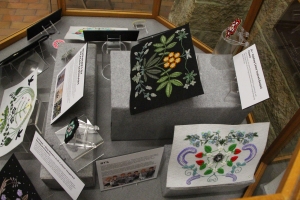 Meagan Barnhart is a Mississauga Ojibwe (Anishinabe)/ Cayuga (Haudenosaunee) artist from McKerrow, Ontario and a Cultural Heritage Conservation and Management student at Fleming College. An exhibit featuring Meagan’s 7-piece bead embroidery series inspired by K-pop group BTS (as well as 10 smaller beaded flowers), is temporarily on display at the Huron County Museum.
Curator of Engagement & Dialogue Sinead Cox interviewed Meagan to find out more about her creative process and the development of her technique. You can see Meagan’s stunning work at the museum until February, 2019.
When did you start beading? What made you want to start?
I started beading when I was really young. My mother beaded a lot and she often got me to sort out beads that were mixed together in a cookie tin. She first started teaching me by doing bead loom work and simple jewellery. However, once her eyes started to bother her while she beaded and circumstances changed in our family, beading went out of my mind. It wasn’t until many years later in my late 20s that my passion was reignited when I did some volunteer work at the Woodland Cultural Centre. For one of the months I was there I worked in the Education department – I didn’t have much knowledge that I could offer unfortunately, so I was asked to do some beadwork for game prizes. From there, I moved to Gatineau, Quebec where I got an internship at the Canadian Museum of History for Indigenous, Inuit, and Metis peoples who are pursuing training in museum work (Aboriginal Training Program in Museum Practices); it was there where I learned how to do bead embroidery, which I commonly do now.
I was influenced by many things: my surroundings and colours. I was exposed to a lot of beadworks at the museum, and I thought to myself that I would love to be that good and it excited me at the possibilities of being able to create something beautiful and calming. I was not only influenced by the beadworks but colours and emotions as well.
The work on display is inspired by the K-pop (South Korean pop) band BTS-can you explain when you 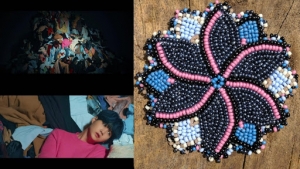 became a fan of BTS, and why they are such inspirations for your work?
The colours in their music videos, [their] lyrics, and emotions represented in their music were great inspirations to me. I have known the group since they debuted, and I can say I was always a fan of theirs, but it wasn’t until around the time I started beading that their journey sunk into my mind – their music and videos often resonated with me and a lot of them felt like a familiar dream and the messages in their music were ones that I never got when I was young and wish I had. [BTS are advocates for youth and loving yourself; they recently addressed the United Nations regarding equipping young people with self-confidence to make a global impact]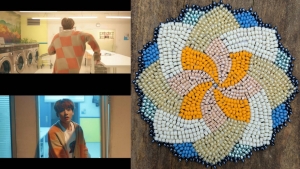
For me, at this moment, beading and BTS kind of go hand-in-hand because it was when I started beading in 2016 [that] I also began to call myself an ARMY (Adorable Representative MC for Youth)–their fandom name.
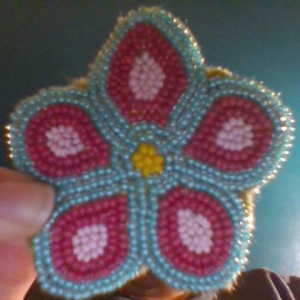
Meagan’s first embroidery piece!
How has your technique/artistry evolved?
I really still use the same materials I always have…only they are a bit better quality now. I would like to experiment on more types of materials, but I am only new to my beading (almost two years now, but I still consider myself new and learning). As of right now I don’t have any other beaders close to me to discuss new techniques or tips. So its slow learning, but I gradually pick up new techniques every once in a while – especially when I feel daring enough to step out of my comfort zone.
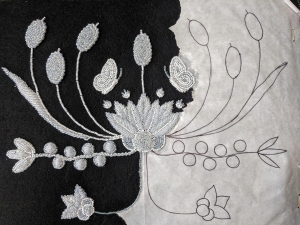
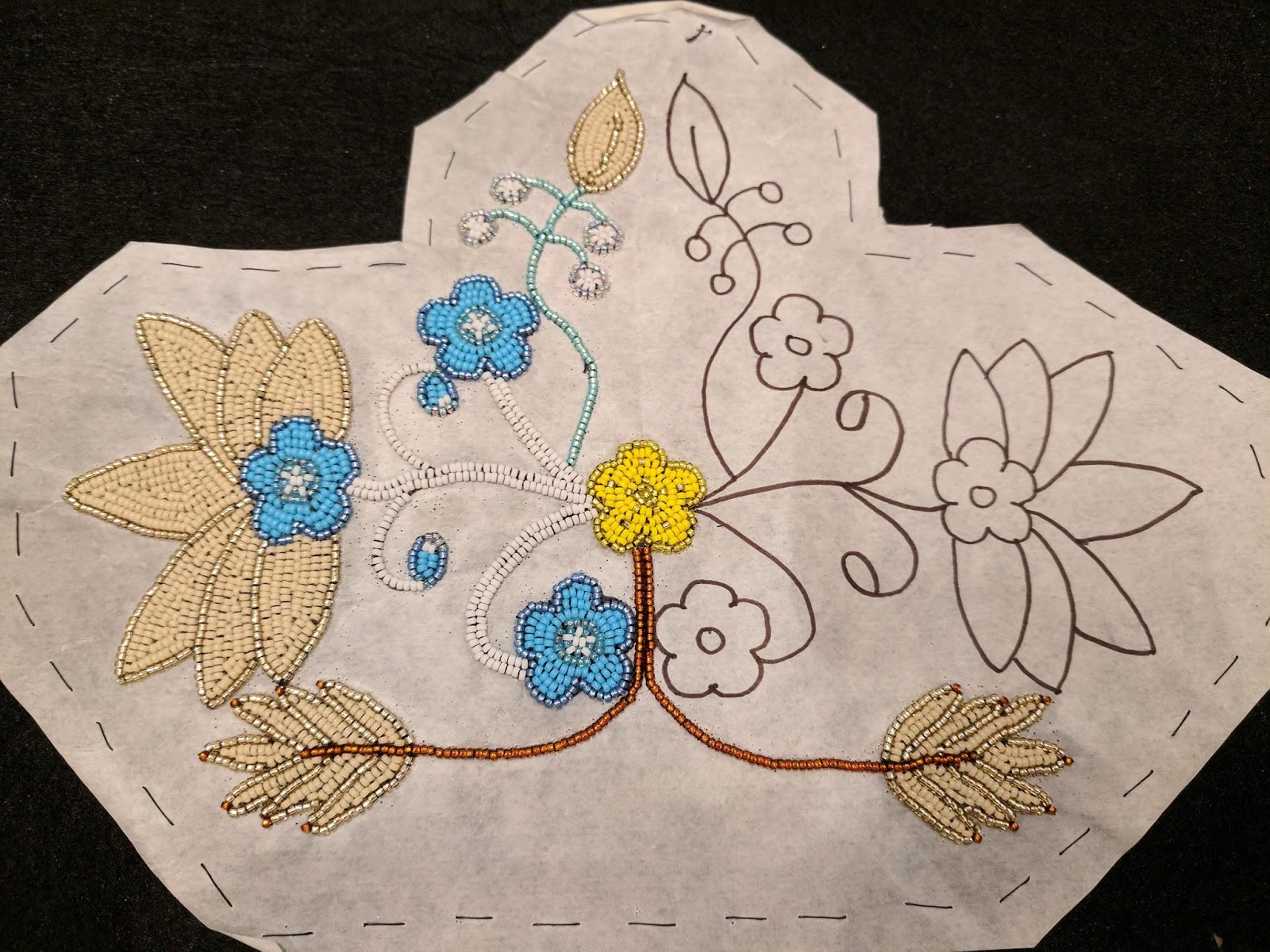
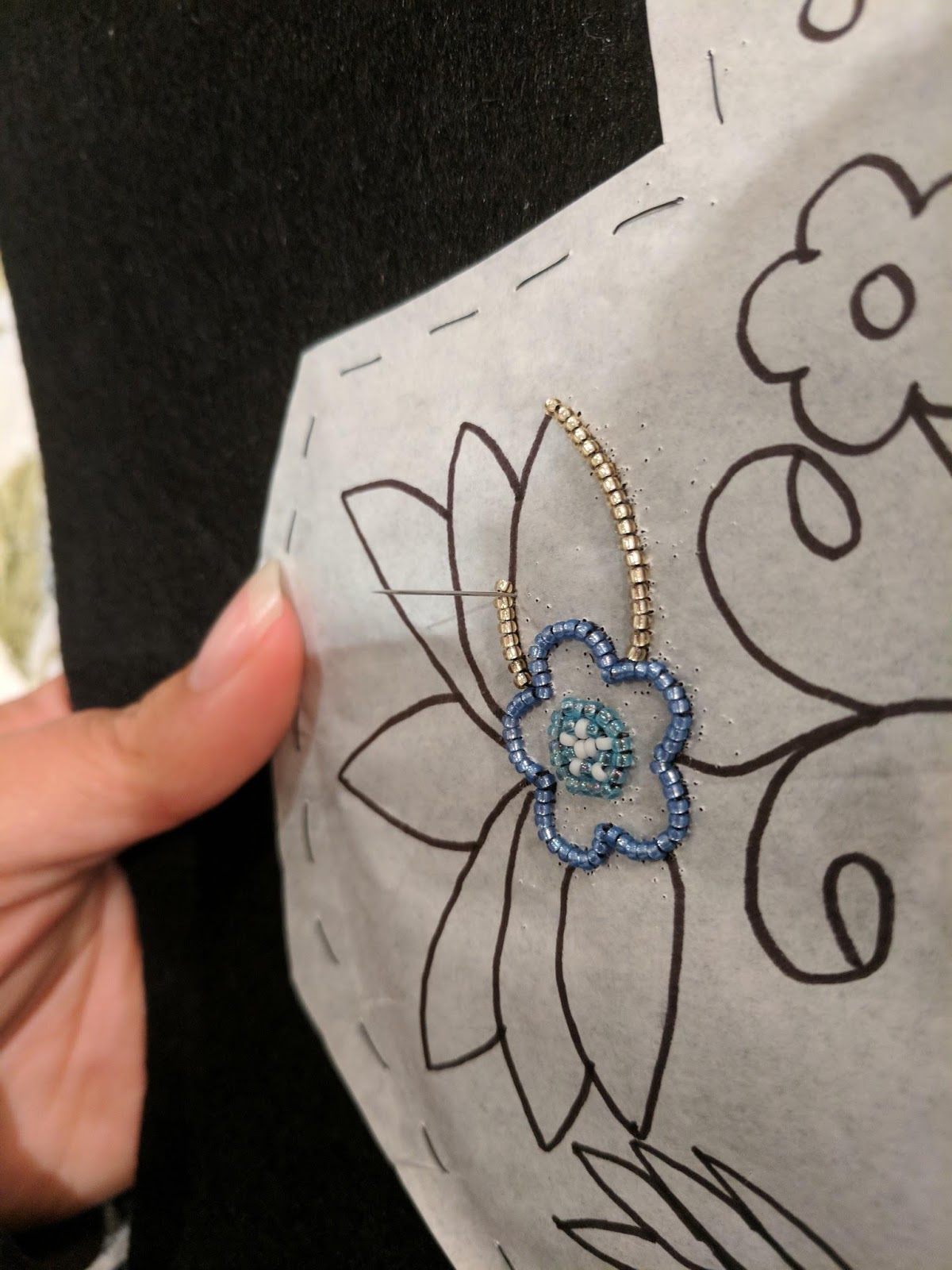
“Suga ~ Nevermind Colour Inspired Beaded Flowers”: Meagan’s first attempt at a raised beadwork in progress.
For example, my raised bead work: I [had] only been taught once how to do a raised beaded strawberry while working at the Woodland Cultural Centre, but [after] that…I felt comfortable with bead embroidery; I ventured on my own to try different techniques with raised bead work. I think I still need to practice a lot with this style and I would benefit greatly in the future having a friend or two around that I can discuss such things with.
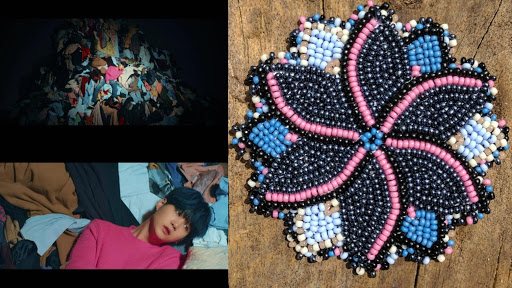
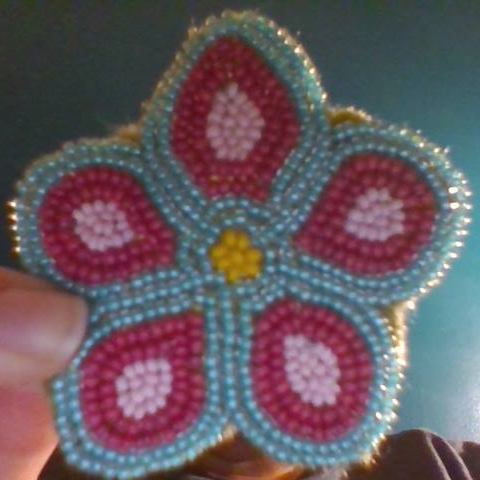
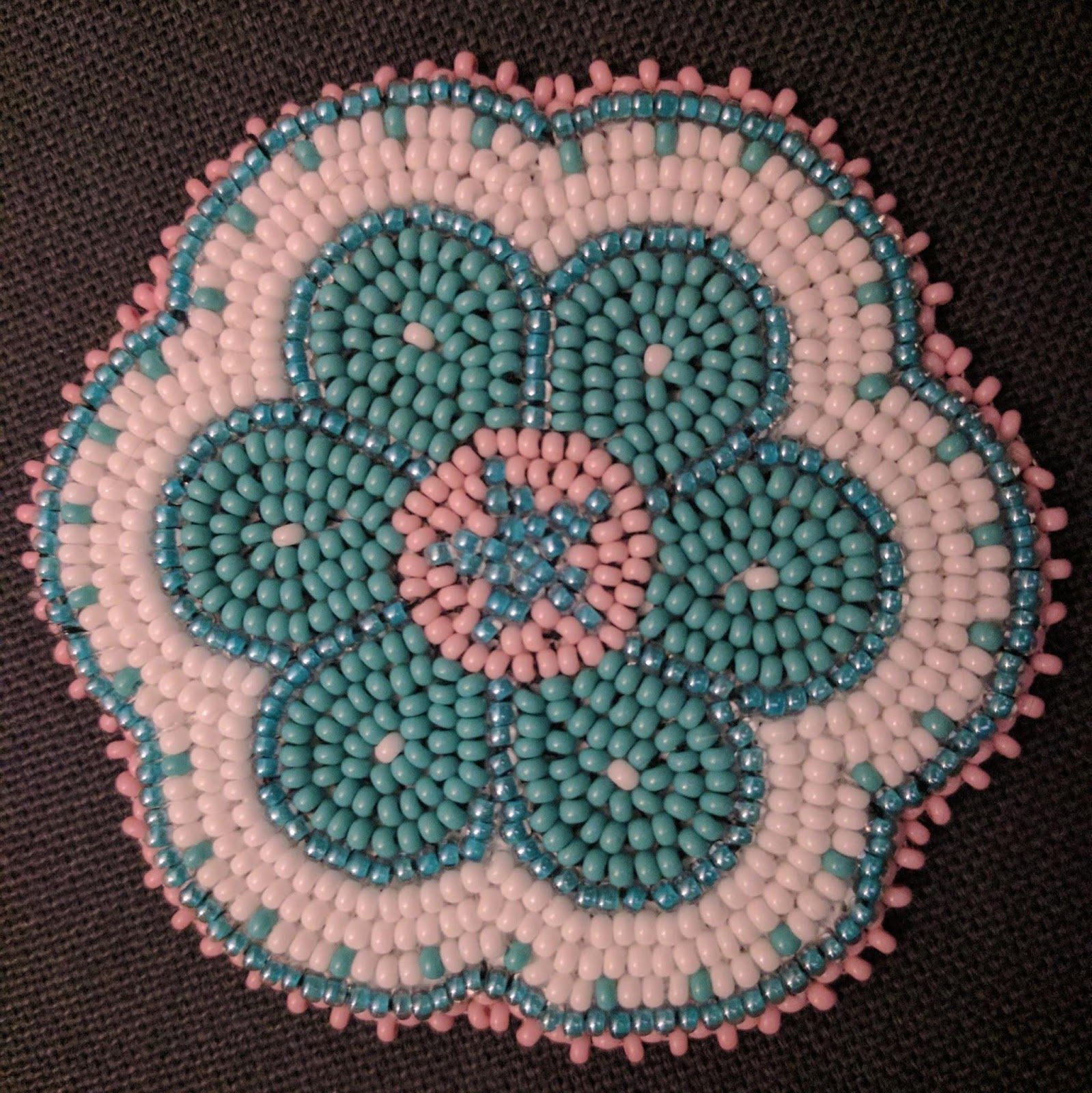
When it comes to the evolution of my BTS colour inspirations, I started out small – using the colours to make single flowers instead of larger pictures with them.
This is my very first one: 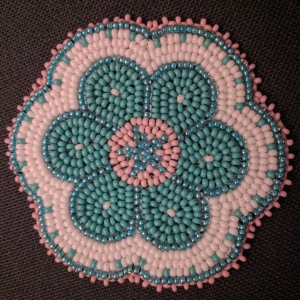
This one was based off their “WINGS: You Never Walk Alone” album. It had two covers, I particularly liked the colours of their aqua and peach coloured album – unfortunately I didn’t have peach at the time, so I used a pink as a replacement. After I finished this one, I continued by doing 3 more for the albums, and one for each member inspired by their clothing they wore at some point within the music video “Spring Day”
Who taught you beading/how did you learn?
I learned how to bead embroider when I was at the Canadian Museum of History from a fellow intern friend who is Métis. Her sister is a beader and invited me to go [to] an evening bead workshop. Unfortunately, it was [so] far by bus to get to the workshop that I only was able to spend less than a half hour with them – and from then on was not able to continue going to the classes. However, this was enough time to teach me the basics and…me and my two fellow intern friends continued to bead on our lunch breaks.
Can you briefly take us through the process of designing the seven pieces in this series?
First I watched the Music Video, then I chose a scene that captured my attention. I then read the lyrics, analysed any imagery within the entire music video to get a sense of what the storyline was – if there was a book, or movie related to the music video or even the series that the music video is apart of (School Series, WINGS Series, Love Yourself Series), I’d read or watch then to get a sense of what the entire series was about…With [each] scene I choose, I pick the colours that were most dominant in the image and choose flowers based on them.
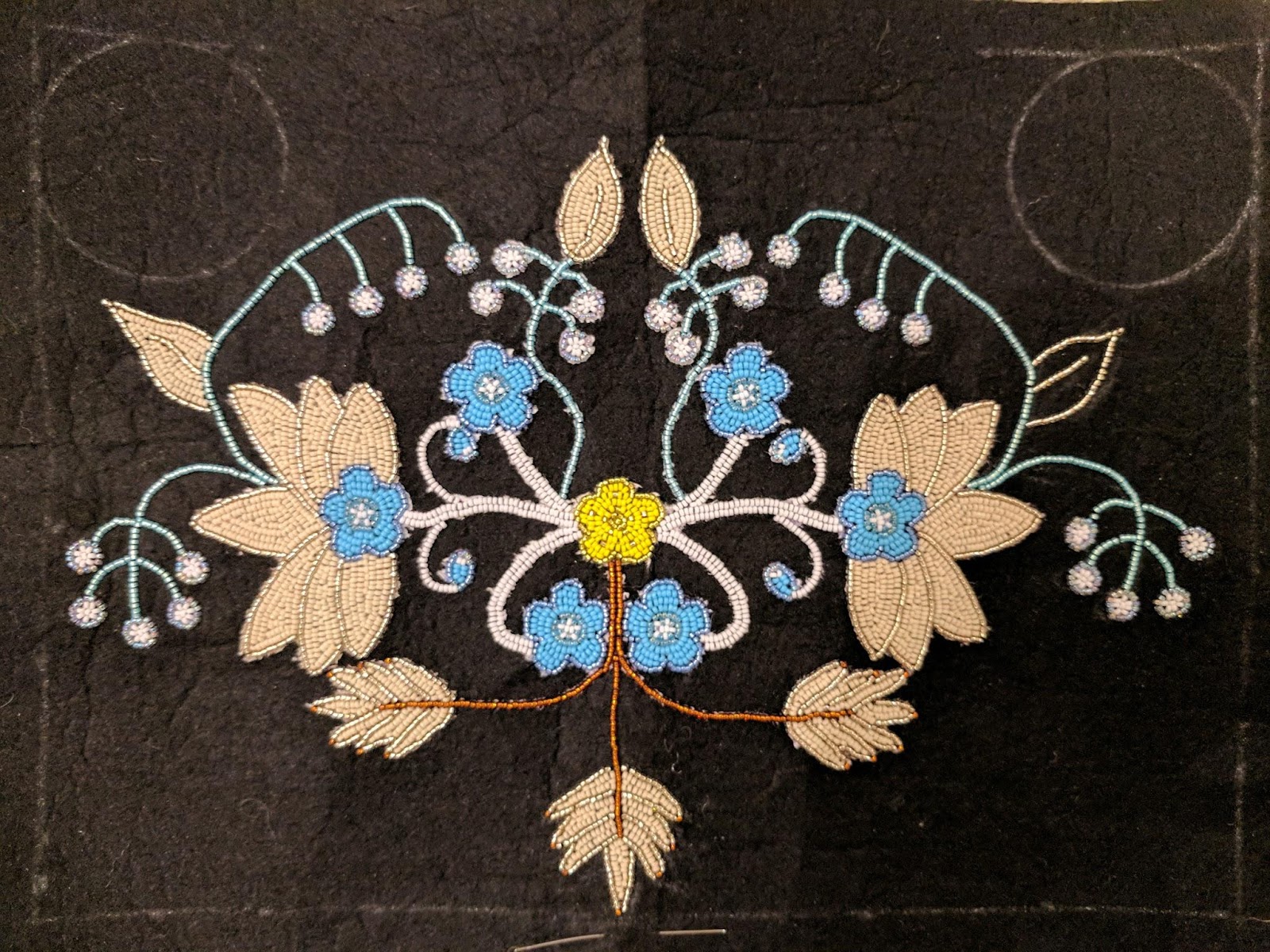
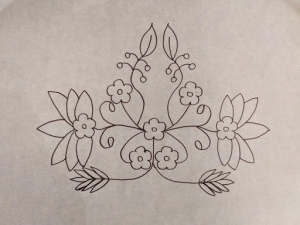 For the flowers, I often tried my best to try to use wildflowers of North America, specifically ones I’m most familiar with in Canada…I would research the meaning of the flowers or what their uses were – if I already knew what they represented or what they were used for, the better. I wanted to choose flowers that would tell a story – something that related to the music video, or BTS’s relationship with their fandom ARMY – especially since their bond is a lot stronger than I have ever seen between artist and fandom. From there I would develop a pattern. I often enjoyed the somewhat-symmetrical design; I say somewhat, because although it looks symmetrical, nothing is ever perfect, and neither are they, they don’t line up perfectly and they don’t have the same amount of beads on each side.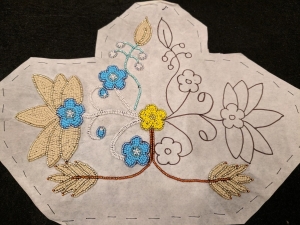
What kind of materials do you use?
I use 15/0 glass seed beads (for the bigger pictures to get more detail). For the singular flowers I mostly use 11/0 glass seed beads, but i mix them sometimes with 15/0 seed beads, 10/0 seed beads, and 11/0 delica seed beads. For the substrate I use 100% polyester felt (more recent ones are made with a stiff felt – as are the big pieces), and either nylon, polyester, and/or cotton thread (I prefer nylon and cotton over polyester for thread because they do not tangle as much), and a 16/0 beading needle. I draw on tracing paper and bead over it. Once the beading is done, I remove the paper as much as possible/visible.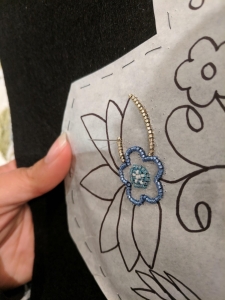
How long did it take you to bead the pieces on display?
For the singular flowers, around 12 hours (it can be more or less depending on size and my familiarity with the pattern I am using), and for the larger pieces I would say around 150 hours (more or less, depending on the amount of difficulty and style). For the full series of the large pieces, the entire project took me a year, practically to the day. For the smaller flowers, that series has almost been a year long as well – I believe my year will be up in November. This year has been full of many projects (not just these ones), so that may have contributed to why these series took me so long to complete.
What’s the most difficult part of creating beadworks? Conversely, what’s your favourite part of the process?
Sometimes the amount of detail you want doesn’t show through, and you will never know until you start. There [were] a few times when I envision[ed] something, made it halfway through my design and had to alter something because it wasn’t working out the way I planned or it wasn’t looking the way I wanted it to. Eye strain is another difficult thing to control as well, especially when you are really focused.
One of my favourite parts is the relaxing feeling it gives me – it’s almost like meditation at times. I also really enjoy seeing the outcome of it all.
Do you have a favourite piece that you’ve created so far?
Each one has a particular place with me when it comes to the big ones [from the series] – However, I think my first one, Serendipity, holds a special place in my heart. It’s not my best one, but it is my first attempt at doing anything so ambitious. I also remember how much i loved that song and music video when it came out – I still do really. There was a lot in this music video that reminded me of what my dreams look like when I sleep, and my first thought was that I really wanted to capture that feeling by capturing the colours. When I look at it, I can see things that I could have done better – even with the story telling I have with the flowers, but instead, these flaws make me smile and i love it just the way it is.
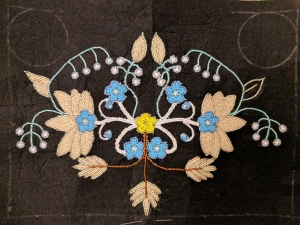
“JIMIN ~ Serendipity Colour Inspired Beaded Flowers” Flowers are lily of the valley, buttercup and periwinkle. The two circles (unfinished in this image) represent the sun and moon.
[BTS member] Jimin is also my bias [a fandom term for preferred member of the group], so that may have something to do with my gentle lean towards Serendipity – it is his solo intro song that inspired me to do this series.
Is there a story or message you hope your work conveys?
Surround yourself with positivity – beauty, happiness, serenity, peace – appreciate your hard times, they will help you recognize the good in even the smallest form if you allow it to.
Where can people follow you & your work?
Instagram: @ojistah88
Twitter: @Ojistah
AMINO (ARMY and ARMY++): Ojistah
Meagan’s work will be on display in the museum lobby October 2018 through February 2019. All photos for this piece courtesy of Meagan Barnhart.
by Sinead Cox | Jul 18, 2018 | Exhibits
Sinead Cox, the museum’s Curator of Engagement & Dialogue, introduces the museum’s latest temporary exhibit, Community Curators: Newcomers (on display now).
From storage and display methods, to how and when we handle objects, museum staff endeavour to protect the artefacts entrusted to our care from the manifold dangers of shifting temperatures, chemical reactions, pests and damage–to preserve each and every artefact for future community access based on its unique needs. I encountered a new artefact-care dilemma recently however, when I had to think about the best way to preserve and protect an artefact’s existing smell while on display.
The 2018 participants for the museum’s recurring ‘Community Curators’ exhibit are both newcomers to Huron County. Instead of choosing an object from the museum’s collection like previous guest curators, they have very generously loaned an artefact of their own. Siham Mohammed of Wingham and Baraa Ahmed Al-Ali of Ashfield-Colborne-Wawanosh both fled with their families from war in Syria, and came to live in Huron County as sponsored refugees. I asked each volunteer curator to select an object or objects that related to their personal story or home country, and to translate the name of that object into English and their first language (Kurdish for Siham, Arabic for Baraa).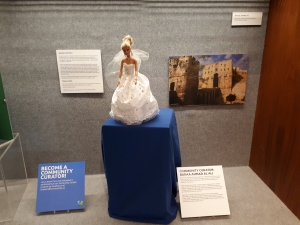
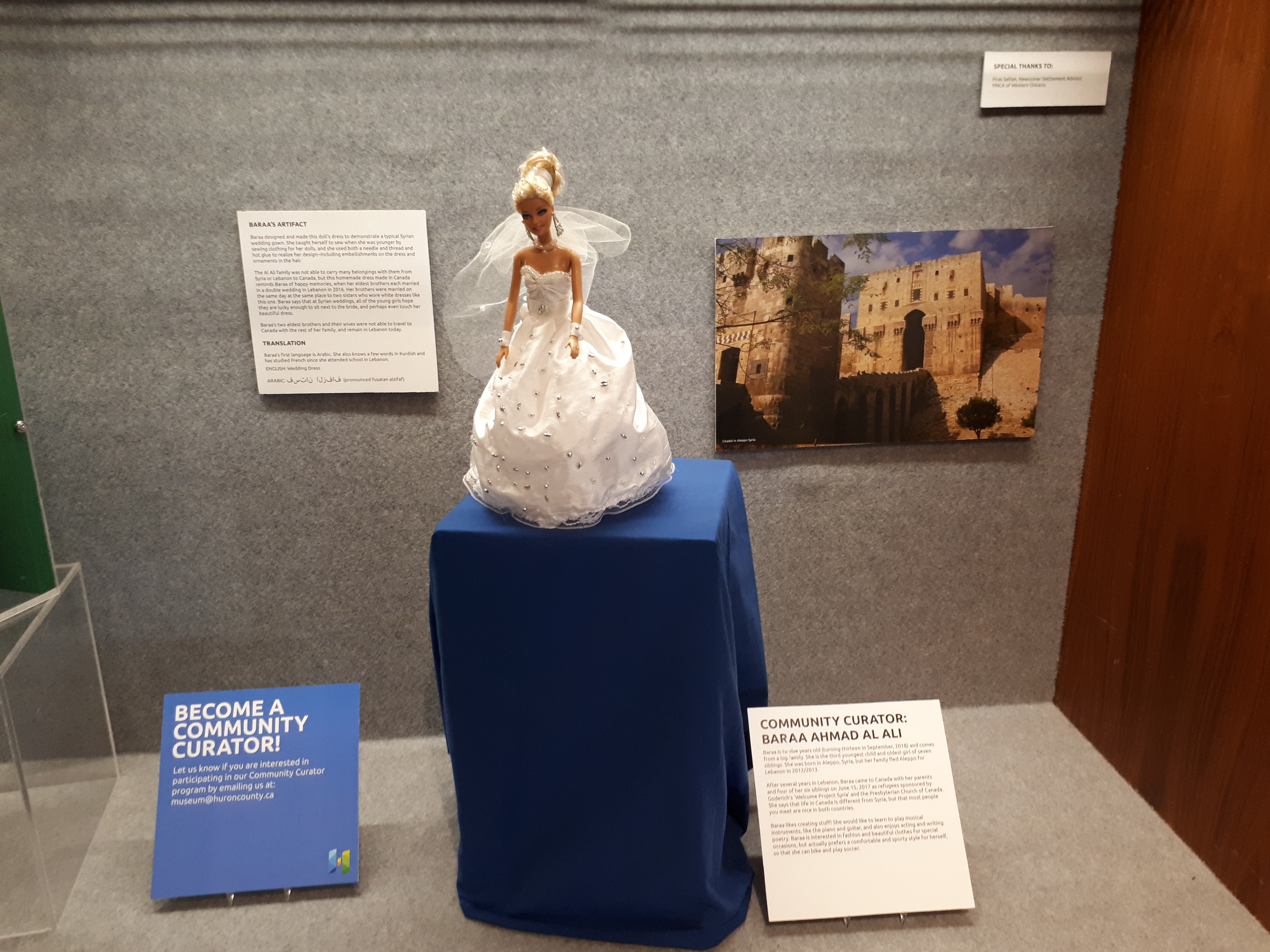
Because her family had few belongings when they came to Canada, twelve-year-old Baraa used her creativity to design and customize a doll’s dress to represent a typical Syrian wedding gown. Baraa’s handmade design evokes happy memories of family weddings in Syria and Lebanon when all of her brothers and sisters were still together.
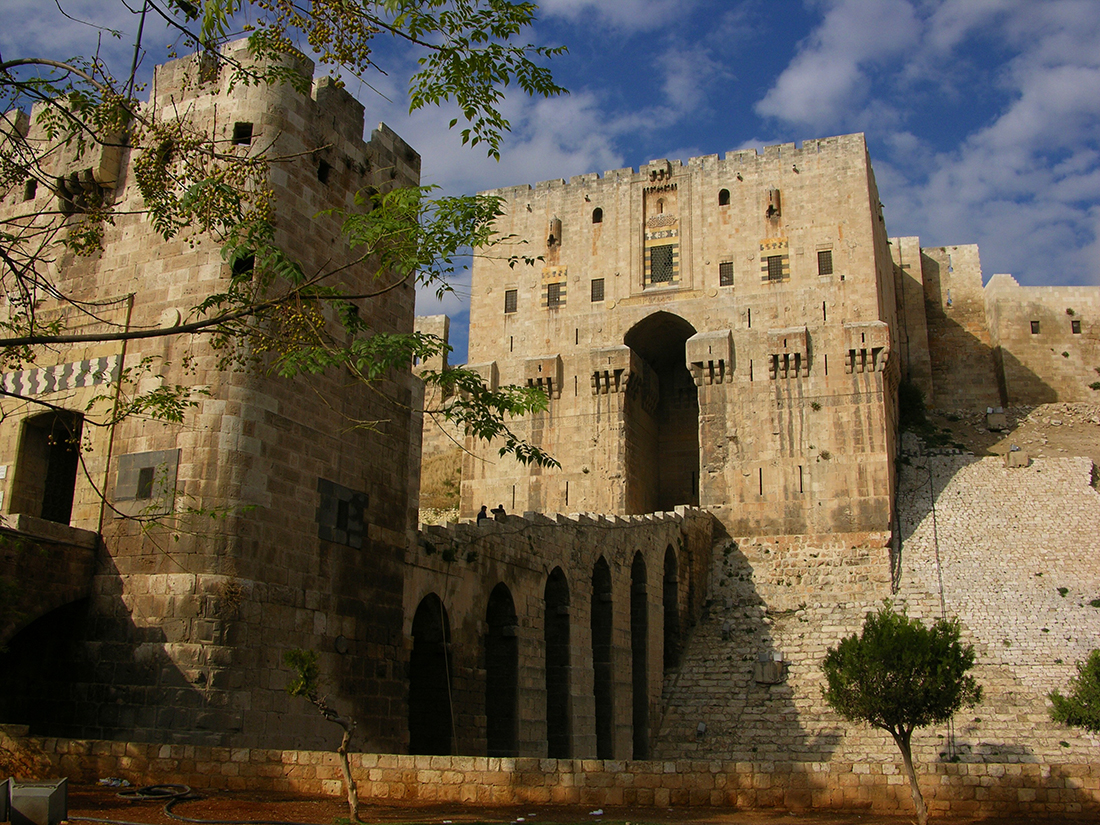
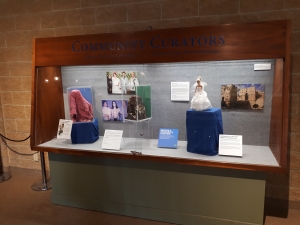 Siham loaned two scarves that she has carried with her since she left Aleppo with her husband in 2011, first fleeing to Turkey for safety and eventually being matched with her new home community in Wingham. The scarves belonged to Siham’s mother, who she hasn’t seen since she left Syria. Although the scarves have lovely floral patterns, Siham doesn’t wear them in Canada as fashion accessories; she keeps them as keepsakes that remind her of her family still in Syria. The scarves remarkably still smell like her mother: strongly of jasmine perfume and more faintly of cigarette smoke.
The museum is very honoured to temporarily host such significant artefacts, and I knew it would be important to preserve the distinctive and familiar odour that adds so much personal value to the scarves. After consulting with our Museum Technician, Heidi Zoethout, we decided to encase each scarf individually in smaller plexi-glass boxes in the larger display case. Visitors will just have to imagine the strong flowery scent, and maybe think about what home smells like to them.
There are many objects donated to the museum’s permanent collection with similar stories: precious items carried from Ireland, England, Scotland, Germany, Holland or India brought with immigrants starting new lives in the presence of something that evokes the familiar sights, sounds, feelings, or scents of home. When the journey demanded that other possessions be sold or left behind, these were the items that remained. And that is really why, in my estimation anyway, it matters to pay attention to and try to preserve the texture, vibrancy, and integrity of these objects as much as we can—their value isn’t always something that you can put a price tag on, but it can encompass a sense of the past that you can see, touch, hear, taste or sometimes even smell.
To learn more about our curators’ stories, you can visit the Community Curators exhibit in the upper mezzanine of the Huron County Museum this summer. If you would like to be a community curator, contact us at museum@huroncounty.ca.
by Sinead Cox | Nov 11, 2017 | Exhibits, Investigating Huron County History
From Nov. 21st, 2017 to March 2018, the museum’s temporary Hot off the Press: Seen in the County Papers exhibit will look behind the headlines to the men, women and changing technologies that have brought Huron’s weekly papers to press for over almost 175 years. In this Remembrance Day post, Sinead Cox, Curator of Engagement & Dialogue and curator of the upcoming exhibit, examines the life of one Huron newsman who was also a veteran of the First World War, and follows the story of his return from service via mentions in the local weekly papers.
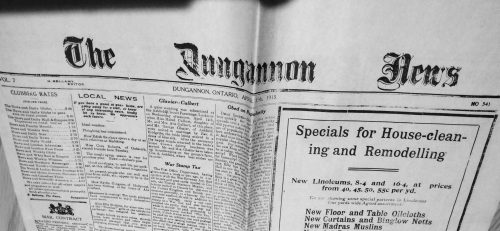
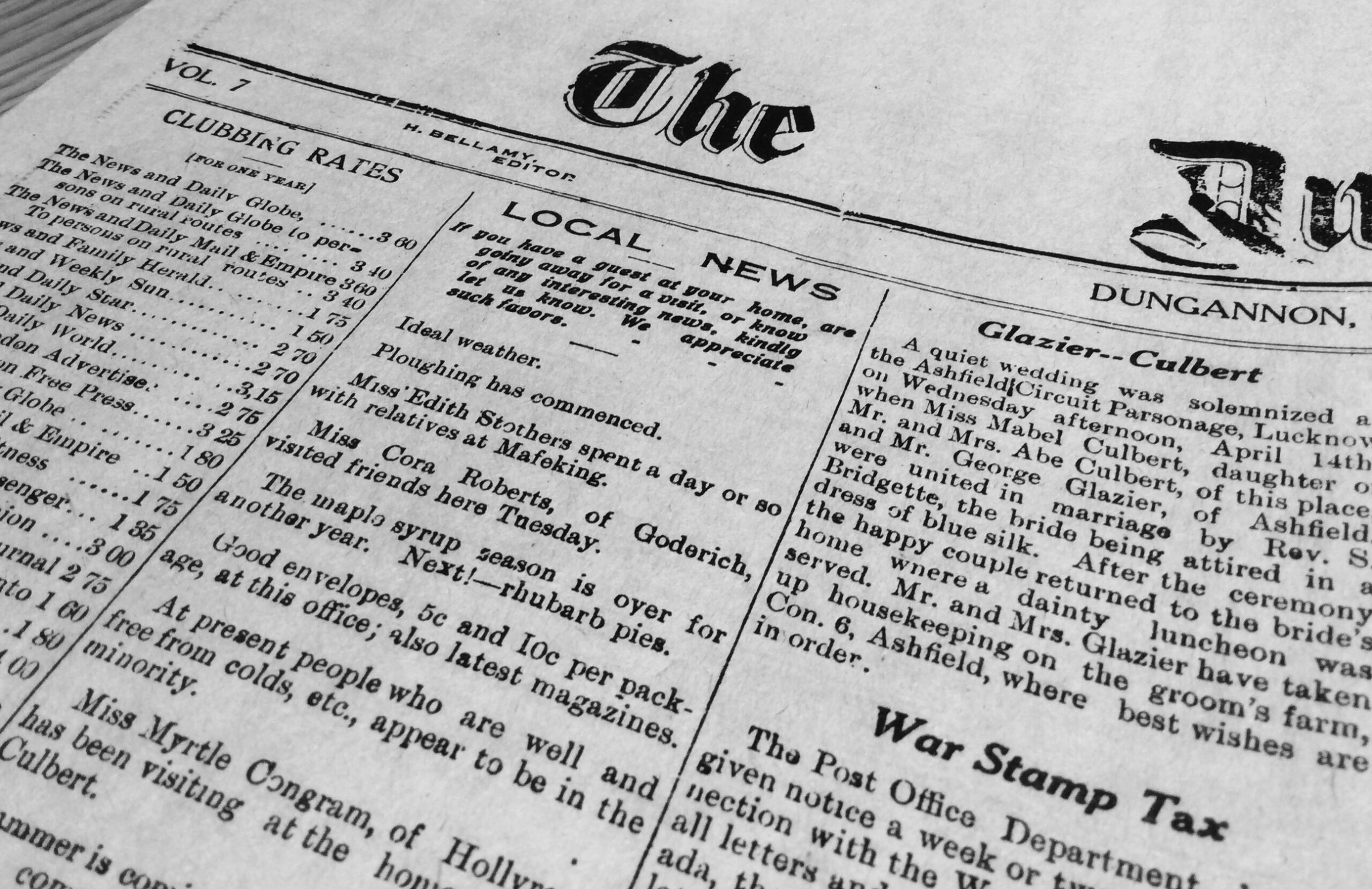
The Dungannon News, 1915-04-15
From my research into Huron County’s newspapers, it’s clear that a lot of effort, long hours and personal sacrifice often went into putting a paper to press and ensuring the latest edition reached local subscribers’ doorsteps on time. There were few excuses that could justify a late paper on the part of its proprietors: perhaps broken equipment, the precedence of a contracted print job (ie printing election ballots), adverse weather, public holidays, or even the rare editor’s vacation. One of the most notable reasons to stop the presses, however, occurred in 1916 when The Dungannon News ceased publication entirely because its editor enlisted to serve overseas with Huron’s 161st Battalion.
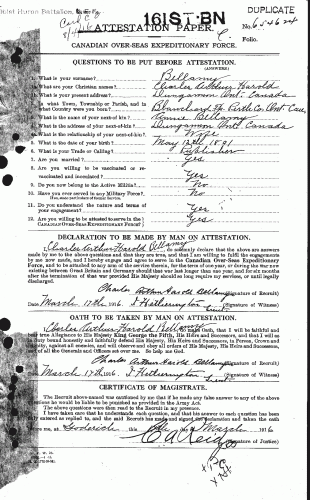
Pte. Bellamy’s attestation paper. You can access his full personnel file at: http://www.bac-lac.gc.ca/
Born in 1891 in Blanshard Township, Perth County, Charles Arthur Harold “Harry” Bellamy had moved to Huron by 1908 when his step-father, Leslie S. Palmer–a former staffer at the St. Marys Journal and owner of the Wroxeter Star–founded The Dungannon News. His sisters, Amelia and Luella Bellamy, also worked locally as operators for the Dungannon telephone office. When his mother and step-father moved to Goderich in 1914, Harry became both editor and publisher of the News while still in his early twenties.
As editor, H. Bellamy strongly supported Canada’s involvement in the Great War within the pages of his publication, and by March of 1916 had decided to enlist himself. At only 24 years old, and a newlywed of less than two years with his wife, Annie Pentland of Ashfield Township, Editor Bellamy signed up to serve with the Canadian Expeditionary Forces at Goderich. With the departure of its proprietor, The Dungannon News merged with Goderich’s Tory weekly, The Star, and the newsman became the news as fellow editors praised Harry Bellamy’s decision in the columns of their papers.
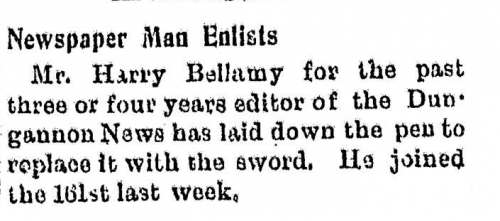
The Wingham Advance, 1916-03-23, pg 5
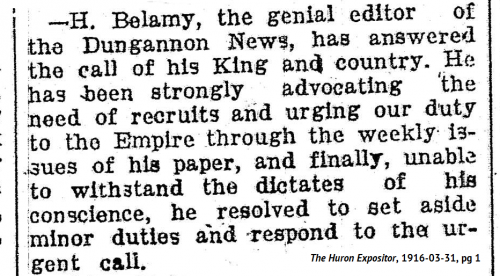
Assigned to the 58th Battalion in Europe, Pte. Bellamy appeared once again in the pages of the local weeklies through his letters from the front. Stationed “somewhere in France” on Dec. 26th, 1916, Harry wrote to his friend F. Ross of how his “three or four days’ trench life” had begun with digging out a trench collapsed by shell-fire; he had become accustomed to ducking down for enemy fire “no matter how deep the mud and water is.” While evading sniper bullets in a no man’s land crater, Bellamy says he pretended he was at home, practicing with friends at the Dungannon Rifle Association.
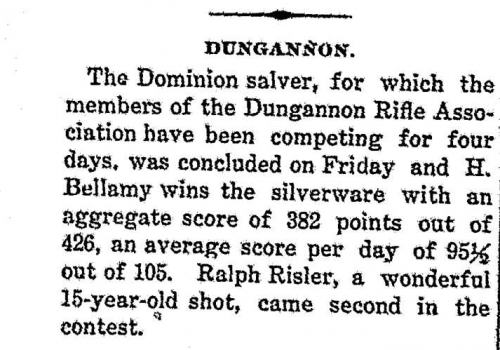
The Wingham Times, 1911-12-28, pg 4
Imagining away the conditions he described would have no doubt been difficult: “We sleep and rest in the dugouts, which are twenty to twenty-five feet underground. After splashing, crawling and wading through trench mud for hours at a time, we find it quite a relief to get down in these underground quarters.” On Christmas day he witnessed “a fierce bombardment…It was a magnificent sight to see the green and red flames and the shells with their tails of fire flying…The noise and din of the various kinds of explosives in use was deafening.” In the same letter, which Goderich’s The Signal printed on its front page, he claimed that the brutal lifestyle had not dampened the soldiers’ spirits: “we never worry over here. We content ourselves with singing, ‘Pack all your troubles in your old kit bag and smile, smile, smile.’”
Although he was writing for the local papers, Pte. Bellamy was not able to regularly read them in Europe, and complained that the delays in mail also prevented him from keeping up-to-date with happenings in Huron County. According to his service records, a year after he had enlisted at Goderich, Harry fell ill with trench fever–an infectious disease carried by body lice. He left France for treatment in the U.K., and after complaining of pain in his limbs at York County Hospital, doctors at the King’s Red Cross Canadian Convalescent diagnosed him with myalgia (joint pain) and an abnormally fast pulse.
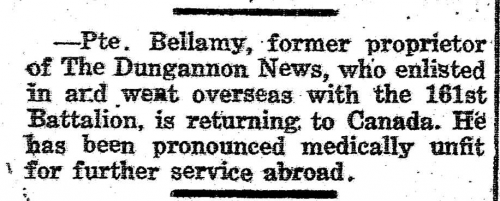
The Huron Expositor, 1917-10-12, pg 5
In articles subsequently written for the Goderich Star, Pte. Bellamy did not detail his failing health, instead returning to his pen to share his experiences sightseeing on leave in Scotland and Ireland in August, 1917. Ever a committed imperialist, he enjoyed witnessing the Glorious Twelfth celebrations in Belfast, but reported caring less for his time in southern Ireland, since “there is no love lost between those in khaki and the Irish rebels.” He felt wistfulness upon the end of his holiday, but Pte. Bellamy’s belief in the righteousness of the war had not wavered; he used his Star articles to rally homefront sentiments against peace until the enemy could be decisively defeated: “let…every one of us, as Canadians, recapture the heroic mood in which we entered the war.”
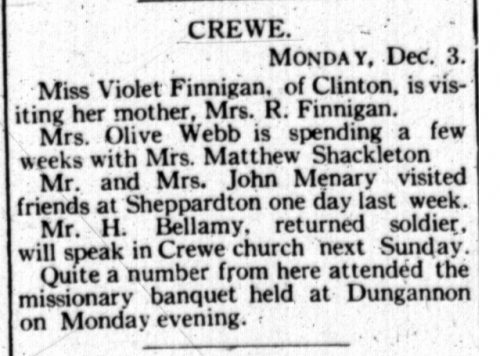
The Signal, 1917-12-06, pg 6
Unable to resume his duties as a soldier, Pte. Bellamy returned to Canada, where in addition to his persistent trench fever, he received a diagnosis of neurasthenia–a contemporary term broadly used for nervous disorders. After his homecoming, he reappeared frequently in the local news columns, usually receiving mention for promoting the war effort at local patriotic events or canvassing for Victory Loans.
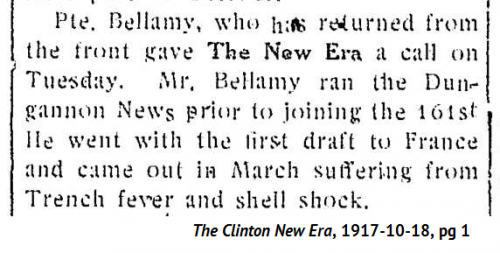 Other brief news items hint, however, that although Pte. Harry Bellamy had returned home to Dungannon, he had not left the trenches entirely behind. He received treatment at a London hospital in early 1918 according to The Signal. Following a social call from former editor Bellamy, the Clinton New Era classified his nervous illness as ‘shell shock’: a mental and emotional disorder common to returning soldiers, which today would probably be understood as post traumatic stress disorder.
In April 1918, a medical board at Guelph honourably discharged Harry as medically unfit due to illness contracted on active service. His records list a ‘nervous debility,’ as well as trench fever as the causes for his dismissal, and note that “this man would not be able to do more than one quarter of a days [sic] work.” The listed symptoms in his medical records include dizzy spells, light headedness, restlessness, hand tremors, headaches, and an irregular heartbeat. The Board determined that the probable duration of his debility was “impossible to state.”
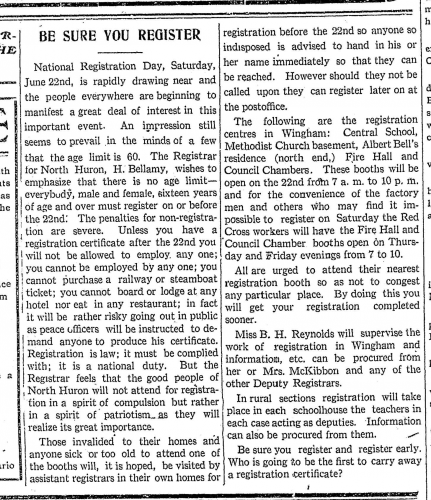
The Wingham Advance, 1918-06-13, pg 5
Despite experts’ doubts about his ability to cope with a full-time job, Harry received a temporary government position as North Huron’s Registrar for 1918’s National Registration Day effort. The federal government intended this wartime “man and woman power census” to identify available labour forces for the homefront and overseas by requiring all Canadians over sixteen to register.
Nothing in the newspapers suggests that Harry Bellamy returned to printing or publishing on a full-time basis in Dungannon. After the war was over in 1919, Ashfield accepted Harry’s application for the township’s annual printing contract with special consideration to him as a “returned soldier,” but according to an item in The Wingham Advance he later declined the work for the pay offered. There was evidently a vocation that Harry Bellamy now felt more passionately for than journalism, because in May of that year the New Era records that he moved to Toronto to accept a bureaucratic position “in connection with the re-establishment of soldiers.” In 1921, Harry ultimately sold The Dungannon News printing equipment to a buyer from Meaford, and he and wife Annie settled permanently in Toronto.They didn’t entirely disappear from print, however, as local news columns over the next decade continued to note the couple’s visits to friends and family in Huron County.
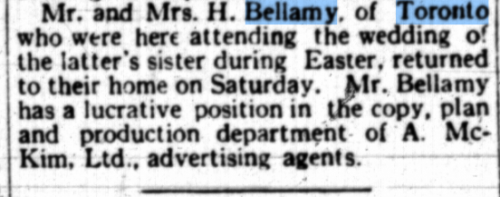
The Signal, 1921-3-31, pg 4
Following Pte. Bellamy’s story via short items in the county papers certainly does not provide a full picture of his life, nor the toll of his experiences in the trenches of France. The information gleaned, though, does speak to the value of these local weeklies as historical resources, and that comparing them against other records–in this case Pte. Bellamy’s military personnel files– can help us to read between the lines. It’s also a pertinent reminder that both historical and news sources are better understood if we know a little about the context and perspective of the people creating them. What emerged in this case was the story of a man whose politics on the page never changed, whose service to the Canadian government continued beyond the battlefield and loyalty to the British empire never faltered, but who nevertheless could not quite pack the personal consequences of war away in an “old kit bag and smile, smile, smile.”
Hot off the Press: Seen in the County Papers opens Nov. 21st at the Huron County Museum! Visit the exhibit to learn more about the stories behind Huron’s historic headlines. You can browse the newspaper collection from the comfort of home at dev.huroncountymuseum.ca/digitized-newspapers. Information for this blog post came from Huron County’s digitized newspapers and Library and Archives Canada’s digitized service records.
by Sinead Cox | Nov 6, 2017 | For Teachers and Students, Investigating Huron County History
What is now Huron County includes parts of the traditional territories of multiple Anishinaabe communities. Liz Duern is a current University Student, and worked as a Museum Assistant at the Huron County Museum & Historic Gaol during the summer of 2017. In this guest blog post for Treaties Recognition Week, Liz shares what she learned during her initial research into the treaty history of this area.
What is a Treaty? How were they created? Treaties are agreements between First Nations and the British Crown. While the Crown used treaties to gain access to land for settlement and mining, First Nations understood treaties as building nation-to-nation relationships and protecting their continued stewardship of the land. The Crown often promised to protect First Nations’ rights and to set aside tracts of land for the exclusive use of the First Nations and their members. Today, the elders of many indigenous communities hold a great amount of knowledge regarding the intent of the treaties passed down through oral history.
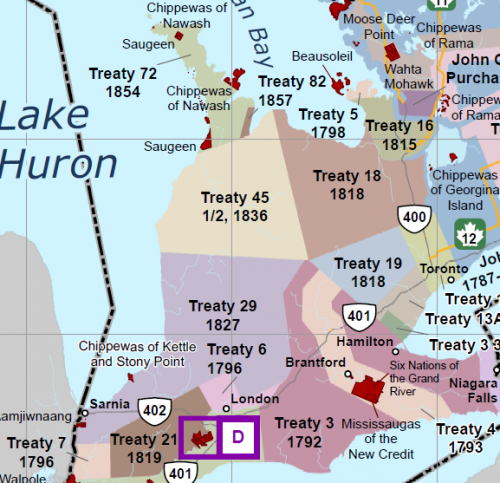
Detail from https://files.ontario.ca/firstnationsandtreaties.pdf
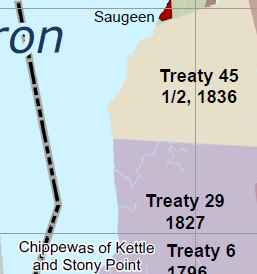
Treaty 29: Following earlier provisional agreements, the Huron Tract (1827) The Huron Tract Treaty was signed by eighteen Anishinaabek chiefs in 1827 in Amherstburg; in addition to what is now Lambton County and part of Wellington under settler municipal boundaries, the Huron Tract included most of what would become the Huron District-most of Huron County and parts of Perth & Middlesex. This treaty ceded 99% of the communities’ remaining lands to the British Crown, and designated four reserves: one along the south of St. Clair Township, one at Sarnia, and two on Lake Huron (Kettle and Stony Point).
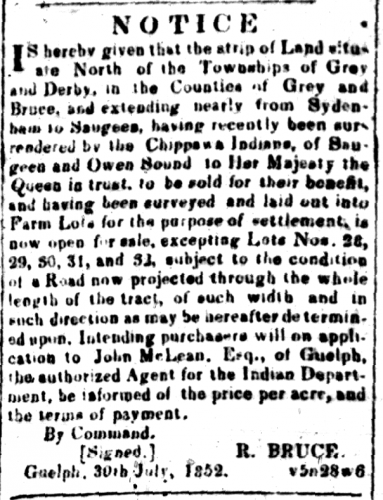
Treaty 45 ½: The Saugeen Treaty (1836) Treaty 45 ½, signed on August 9, 1836, dealt with part of the Saugeen Ojibway Nation’s traditional territory. The British promised the Saugeen Ojibway Nation that they would protect the Indigenous peoples who resided on the Saugeen Peninsula and that the Saugeen Peninsula would be protected for their use. Not long after this, the British claimed that the Saugeen Peninsula could not be protected against settlers unless another treaty was negotiated. This treaty was Treaty 72, which ceded about 500,000 acres of the Saugeen Peninsula to the British Crown.
Huron Signal, 1852-09-16, page 4
via https://www.huroncountymuseum.ca/digitized-newspapers/
Treaties are not just historical documents, but outline ongoing rights and responsibilities that are protected by the Constitution Act, 1982. These rights and the spirit of the original agreements have often been violated “by colonial policies designed to exploit, assimilate and eradicate” First Nations communities and their cultures. Access teaching resources to better understand what it means to live on Treaty Land.

by Sinead Cox | Oct 4, 2017 | Investigating Huron County History
This is the third instalment of a four-part series, Unsafe in any County, by Special Project Coordinator Jeremy Dechert. The series focuses on the dangers posed by historic automobiles or automobile components and is inspired by the museum’s growing database of historical digitized newspapers from across Huron County. These newspapers can be accessed by visiting our website. In our previous two instalments, we focused on the dangers of the 1953 Buick Roadmaster’s braking system, and the dangers and innovations of early automobile windshields.
This week we will be discussing the infamous Chevrolet Corvair, a vehicle that was thrust to the forefront of a national vehicle safety campaign. To some it was a menace; to others, it was merely a scapegoat.
In the late 1950s, Chevrolet wanted to break into the compact car market. European imports like the Volkswagen Beatle and the newly released Studebaker-Packard Lark were selling well and Chevrolet wanted to take a chunk out of their market share. Only one domestically produced compact vehicle was being sold at this time, the AMC American Rambler.
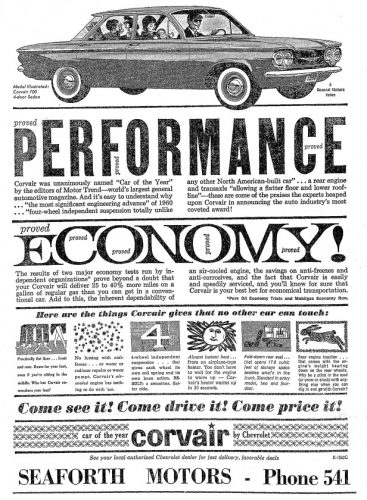
 In 1959, Chevrolet released their infamous Corvair. It marked a significant change for Chevrolet. Instead of placing the engine in the front of the car, it was moved to the back. The suspension system incorporated a swing axel design, allowing each wheel to independently absorb impacts. The modifications made for the Corvair were touted as a being practical by allowing for more floor space, reducing engine noise and heat, and providing better handling and suspension.
In an advertisement published in the November 26, 1959 issue of the Seaforth News, Chevrolet boasted that “every wheel can sod a bump without affecting any other. So the ride is far softer- and the wheels cling to the pavement better.” This advertisement also claimed that the Corvair “rides rock solid through the tightest turns. Steering is light as a feather, [so it] will never need power assistance.”
In another advertisement, published in the April 28, 1960 edition of the Seaforth News, the Corvair’s suspension was said to “give each wheel its own cell spring and its own knee action. Result: a smoother, flatter ride.”
The Corvair’s suspension system may have made for a smooth ride when passing over bumps, but flexibility of the axels made the Corvair’s wheels susceptible to tucking under the vehicle when taking sharp turns. This could result in the vehicle skidding out of control or tipping over. Compounding this issue was the fact the vehicle’s engine was located in the rear. This could generate quite a bit of momentum, exacerbating the traction issue.
 In his book Unsafe at Any Speed, Ralph Nader cited a 1965 Car and Driver article, stating that the Corvair (prior to 1965) “was one of the nastiest-handling cars ever built. The tail gave little warning that it was about to let go, and when it did, it let go with a vengeance few drivers could cope with. The rear wheels would lose traction, tuck under, and with the tail end up jacked up in the air, the car would swing around like a three-pound hammer on a thirty-foot string.”
Like Buick did with their 1953 Roadmaster, Chevrolet provided a factory-made modification package to address the shortcomings of the Corvair. The package was offered as early as 1961 and provided more substantial suspension springs and shock absorbers, a front stabilizer bar, and rear axle round straps to reduce wheel tuck under. However, like Buick, Chevrolet did not openly advertise this modification package. It was also factory installed. This meant that the average, less-informed, Corvair driver would either not know about the package or see its value.
Also like Buick, Chevrolet was hit with lawsuits filed by aggrieved customers. In 1965, three lawsuits were filed against GM for alleged vehicle instability. Two were won by GM and one was not. In none of the cases was information on technical data or test results revealed.
The safety of the Corvair was brought to light by Ralph Nader in his book Unsafe at Any Speed. He took Chevrolet to task for disregarding of the Corvair’s safety issues once they came to light. The unethical nature of Chevrolet’s response to Nader’s book and public safety campaign did not help Chevrolet’s image. They hired private detectives to find compromising information about Nader in order to discredit and silence him. However, according to a subsequent study for the National Highway Traffic Safety Administration, it was determined that the Corvair (1960-1963) was no more dangerous than similar vehicles produced by other manufactures. So, was Chevrolet unfairly singled out for creating an unsafe vehicle? Yes. But, were they unfairly criticized? No.

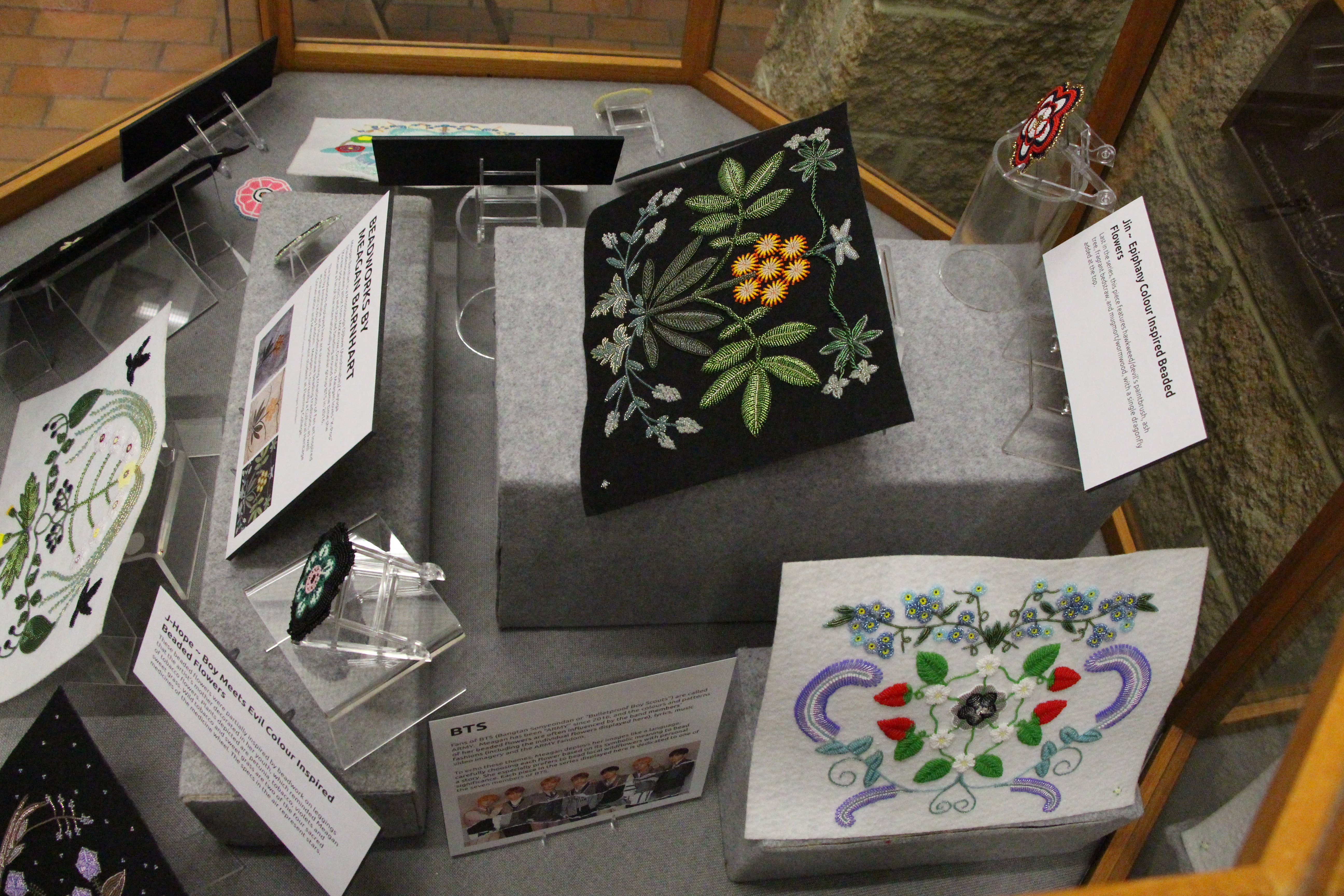 Meagan Barnhart is a Mississauga Ojibwe (Anishinabe)/ Cayuga (Haudenosaunee) artist from McKerrow, Ontario and a Cultural Heritage Conservation and Management student at Fleming College. An exhibit featuring Meagan’s 7-piece bead embroidery series inspired by K-pop group BTS (as well as 10 smaller beaded flowers), is temporarily on display at the Huron County Museum.
 became a fan of BTS, and why they are such inspirations for your work?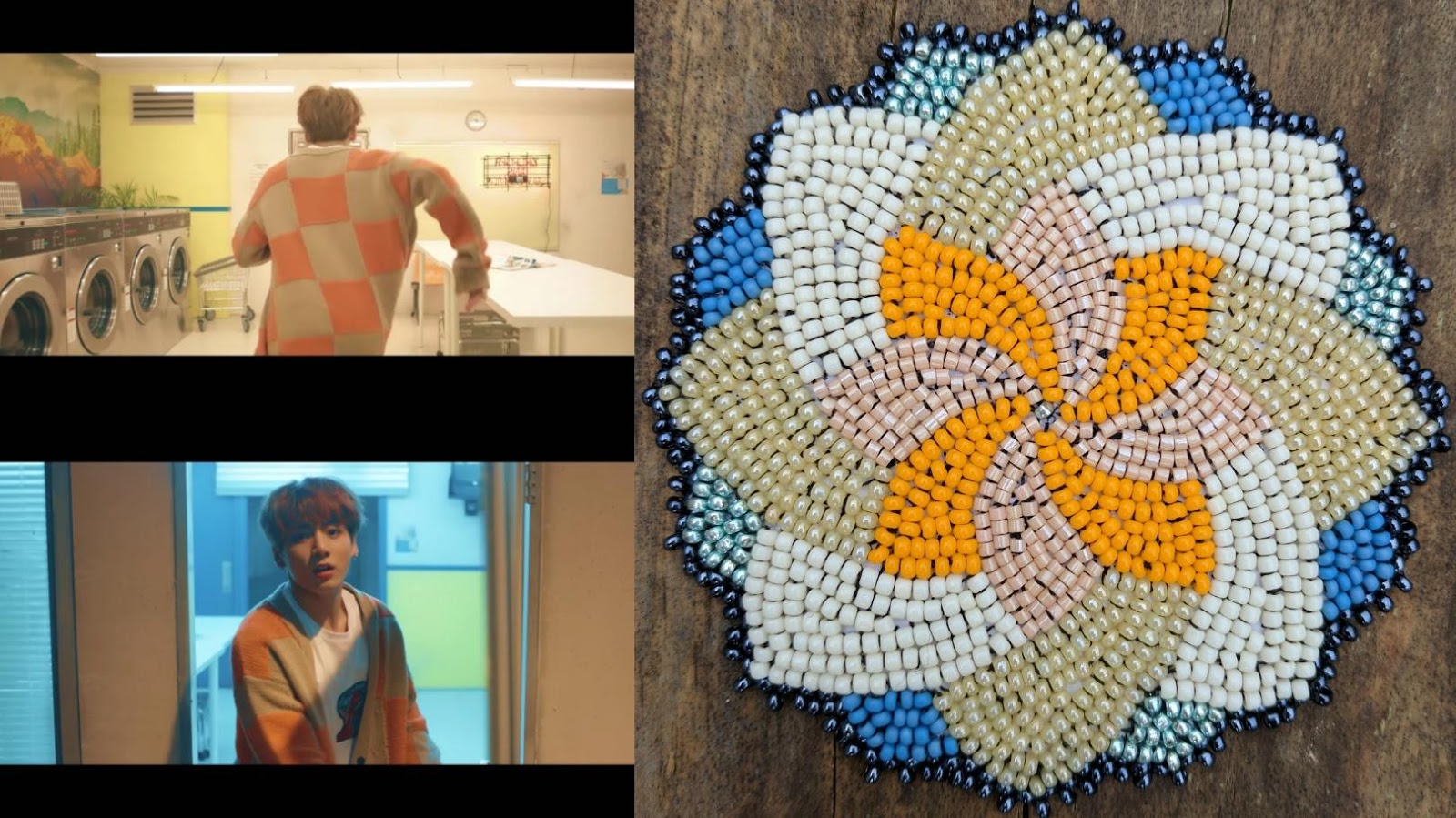
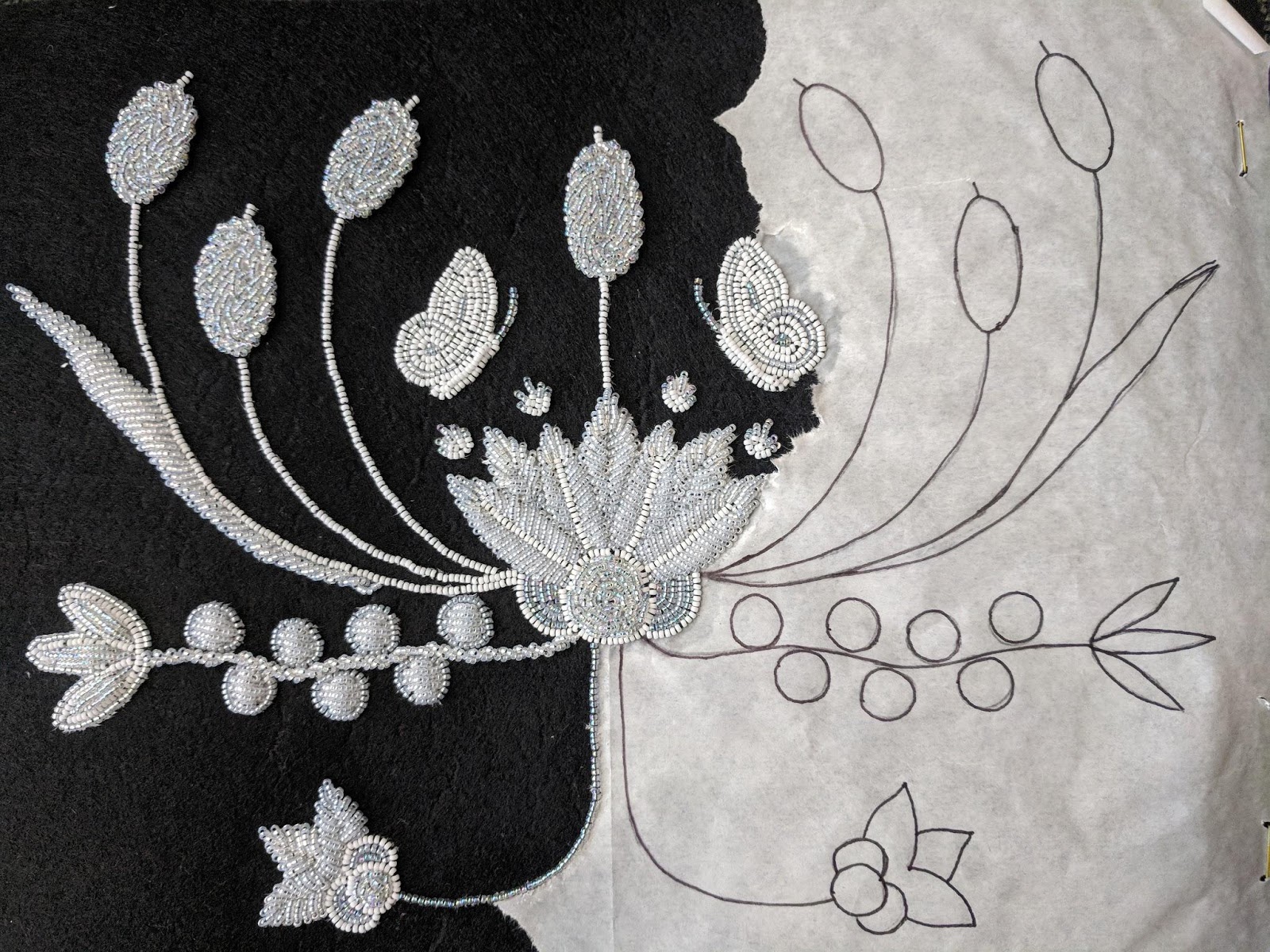
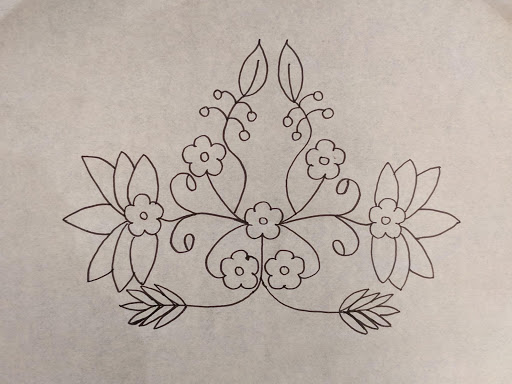 For the flowers, I often tried my best to try to use wildflowers of North America, specifically ones I’m most familiar with in Canada…I would research the meaning of the flowers or what their uses were – if I already knew what they represented or what they were used for, the better. I wanted to choose flowers that would tell a story – something that related to the music video, or BTS’s relationship with their fandom ARMY – especially since their bond is a lot stronger than I have ever seen between artist and fandom. From there I would develop a pattern. I often enjoyed the somewhat-symmetrical design; I say somewhat, because although it looks symmetrical, nothing is ever perfect, and neither are they, they don’t line up perfectly and they don’t have the same amount of beads on each side.