by Sinead Cox | Aug 25, 2020 | Archives, Blog, Exhibits, Image highlights, Investigating Huron County History
In anticipation of the Huron County Museum’s in-development exhibit Forgotten: People & Portraits of the County, volunteer Kevin den Dunnen takes an in-depth look at one of the many studio photographers to work in Huron County, and traces the professional and personal journey of Irene Burgess.
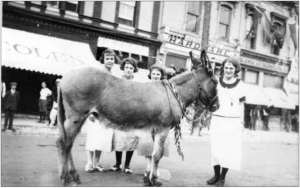
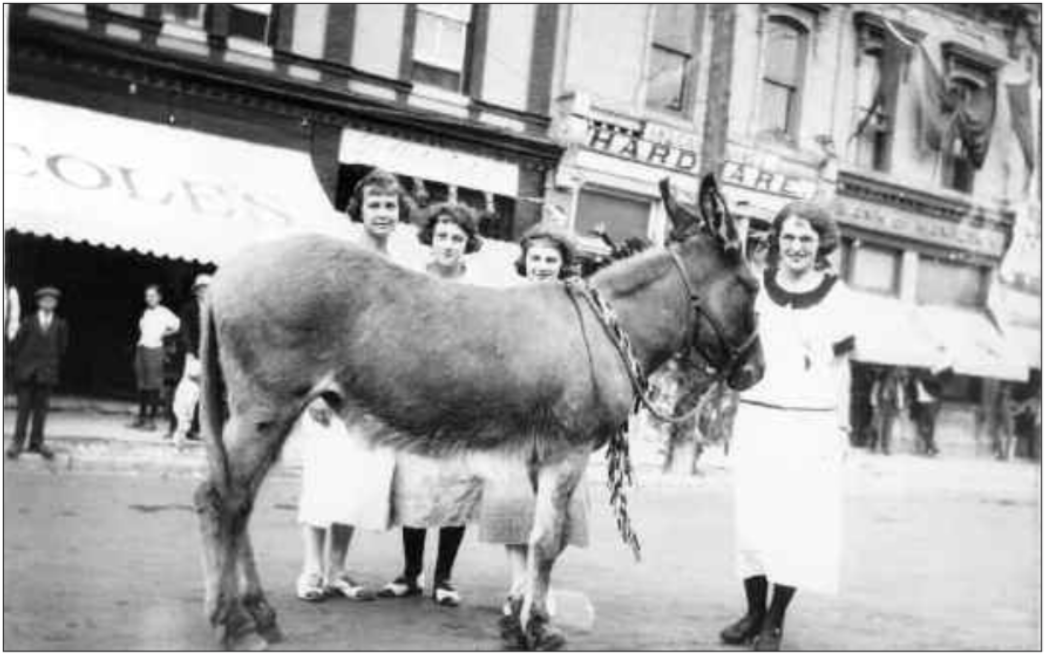
Summer of 1923 “old home week” in Mitchell, Ontario. Irene is the farthest left of the four. Image courtesy of the Stratford-Perth Archives.
Hiding within the Huron County Museum’s online and free-to-use newspaper archives are an unlimited number of stories like the one of Miss Irene Burgess. Irene Burgess was a woman that defied societal norms. In a time where women were rarely given the freedom to pursue a chosen career, Irene managed her own photography studio. While many women were expected to marry and have families, Irene stayed single. She was also faced with many tragedies in her life. Neither of her two siblings lived past 32. Her mother passed away at 51. Her niece nearly died at the age of 6. She lost the photography studio after an explosion. Through all of this, the communities of Perth and Huron Counties rose to support her.
Personal Life
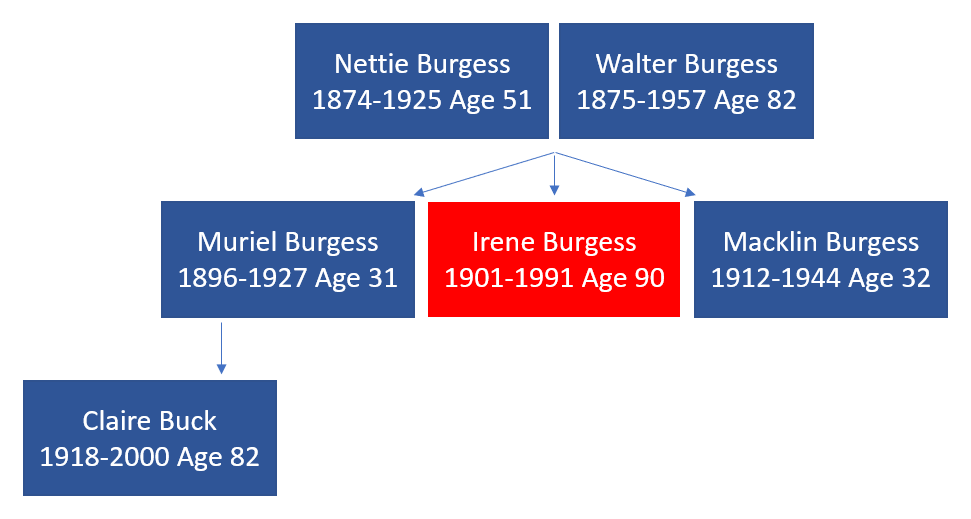
Nettie Irene Burgess was born September 20, 1901, in Mitchell, Ontario. Her parents were Nettie and Walter Burgess. She had two siblings – an older sister named Muriel, born in 1896, and a younger brother named Macklin, born in 1912. Her father, Walter, was a long-time photographer in Mitchell and owner of W.W. Burgess Studio. Growing up around photography gave Irene plenty of exposure to the business. This experience would prove to be important in her adult life.
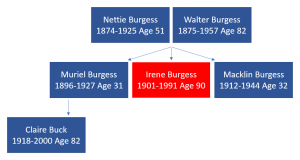
A brief family tree of the Burgess family. Of note, it only contains the names of family members included in this article.
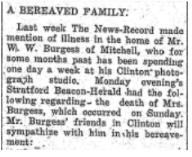
Excerpt from the November 26, 1925, edition of The Clinton News-Record detailing the passing of Irene’s mother Mrs. Nettie Burgess.
Irene experienced several tragedies throughout her life. By her 43rd birthday, only she and her father survived from their family of five. The first to pass was Irene’s mother, Nettie Helena Burgess, on November 22, 1925, at the age of 51. Irene’s sister, Mrs. D.F. Buck ( née Muriel Burgess) and her 6-year-old daughter Claire had been staying with her parents Walter and Nettie Burgess; Mrs. Buck had been ill for some time. During their stay, Claire became ill with pleuro-pneumonia. On the brink of death for several days, she began to recover with the help of her grandmother, Nettie. While caring for Claire, Nettie contracted pneumonia. Less than six days later, Nettie passed away in the presence of her family and nurse. 6-year-old Claire would live for another 75 years thanks to the care of her grandmother.
The next member of Irene’s family to pass would be her sister Muriel. Muriel was married to D.F. Buck, a photographer from Seaforth. They had three children, a daughter named Claire, and two sons named Craig and Keith. On March 24, 1926, an update in the Mitchell Advocate indicated that Irene would be visiting her sister, Mrs. D.F. Buck, at the Byron Sanitorium. According to the update, Mrs. Buck was “progressing favourably” but had been in poor health for some time. Almost fourteen months later on May 12, 1927, The Seaforth News wrote about the death of Mrs. D. F. Buck occurring the past Friday. While not mentioning the cause, the obituary described her as being “in poor health for a considerable period.”
On July 18, 1944, the Clinton News Record posted an obituary for Irene’s brother Macklin Burgess who passed away from a long-time illness at the age of 32. Macklin was in the photography and radio business. He left behind his wife, Elizabeth May, and three children, David, Nancy, and Dixie.
The next of Irene’s family to pass would be her father, Walter Burgess, in 1957 at the age of 82.
An interesting note in the life of Miss Irene Burgess is that she never married. In the Dominion Franchise Act List of Electors, 1935, Irene (age 34) is listed as a spinster (meaning a woman that is unmarried past the age considered typical for marriage). Whenever Irene is referenced in a newspaper, her title is Miss Irene Burgess. Irene would live until 1991.
The Clinton Studio
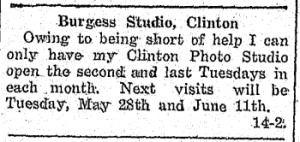
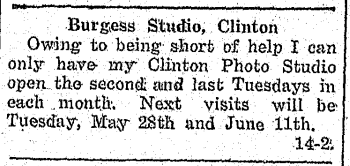
A notice posted by Walter Burgess in the May 23, 1929, edition of The Clinton News-Record
Walter Burgess operated a Clinton studio throughout the 1920s. The November 26th, 1925 edition of The Clinton News-Record mentions that Walter had only been spending one day a week at his Clinton Studio being “short of help.” A notice posted in The Clinton News-Record on May 23 1929 by Walter Burgess stated that his Clinton studio would only be open “the second and last Tuesdays in each month.” On October 1 of 1931, Walter announced that his newly-renovated Clinton studio would be open every weekday. His daughter, Miss Irene Burgess, would now be in charge of the location. Walter proclaimed Irene as “well experienced in Photography” and having “long experience with her father.” Not long after Irene became manager, Clinton residents would see the name Burgess Studios much more often in their newspapers.
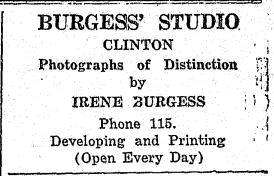
When Irene began managing the Clinton Studio in 1931, advertisements for the business began increasing. The slogan “Photographs of Distinction” appeared in advertisements from 1937 until the week of the fire. These ads were brief, only including the business name, slogan, Irene’s name, and the services provided. Earlier advertisements include one from 1933: “It is your duty to have a good photograph. Your family wants it – business often demands it.” Another example from 1932 reads, “You have plenty of leisure time to get that portrait of [the] family group taken.” The Clinton studio began under the leadership of Walter W. Burgess, but Irene would soon grow the business larger than her father had the time for– that is, until the explosion.
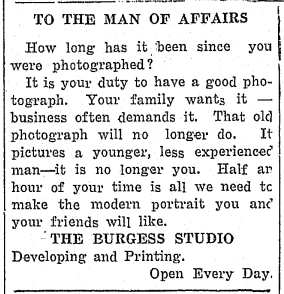
Advertisement posted in the January 26, 1933, edition of The Clinton News-Record.
The Explosion
On the afternoon of Monday, November 24, 1941, an explosion set fire to the second story of the J. E. Hovey Drug Store sweeping the entire business block. This was the place of business for Burgess Studio, Clinton. The fire swept through the building and damaged several businesses including R. H. Johnson Jewelry Store, Charles Lockwood Barber Shop, and Mrs. A MacDonald’s Millinery and Ladies Wear Shop. Irene was not in the studio when the fire started and did not call the authorities. Instead, the fire was discovered by Police Constable Elliot who identified smoke around the second-story window of the J. E. Hovey Drug Store Building. The fire was well covered in local newspapers. Featured on the second page of the Seaforth News more than a week after the incident, it was reported that the fire almost reached the “main business section of the town.” On its front page the week of the accident, The Clinton News-Record described the fire as “one of the most dangerous Clinton firemen have fought for years.” Unfortunately, Irene did not have insurance and was forced to close her business in Clinton. An update written on November 27, 1941 in The Clinton News-Record mentioned Irene’s departure for Mitchell to stay with her father for an “indefinite time.” A week later, on December 4, 1941, Irene posted a notice in the News-Record reading that, “owing to the recent fire damaging my equipment and Studio, I will be unable to continue operation.” She suggested that customers could mail their orders to the new studio. Additionally, customers could drive to her father’s studio in Mitchell and have their travel expenses paid. While this time must have been devastating for Irene, the community came together to show their support for her.
Community Support
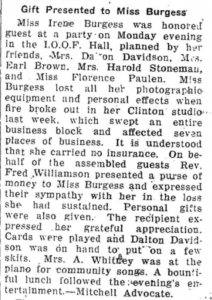
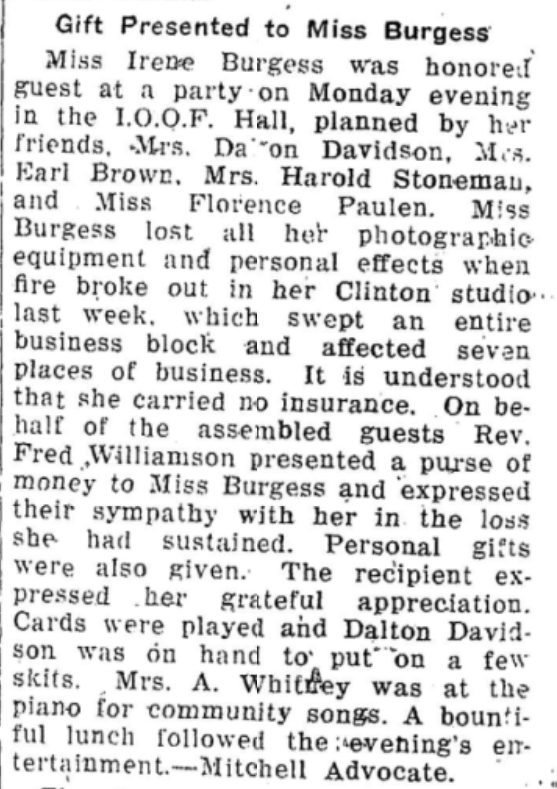
Excerpt from the December 12, 1941, edition of the Huron Expositor describing an even held in Irene Burgess’ honour.
Two weeks after the explosion, the Mitchell Advocate reported about an event held at the I.O.O.F. Hall where Irene was the “honoured guest.” The event was planned by Irene’s friends Mrs. Dalton Davidson, Mrs. Earl Brown, Mrs. Harold Stoneman, and Miss Florence Paulen. Entertainment included skits, piano music by Mrs. A. Whitney, cards, and a “bountiful lunch.” Irene received a “purse of money” and personal gifts from her friends along with their condolences. The rallying support for Irene shows the positive impact she had in the communities of Clinton, Seaforth, and Mitchell. An uplifting end to an otherwise sad story.
Conclusion
Aside from her brother’s passing in 1944, Miss Irene Burgess was seemingly never mentioned again in the Huron County Newspapers accessible through the digital newspaper portal. She would live until 1991 in St. Marys, Ontario.
Huron County’s digitized newspaper collection is a vast historical database where you can find historical stories from our own county. While performing research for the upcoming exhibit “Forgotten: People & Portraits of the County,” I came across this story which piqued my interest. Without access to the digitized newspaper collection, the story of Irene’s remarkable journey would never have been found. This post was compiled using newspaper articles between the years of 1925 and 1944. Birth and death dates were found within newspapers and using external resources.
If you have a photograph by a Huron County photographer you would like to donate or share, please contact the Museum’s archivist by calling 519-524-2686, ext. 2201 or email mmolnar@huroncounty.ca. To learn more about the Huron County Archives & Reading Room, visit: https://www.huroncountymuseum.ca/huron-county-archives/
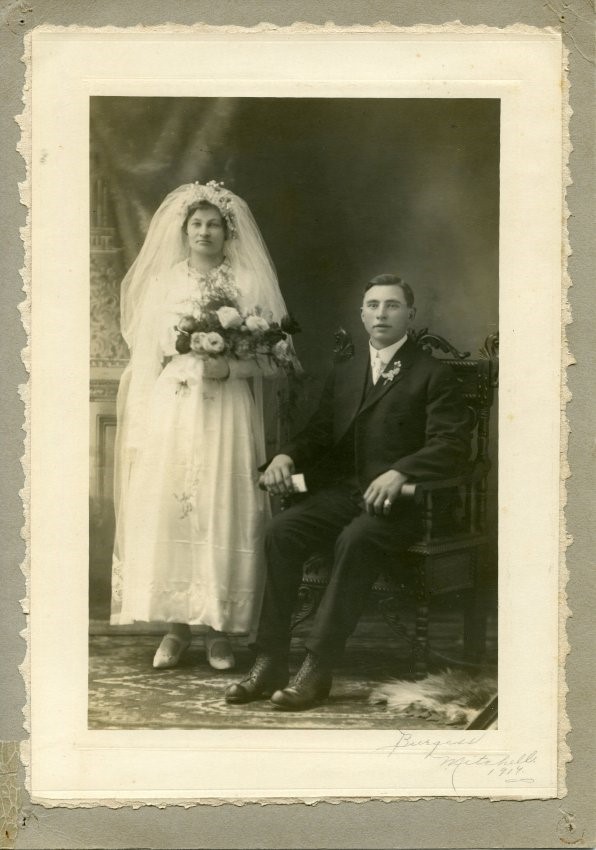
A950.1857.001 A photograph taken by Burgess Studio Mitchell in 1914. If you have a photograph from Burgess’ Studio, Clinton you would like to donate, please consider contacting the Huron County Museum.
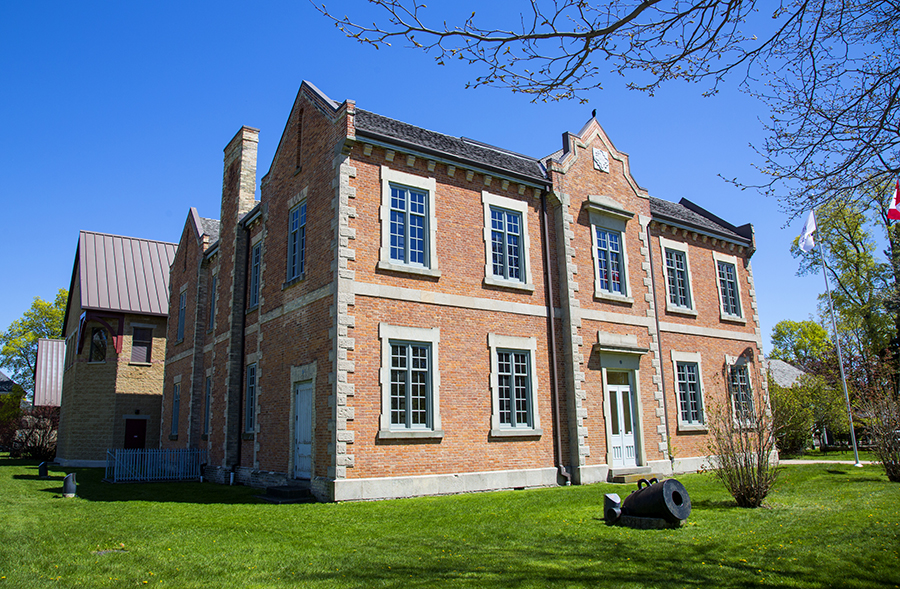
by Sinead Cox | Apr 9, 2020 | Archives, Artefacts, Media Releases/Announcements
Huron County Museum staff may not be working at the physical location of the Museum but we are still working for the Museum and thinking about our collections, exhibitions and programmes. Much of what we do relies on the words and collecting habits of others past and present. With that mindset it is important now for us to think about the current Coronavirus pandemic and the future of collecting items relevant to Huron County throughout this time.
The collecting mandate for the Huron County Museum is to collect the stories and artifacts of our local area, with particular emphasis on items that were made by or used by Huron County people. We are looking for your help to document and illustrate how Coronoavirus has affected us close to home.
When this crisis is over we will be putting together a collection of items relating to the Coronavirus pandemic to keep in our archives for future use and research. Items could include: photographs, journals, letters, signs, or documents that tell the story of COVID-19 and its effects on the lives of those living in Huron County.
We understand that this is a difficult time for many so participation is voluntary and has no timeline. Items may come today, 2 months from now, or even years from now. The purpose of the collection will be to document and will be used for future research and exhibition.
If you are interested in helping create a documentary history of the pandemic in our community you may mail items to the Huron County Museum, 110 North St., Goderich; email to museum@huroncounty.ca; or bring your items directly to the Museum after the site re-opens to the public. Staff are available by email to answer your questions.
Stay safe and healthy,
Elizabeth French-Gibson
Senior Curator
Huron County Museum & Historic Gaol
by Elizabeth French-Gibson | Mar 8, 2017 | Archives, Investigating Huron County History, Uncategorized
The list of women from Huron County who served as nursing sisters in the First World War is now up to 50 names! This list includes women who served with the Canadian Army Medical Corps (CAMC), American Army Medical Corps, Red Cross, and Queen Alexandra’s Imperial Military Nursing Service. As more records become available online, we are finding out more about what their lives were like before, during, and after the war.
It can be difficult to find out what happened to a nurse after the war ended for many different reasons. Many women married and changed their name, some moved across the country or the United States, and a lot of records still aren’t available due to privacy legislation. Due to limited resources, it can be very difficult track people down and verify their identity.
One such woman is Mary Agatha Bell, who was born, according to her Attestation Papers, on November 5, 1879 in St. Augustine but lived in Blyth, Ontario. Mary enlisted on April 3, 1917 in London, Ontario, left Canada on May 20, 1917, and arrived in England on May 30, 1917. While overseas, Mary mainly served with the 7th Canadian General Hospital in France. She also did temporary duties with the 6th and 8th Canadian General Hospitals. After the war ended, Mary sailed back to Canada in July 1919 on the S.S. Olympic.

U.S., Border Crossings from Canada to U.S. – Ancestry.ca
It was difficult to track down what happened to Mary Agatha Bell after the war. On October 11, 1925, a birth registration* was issued to a Mary Bridget Bell born on November 5, 1874 in St. Augustine, Ontario. Records show that this Mary Bridget Bell moved to the state of New York on October 22, 1925. A border crossing document from August 1945 states that Mary’s address was 11 Hows Avenue, New Rochelle, New York, where she worked as a registered nurse. The document also states that she is missing the fourth toe on her left foot.

New York, Naturalization Records – Ancestry.ca
This last piece of information was critical in definitively proving that Mary Agatha Bell (born in 1879) is the same person as Mary Bridget Bell (born 1874). According to her service file, Mary starting experiencing problems with her left foot in France, 1918. Notes in her file refer to her problem as a “contracted toe”. The 4th toe on her left foot was eventually amputated when she returned to Toronto in 1919 at St. Andrews Hospital.
It appears that Mary lied about her birth year on her Attestation Paper. This was not uncommon among women enlisting as nursing sisters in WWI. Mary would have been a much more appealing candidate at age 38 than her real age of 43. Why she decided to change her middle name from Agatha to Bridget still remains a mystery…
*Birth registrations were often issued to adults who didn’t have birth certificates
by Elizabeth French-Gibson | Nov 28, 2016 | Archives, Investigating Huron County History, Project progress
Late last autumn, the Huron County Museum was fortunate enough to receive funding from the Federal Government to produce, among other things, two films about Huron County during the First World War.

Maud Stirling was originally from Bayfield.
One film was about Huron County on the Home Front (watch here!) and the other was supposed to be about Maud Stirling, a nurse from Bayfield who was awarded the Royal Red Cross, 2nd Class. While doing background research for the films, I thought it would be interesting to see how many other women from Huron County enlisted as nursing sisters during the war, thinking I would only find a dozen or so more names. As of November 2016, 48 women with ties to Huron County have been identified as WWI nurses, with several other names on the “maybe” list. More research still needs to be done!
The list of names so far:
| Mary Agatha Bell
|
Ellie Elizabeth Love
|
| Mary Agnes Best
|
Marjorie Kelly
|
| Mary Ann Buchanan
|
Clara Evelyn Malloy
|
| Martha Verity Carling
|
Mary Mason
|
| Olive Maud Coad
|
Jean McGilvray
|
| Muriel Gwendoline Colborne
|
Beatrice McNair
|
| Lillian Mabel Cudmore
|
Mary Wilson Miller
|
| Alma Naomi Dancey
|
Anna Edith Forest Neelin
|
| Gertrude Donaldson (Petty)
|
Bertha Broadfoot Robb
|
| Mary Edna Dow
|
Barbara Argo Ross
|
| Lillian Beatrice Dowdell
|
Katherine Scott
|
| Elizabeth Dulmage
|
Ella Dora Sherritt
|
| Annie Isabel Elliott
|
Jeanette Simpson
|
| Frances M. Evans
|
Emmaline Smillie
|
| Annie Mae Ferguson
|
Annie Evelyn Spafford
|
| Clara Ferguson
|
Annie Maud Stirling
|
| Jean Molyneaux Ferguson
|
Helen Caton Strang
|
| Margaret Main Fortune
|
Vera Edith Sotheran
|
| Anna Ethel Gardiner
|
Mabel Tom
|
| Florence Graham
|
Cora Washington (married name Buchanan)
|
| Irene May Handford
|
Annie Whitely (Hennings)
|
| Bessie Maud Hanna
|
Ann Webster Wilson
|
| Ruth Johnson Hays
|
Harriet Edith Wilson
|
| Clara Hood
|
Jessie Wilson
|

Florence Graham was originally from Goderich, She was a nurse in the United States Army. She was killed in a car accident in France on May 27, 1919.
I learned that many women enlisted not just with the Canadian Army Medical Corps but also with the American or British Army. Here are just some of the resources I’ve used to help track down the nursing sisters and their stories:
Library and Archives Canada: for digitized personnel records, including Attestation Papers and service files
Great Canadian War Project: for an alphabetical list and nursing sister awards
The UK National Archives: for British Army nurses’ service records (caution – the records aren’t free)
Ancestry.ca: a number of different resources are useful on this site, including Imperial War Gratuities, 1919-1921 and New York, Abstracts of World War I Military Service, 1917-1919. You need a subscription to access Ancestry or you can visit your local Huron County Library branch for free access!
Digitized Newspapers: Huron County’s newspaper have be one of the most useful resources for tracking down names of nursing sisters
There are many more women and stories to discover and I am looking forward to continuing on with this intriguing research project. Stay tuned for some of my discoveries!
by Sinead Cox | Aug 10, 2015 | Archives, Artefacts, Collection highlights, Special Events
On Saturday, August 22nd The Huron County Museum is transforming into Wonderland for a Mad Hatter’s Tea Party. In honour of the 150th anniversary of Lewis Caroll’s Alice’s Adventure in Wonderland, Summer Museum Assistant Becca Marshall shares some of her favourite facts about the nonsense-novel and its legacy.

Victorian Apartment, Huron County Museum
Have you ever visited the Victorian Apartment at the Huron County Museum? If so, you can probably picture the elaborate dining room set-up and recall the posted list of extensive etiquette required for Victorian tea time. It was social customs and rules such as these that inspired 19th century author Lewis Carroll to parody Victorian life in his fantastical novel Alice’s Adventures in Wonderland. Scenes such as The Mad Hatter’s Tea Party were influenced by Carrol’s loathing for the rigid traditions.
Carrol’s subtle digs at the Victorian culture are not the only secrets that this classic holds – so in celebration of Alice’s 150th publishing anniversary here are 14 things you might not know about Alice and the man who imagined her iconic world:
- Lewis Carroll was a pseudonym for Charles Lutwidge Dogson (born January 27, 1832 in the Cheshire village of Daresbury, England).
- The original title for the novel was Alice’s Adventures Underground. Dodgson then expressed his fears that this title might suggest a book containing ‘instruction about mines’ and then considered other titles such as “Alice among the elves/ goblins, or Alice’s hour/doings/adventures in elf-land/wonderland.” Preferring the final option Alice’s Adventures in Wonderland was the final title.

Portrait of Queen Victoria, Governor’s House, Huron Historic Gaol
3. An apocryphal anecdote circulated that Queen Victoria was such a tremendous fan of the story, that she proposed that Carroll should dedicate his next book to her, An Elementary Treatise on Determinants, With Their Application to Simultaneous Linear Equations and Algebraic Equation—probably not what she would have had in mind. Dodgson denied this story.
4. Carrol’s novels were banned in China in 1931 on the grounds that “animals should not use human language.”
- Carroll is credited with inventing the words “chortle” and “galumph” in Through the Looking Glass.
6. There is unconfirmed evidence that Carroll had a rare neurological disorder called “Todd’s Syndrome” (or suffered from similar migraine-induced symptoms). The disorder causes hallucinations that make visual objects appear to be changing sizes – often prompting the individual to feel as though their body is disproportionate. Psychiatrist John Todd discovered the disorder in 1955 and it was later named “Alice in Wonderland Syndrome” in reference to the theme of Alice and her surrounding objects shrinking and growing in odd ways throughout the book.

Illustration from Alice’s Adventures in Wonderland.
- Alice’s Adventures in Wonderland can be best classified by the genre “literary nonsense.”
- Carroll illustrated the original draft of his manuscript, but hired John Tenniel to do the published version.
- Mock Turtle Soup is a real dish that was popular during the Victorian period. The heads, hooves, and brains of calves were used as a cheaper replacement for green turtle soup.

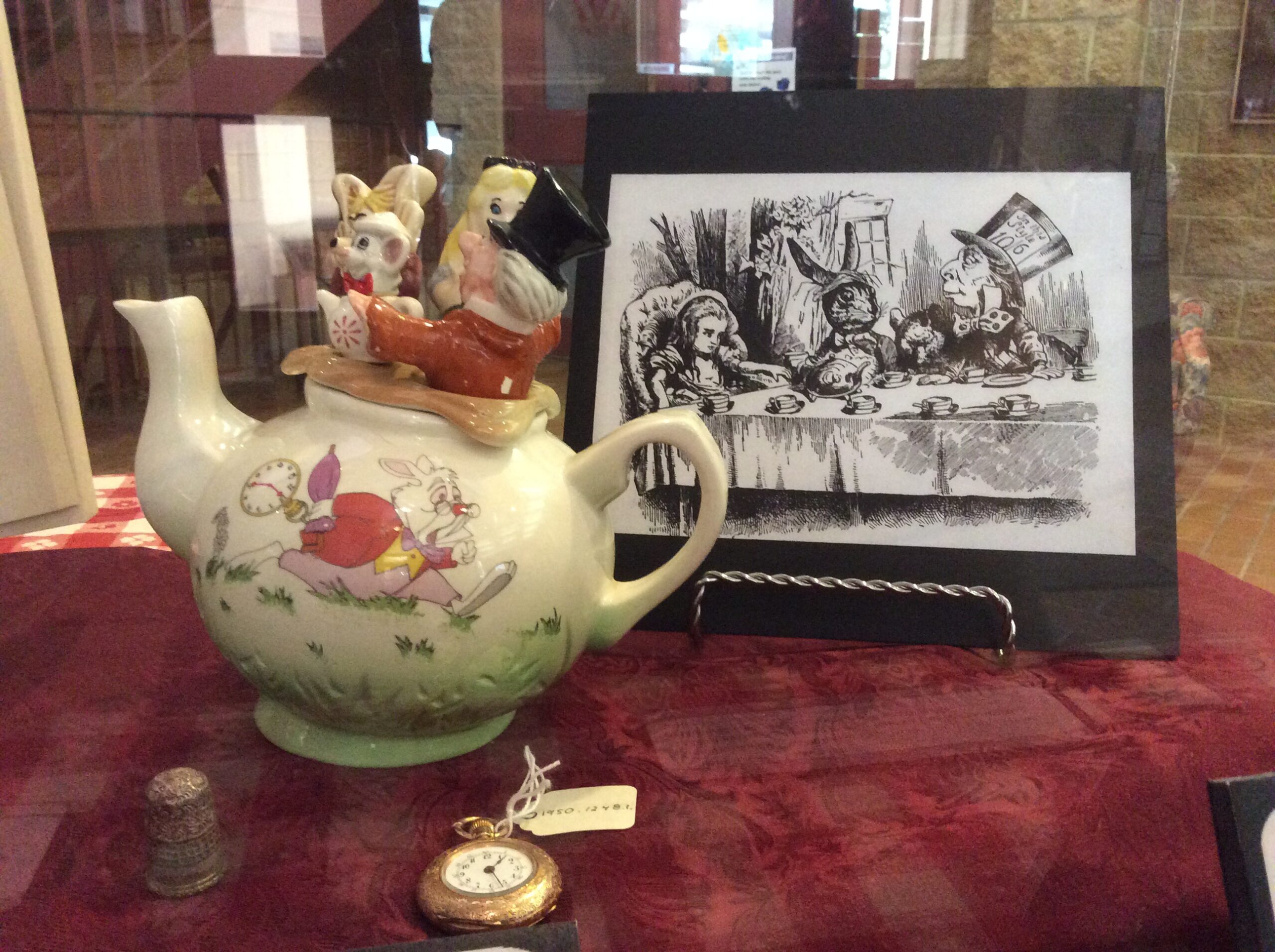
Mad Hatter’s Tea Party Display, Upper Mezzanine, Huron County Museum
- It was young Alice Liddell who inspired the famous novel. During a group boating trip with the Liddels Alice and her two sisters begged Carrol for a story. Happy to oblige Carrol cast Alice as the main character (her sisters Lorina and Edith were ‘Elise and Tillie’ in the Dormouse’s story) and began creating ridiculous adventures for her to go on. Alice enjoyed the story so much that she demanded that Carrol write it down – thus creating the first draft of the book.
11. Why does the Mad Hatter have a 10/16 sign on his hat? Carroll answered this in the abridged “Nursery” Alice for younger readers, explaining that the Hatter would carry around his hats to sell, and the one he wore was no exception. The 10 and 6 are for “ten shillings and six pence.” This was a rather pricey sum in the Victorian age, alluding to superior quality and style.
12.To answer the Mad Hatter’s famous question “Why is a raven like a writing desk?” we have Carroll’s very own words, from a preface to later editions of the book…

China Cabinet, Victorian Apartment, Huron County Museum
“Enquiries have been so often addressed to me, as to whether any answer to the Hatter’s Riddle can be imagined, that I may as well put on record here what seems to me to be a fairly appropriate answer, viz: ‘Because it can produce a few notes, tho they are very flat; and it is nevar put with the wrong end in front!’ This, however is merely an afterthought; the Riddle as originally invented, had no answer at all.” (Note how Carroll spelt “never” instead as a backwards “raven.”)
That’s a wrap, did you know any of these facts? Come join the Huron County Museum August 22nd to learn more and celebrate the 150th publishing anniversary of Alice’s Adventures in Wonderland at the Mad Hatter’s Tea Party from 11-4:30. Games, activities, refreshments and desserts await!

Mad Hatter’s Tea Party Display, Curated by Becca Marshall
by Elizabeth French-Gibson | Mar 23, 2015 | Archives, Collection highlights
By Emily Beliveau, Digital Project Assistant

Cover image from the pamphlet ‘Sweets,’ from the Huron County Museum Collection, Object Id: 2005.0001.011. Original size: 18 cm x 11.4 cm.
We recently rediscovered this “Sweets” pamphlet while researching cookbooks and recipes for our upcoming exhibit Delicious. At first glance, it appears to be nothing more than a small newsprint booklet of candy recipes. Looking closer, its true purpose becomes clear: it’s a promotional vehicle for Lydia E. Pinkham’s Vegetable Compound, a herbal remedy marketed to cure all manner of womanly ailments.
Lydia E. Pinkham (1819-1883) became a successful businesswoman by commercializing a home remedy to treat a variety of female health complaints, such as irregular menstruation, symptoms of menopause, nervous disorders, and childlessness. She started making her concoction in her kitchen in Lynn, Massachusetts, and eventually expanded the business into an international manufacturing enterprise with production centres in the United States, Canada, and Mexico.

Pages 8 and 9 of ‘Sweets’ pamphlet, featuring recipes for Crystallized Fruit, Fruit Cream, Cocoa Fudge, Peanut Butter Fudge and testimonials regarding the use of Lydia E. Pinkham’s Vegetable Compound and Blood Pills for treating suppressed menstuation.
Lydia E. Pinkham’s Vegetable Compound came in tablet or liquid form and contained black cohosh (Cimicifuga racemosa), life root (Senecia aureus), unicorn root (Aletris farinosa), pleurisy root (Asclepias tuberosa), and fenugreek seed (Trigonella foenum-graecum). It’s effectiveness has never been medically proven. The liquid form contained 18% alcohol.
Pinkham’s remedies were aggressively marketed, making the Vegetable Compound the most popular among a multitude of other patent medicines. It’s direct woman-to-woman consumer marketing combined with published testimonials from users, led to its phenomenal success. In 1925, its most profitable year, sales of Vegetable Compound grossed $3.8 million.
By the time Pinkham died in 1883, she was a household name and one of the most recognizable women in America due to the ubiquity of her image in newspaper ads and on product packaging. After her death, her family ran the business until 1968, when it was sold to Cooper Laboratories of Connecticut. Lydia E. Pinkham’s Vegetable Compound is still sold today as a herbal remedy.

Ad for Lydia E. Pinkham’s Vegetable Compound from the St. John Daily Evening News, 17 April 1883.
Further reading and additional resources:
Biography and more Pinkham Pamphlets from Harvard University Library
Blog post about Lydia E. Pinkham from the Museum of Heath Care
Background information about patent medicine from the Smithsonian