by Amy Zoethout | May 4, 2021 | Artefacts, Collection highlights
Take a closer look at the Huron County Museum & Historic Gaol and its collections as staff share stories about some well-known and some not-so-well-known features, artifacts, and more. Acting Education and Programming Coordinator Dan Genis looks at the Museum’s record collection.
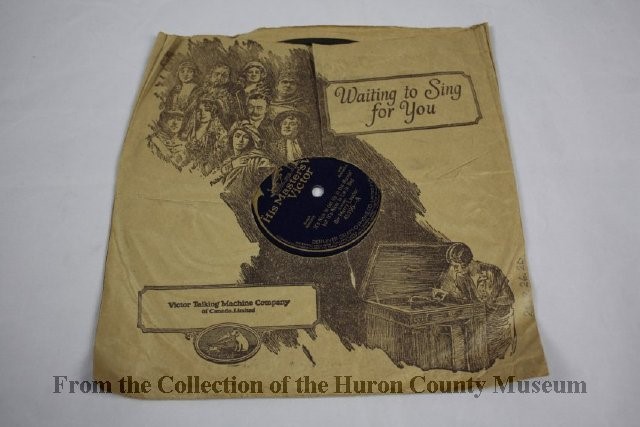
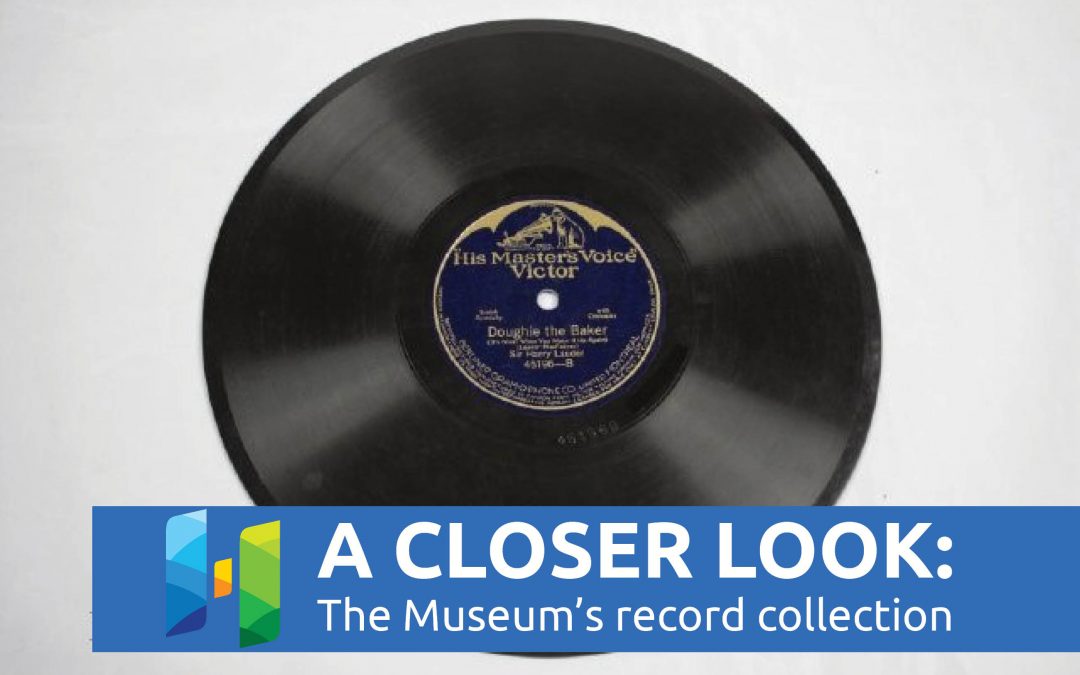
Record sleeve advertising the Victor Talking Machine Company of Canada Limited, featuring the slogan “Waiting to Sing to You.” Contains an early 1920s record by Harry Lauder. 2018.0026.002b
Did you know that Huron County Museum has a record collection?
While you might assume that record collections only belong to hardcore music fans or collectors, the Huron County Museum has an impressive record collection of its own. The museum collection contains almost 200 records, largely dating from 1900-1970. Music is a vital part of a community’s culture, which makes music-related artifacts important as well.
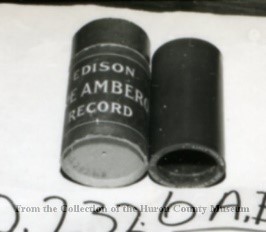
An Edison Blue Amberol phonograph record released in 1913. This 4 minute 17 second record plays “Alice Where Art Thou?” by Ernest Pike, originally composed by Joseph Ascher. M960.0232.006a
The collection begins with phonograph cylinders, commonly called “records”. Like the one in the above picture, the cylinders were meant to be played on a phonograph. Invented by Thomas Edison in 1877, early phonographs recorded sound as small grooves on a wax (later plastic) cylinder. To play the recording, the cylinder rotated and a stylus traced over the grooves and vibrated, reproducing the original sound. While in North America any sound-reproducing “talking” machine that uses records can be called a phonograph, in the United Kingdom (UK) the term more specifically refers to machines that play cylinders.
In 1889, Emile Berliner invented a phonograph that played discs records, calling it the “Gramophone.” Although disc records had been sold as early as 1889, it was not until the 1910s that they overtook phonograph cylinders as the record format of choice. Most disc records, including the “Harry Lauder” record in the picture above, were made with shellac. In the UK “Gramophone” became the term used to describe any disc-playing talking machine, but “phonograph” and “talking-machine” continued to be used in North America. This is especially confusing in Canada where all three terms had been and continue to be used interchangeably.
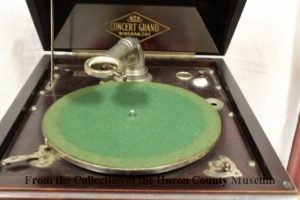
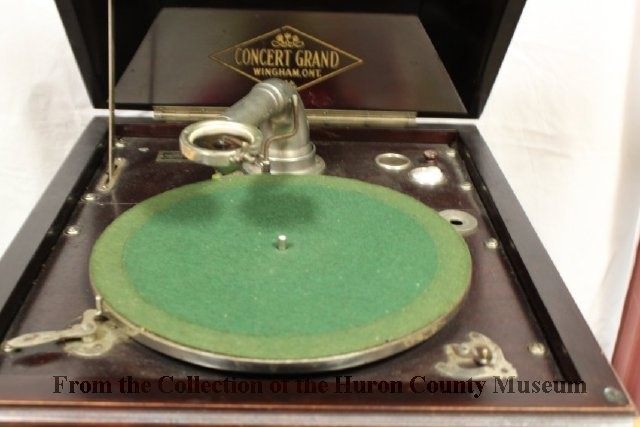
The “Concert Grand” talking machine (or gramophone), manufactured at the Gunn-Son-ola Talking Machine Co. in Wingham, Ontario. The gramophone was purchased by Lily and George McClenaghan and was always in their home at Whitechurch. 2018.0026.001a
The Gunn-Son-ola Talking Machine Company was founded in Wingham by Michigan manufacturer William Gunn in 1920. Gunn had purchased the Walker and Clegg furniture factory located on Alfred Street. Gun-son-ola churned out talking machines and cabinets for over ten years, at its peak employing 162 people. The company went bankrupt in 1931 and was taken over by Brown Bros. Manufacturing, which reverted the factory back into the manufacturing of general furniture products.
In the 1940s Polyvinyl chloride (PVC) began replacing shellac in the manufacturing of records. These new “vinyl” records were more flexible and less likely to break, which also allowed for smaller grooves (“microgrooves”) which could store more music.
By the time “The Best of Vera Lynn” was released in 1968, vinyl records were the most popular way of listening to recorded music. In the early 1980s cassette tapes had replaced vinyl in popularity, only to be itself replaced by the compact disk (CD) in the 1990s.There has been a vinyl record revival in recent years, with vinyl sales in 2020 surpassing CD sales in the US for the first time since 1986.
To check out more of the Huron County Museum’s record collection, head over to our online collections database at: https://huroncountymuseum.pastperfectonline.com/
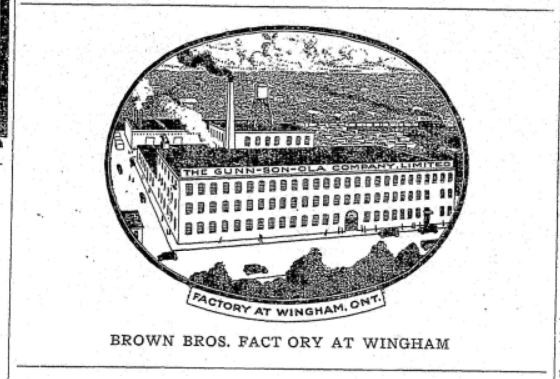
A drawing of the Gunn-son-ola factory in Wingham, which primarily made talking-machines and radio cabinets. By 1935 it was owned by the Brown Bros. Company. The Wingham Advance Times 1935-05-16
by Amy Zoethout | Mar 13, 2021 | Artefacts, Blog, Collection highlights, Textile Collection
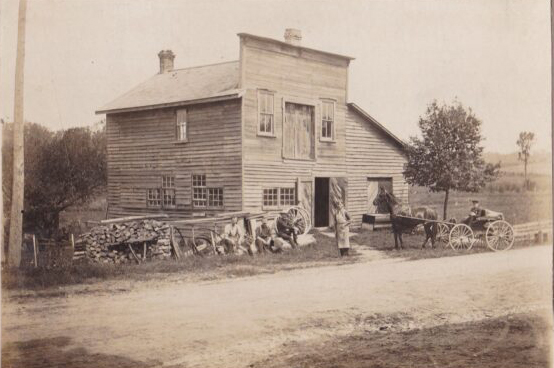
Above: Herb Wheeler’s Carpentry Shop in Belgrave, ON. Herb is seen standing in front (Photo courtesy of Richard Anderson).
Guest blogger Sharlene Young-Bolen, of Stitch Revival Studio in Blyth, shares more about how a Huron County Museum artifact inspired her to create the Huron Wristers pattern and how her research into the origin of the pattern led her to connect to family of the original owner. The original gloves are currently on display in the Museum Gift Shop where Sharlene’s Huron Wristers kits are also available for purchase.
Was there a Wheeler family tie to either Estonia or the British Isles? The answer would help to identify the glove pattern perhaps. When an Instagram post by Best Dishes, a Goderich business owned by Sarah Anderson, appeared in my feed one day identifying the wristers pattern as based on a family heirloom, chance had dropped the perfect opportunity. It was time to connect. A couple messages back and forth and the story unfolded…
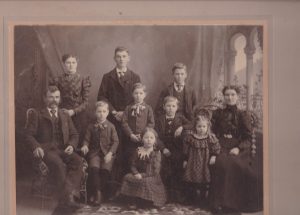
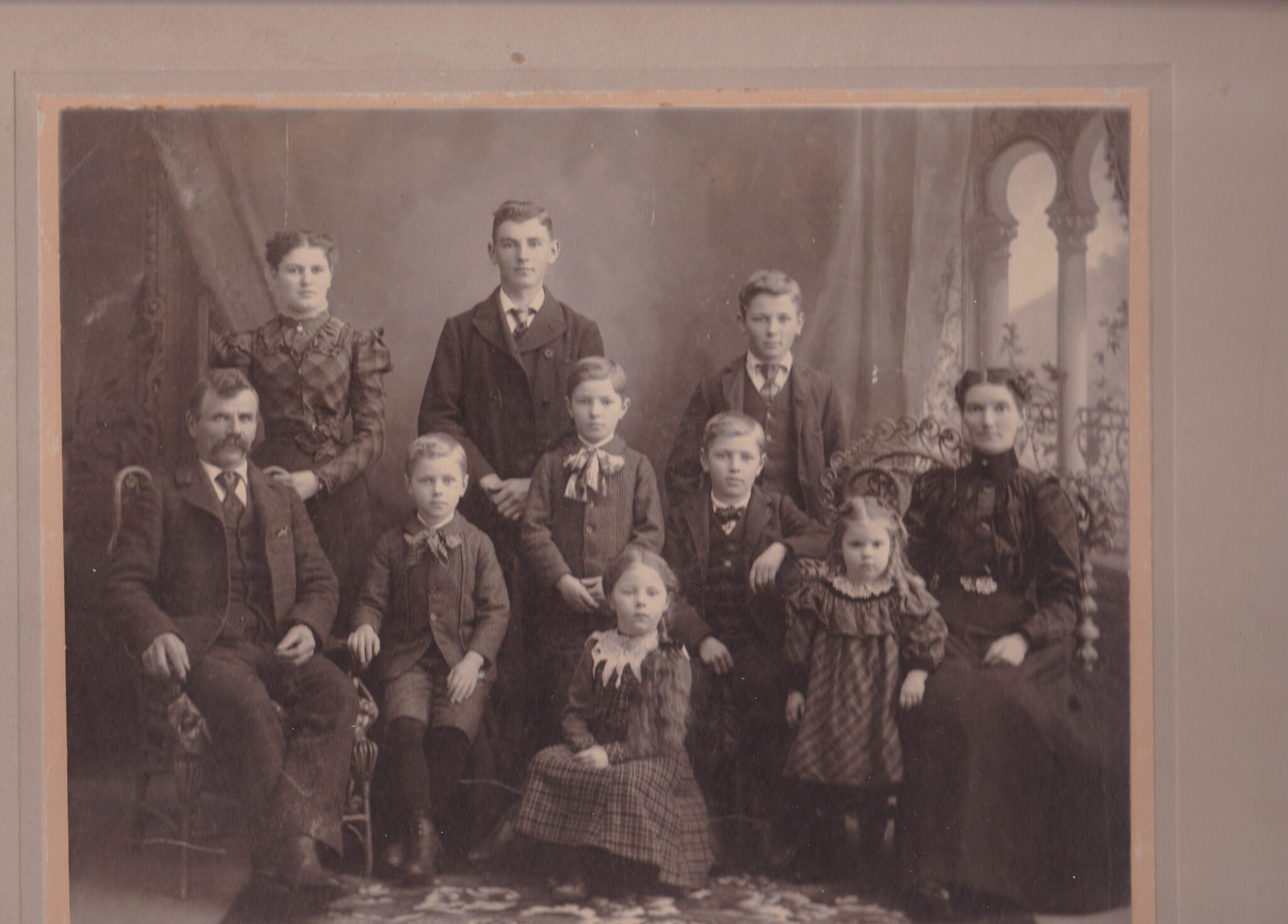
The Charles Wheeler Family circa 1900. Back: Carrie, Herb, Ernest. Centre: Charles, Cecil, Jesse, Lennie, Mary Ann; Front: Lena, Myrtle (Photo courtesy of Richard Anderson).
Sarah, as it turns out, is the daughter of Richard Anderson, great-nephew of Herbert Wheeler, the original owner of the gloves. Richard sent the following information about the history of the Charles Wheeler Family:
Charles Wheeler Sr. was born in Dorsetshire, England and came to Canada in 1846, locating in Tecumseh Township where he spent 18 years. In 1864 he moved with his family to Morris Township where he bought 300 acres which would be the N ½ of Lots 10, 11 and 12, Concession 5, more commonly known as the 4th Line. He married Caroline Lawrence and they raised a family of five sons, Charles, John and Lawrence of Morris Twp., William of Alma, Frank of Belgrave, and a daughter Mrs. Ann Hughes of Escanaba, Michigan.
Charles Wheeler Jr. married Mary Ann Wilkinson and they raised a family of five sons, including Herbert, and three daughters. Charles farmed on Lot 12 and after his death in 1913, his son Jesse took over the home farm. When Jesse married, his mother moved to Belgrave to the house now occupied by Wes and Annie Cook. Jesse continued to farm there until he retired to Belgrave.
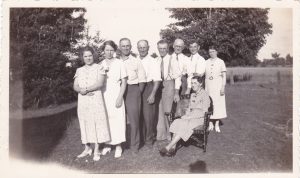
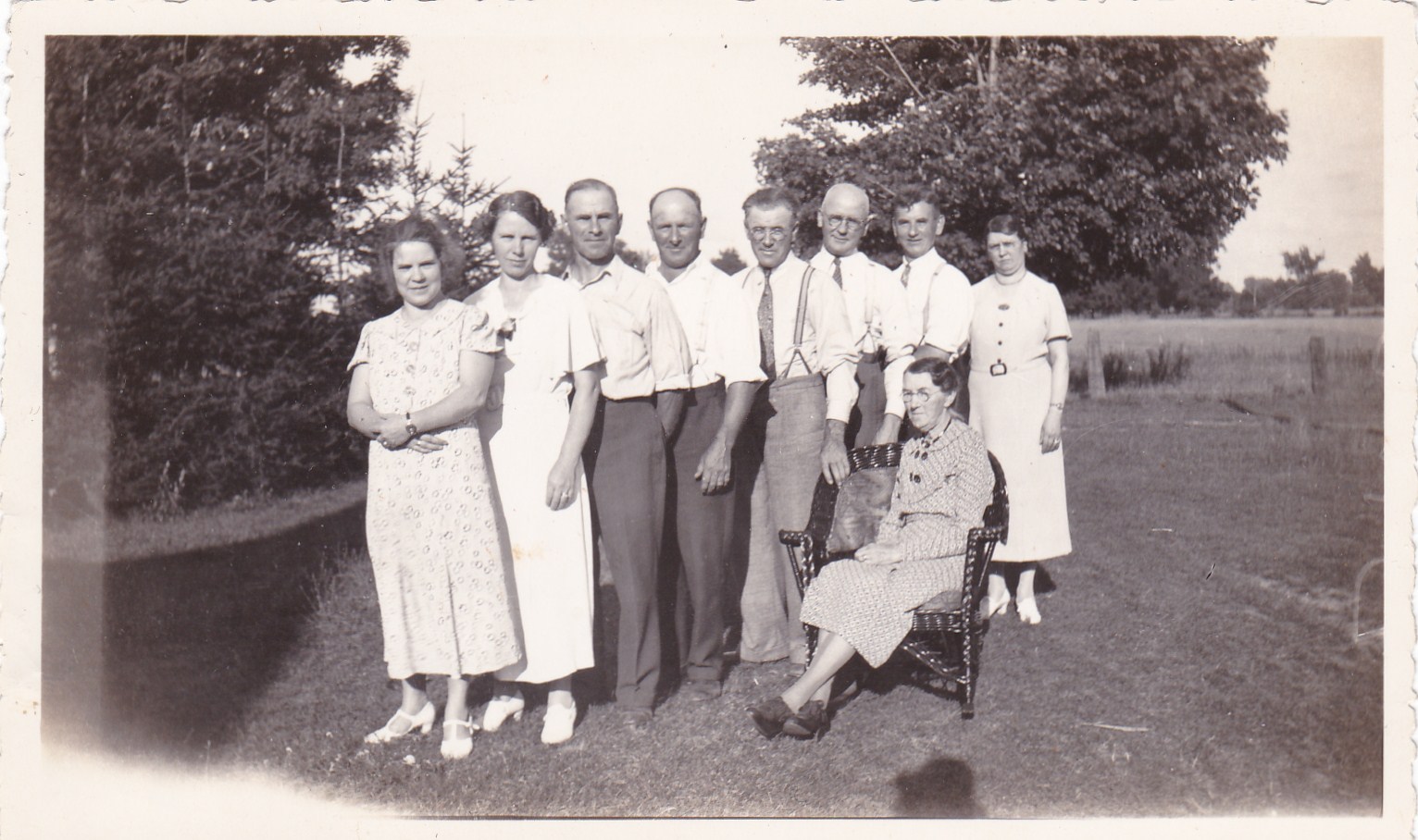
The Charles Wheeler Family, standing in birth order; youngest to oldest, L-R Myrtle, Lena, Cecil, Jesse, Lennie, Ernie, Herb, Carrie (Photo courtesy of Richard Anderson).
Herbert married Pearl Procter. They lived in Belgrave and had three children: Goldie, who married Winnie Lane and lived in London; Velma married Wilfred Pickell and lives in Vancouver; Ken married Mabel Coultes and farmed in East Wawanosh before retiring to Belgrave. Herbert had a woodworking shop in Belgrave.
Herbert’s grandson David Pickell, recalls: “When I knew my grandparents, Pearl and Herb, they lived in Belgrave. Herb Wheeler was a carpenter and, as the name suggests, repaired farm equipment such as wooden wheeled carts etc. He was quiet, and had a subtle sense of humour us kids loved.”
The following poem was written about Herbert Wheeler by a family member and gives a wonderful, lasting impression of just who Herbert was and his occupation as a talented woodworker, carpenter and barber. It would have been great to experience just what this writer did so long ago.
Herb Wheeler’s Carpentry Shop & Hair Cutting CIRCA 1932-1945
Whenever Herb was in his shop, I’d like to go and look,
He might be cutting some one’s hair, or be reading some big book,
There were jigs galore hanging all around, some maybe for a sleigh,
There were shavings bright upon the floor, they would soon be swept away.
Herb never left a job undone, if he could finish it that day,
Except of course a larger job, he would maybe stop and say,
“Tomorrow is another day, I’ll hope to get it done,”
“But if I don’t the job will keep, it’s not hurting any one. ”
Sometimes just after Supper, Herb again would be around,
He’d pump up a gas lantern, light it up and settle down.
For Herb, doubled as a barber, he’d cut hair two weekday nights,
Herb, never used power clippers, he did not charge enough by rights.
Somehow, Two bits is what I think, was all a haircut cost,
I really can’t remember, it’s something I have lost.
Herb did not pull your hair at all, as hand clippers often do,
He’d sometimes talk as the clippers clicked, and he’d ask, “does this suit you” ?
Herb was skilled at doing wood work, he could make most anything,
He made a Bob sled for the kids, it nearly did take wing.
The fastest sled around those parts, down the ninth line hill it flew.
Ken would try to give us all a ride, or sometimes maybe two.
I expect that Goldie used the sled, and likely Velma too,
It needed someone that could steer, and knew just what to do.
I’ve seen the times, when snow was hard, and a fast start at the top,
You’d have to turn the corner, at the highway, to get stopped.
Herb made Ken skis, that were Black Ash wood, what a lovely pair,
The skis would take you down a hill, like you were cushioned on some air.
When the skis were waxed and shone and dried, no one ever saw the like,
They would make a run ahead of all, they would go clean out of sight
There were other things of super class, that emerged for that shop door.
A set of kitchen cupboards, like you’d never seen before.
Herb had a little saying, and he practiced it always
“If you measure twice before you cut, it eliminates delays”!
I have seen him make a set of shafts, the wood he’d have to steam
To make a bend for the horse to fit into the cutters beam.
Herb had the kind of patience, that a lot of people lack,
That is what made him extra special, with an extra special knack.
So far, the research has yielded no straight answers as to the gloves’ origin, but the search continues. While a pattern might give you a hint to the origin of a knitted item, you need to identify more, such as the cast-on method, the type of ribbing, how the fringe was made, and how the strands (or floats) were carried across the back of the knitting. A full reproduction of Herbert’s gloves would help to answer the remaining questions.
In conclusion, there really isn’t a conclusion… But what I can say is that taking the time to explore knitting traditions and a local family’s history has been a fascinating, rewarding experience. I’m so grateful for Herbert’s relatives who have answered my questions and sent so many wonderful images to be shared here with everyone. They went to a lot of work to compile the info and family photographs and I can’t thank them enough for all their time and effort.
I’ve come to think that the original knitter may have incorporated features that he liked into these gloves, perhaps not following one certain pattern, but rather combining different elements into one. A full recreation of the gloves is planned for late fall 2021 and right now I’m testing a local wool I may be using for the reproduction. Stay tuned to the website for further updates as we move forward.
Learn more:
by Sinead Cox | Mar 3, 2021 | Artefacts
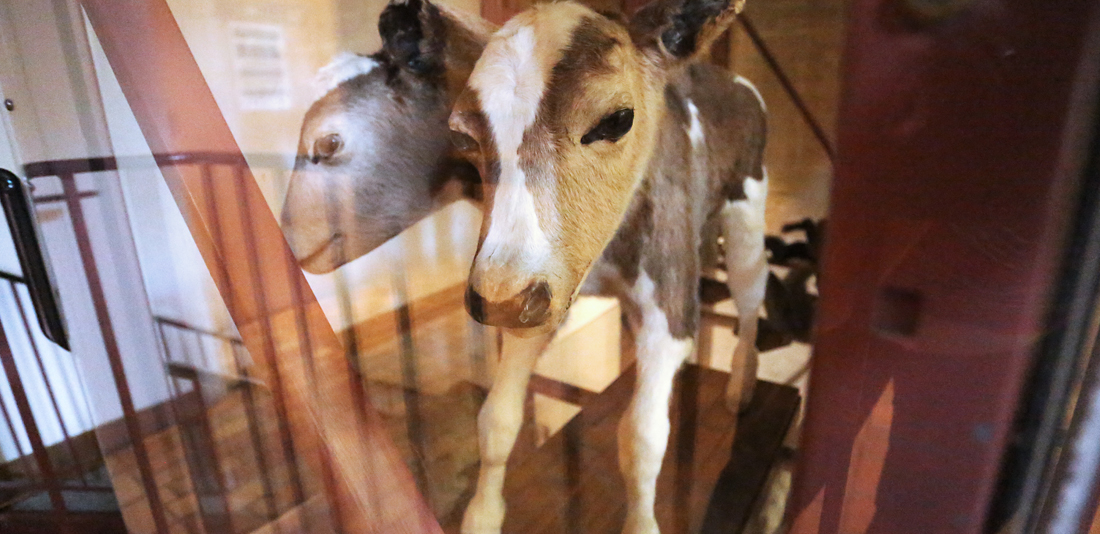
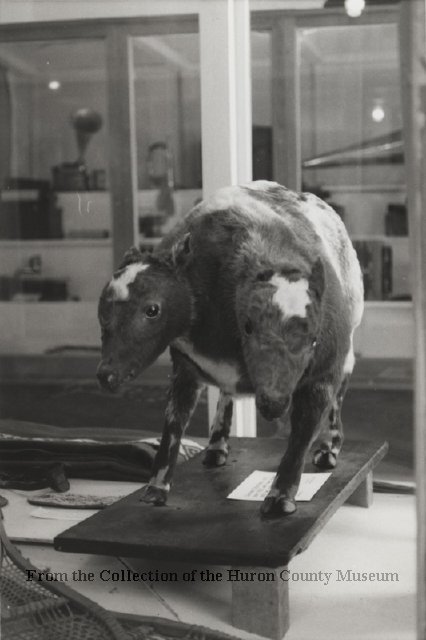
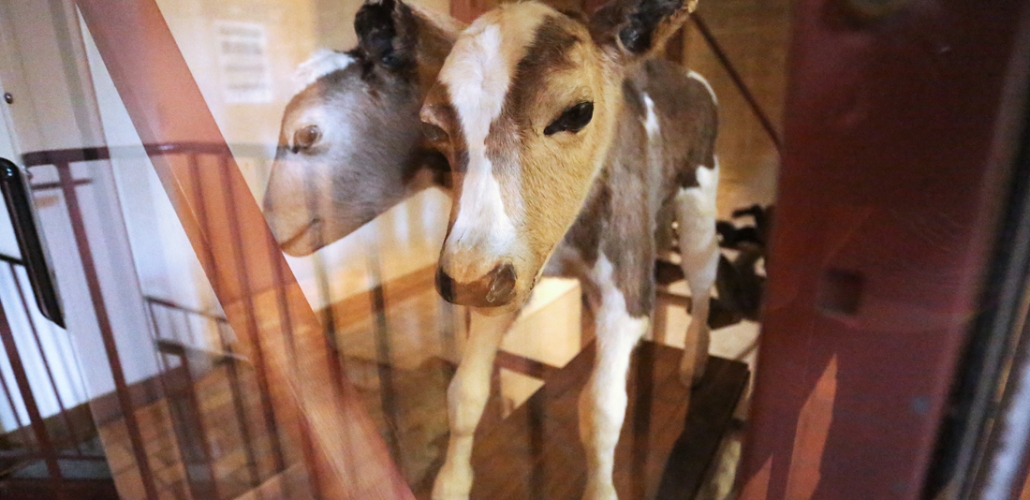
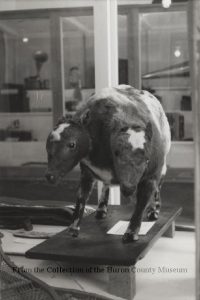
Take a closer look at the Huron County Museum & Historic Gaol and its collections as staff share stories about some well-known and some not-so-well-known features, artifacts, and more. The Huron County Museum’s two-headed calves are perhaps our most recognizable artifacts, and attract a lot of questions from visitors.
Although familiar with the two-headed calves’ history, Acting Senior Curator Sinead Cox wanted to know more about the genetic causes of polycephaly: the condition of a single animal having more than one head. How and why does this rare phenomenon happen?
Sinead talked to veterinarian Dr. Alaina Macdonald to find out more from an expert on animal health.
Sinead Cox: Can you share a little bit about yourself and your professional background?

Dr. Alaina Macdonald
Dr. Alaina Macdonald: I graduated from the Ontario Veterinary College in 2019 and have worked in mixed animal practice since graduation. I have always carried an appreciation for agriculture, and love being able to help animals and their humans live healthy lives. My newest interest is learning how to incorporate aspects of human, animal and environmental health in problem solving of worldwide issues.
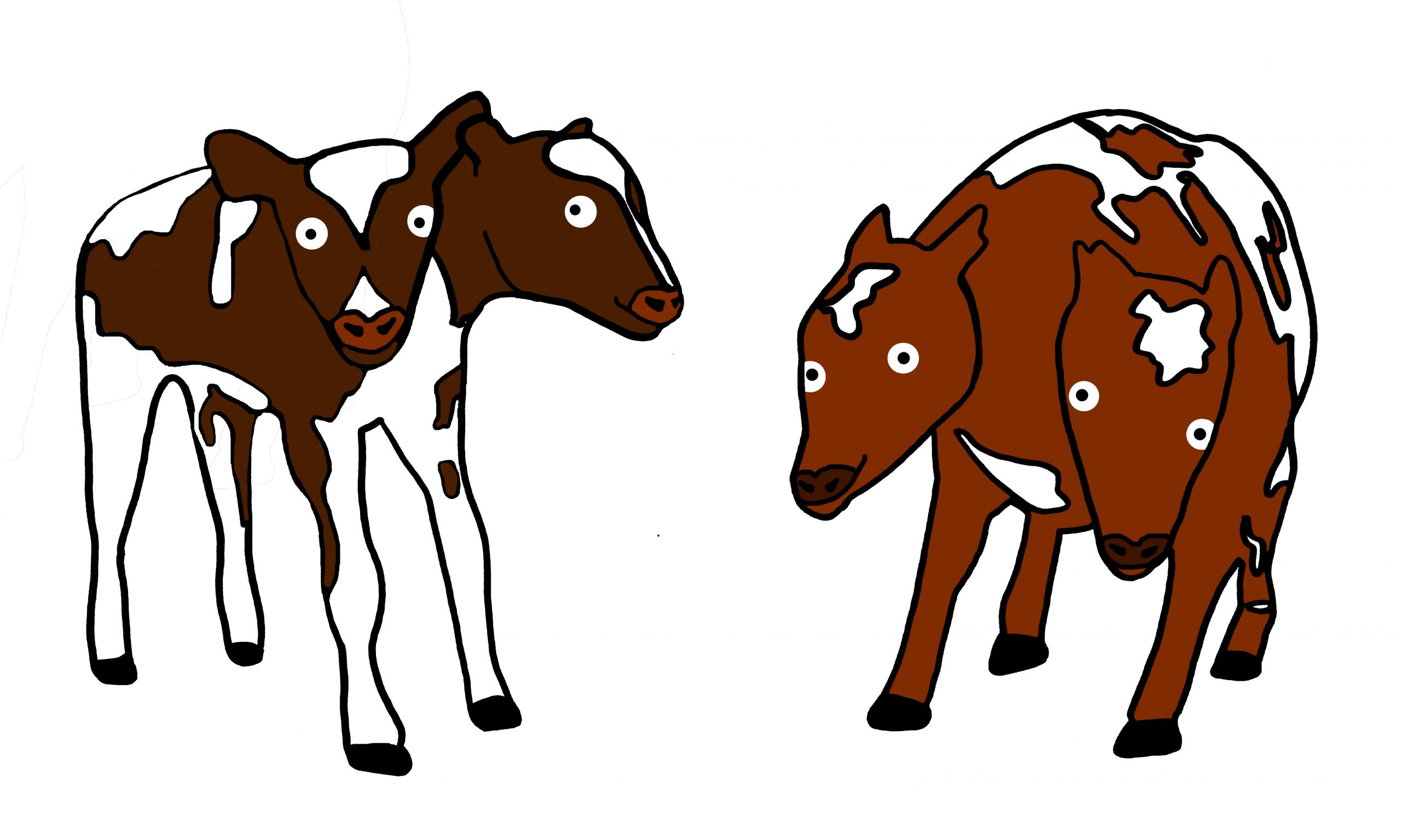
SC: The Huron County Museum has two taxidermied calves in our collection with two heads and two tails. How on earth does an animal end up having two heads?
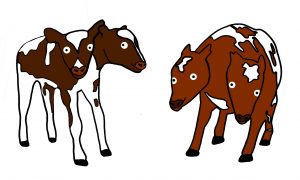
AM: The rare development of two-headed offspring is directly related to the formation of identical twin embryos early in the pregnancy. This phenomenon is seen in reptiles, birds, amphibians, and mammals (including humans). In fact, much of what we know about two-headed animals can be better understood by studying human conjoined twins, as it is a very similar process! When an egg becomes fertilized, a tiny embryo is formed. Occasionally, the embryo divides in a way which produces a second embryo with the same genetic material. This process must occur in a very delicate and specific balance of gene expression and the correct environmental conditions. Most often, it occurs before day 10 of gestation, and the result is two identical twins. Rarely, this process occurs late (around day 13-14), and the process of mitosis (cell division) is interrupted, resulting in two identical embryos which did not fully divide. Some literature indicates that polycephaly is due to a disruption of the primitive streak, which is an organized embryonic structure of cells present towards the second week of gestation.
SC: Could there be environmental factors that would cause this?
AM: No one knows the exact mechanism behind the abnormal splitting of the embryo. Trace mineral deficiencies and environmental factors such as increasing water temperatures and toxin exposure have been implicated in some species, but there are likely many causes. Anything that disrupts that delicate timing of gene expression (including random chance) can cause abnormalities in embryonic development.
SC: How often does this happen?
AM: There is no way to truly know how often this occurs, as this event would generally result in the early loss of pregnancy, and those pregnancies often are undetected. Indeed, it is exceptionally rare for the embryo to develop into a full-term fetus, and to survive the length of the gestation. It is not considered an inherited trait, because the offspring almost never live to reproductive age. In humans, development of identical twins is not considered genetic, which would also indicate that polycephaly in animals and conjoined twins in humans is a “chance” event with possible implications for environmental factors.
 SC: Wow. That really puts into perspective how rare and special these calves are. Both of the calves at the museum were born in the early twentieth century. Is polycephaly more likely to happen now than in the past?
AM: Interestingly, fossil evidence indicates that polycephaly has been present in some species for the last 150 million years!
SC: I always think it’s sort of lovely that our two-headed calves are so loved and live on forever at the museum, when they had very short lives (less than a day). Why doesn’t a two-headed calf live very long?
AM: Calves with two heads often have many other congenital abnormalities. For example, the cardiovascular, neural and digestive systems may be malformed, which makes it nearly impossible for the calf to carry out normal vital functions. A live birth of any two-headed animal is rare, and many of them die shortly after birth. There was one calf who survived with intensive care for several months, which is likely the longest any polycephalic calf has lived.
SC: Have you ever seen any two-headed animals in your work life?
AM: No, I have never seen a two-headed animal myself. I am sure it comes as quite a surprise to everyone involved! There is some evidence to suggest that the many-headed creatures described in Greek mythology may have been inspired by polycephalic animals observed during those times.
SC: What is the strangest or most unexpected thing you have seen as a veterinarian?
AM: I have seen some animals in strange predicaments; from the kitten who ate pieces of a couch, to the dog with a piece of tooth embedded in his leg and the cat with a fishhook in his lip, all had something to teach me about veterinary medicine. The most startling moment of my career was when I was standing beside a horse, taking her temperature, and as we stood looking out the barn door the farm was struck by lighting! Everyone was fine, but the farmer needed to replace his electric fence. Nature always has a way of surprising us!
 Thank you to Dr. Alaina Macdonald for answering our questions and making us appreciate the uniqueness of these unforgettable artifacts even more! For more information on polycephaly, Alaina suggests these references:
https://pubmed.ncbi.nlm.nih.gov/15278382/
http://www.bbc.com/earth/story/20161018-the-two-headed-creatures-that-may-have-inspired-hydra
https://www.nationalgeographic.com/news/2016/11/two-faced-calf-lucky-becomes-oldest-on-record/#:~:text=A%20young%20cow%20calf%20with,a%20farm%20in%20Campbellsville%2C%20Kentucky.
FURTHER READING: