
Researching Canada’s ‘Last Public Hanging’

Researching Canada’s ‘Last Public Hanging’

The following blog posts were originally published by Carling Marshall-Luymes on her personal blog while she was an intern for the Huron County Museum & Huron Historic Gaol in 2007. You can see the exhibit on the history of capital punishment on permanent display in Cell Block 1 when you visit the Huron Historic Gaol today.

The Executioner

I’ve begun my internship at the Huron County Museum and Historic Gaol and I’m currently researching public hangings in (Upper and Lower) Canada for an upcoming exhibit. Three men were hanged at the Gaol in Goderich (1861, 1861 and 1911), all for murder; the first two were public hangings. I’ve set out to answer, among other things, why people were hanged, why such large crowds of spectators came out to watch hangings and why public hangings. These began as easy questions, to which I expected to find straight forward answers, but their answers are proving less simple than I had anticipated and I intend to shift the nature of my blog by writing about my research.

I work where Steven Truscott was incarcerated at age 14 during his 1959 trial for the rape and murder of schoolmate, 12 year old Lynne Harper, and became the youngest Canadian sentenced to death before his sentence was commuted to life imprisonment. Thinking about Steven Truscott everyday and seeing the emotional response visitors have to his case, my assumption was that capital punishment (both public and behind prison walls) was abolished on the basis of humanity towards the convicted; but my research as opened my eyes to a lot of arguments for the abolishment of capital punishment.

John Radclive, Canada’s first professional hangman was appointed in 1892 after carrying out several successful hangings for various Ontario sheriffs. Most career hangmen were destroyed by their profession and Radclive was no exception. During his career Radclive began a ritual of finishing a full bottle of brandy after each execution; he drank excessively both before and after hangings. In a Star interview in Dec. 1906, Radclive spoke of himself: “I am a sick man, too sick to talk,” he said. “I have been sick a long time, very sick.” He died in February 1911, at 55, of cirrhosis of the liver at home in Toronto.

There seems to be some similarity between Radclive and the hangman hired by the Huron District gaol governor {William] Robertson [in 1861] – alcoholism. In a telegram discussing the hangman’s journey from Toronto to Goderich, Robertson is warned that the hangman is an unreliable drunkard, and a turn-key is thus being sent with him.

In an interview with psychologist Rachel MacNair, Radclive described his internal torment:
“Now at night when I lie down,” he said, “I start up with a roar as victim after victim comes up before me. I can see them on the trap, waiting a second before they meet their Maker. They haunt me and taunt me until I am nearly crazy with an unearthly fear.”

Public attitudes towards the hangman must have furthered his torment. In 1900 the Star wrote of Radclive: “If he were a man of delicate sensibilities he would not be the hangman. He is a necessity in our system, but he should be treated as if he is the hole in the floor of the gallows.” At the same time, a 1910 Globe editorial wrote on the role of the hangman: “It is an unpleasant subject, but it is a public question, and it is a public function for which all are reposnsible.” At a time when the population supported capital punishment I find it ironic that the they were so repulsed by the man carrying out their will. Countless people have to be involved in an execution by the state, directly or indirectly and in addition to the hangman, and I’ve realized the significance of acknowledging the psychological stress on these men and women as part of the case against capital punishment.

– – – – – – – – – – – – – – — – – – — – – – – – – – — – – – – – – – – – – – –

The agony of the executioner; How a Parkdale man became our first official hangman and was destroyed by it. By Patrick Cain; [ONT Edition]
PATRICK CAIN Patrick Cain. Toronto Star. Toronto, Ont.: May 20, 2007. pg. D.4

Capital Punishment in Canada. Department of Justice http://www.justice.gc.ca/en/news/fs/2003/doc_30896.html

Canada's Last Public Hanging?

Where was Canada’s last public hanging? This is a question I’ve been trying to answer for our upcoming exhibit; but the answer has proven less straight forward than I anticipated. Yesterday, I was excited to find an An Order-in-Council, signed by John A MacDonald legislating the end of public hangings in Canada. Though hangings continued behind prison walls until 1962, was Canada’s last public hanging at our Huron County Gaol?

The hanging of Patrick Whelan at the Carleton County Jail on February 11 1869 for the assassination of MP and Father of Confederation D’Arcy McGee [left] is mistakenly claimed to be the last public hanging in Canada. Ten months later, on December 7, 1869, Nicholas Melady was hanged in Goderich at the Huron District Gaol for the murder of his father and step-mother. A recently published book detailing the crime and hanging, by Melady’s descendant John Melady, is titled Double Trap: Canada’s Last Public Hanging.

However – in 1869, Canada only included the provinces of Ontario, Quebec, Nova Scotia and New Brunswick. Hangings continued in public in areas that had not yet entered Confederation, such as the prairie provinces and BC.

While hangings were performed behind prison walls, the public was often still able to watch.

  • The Sheriff could and often did invite interested spectators and newspaper reporters.
  • Spectators were known to climb any nearby structure that would allow them to see into the yard. At the Montreal execution of Timothy Candy in 1910, dozens of people viewed the hanging from the roofs of adjoining houses. In this photo of the 1904 execution of Stanislau Lacroix in Hull, you can see the crowds on the nearby rooftops and telephone poles.
  • Crowds of excited spectators were hard to stop. In March 1899, 2,000 uninvited guests stormed a Montreal gaol to witness a hanging, joining the 200 witnesses already inside the prison yard.
  • The law was not always followed.
  • The hanging scaffold was sometimes built taller than the prison walls to allow for public viewing.

An elderly museum patron noted several years earlier that he recalls watching gallows being built in public in Hamilton while riding the streetcar. Was this a case where the gallows were built higher than the prison walls to allow curious spectators a view? or was the law simply ignored? I’m not sure I can claim for certain that the hanging of Melady in Dec. 1869 was the last public hanging even in the provinces within Confederation at the time.

Legislating the End to Public Hanging...A Clarification

A clarification on the legislation abolishing public hanging in Canada… I initially made the same error that John Melady makes in Double Trap and attributed the move of hangings behind prison walls to Order-in-Council 1021. Upon a careful reading of the Order-In-Council, which, after I came to understand the nature of Orders-In-Council more clearly, was in accordance with an act of Parliament, “Act 32-33 Victoria c. 29,” I realized that the Order-In-Council was only supplementing the legislation by creating additional rules and regulations related to hanging, including:

  • Executions were to be carried out within the walls oft he prison in which the offender was confined at the time of execution
  • Executions should take place at 8 am
  • Hanging should continue to be the mode of execution
  • A black flag was to be raised after an execution and remain up for one hour
  • The prison bell (or the bell of a neighbouring church) was to ring for 15 minutes before and 15 minutes after an execution

After receiving a copy of “Act 32-33 Victoria c. 29” from the Library of Parliament it’s clear that Section 109 of the Act, which went into effect 1 January 1870, is actually the legislation ending public hanging, declaring:

“Judgment of death to be executed on any prisoner after the coming into force of this Act, shall be carried into effect within the walls of the prison in which the offender is confined at the time of execution.”

Why did Canada abolish public hanging?

Between the years of 1850 and 1870, public executions ended in countries such as the German states, the Netherlands, Austria, and Spain, as well as England and Canada.

The end of public hangings in Canada under Act 32-33 Victoria chapter 29 brought relief to the general public but I was surprised to find that this was not because they disagreed with the death penalty (though some did), but largely because of the crowds that came to watch the executions.

People argued that public hangings should end for many reasons, and the ‘hanging crowd’ was a significant reason. People complained about rowdy crowds that showed up to watch hangings. When public hangings ended in England, the Times of London reported:

We shall not in the future have to read how, the night before the execution, thousands of the worst characters in England, abandoned women and brutal men, met beneath the gallows to pass the night in drinking in buffoonery, in ruffianly swagger and obscene jest.

Many polite Victorians felt that ending public hangings would advance civilization and they themselves felt uncomfortable watching hangings; at the same time they found the rowdy crowds’ fascination with death, obscene language and gestures, and disrespect for authority embarrassing.

Many also felt that death wasn’t solemn enough: the carnival-like atmosphere among the crowds that watched the executions prevented people from being deterred to commit crimes. It was also argued that by watching hangings, people were familiar with death and would no longer value human life or feel compassion towards others.

What I was most surprised to find that was by ending public hangings, the perpetuation of the death penalty was actually ensured. If people did not have to deal with the crowd, they would no longer have a reason to protest hangings. By making the hangings private, the death penalty could continue.

Capital punishment: Huron County opinion in 1869

Jesse Imeson was formally charged yesterday at the Goderich courthouse, about a two blocks away from where I was working at the Historic Gaol. By my lunch break, which I took at a shady picnic table on the courthouse grounds, the media circus had died down. Later, listening to the news, I was surprised to hear not that a crowd had gathered that morning by the courthouse, but that they had shouted at him and called out to reinstate the death penalty.

While researching the exhibit on public hanging, I was curious about what Huron County residents felt about the death penalty then, and I was surprised by a 11 Dec 1869 editorial in the Seaforth Expositor we had in our archives. The editor argued that public execution wasn’t an effective deterrent against crime, and crude and rowdy crowds had become hardened by watching public executions.

On the Melady hanging, he wrote:

We hope in the name of God – in the name of humanity – that capital punishment may soon be abolished in this ‘our Canada,’ and placed where it ought to be, with the grim relics of barbarous times.

I was hoping for a variety of letters to the editor in response, but as they were uncommon in this paper at the time, there was only one that seems to favour the death penalty:

The man that violates the law is a criminal, and is a scoundrel of whom we should get rid of in the most available way.

Semi-public? - The Hoag Hanging, Walkerton - 1868

As legislation mandating that executions move behind gaol walls came into effect 1 January 1870, I was researching under the assumption that most hangings before this date were outside gaol walls. I was interested to find The Globe article describing the 1868 hanging of John Hoag at the Walkerton gaol (Bruce County had only recently separated from Huron County, therefore this execution wasn’t in Goderich), where the scaffold seems to have been built higher than the walls, but not allowing to see the convicted after he had dropped:

The Sheriff then examined the fatal apparatus; the masked executioner did his work; and the body dropped within the gaol wall, depriving the gaping and motley crowd, some of them women with children in their arms, of the awful spectacle of the body quivering on the rope for a few minutes, perhaps five or six. A number of people were inside the wall and saw the whole [The Globe, 16 December 1868].

At this point I was concerned that perhaps the Melady hanging at our Huron County gaol may have also only been ‘semi-public’ and maybe not the last officially public hanging. I was found The Globe article on the Melady hanging [though blurry to read], which states that Melady was taken from ” the northern exit of the prison, ascended a temporary staircase, and took his position on the scaffold, which was on a level with the prison wall” and suggests that the hanging was entirely public.

However, there is always the possibility that though Melady ascended the stairs to the gallows publicly, because the scaffold was level with the prison wall, the trap could have been on the opposite side of the wall, and he could have dropped out of public view. It seems unlikely however that, as I mentioned in a previous post, both the Seaforth Expositor and The Globe would have made reference to it as the last public hanging if it was only ‘semi-public’ like the Hoag hanging.
Huron Historic Gaol: Resources for Teachers and Students

Huron Historic Gaol: Resources for Teachers and Students

The Huron Historic Gaol is a national historic site and Huron County’s first municipal building. Between 1841 and 1972, it not only served as a correctional facility, but as the site of Huron’s first County Council meeting, its first courthouse, and as an inadequate refuge for those facing hardships that included poor health, homelessness, and mental health struggles.

The history of the gaol intersects with subjects ranging from history and social studies to civics and law. There are onsite programs and resources for every learner, from elementary school to post-secondary students. Educators and students can access these locally available resources to prompt in-depth discussions or create essays on capital punishment, government structures, social safety nets,  legal history, social justice, and much more.

Videos

Behind the Bars video series of prisoner stories

The Young Canuckstorian Project: Margaret & William Dickson, longtime caretakers of Huron Gaol

From Family, Friends and Love, to Betrayal: The Last Official Public Hanging in Canada


Virtual Tours

Explore the 360 virtual tour of the gaol from the classroom: Huron Historic Gaol – Google Maps

You can also try our Virtual Escape RoomContact staff for a guided experience, or book one of our virtual field trips!

Ask an Expert

Contact museum [@] huroncounty.ca to book a guided group tour or onsite education program.

Knowledgeable staff are also available for in-person or virtual outreach to speak about multiple topics related to the gaol’s fascinating history! Get in touch with your questions, or you can choose from an existing list of presentations. 


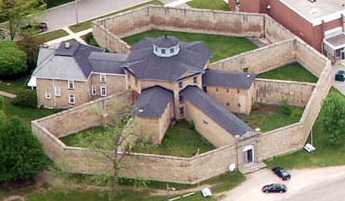
Aerial view of the Huron Historic Gaol, a central building surrounded by tall octogonal stone walls.
Huron Historic Gaol, located at 181 Victoria St. N, Goderich
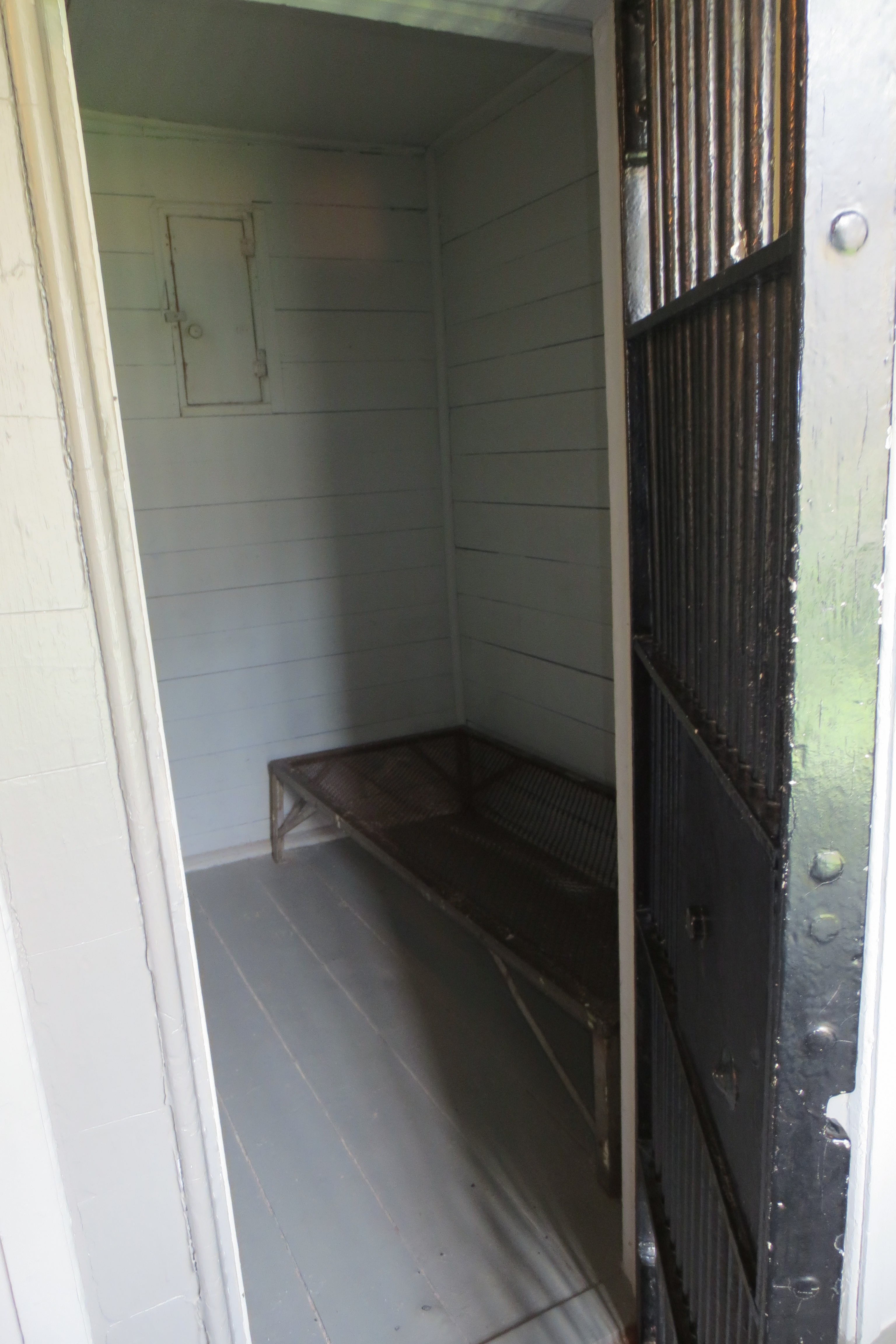
Photograph of a jail cell, barred door ajar. Metal bead inside. Small rectangular window closed.
Contact staff to visit the gaol onsite or virtually!
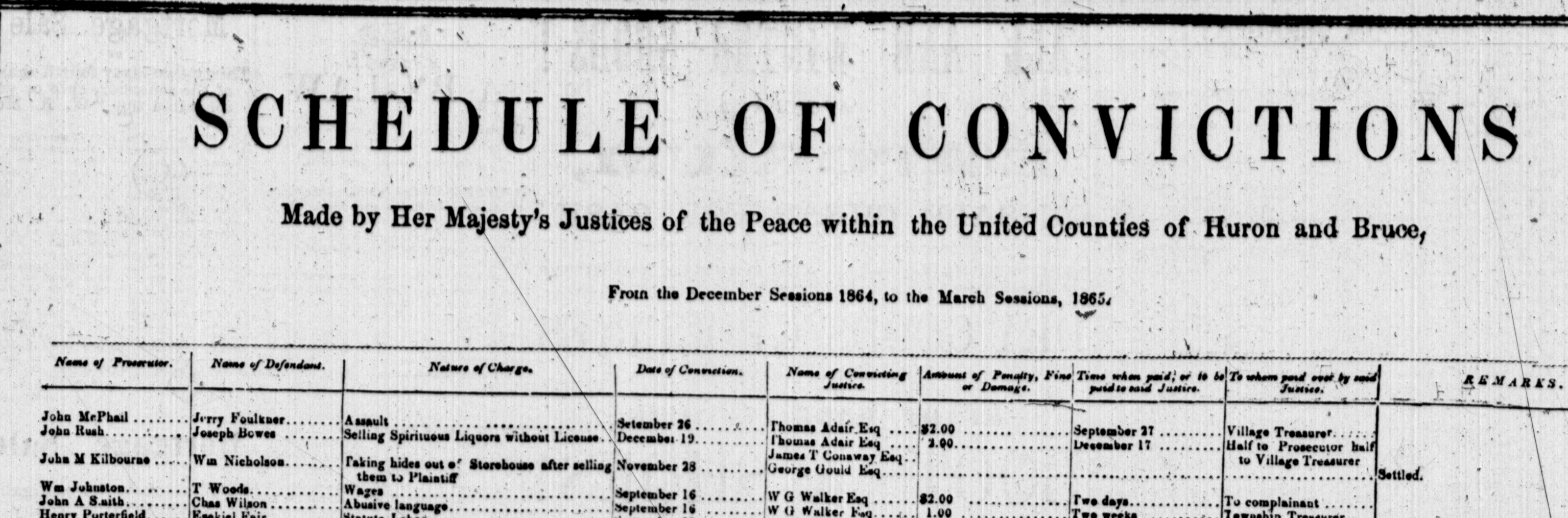
Newspaper clipping: "Schedule of Convictions." Columns list prosecutor, defendant, crime, result and remarks.
Clipping from the Huron Signal, 1865-04-06.  In the early decades of Huron County’s history,  local newspapers regularly published the full Schedules of Convictions listing those accused of crimes as well as accounts of court proceedings.

Research Resources

Huron County’s digitized newspapers chronicle local news from across the county! Click to search more than a century of history via Huron County’s digitized newspapers: free, online and keyword searchable.

You may find many items in the online newspapers about prisoners, significant cases, lists of crimes via the Schedule of Convictions, or the history of the building via reports to Council  & inquests. Review the search tips on our website to help with your search results.


Visit our online catalogue to find artifacts in the museum’s collection that  relate to the Huron Gaol or the communities it served, as well as local law enforcement and court systems.

For in-person research, you can find indexes for certain court records and information on how to book an appointment with the Archivist on the Archives page of our website! Scroll to the bottom for finding aids. Virtual appointments are also now available.

Reading List

Huron Historic Gaol | Huron County Library | BiblioCommons

Check out our reading list in the Huron County Library catalogue for books about the jail and notable prisoners, including Steven Truscott and James Donnelly.

Online Readings/Third Party Links:

The Final Days of Nicholas Melady Jr. as Witnessed by William Dickson

 Heaven & Hell on Earth: The Massacre of the Black Donnellys

Huron Historic Gaol: National Historic Site Designation


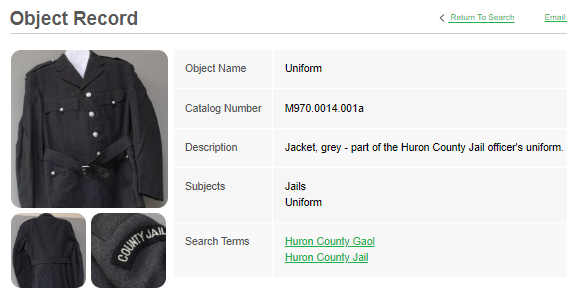
Screenshot of search results. Three Images of a jail uniform, including "County Jail" text on shoulder. Text identifies as "Jacket, grey - part of the Huron County Jail officer's uniform".
Search thousands of selected artifacts online!
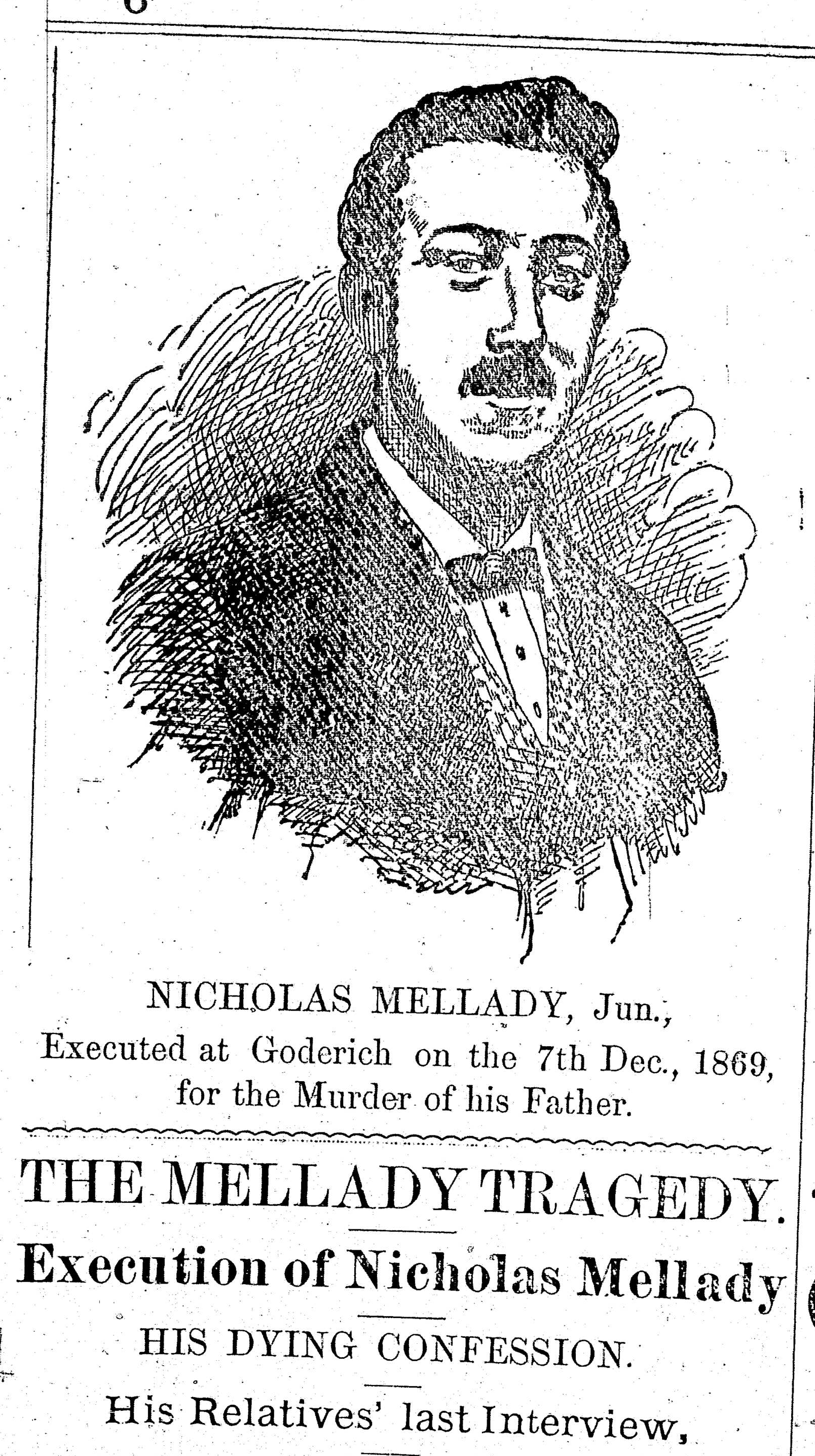
Black & white newspaper clipping. Print block image of an illustrated portrait of a mustached man in a suit. Text below: Nicholas Mellady, Executed at Goderich on the 7th Dec., 1869,<br />
for the Murder of his Father. THE MELLADY TRAGEDY.".<br />
Execution of Nicholas Mellady;HIS DYING CONFESSION.<br />
His Relatives' last Interview,"
From The Huron Expositor, 1869-12-11, pg 6. Access more online from the classroom or from home!
Prisoner Profiles
Prisoner Profiles is available from the gift shops at the Huron County Museum or Huron Historic Gaol, or borrow it for FREE from your local library!
New Huron Historic Gaol exhibit shares historical data about prisoners

New Huron Historic Gaol exhibit shares historical data about prisoners

Written by museum assistant Kevin den Dunnen, who is working on exhibit research projects this summer.

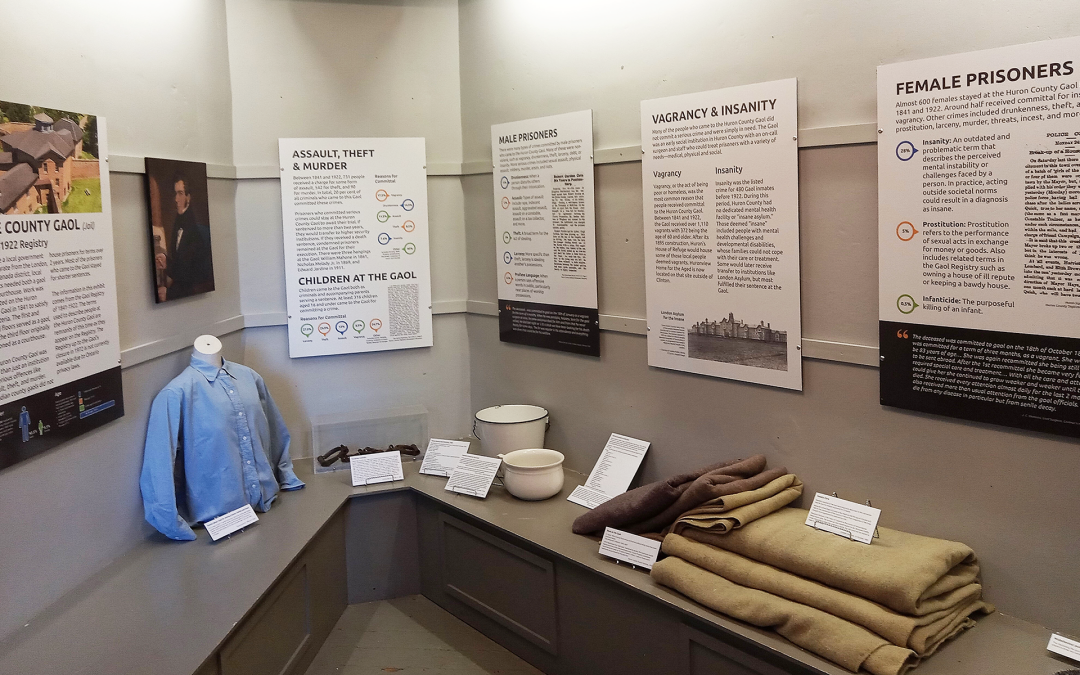
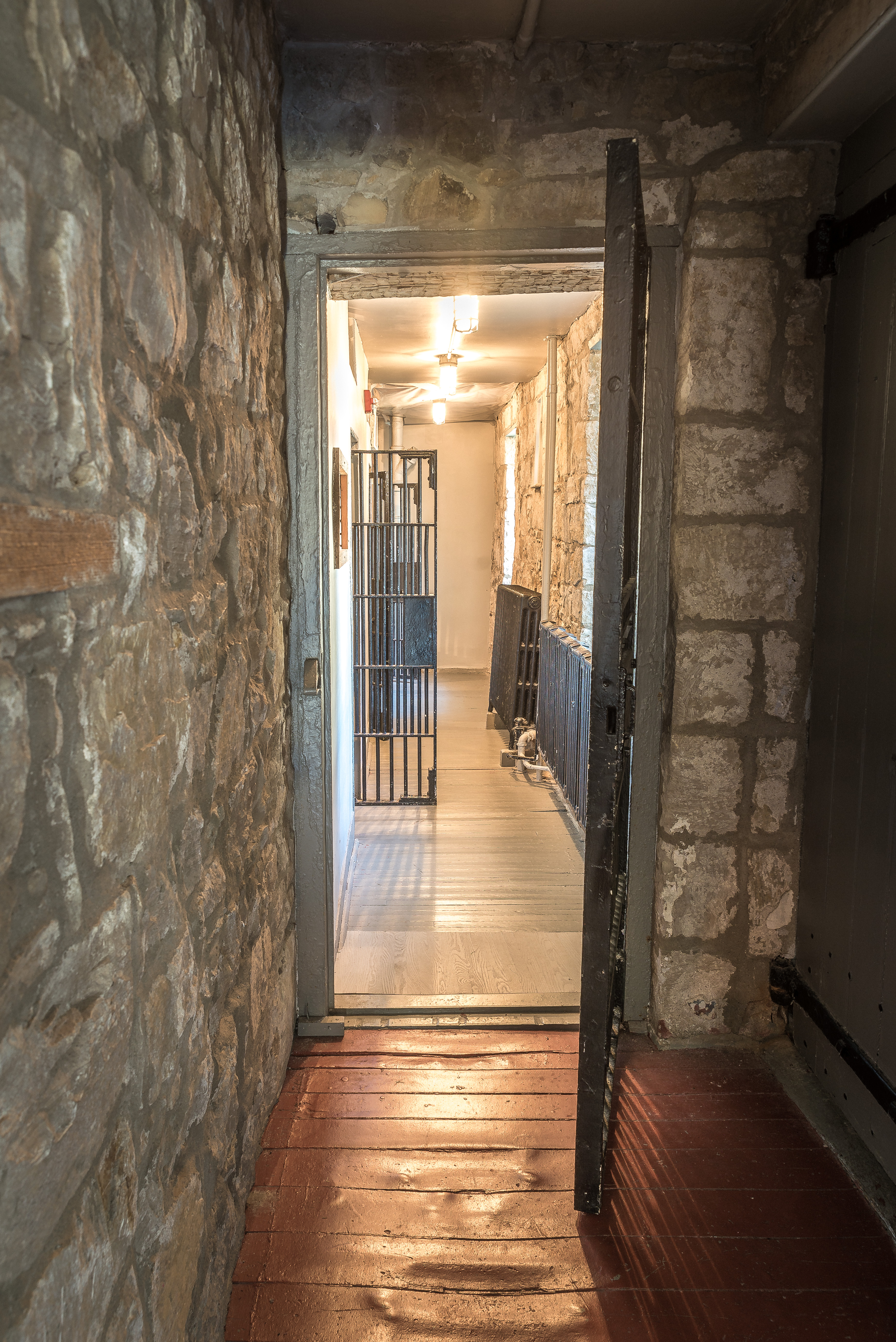
Over 6,600 people came through the Huron County Gaol’s long and narrowing hallway between 1841 and 1922. For each entry into the Gaol, employees recorded information about that person such as the crime they committed, the institution they transferred to, their age, height, eye colour, relationship status, residence, religion, sentence length, etc. This registry is essentially a brief snippet into a person who, in many cases, would otherwise never have such detailed information about their lives presented for historical interpretation. A new exhibit at the Huron Historic Gaol presents an analysis of the people who came to the Gaol through the registry up until 1922. While the Gaol operated until 1972, due to privacy restrictions, staff can only access registry entries after they are 100 years old.

Interpreting more than 6,600 distinct entries in the Gaol Registry presents a challenge to museum staff who must comb through this information to provide accurate data about the prisoners of the Gaol. As part of my programs at school, I interpreted quantitative data and presented visually engaging infographics for public audiences. It was during my employment at the Huron County Museum & Historic Gaol last summer that I recognized the Gaol Registry is compatible with business intelligence software I used in school. This allowed me to present the data as an interactive infographic, giving Museum staff the ability to easily analyze information such as the crimes committed, residence, and religion of prisoners at the Gaol. In this way, staff can answer questions such as the makeup of crime from differing communities in Huron County in a matter of minutes rather than hours.

With so much information available, much of the information in the Gaol Registry did not make it into the new exhibit. For instance, the makeup of prisoner height is difficult to correlate into an overarching exhibit theme. In this blog, however, I can tell you that the most common height for male prisoners was 5’ 8” with 13.6%, while 5’ 6”, 5’ 7”, and 5’ 9” round out the top four and are each above 10% of the male prisoner population. For female prisoners, 5’ 5” was the most common height with 17.7%, while 5’ 2”, 5’ 4”, and 5’ 3” fill out the top four with each above 11% of the female prisoner population.

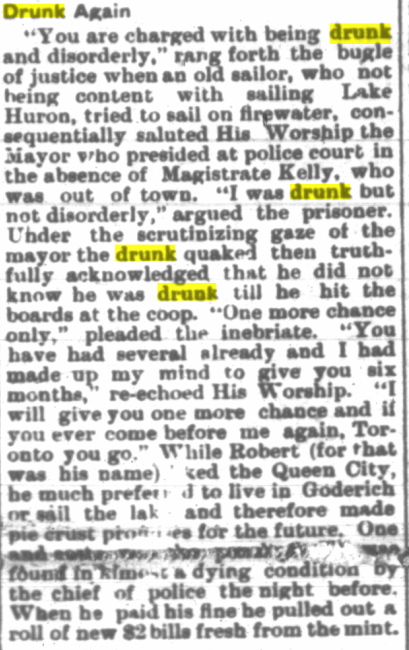
The crime demographics for places of residence is another interesting data set that did not make it into the exhibit. For Goderich-based prisoners, drunkenness was the most common crime with vagrancy second. Prisoners registered from Wingham most commonly committed larceny with vagrancy second. Prisoners from Seaforth most often came in for vagrancy, followed closely by assault and then drunkenness. Prisoners from Exeter most often committed larceny, followed by assault and then vagrancy.

Since Huron County was one of the last dry counties in Ontario, temperance, or the act of professing abstinence from alcohol, was commonly recorded by gaol staff. Some stories relating to temperance feature in the new exhibit, but it is possible to analyze this information further using business intelligence software. For instance, Clinton prisoners recorded one of the highest percentages of temperance. Almost 48% of prisoners from Clinton were temperate. We can analyze this data another step through gender. 85% of females from Clinton declared temperance. In comparison, Gaol staff recorded 34% of Goderich residents as temperate. 49% of female prisoners from Goderich were temperate. We can further interpret the Clinton dataset using religion. While almost 20% of all prisoners from Clinton were Methodist, 43% of temperate prisoners from Clinton were Methodist.

The last information I will share with you in this post is marital status. 54% of prisoners who came through the Gaol’s long, narrowing hallway, were single, 40% of prisoners were married, and 6% were widowed. This information remains consistent within a few percentage points across residences like Goderich, Exeter, Lucknow, Seaforth, Wingham, and Clinton.

These are but a few facts outlined in the registry and staff continue to use these details as they research prisoners and their lives at the Gaol.

Want to learn more about the lives of prisoners from the Huron County Gaol? Come visit the new exhibit and speak with our staff about the Gaol Registry.


Image of a clipping from the Goderich Signal published November, 1913

From the Huron Historic Newspaper collection. Published in The Signal, 1913-11-6, Page 6 

Image of a whisky jug from the Museum's collection

The owners of this whisky jug came by boat to Goderich then walked through the Queens Bush to homestead near Teeswater and Langside. The jug was carried slung over a stick on the back of a man when he walked through the Queens bush to barn and house raisings. The MacDougall’s often went to raisings 50 miles away (Goderich) after clearing bush near Langside, Bruce County. Object ID: M9590109001

“No Possible Escape”: A Short History of Fire at the Huron Gaol

“No Possible Escape”: A Short History of Fire at the Huron Gaol

“No Possible Escape” sounds positive when it comes to jailbreaks, but less so in the case of emergency. Curator of Engagement & Dialogue Sinead Cox looks back at fire and fire safety at the Huron Historic Gaol.

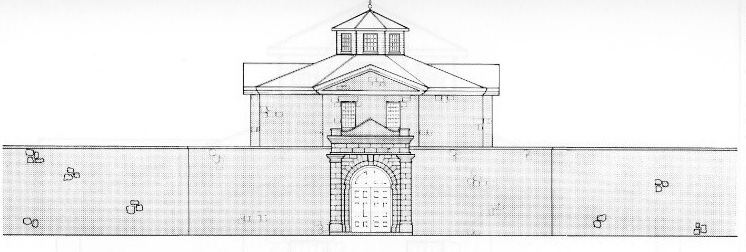
The Huron Historic Gaol is one of the most recognizable, historically significant and architecturally unique buildings in Huron County. Today it stands as a venue for visitors to hear the stories of the prisoners and staff who walked its halls, and considering the number of times the building has caught fire over its 180+ year history, this is nothing less than a small miracle.

Although the outer walls may give the impression that it is solid stone, the construction of the gaol interior is actually significantly timber. The unique octagonal layout of rooms and yards around a central spiral staircase are designed to keep prisoners in, with perhaps less architectural forethought when it comes to allowing people to quickly get out, should the upper floors become engulfed in flames.

In 1851, when the building was only a decade old and served the United Counties of Huron, Perth and Bruce, an errant chimney spark caused the first known fire of significance. Fortunately, the only harm sustained in that instance was damage to the building’s roof. Afterwards, the Gaol Inspector recommended covering the roof with metal, and that the county purchase a new ladder tall enough to actually enable water to be carried high enough to fight a fire (staff presumably having discovered the inadequacies of the previous ladder during the emergency). No ladder would have been very useful as a means of rescue for prisoners, however, as all of the windows on the gaol’s upper floors were barred to prevent escape.

In the 1860s the County of Huron replaced the tin-covered roof with slate, later swapped for asphalt shingles about a century later. When reverting to slate in 2021, roofers discovered lumber inside the cupola still bore blackened scorch marks from historic fires. The cupola, or central tower, has been struck by lightning at least twice: in 1892 and 1929. Torrential rain prevented fire in the first case, but the second strike “set the tower ablaze” just after one a.m.  According to The Clinton News Record, “a terrific electric storm was in progress and firemen had difficulty at first in plying streams of water on the tower, owing to its height. Some of the firemen climbed on to the slate roof, slippery with rain, and fought the flames from perilous positions.” The newspaper claimed that despite the late hour and extreme weather, a crowd of people gathered outside the gaol’s walls to watch their efforts. While firefighters risked their lives to stop the fire from spreading to the lower floors, a constable escorted the seven prisoners currently committed to the Huron Gaol to an outside courtyard, still confined within the 18 ft walls. Thankfully, the fire was successfully contained within the cupola and extinguished, but the flames and the water employed to douse them had caused more than $1,000 in damages (equal to just over $16,500 today). The county enlisted prisoner labour to help with the subsequent clean-up and repairs.

Black bucket with 'Fire Brigade' written on it.

Fire bucket. M951.0732.001

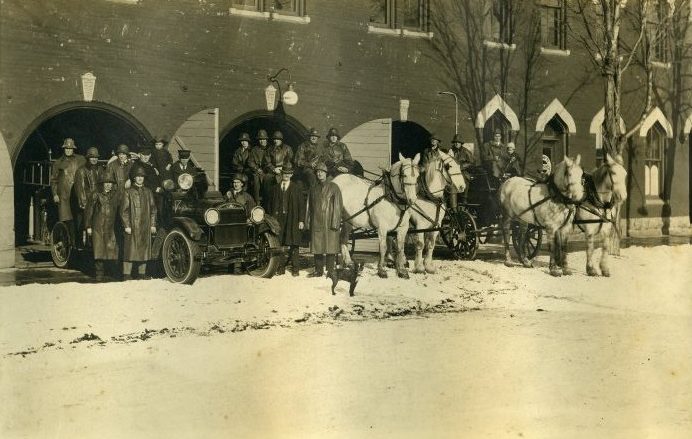
Photograph of firefighters, vehicles and animals in front of fire station.
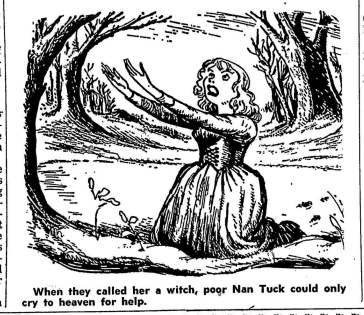
Illustration of a young woman being accused of witchcraft

Huron Historic Gaol, Goderich Ontario

 black fireman's helmet hat with red underneath and a gold figure of a man blowing a fire horn.

1855 Fireman’s helmet donated by Town of Goderich. M951.0734.001. 

large brass fire extiguisher --  2 1/2 galloncylindrical with red rubber hose that has cracked and hardened;  stenciled in black on side is "WESTDALE". Instructions on side.  "Guardene Extinguisher"

Fire Extinguisher. 2017.0024.003. 

large brass fire extiguisher --  2 1/2 galloncylindrical with red rubber hose that has cracked and hardened;  stenciled in black on side is "WESTDALE". Instructions on side.  "Guardene Extinguisher"

A950.1976.001. Fire crew at former Goderich Fire Station located on East Street, 1925. 

The cupola caught fire again in 1944, this time from burning leaves, either carried from the ground by a strong wind or ignited in the eaves by a spark. Although this fire burned only briefly, it caused destruction and water damage similar or worse than the 1929 blaze: costs duly submitted to the county’s insurer.

Officials and staff recognized the inadequacies of the gaol’s design very early in its operation: the lack of fire exits was one of the reasons that District Council and the courts complained about meeting there before the construction of a separate courthouse in 1856. Despite the general awareness of the threat, safety measures provided by the county did not always meet the needs of staff or emergency responders. After the 1892 lightning strike, Gaoler William Dickson found that the gaol’s fire hose was faulty, and burst in multiple places when tested with pressure.  As early as 1882, after yet another recent narrow escape from flames, local newspaper editorials from the Goderich Star and Clinton New Era condemned the gaol as an outdated fire trap. The Era argued for replacing the gaol and courthouse  with new, modern municipal buildings in a more central location. The Gaol and Court House Committee instead recommended “that a Babcock Fire Extinguisher for the gaol be furnished, also that a suitable water tank be built in the gaol yard,  owing to the inflammable and unsafe condition of the gaol stairs, there is no possible escape for the inmates in case of fire.”

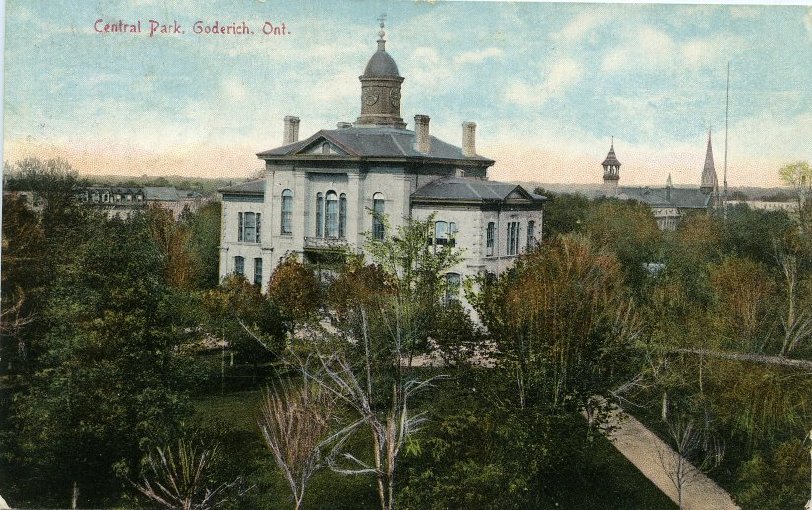
Colour postcard of Huron County Courthouse located in Goderich Square, surrounded by trees. Nineteenth century.

Postcard of courthouse at “Central Park” or Square, Goderich. Built 1856. This courthouse was destroyed by fire and replaced in 1954. 2008.0032.083. 

In the 1890s, Huron County Council acknowledged the aging heating stoves in each cell block’s dayroom as another serious danger and replaced them. Prior to electric lights, staff also had to contend with mandatory corridor lamps, burning day and night at the risk of overheating. Gaoler Dickson lamented to County Council in 1896 that, “twice [a lamp has exploded] during the almost 32 years I have been in your employ. The last time it was towards morning and fortunately my subordinate was awake and succeeded in extinguishing the fire at the cost of the bedding of two beds.” Dickson credited the turnkey’s quick action in preventing what was nearly a terrible tragedy: “At the time of the explosion there were 18 prisoners under lock and key, besides 5 members of my own family who were sleeping on the second floor. Had the flames caught the stair, all on the upper floors would have been entirely cut off from escape. In view of this danger to life and property, I would respectfully ask that you place one incandescent in said hallway.” The gaoler’s lobbying successfully resulted in the installation of incandescent lights at the gaol, but the issue of the single exit remained unaddressed. It’s easy to imagine that if the fire had spread beyond the smothering power of gaol blankets, that a quick decision may have been made to prioritize the evacuation staff and family before the overcrowded inmates sleeping behind multiple locked doors.

The close-call fires at the gaol over the decades were all seemingly accidental, with the exception of one incident during the holiday season in 1943. The gaol’s annual Christmas celebrations included a special meal for the prisoners with treats donated by the community, and that year they also enjoyed a decorated Christmas tree. On December 27th,  the dry boughs of the tree caught fire in one of the cell blocks, spreading to the woodwork and choking that ward with thick smoke. The Goderich fire department responded to gaol staff’s call for help, and successfully extinguished the flames in a manner of minutes. A follow-up investigation found that the cell block’s three resident inmates had intentionally started the fire to create a distraction for escape.  Convicted forger Floyd McCullough admitted to helping his teenaged cellmates, Angus Trudeau and Lorne Derevere, in devising how to ignite the Christmas tree remnants. The two younger men, committed for robbing Bayfield-area cottages, ultimately also pled guilty to the arson. No opportunity for jailbreak had ever actually materialized as planned; the trio were simply evacuated to another part of the gaol to avoid the smoke inhalation that may have endangered their lives if not for a turnkey’s quick arrival on the scene. All three faced added time behind bars for the conspiracy.

Cell Block

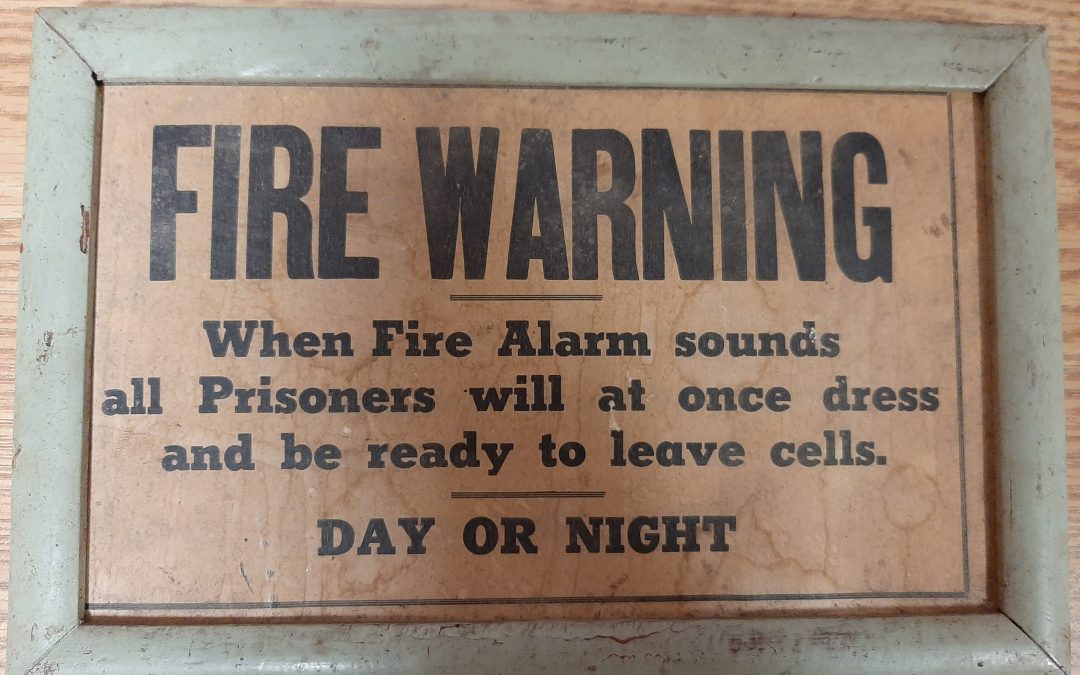
 The aging building’s vulnerability to fire remained a concern throughout the twentieth century, resulting in a fire-proof coating applied to the cells in 1939, various furnace installations and upgrades, and an alarm system installed by the 1950s. Jurisdiction over Ontario’s county correctional facilities transferred to the Province in 1964, and in 1972 the Ontario Department of Correctional Services decided to close the Huron Gaol. From 1974, the gaol opened its doors as a historic site and museum, originally managed by the Historic Jail Board– the County of Huron retained responsibility for fire insurance. The County resumed direct control of the building in the 1990s.

The Huron Historic Gaol would pass its 175th  birthday before finally gaining a fire escape and new fire exits on the second and third floors of the gaol after major upgrades in 2018. The work was undertaken with care to protect the site’s historical appearance and architecture.  As a historic site, fire safety could be addressed to meet contemporary standards without concerns about compromising security.  Today, the spectre of potential disaster by fire need not haunt staff and visitors to the degree it once did generations of prisoners and gaol employees. The gaol’s countless near misses with destruction are a reminder of the importance of adequate preparations and equipment to combat fire, as well as the need for strict safety regulations for public buildings.  It is only a mixture of ad hoc precautions, the quick actions of the gaol’s small staff, the intervention of local firefighters and also simple luck, that has successfully preserved this one-of-a-kind building and the lives of those who have lived and worked within its walls over three separate centuries. 

Find out More!

Can you Escape the Huron Historic Gaol? : Virtual Escape Room

Can you Escape the Huron Historic Gaol? : Virtual Escape Room

Can You Escape the Huron County Gaol?

Our new interactive and educational escape room “Escape The Huron County Gaol” will let you explore the gaol even when the site isn’t open. 

Navigate your way through the Huron HIstoric Gaol using the Google 360 walkthrough on the Huron County Museum Website and learn historical facts about this fascinating national heritage site as you attempt to escape its iconic walls. 

This activity is recommended for ages 7+ and younger children may require adult assistance to read the clues and navigate the 360 tour.

This interactive uses the Google 360 walkthrough of the Huron County Historic Gaol. Open the escape room form, and then open the Google 360 on another tab or device. To find the Google 360 walkthrough of the Gaol, scroll to the bottom of the linked page. 

If you would like to book a virtual program with staff guiding the escape room and providing extra information  and interpretation for your classroom or group, email museum@huroncounty.ca 


Image of cupola/tower inside gaol courtroom.
Double, Double Toil and Trouble: The Tale of Maggie Pollock and the Huron County Witch Trial

Double, Double Toil and Trouble: The Tale of Maggie Pollock and the Huron County Witch Trial

In time for Halloween, students Kyra Lewis & Mary Murdoch share the history of witches in North America and Huron County’s own witchcraft case: “the weirdest [case] that has come before the Ontario Courts in many years”.

Today, popular culture often suggests that the legal pursuit of witches was something that began and ended with the infamous Salem Witch Trials in Salem, MA, in the 1690s. However, that was far from the beginning or end of the story. In fact, Huron County had its own witchcraft case as recently as the 1920s: the case of Maggie Pollock of Morris Township.

Background: The History of Witchcraft Law in North America

The history of prosecuting witchcraft as a crime has a long history in North America preceding Miss Pollock’s case. Historic Haudenosaunee society viewed witchcraft as very serious offence. Because witchcraft could endanger anyone in the community, people took accusations of witchcraft very seriously. Practicing witchcraft also went against the core principles of unity and peace found in “The Great Law”. The Great Law refers to the guiding principles of life in the Haudenosaunee Confederacy. The first step was to determine if the person was guilty. If the Council found the accused to be guilty, the punishment was death. If the accused promised to change their ways, they would always be forgiven and spared.

By the time Europeans began settling in North America, widespread panic surrounding witchcraft had decreased in Europe. However, in the 13 American colonies, settlers were still paranoid about the possibility of witches living in their midst. Not Salem, but Windsor, CT, was actually the first place in the US where an execution of a person charged with witchcraft took place. In total, Connecticut accused 46 people of witchcraft between 1647 and 1697. Of the 46 accused, 11 were executed. There were also witchcraft trials in Virginia between 1626 and 1730, but no executions.

Massachusetts’ Salem Witch Trials began in June of 1692. Residents of Salem accused 150 men and women of witchcraft. Over a period of 11 months, the residents of Salem killed 19 people by hanging and tortured one man to death. Of the 20 people killed, six were men. Five more people would die in prison before the end of the trials.

In Canada, pretending to practice witchcraft was illegal until 2018 under section 365 of the Criminal Code of Canada. This section read:

Pretending to practise witchcraft, etc.

365 Every one who fraudulently

  • (a) pretends to exercise or to use any kind of witchcraft, sorcery, enchantment or conjuration,
  • (b) undertakes, for a consideration, to tell fortunes, or
  • (c) pretends from his skill in or knowledge of an occult or crafty science to discover where or in what manner anything that is supposed to have been stolen or lost may be found, is guilty of an offence punishable on summary conviction.

Note that the crime in question was pretending to practice witchcraft. The Criminal Code of Canada did not mention the practice of witchcraft itself. The law was implemented in 1892 and was based off of a previous 1735 British Statute which condemned “fraudulent” claims of occult powers. The statute attempted to remove earlier religious rhetoric prior to the 18th century, which presumed and enforced that witches were indeed a very justifiable and dangerous threat to humanity. Instead, the 1735 Statute suggested that claiming occult powers was inherently fraudulent, thus upholding the notion that witches were not real. Logistically it was intended to limit fraud, and preying on the naive and desperate, but much like earlier witchcraft laws it could be used to prosecute vulnerable or marginalized women.

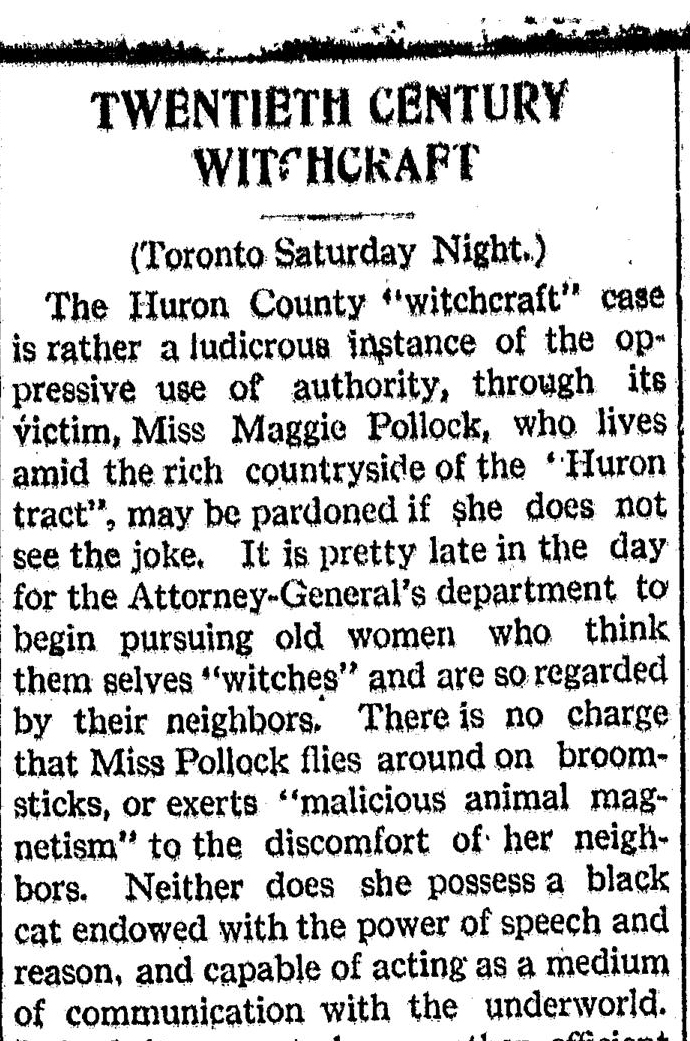
Although not commonly used in the 20th and 21st centuries, the law against pretending to practice witchcraft remained in effect until 2018.  Maggie Pollock, a Huron County woman, was charged under the law in 1919 in “the weirdest [case] that has come before the Ontario Courts in many years”.

Illustration of a young woman being accused of witchcraft

The Huron Expositor, 1963

Newspaper clipping from WIngham Advance

The Wingham Advance, 1920-04-29

newspaper clipping from Wingham Advance Times

Wingham Advance Times, 1930-09-11

Morris Township’s Gifted Lady

Margaret Pollock, more often referred to as “Maggie” or “Miss Pollock”, was a woman born in Huron County on May 11, 1879.

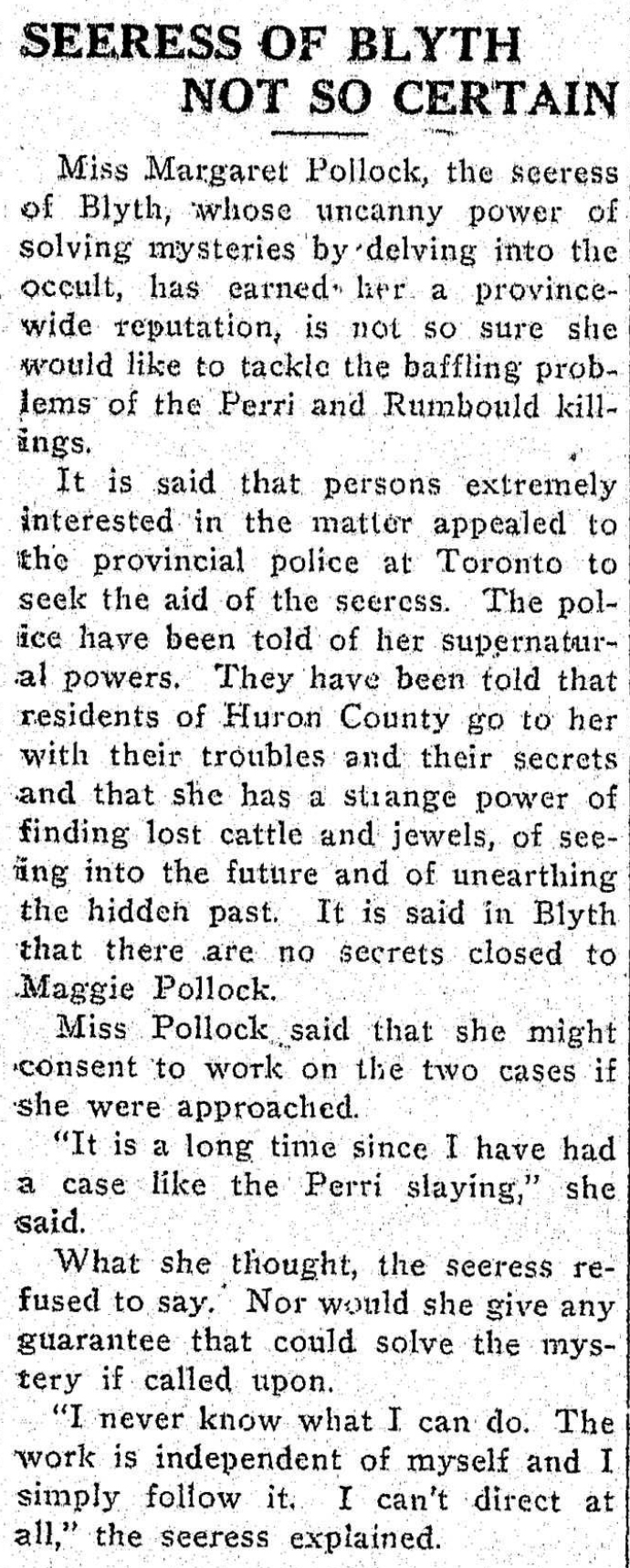
She was of Irish descent and lived and worked on her brother’s farm as a housekeeper in Morris Township, near Blyth. Maggie claimed to be “possessed with a peculiar occult gift” that she used on several occasions to help neighbors locate lost or stolen items and property. Following a peculiar court case, Maggie’s “gifts” would earn her sudden celebrity not only in Huron County, but across the country.

From a young age, Maggie knew that she had a special gift. At 16, she realized that she had an ability to see and to hear things that others could not. While visiting a friend’s house in Boston, Maggie realized that she had seen the house and an elderly woman who lived there before. Around the turn of the century, Maggie experienced visions of two strange machines. The first Maggie thought was a chariot of angels at first glance, but then she noticed that the machine had wheels. It shocked Maggie when she saw the machine in the sky land right beside her and saw regular people disembark from it. Maggie saw the second strange machine when she was driving down the road and turned around to see a machine that ran like a train without a track behind her. This vision puzzled Maggie. It wasn’t until many years later that Maggie realized that she had seen an airplane and a car many years before the modern version of either was invented. While some might label Maggie’s gift as relating to the occult, Maggie claimed that her abilities were completely natural, without witchcraft or trickery involved. When Maggie’s neighbours came to her for help, Maggie never guaranteed results, but rather promised to do the best that she could to help them. When questioned about the things she saw, Maggie claimed that she had no powers of her own, but that her visions and insights were a God-given gift which she felt compelled to share when they came to her.

Huron County’s Witchcraft Case

On June 30, 1919, Maggie was brought to the Huron County Gaol after she was accused of “Telling Fortunes,” which was illegal under section 365 of the Canadian Criminal Code. In Goderich, a farmer had testified that he had given Maggie 50 cents for a séance. He did this in an attempt to locate oats and grain which someone had stolen from him. It wasn’t revealed in court whether Maggie’s premonition actually resulted in recovering the oats and grain, but she saw a vision of the thief and was able to describe his horse. She appeared before Goderich Judge Henry Dickson, and the court decided that; “she did unlawfully pretend from her skill and knowledge in an occult and crafty science to discover when and in what manner certain goods and chattels, to wit, certain grain and oats, supposed to have been stolen from one, John Lienhardt.”

On Oct. 13, 1920, Maggie’s case was appealed to Osgoode Hall, one of the oldest and most distinguished legal associations in the country, by her counsel, Mr. C. Garrow. Osgoode upheld Judge Dickson’s conviction. According to the contemporary account of the Clinton News Record, “The judge admonished her that the practice must cease and has bound her over in bonds of $200 from herself and from her brother to refrain from pretensions of occult power and from practicing the occult science.” The court gave Maggie permission to offer her opinion about lost items, but not to claim that she had any special powers.

Members of the local community continued to support Maggie during her conviction and appeal, and her supporters were upset with her treatment in the legal system. The Toronto Saturday Night chastised the judges and those involved with the case for, “harrying a poor old woman.” A neighbour, Mrs. Sinclair, also testified at Osgoode Hall to corroborate the effectiveness of Maggie’s “gifts”. She stated that Maggie had successfully helped her to find a lost diamond ring. Maggie had claimed to do this by speaking with Sinclair’s deceased mother, and told Mrs. Sinclair that she had thrown out the ring with some dust. Maggie added that Mrs. Sinclair would find the ring when the snow melted. Despite this advice, Mrs. Sinclair and her husband decided to melt the snow. When this did not work, she sent a letter to Maggie detailing what she had done, and that she had not found the ring. Maggie replied that Mrs. Sinclair needed to be patient. Sure enough, the snow thawed weeks later, and the ring was there.

The Legend of Miss Maggie Pollock 

Considering a continued public fascination with witchcraft and the occult, it is no surprise that Maggie’s legal battle gained widespread recognition in 1920. It was notable to some that an older woman from Huron County could perform such “miracles,” while others were shocked that she could be accused of something as archaic as witchcraft. The Toronto Daily Star questioned the wisdom of the verdict: “There is a fairly widespread belief in the occult. It is growing. Why not cope with this sort of thing more intelligently than by merely putting the ban of the law upon it?” The same article suggested that rather than legal prosecution, a public test to determine the validity of Maggie’s gifts would be the superior solution: her powers could simply be disproved or verified to harmlessly help with more cases of missing valuables.

A large number of supporters did not doubt Maggie’s abilities. She received many visitors and letters from people as far away as Florida, Texas, Missouri, Nebraska, California and Vancouver. Her skills were also allegedly sought-after on the other side of the law. The police asked her to locate missing bodies of drowned persons several times: including a young boy who had drowned in Wingham and a man who fell through ice in New Hamburg. The Seaforth News reported that Maggie was also paid a visit by High Constable A.J. Wharton of London to discuss the escape of two murderers from London Jail in 1927.  

Maggie Pollock passed away in August of 1931, in her 70th year. The Seaforth News said of her, “[She] has honour in her own country, because her neighbours have always had the upmost faith in her and can relate scores of interesting stories.” She was fondly remembered as, “a well-known and highly respected resident of Morris Township.” Despite the verdict of the witchcraft case, Maggie was able to continue to help others with her gifts as she had wanted. Whether those gifts were real is still something up for debate. One thing is certain, Miss Maggie Pollock was one magical woman, one way or another.

Sources Consulted & Links to Learn More!