by Elizabeth French-Gibson | Mar 8, 2017 | Archives, Investigating Huron County History, Uncategorized
The list of women from Huron County who served as nursing sisters in the First World War is now up to 50 names! This list includes women who served with the Canadian Army Medical Corps (CAMC), American Army Medical Corps, Red Cross, and Queen Alexandra’s Imperial Military Nursing Service. As more records become available online, we are finding out more about what their lives were like before, during, and after the war.
It can be difficult to find out what happened to a nurse after the war ended for many different reasons. Many women married and changed their name, some moved across the country or the United States, and a lot of records still aren’t available due to privacy legislation. Due to limited resources, it can be very difficult track people down and verify their identity.
One such woman is Mary Agatha Bell, who was born, according to her Attestation Papers, on November 5, 1879 in St. Augustine but lived in Blyth, Ontario. Mary enlisted on April 3, 1917 in London, Ontario, left Canada on May 20, 1917, and arrived in England on May 30, 1917. While overseas, Mary mainly served with the 7th Canadian General Hospital in France. She also did temporary duties with the 6th and 8th Canadian General Hospitals. After the war ended, Mary sailed back to Canada in July 1919 on the S.S. Olympic.

U.S., Border Crossings from Canada to U.S. – Ancestry.ca
It was difficult to track down what happened to Mary Agatha Bell after the war. On October 11, 1925, a birth registration* was issued to a Mary Bridget Bell born on November 5, 1874 in St. Augustine, Ontario. Records show that this Mary Bridget Bell moved to the state of New York on October 22, 1925. A border crossing document from August 1945 states that Mary’s address was 11 Hows Avenue, New Rochelle, New York, where she worked as a registered nurse. The document also states that she is missing the fourth toe on her left foot.

New York, Naturalization Records – Ancestry.ca
This last piece of information was critical in definitively proving that Mary Agatha Bell (born in 1879) is the same person as Mary Bridget Bell (born 1874). According to her service file, Mary starting experiencing problems with her left foot in France, 1918. Notes in her file refer to her problem as a “contracted toe”. The 4th toe on her left foot was eventually amputated when she returned to Toronto in 1919 at St. Andrews Hospital.
It appears that Mary lied about her birth year on her Attestation Paper. This was not uncommon among women enlisting as nursing sisters in WWI. Mary would have been a much more appealing candidate at age 38 than her real age of 43. Why she decided to change her middle name from Agatha to Bridget still remains a mystery…
*Birth registrations were often issued to adults who didn’t have birth certificates
by Elizabeth French-Gibson | Dec 15, 2014 | Huron Historic Gaol, Investigating Huron County History, Uncategorized
By Emily Beliveau, Digital Project Assistant
7 December 1869.
Earlier this month, we marked the anniversary of the last public hanging at the Huron Gaol. One hundred and forty-five years ago, Nicholas Melady was executed for the murder of his father and stepmother. The hanging took place outside the walls of the Huron Gaol in front of a few hundred spectators. We believe this was the last public hanging in Canada. It’s often difficult to make these kinds of historical determinations with total certainty, but we make this claim because we don’t know of any other hangings that occurred between then and 1 January 1870, when the law changed to prohibit public executions.
Public vs. private hangings
Until the law changed in 1870, executions in Canada were public events that were held outside of jail walls and attracted spectators. (For most of Canada’s history, the only legal method of execution was hanging, and the only crimes punishable by death were rape, murder, and treason.) When public hangings were abolished, private hangings continued. Private hangings occurred within the wall of the prison, which curtailed the crowd of potential spectators, but didn’t necessarily eliminate viewing possibilities. Enterprising citizens could perhaps catch a view from a nearby rooftop or other structure.
In 1976, capitol punishment was abolished in Canada by Bill C-84. The last executions to be carried out were in 1962 at the Don Jail in Toronto (a double hanging).
Confirming the claim
At the beginning of this post, I said we believe the execution of Nicholas Melady at the Huron Gaol was the last public hanging in Canada. Why can’t we say for sure? As I mentioned, it can be very difficult to verify claims about lasts, firsts, and other seemingly definitive events in the historical record, for a number of reasons.
We have a strong case to make, but with caveats. Canada in 1869, for instance, only included the present-day provinces of Ontario, Quebec, Nova Scotia, and New Brunswick. Public hangings may have occurred in areas that are now part of Canada, but were out of the jurisdiction of the 1870 law at the time. These are the kinds of things that complicate the certainty of such claims.
Further reading
In 2007, Carling Marshall-Luymes, an intern at the Huron Historic Gaol, wrote a series of blog posts about researching the last public hanging. Her work contributed to the exhibit that is on display in one of the first-floor cell blocks of the Gaol.
Read her posts here:
Blogging Behind the Bars
Canada’s last public hanging
Legislating an end to public hanging…a clarification
Why did Canada abolish public hanging?
Capitol punishment: Opinion in Huron County in 1869
Semi-public? Hoag Hanging, Walkerton, 1868
by Elizabeth French-Gibson | Oct 31, 2014 | Artefacts, Image highlights, Special Events, Uncategorized
By Emily Beliveau, Digital Project Assistant
This year, our museum pumpkin is inspired by the History Hall funeral parlour display — it’s a jack-o’-lantern hearse, complete with casket and occupant. The styling was based on a horse-drawn hearse on display at the museum, a late-1800s model that was used in Dungannon, as shown in the photo below.

Horse-drawn hearse with Robert Bowers, driver, (left) and William Sproul, undertaker, (right) in Dungannon, Ont. in the late 1880s. Photograph by J. W. Trussler, Object ID 1950.1459.039. You can see this hearse in person in the History Hall gallery at the Huron County Museum.
by Elizabeth French-Gibson | Aug 14, 2014 | Textile Collection, Uncategorized
By Mary-Katherine Whelan, Intern
Mary-Katherine has been interning at the Huron County Museum & Historic Gaol since May and is currently enrolled in the Museum Management and Curatorship program at Fleming College. A graduate from the Arts Management Program at the University of Toronto, she has previously worked for the National Historic Sites Alliance of Ontario, the Stratford Festival of Canada, the Niagara Historical Society, and Great North Artist Management. In part two of this two-part series, she details some of the many online museum collections of vintage fashion.
Online Museum Collections
Over the last ten years cultural and historic institutions have gradually photographed and made their costume collections accessible online. There is a great wealth of resources available online that I regularly consult when I’m stumped.

Evening ensemble designed by Nabob, about 1927: V&A Collection
Victoria and Albert Museum has a great collection available online. The collections made available span from 18th century to 20th century fashion, and include drawings, photographs, art work, and historical context and introduction for each collection.

Evening dress designed by Yves Saint Laurent, 1967. The Museum at FIT.
The Museum at FIT (Fashion Institute of Technology) has, like the V&A, a comprehensive collection available online, which spans from the 18th century to the 21st century. What is unique about this collection is that it is very focused on costumes designed by noted fashion designers from the 20th century onward, and includes biographies of the designers. The collection has a searchable feature that is easy to use and can be narrowed down based on what you are specifically looking for.
The McCord Museum in Montreal has an online collection of costumes and textiles that are uniquely Canadian. Currently, the McCord Museum has over 900 images from their Costume and Textiles collection available online. What is great about the McCord Collection is that visitors are able to download the images directly from the website and if interested can order high quality images from the collection.

Finger-woven sash: Northern Plains Métis, c.1900-1910, McCord Museum.
The online collection of The Kyoto Costume Institute is much smaller than others on this list (200 items) but they have a great interactive timeline that you can click through for in-depth information about items from the collection including context, designer name (if applicable), materials used and date.
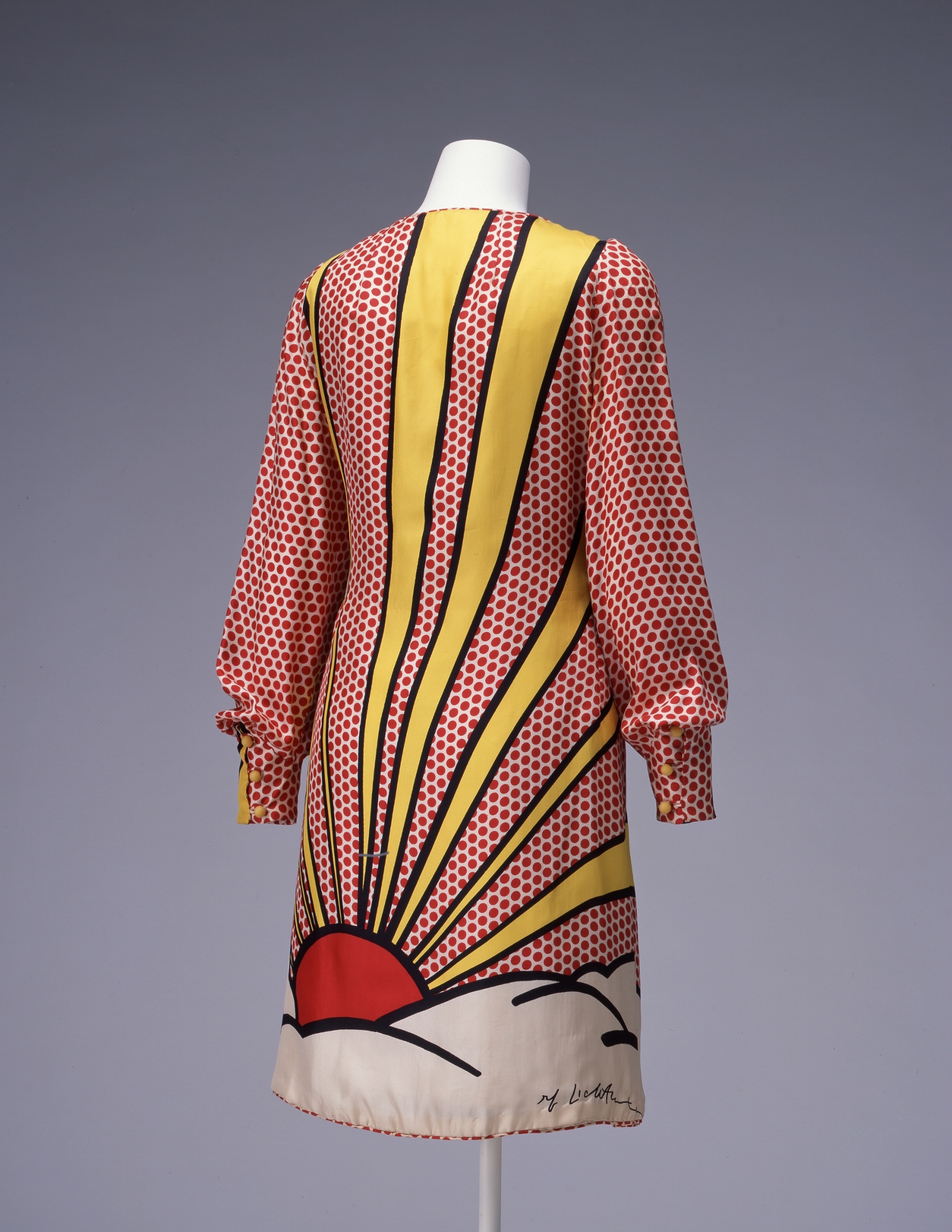
Dress Coat, designed by Roy Lichtenstein (Textile), Lee Rudd Simpson c. 1965. Kyoto Costume Institute.
Current Exhibitions
The Museum at FIT has pulled together a comprehensive list of fashion and historical costume related exhibitions from institutions around the world.
For local costume history, visit the dress shop display in the History Hall at the Huron County Museum and check out Fashion Fridays posts by summer student Tess Burnfield on the museum Facebook page.

Dress shop display in History Hall Gallery, Huron County Museum
by Elizabeth French-Gibson | Aug 6, 2014 | Textile Collection, Uncategorized
By Mary-Katherine Whelan, Intern
Mary-Katherine has been interning at the Huron County Museum & Historic Gaol since May and is currently enrolled in the Museum Management and Curatorship program at Fleming College. A graduate from the Arts Management Program at the University of Toronto, she has previously worked for the National Historic Sites Alliance of Ontario, the Stratford Festival of Canada, the Niagara Historical Society, and Great North Artist Management. In part one of this two-part series, she details some of her favorite books and blogs for researching the history of fashion.
My love of historical fashion …
Fashions from the past can tell us a lot about the people that made the clothes, purchased them, and wore them. I’ve long been fascinated by historical fashions and over the years have researched and read copious amounts of books on the topic.
As an emerging museum professional I’ve found that my knowledge of historical fashions and dress have increased my ability to successfully date photographs and artifacts. During my schooling I had the privilege of working with a variety of artifacts like Victorian wedding gowns, glass buttons, purses, uniforms and some of the tools used to create clothing. I often fell back on several go-to books and websites to help pinpoint a time period when accession forms lack a discernable time period.

Empire Fashions, a colouring book by Tom Tierney,
Book Resources
One of my first exposures to historical fashions were from Tom Tierney fashion plate colouring books and paper dolls. The more historically-oriented selections are drawings based on fashion plates from the Victorian era. As I grew older I started to seek out the sources that Tierney used as well as other books on the evolution and history of historic costumes and clothing. Some of my favourite publications are Tierney’s Empire Fashions Colouring Book, and Medieval Fashions Colouring Book. If you are interested in checking out some of Tom Tierney’s other publications, visit the Dover publications website.
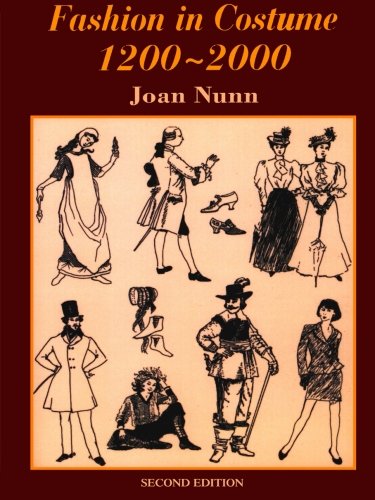
Fashion in Costume 1200-2000, Revised, by Joan Nunn, 2nd edition, 2000.
Another book that I rely on is Joan Nunn’s Fashion in Costume 1200-2000, Revised, which chronologically details types of clothing styles while providing cultural and historical context with accompanying drawings. The book is easy to understand and doesn’t lose the reader with overly technical terminology. While not an exhaustive record, the book gives a good overview and serves as a great introduction.

What People Wore When, Melissa Leventon, ed.
Additionally, What People Wore When – A Complete Illustrated History of Costume from Ancient Times to the Nineteenth Century for Every Level of Society by Melissa Leventon is an amazing visual resource. Using classic 19th century illustrations by Auguste Racinet and Friedrich Hottenroth the book presents these illustrations chronologically while providing in depth contextual information, glossary of terms and a detailed bibliography to help better illustrate why people wore what they did and how certain styles have impacted fashion today.
Blogs
While not museum collections, these blogs are worth checking out! They feature examples of vintage or recreated historical fashions and are a good place for discovery, research, or inspiration.
The American Duchess
A blogger who designs and fabricates her own historical clothing
OMG That Dress
A tumblr blog devoted to sharing photographs of men and women’s fashions, plus jewelry and accessories
The Hidden Wardrobe
A blogger who works at Berrington Hall showcases and explores 18th century and 19th century costumes from the National Trust Collection
Worn Through
A blogger whose approach is more academic in scope and aims to spark discussion about current trends and topics
by Elizabeth French-Gibson | Apr 10, 2014 | Investigating Huron County History, Uncategorized
By Jenna Leifso, Archivist
Last week we looked at whether James Bond was named after someone buried in Maitland Cemetery, today we are going to determine if Hollywood royalty came to No. 31 Air Navigation School (Port Albert).
Myth #2: According to a story told in the book The Story of Port Albert 175 Years one lucky Wireless Operator, while on leave, managed to fit in a trip to Hollywood. While he was there, he got married to the daughter of Louis B. Mayer “of M.G.M. fame”. As the story goes, “[h]e not only returned with a beautiful wife but a limo to match. Married persons were allowed to live off the base so not a lot more was seen of him.”
The Facts: Louis B. Mayer did have two daughters, Edith and Irene, however, it would have been impossible for the Wireless Operator in question to marry one of them because they were both already hitched! Edith married William Goetz in 1930 and Irene was married to Producer David O. Selznick. Around the time of WWII, William Goetz was the vice president of 20th Century Fox and David O. Selznick was a successful film producer and executive.
It’s possible that the Wireless Operator married another famous studio executive’s daughter but I haven’t come across any mention of the nuptials in the base’s various newsletters.