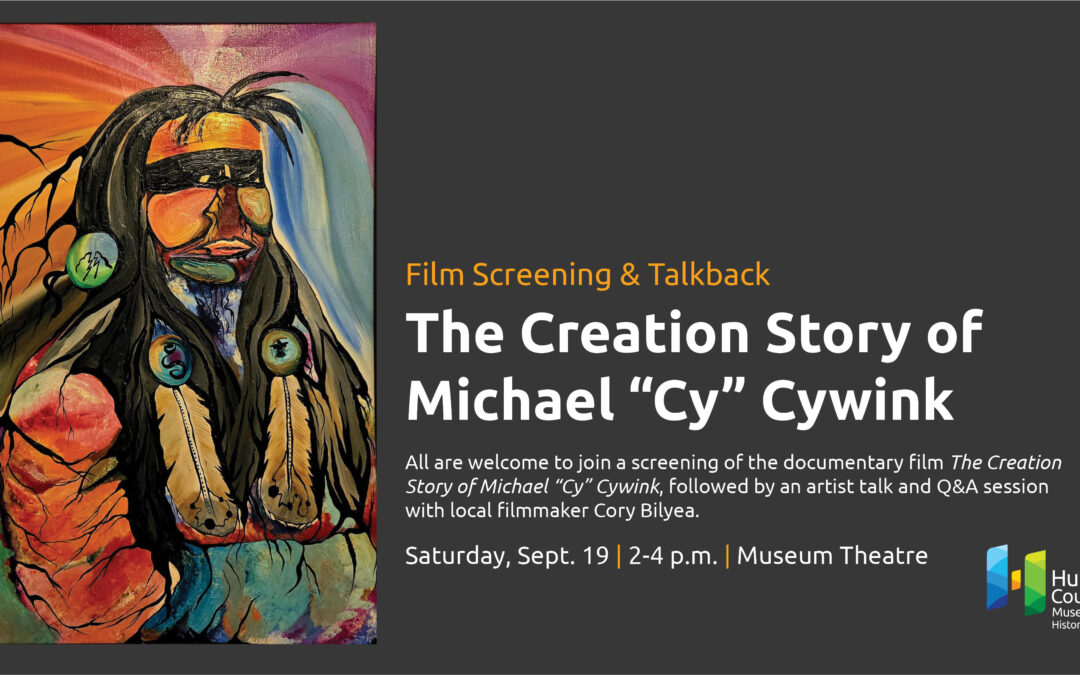
Film Screening & Talkback: The Creation Story of Michael “Cy” Cywink
A screening of the documentary film The Creation Story of Michael “Cy” Cywink, followed by an artist talk and Q&A session with local filmmaker Cory Bilyea.
The film honours the life and enduring legacy of the late Anishinaabe muralist, author, and curator Michael “Cy” Cywink. For over 40 years, Cy dedicated his life to breaking down cultural walls, sharing oral traditions, and mentoring youth through community-led public art. According to the Huron Citizen, “to call Bilyea’s film an artist biography hardly feels sufficient…The Creation Story is…also a meditation on the very nature of creativity [and] at times, a striking, simple, one-on-one art class, unlike any other.”
This screening is included with regular admission to the museum (FREE with a Huron County Library card or museum membership). Seating in the theatre limited, so please RSVP below to save your seat.
About the Artist: Michael “CY” Cywink, was an Internationally recognized artist/author/curator/muralist and band member of the Wiikwemkoong Unceded Territory on Manitoulin Island. He
was also an alumnus of the Museum Studies Program at the Institute of American Indian Arts in Santa Fe, New Mexico. Michael was an independent curator. Previously he was the arts coordinator for the Wiikwemikoong Art Gallery, and curator for the Ojibwe Cultural Foundation in M’Chigeeng, Manitoulin Island, as well as a First Nation’s cultural consultant with Walt Disney Imagineering / Disney’s America theme park project in Glendale, California. He interned at the Canadian Museum of Civilization of Man, Hull, Quebec (now the Canadian Museum of History), the National Museum of American Indian, Smithsonian, Washington, DC, the Institute of American Indian Arts Museum, Santa Fe, NM, and Walt Disney Imagineering, Glendale, CA. Throughout the 1980s he was a counselor /contract street worker (at risk youth) in Toronto. He began exhibiting his work in 1979.
About the Filmmaker: Cory Bilyea is an award-winning Onyota’a:ká: journalist, photographer, and documentary filmmaker dedicated to deconstructing colonial state frameworks and archiving contemporary oral histories. A prominent voice in regional and national Canadian media, she is a former CJF-CBC Indigenous Journalism Fellow whose impactful reporting has consistently kindled the public conscience on issues of systemic failure, institutional trauma, and off-reserve cultural reclamation. Bilyea’s work is uniquely informed by her lived experience as a Sixties Scoop survivor and former unhoused youth. Rather than allowing these structural traps to define her, she utilized the sharp observational and environmental-assessment skills honed on the pavement to become an elite investigative truth-teller. Her journalism has earned widespread professional acclaim, recognized for its raw emotional honesty, rigorous investigative depth, and unwavering commitment to community advocacy. Beyond the press room, Bilyea is an accomplished multi-disciplinary visual storyteller. She spent seven years writing, directing, and producing the powerful documentary The Creation Story of Michael “Cy” Cywink, a project exploring Indigenous artistic philosophy, resilience, and healing. Her subsequent fellowship work has focused heavily on the vital, ongoing battle for language revitalization across Canada.