
Researching Canada’s ‘Last Public Hanging’

Researching Canada’s ‘Last Public Hanging’

The following blog posts were originally published by Carling Marshall-Luymes on her personal blog while she was an intern for the Huron County Museum & Huron Historic Gaol in 2007. You can see the exhibit on the history of capital punishment on permanent display in Cell Block 1 when you visit the Huron Historic Gaol today.

The Executioner

I’ve begun my internship at the Huron County Museum and Historic Gaol and I’m currently researching public hangings in (Upper and Lower) Canada for an upcoming exhibit. Three men were hanged at the Gaol in Goderich (1861, 1861 and 1911), all for murder; the first two were public hangings. I’ve set out to answer, among other things, why people were hanged, why such large crowds of spectators came out to watch hangings and why public hangings. These began as easy questions, to which I expected to find straight forward answers, but their answers are proving less simple than I had anticipated and I intend to shift the nature of my blog by writing about my research.

I work where Steven Truscott was incarcerated at age 14 during his 1959 trial for the rape and murder of schoolmate, 12 year old Lynne Harper, and became the youngest Canadian sentenced to death before his sentence was commuted to life imprisonment. Thinking about Steven Truscott everyday and seeing the emotional response visitors have to his case, my assumption was that capital punishment (both public and behind prison walls) was abolished on the basis of humanity towards the convicted; but my research as opened my eyes to a lot of arguments for the abolishment of capital punishment.

John Radclive, Canada’s first professional hangman was appointed in 1892 after carrying out several successful hangings for various Ontario sheriffs. Most career hangmen were destroyed by their profession and Radclive was no exception. During his career Radclive began a ritual of finishing a full bottle of brandy after each execution; he drank excessively both before and after hangings. In a Star interview in Dec. 1906, Radclive spoke of himself: “I am a sick man, too sick to talk,” he said. “I have been sick a long time, very sick.” He died in February 1911, at 55, of cirrhosis of the liver at home in Toronto.

There seems to be some similarity between Radclive and the hangman hired by the Huron District gaol governor {William] Robertson [in 1861] – alcoholism. In a telegram discussing the hangman’s journey from Toronto to Goderich, Robertson is warned that the hangman is an unreliable drunkard, and a turn-key is thus being sent with him.

In an interview with psychologist Rachel MacNair, Radclive described his internal torment:
“Now at night when I lie down,” he said, “I start up with a roar as victim after victim comes up before me. I can see them on the trap, waiting a second before they meet their Maker. They haunt me and taunt me until I am nearly crazy with an unearthly fear.”

Public attitudes towards the hangman must have furthered his torment. In 1900 the Star wrote of Radclive: “If he were a man of delicate sensibilities he would not be the hangman. He is a necessity in our system, but he should be treated as if he is the hole in the floor of the gallows.” At the same time, a 1910 Globe editorial wrote on the role of the hangman: “It is an unpleasant subject, but it is a public question, and it is a public function for which all are reposnsible.” At a time when the population supported capital punishment I find it ironic that the they were so repulsed by the man carrying out their will. Countless people have to be involved in an execution by the state, directly or indirectly and in addition to the hangman, and I’ve realized the significance of acknowledging the psychological stress on these men and women as part of the case against capital punishment.

– – – – – – – – – – – – – – — – – – — – – – – – – – — – – – – – – – – – – – –

The agony of the executioner; How a Parkdale man became our first official hangman and was destroyed by it. By Patrick Cain; [ONT Edition]
PATRICK CAIN Patrick Cain. Toronto Star. Toronto, Ont.: May 20, 2007. pg. D.4

Capital Punishment in Canada. Department of Justice http://www.justice.gc.ca/en/news/fs/2003/doc_30896.html

Canada's Last Public Hanging?

Where was Canada’s last public hanging? This is a question I’ve been trying to answer for our upcoming exhibit; but the answer has proven less straight forward than I anticipated. Yesterday, I was excited to find an An Order-in-Council, signed by John A MacDonald legislating the end of public hangings in Canada. Though hangings continued behind prison walls until 1962, was Canada’s last public hanging at our Huron County Gaol?

The hanging of Patrick Whelan at the Carleton County Jail on February 11 1869 for the assassination of MP and Father of Confederation D’Arcy McGee [left] is mistakenly claimed to be the last public hanging in Canada. Ten months later, on December 7, 1869, Nicholas Melady was hanged in Goderich at the Huron District Gaol for the murder of his father and step-mother. A recently published book detailing the crime and hanging, by Melady’s descendant John Melady, is titled Double Trap: Canada’s Last Public Hanging.

However – in 1869, Canada only included the provinces of Ontario, Quebec, Nova Scotia and New Brunswick. Hangings continued in public in areas that had not yet entered Confederation, such as the prairie provinces and BC.

While hangings were performed behind prison walls, the public was often still able to watch.

  • The Sheriff could and often did invite interested spectators and newspaper reporters.
  • Spectators were known to climb any nearby structure that would allow them to see into the yard. At the Montreal execution of Timothy Candy in 1910, dozens of people viewed the hanging from the roofs of adjoining houses. In this photo of the 1904 execution of Stanislau Lacroix in Hull, you can see the crowds on the nearby rooftops and telephone poles.
  • Crowds of excited spectators were hard to stop. In March 1899, 2,000 uninvited guests stormed a Montreal gaol to witness a hanging, joining the 200 witnesses already inside the prison yard.
  • The law was not always followed.
  • The hanging scaffold was sometimes built taller than the prison walls to allow for public viewing.

An elderly museum patron noted several years earlier that he recalls watching gallows being built in public in Hamilton while riding the streetcar. Was this a case where the gallows were built higher than the prison walls to allow curious spectators a view? or was the law simply ignored? I’m not sure I can claim for certain that the hanging of Melady in Dec. 1869 was the last public hanging even in the provinces within Confederation at the time.

Legislating the End to Public Hanging...A Clarification

A clarification on the legislation abolishing public hanging in Canada… I initially made the same error that John Melady makes in Double Trap and attributed the move of hangings behind prison walls to Order-in-Council 1021. Upon a careful reading of the Order-In-Council, which, after I came to understand the nature of Orders-In-Council more clearly, was in accordance with an act of Parliament, “Act 32-33 Victoria c. 29,” I realized that the Order-In-Council was only supplementing the legislation by creating additional rules and regulations related to hanging, including:

  • Executions were to be carried out within the walls oft he prison in which the offender was confined at the time of execution
  • Executions should take place at 8 am
  • Hanging should continue to be the mode of execution
  • A black flag was to be raised after an execution and remain up for one hour
  • The prison bell (or the bell of a neighbouring church) was to ring for 15 minutes before and 15 minutes after an execution

After receiving a copy of “Act 32-33 Victoria c. 29” from the Library of Parliament it’s clear that Section 109 of the Act, which went into effect 1 January 1870, is actually the legislation ending public hanging, declaring:

“Judgment of death to be executed on any prisoner after the coming into force of this Act, shall be carried into effect within the walls of the prison in which the offender is confined at the time of execution.”

Why did Canada abolish public hanging?

Between the years of 1850 and 1870, public executions ended in countries such as the German states, the Netherlands, Austria, and Spain, as well as England and Canada.

The end of public hangings in Canada under Act 32-33 Victoria chapter 29 brought relief to the general public but I was surprised to find that this was not because they disagreed with the death penalty (though some did), but largely because of the crowds that came to watch the executions.

People argued that public hangings should end for many reasons, and the ‘hanging crowd’ was a significant reason. People complained about rowdy crowds that showed up to watch hangings. When public hangings ended in England, the Times of London reported:

We shall not in the future have to read how, the night before the execution, thousands of the worst characters in England, abandoned women and brutal men, met beneath the gallows to pass the night in drinking in buffoonery, in ruffianly swagger and obscene jest.

Many polite Victorians felt that ending public hangings would advance civilization and they themselves felt uncomfortable watching hangings; at the same time they found the rowdy crowds’ fascination with death, obscene language and gestures, and disrespect for authority embarrassing.

Many also felt that death wasn’t solemn enough: the carnival-like atmosphere among the crowds that watched the executions prevented people from being deterred to commit crimes. It was also argued that by watching hangings, people were familiar with death and would no longer value human life or feel compassion towards others.

What I was most surprised to find that was by ending public hangings, the perpetuation of the death penalty was actually ensured. If people did not have to deal with the crowd, they would no longer have a reason to protest hangings. By making the hangings private, the death penalty could continue.

Capital punishment: Huron County opinion in 1869

Jesse Imeson was formally charged yesterday at the Goderich courthouse, about a two blocks away from where I was working at the Historic Gaol. By my lunch break, which I took at a shady picnic table on the courthouse grounds, the media circus had died down. Later, listening to the news, I was surprised to hear not that a crowd had gathered that morning by the courthouse, but that they had shouted at him and called out to reinstate the death penalty.

While researching the exhibit on public hanging, I was curious about what Huron County residents felt about the death penalty then, and I was surprised by a 11 Dec 1869 editorial in the Seaforth Expositor we had in our archives. The editor argued that public execution wasn’t an effective deterrent against crime, and crude and rowdy crowds had become hardened by watching public executions.

On the Melady hanging, he wrote:

We hope in the name of God – in the name of humanity – that capital punishment may soon be abolished in this ‘our Canada,’ and placed where it ought to be, with the grim relics of barbarous times.

I was hoping for a variety of letters to the editor in response, but as they were uncommon in this paper at the time, there was only one that seems to favour the death penalty:

The man that violates the law is a criminal, and is a scoundrel of whom we should get rid of in the most available way.

Semi-public? - The Hoag Hanging, Walkerton - 1868

As legislation mandating that executions move behind gaol walls came into effect 1 January 1870, I was researching under the assumption that most hangings before this date were outside gaol walls. I was interested to find The Globe article describing the 1868 hanging of John Hoag at the Walkerton gaol (Bruce County had only recently separated from Huron County, therefore this execution wasn’t in Goderich), where the scaffold seems to have been built higher than the walls, but not allowing to see the convicted after he had dropped:

The Sheriff then examined the fatal apparatus; the masked executioner did his work; and the body dropped within the gaol wall, depriving the gaping and motley crowd, some of them women with children in their arms, of the awful spectacle of the body quivering on the rope for a few minutes, perhaps five or six. A number of people were inside the wall and saw the whole [The Globe, 16 December 1868].

At this point I was concerned that perhaps the Melady hanging at our Huron County gaol may have also only been ‘semi-public’ and maybe not the last officially public hanging. I was found The Globe article on the Melady hanging [though blurry to read], which states that Melady was taken from ” the northern exit of the prison, ascended a temporary staircase, and took his position on the scaffold, which was on a level with the prison wall” and suggests that the hanging was entirely public.

However, there is always the possibility that though Melady ascended the stairs to the gallows publicly, because the scaffold was level with the prison wall, the trap could have been on the opposite side of the wall, and he could have dropped out of public view. It seems unlikely however that, as I mentioned in a previous post, both the Seaforth Expositor and The Globe would have made reference to it as the last public hanging if it was only ‘semi-public’ like the Hoag hanging.


Huron Historic Gaol: Resources for Teachers and Students

Huron Historic Gaol: Resources for Teachers and Students

The Huron Historic Gaol is a national historic site and Huron County’s first municipal building. Between 1841 and 1972, it not only served as a correctional facility, but as the site of Huron’s first County Council meeting, its first courthouse, and as an inadequate refuge for those facing hardships that included poor health, homelessness, and mental health struggles.

The history of the gaol intersects with subjects ranging from history and social studies to civics and law. There are onsite programs and resources for every learner, from elementary school to post-secondary students. Educators and students can access these locally available resources to prompt in-depth discussions or create essays on capital punishment, government structures, social safety nets,  legal history, social justice, and much more.

Videos

Behind the Bars video series of prisoner stories

The Young Canuckstorian Project: Margaret & William Dickson, longtime caretakers of Huron Gaol

From Family, Friends and Love, to Betrayal: The Last Official Public Hanging in Canada


Virtual Tours

Explore the 360 virtual tour of the gaol from the classroom: Huron Historic Gaol – Google Maps

You can also try our Virtual Escape RoomContact staff for a guided experience, or book one of our virtual field trips!

Ask an Expert

Contact museum [@] huroncounty.ca to book a guided group tour or onsite education program.

Knowledgeable staff are also available for in-person or virtual outreach to speak about multiple topics related to the gaol’s fascinating history! Get in touch with your questions, or you can choose from an existing list of presentations. 


Aerial view of the Huron Historic Gaol, a central building surrounded by tall octogonal stone walls.
Huron Historic Gaol, located at 181 Victoria St. N, Goderich
Photograph of a jail cell, barred door ajar. Metal bead inside. Small rectangular window closed.
Contact staff to visit the gaol onsite or virtually!
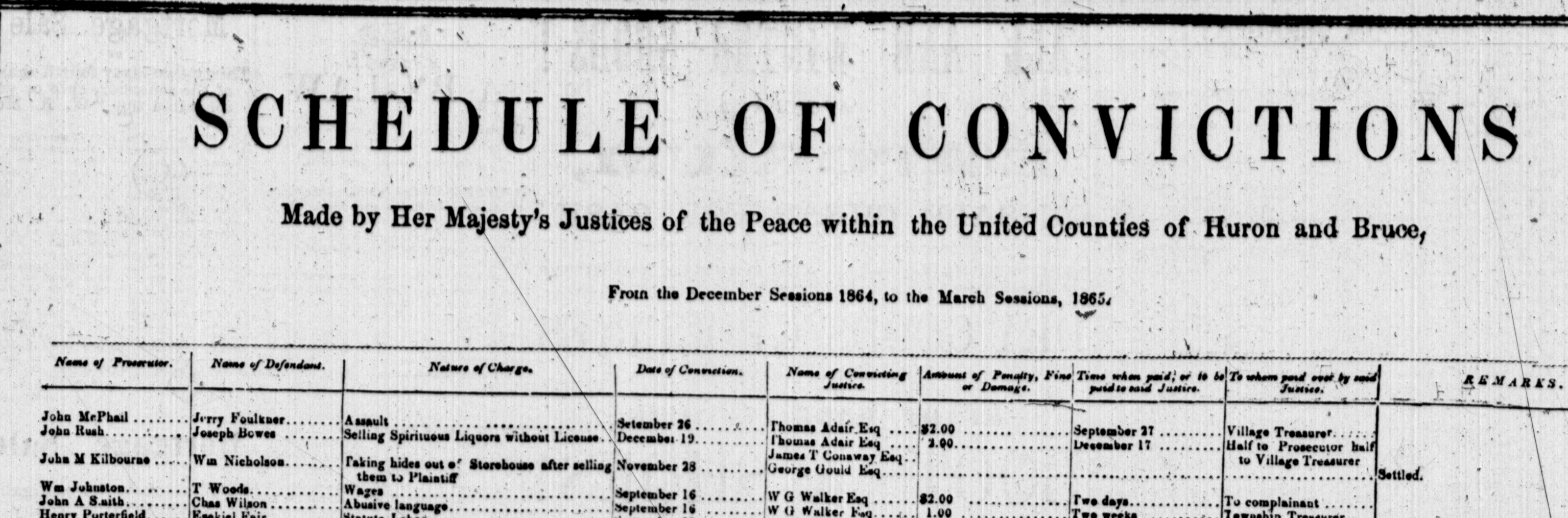
Newspaper clipping: "Schedule of Convictions." Columns list prosecutor, defendant, crime, result and remarks.
Clipping from the Huron Signal, 1865-04-06.  In the early decades of Huron County’s history,  local newspapers regularly published the full Schedules of Convictions listing those accused of crimes as well as accounts of court proceedings.

Research Resources

Huron County’s digitized newspapers chronicle local news from across the county! Click to search more than a century of history via Huron County’s digitized newspapers: free, online and keyword searchable.

You may find many items in the online newspapers about prisoners, significant cases, lists of crimes via the Schedule of Convictions, or the history of the building via reports to Council  & inquests. Review the search tips on our website to help with your search results.


Visit our online catalogue to find artifacts in the museum’s collection that  relate to the Huron Gaol or the communities it served, as well as local law enforcement and court systems.

For in-person research, you can find indexes for certain court records and information on how to book an appointment with the Archivist on the Archives page of our website! Scroll to the bottom for finding aids. Virtual appointments are also now available.

Reading List

Huron Historic Gaol | Huron County Library | BiblioCommons

Check out our reading list in the Huron County Library catalogue for books about the jail and notable prisoners, including Steven Truscott and James Donnelly.

Online Readings/Third Party Links:

The Final Days of Nicholas Melady Jr. as Witnessed by William Dickson

 Heaven & Hell on Earth: The Massacre of the Black Donnellys

Huron Historic Gaol: National Historic Site Designation


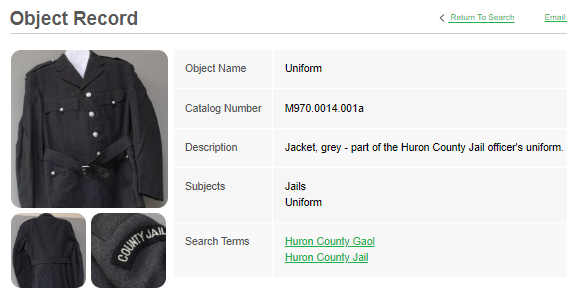
Screenshot of search results. Three Images of a jail uniform, including "County Jail" text on shoulder. Text identifies as "Jacket, grey - part of the Huron County Jail officer's uniform".
Search thousands of selected artifacts online!
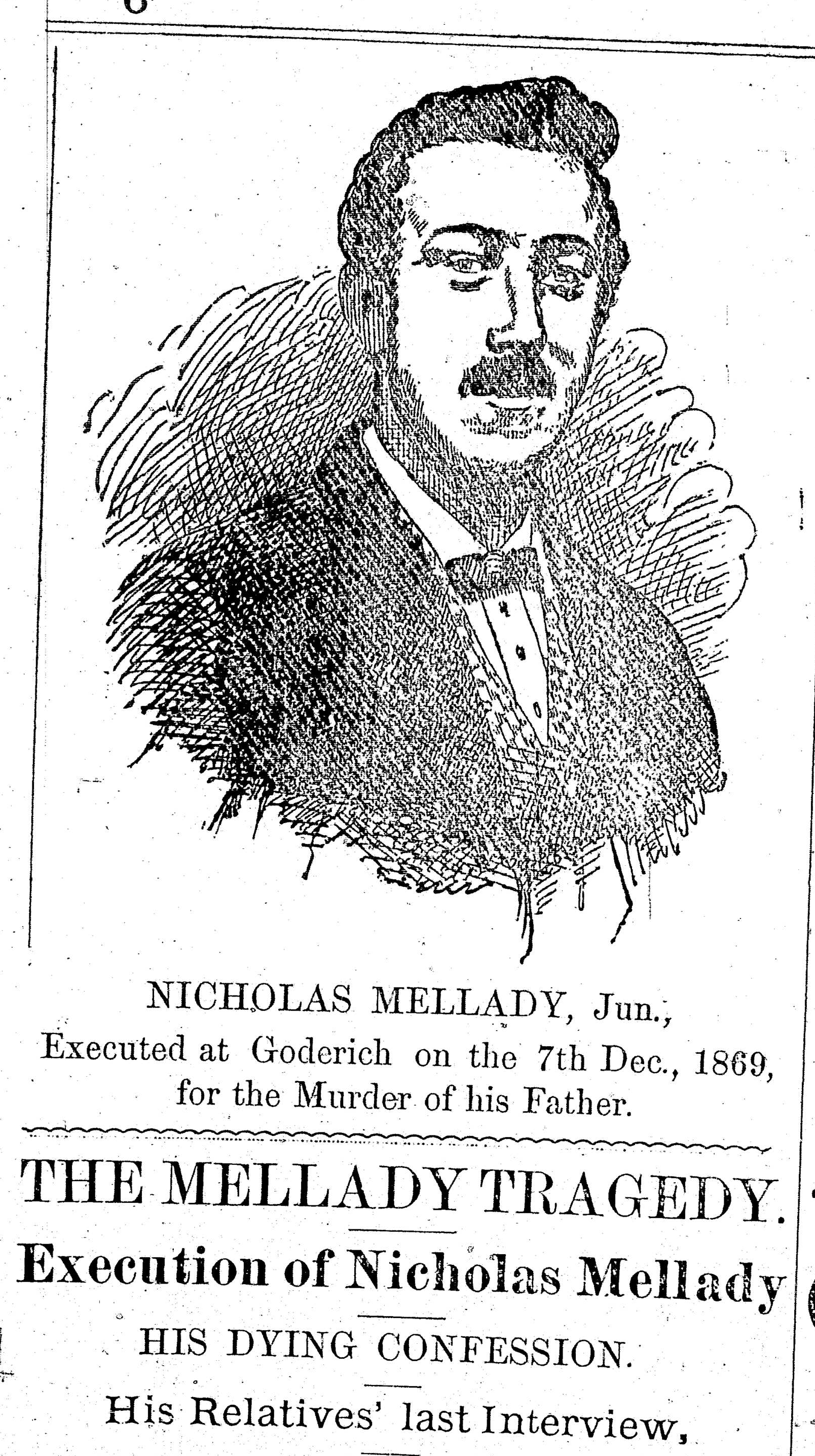
Black & white newspaper clipping. Print block image of an illustrated portrait of a mustached man in a suit. Text below: Nicholas Mellady, Executed at Goderich on the 7th Dec., 1869,<br />
for the Murder of his Father. THE MELLADY TRAGEDY.".<br />
Execution of Nicholas Mellady;HIS DYING CONFESSION.<br />
His Relatives' last Interview,"
From The Huron Expositor, 1869-12-11, pg 6. Access more online from the classroom or from home!
Prisoner Profiles
Prisoner Profiles is available from the gift shops at the Huron County Museum or Huron Historic Gaol, or borrow it for FREE from your local library!
An Unconquered Crime: Infanticide in Huron County

An Unconquered Crime: Infanticide in Huron County

According to the Criminal Code of Canada, “a female person commits infanticide when by a wilful act or omission she causes the death of her newly-born child.” Using local resources, student Kevin den Dunnen explores local cases of infanticide in the late 19th and 20th century (the period for which Gaol records are readily available), and the contemporary attitudes towards this act at home and abroad.

Through the 19th and 20th centuries, Huron County newspapers printed cases of infanticide, or the act of killing an infant, allegedly taking place in other countries and cultures. These articles often framed this the context of the supposed inferiority of cultures without the influence of Western Christianity. (1) However, the prevalence of infanticide in Huron County and surrounding areas during this same time period disproves any claims of cultural immunity to infanticide in southwestern Ontario’s Christian-dominated communities.

There are many social factors that contributed to the infanticides that occurred in Huron County. In the 19th and 20th centuries, a birth outside wedlock threatened an unmarried woman’s status in society. Many known infanticide cases in Huron County involved these young, unmarried women. Contributing to the devastating decision to commit infanticide was the lack of local social services available to single women needing help to provide for their child. As such, infanticide has been present in Huron County for much of its history.

The story of a Huron County woman called Catherine and her child exemplifies many of these themes. Catherine was a 30-year-old servant and unmarried woman working in Goderich Township in 1870. She had gone to her doctor that year claiming her body was swelling. The doctor suspected that she might be pregnant, but Catherine did not agree. Later on, her employer came home to find some of her work unfinished and could not find her. Upon searching, they found her sitting in a privy. After telling her to leave the privy several times, Catherine went to the house. Upon inspection of the privy the next morning, the house-owner and a doctor found a dead child in the privy vault covered by paper and a board. In his subsequent report, the coroner believed that the baby was born alive. (2) Upon first reading, this story appears to be a cold-blooded case of infanticide, but the reality of the society around Catherine makes the situation far more complex.

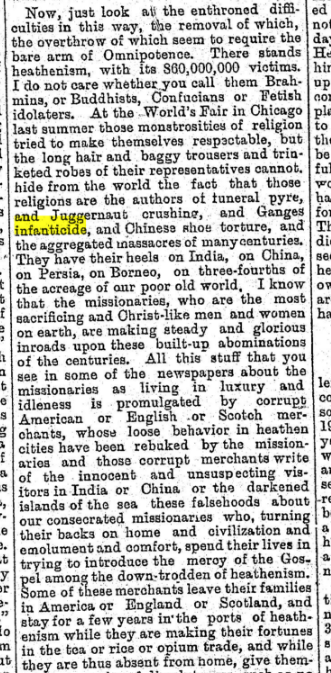
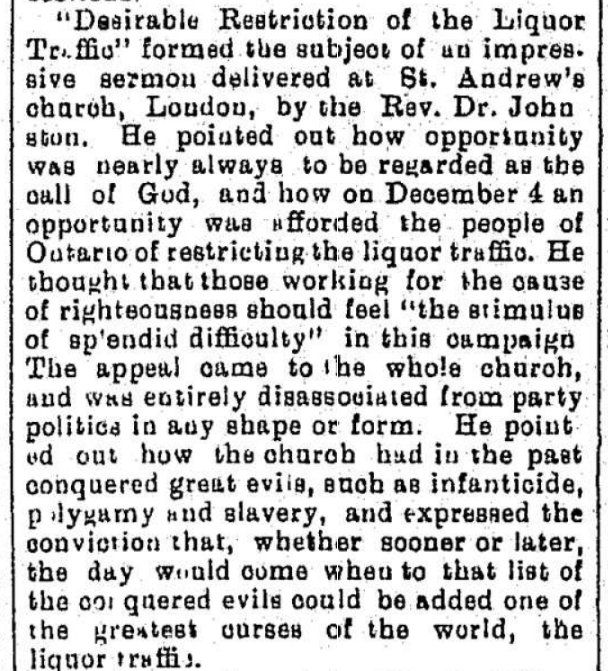
Turn of the 20th century newspapers in Huron County printed or reprinted articles from larger news agencies about non-Christian societies in India, China, and Hawaii and touted their supposed propensity of infanticide. These stories promoted the positive influence of Christian conversion outside of Canada, even though infanticide was also a local issue. Figure 1 is one such article from The Exeter Times, published on Feb. 1, 1894. This article states that the work of missionaries converting foreign societies to Christianity would “introduce the mercy of the Gospel among the down-trodden of heathenism.” The uncredited author claimed non-Christian cultures frequently committed infanticide but stopped when they converted to Christianity. (3) There is an apparent hypocrisy in these newspapers portraying other societies as uncivilized while the same issues were happing contemporaneously in their own Ontario communities. Figure 2 shows an article from The Brussels Post, dated Nov. 20, 1902. In this article, the author argues the need for laws restricting the distribution of alcohol. They state that such opportunities to change society are “the call of God” whose influence had already “conquered great evils, such as infanticide.” Yet, infanticide still occurred in the paper’s own region.

How prevalent an issue infanticide was throughout Huron County’s history is difficult to know, because many cases likely went unreported. A large proportion of the known cases involved single mothers of illegitimate children. However, some scholars suggest that more cases of undocumented infanticide frequently occurred in Western societies. These theories argue that hidden infanticide by married couples might partly explain changing gender ratios in select western societies. They claim this was a way of tailoring gender to fit family needs, like wanting males to help with farming. (4) Single women living and working away from their families would face greater difficulties concealing a birth without detection. Hidden infanticide drew attention from journals like the Upper Canada Journal of Medical, Surgical and Physical Science in 1852. This journal argued that women should have to register their children immediately after birth to lessen the chance of hidden infanticide. (5) This call for registration suggests that the journal suspected or knew of infanticide cases where the mother did not register their child to hide its birth. This research indicates that communities like Huron County could have many cases of infanticide that county records do not include.

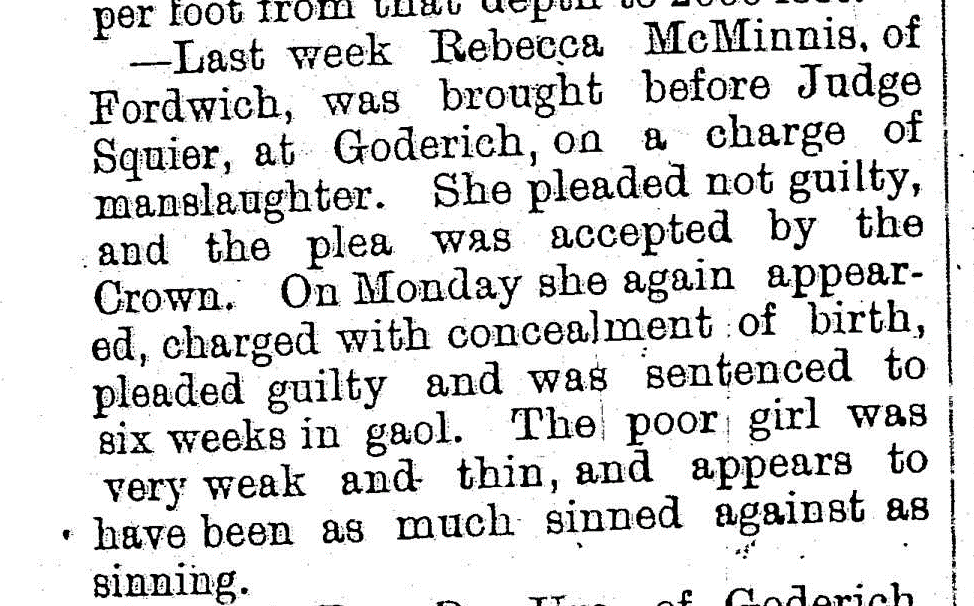
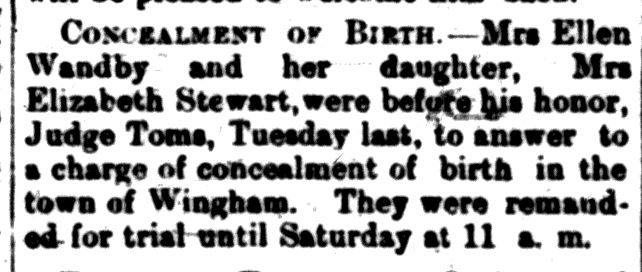
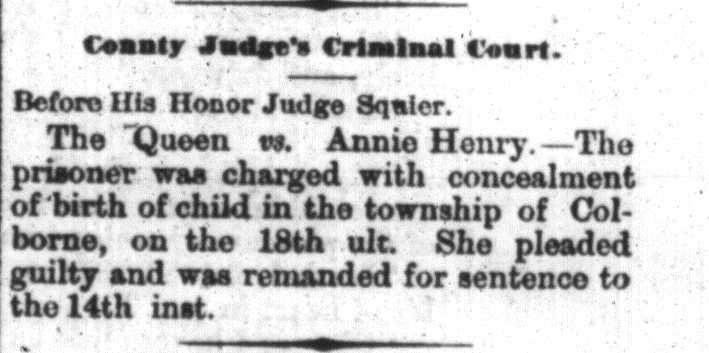
One record that is available for study is the “Huron County Gaol Registry.” The portion of the Registry currently available for research includes entries for every person who stayed at the Gaol from 1841-1922. There are at least 12 cases that list infanticide, concealment of birth, child exposure, or a related charge as the reason for committal (Figure 3 and 4). While not a staggeringly high number, these records only include the people sentenced to gaol for allegedly killing their infant or related crimes. If they were not apprehended or not committed to jail, they would not appear in the registry. Additional cases do appear in the local newspaper accounts (Figure 5) and coroner’s inquest records , including Catherine’s story .  The registry shows that the first prisoner committed for infanticide came to the Gaol in 1846 and that a prisoner was committed for procuring drugs for an illegal abortion in 1920. While not demonstrating frequency with complete accuracy, the registry clearly does indicate that infanticide and other crimes resulting from unwanted pregnancies occurred in Huron County throughout the entire period documented from 1841-1922. These instances of infanticide would increase when including the records of nearby counties like Middlesex, Bruce, and Perth, which also had reported infanticide cases during the same period. There was therefore no reason to look to other countries to find the circumstances that fostered infanticide: Huron County residents could see the evidence in their own towns and the surrounding counties.

image of a newspaper clipping

Figure 1: “The Safe Arm of God,” The Exeter Times, 1894-2-1, Page 6 

Image of figure 2 - newspaper clipping from Brussels Post

Figure 2: “Prohibition Notes,” The Brussels Post, 1902-11-20, Page 4

Figure 3: Newspaper clipping from The Huron Expositor, 07-22-1881, pg 5.

Figure 3: The Huron Expositor, 07-22-1881, pg 5.

Newspaper clipping: "Concealment of a Birth" Mrs. Ellen Wandby and her daughter, Mrs. Elizabeth Stewart, were before his honour Judge Toms, Tuesday last, to answer to a charge of concealment of birth in the town of Wingham.

Figure 4:The Huron Signal, 06-10-1887, pg 4.

Figure 3: Newspaper clipping from The Huron Expositor, 07-22-1881, pg 5.

Figure 5: The Huron Signal, 12-10-1880, pg 1.

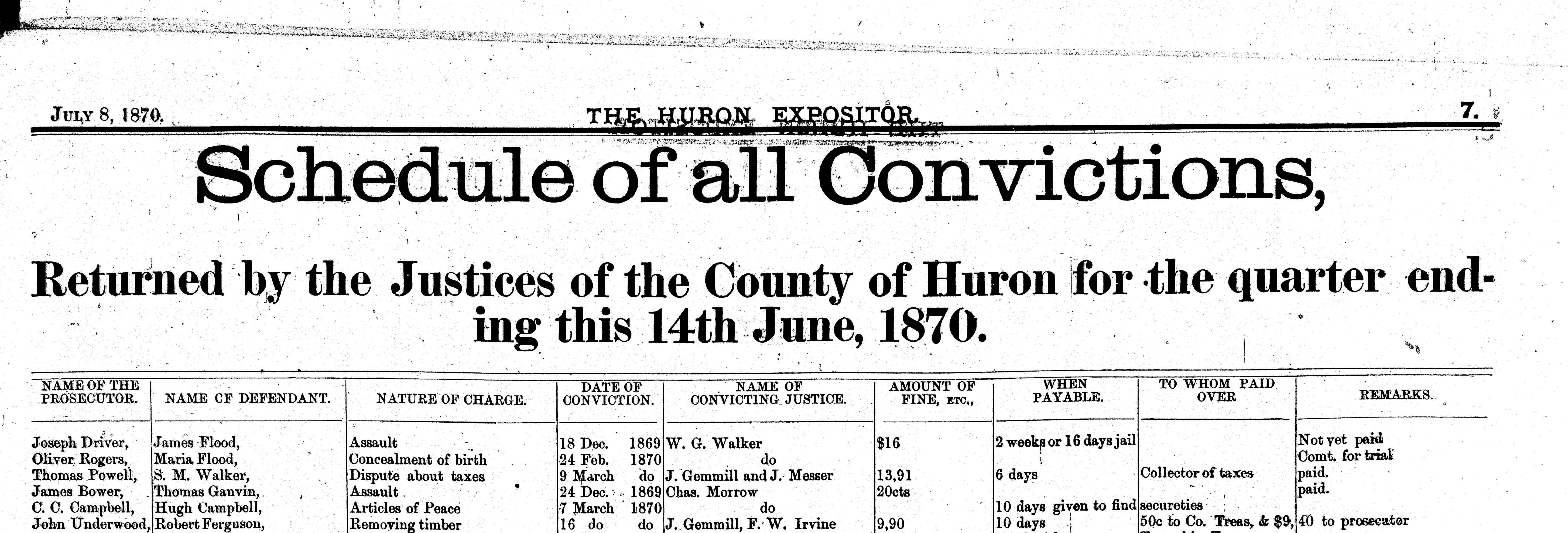
Image of newspaper clipping from 1870 Schedule of Convictions featuring prosecution of Maria Flood for “concealment of birth.” The Huron Expositor, 07/08/1870, pg 1.

Mothers faced most of the blame for infanticide from the legal system and contemporary journalists for reported cases. However, this viewpoint often neglects to consider both the devastating judgements placed upon these women for their unwanted pregnancies, and the lack of support available to help struggling mothers. Of the cases involving infanticide, concealment of birth, or abortion found in the Huron County newspapers and Gaol records, a large number involve young women under 25 years old and illegitimate children (the offspring of a couple not married to each other).  For example, a case from 1864 involves a 15-year-old unmarried female servant; a case from 1877 involves a 22-year-old single female servant; a case from 1880 involves a 17-year-old female servant. As servants, these women were dependent on wage labour. With the birth of a child, the woman would have to give up employment to care for the baby, as without the security of legal marriage the father would often refuse any support. Her ability to care for herself, let alone the child, declined greatly after giving birth. In addition, women faced religious and societal pressures to remain chaste until marriage. Bearing an illegitimate child proved to society that a woman was unchaste. (6) Women who gave birth to illegitimate children, no matter the circumstances of their conception, would face harsh judgement from their communities, which could impact their ability to find new work or to be married. These women with illegitimate children immediately became outcasts. This happened because Christian societies at the time judged much of a single woman’s morality and value according to her chastity. (7) As such, women of this period faced significant social judgement if they had an illegitimate child. The idea of concealing the child’s birth may have appeared to be the only choice for single mothers hoping to retain their ability to earn a living, maintain their place in society and avoid becoming an outcast, which could lead to cases of infanticide and child abandonment. 

The lack of available social services in Huron County before the 20th century could also factor into these cases of infanticide. Before Huron County’s House of Refuge opened near Clinton in 1895, the only municipal building available for social services was the Huron County Gaol. There was no local lying-in hospital or home for unwed mothers. During this period, the Gaol often housed the elderly, destitute, and sick. Some lower tier municipalities made the choice to commit unwed mothers to gaol to give birth, and multiple women would have their babies behind bars at the Huron Gaol. This was an inexpensive way to house the mother and child until such a time she could return to the labour market. A young woman faced with the birth of an illegitimate child in Huron County would therefore have little support and few options available should she struggle to care and provide for her baby, and may have to bear the stigma of being committed to gaol regardless of committing a crime.

While newspapers like The Exeter Times and Lucknow Sentinel reprinted articles featuring infanticide as a cautionary tale to criticize and condemn outside cultures and to promote the positive influence of western Christianity, infanticide remained prevalent in their own communities. Stories like that of Catherine demonstrate the difficult circumstances that sometimes drove women to commit infanticide. Having an illegitimate child immediately lessened the perceived status and life options of a young woman in respectable Christian Southwestern Ontario society. Also contributing to the devastating decision by some of these young women to commit infanticide was the lack of social services available to help them provide for a child. As such, infanticide was not a conquered issue for the residents of Huron County in the 19th and early 20th century.

Sources:

  • (1) Nicola Goc, Women, Infanticide, and the Press, 1822-1922: News Narratives in England and Australia (New York, NY: Routledge, 2016), 28.
  • (2) Coroner’s Report #365 Huron County Archives,  Unnamed baby of  Catherine J.  
  • (3 “The Safe Arm of God,” The Exeter Times, February 1, 1894, p. 6.
  • (4) Gregory Hanlon, “Routine Infanticide in the West 1500-1800,” History Compass 14, no. 11 (2016): pp. 535-548, https://doi.org/10.1111/hic3.12361, 537. 
  • (5) Kirsten Johnson Kramar, Unwilling Mothers, Unwanted Babies: Infanticide in Canada (Vancouver, BC: UBC Press, 2006), 97.
  • (6) Nicolá, Women, Infanticide, and the Press, 21.
  • (7) Nicolá, Women, Infanticide, and the Press, 21.

Further Reading

Find an index of coroner’s inquests on our Archives page (scroll to the bottom to find indexes and finding aids).

Find more stories from Huron’s past through a search of Huron County’s historical newspapers online!

Double, Double Toil and Trouble: The Tale of Maggie Pollock and the Huron County Witch Trial

Double, Double Toil and Trouble: The Tale of Maggie Pollock and the Huron County Witch Trial

In time for Halloween, students Kyra Lewis & Mary Murdoch share the history of witches in North America and Huron County’s own witchcraft case: “the weirdest [case] that has come before the Ontario Courts in many years”.

Today, popular culture often suggests that the legal pursuit of witches was something that began and ended with the infamous Salem Witch Trials in Salem, MA, in the 1690s. However, that was far from the beginning or end of the story. In fact, Huron County had its own witchcraft case as recently as the 1920s: the case of Maggie Pollock of Morris Township.

Background: The History of Witchcraft Law in North America

The history of prosecuting witchcraft as a crime has a long history in North America preceding Miss Pollock’s case. Historic Haudenosaunee society viewed witchcraft as very serious offence. Because witchcraft could endanger anyone in the community, people took accusations of witchcraft very seriously. Practicing witchcraft also went against the core principles of unity and peace found in “The Great Law”. The Great Law refers to the guiding principles of life in the Haudenosaunee Confederacy. The first step was to determine if the person was guilty. If the Council found the accused to be guilty, the punishment was death. If the accused promised to change their ways, they would always be forgiven and spared.

By the time Europeans began settling in North America, widespread panic surrounding witchcraft had decreased in Europe. However, in the 13 American colonies, settlers were still paranoid about the possibility of witches living in their midst. Not Salem, but Windsor, CT, was actually the first place in the US where an execution of a person charged with witchcraft took place. In total, Connecticut accused 46 people of witchcraft between 1647 and 1697. Of the 46 accused, 11 were executed. There were also witchcraft trials in Virginia between 1626 and 1730, but no executions.

Massachusetts’ Salem Witch Trials began in June of 1692. Residents of Salem accused 150 men and women of witchcraft. Over a period of 11 months, the residents of Salem killed 19 people by hanging and tortured one man to death. Of the 20 people killed, six were men. Five more people would die in prison before the end of the trials.

In Canada, pretending to practice witchcraft was illegal until 2018 under section 365 of the Criminal Code of Canada. This section read:

Pretending to practise witchcraft, etc.

365 Every one who fraudulently

  • (a) pretends to exercise or to use any kind of witchcraft, sorcery, enchantment or conjuration,
  • (b) undertakes, for a consideration, to tell fortunes, or
  • (c) pretends from his skill in or knowledge of an occult or crafty science to discover where or in what manner anything that is supposed to have been stolen or lost may be found, is guilty of an offence punishable on summary conviction.

Note that the crime in question was pretending to practice witchcraft. The Criminal Code of Canada did not mention the practice of witchcraft itself. The law was implemented in 1892 and was based off of a previous 1735 British Statute which condemned “fraudulent” claims of occult powers. The statute attempted to remove earlier religious rhetoric prior to the 18th century, which presumed and enforced that witches were indeed a very justifiable and dangerous threat to humanity. Instead, the 1735 Statute suggested that claiming occult powers was inherently fraudulent, thus upholding the notion that witches were not real. Logistically it was intended to limit fraud, and preying on the naive and desperate, but much like earlier witchcraft laws it could be used to prosecute vulnerable or marginalized women.

Although not commonly used in the 20th and 21st centuries, the law against pretending to practice witchcraft remained in effect until 2018.  Maggie Pollock, a Huron County woman, was charged under the law in 1919 in “the weirdest [case] that has come before the Ontario Courts in many years”.

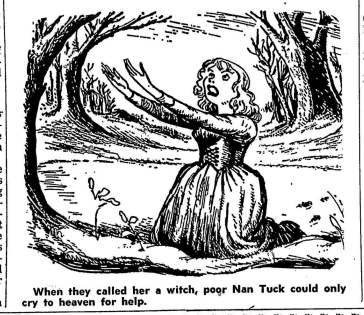
Illustration of a young woman being accused of witchcraft

The Huron Expositor, 1963

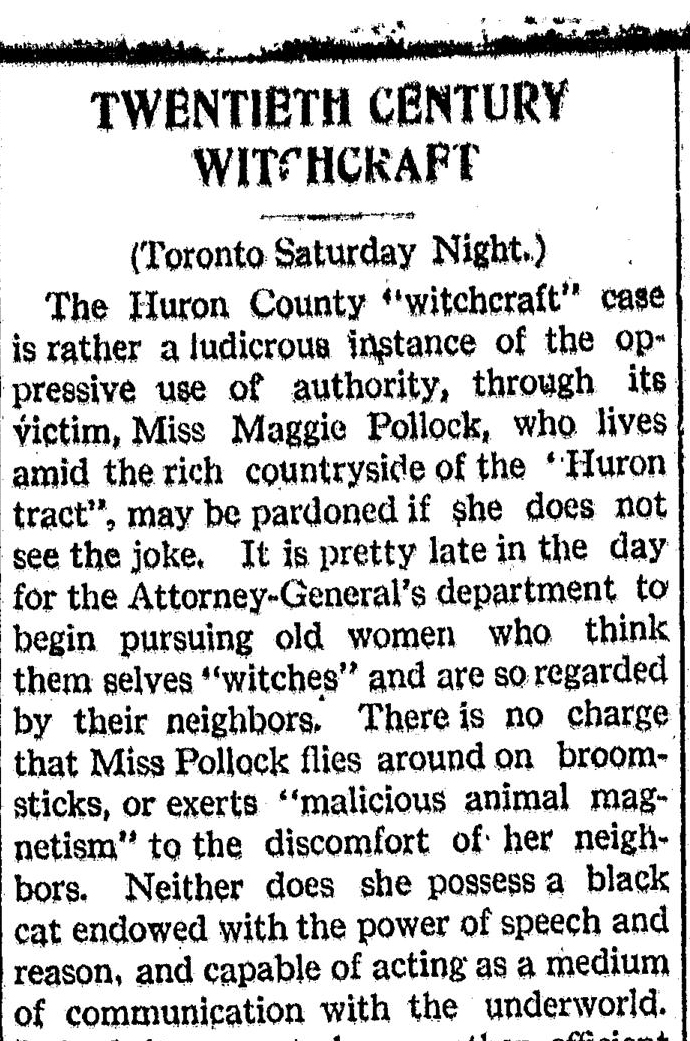
Newspaper clipping from WIngham Advance

The Wingham Advance, 1920-04-29

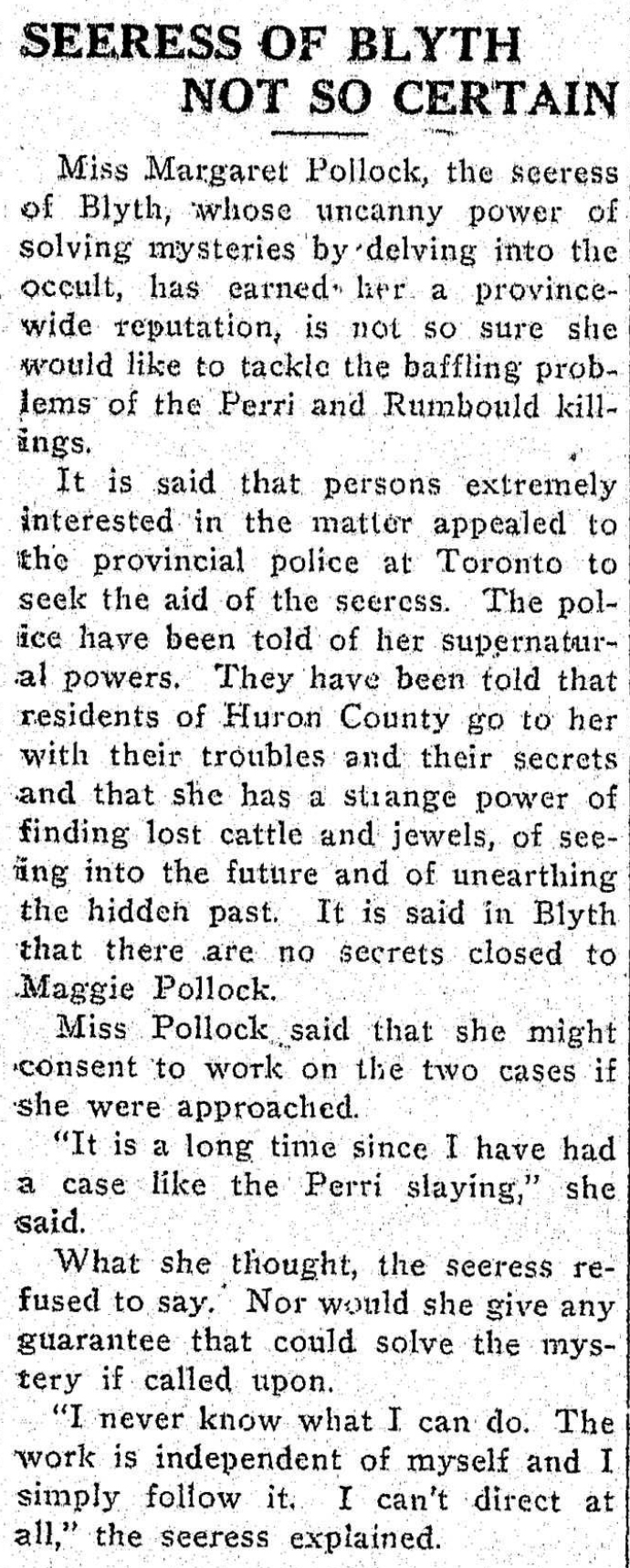
newspaper clipping from Wingham Advance Times

Wingham Advance Times, 1930-09-11

Morris Township’s Gifted Lady

Margaret Pollock, more often referred to as “Maggie” or “Miss Pollock”, was a woman born in Huron County on May 11, 1879.

She was of Irish descent and lived and worked on her brother’s farm as a housekeeper in Morris Township, near Blyth. Maggie claimed to be “possessed with a peculiar occult gift” that she used on several occasions to help neighbors locate lost or stolen items and property. Following a peculiar court case, Maggie’s “gifts” would earn her sudden celebrity not only in Huron County, but across the country.

From a young age, Maggie knew that she had a special gift. At 16, she realized that she had an ability to see and to hear things that others could not. While visiting a friend’s house in Boston, Maggie realized that she had seen the house and an elderly woman who lived there before. Around the turn of the century, Maggie experienced visions of two strange machines. The first Maggie thought was a chariot of angels at first glance, but then she noticed that the machine had wheels. It shocked Maggie when she saw the machine in the sky land right beside her and saw regular people disembark from it. Maggie saw the second strange machine when she was driving down the road and turned around to see a machine that ran like a train without a track behind her. This vision puzzled Maggie. It wasn’t until many years later that Maggie realized that she had seen an airplane and a car many years before the modern version of either was invented. While some might label Maggie’s gift as relating to the occult, Maggie claimed that her abilities were completely natural, without witchcraft or trickery involved. When Maggie’s neighbours came to her for help, Maggie never guaranteed results, but rather promised to do the best that she could to help them. When questioned about the things she saw, Maggie claimed that she had no powers of her own, but that her visions and insights were a God-given gift which she felt compelled to share when they came to her.

Huron County’s Witchcraft Case

On June 30, 1919, Maggie was brought to the Huron County Gaol after she was accused of “Telling Fortunes,” which was illegal under section 365 of the Canadian Criminal Code. In Goderich, a farmer had testified that he had given Maggie 50 cents for a séance. He did this in an attempt to locate oats and grain which someone had stolen from him. It wasn’t revealed in court whether Maggie’s premonition actually resulted in recovering the oats and grain, but she saw a vision of the thief and was able to describe his horse. She appeared before Goderich Judge Henry Dickson, and the court decided that; “she did unlawfully pretend from her skill and knowledge in an occult and crafty science to discover when and in what manner certain goods and chattels, to wit, certain grain and oats, supposed to have been stolen from one, John Lienhardt.”

On Oct. 13, 1920, Maggie’s case was appealed to Osgoode Hall, one of the oldest and most distinguished legal associations in the country, by her counsel, Mr. C. Garrow. Osgoode upheld Judge Dickson’s conviction. According to the contemporary account of the Clinton News Record, “The judge admonished her that the practice must cease and has bound her over in bonds of $200 from herself and from her brother to refrain from pretensions of occult power and from practicing the occult science.” The court gave Maggie permission to offer her opinion about lost items, but not to claim that she had any special powers.

Members of the local community continued to support Maggie during her conviction and appeal, and her supporters were upset with her treatment in the legal system. The Toronto Saturday Night chastised the judges and those involved with the case for, “harrying a poor old woman.” A neighbour, Mrs. Sinclair, also testified at Osgoode Hall to corroborate the effectiveness of Maggie’s “gifts”. She stated that Maggie had successfully helped her to find a lost diamond ring. Maggie had claimed to do this by speaking with Sinclair’s deceased mother, and told Mrs. Sinclair that she had thrown out the ring with some dust. Maggie added that Mrs. Sinclair would find the ring when the snow melted. Despite this advice, Mrs. Sinclair and her husband decided to melt the snow. When this did not work, she sent a letter to Maggie detailing what she had done, and that she had not found the ring. Maggie replied that Mrs. Sinclair needed to be patient. Sure enough, the snow thawed weeks later, and the ring was there.

The Legend of Miss Maggie Pollock 

Considering a continued public fascination with witchcraft and the occult, it is no surprise that Maggie’s legal battle gained widespread recognition in 1920. It was notable to some that an older woman from Huron County could perform such “miracles,” while others were shocked that she could be accused of something as archaic as witchcraft. The Toronto Daily Star questioned the wisdom of the verdict: “There is a fairly widespread belief in the occult. It is growing. Why not cope with this sort of thing more intelligently than by merely putting the ban of the law upon it?” The same article suggested that rather than legal prosecution, a public test to determine the validity of Maggie’s gifts would be the superior solution: her powers could simply be disproved or verified to harmlessly help with more cases of missing valuables.

A large number of supporters did not doubt Maggie’s abilities. She received many visitors and letters from people as far away as Florida, Texas, Missouri, Nebraska, California and Vancouver. Her skills were also allegedly sought-after on the other side of the law. The police asked her to locate missing bodies of drowned persons several times: including a young boy who had drowned in Wingham and a man who fell through ice in New Hamburg. The Seaforth News reported that Maggie was also paid a visit by High Constable A.J. Wharton of London to discuss the escape of two murderers from London Jail in 1927.  

Maggie Pollock passed away in August of 1931, in her 70th year. The Seaforth News said of her, “[She] has honour in her own country, because her neighbours have always had the upmost faith in her and can relate scores of interesting stories.” She was fondly remembered as, “a well-known and highly respected resident of Morris Township.” Despite the verdict of the witchcraft case, Maggie was able to continue to help others with her gifts as she had wanted. Whether those gifts were real is still something up for debate. One thing is certain, Miss Maggie Pollock was one magical woman, one way or another.

Sources Consulted & Links to Learn More!