Double, Double Toil and Trouble: The Tale of Maggie Pollock and the Huron County Witch Trial
In time for Halloween, students Kyra Lewis & Mary Murdoch share the history of witches in North America and Huron County’s own witchcraft case: “the weirdest [case] that has come before the Ontario Courts in many years”.
Today, popular culture often suggests that the legal pursuit of witches was something that began and ended with the infamous Salem Witch Trials in Salem, MA, in the 1690s. However, that was far from the beginning or end of the story. In fact, Huron County had its own witchcraft case as recently as the 1920s: the case of Maggie Pollock of Morris Township.
Background: The History of Witchcraft Law in North America
The history of prosecuting witchcraft as a crime has a long history in North America preceding Miss Pollock’s case. Historic Haudenosaunee society viewed witchcraft as very serious offence. Because witchcraft could endanger anyone in the community, people took accusations of witchcraft very seriously. Practicing witchcraft also went against the core principles of unity and peace found in “The Great Law”. The Great Law refers to the guiding principles of life in the Haudenosaunee Confederacy. The first step was to determine if the person was guilty. If the Council found the accused to be guilty, the punishment was death. If the accused promised to change their ways, they would always be forgiven and spared.
By the time Europeans began settling in North America, widespread panic surrounding witchcraft had decreased in Europe. However, in the 13 American colonies, settlers were still paranoid about the possibility of witches living in their midst. Not Salem, but Windsor, CT, was actually the first place in the US where an execution of a person charged with witchcraft took place. In total, Connecticut accused 46 people of witchcraft between 1647 and 1697. Of the 46 accused, 11 were executed. There were also witchcraft trials in Virginia between 1626 and 1730, but no executions.
Massachusetts’ Salem Witch Trials began in June of 1692. Residents of Salem accused 150 men and women of witchcraft. Over a period of 11 months, the residents of Salem killed 19 people by hanging and tortured one man to death. Of the 20 people killed, six were men. Five more people would die in prison before the end of the trials.
In Canada, pretending to practice witchcraft was illegal until 2018 under section 365 of the Criminal Code of Canada. This section read:
Pretending to practise witchcraft, etc.
365 Every one who fraudulently
- (a) pretends to exercise or to use any kind of witchcraft, sorcery, enchantment or conjuration,
- (b) undertakes, for a consideration, to tell fortunes, or
- (c) pretends from his skill in or knowledge of an occult or crafty science to discover where or in what manner anything that is supposed to have been stolen or lost may be found, is guilty of an offence punishable on summary conviction.
Note that the crime in question was pretending to practice witchcraft. The Criminal Code of Canada did not mention the practice of witchcraft itself. The law was implemented in 1892 and was based off of a previous 1735 British Statute which condemned “fraudulent” claims of occult powers. The statute attempted to remove earlier religious rhetoric prior to the 18th century, which presumed and enforced that witches were indeed a very justifiable and dangerous threat to humanity. Instead, the 1735 Statute suggested that claiming occult powers was inherently fraudulent, thus upholding the notion that witches were not real. Logistically it was intended to limit fraud, and preying on the naive and desperate, but much like earlier witchcraft laws it could be used to prosecute vulnerable or marginalized women.
Although not commonly used in the 20th and 21st centuries, the law against pretending to practice witchcraft remained in effect until 2018. Maggie Pollock, a Huron County woman, was charged under the law in 1919 in “the weirdest [case] that has come before the Ontario Courts in many years”.
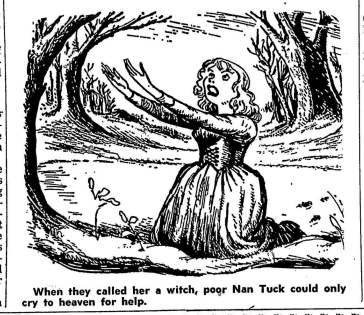
The Huron Expositor, 1963
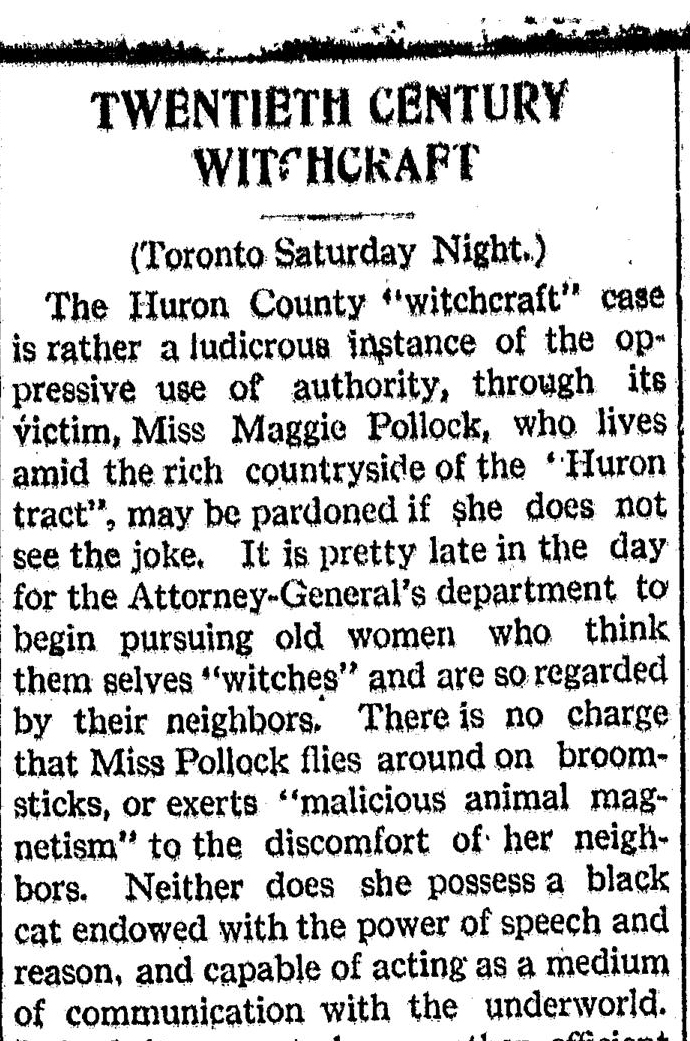
The Wingham Advance, 1920-04-29
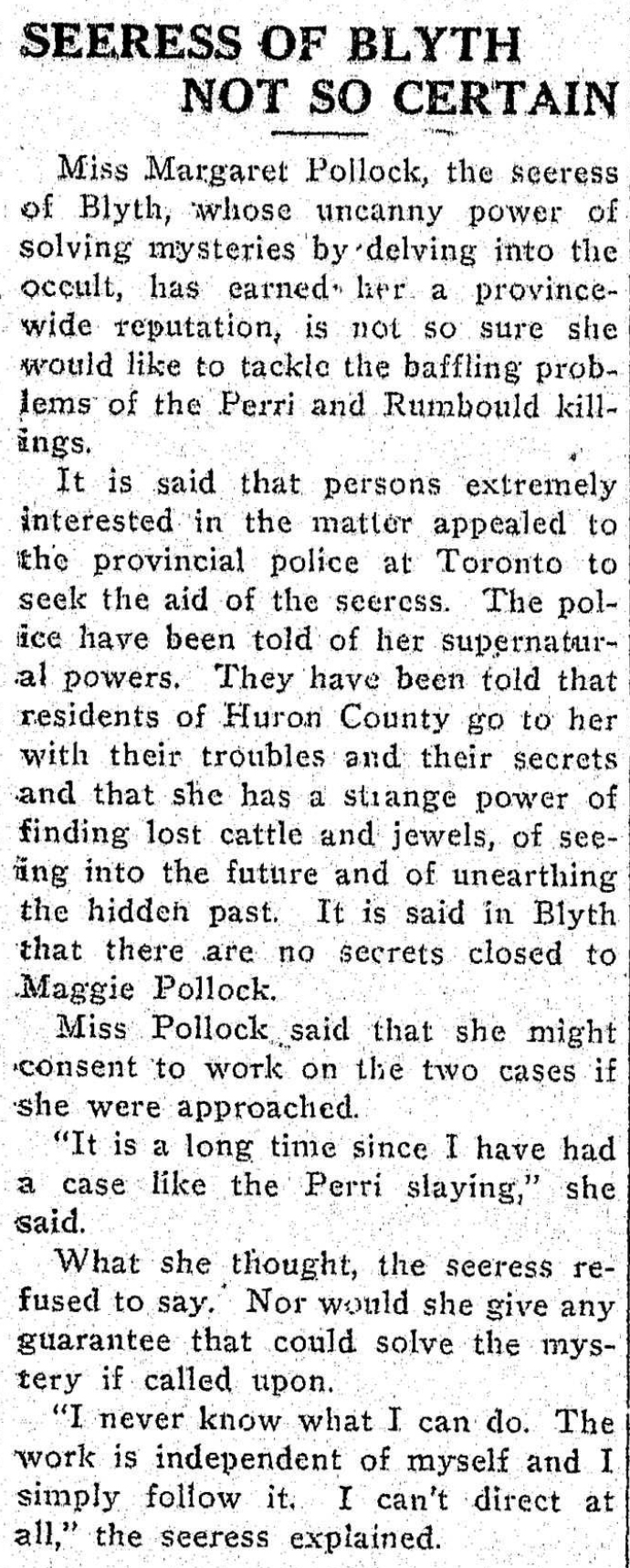
Wingham Advance Times, 1930-09-11
Morris Township’s Gifted Lady
Margaret Pollock, more often referred to as “Maggie” or “Miss Pollock”, was a woman born in Huron County on May 11, 1879.
She was of Irish descent and lived and worked on her brother’s farm as a housekeeper in Morris Township, near Blyth. Maggie claimed to be “possessed with a peculiar occult gift” that she used on several occasions to help neighbors locate lost or stolen items and property. Following a peculiar court case, Maggie’s “gifts” would earn her sudden celebrity not only in Huron County, but across the country.
From a young age, Maggie knew that she had a special gift. At 16, she realized that she had an ability to see and to hear things that others could not. While visiting a friend’s house in Boston, Maggie realized that she had seen the house and an elderly woman who lived there before. Around the turn of the century, Maggie experienced visions of two strange machines. The first Maggie thought was a chariot of angels at first glance, but then she noticed that the machine had wheels. It shocked Maggie when she saw the machine in the sky land right beside her and saw regular people disembark from it. Maggie saw the second strange machine when she was driving down the road and turned around to see a machine that ran like a train without a track behind her. This vision puzzled Maggie. It wasn’t until many years later that Maggie realized that she had seen an airplane and a car many years before the modern version of either was invented. While some might label Maggie’s gift as relating to the occult, Maggie claimed that her abilities were completely natural, without witchcraft or trickery involved. When Maggie’s neighbours came to her for help, Maggie never guaranteed results, but rather promised to do the best that she could to help them. When questioned about the things she saw, Maggie claimed that she had no powers of her own, but that her visions and insights were a God-given gift which she felt compelled to share when they came to her.
Huron County’s Witchcraft Case
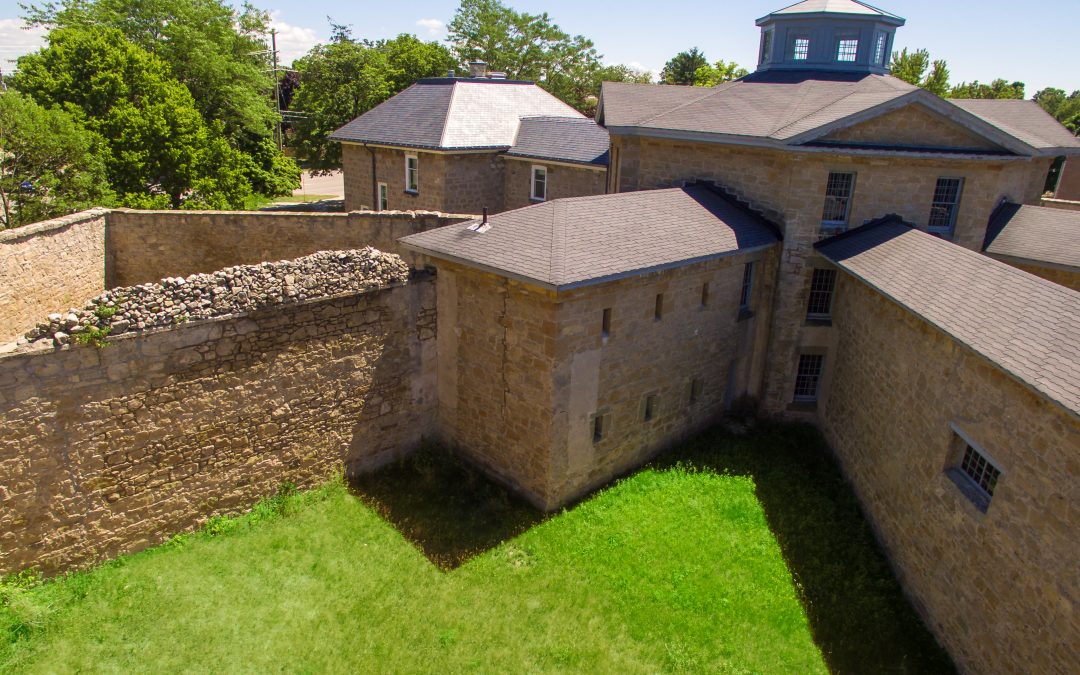
On June 30, 1919, Maggie was brought to the Huron County Gaol after she was accused of “Telling Fortunes,” which was illegal under section 365 of the Canadian Criminal Code. In Goderich, a farmer had testified that he had given Maggie 50 cents for a séance. He did this in an attempt to locate oats and grain which someone had stolen from him. It wasn’t revealed in court whether Maggie’s premonition actually resulted in recovering the oats and grain, but she saw a vision of the thief and was able to describe his horse. She appeared before Goderich Judge Henry Dickson, and the court decided that; “she did unlawfully pretend from her skill and knowledge in an occult and crafty science to discover when and in what manner certain goods and chattels, to wit, certain grain and oats, supposed to have been stolen from one, John Lienhardt.”
On Oct. 13, 1920, Maggie’s case was appealed to Osgoode Hall, one of the oldest and most distinguished legal associations in the country, by her counsel, Mr. C. Garrow. Osgoode upheld Judge Dickson’s conviction. According to the contemporary account of the Clinton News Record, “The judge admonished her that the practice must cease and has bound her over in bonds of $200 from herself and from her brother to refrain from pretensions of occult power and from practicing the occult science.” The court gave Maggie permission to offer her opinion about lost items, but not to claim that she had any special powers.
Members of the local community continued to support Maggie during her conviction and appeal, and her supporters were upset with her treatment in the legal system. The Toronto Saturday Night chastised the judges and those involved with the case for, “harrying a poor old woman.” A neighbour, Mrs. Sinclair, also testified at Osgoode Hall to corroborate the effectiveness of Maggie’s “gifts”. She stated that Maggie had successfully helped her to find a lost diamond ring. Maggie had claimed to do this by speaking with Sinclair’s deceased mother, and told Mrs. Sinclair that she had thrown out the ring with some dust. Maggie added that Mrs. Sinclair would find the ring when the snow melted. Despite this advice, Mrs. Sinclair and her husband decided to melt the snow. When this did not work, she sent a letter to Maggie detailing what she had done, and that she had not found the ring. Maggie replied that Mrs. Sinclair needed to be patient. Sure enough, the snow thawed weeks later, and the ring was there.
The Legend of Miss Maggie Pollock
Considering a continued public fascination with witchcraft and the occult, it is no surprise that Maggie’s legal battle gained widespread recognition in 1920. It was notable to some that an older woman from Huron County could perform such “miracles,” while others were shocked that she could be accused of something as archaic as witchcraft. The Toronto Daily Star questioned the wisdom of the verdict: “There is a fairly widespread belief in the occult. It is growing. Why not cope with this sort of thing more intelligently than by merely putting the ban of the law upon it?” The same article suggested that rather than legal prosecution, a public test to determine the validity of Maggie’s gifts would be the superior solution: her powers could simply be disproved or verified to harmlessly help with more cases of missing valuables.
A large number of supporters did not doubt Maggie’s abilities. She received many visitors and letters from people as far away as Florida, Texas, Missouri, Nebraska, California and Vancouver. Her skills were also allegedly sought-after on the other side of the law. The police asked her to locate missing bodies of drowned persons several times: including a young boy who had drowned in Wingham and a man who fell through ice in New Hamburg. The Seaforth News reported that Maggie was also paid a visit by High Constable A.J. Wharton of London to discuss the escape of two murderers from London Jail in 1927.
Maggie Pollock passed away in August of 1931, in her 70th year. The Seaforth News said of her, “[She] has honour in her own country, because her neighbours have always had the upmost faith in her and can relate scores of interesting stories.” She was fondly remembered as, “a well-known and highly respected resident of Morris Township.” Despite the verdict of the witchcraft case, Maggie was able to continue to help others with her gifts as she had wanted. Whether those gifts were real is still something up for debate. One thing is certain, Miss Maggie Pollock was one magical woman, one way or another.
Sources Consulted & Links to Learn More!
- Access Huron County’s digitized newspapers, including contemporary accounts of Maggie’s case from papers like the Brussels Post, Signal (Goderich) and Seaforth News
- THE INHERENT RIGHT OF THE HAUDENOSAUNEE TO CRIMINAL JUSTICE JURISDICTION IN CANADA: A PRELIMINARY INQUIRY by Michael R Cousins
- A Report on the Relationship between Restorative Justice and Indigenous Legal Traditions in Canada, Government of Canada
- “Canada’s last witch trials: Women accused of fake witchcraft” by Robin Levinson-King
- History of Witches via the History Channel
-
UK Parliament – on witchcraft laws in Britain, good to see the evolution of the law and how it got to the Canadian criminal code
-
Surry Heritage – Witchcraft in Surrey
-
In Canada, pretending to be a witch is a punishable offense – The Washington Post