by Amy Zoethout | Jan 21, 2025 | Blog, Huron Made
The
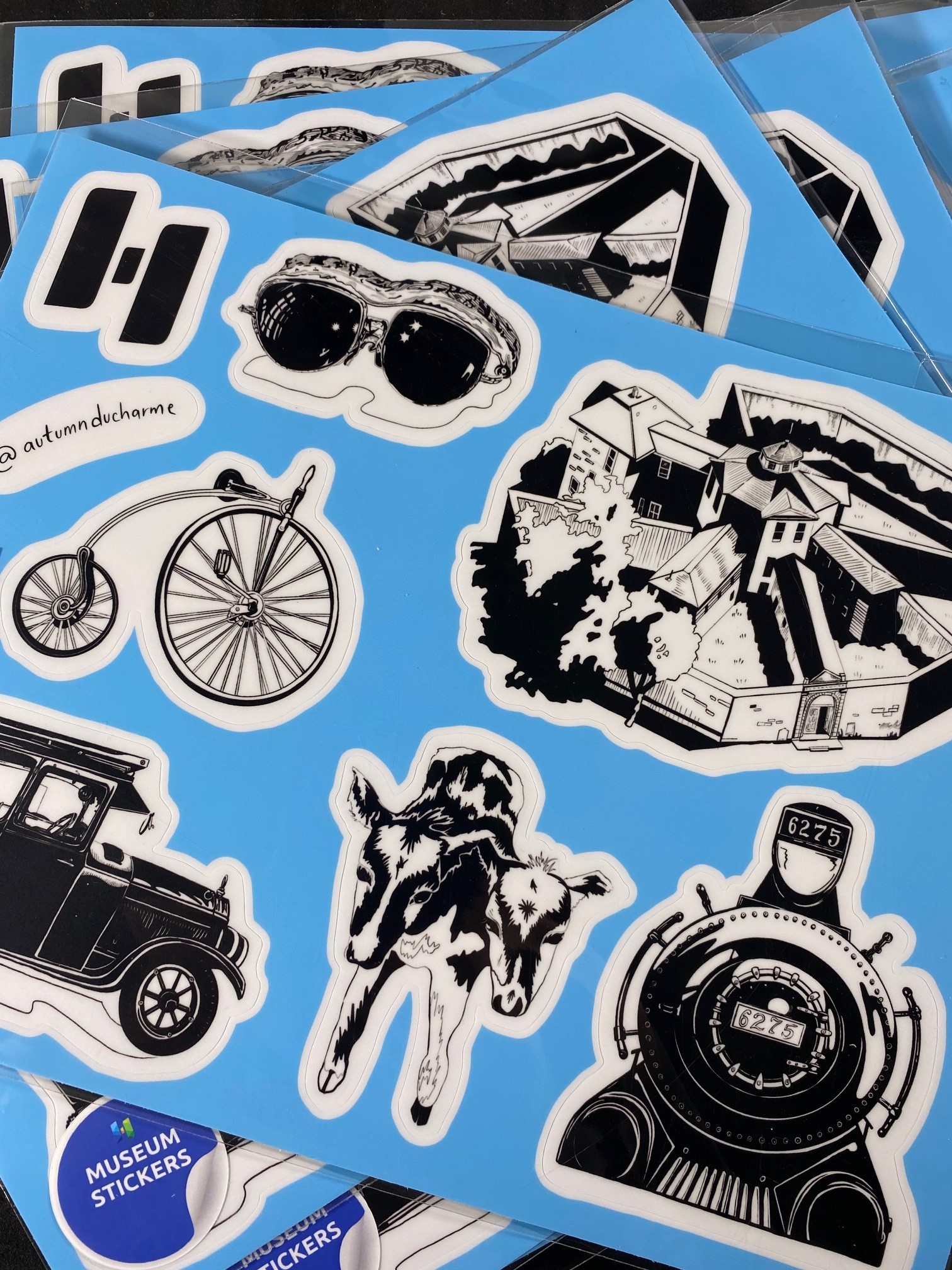
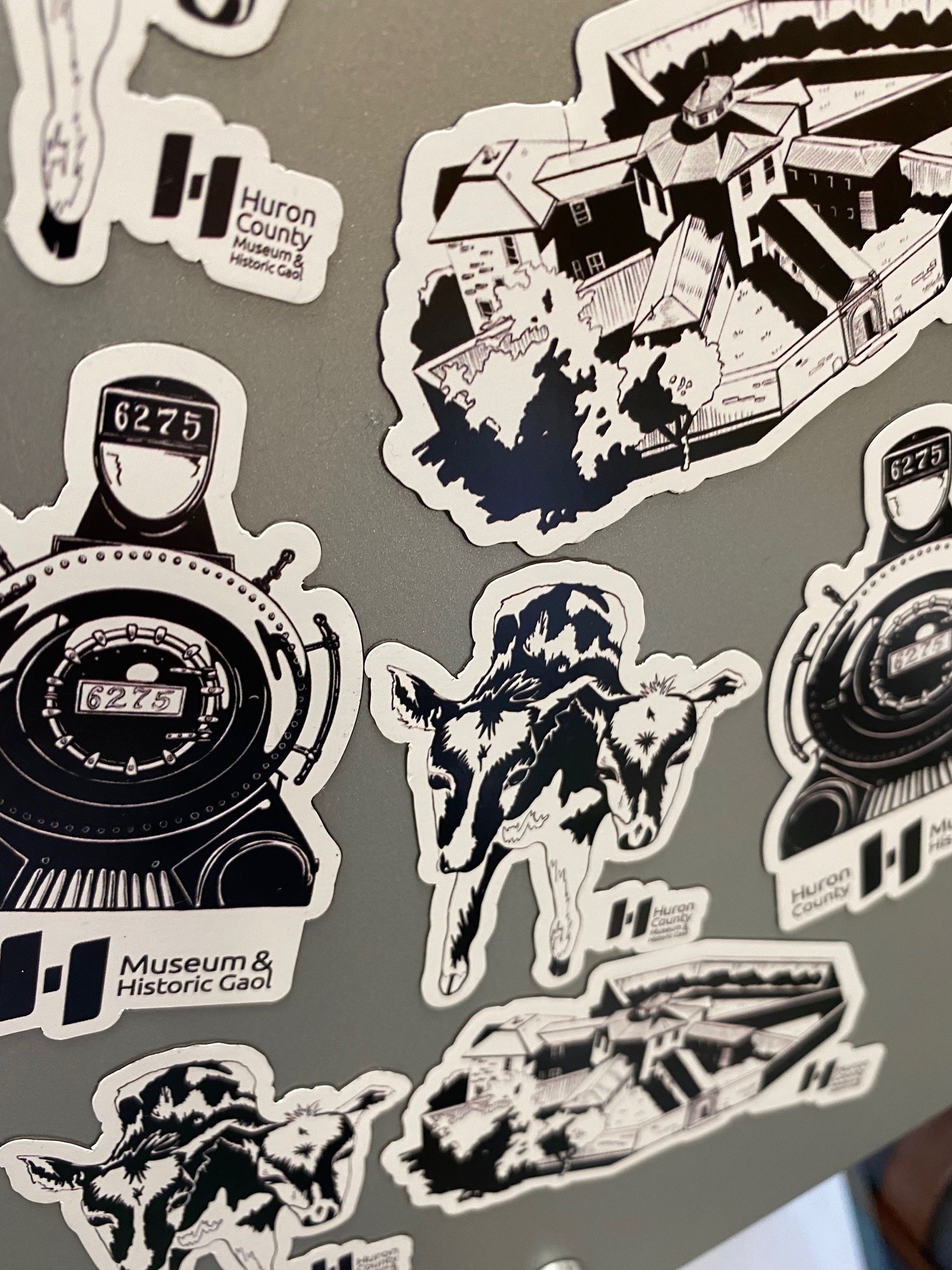
Huron County Museum Gift Shop is growing its selection of products made by area artists and makers and we are pleased to feature the work of Huron County artist Autumn Ducharme! Autumn was commissioned to create illustrations of some of our favourite features of the Museum and Gaol, including the steam locomotive, the two-headed calf, Herbie Neill’s car, and, of course, the Gaol! These illustrations will be used on a number of items, including sticker sheets and magnets! If you would like to pick up some of Autumn’s work, the Gift Shop is open during regular Museum hours and does not require admission to come in to shop and to support local! Learn more about Autumn and her work below!
Who are you and what do you make?
My name is Autumn and I am a visual artist and farm hand. I make prints, paintings, murals, tattoos now and again, and graphic illustrations. When I’m not making art or digging in the dirt, I write poems, rock climb, and travel.
How did you start making art?
I started making art when I was old enough to hold a pencil. I was an inspired little mind who was encouraged by teachers and mentors to keep drawing. From my first preschool finger paintings of butterflies the teacher sent home to be framed to my kindergarten drawings of how I imagined Zimbabwe and the Arctic to be, people kept saying how great they were. Perhaps as a tiny anxious kid I was pretty susceptible to these sorts of praises. Momentary prizes from Remembrance Day drawing contests and consistent arts awards in school keep me pursuing the world of visual communication. Not to mention being somewhat obsessed with any form of expression be it drawing, writing or dancing. Sometimes I wonder if I’d have had that kind of encouragement behind me in the sciences, I would be somewhere else in life but, one will never know! Unfortunately, you kind of have to take all the sciences for a while and I was only interested in plants. And slept through math. Haha. Maybe it’s just in my nature.
How would you describe your work?
I would describe my art as detailed and emotional, at least the more successful works. I’ve always gotten lost in line work and often had to dial it back for applications in print. Though I like the chance in bigger works to have space to explore more detail, except budget always gets in the way of this exploration. I appreciate when I get the chance to spend a lot of time with a work or idea and really fully apply myself to the themes and subjects present. I’d like if my artwork could bring you into a perspective or reality a little shifted from your own, create immersive feelings that really drew me to the art world in the first place.
What inspires you?
I’m inspired by concepts of home and freedom. I explore symbolism that describes certain places and chapters in my life and aspirations for the future. Even with commission work, I hope to connect to an aspect of the work that I can speak to personally. Otherwise, the work doesn’t feel authentic or worthwhile. My personal practice typically starts as paper collaged works or collected references both from my own albums or outside sources. I’ve had my grandmother’s National Geographic magazines around for some years now, cut up, glued together, and pinned to my walls. I’m inspired by plants of all kinds, houses and homey spaces, movement arts, and strong women.
What do you like most about being an artist?
What I like most about being an artist is the freedom to create your own life. I don’t fall into a typical career pathway with a strict schedule or routine so I have the ability to switch things up, drastically and often. I love that I can move locations, get side work to free up my creative flow, try something new, and jump country without a dramatic exit from some corporate job and responsibilities. I like that the expectations were low going in, like the starving artist trope has been with me from the very beginning so ever year when I make a liiiittle bit more from my art it feels like a win even though it isn’t much. I’ve also had the expectation from a young age that I will need to be frugal and adapt to this lifestyle because it is the one I chose. I read a lot of travelling on a shoestring books through my teens…
If someone likes your work and wants to see more, where can they go (besides the Museum GIft Shop, of course!)?
If you like my work and want to see more, follow my Instagram @autumnducharme. It acts as a sort of living portfolio. My website will be deactivated mid-January as it was too expensive to maintain. I also put up a few works for sale on Big Cartel that are always changing. This link is available through my instagram profile when I post new work. Keep an eye out for a Substack blog coming soon and subscribe to my inconsistent and well-spaced out newsletter or travel art mail via email: autumnducharme@hotmail.com.
by Amy Zoethout | Mar 27, 2024 | Archives, Blog
Written by Collections Assistant Noah Chapman.
Recently, the Huron County Museum began the transfer of artifacts from the (now-closed) North Huron Museum. Among the items was this image of a group of World War One soldiers (object number 2023.0067.352). Unfortunately, the original label has worn off and the North Huron documentation did not have in-depth detail. The only information was the name of one of the photographed soldiers, his wife, and the donor’s name.
A mystery was at hand. One of the most important goals of the museum is to restore lost context to items in the collections. For us, this was an opportunity to conduct some practical historical research. In doing this, we were able to recall the memory of one of Huron County’s World War One servicemen.
The North Huron documents had these clues:
- The name of the donor that brought the picture to the North Huron Museum.
- The picture had belonged to Mrs. Emily Elston; she was an English War bride.
- Emily Elston had two husbands. The first was Bert Thomas, who she had met in a hospital during the war. He later died from the effects of a mustard gas attack.
- Emily’s second husband was named William Elston.
The person of most interest was Bert Thomas. We wanted to find out what unit he had served in and in what role. The problem is that “Bert” is a nickname that can be short for a lot of different names! Finding him would not be easy, as we did not even know what Huron community he had come from.
The first place we looked was online. Online obituaries and websites are a great place to find birth and death dates, spouses, and family members. Unfortunately, searches of the four available names did not yield much information; adding “Wingham” or “Huron County” to the search did not help with finding a lot about Bert or Emily. However, we were able to find records online for a William “Bill” Elston who served in World War Two. This was a good start, but it was unclear if this was the same William Elston that was married to Emily Elston.
The next clue we found was the obituaries of several members of the Elston families. Here, several clues came together to form a better picture of this family. From the obituary of Edwin Elston, we learned that most of the family was from Wingham. We also learned that Edwin and Bill were siblings. Edwin and Bill were sons of Emily (Thomas) Elston and William Elston. This helped to clarify that there were two William Elstons. The man I found the service record for was William Jr., “Bill”. Bill also had a half brother named Bernard Thomas, who was the son of one Albert Thomas. Albert Thomas is the “Bert” Thomas who served in World War One and was in the unidentified photo.
Even with a full name, it was still difficult to find information on Albert’s military service online. We tried another great free online resource, the Huron County Digitized Newspapers. Finally! We were able to find some evidence of his military service.
Albert had been a farmer in Bluevale and had four children with his first wife, who had passed away in February 1915. On June 24, 1915, the Wingham Advance-Times reported that Albert Thomas of Bluevale had auctioned off his farm stock and implements. At the age of 32, he left for London to enlist with the third Canadian Expeditionary contingent. This explained why Albert Thomas wasn’t listed as a member of the Huron CEF units (like the 161st Battalion). Such units were not formed until late 1915. While Huron County did have existing military units like the 33rd Regiment, recruitment had been slow. The Canadian Expeditionary Force had focused on urban recruits, rather than rural communities. This did not stop Huron County men, like Albert, from enlisting with urban regiments. On Feb. 2, 1916, the Wingham Advance-Times reported that Albert had enlisted with a Battalion in Woodstock. He returned home for a short visit before shipping out.
Now that we knew that Albert had been born in Bluevale, we were able to find Albert’s grave record. He enlisted with the 168th Oxford County Battalion. The 168th is the unit pictured in the North Huron Photograph. This is further proven by the remains of the label on the photograph. Part of a word- “ock” is still visible- “Woodstock”. We reached out to the Woodstock Museum. They also had a copy of this photograph, and that it was the 168th “Oxfords” Battalion.
The 168th (and Albert) embarked on Sept. 12, 1916 from Halifax, Nova Scotia, Canada. They disembarked on Sept. 22, 1916 at Liverpool, England. They deployed on Jan. 13, 1917 to France, where the unit reinforced other British regiments. Albert transferred to the Canadian Overseas Railway Construction Corps (C.O.R.C.C.) as a sapper. The role of the C.O.R.C.C. was to repair and expand railways in France. They supported the supply chain to the front lines, and dug trenches and fortifications. They would see action at Arras, Ypres, and Amiens; we believe that Albert took part in these actions.
Albert had a number of interesting experiences during the war. He caught trench fever early into his deployment and returned to England. While recovering from this illness, we believe he met his wife Emily Kate Austen, a nurse serving in a British hospital. Their son Bernard Thomas was born in 1917.
Albert briefly returned to France, but his fever relapsed shortly after. He was ordered back to England. While on passage back through the English Channel, the steamer in front of Albert’s vessel would be torpedoed by an enemy submarine. The passengers were transferred to Albert’s boat, which capsized due to being overloaded. Albert would be thrown overboard and would lose consciousness; he was unable to account for his rescue. Due to the cold water, he would contract malaria fever, which caused hip paralysis.
On Oct. 24, 1918, the Wingham Advance-Times reported that Albert was invalidated back to Canada, reuniting with his family. He began treatment for mustard poisoning in Burlington. His wife Emily and son Bernard would emigrate to Canada in 1919. The Wingham Advance-Times reported that Albert was still undergoing treatment in late 1919. On July 15, 1920, Albert “Bert” Thomas succumbed to diphtheria, a complication of his poisoning and previous illnesses. The 1921 census shows Emily and all five children still living in the area. Emily would move to Wingham, marry William Elston, and have three more children. Some of her children would also have military careers, serving in the Second World War and the Korean War.
We hope this look into the research that goes into our incoming collections was interesting! Through our ongoing research, we aim to recover, retell, and showcase these kinds of stories. As our research into the collection continues, keep an eye out for more expanded histories on our social media, at the Museum, and around the community.