by Sinead Cox | Apr 27, 2020 | Blog, Investigating Huron County History
Patti Lamb, museum registrar, outlines Huron County’s connection to the Disney legacy.
While most of us know the impact that Walt Disney has had on the entertainment world; whether that be through the amusement parks that bear his name or the children’s movies that we all love; few realize that his ancestral roots lie in Huron County. The connections in Huron County to Disney are rooted with his ancestors but modern day connections still exist.
Ancestral Connections
In 1834, Walt’s great grandfather Arundel Elias Disney, wife Maria Swan Disney and 2 year old Kepple Elias Disney; along with older brother Robert Disney and his wife, sold their properties in Ireland, departed from Liverpool, England and immigrated to America landing in New York on October 3, 1834. According to a written biography by Walt’s father there were 3 brothers that immigrated at the same time. The brothers went into business in New York while Elias (as he was most commonly called) made his way to Upper Canada settling in Goderich Township near Holmesville. By 1842, Elias had purchased Lots 38 and 39 on the Maitland Concession, a tract of land comprising of 149 acres. There, along the Maitland River, on Lot 38 he built one of the earliest saw and grist mills in the area. Brother Robert eventually purchased 93 acres on Lots 36 and 37 of the same concession. Elias and Maria had 16 children.
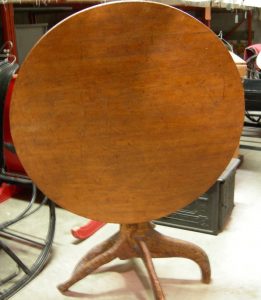
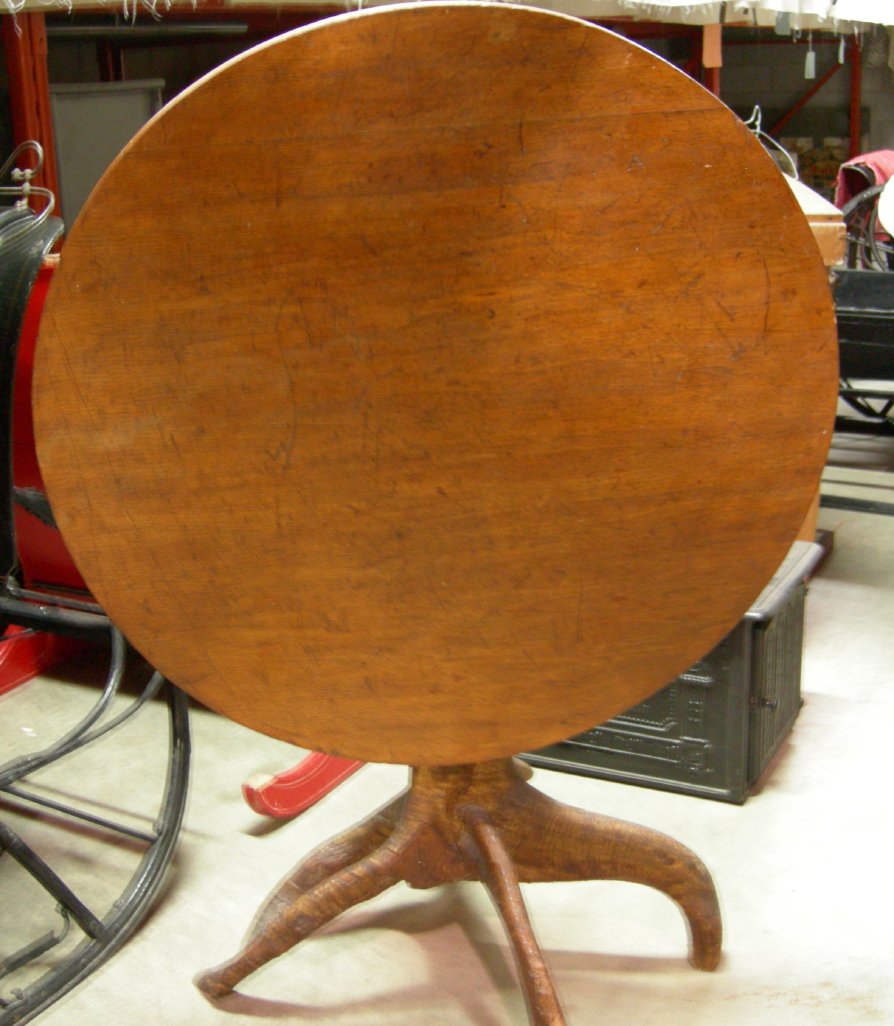
James and Ann (Swanson) Munro were among the first settlers in the Holmesville District and James was the first blacksmith in Holmesville (1834 – 1871). The base for this table is made from a birch stump that he selected from his 36 acre property (Lot 83, Maitland Concession) which he purchased August 15, 1832. The original 5 roots serve as legs. The top is of cherry lumber, sawn from some of the first logs to go through the saw mill owned by Elias Disney (great grandfather of Walt Disney). On the underside is carved the name “Emily” for one of James and Ann’s 12 children.
N7143.001b
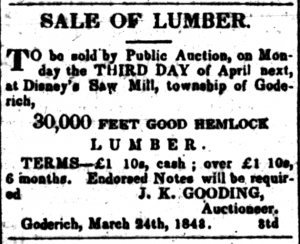
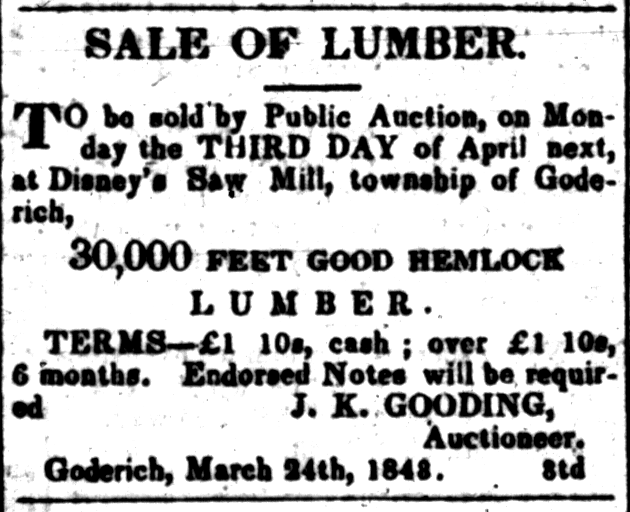
Advertisement for the sale of lumber from the Disney Saw Mill from the Huron Signal, March 24, 1848.
On March 18, 1858, Kepple Disney (Walt’s grandfather) married Mary Richardson, whose family were also early Goderich Township settlers near Holmesville. They purchased a farm on Lots 27 and 28 of Morris Township near Bluevale. Kepple and Mary had 11 children of which Elias Charles Disney (Walt’s father) was the oldest, born on February 6, 1859 in Bluevale and baptized in St. Paul’s Church in Clinton. All 11 children would eventually attend Bluevale Public School. Kepple did not really enjoy farming. He liked to travel and became intrigued in the drilling industry so in 1864, while keeping the homestead in Morris Township, he moved his family to Lambton County. He stayed in Lambton for 2 years before arriving in Goderich.
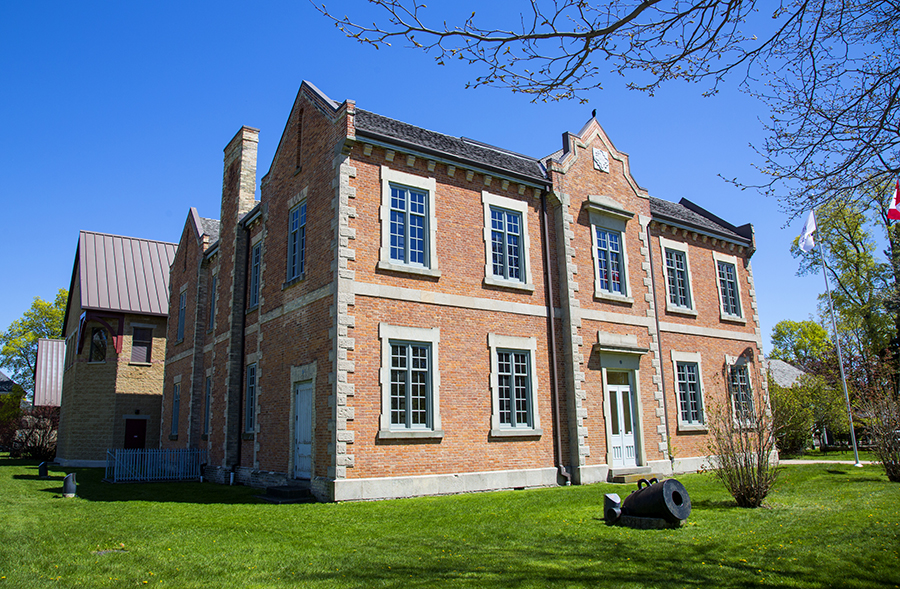
Here, Kepple was employed by Peter MacEwan and worked for him drilling for oil at a well in Saltford, just north of Goderich. Instead of oil, it was salt that was discovered, but that’s another story. In the July 1868 Voter’s List, the Disney’s appear as tenants of a house owned by James Whitely on Lot 275 in St. David’s Ward, Goderich. School records show that in 1868, 8 year old Elias and 6 year old Robert would attend Central Public School in Goderich (now part of the Huron County Museum). It appears the Disney’s left Goderich and moved back to the homestead in Morris Township sometime before 1869.
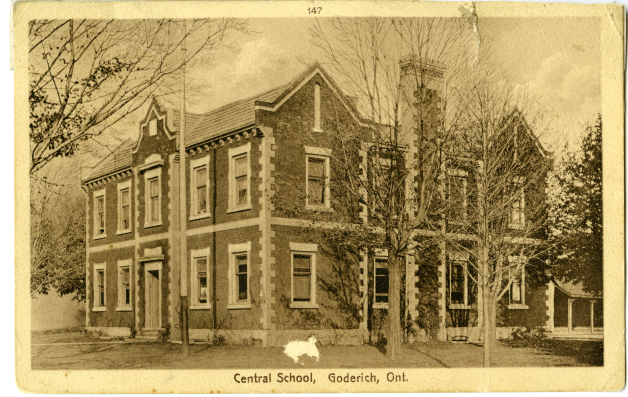
Postcard of Central School, N3103.
In 1878, Kepple left for California, where gold had been found, taking with him his oldest sons Elias and Robert. They stopped over in Ellis, Kansas and purchased 200 acres. Kepple sent for the rest of his family and his property in Morris Township was sold.
Ellis, Kansas is where Elias met neighbour Flora Call and on January 1, 1888 they were married. Kepple Disney’s family moved to Florida in 1884 and Elias, Flora and son later moved to Chicago. On December 5, 1901, Walter Elias (Walt) Disney was born, the 4th child of 5 for Elias and Flora Disney. After living in Chicago for 17 years, when Walt was 5 the family moved to Maceline, Missouri. They lived there for four years before moving onto Kansas City, Kansas.
At age 18, Walt started work as a commercial artist and from 1920 – 1922 was a cartoonist. He moved to Hollywood and opened a small studio (Walt Disney Studios) in 1923. He married Lillian Bounds on July 25, 1925 who was working for Walt Disney Studios at the time. The Disneys later had two daughters, Diane Marie and Sharon Mae. In 1928, Mickey Mouse, originally named Mortimer, was created.
In June 1947, Walt made a trip to Canada to visit his ancestral past. He stopped in at the Bluevale Post Office to enquire where the Disney homestead was located then drove to the farm that his father had spoken of so fondly. Walt drove on to Holmesville to visit the cemetery where his Disney great uncles and aunts, and his Richardson great grandparents are buried. Walt also visited Central School in Goderich and took some time to draw some cartoons for the students. He stayed the night in Goderich before travelling to Detroit and flying home.
Walt Disney died on December 15, 1966 at age 66 of lung cancer. His wife Lillian died September 16, 1997 at age 98.
Penhale Wagon
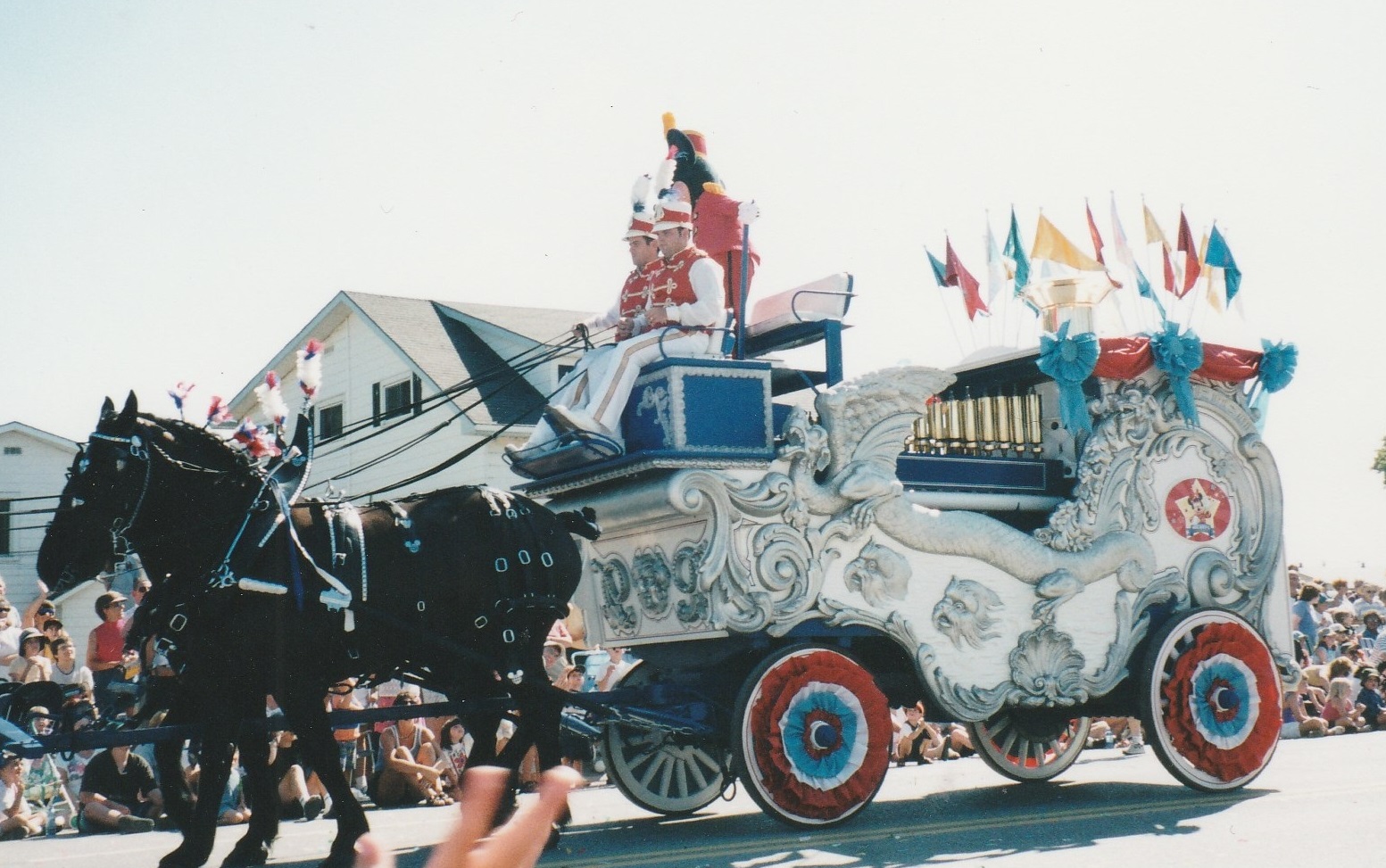
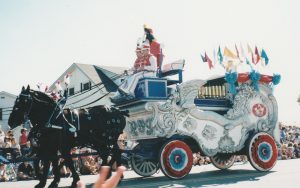
Huron County Disney connections also exist near the small village of Bayfield, Huron County. In 1974, as a hobby, Tom Penhale started building custom wagons. By 1983, it was a full time business. Tom’s business relationship with Disney started in December 1982 with the delivery of a set of hand crafted hames to the Walt Disney Ranch Fort Wilderness. In May 1983, he won the honour of building the show wagon that would compete in the 100th Anniversary of the Percheron Congress at the Calgary Stampede that coming June. He was chosen above many other craftsmen from all over North America.
Although a typical custom wagon would take about 3 months to complete, this one needed to be finished in 6 weeks. Official blueprints and a designer were flown in.
Working 16 hour days, with some local help, the wagon was completed on time. An artist came from the Disney World Studios in Florida to finish up. It was painted 4 different shades of blue, trimmed in 22 karat gold, and the lettering in silver spun with cotton.
Tom Penhale was given official recognition as the wagon builder when the Disney World Wagon was declared the World Champion Percheron Hitch during the 1983 Calgary Stampede.
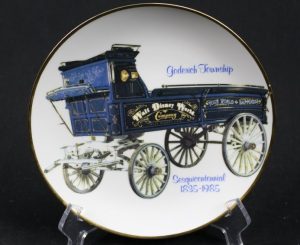
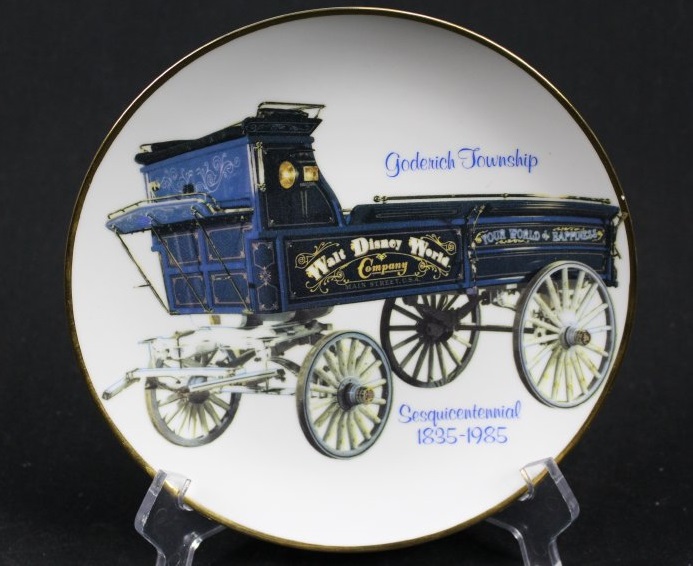
Souvenir plate from the Goderich Township Sesquicentennial 1835 – 1985 featuring Tom Penhale’s Disney World wagon.
2018.0042.001
A Disney Parade
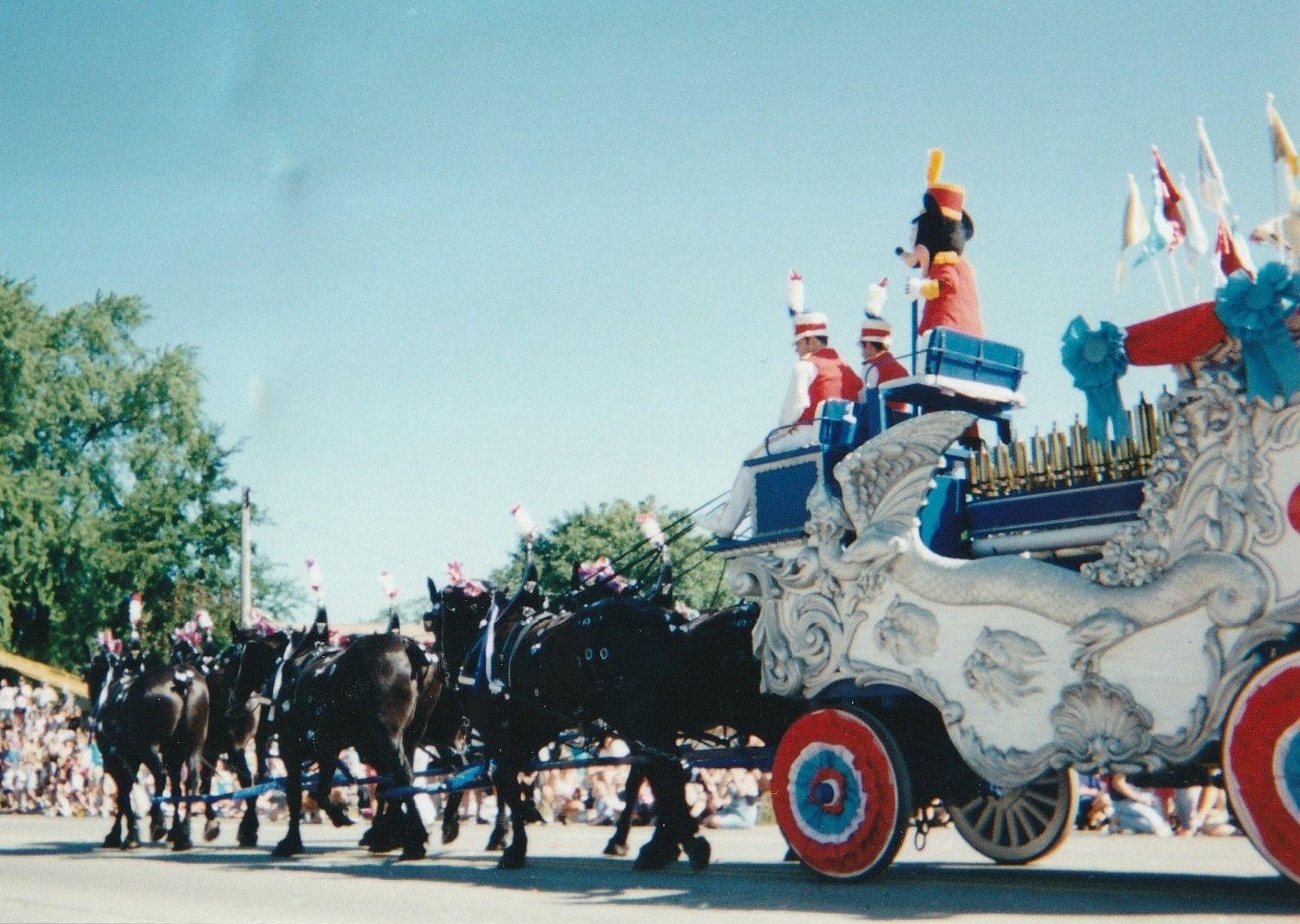
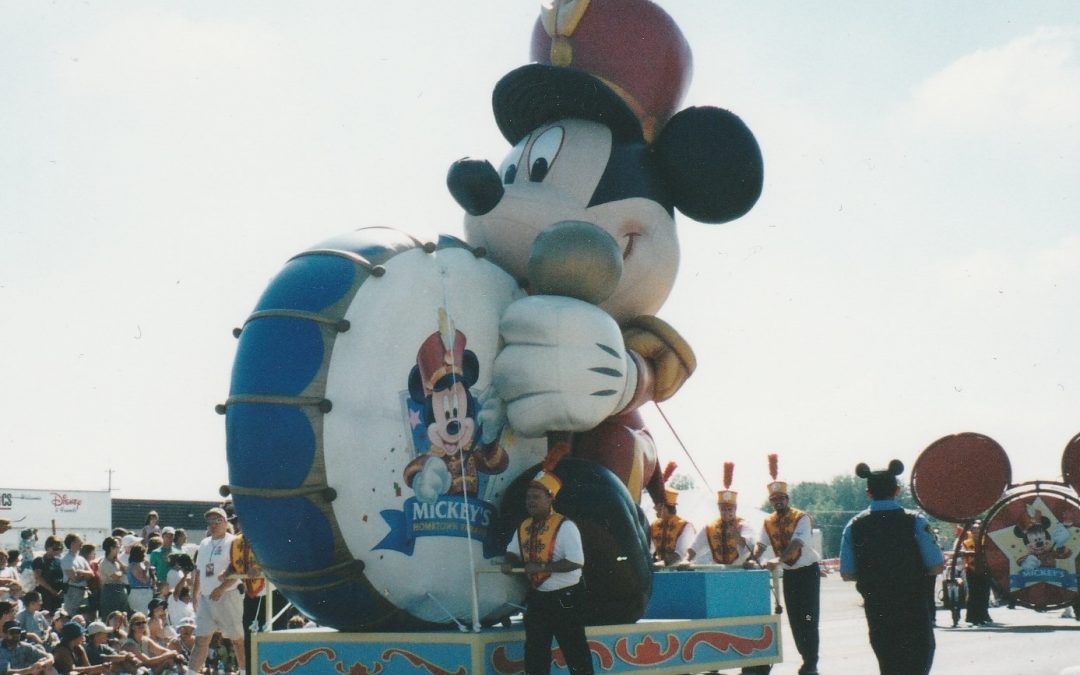
In July 1999, Goderich was the host for the first and only Canadian Hometown Disney Parade featuring Mickey Mouse, friends and characters. There were only 5 cities chosen in North America that year. Doug Fines, who was the President of the Goderich Chamber of Commerce at the time, submitted the winning essay to the contest to host the parade. The essay needed to convey true Mickey community spirit but of course having ancestral roots in Huron County helped as well. The organizers were expecting approximately 50,000 people to line the 2 ½ km route through Goderich. It is estimated that the final number was closer to 100,000.

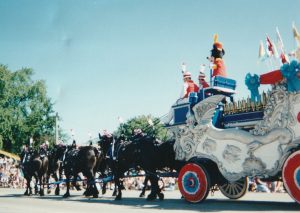
While the connections between the famed Walt Disney and Huron County are few, their significance is no less meaningful. From ancestral roots to prize winning wagons and parades, it really is “a small world after all”.
by Sinead Cox | Apr 9, 2020 | Archives, Artefacts, Media Releases/Announcements
Huron County Museum staff may not be working at the physical location of the Museum but we are still working for the Museum and thinking about our collections, exhibitions and programmes. Much of what we do relies on the words and collecting habits of others past and present. With that mindset it is important now for us to think about the current Coronavirus pandemic and the future of collecting items relevant to Huron County throughout this time.
The collecting mandate for the Huron County Museum is to collect the stories and artifacts of our local area, with particular emphasis on items that were made by or used by Huron County people. We are looking for your help to document and illustrate how Coronoavirus has affected us close to home.
When this crisis is over we will be putting together a collection of items relating to the Coronavirus pandemic to keep in our archives for future use and research. Items could include: photographs, journals, letters, signs, or documents that tell the story of COVID-19 and its effects on the lives of those living in Huron County.
We understand that this is a difficult time for many so participation is voluntary and has no timeline. Items may come today, 2 months from now, or even years from now. The purpose of the collection will be to document and will be used for future research and exhibition.
If you are interested in helping create a documentary history of the pandemic in our community you may mail items to the Huron County Museum, 110 North St., Goderich; email to museum@huroncounty.ca; or bring your items directly to the Museum after the site re-opens to the public. Staff are available by email to answer your questions.
Stay safe and healthy,
Elizabeth French-Gibson
Senior Curator
Huron County Museum & Historic Gaol
by Sinead Cox | Mar 30, 2020 | Artefacts, Collection highlights, Exhibits, For Teachers and Students, Uncategorized
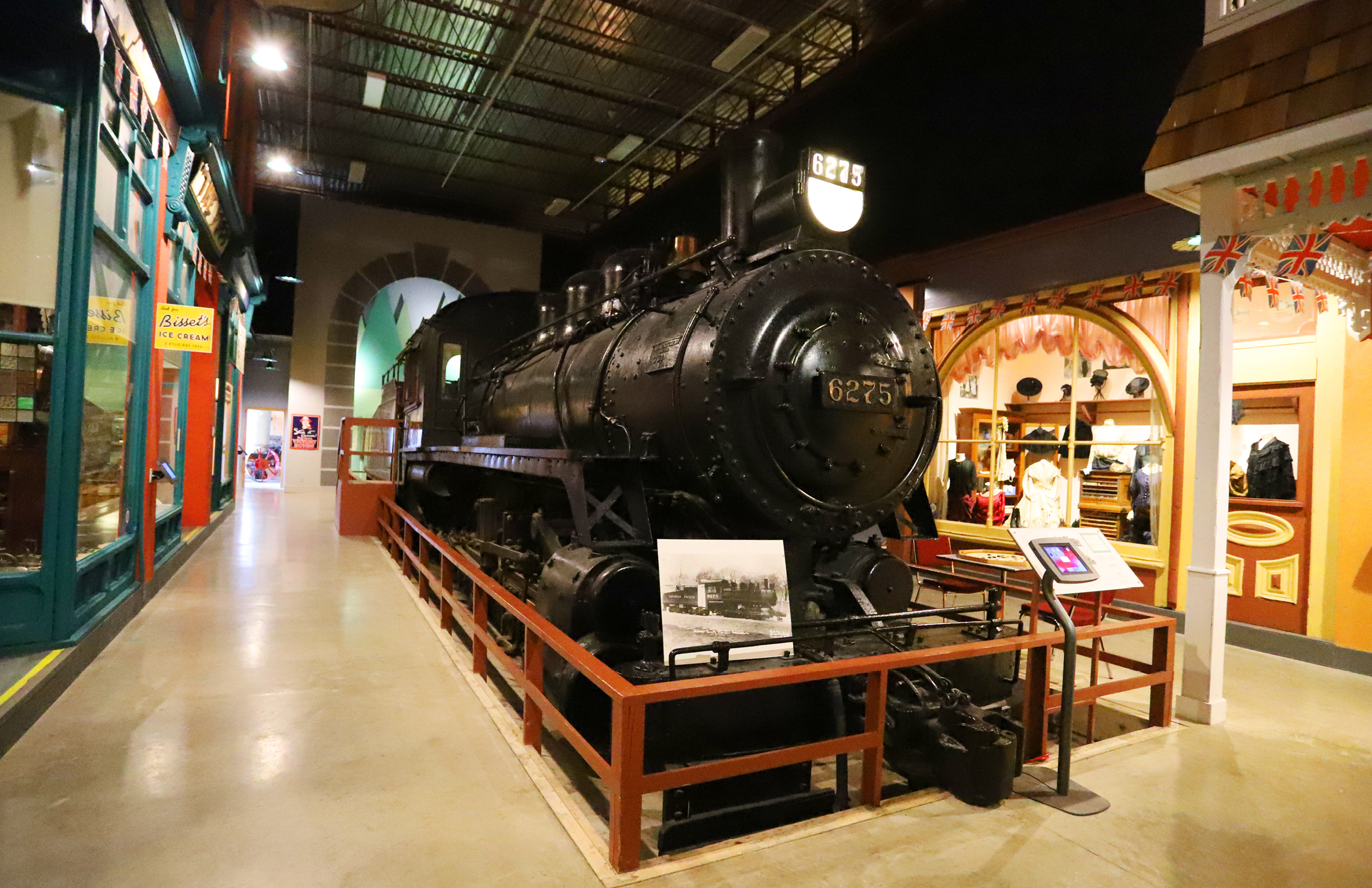
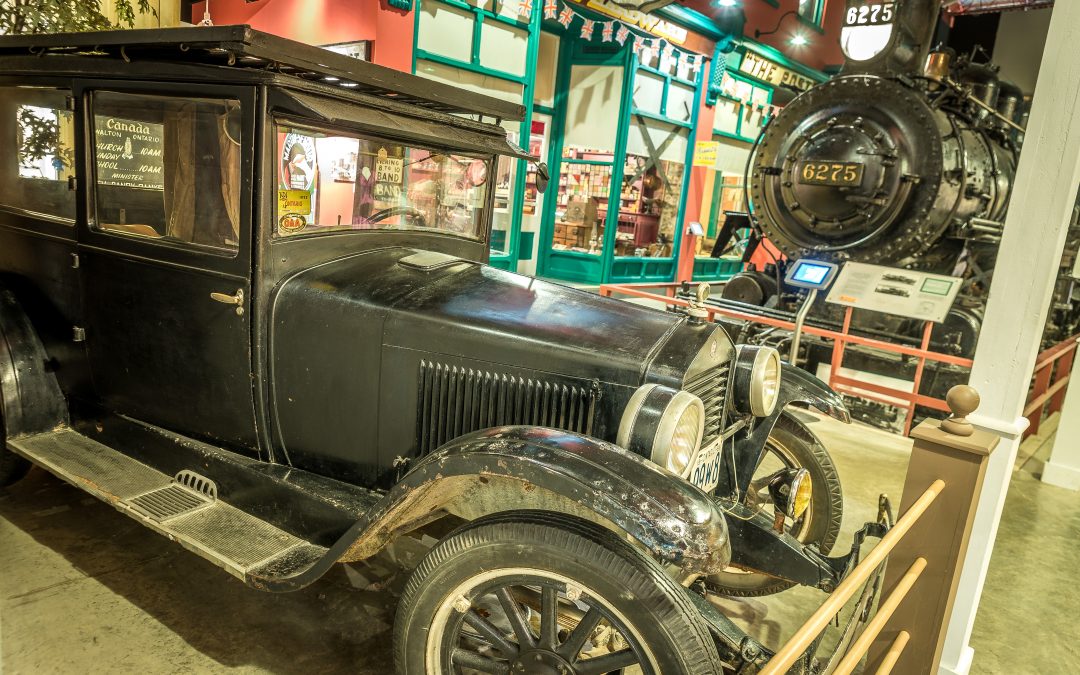
Huron County Museum: Virtual Permanent Galleries
The Huron County Museum’s virtual exhibits grant a close-up glimpse of select artifacts on permanent display in our galleries, as well as information that you can’t guess with just a look. The featured objects represent a small sampling of the thousands of artifacts in the museum’s collection. Updating the online exhibits is an ongoing project; in the future, student employees will be refreshing the images and providing even more information. These exhibits are also available via ipads onsite when the museum is open.
Huron County Main Street
Our Main Street features real storefronts and objects from across the county of Huron.
Click the storefront names to step inside and see artifact highlights!
Military Gallery
Click the titles below to see archival documents and more related to Huron County and the First World War.
Huron County Museum Feature Gallery: Virtual Exhibits
The Huron County Museum rotates exhibits of special interest through the year in our Feature Galleries. Click to explore past temporary exhibits that you may have missed or want to rediscover.
by Sinead Cox | Mar 18, 2020 | Blog, Investigating Huron County History
Beth Knazook, Special Project Coordinator for Huron’s digitized newspaper project reviews the bitter rivalry between Huron’s first newspaper editors. You can search the newspapers yourself for free at https://www.huroncountymuseum.ca/digitized-newspapers/
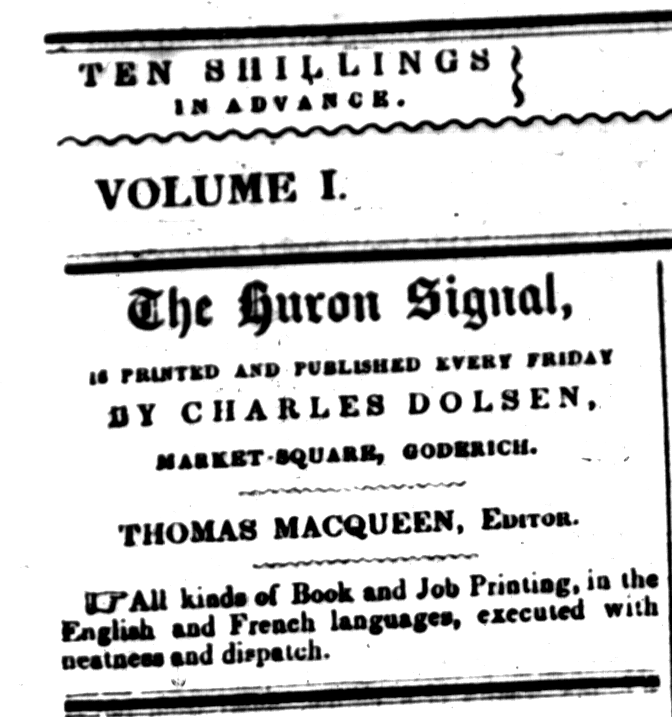
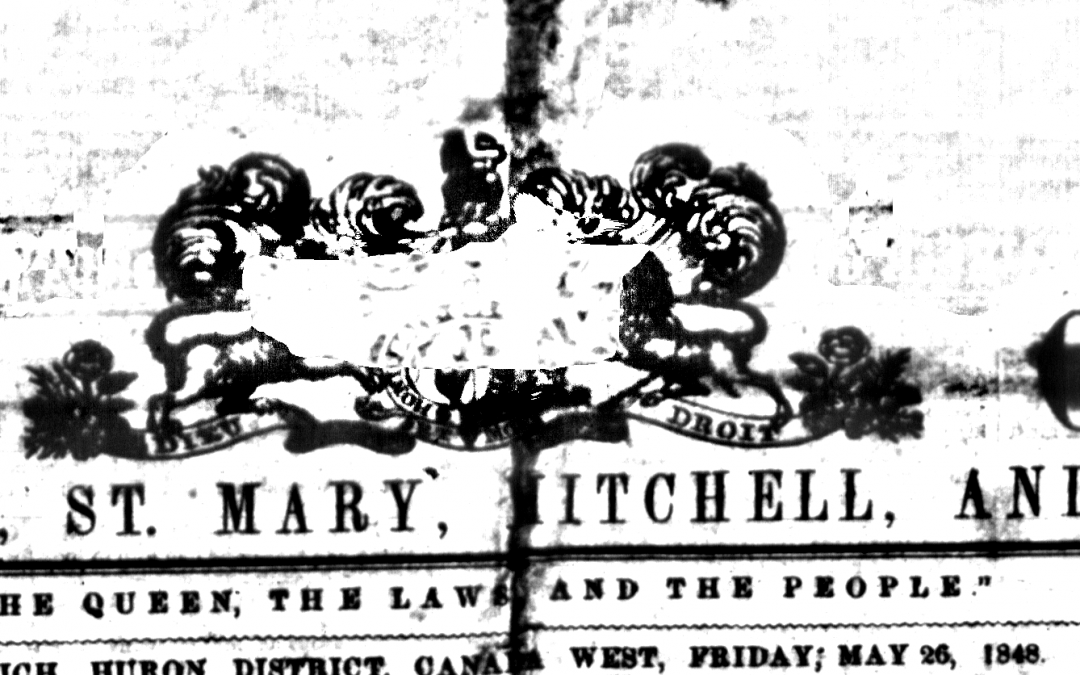
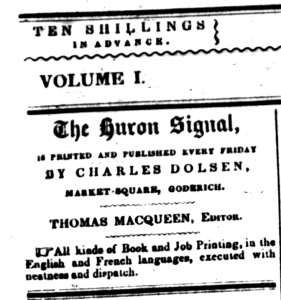 The Signal was the first newspaper printed in Huron County, beginning on February 4, 1848. Published in Goderich by Charles Dolsen, and edited by Thomas Macqueen (or “McQueen”), it promised to deliver “as many Essays and as much knowledge on all subjects of practical importance, as our space and time will reasonably allow,” Huron Signal (February 4, 1848), 2.
Macqueen was born in Ayrshire, Scotland, where he gained some fame as a poet and an accomplished lecturer. He immigrated to Canada and lived with his sister in Renfrew, Ontario, where he worked briefly as editor of The Bathurst Courier (Perth) before moving to Goderich to take up the position of editor for the Huron Signal. Instead of focusing only on local news, Macqueen brought literature, political, and cultural news from afar to the Western frontier of Canada. In its first issue, he ran articles detailing the history of Cortez’s conquest of Mexico, a travel account of Smyrna, and tales of “The Bushman” living in the Australian outback. He covered scientific news as well, re-printing snippets from other papers containing new information about exciting discoveries like electricity. He also included his own poetry, and encouraged others to contribute poems and songs.
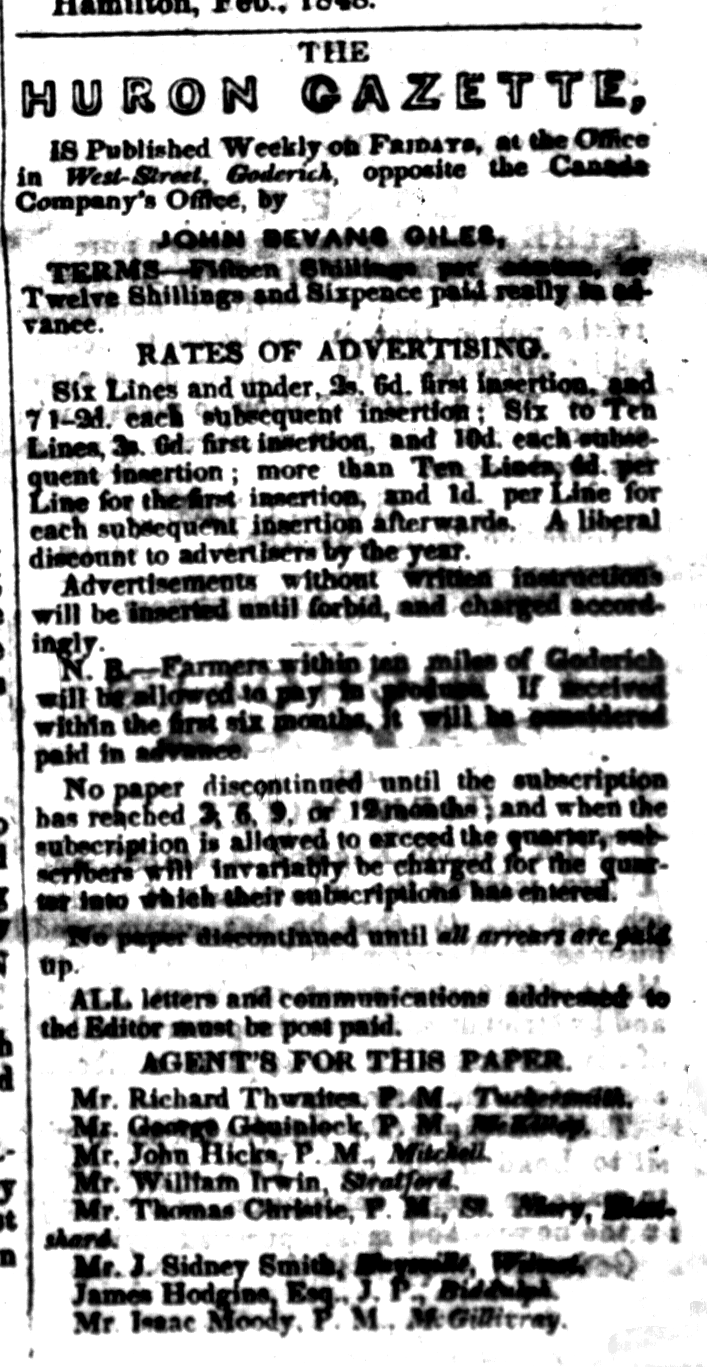
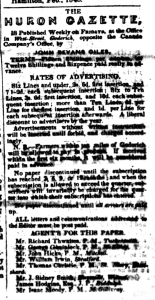 The Huron Gazette began publishing a few weeks later, on February 25, 1848, offering a conservative counterpoint to the Huron Signal’s liberal voice. There are fewer surviving copies of the Gazette from which to piece together the history and contents of the paper, but it seems to have been more practical in its aims. Local advertisements appeared alongside snippets of home and foreign news, dispatches from British Parliament, and editorials – with some entertaining fictional stories thrown in the mix. By late May, the paper had become so popular that editor John Beverley Giles considered either using larger paper sheets or going to a semi-weekly delivery to fit in more content. “We thank our kind supports for the patronage that has demanded from us this alteration, and we think it will evidence to the Province in general the enterprise and intelligence of the Huron Tract,” Huron Gazette (May 26, 1848), 2.
Perhaps a rivalry between the editors of these two papers was inevitable given their political leanings, but Mr. Giles appears to have had a particular talent for provoking the Signal’s Thomas Macqueen. His commentary in the Gazette frequently took the form of very personal attacks, which in turn provoked exasperated and increasingly angry responses in the Signal. Accusations made about the conduct of Mr. Macqueen on the occasion of the annual Agricultural Society’s Show in 1848 prompted several surprised and supportive letters to the editor condemning the malicious gossip in the Gazette.
Thomas Macqueen’s frustration with the Gazette seems to have reached its limit when he declared “We think Mr. Giles is unfortunate in every thing he takes in hand, and still more unfortunate when he tries the pen. His paper will soon be unable to contain his answers to the remonstrances of those he has offended by his impudence. We think he should give it up, —or if not, he should cease to be guided or counselled by those reckless inexperienced characters who are driving him to misery and disgrace for their own vain and selfish purposes, and who lately forced him to insult the respectable community of Goderich under the designation of ‘bare-footed boys and slip-shod girls,’” Huron Signal (May 12, 1849), 2.
Not many issues of the Huron Gazette have survived to explain Mr. Giles’ side of the story, but we do know that in June of 1849, Mr. Macqueen’s predictions about the Gazette’s impending doom were proven right. Mr. Giles abandoned the editorship of the Gazette, although the paper survived a little while longer under editor(s) who seem to have wanted to keep their names hidden. The Huron Signal reported at one point that “nobody is the Editor of it, and nobody will take the responsibility of it. It is not read by 50 men in the District of Huron, and of that fifty, there are not five who attach the slightest credit to any of its statements,” Huron Signal (June 22, 1849), 2. When the Gazette ceased publication in 1849, Mr. Giles left town – but not the newspaper business. He would take up the editorship of the St. Catharines Constitutional, hopefully with better results.
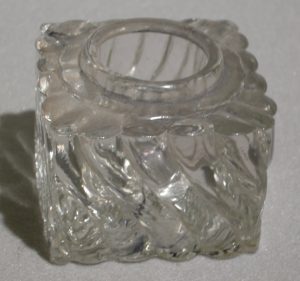
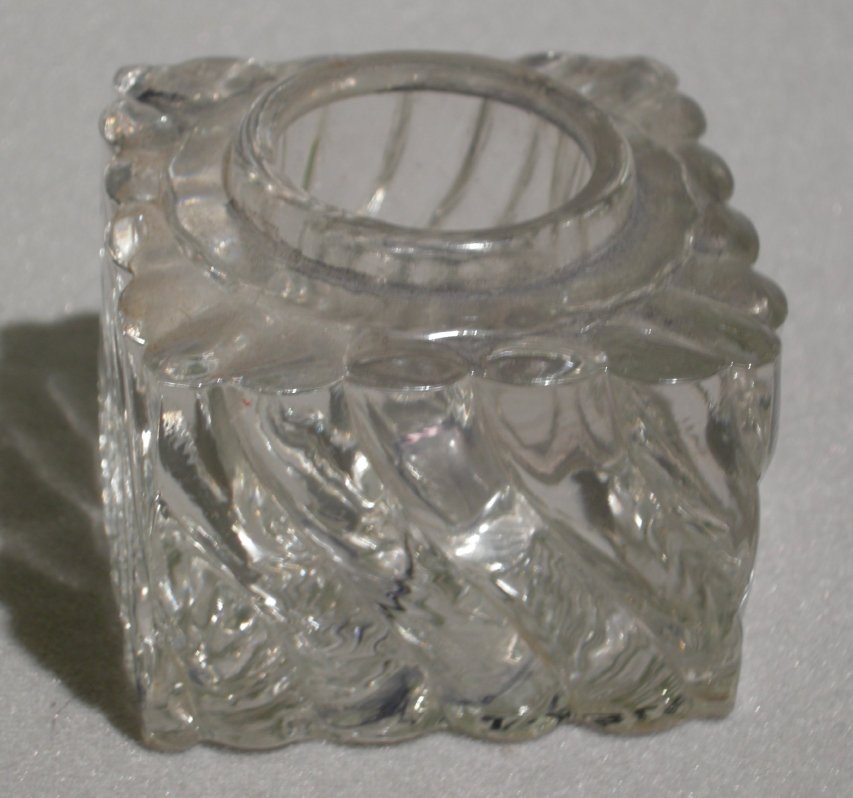
Inkwell used by Thomas McQueen. 1978.10.1. Collection of the Huron County Museum.
Macqueen edited the Signal until his death in 1861 at the age of 57, at which point J.W. Miller took over as editor while the publishing side was managed by Macqueen’s son-in-law, T. J. Moorhouse. The paper was then sold to William T. Cox, who ran it until 1870, and from there it changed hands many more times over the years. The Huron Signal survives today in the form of the Goderich Signal Star. Over the course of the paper’s long history, there has been a lot more (friendly) competition in the Huron County weekly news business.
by Sinead Cox | Oct 11, 2018 | Blog, Exhibits
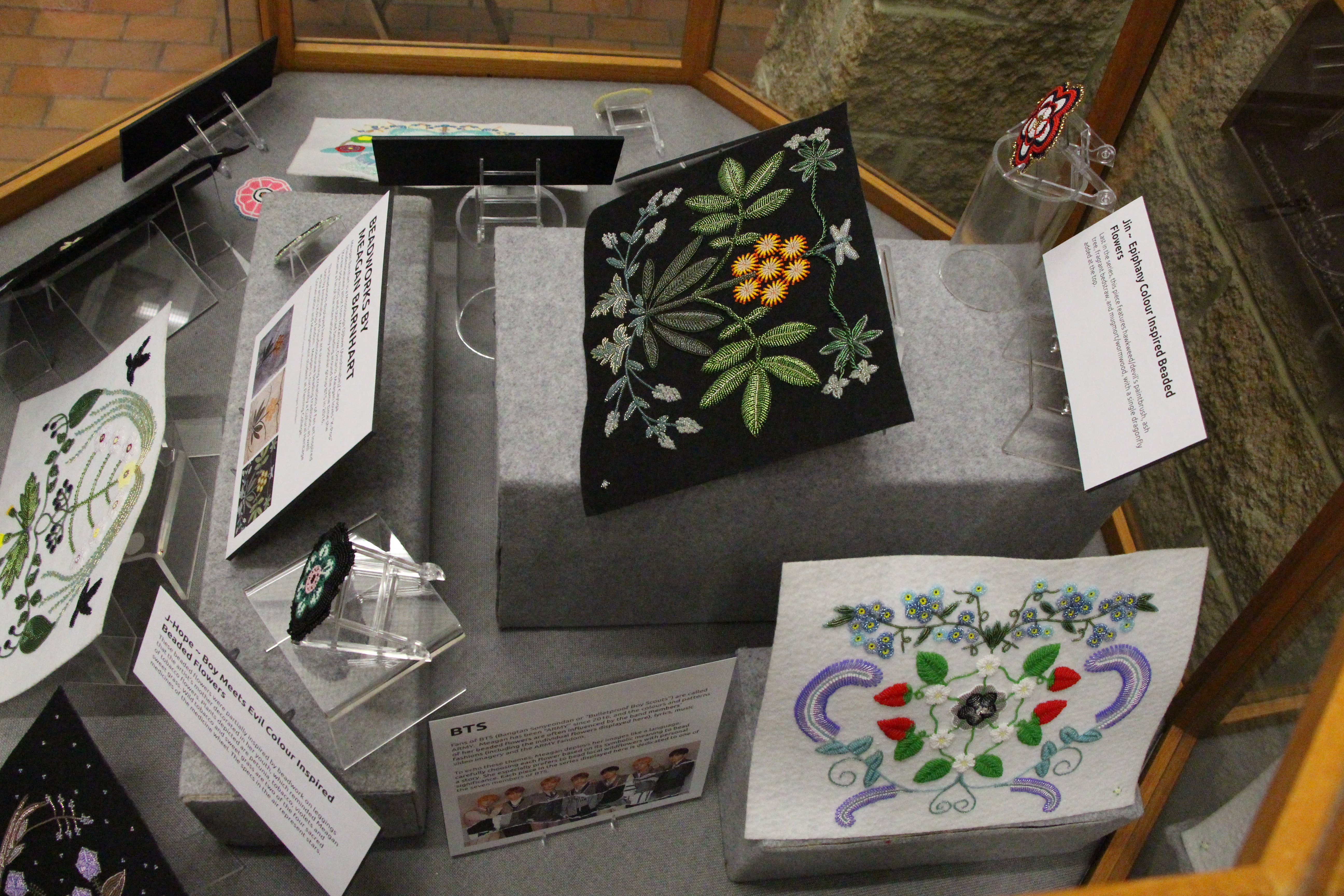
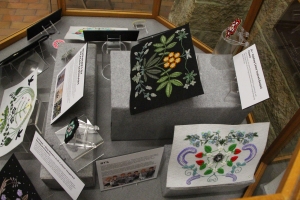 Meagan Barnhart is a Mississauga Ojibwe (Anishinabe)/ Cayuga (Haudenosaunee) artist from McKerrow, Ontario and a Cultural Heritage Conservation and Management student at Fleming College. An exhibit featuring Meagan’s 7-piece bead embroidery series inspired by K-pop group BTS (as well as 10 smaller beaded flowers), is temporarily on display at the Huron County Museum.
Curator of Engagement & Dialogue Sinead Cox interviewed Meagan to find out more about her creative process and the development of her technique. You can see Meagan’s stunning work at the museum until February, 2019.
When did you start beading? What made you want to start?
I started beading when I was really young. My mother beaded a lot and she often got me to sort out beads that were mixed together in a cookie tin. She first started teaching me by doing bead loom work and simple jewellery. However, once her eyes started to bother her while she beaded and circumstances changed in our family, beading went out of my mind. It wasn’t until many years later in my late 20s that my passion was reignited when I did some volunteer work at the Woodland Cultural Centre. For one of the months I was there I worked in the Education department – I didn’t have much knowledge that I could offer unfortunately, so I was asked to do some beadwork for game prizes. From there, I moved to Gatineau, Quebec where I got an internship at the Canadian Museum of History for Indigenous, Inuit, and Metis peoples who are pursuing training in museum work (Aboriginal Training Program in Museum Practices); it was there where I learned how to do bead embroidery, which I commonly do now.
I was influenced by many things: my surroundings and colours. I was exposed to a lot of beadworks at the museum, and I thought to myself that I would love to be that good and it excited me at the possibilities of being able to create something beautiful and calming. I was not only influenced by the beadworks but colours and emotions as well.
The work on display is inspired by the K-pop (South Korean pop) band BTS-can you explain when you 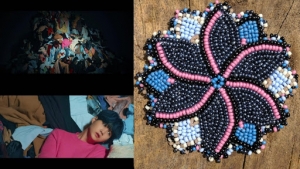 became a fan of BTS, and why they are such inspirations for your work?
The colours in their music videos, [their] lyrics, and emotions represented in their music were great inspirations to me. I have known the group since they debuted, and I can say I was always a fan of theirs, but it wasn’t until around the time I started beading that their journey sunk into my mind – their music and videos often resonated with me and a lot of them felt like a familiar dream and the messages in their music were ones that I never got when I was young and wish I had. [BTS are advocates for youth and loving yourself; they recently addressed the United Nations regarding equipping young people with self-confidence to make a global impact]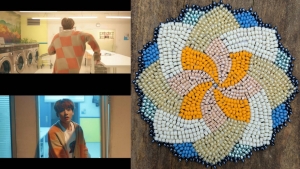
For me, at this moment, beading and BTS kind of go hand-in-hand because it was when I started beading in 2016 [that] I also began to call myself an ARMY (Adorable Representative MC for Youth)–their fandom name.
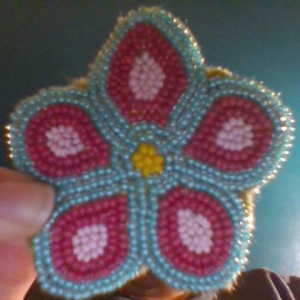
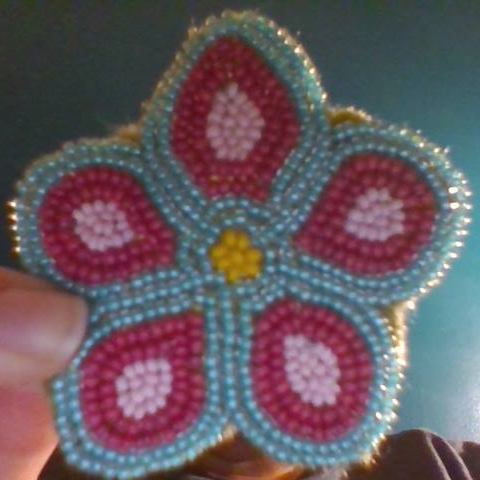
Meagan’s first embroidery piece!
How has your technique/artistry evolved?
I really still use the same materials I always have…only they are a bit better quality now. I would like to experiment on more types of materials, but I am only new to my beading (almost two years now, but I still consider myself new and learning). As of right now I don’t have any other beaders close to me to discuss new techniques or tips. So its slow learning, but I gradually pick up new techniques every once in a while – especially when I feel daring enough to step out of my comfort zone.
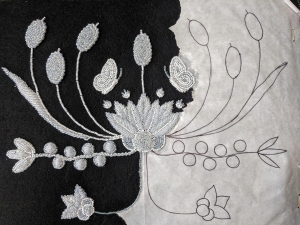
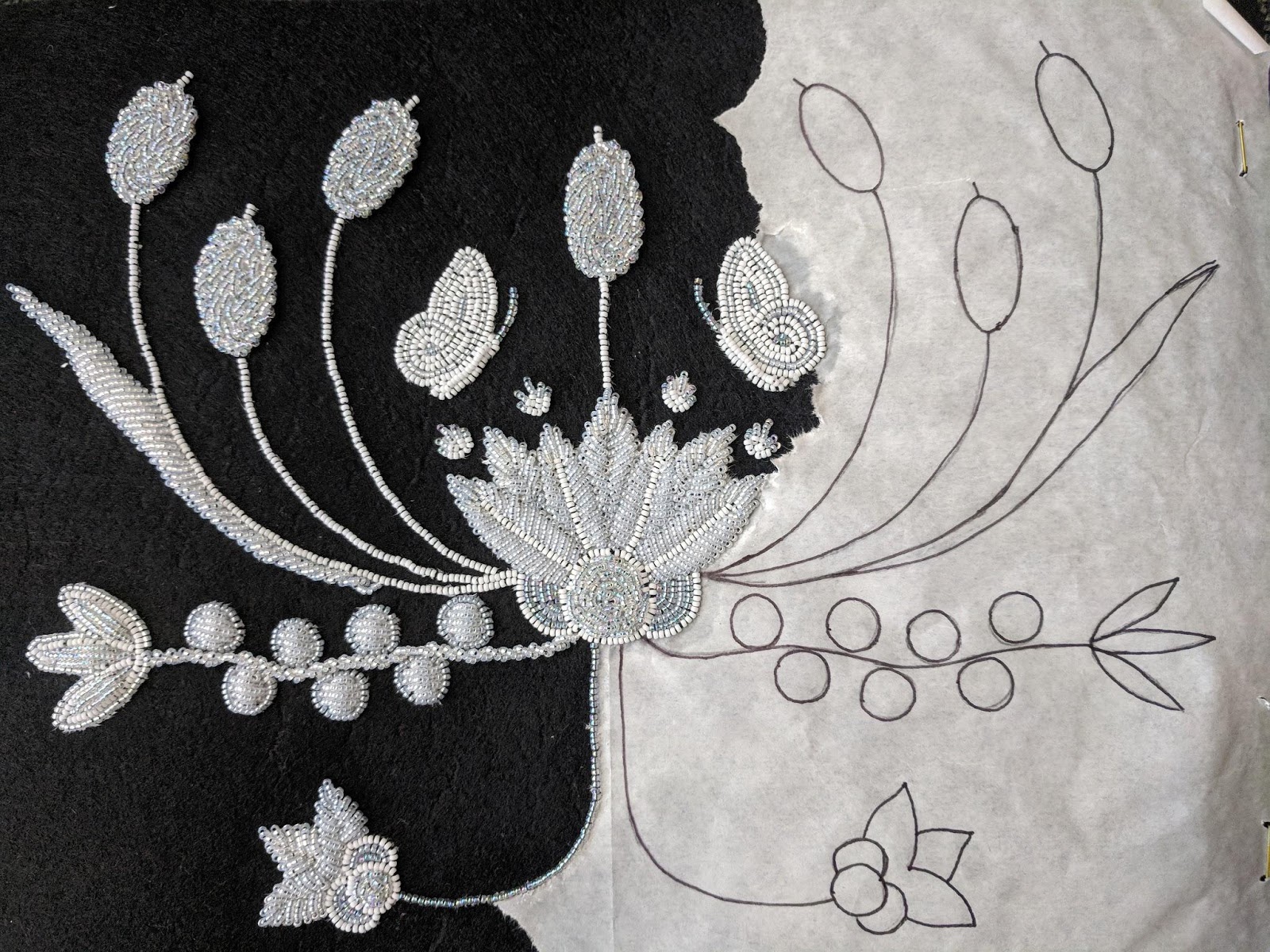
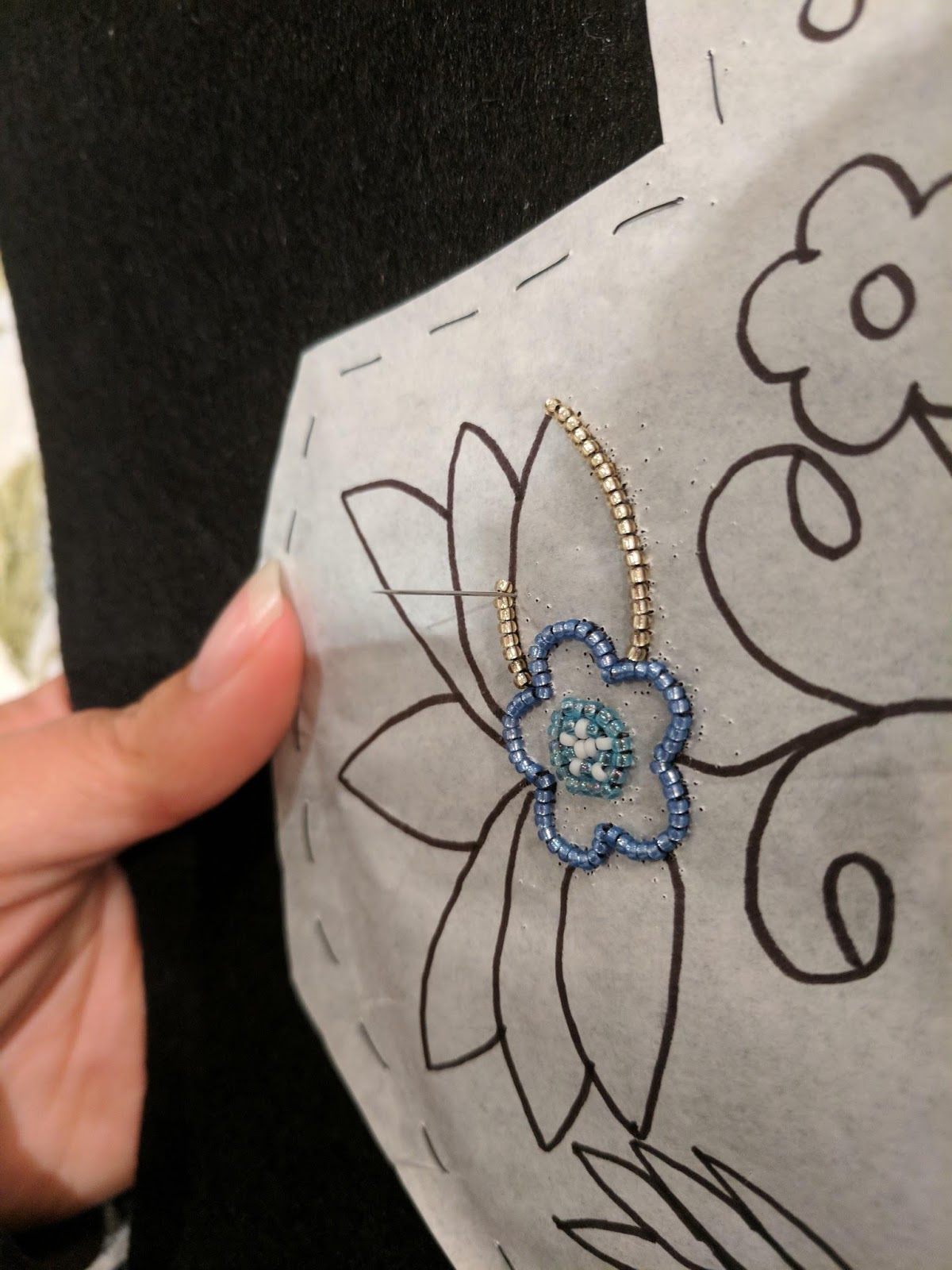
“Suga ~ Nevermind Colour Inspired Beaded Flowers”: Meagan’s first attempt at a raised beadwork in progress.
For example, my raised bead work: I [had] only been taught once how to do a raised beaded strawberry while working at the Woodland Cultural Centre, but [after] that…I felt comfortable with bead embroidery; I ventured on my own to try different techniques with raised bead work. I think I still need to practice a lot with this style and I would benefit greatly in the future having a friend or two around that I can discuss such things with.
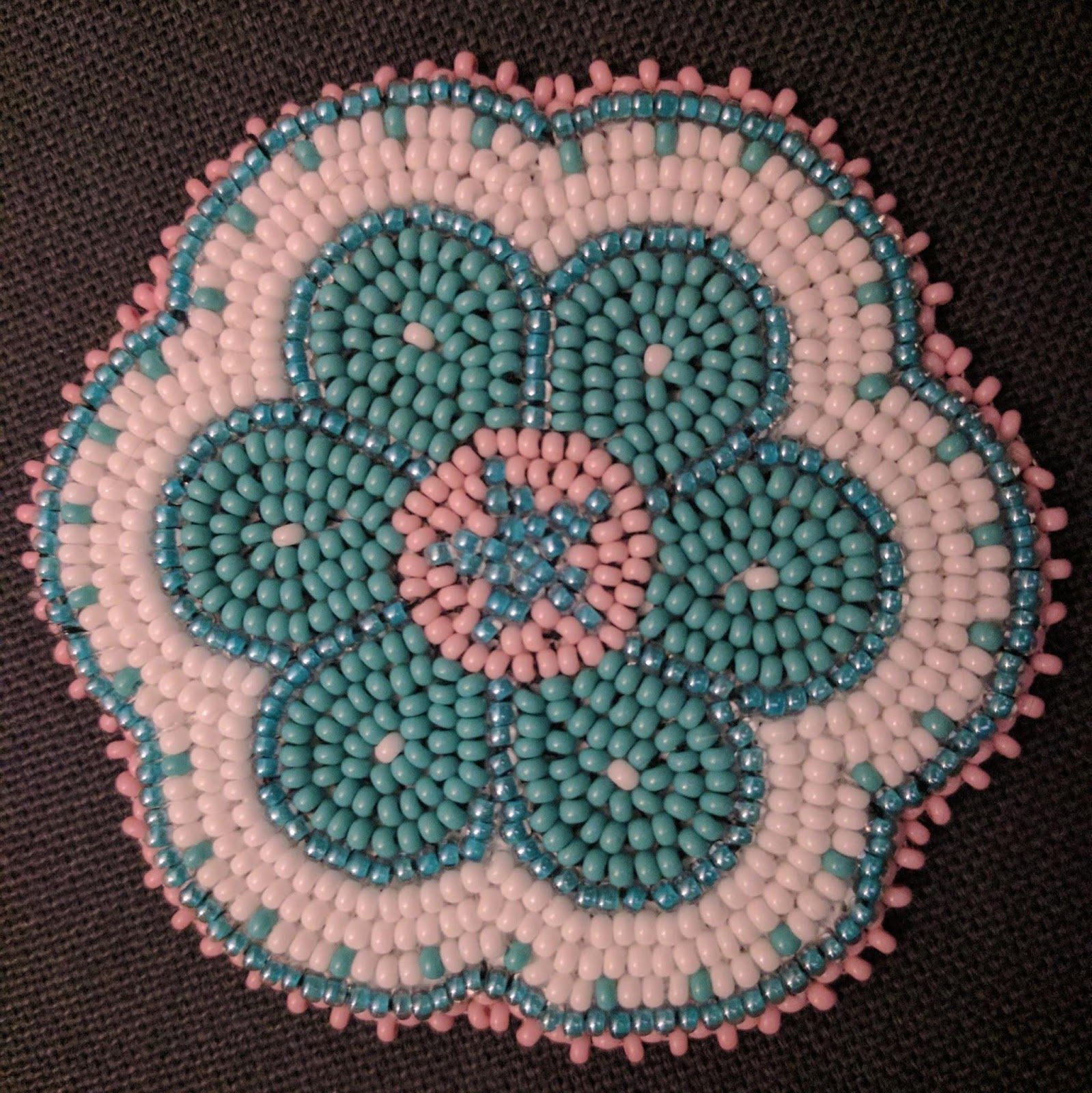
When it comes to the evolution of my BTS colour inspirations, I started out small – using the colours to make single flowers instead of larger pictures with them.
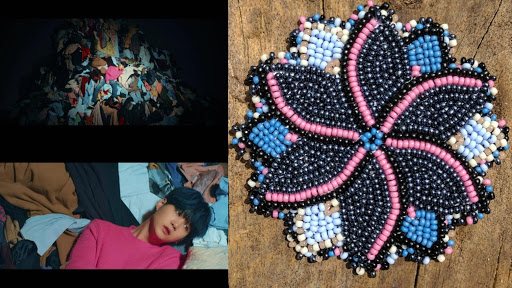
This is my very first one: 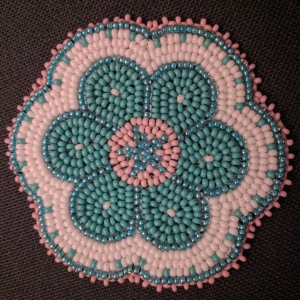
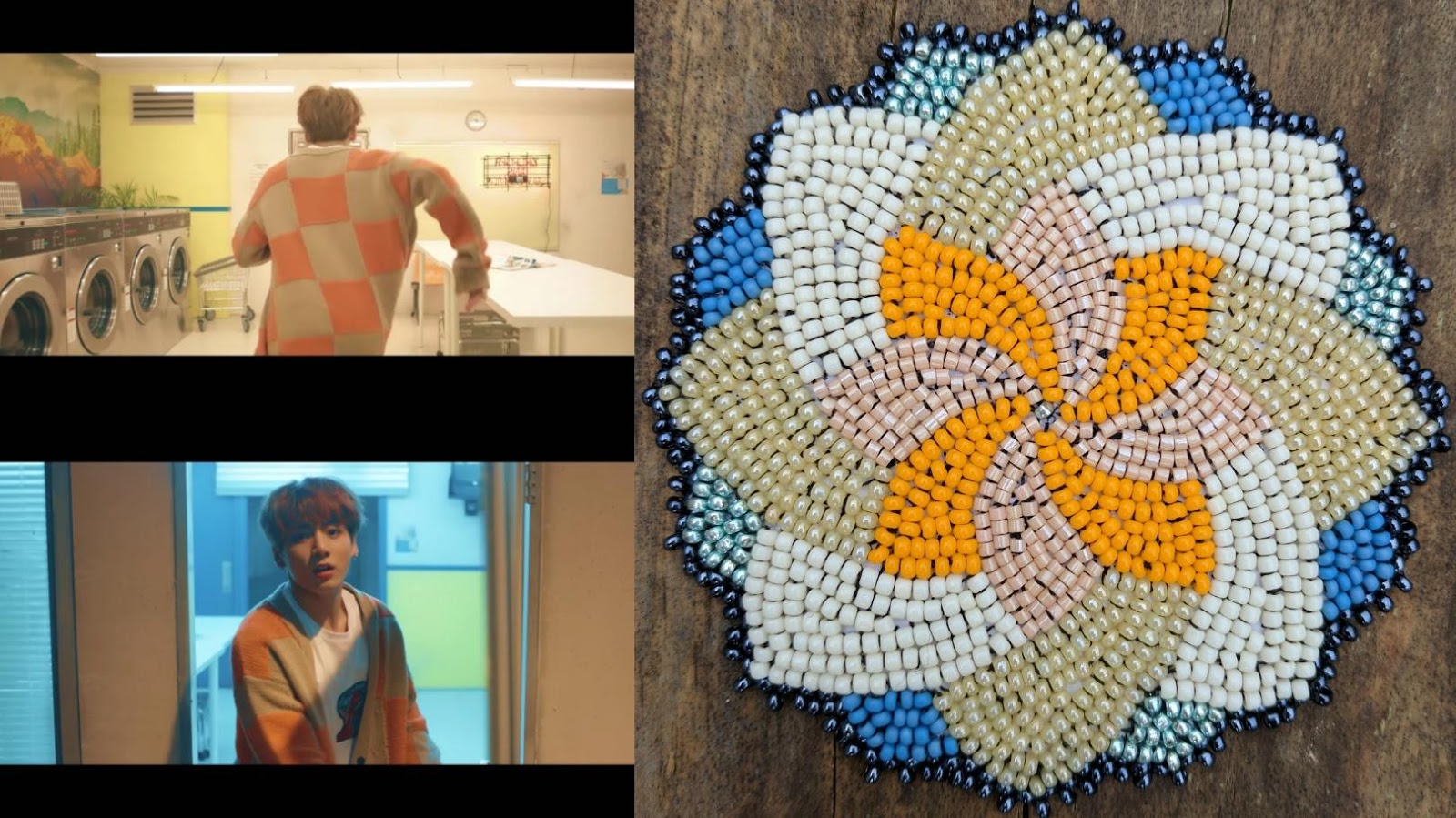
This one was based off their “WINGS: You Never Walk Alone” album. It had two covers, I particularly liked the colours of their aqua and peach coloured album – unfortunately I didn’t have peach at the time, so I used a pink as a replacement. After I finished this one, I continued by doing 3 more for the albums, and one for each member inspired by their clothing they wore at some point within the music video “Spring Day”
Who taught you beading/how did you learn?
I learned how to bead embroider when I was at the Canadian Museum of History from a fellow intern friend who is Métis. Her sister is a beader and invited me to go [to] an evening bead workshop. Unfortunately, it was [so] far by bus to get to the workshop that I only was able to spend less than a half hour with them – and from then on was not able to continue going to the classes. However, this was enough time to teach me the basics and…me and my two fellow intern friends continued to bead on our lunch breaks.
Can you briefly take us through the process of designing the seven pieces in this series?
First I watched the Music Video, then I chose a scene that captured my attention. I then read the lyrics, analysed any imagery within the entire music video to get a sense of what the storyline was – if there was a book, or movie related to the music video or even the series that the music video is apart of (School Series, WINGS Series, Love Yourself Series), I’d read or watch then to get a sense of what the entire series was about…With [each] scene I choose, I pick the colours that were most dominant in the image and choose flowers based on them.
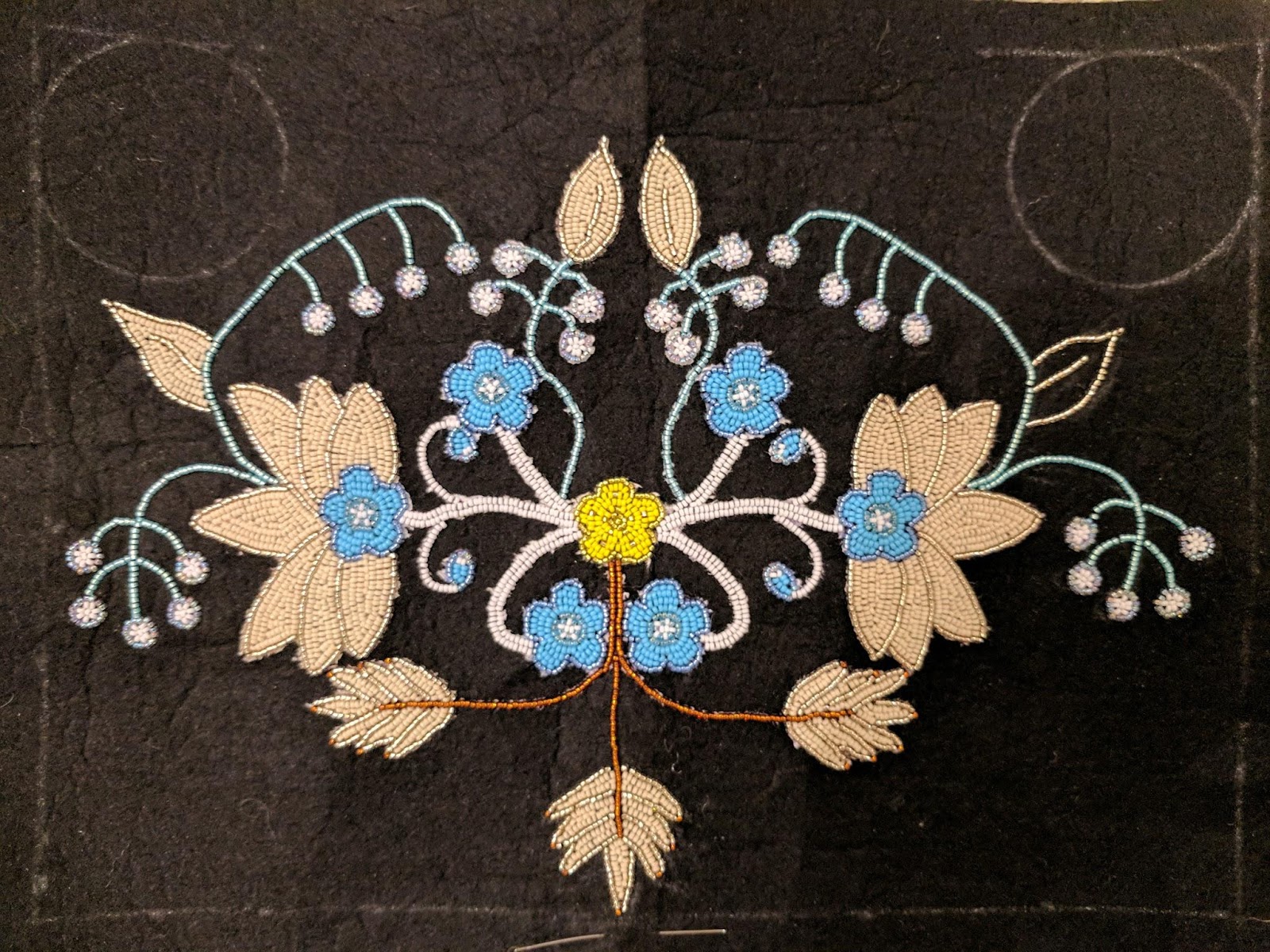
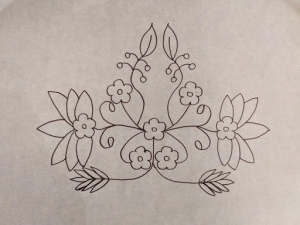 For the flowers, I often tried my best to try to use wildflowers of North America, specifically ones I’m most familiar with in Canada…I would research the meaning of the flowers or what their uses were – if I already knew what they represented or what they were used for, the better. I wanted to choose flowers that would tell a story – something that related to the music video, or BTS’s relationship with their fandom ARMY – especially since their bond is a lot stronger than I have ever seen between artist and fandom. From there I would develop a pattern. I often enjoyed the somewhat-symmetrical design; I say somewhat, because although it looks symmetrical, nothing is ever perfect, and neither are they, they don’t line up perfectly and they don’t have the same amount of beads on each side.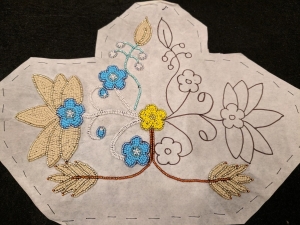
What kind of materials do you use?
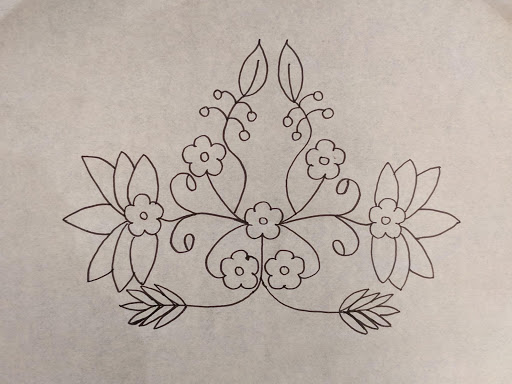
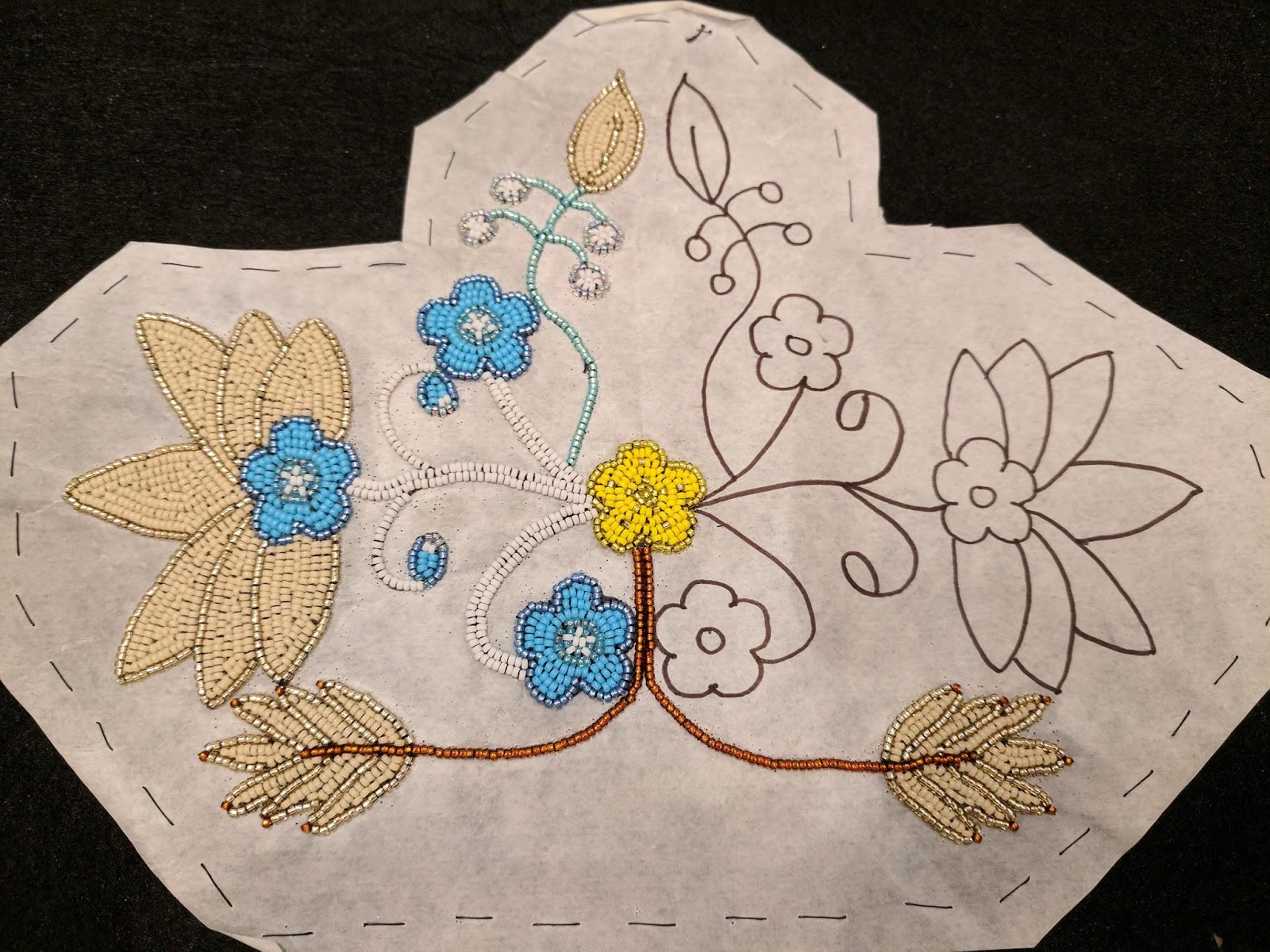
I use 15/0 glass seed beads (for the bigger pictures to get more detail). For the singular flowers I mostly use 11/0 glass seed beads, but i mix them sometimes with 15/0 seed beads, 10/0 seed beads, and 11/0 delica seed beads. For the substrate I use 100% polyester felt (more recent ones are made with a stiff felt – as are the big pieces), and either nylon, polyester, and/or cotton thread (I prefer nylon and cotton over polyester for thread because they do not tangle as much), and a 16/0 beading needle. I draw on tracing paper and bead over it. Once the beading is done, I remove the paper as much as possible/visible.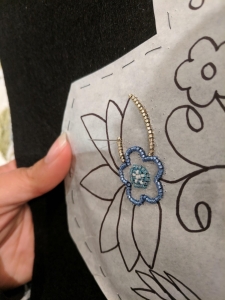
How long did it take you to bead the pieces on display?
For the singular flowers, around 12 hours (it can be more or less depending on size and my familiarity with the pattern I am using), and for the larger pieces I would say around 150 hours (more or less, depending on the amount of difficulty and style). For the full series of the large pieces, the entire project took me a year, practically to the day. For the smaller flowers, that series has almost been a year long as well – I believe my year will be up in November. This year has been full of many projects (not just these ones), so that may have contributed to why these series took me so long to complete.
What’s the most difficult part of creating beadworks? Conversely, what’s your favourite part of the process?
Sometimes the amount of detail you want doesn’t show through, and you will never know until you start. There [were] a few times when I envision[ed] something, made it halfway through my design and had to alter something because it wasn’t working out the way I planned or it wasn’t looking the way I wanted it to. Eye strain is another difficult thing to control as well, especially when you are really focused.
One of my favourite parts is the relaxing feeling it gives me – it’s almost like meditation at times. I also really enjoy seeing the outcome of it all.
Do you have a favourite piece that you’ve created so far?
Each one has a particular place with me when it comes to the big ones [from the series] – However, I think my first one, Serendipity, holds a special place in my heart. It’s not my best one, but it is my first attempt at doing anything so ambitious. I also remember how much i loved that song and music video when it came out – I still do really. There was a lot in this music video that reminded me of what my dreams look like when I sleep, and my first thought was that I really wanted to capture that feeling by capturing the colours. When I look at it, I can see things that I could have done better – even with the story telling I have with the flowers, but instead, these flaws make me smile and i love it just the way it is.
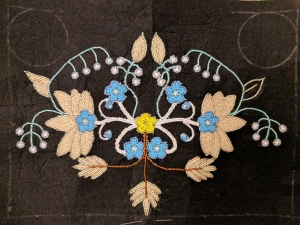
“JIMIN ~ Serendipity Colour Inspired Beaded Flowers” Flowers are lily of the valley, buttercup and periwinkle. The two circles (unfinished in this image) represent the sun and moon.
[BTS member] Jimin is also my bias [a fandom term for preferred member of the group], so that may have something to do with my gentle lean towards Serendipity – it is his solo intro song that inspired me to do this series.
Is there a story or message you hope your work conveys?
Surround yourself with positivity – beauty, happiness, serenity, peace – appreciate your hard times, they will help you recognize the good in even the smallest form if you allow it to.
Where can people follow you & your work?
Instagram: @ojistah88
Twitter: @Ojistah
AMINO (ARMY and ARMY++): Ojistah
Meagan’s work will be on display in the museum lobby October 2018 through February 2019. All photos for this piece courtesy of Meagan Barnhart.