by Amy Zoethout | Jan 27, 2021 | Artefacts, Collection highlights
Take a closer look at the Huron County Museum & Historic Gaol and its collections as staff share stories about some well-known and some not-so-well-known features, artifacts, and more. In the first of this new blog series, Collections Intern Thomas Lang looks at one of the Museum’s most recognizable artifacts, the M4A2E8 Sherman Tank, and shares how an armoured vehicle manufactured in the United States found its way to Goderich.
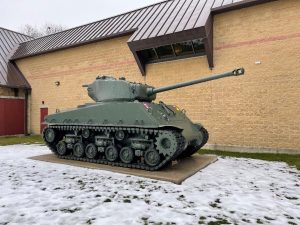
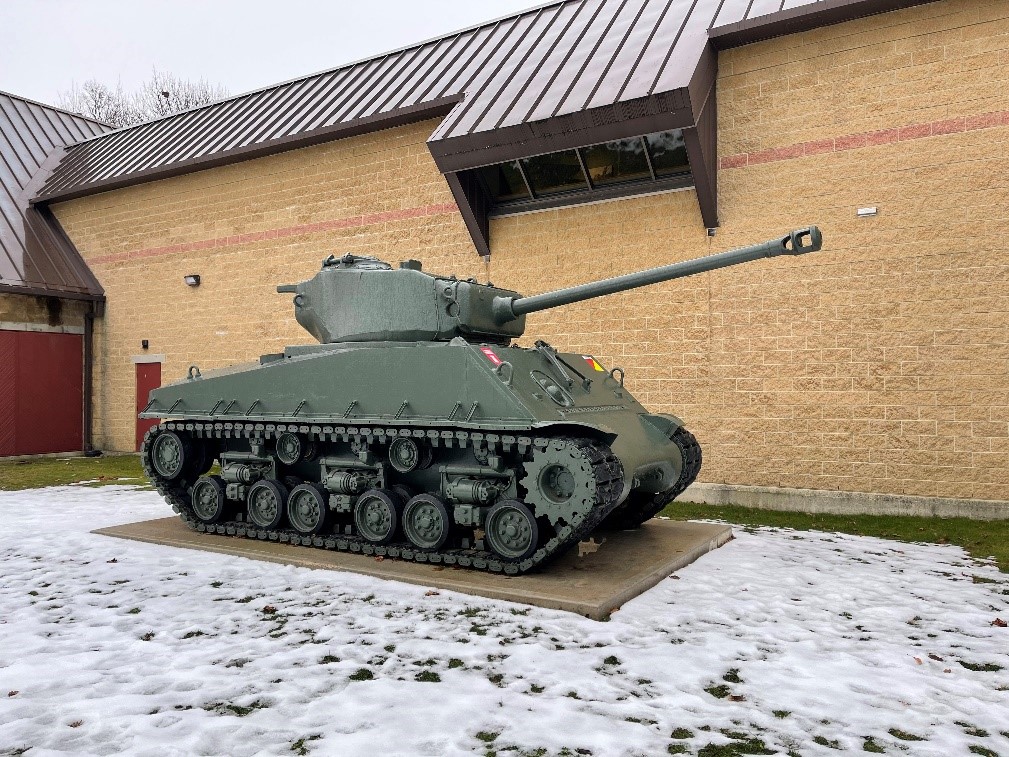
The M4A2E8 Sherman Tank as seen in 2021 on the grounds of the Huron County Museum.
The M4A2E8 Sherman Tank has been a part of the Huron County Museum’s collection since 1978 and is a popular feature on the Museum grounds. Manufactured by General Motors’ Fisher Tank Arsenal in Grand Blanc, Michigan, at the tail end of the Second World War, it was one of 294 tanks purchased by the Canadian Militia for training purposes in 1946. Between its variants, the Sherman was the most widely used tank among the Allies in the Second World War, and reserve units in Canada continued to operate them until the 1970s. The Museum’s tank was attached to the Ontario Regiment in Oshawa until November, 1973, when it was declared surplus and purchased by the Royal Canadian Legion, Branch 109 Goderich.
After being displayed near the Goderich Airport for five years, the Legion donated the tank to the Huron County Museum and held a Memorial Dedication Service on Aug. 20, 1978. The Legion dedicated the memorial to all the Allied armies who used Sherman tanks in the Second World War and to those who produced these armoured vehicles on the homefront. Lieutenant-Colonel David Currie, recipient of the Victoria Cross for his actions at the Battle of the Falaise Pocket, unveiled the plaque at the Museum and the Legion painted the tank to resemble Currie’s command tank in the 29th Armoured Reconnaissance Regiment (The South Alberta Regiment) to commemorate his service.
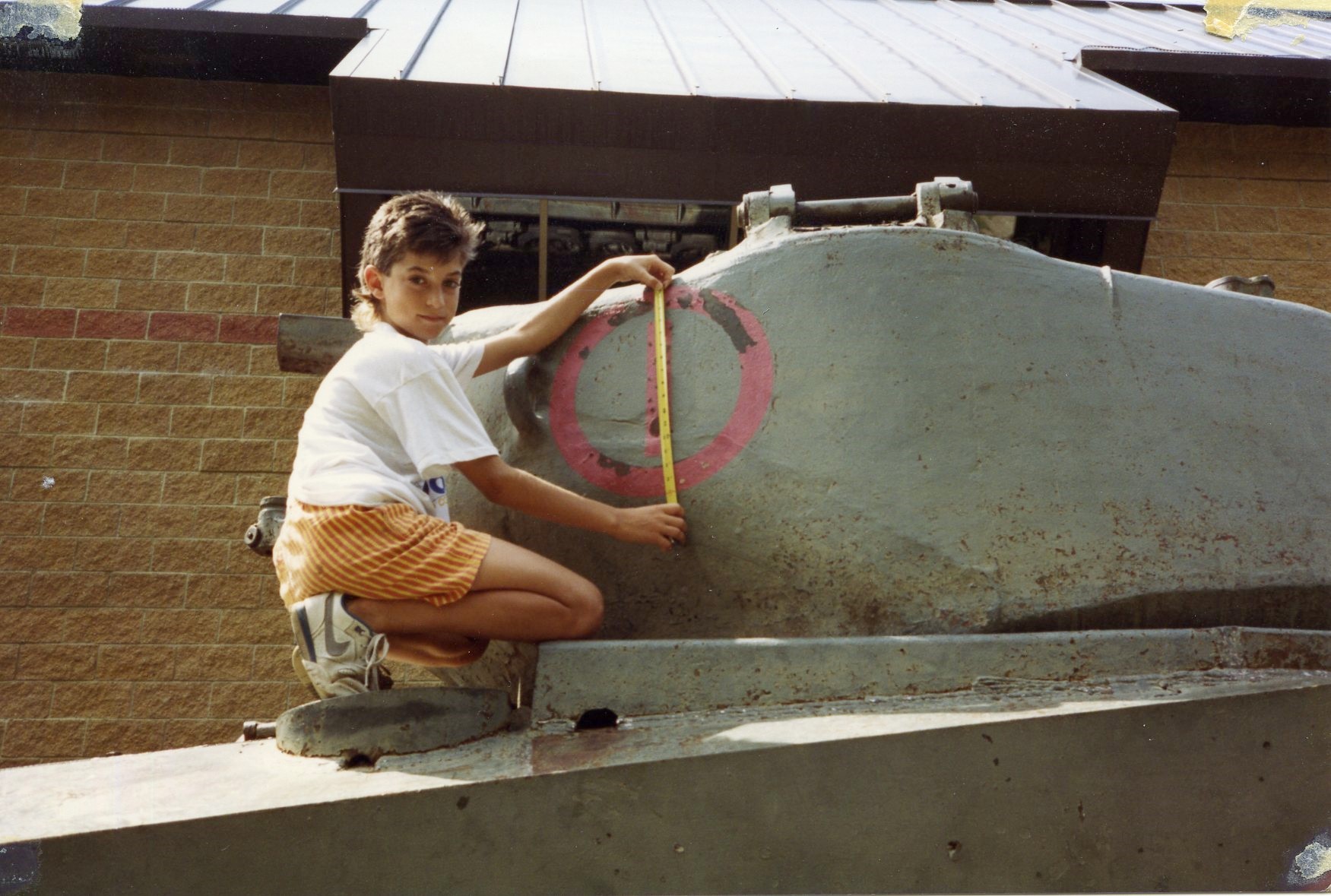
Since the ceremony, the tank has remained on public display outside the Museum. In 1996, a group of student volunteers painted the tank as part of the Junior Curators Painting Project. Today, we have repainted and added identification markers to the tank to reflect what it would have looked like while being used by the Ontario Regiment.
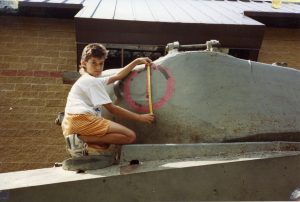
A student paints the tank during the Junior Curators Painting Project in the summer of 1996.
While the Museum is temporarily closed to the public, you can still see the Sherman tank, as it is always on display on the north side of the Museum on Trafalgar Street.
Further information about the Sherman Tank:
by Amy Zoethout | Dec 24, 2020 | Archives, Artefacts, Blog, Exhibits
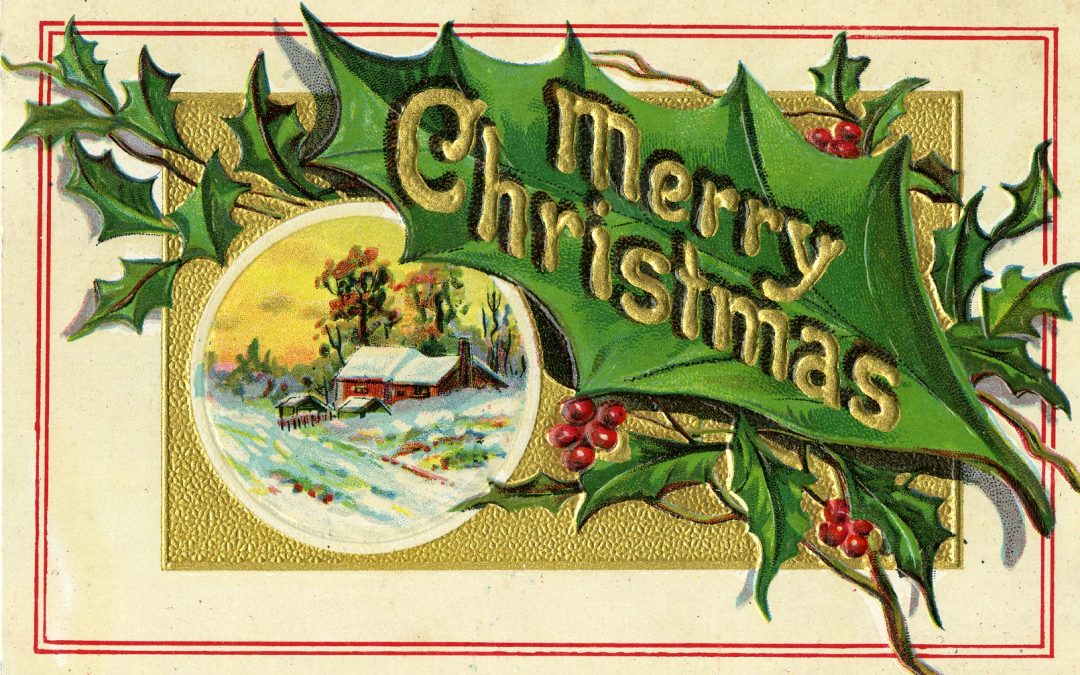
Technology over the last several years has made it so easy to quickly connect with friends and loved ones that the tradition of sending Christmas cards has not been as popular as it once was. But in the midst of a global pandemic, when we can’t celebrate together like we normally would, people are looking for more meaningful ways to let loved ones know they are thinking of them, and what better way than a lovely greeting delivered through the mail. And while we can’t send out a seasonal greeting to you all through the mail, we can still use the power of technology to share a little Christmas cheer by taking a look through some of the Christmas cards in our collection. 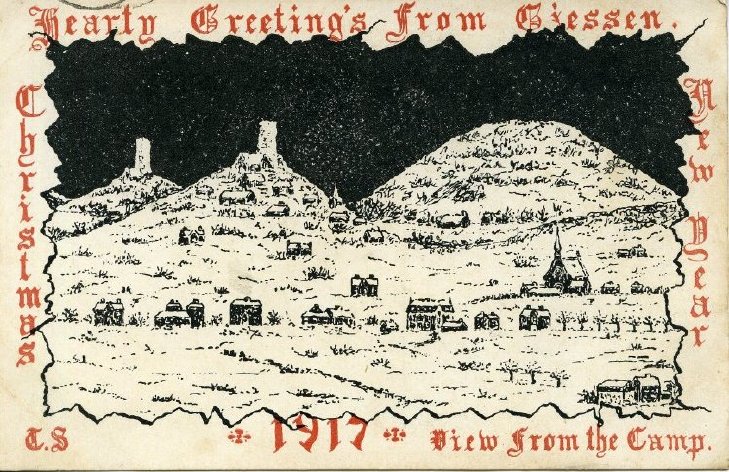
Christmas Greetings, From Germany To Edith Williams From Prison Camp 106684 Co.10 Bar. B A994.0007.033
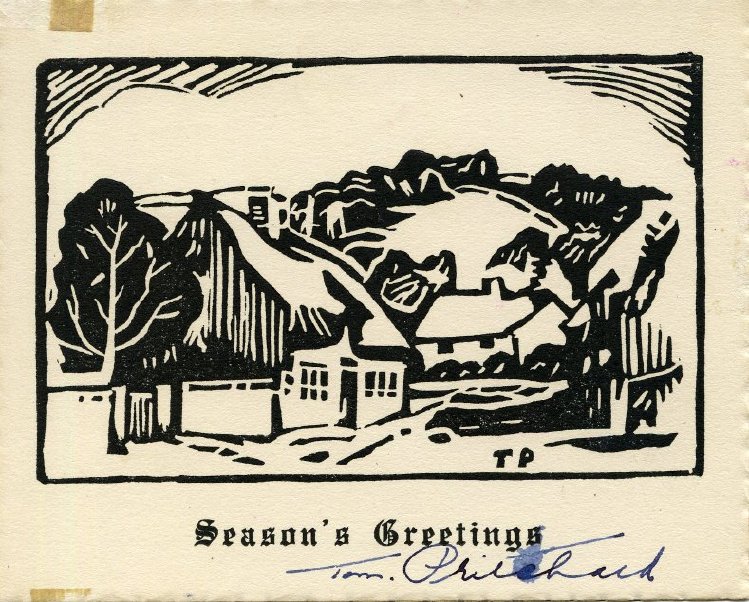
A Christmas notecard “Season’s Greetings”. On the front of card is a Tom Pritchard print of a farm/house by a hill and is signed by Tom Pritchard. Donated by Town of Goderich. 2011.0021.009
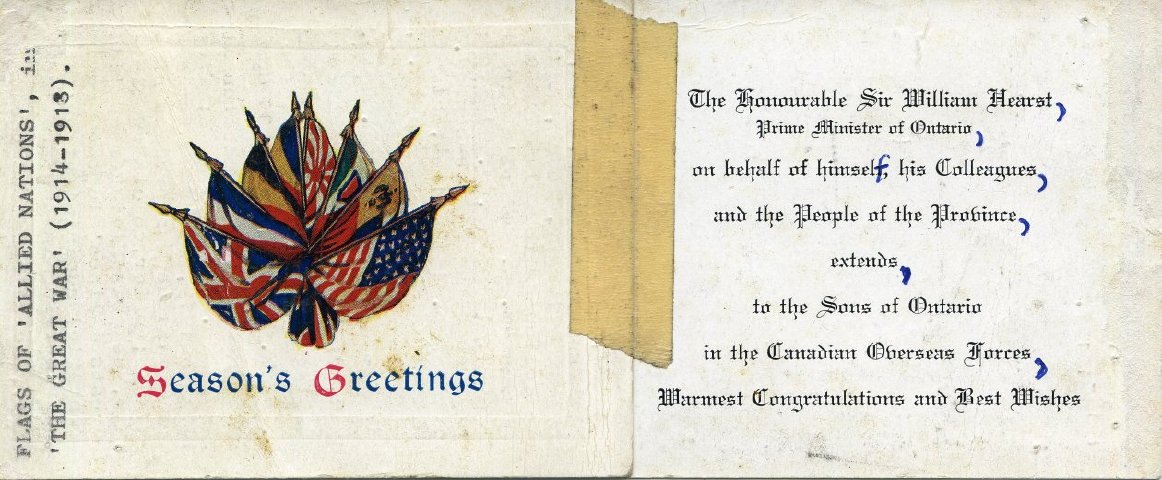

This Christmas postcard features flags of Allied nations in the First World War. The back of the card includes a bio of Ontario Premier William Hearst. 2004.0044.006
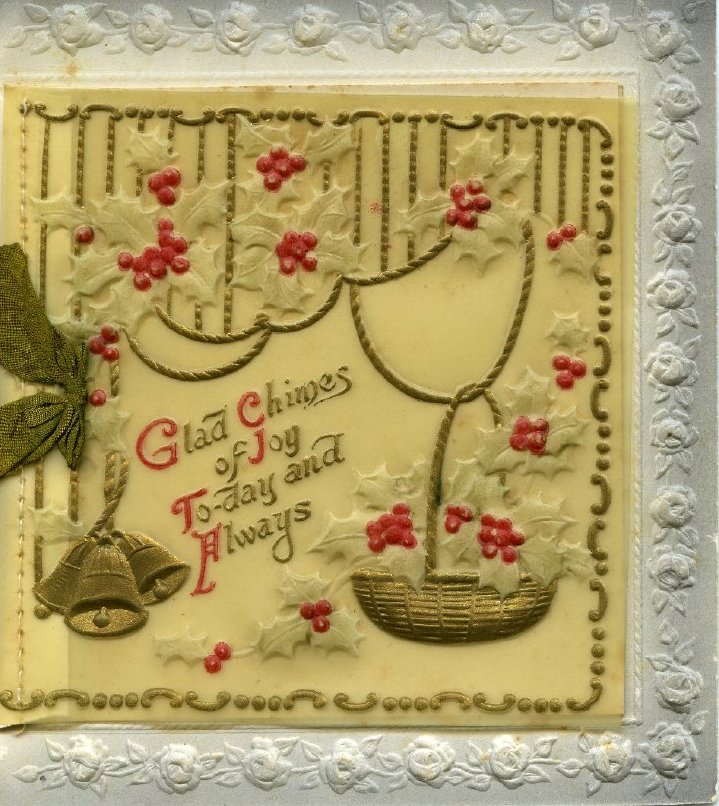
The back of this card has a silver embossed border. The front of the card is made of plastic with bells and holly designs on it. On the inside left is printed “THAT YOU’LL REMEMBER ME”. On the inside right is printed A GREETING…ANOTHER CHRISTMAS. A951.0664.001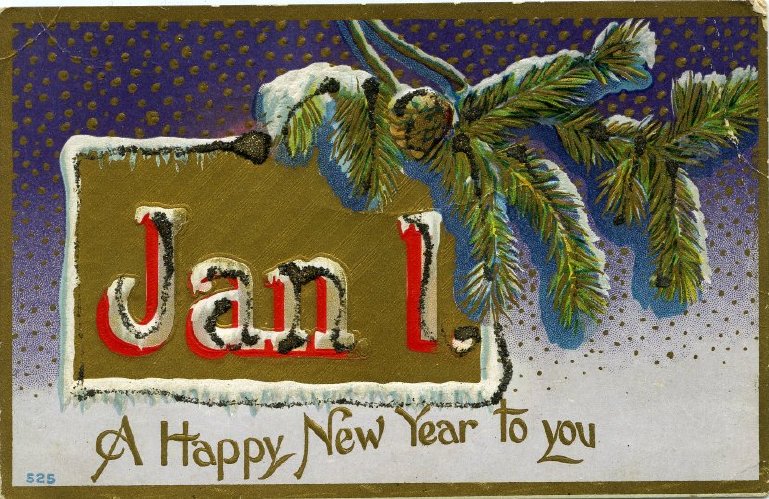
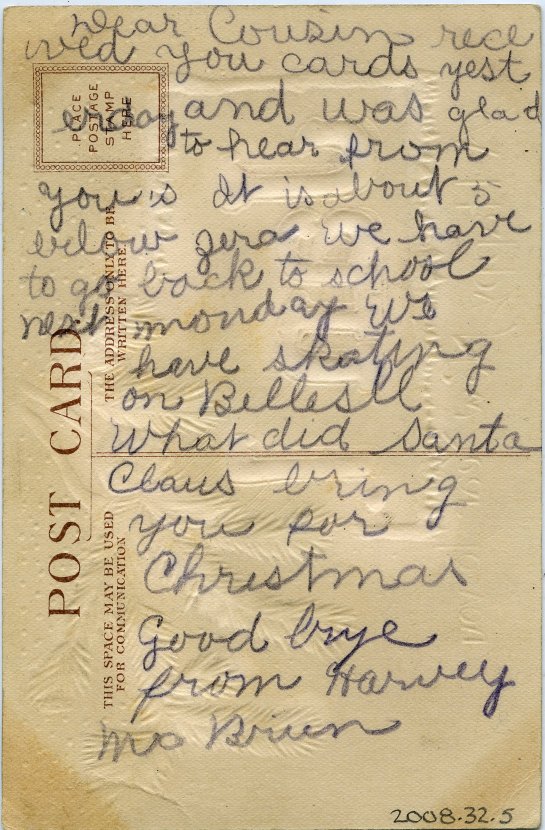 This Happy New Year postcard does not include a postmark, but reads on the back: “Dear cousin, received your cards yesterday and I was glad to hear from you’s. It is about 5 below zero, we have to go back to school next Monday. We have skating on Belles Isle. What did Santa Claus bring you for Christmas. Good bye from Harvey M Brien.” 2008.0032.005
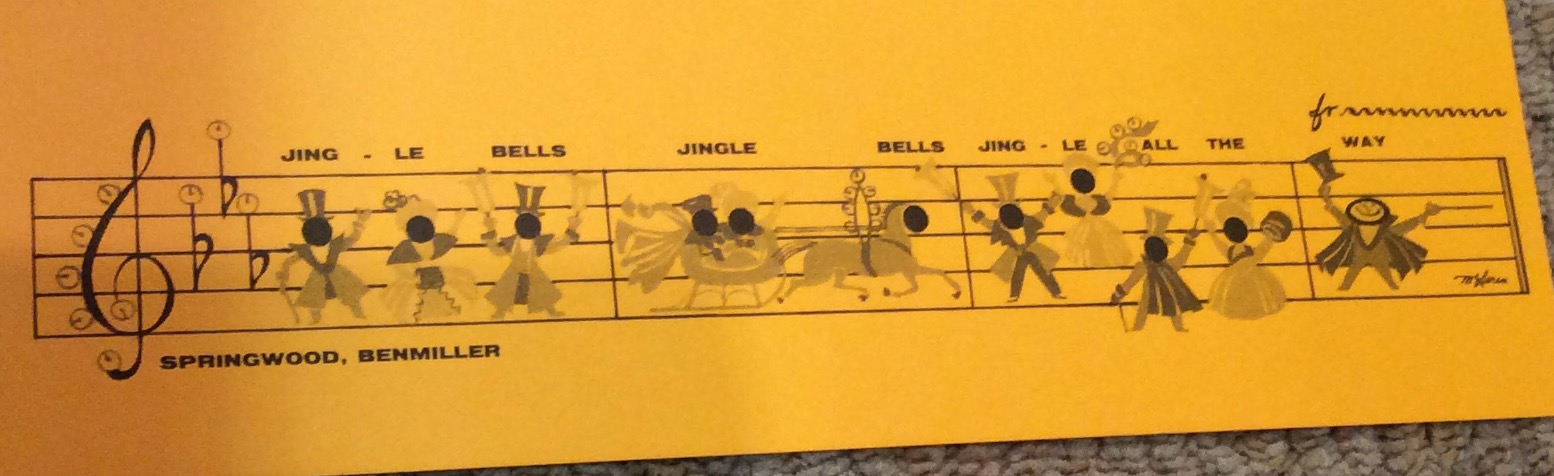
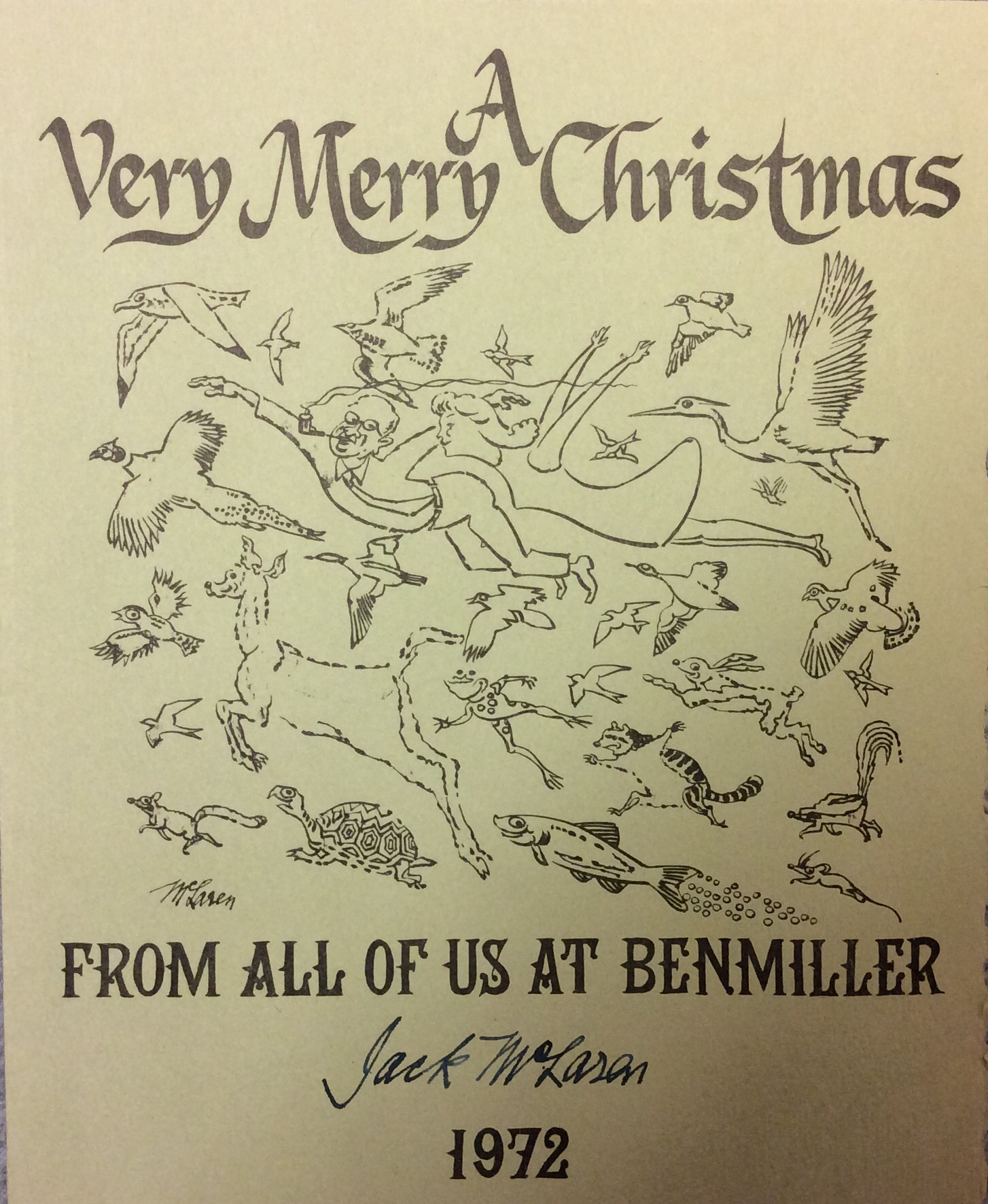
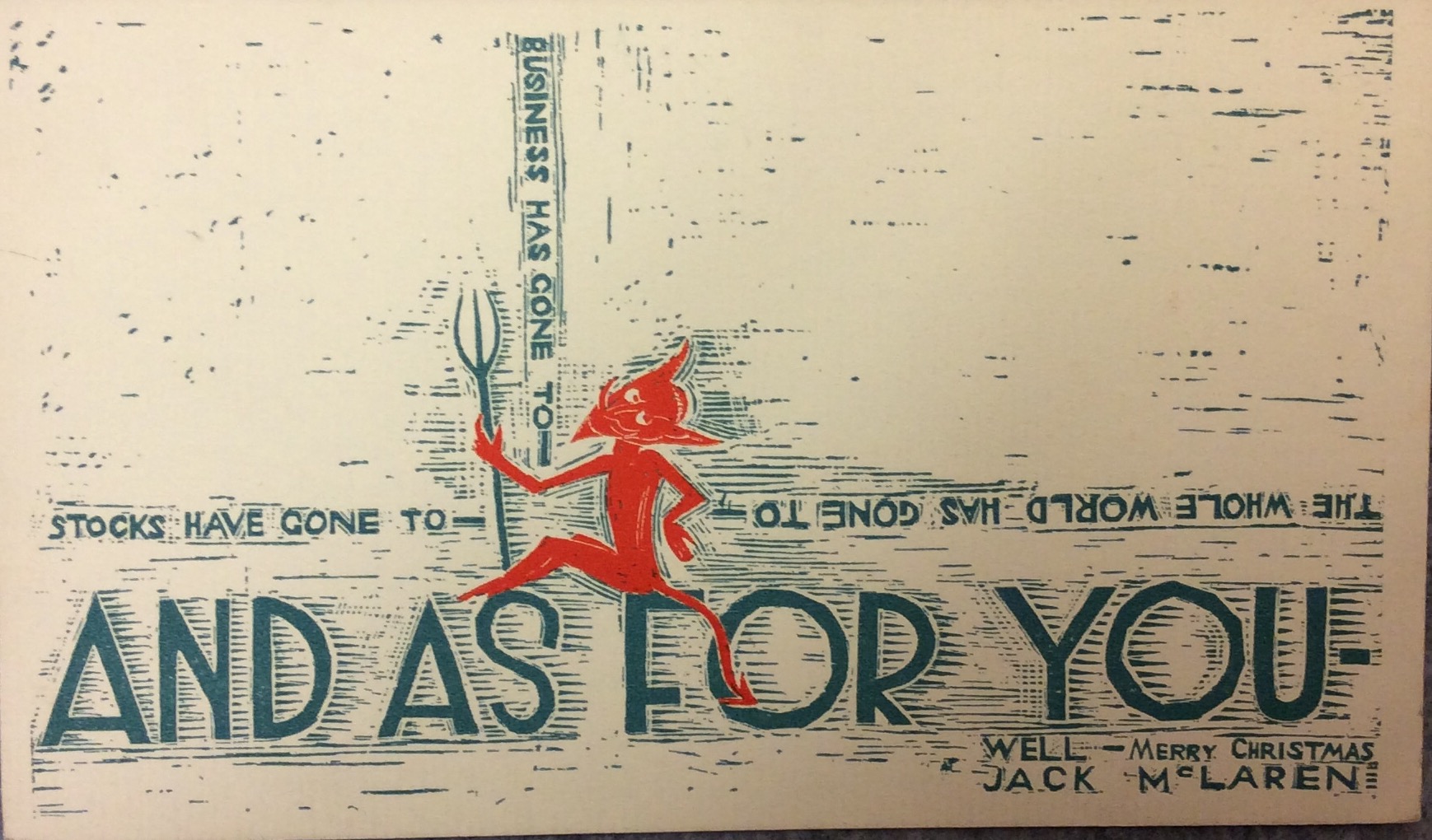
And, of course, we couldn’t share our Christmas card collection without sharing a selection of cards from artist Jack McLaren, who is the subject of our exhibit Reflections: The Life & Work of J.W. (Jack) McLaren. Depending on the year, his collection includes some happy and cheerful seasonal greetings….
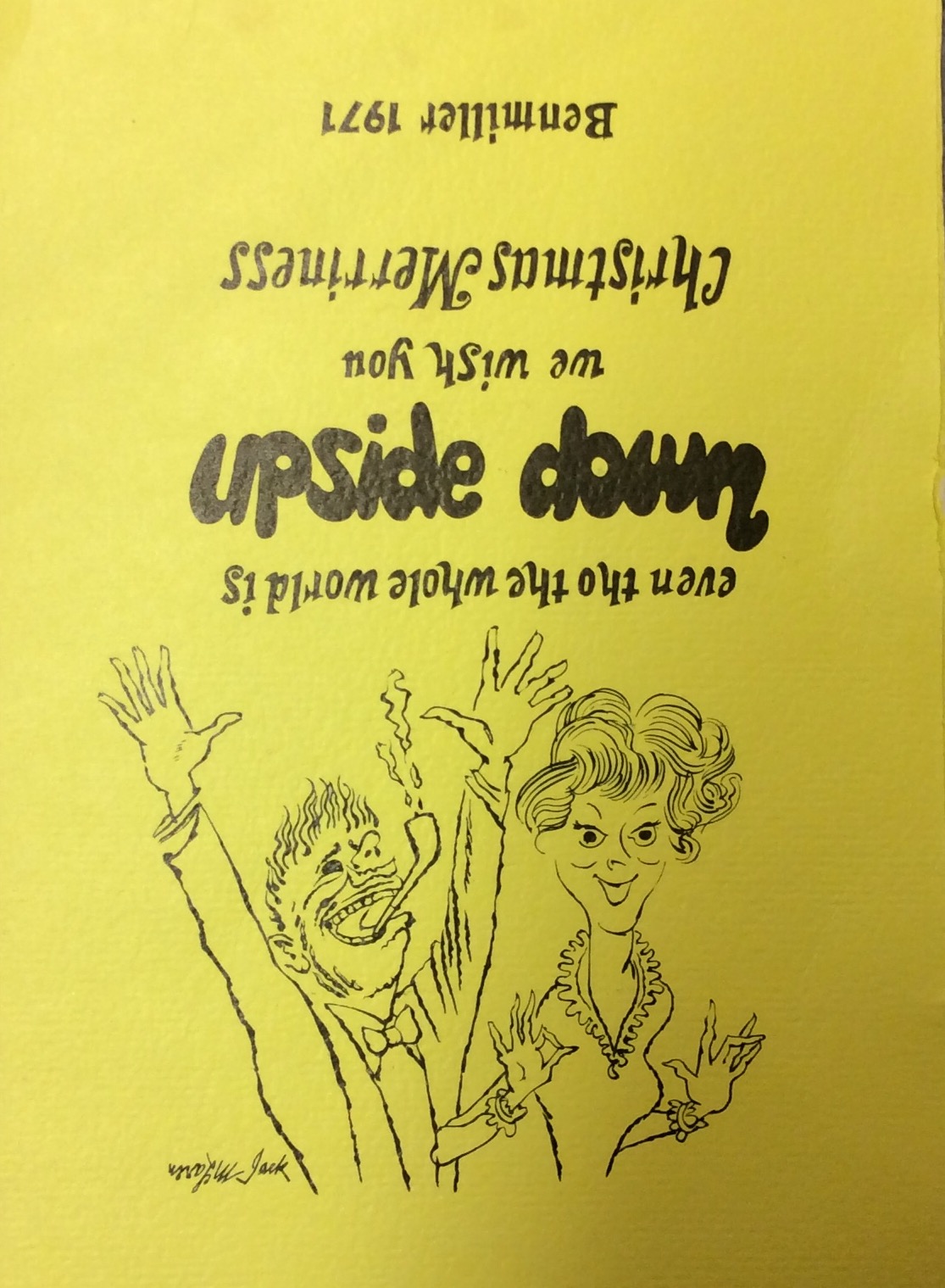
And some that seem appropriate for the 2020 holiday season…
by Sinead Cox | Apr 9, 2020 | Archives, Artefacts, Media Releases/Announcements
Huron County Museum staff may not be working at the physical location of the Museum but we are still working for the Museum and thinking about our collections, exhibitions and programmes. Much of what we do relies on the words and collecting habits of others past and present. With that mindset it is important now for us to think about the current Coronavirus pandemic and the future of collecting items relevant to Huron County throughout this time.
The collecting mandate for the Huron County Museum is to collect the stories and artifacts of our local area, with particular emphasis on items that were made by or used by Huron County people. We are looking for your help to document and illustrate how Coronoavirus has affected us close to home.
When this crisis is over we will be putting together a collection of items relating to the Coronavirus pandemic to keep in our archives for future use and research. Items could include: photographs, journals, letters, signs, or documents that tell the story of COVID-19 and its effects on the lives of those living in Huron County.
We understand that this is a difficult time for many so participation is voluntary and has no timeline. Items may come today, 2 months from now, or even years from now. The purpose of the collection will be to document and will be used for future research and exhibition.
If you are interested in helping create a documentary history of the pandemic in our community you may mail items to the Huron County Museum, 110 North St., Goderich; email to museum@huroncounty.ca; or bring your items directly to the Museum after the site re-opens to the public. Staff are available by email to answer your questions.
Stay safe and healthy,
Elizabeth French-Gibson
Senior Curator
Huron County Museum & Historic Gaol
by Sinead Cox | Mar 30, 2020 | Artefacts, Collection highlights, Exhibits, For Teachers and Students, Uncategorized
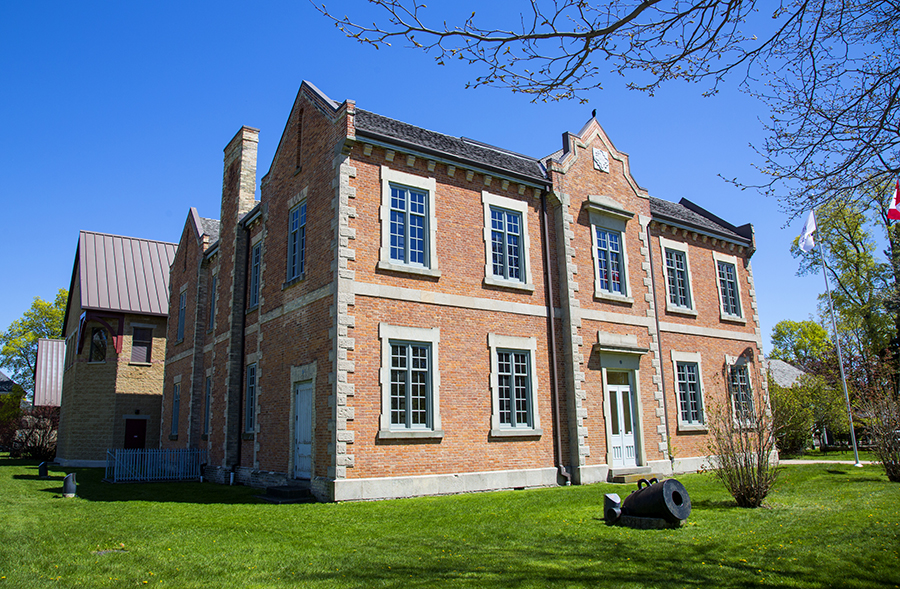
Huron County Museum: Virtual Permanent Galleries
The Huron County Museum’s virtual exhibits grant a close-up glimpse of select artifacts on permanent display in our galleries, as well as information that you can’t guess with just a look. The featured objects represent a small sampling of the thousands of artifacts in the museum’s collection. Updating the online exhibits is an ongoing project; in the future, student employees will be refreshing the images and providing even more information. These exhibits are also available via ipads onsite when the museum is open.
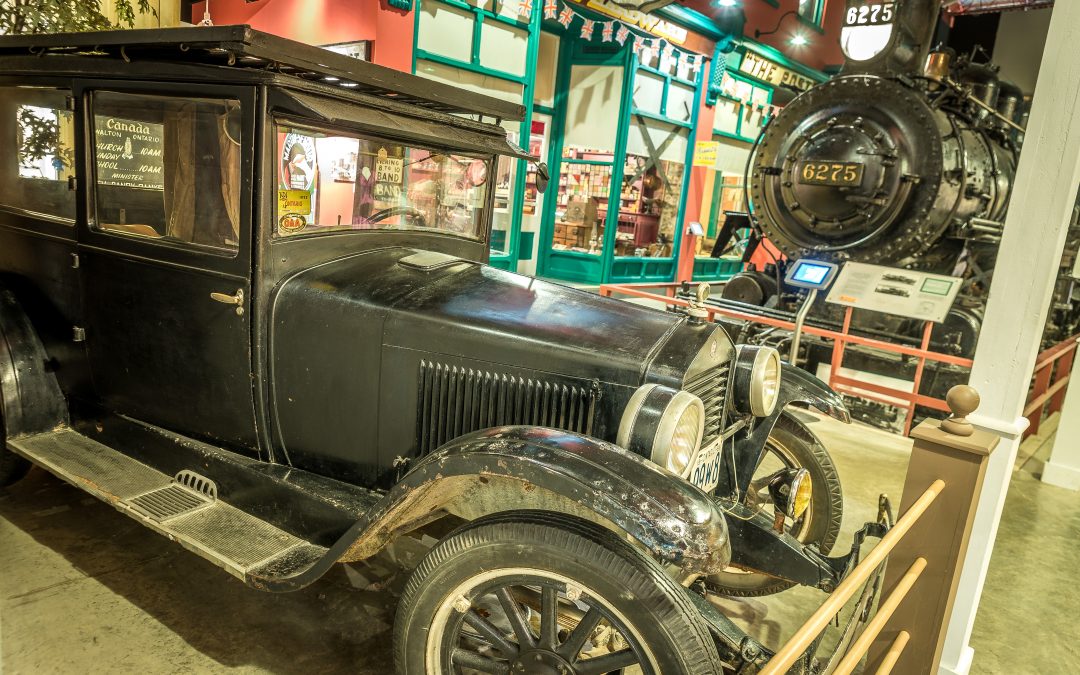
Huron County Main Street
Our Main Street features real storefronts and objects from across the county of Huron.
Click the storefront names to step inside and see artifact highlights!
Military Gallery
Click the titles below to see archival documents and more related to Huron County and the First World War.
Huron County Museum Feature Gallery: Virtual Exhibits
The Huron County Museum rotates exhibits of special interest through the year in our Feature Galleries. Click to explore past temporary exhibits that you may have missed or want to rediscover.
by Erin Samuell | Jun 1, 2018 | Artefacts, Blog, Collection highlights, Uncategorized
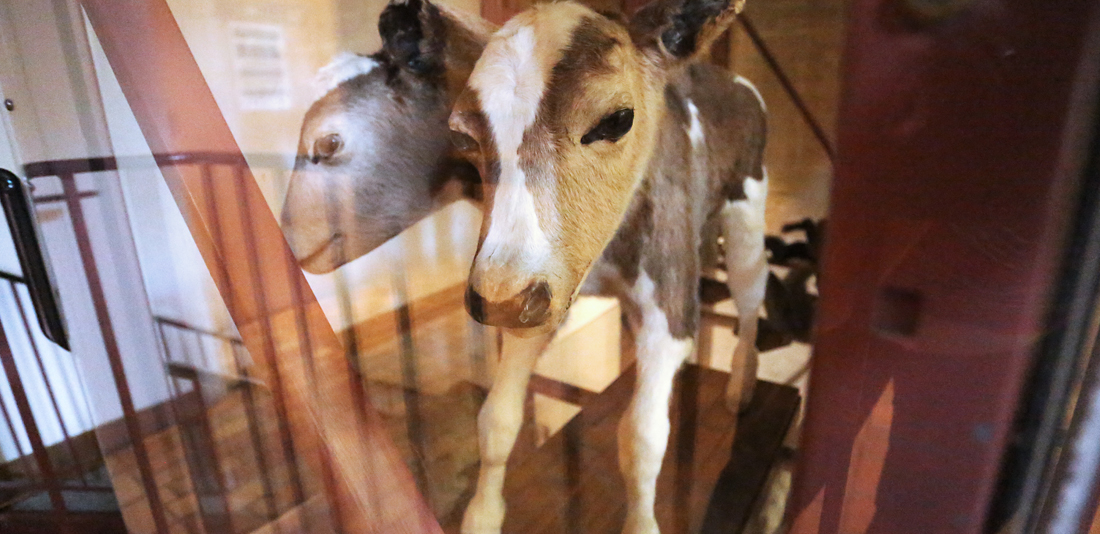
Did you know that the Museum has two two-headed calves in our collection? Since the Museum’s earliest days these calves have been a crowd pleasing favourite among visitors – which one do you favour?
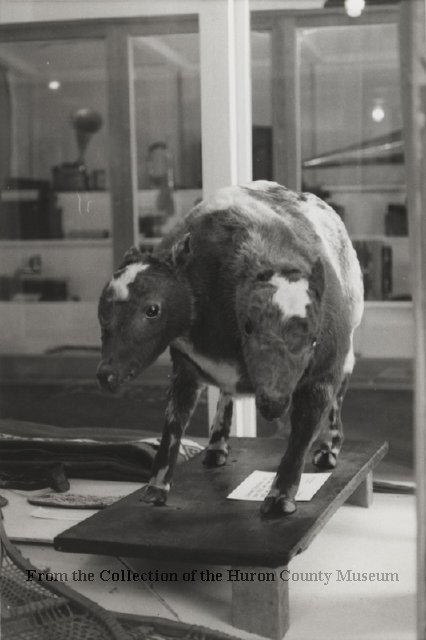
The first calf, a female, was born on the farm of William McFadzean, near Walton in 1925 with two heads, two tails, two hearts, two spinal cords and four legs. During birth one of the necks was broken and the calf died shortly after and was buried. Richard Hoy, owner of the store, restaurant, and butcher shop in Walton was also a taxidermist. When he heard the news, he exhumed the calf and preserved it.
M959.0226.001
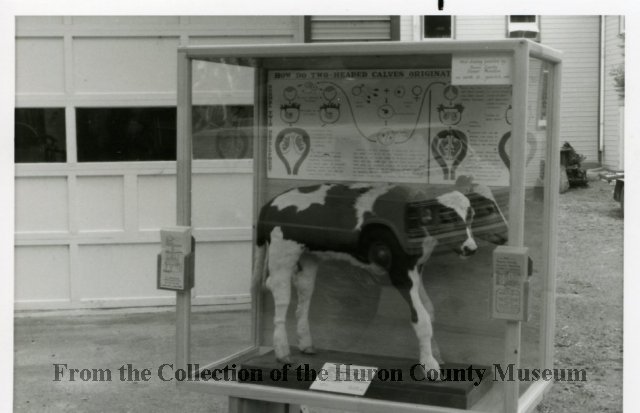
The second, a male Friesian Holstein calf, was born with two heads, two tails and one set of organs in 1936 on William Long’s farm in Colborne Township. Dr. Meyers of Goderich was the veteranarian. The calf was mounted by a taxidermist from Toronto.
Excerpt from a newspaper clipping in 1936 (newspaper unknown):
“A freak Holstein calf was born on the farm of Mr. William Long, but lived only for a short while. The calf had two heads and two tails. About once in 2500 births there is a calf with two heads, but the veteranarian in attendance had never experienced the birth of a calf with two heads and two tails. Life was noticed in one of the heads for a few minutes, and the body of the calf was quite normal in that it had only four legs, one body, and one set of organs. Mr. Long is thinking of sending the body to a taxidermist to have it mounted.”
M966.114.001
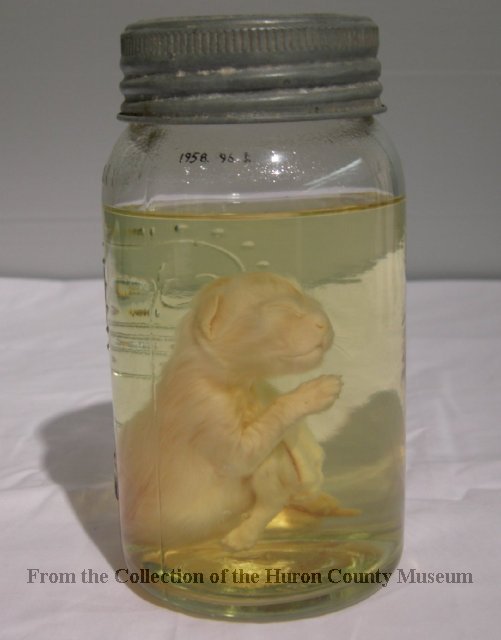
If two headed calves aren’t your thing, how about an 8 legged kitten? This creepy cat (a staff favourite artifact) was born with eight legs and stored in a jar filled with formaldehyde solution.
M958.0096.001
Find even more fascinating artifacts in the Museum’s On-line Collection!
by Sinead Cox | Aug 17, 2017 | Artefacts, Collection highlights, Project progress
This week Summer student Shelby Hamp ends a six-week position as Artifact Photography Assistant at the Huron County Museum thanks to the Government of Ontario’s Summer Experience program. Shelby has been photographing museum artifacts in the Victorian Apartment gallery and main storage. In a guest post for our blog, Shelby shares some of her personal favourites among the artifacts she has taken pictures of.
The Huron County Museum is filled with many weird and incredible things. I have come across little critters in jars, intricate designs on silverware and plates, and the miniature collection.
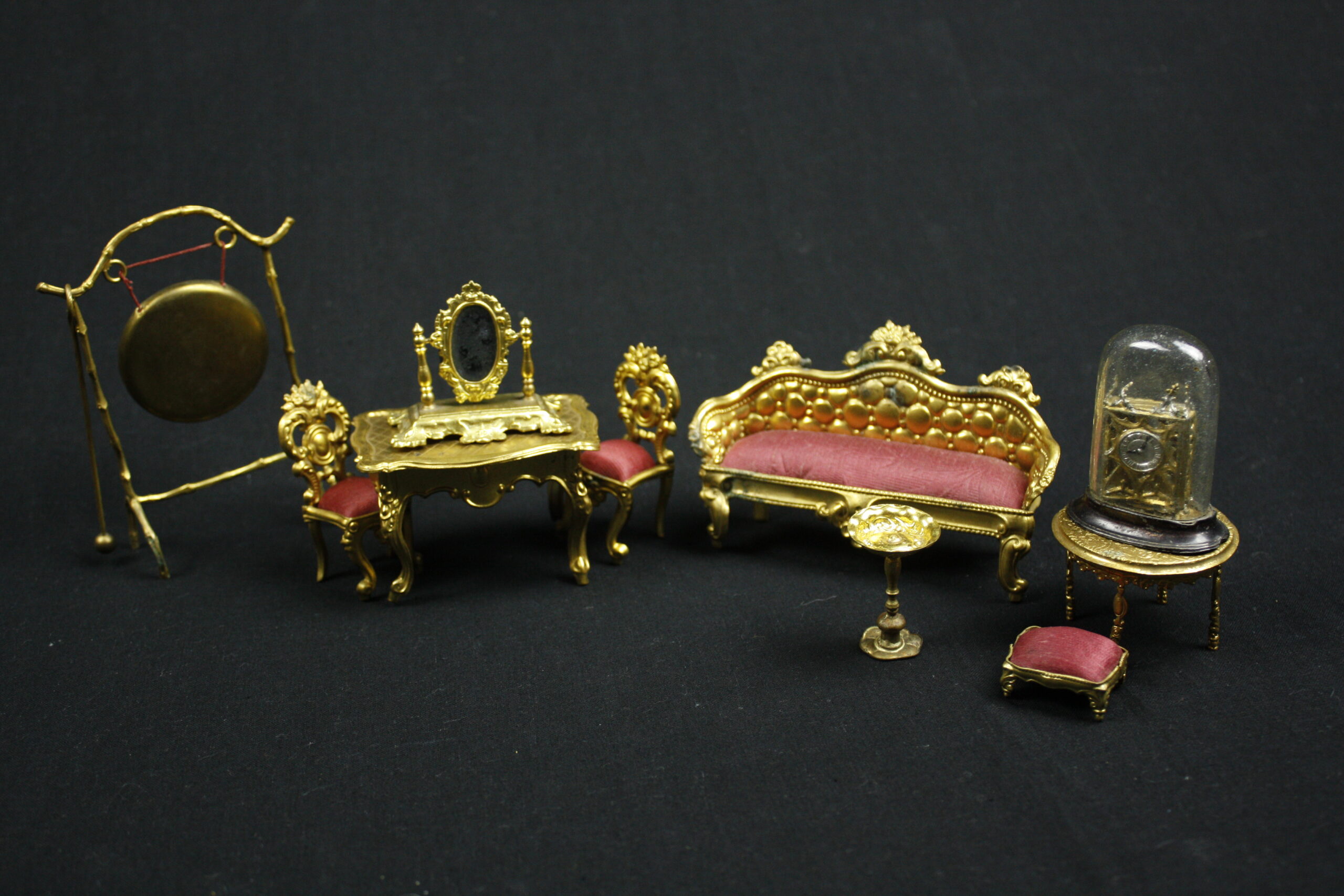
My job at the museum is to photograph the toy collection, and this week I came across the miniatures. There is a ton of them; little Victorian furniture, coffins, washboards, and many other tiny versions of everyday things. Some were tiny product examples; others were children’s toys. These toys are in very good condition and are toys I wish I had grown up with. The neatest toys I have come across were small parlour items: a clock, couch, dinner gong, and a few other items. Everything is gold and the sofas and chairs have mauve fabric as cushioning. These toys were used between 1890 and 1910; the donor’s mother originally played with them and then the donor and her sister also played with them. Other doll items were also donated with this accession (gift to the museum) in 1995, and all have a history that dates to the late 1800s. The best part is: everything is still in mint condition.
Visit the Huron County Museum at 110 North Street, Goderich to see more of our collection! Do you have a favourite artefact? Share with us on Instagram or Twitter.