Kyle Pritchard is the Digitization Coordinator at the Huron County Museum. With the Digitized Newspaper Collection nearing completion, the project sets its sights on historical records in the archival collection at the Huron County Museum Archives with the assistance of the Department of Canadian Heritage. Consider supporting the digital collection today by donating at the front desk of the Huron County Museum. You can search the digitized newspapers yourself for free at https://www.huroncountymuseum.ca/digitized-newspapers/
After six long years and the hard work of many, the Huron County Digital Newspaper Project is nearly complete. As the digitization of Huron County’s newspaper collection enters its final stages, the scope of the project is expanding to offer a greater variety of digital content for researcher and the community. Over the coming two years, select archival records held at the Huron County Museum will be added to the online web portal. This has been made possible after Huron County Cultural Services’ digitization project received news it had secured funding with the Department of Canadian Heritage as part of the Digital Museum Assistance Program. The goal of digitizing records in the museum archival collection is to transition our current online repository on the Digitized Newspaper Collection into a digital archive, where a wider variety of source material about local cultural heritage is available for local and academic research, and community engagement.
The Digitized Newspaper Collection has thrived over the last few years, despite the unexpected hurdles, delays and setbacks that have accompanied the trials and tribulations of enduring a global pandemic. In February of this year, the digitization project was awarded the Digital Access to Heritage Grant as part of the Museum Assistance Program, which is contributing to funding the next years of digitization. Huron County’s newspaper digitization also received the Ontario Library Association’s (OLA) Archival and Preservation Achievement Award back in February.
The Huron County Digitized Newspapers Collection began in 2016 to improve access to the enormous volume of local newspaper content previously only available on microfilm and in their physical format. The digitized collection now holds over 550,000 newspaper pages and receives between 7,000 and 9,000 online visitors per year. The papers preserve a century and a half of local historical content and are searchable using OCR (optical character recognition) technology. The collection is designed to assist researchers to advance our understanding of the history of Huron County and its growing community and has proven an invaluable tool for researchers in a wide range of topics, including political, social, cultural and genealogical history. The project aims to increase the accessibility of archival records at the Huron County Museum by increasing researchers’ awareness and knowledge of the collection.
DIGITIZING ARCHIVAL COLLECTIONS
The expansion of the Huron County Cultural Services digitization initiative focuses on five archival collections at the Huron County Museum Archive between now and mid-2024. These are the J.G. Henderson Collection, Huron County Assessment Rolls, CKNX films, rural diaries and the Huron County Return of Inhabitants. The timeline for digitizing archival materials prioritizes the release of content based on popularity, preservation, and the materials contributions to local cultural heritage.
The first of these digitization projects is centred on the J.G. Henderson Collection. The Henderson Collection holds a large volume of materials, including a collection of photographs of particular interest to digitization. The collection is named after J. Gordon Henderson, a photographer who moved to Goderich, Ontario when he purchased a local photography business in 1939. Henderson was the principle photographer of the community during his lifetime. The files in the Henderson collection include local photographs like wedding portraits, candid shots, and captures of day-to-day life. The photography studio in Goderich relocated several times over the years, though most of the portraits taken during WWII were captured at the Hamilton Street studio. Throughout his forty years as a professional photographer in Goderich, Henderson only shot and developed in black and white film. All of the photographs held in this collection were taken by J. Gordon Henderson. Around 500 of these photographs have been selected for digitization based on their ability to highlight community activities and events. Those selected for digitization represent just a small part of Henderson’s collection of professional work held at the Huron County Museum Archives which are of benefit to public and academic research.
The second digitization project are assessment rolls located at Huron County Museum Archives for Goderich, Steven and Hay Townships dated up until 1940. This includes four archival series for Hay township, three archival series for Stephen township, and four archival series for Goderich township. Assessment Rolls provide details of homeownership within the county at various points in history, and are of particular use for demographic and genealogical historians. The records also allow for a closer examination of living arrangements and demographic change over time across the region.
The CKNX films will be the third records to be digitized. CKNX radio station was created by W.T. Cruickshank, which started broadcasting out of Wingham in the mid-1930s. In 1955, CKNX expanded to television broadcasting, becoming the first rurally-based television station in North America. CKNX was a pioneer in broadcast television and set the standard for other rurally-based television-stations across Canada. Crews from CKNX travelled all over Southern Ontario filming parades, schools, sports, and other significant events. The culturally significant films showcase how rural Canadians lived, worked, and enjoyed their time in the early-1960s. There are currently 36 CKNX films in the Huron County Museum Archives, which range in content from depictions of local scenery, architecture, organizations and businesses. The project will digitize half of this collection, prioritizing films with important historical value which showcase the local environment and activities involving community engagement.
The Huron County Museum Archives holds a small collection of historical diaries written by members of the local community which will be the fourth set of records to be made available digitally. The majority of the diaries date to the turn of the 20th century, with some written during the Victorian period and others written during the First World War. Historical diaries are hidden gems inside the archival stacks. Often underutilized, historians are only now beginning to discover the value of these rich sources of rural, family and community life. Eight of these diaries were transcribed during a research project in 2017, and their transcriptions will be made available online alongside the digitized diaries.
Lastly, the Huron County Museum Archives holds the Assessment and Return of Inhabitants records for 1842 to 1850, which will mark the final project to be digitized. Records from the return of Inhabitants can quantify the demographics of local populations over time and offer a window into the settlement of the county. These are popular archival records requested by researchers and the community at a higher degree of frequency than other records in the collection. Due to their age and wear, the digitization of these records is important for the long-term preservation of the original documents.
CONCLUSION
The next phase of digitization aims to diversify the digital content available within the collection by focusing on archival materials which capture local cultural heritage through a variety of mediums, which depict a fuller image of rural life and day-to-day experiences within the community. These include archival photographs, diaries, films and government records. The digitization of these archival records is an important contribution to local history and serves the benefit of preserving some of the most popular records in Huron County’s archival collection.
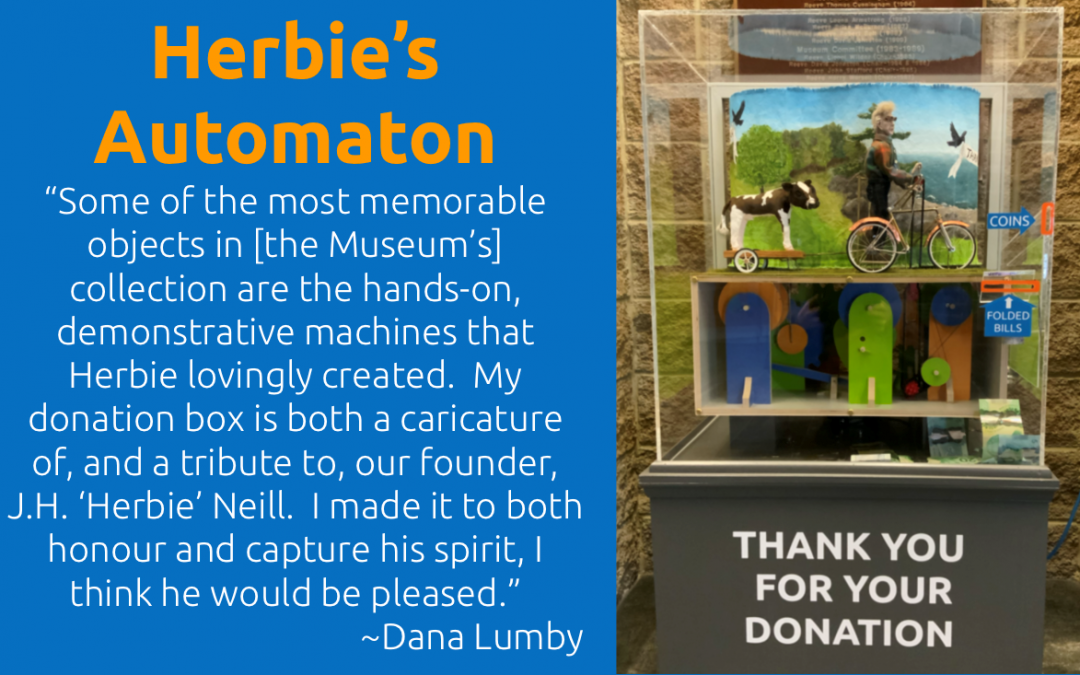
The Huron County Museum and Historic Gaol’s Museum Technician Assistant Dana Lumby shares how she created the museum’s donation box.
Creating the museum’s donation box has been one of my favourite projects. I was tasked to make an interactive donation box that would provide some sort of visual “reward” in exchange for a donation. I did not have to look very far to find inspiration. As many of you will already know, our founding Curator J.H. “Herbie” Neill was a maker and a tinkerer. He left us with a collection of handmade, hands-on, demonstrative machines that visitors have been encouraged to animate since the Museum opened in 1951. (Unfortunately, given the current pandemic, visitors are temporarily unable to touch Mr. Neill’s machines, as these artifacts cannot be sanitized.) The donation box features a miniature Herbie Neill pedaling his custom, hand-pedaled bicycle through the countryside while towing our unofficial mascot, the two-headed calf. Depositing a coin, or a folded bill, in the respective slot starts the mechanism and also triggers a recording of our orchestral regina.
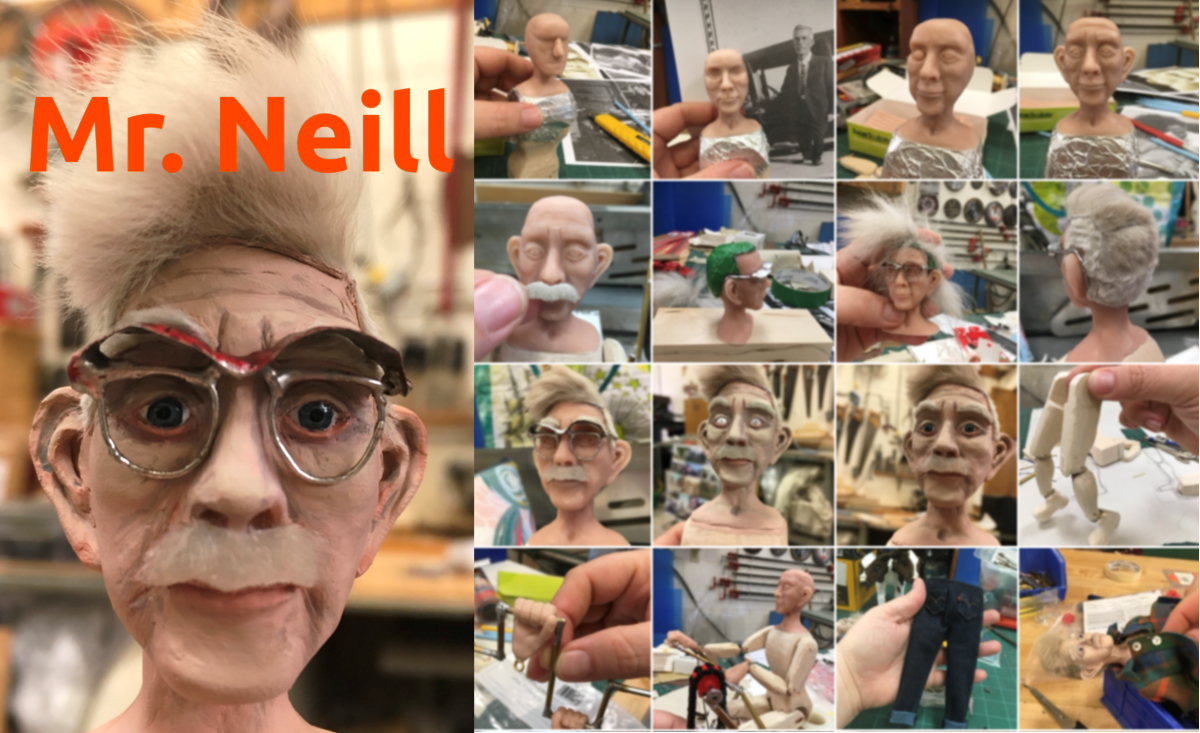
Herbie’s articulated body was carved from basswood and his face and hands were sculpted using polymer clay. I painted the clay to give him a realistic skin tone, added a gloss varnish to his eyes, and created a miniature wig out of rabbit fur, then gave him a tiny haircut. I created the special glasses, with copper and solder, to replicate the ones that Mr. Neill modified to protect his eyes. He suffered from sensitivity to light and added the metal shade to his glasses to help. You can see Mr. Neill’s actual modified glasses on display in the Neill Gallery at the Huron County Museum. I made his clothing from upcycled fabrics, including a pair of my own jeans.
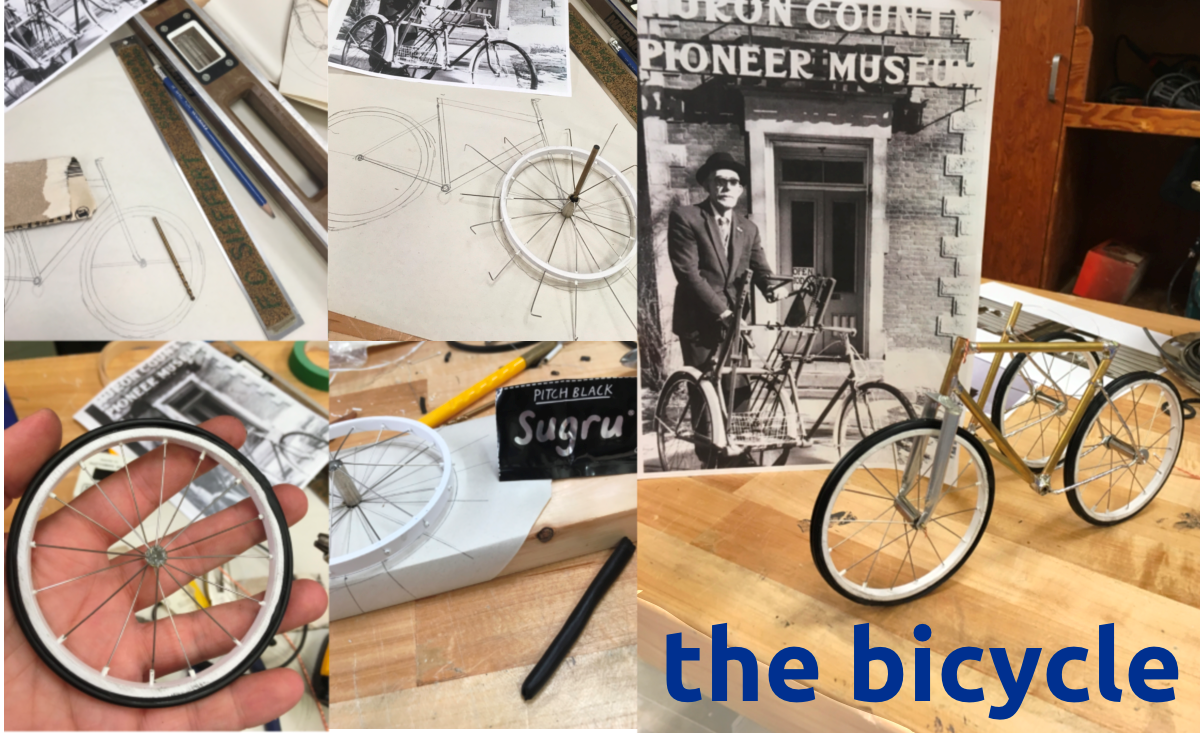
Because Mr. Neill suffered from mobility issues, he fabricated a special hand-pedaled bicycle for himself using bike parts and repurposed metal objects. I recreated his vehicle in miniature, working from a photograph. The wheels were made with a slice of 4” pvc piping, stainless steel wire, black electrical wire, epoxy and sugru – which is a moldable glue that remains flexible when cured. The body of the bicycle was made with various dimensions of miniature brass tubing.
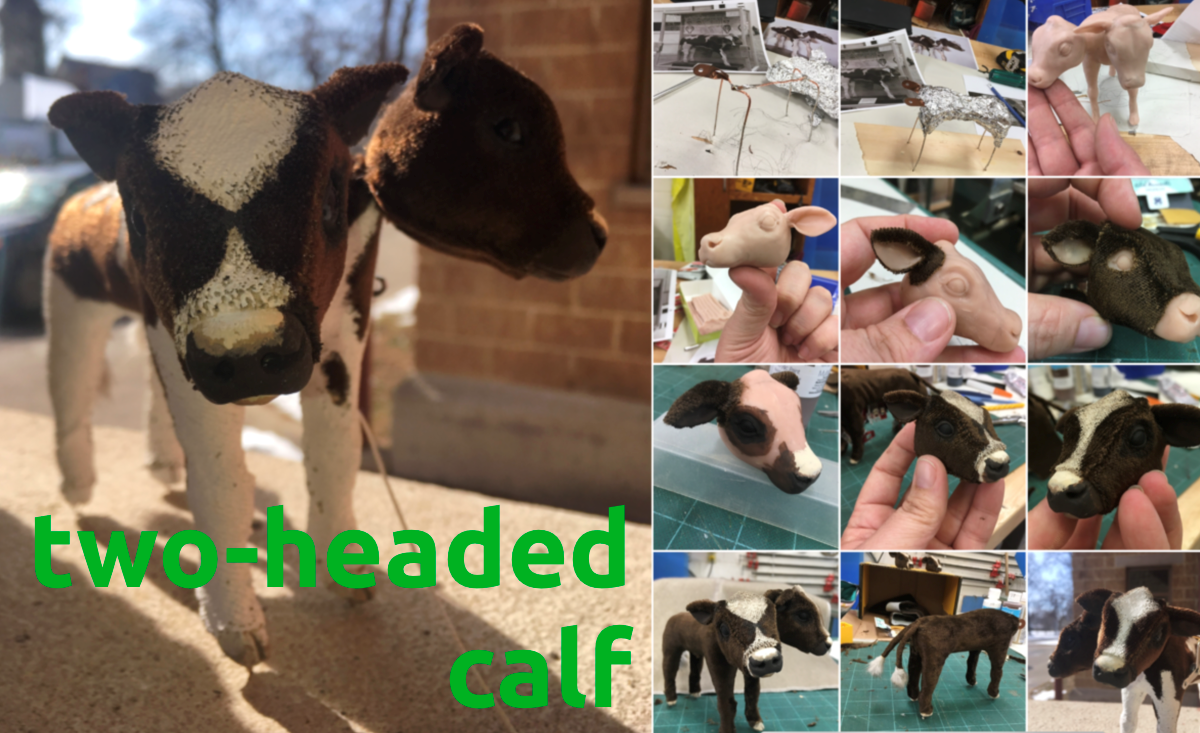
The two-headed calves were made of polymer clay on a metal armature. I covered them with a velvet fabric to mimic fur and painted the uncovered bits. I modeled the painted markings after one of our two-headed calves. When animated, one calf nods yes and the other no. I affectionately refer to them as Beau and Vinnie.
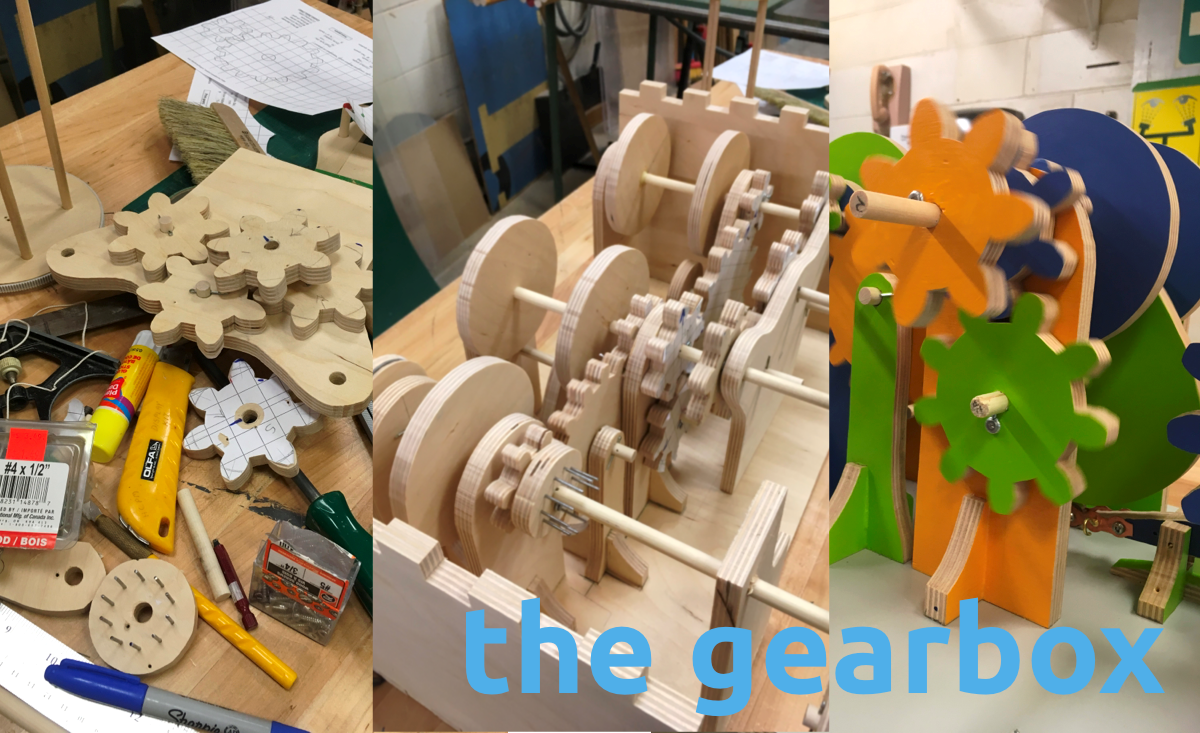
Once the models of Mr. Neill, the calves and the bicycle were finished, I set to work creating a set of wooden gears and cogs that would set them in motion. There was a lot of trial and error, taking apart and putting back together, and one very messy workbench, but I eventually figured it out. “Herbie” pedaled, the bike and trailer wheels turned, the calves disagreed with one another, and the hand-painted background scrolled by, all with the turning of a single crank.
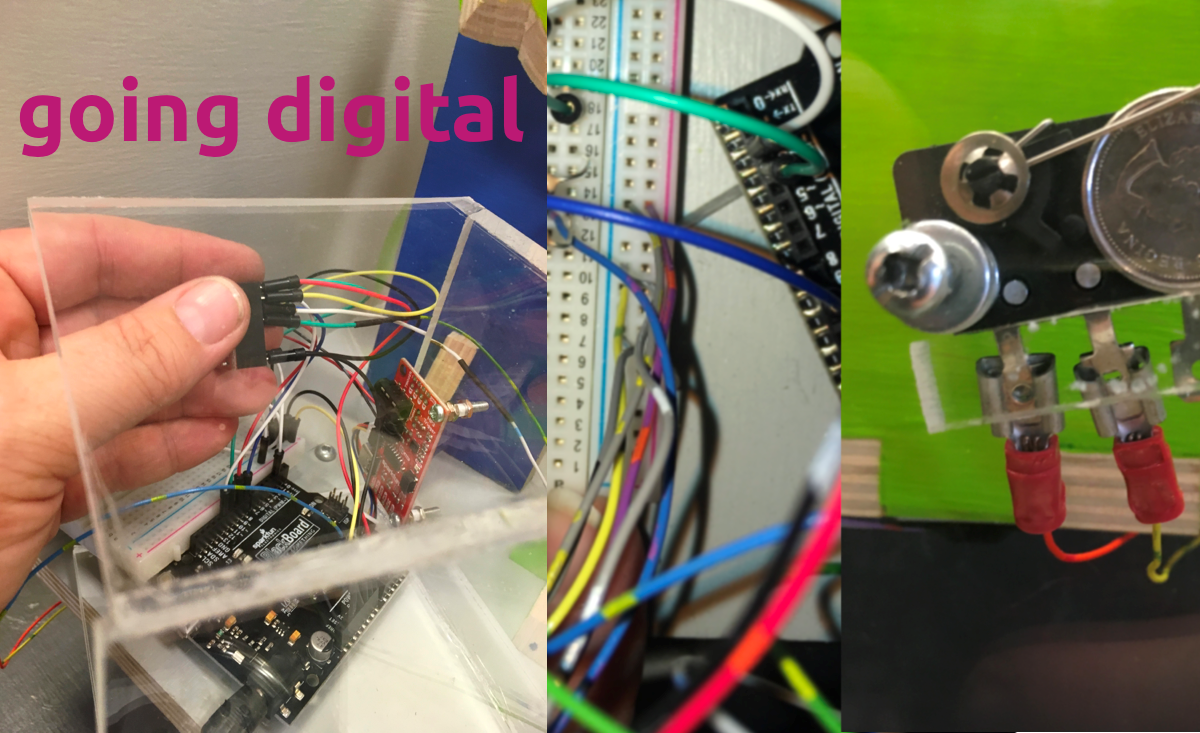
Once the mechanics of getting everything moving had been figured out, I had to find a way to pair the contraption with some circuitry so the action would be triggered each time a donation was made. I knew I wanted it to work when either a coin or a bill were inserted, so I decided to use two different switches. I chose an infrared interrupt switch (which senses a break in its infrared beam when something passes through it) for the bills*, and a mechanical coinswitch (not unlike what you would find in a pinball machine) to sense the coins. I wrote a simple program using Arduino that plays an MP3, and powers the motor for a set amount of time when either of the switches are triggered. I had never used Arduino before, but it was relatively easy to teach myself using the resources on the Arduino website, and the forums and tutorials on the sparkfun website. Sparkfun has lots of information, great components and reasonable prices, but they are an American company so I sourced their products via these Canadian distributors: Digi-Key and Elmwood
*Fun Fact: Canadian polymer bills are not quite opaque enough to block an infrared beam, which is why you are asked to fold your bill before inserting.
Here is a video of the donation box in action, or come and see the real thing in the front lobby of the museum! Click here for information about visiting the museum.
This week Summer student Shelby Hamp ends a six-week position as Artifact Photography Assistant at the Huron County Museum thanks to the Government of Ontario’s Summer Experience program. Shelby has been photographing museum artifacts in the Victorian Apartment gallery and main storage. In a guest post for our blog, Shelby shares some of her personal favourites among the artifacts she has taken pictures of.
The Huron County Museum is filled with many weird and incredible things. I have come across little critters in jars, intricate designs on silverware and plates, and the miniature collection.
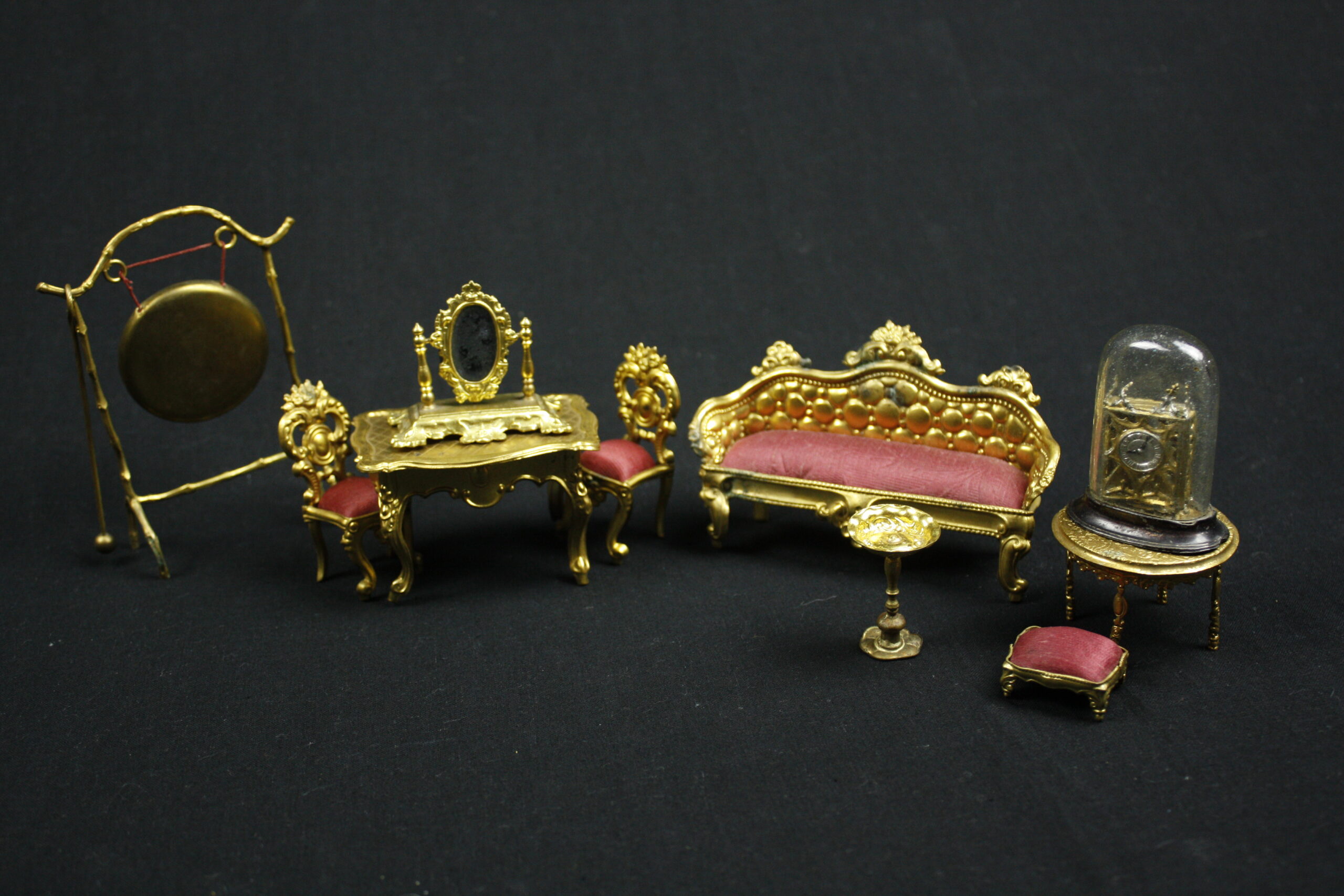
My job at the museum is to photograph the toy collection, and this week I came across the miniatures. There is a ton of them; little Victorian furniture, coffins, washboards, and many other tiny versions of everyday things. Some were tiny product examples; others were children’s toys. These toys are in very good condition and are toys I wish I had grown up with. The neatest toys I have come across were small parlour items: a clock, couch, dinner gong, and a few other items. Everything is gold and the sofas and chairs have mauve fabric as cushioning. These toys were used between 1890 and 1910; the donor’s mother originally played with them and then the donor and her sister also played with them. Other doll items were also donated with this accession (gift to the museum) in 1995, and all have a history that dates to the late 1800s. The best part is: everything is still in mint condition.
Visit the Huron County Museum at 110 North Street, Goderich to see more of our collection! Do you have a favourite artefact? Share with us on Instagram or Twitter.
Guest blogger and local Wingham artist Becca Marshall finishes her series on the museum as ‘gathering place’ with a behind the scenes look at her exhibit on display now at Brock University.
After a long year of photographing, developing, printing, and researching, we have finally made it to the finish line. As such, the end of my project was marked with a gallery exhibition of the photographs I took throughout the year accompanied by text and installation pieces on April 13th at the Marilynn I. Walker School of Fine and Performing Arts in St. Catharines, ON. I thought I would include some photos and descriptions of the pieces below for those who wish to see the end result, or, if you are in the area you can go to the gallery and see the installation in person (On display Tuesday-Saturday from 1-5 pm until May 5th).
A couple of photos from the installation process.
Over the course of a couple of days and with the assistance of Matthew Tegal and Marcie Bronson from Rodman Hall, and Professor Amy Friend and Lesley Bell from Brock University, we were able to set up and install the show.
Step Lightly (2017) Pigment print on luster paper and graphite This is the beginning piece of the exhibition. The photo features the train of Jean (Scott) Taylor’s wedding dress and is accompanied by personal writing in graphite directly on the wall next to the image so that it can only be seen up close. A smaller image is hidden to the side of the text of an old bottle of Potassium Chlorate medication.
Shelf Life (2017) Assortment of boxes This piece takes up the span of the long wall. The eclectic boxes are a stand in for the discovery process that a person experiences in the museum. Visitors are encouraged to take their time opening the boxes and looking for things that might have been left behind.
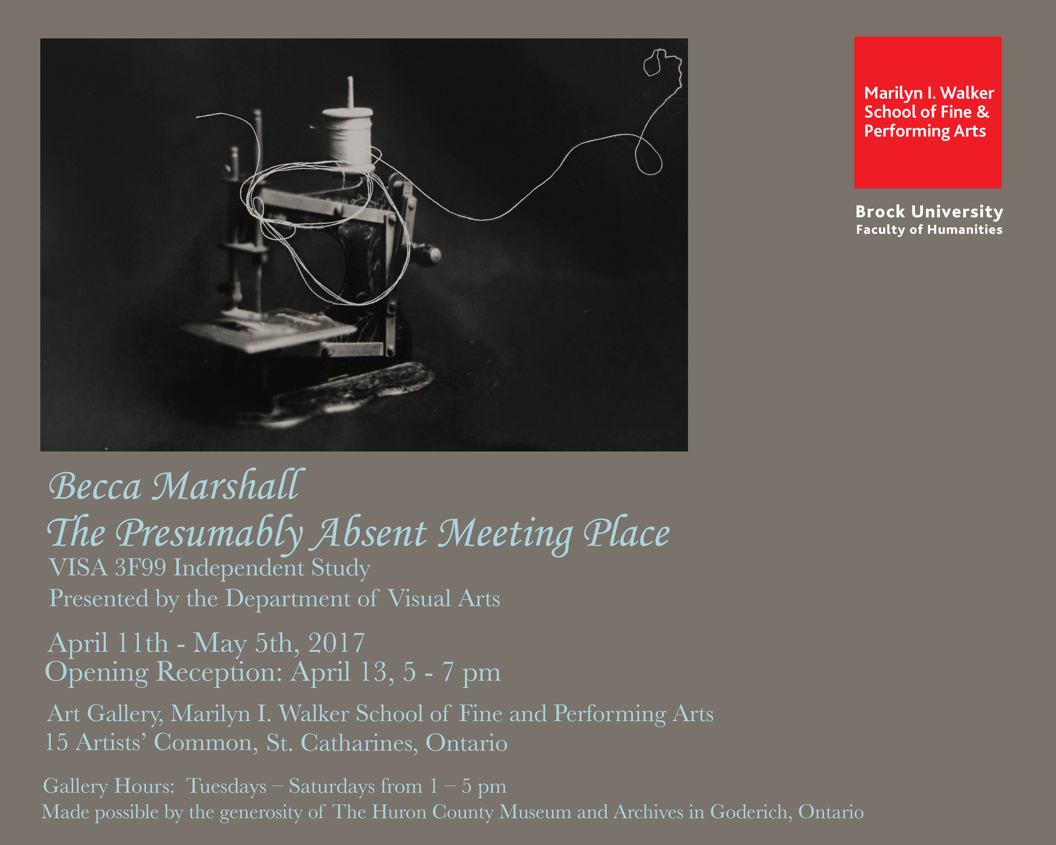
Pulling Threads (2017) Pigment print on luster paper, graphite, and archival tissue paper This piece consists of the large format print of the child’s sewing machine from the museum coupled with a collage of tissue paper with fragmented writing. Beneath these sheets are more hidden photos. The viewer either has to lift the pages up to view the smaller pieces, or they might catch a glimpse when someone walks by and the breeze lifts up the pages for a few moments, exposing the photos underneath.
Twelve Parts Fragile (2017) Pigment print on cotton rag paper The final piece of the show is a series of artifact photographs presented side by side so that they read like a sentence. This piece ties together the nature of the museum- the bringing together of like and unlike things to share their stories.
In many ways, I still cannot believe that this project is over. It was the experience of a lifetime and I am so grateful to the incredible staff at the museum who so generously gave their time and resources to help me better understand the nature of collections, curation, and our relationship to artifact display.
Additionally, without the support of my supervising instructors, Professor Amy
Friend and Dr. Keri Cronin, along with the advice and aid of Matthew Tegal, Marcie Bronson, and Lesley Bell, this project would never have gotten off the ground. Their constant support was of the utmost value. Overall, I learned so much about the silent conversations and nuances that inform our interactions with artifacts from the past – and I am so grateful for those of you who followed
me along on this journey.
Over the course of the past several months that I’ve spent photographing artifacts at the museum, I’ve been lucky to get the perspectives of several different Huron County Museum staff members to see how they encounter objects and their narratives. Below are a selection of responses from interviews with Curator Elizabeth French-Gibson, Archivist Jenna Leifso, Registrar Patti Lamb, and Museum Technician Heidi Zoethout.
Do you have a favourite artifact/archival document at the museum (either on display or in storage)? If so, could you describe why?
Jenna Leifso (Archivist): I really enjoy the photograph collection and couldn’t pick just one photo because every time I catalogue a new collection or look through the photos I find something that delights me. The facial expressions, the clothes, and the hair are all really incredible.
Elizabeth French-Gibson (Curator): My favourite artifacts are the textiles, primarily the clothing. I look at each piece and wonder about the person who wore it – why did they have it & why did they save it? I am curious to know what other clothes they had and wore out, had and ruined or simply had and didn’t think were significant enough to save. We have many pieces in the collection that are the fancy dress, wedding attire, baby clothing, etc. that are beautiful and special but what about the everyday? What did they chose to simply wear and what to wear out?
Patti Lamb (Registrar): So many of our artifacts tell really cool stories, it’s hard to pick out just one. But my favourite artifact has to be Tiger Dunlop’s silver cup with the gold sovereign in it. We just received it a few months ago. It is so incredible to me to be able to hold in my hands the same silver cup that Tiger Dunlop drank from…someone that was so significant politically to Goderich, the county, our county and the world. The cup was willed to his sister in his quirky will.
Beaded necklace: 1957.10.3. Photo from Huron County Museum’s catalogue.
Heidi Zoethout (Museum Technician): I have a few favourites, right now the top of the list is the carved beaded necklace. The detail in the larger beads is amazing. I did not realize that some beads are carved fruit pits. Something that is normally discarded that can be made into something so beautiful.
Close-up of carved bead.
.
What is your perception of artifacts? What place and value do you think they have in society to-day?
Jenna Leifso (Archivist): I think I may have a different perception of artifacts than most people. Growing up, my family always went to museums and historical villages. I think it’s cool to see how we have evolved and how we are always trying to constantly improve.
Elizabeth French-Gibson (Curator): I think that artifacts provide us with a tangible connection with the past. It is necessary to have all types of artifacts available to the public in order to have a better view of the past. It would be easy to change the story, or overlook the mundane if the true pieces were not there. Each artifact has the ability to tell a story but the storyteller must be open to what it is truly saying.
Patti Lamb (Registrar): The artifacts create ties with the past and gives history a visual component. In such a disposable world in which we live, I think it’s important to be able to physically see and possibly touch items from the past.
Heidi Zoethout (Museum Technician): Some people look at an artifact and imagine who would have used it and create a scene in their mind. When I am working with an artifact, I think about the work and thought that went into its creation. Some designs have not changed much over time while others can be seen evolving through the collection we have.Through artifacts we are able to see how our thoughts and values have changed over time as a society and where they have not. It is a common refrain when staff are moving large objects that “they don’t make them like that anymore”. From the materials used, the amount of material used and the details that have gone into producing the product. An example of this is a bicycle that I was preparing for exhibit. It had many grease fittings which we no longer require on bicycles and the rims were made from wood. The wood had been lacquered and pin striping had been applied. When I finished working with the bicycle I came to appreciate it as work of art rather than a mode of transportation.
What would your dream project be? (e.g curating a certain type of exhibition, working with a certain set of artifacts, researching a particular area, etc.)
Jenna Leifso (Archivist): One of my dream projects would be exploring how Huron County residents acquired their clothes. I think there is a misconception that rural citizens were out of fashion and that everything was homemade, drab and boring. It would be interesting to have an exhibit that looks at the clothing factories that used to be here, mail order catalogues like Eatons and Simpsons, and how residents were influenced by fashions overseas. I would use photographs, newspaper advertisements, local directories, maps, correspondence, diary entries, and of course, clothes that are in the collection to research and create this exhibit.
Elizabeth French-Gibson (Curator): I would like to be able to spend more time on research for the Gaol. I think there are resources out there that we have not found yet and the resources that we have that have not been given the focus yet. It would be interesting for me to be able to learn more about the circumstances and lives of the people who spent time in our Gaol, as well as the functions and habits of the Gaol itself.
Patti Lamb (Registrar): My dream project would be anything related to glass or to be able to spend a greater amount of time on the Huron Pottery exhibit and the archeological collection.
Heidi Zoethout (Museum Technician): Currently my dream project would be organizing offsite storage so we could have tours available to the public. There are many details and much work required to make that possible.
Overall, throughout this project one of the most valuable experiences has been hearing the varying perspectives on museums, exhibit design, and artifacts, from such a knowledgeable and unique staff. The differing responses speak to how each of us experiences artifacts and their narratives differently according to our own lived experiences.
The artistic exhibition of photographs taken during this project will be on display in St. Catharines at the Marilyn I. Walker School of Fine and Performing Arts from April 11th – May 5th with an opening reception to be held on April 13th from 5-7pm.
What discoveries await you in Huron’s newly digitized historical newspapers? Special Project Coordinator Jeremy Dechert introduces Project Silas! Stay tuned for more updates, search tips and highlights.
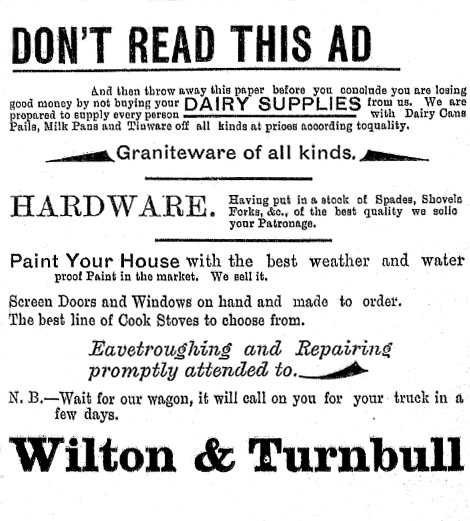
From The Brussels Post, Nov. 18, 1898.
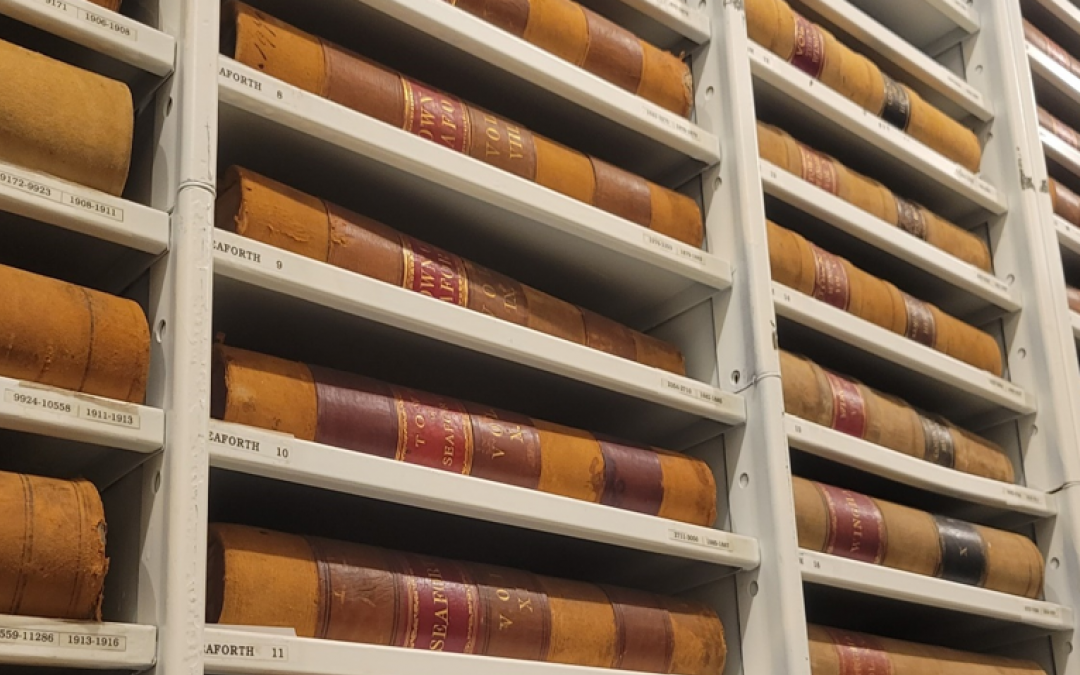
The Huron County Library, in partnership with the Huron County Museum, has been digitizing, OCRing (optical character recognition technology which reads and transcribes images) and publishing historical newspapers from communities across Huron County. Codenamed Project Silas, this initiative is aimed at assisting both academic and casual researchers in their quest for knowledge of Huron County’s past. Local newspapers are robust sources of historical information due to their consistent and specific reporting on particular persons, events, and places. Digitizing newspapers which were previously on microfilm and allowing them to be text searchable further democratizes public information and saves researchers countless hours of work and frustration by making multiple papers available from the comfort of your own home.
Cultural Services staff at the County of Huron have worked diligently to both build the project structure and process and post newspapers from the towns and villages of Blyth, Exeter, Goderich, and Wingham so far. I took over the project at the beginning of this month, and have recently added papers from Brussels to the website. Papers from Clinton and Seaforth are soon to follow. By the end of 2017 we hope to have additional papers from Zurich, Gorrie, Wroxeter, and Goderich on the website as well.
Stay up-to-date on the progress of Project Silas by…



 In many ways, I still cannot believe that this project is over. It was the experience of a lifetime and I am so grateful to the incredible staff at the museum who so generously gave their time and resources to help me better understand the nature of collections, curation, and our relationship to artifact display.