by Sinead Cox | Jun 21, 2024 | Artefacts, Blog, Collection highlights, Special Events
July 9th is Cow Appreciation Day and summer student Chloe Oesch has been exploring the museum’s collection for stories about cows and delicious local dairy products from Huron County’s past! If you are interested in finding more cow-related artifacts, you can search our online collections database from home!
Andrew Dairy was a Goderich dairy company from 1949 to 1977, run out of “The Andrew Dairy Bar” located at 45 West St. Operated by Amos Andrew, Andrew Dairy provided fresh milk to many Goderich locals through their delivery service.
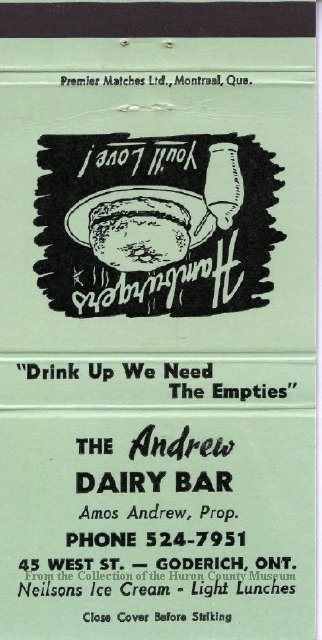
The dairy bar on West Street also had its own separate storefront that operated much like a café. On one of their matchbooks the Museum has in its collection, they advertise “Neilsons Ice cream” and “Light lunches”. We can also see that they accepted bottle returns from customers, as they advertise the phrase “Drink up, we need the empties.”
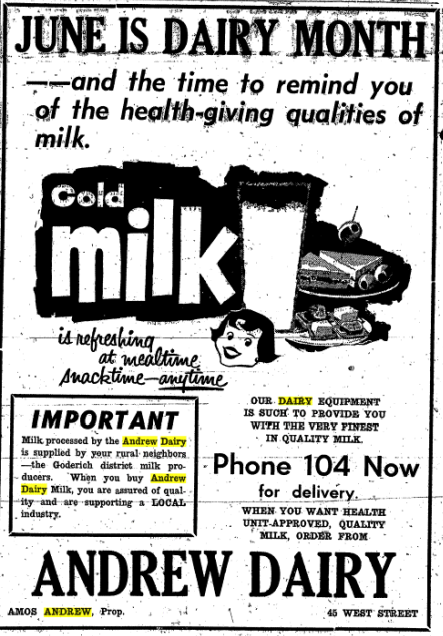
Their operation was completely local as well, their milk being “supplied by your local neighbors” as seen in their 1959 newspaper advertisement. The Huron County Museum is in possession of many items from this local business. In addition to several glass milk bottles, the Museum was able to preserve one of Andrew Dairy’s milk delivery wagons.
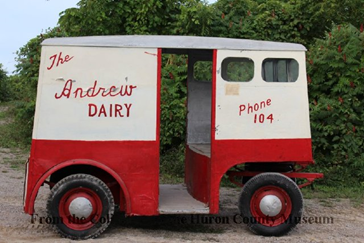
This red and white milk wagon, pictured below, was used for deliveries by Andrew Dairy until 1961. The wagon was possibly built by John Pedersen, a blacksmith from London from about 1939. This wagon was the last of the horse-drawn milk wagons to be used in this part of Huron County. The wagon was pulled by a single horse and had a 20 lb tethering weight used to stop the wagon and horse when delivering milk to customer’s homes.
Although the days of the milk man have long gone past, the Huron County Museum will still be celebrating our local dairy industry on Tuesday, July 9, for Cow Appreciation Day in 2024! The museum will have a local dairy educator from the Dairy Farmers of Ontario, and several dairy and cow related items on display from our collection. And, as always, our iconic two headed calves will be on display at the museum for you to visit!
M963.0005.001. This artifact is stored at the museums offsite storage.
2020.0027.029. Advertising the milk bar in Goderich.
by Amy Zoethout | Jun 17, 2022 | Blog, Special Events
By Robyn Weishar, Programs and Marketing Assistant
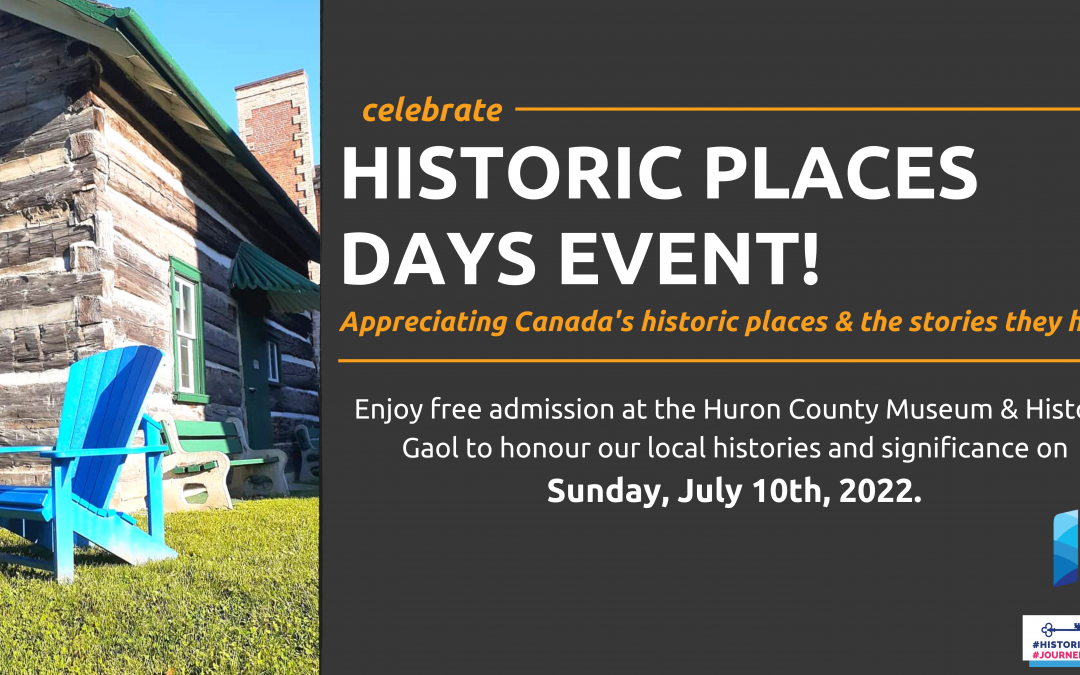
The Huron County Museum and Historic Gaol is excited to participate in the annual Historic Places Days celebration alongside many other participating historic sites across Canada. Historic Places Days is a promotional event spearheaded by the National Trust for Canada, which focuses on protecting and featuring over 600 historic sites across Canada. It’s a great time to take advantage of your proximity to two great places of historical significance located right here in Huron County!
Join us Sunday, July 10, as we celebrate at both the Museum and Gaol with free admission to both sites and fun activities for all ages!
- Activities will be set up at the Gaol from 1-4:30 p.m. Activities will be held in the Gaol courtyard and will include bean bag toss, horseshoes, scavenger hunt, and obstacle course.
- Blyth food vendor Cherrey’s Dog House will be stationed at the Museum from 1:30-3:30 p.m. for those who want to purchase lunch, or BYOB (Bring Your Own (picnic) Blanket) and your own snacks/food for an afternoon picnic and Sunday wind-down on the Museum lawn.
- While you picnic, enjoy musical entertainment in front of the log cabin. From 1:15-4:30 p.m., enjoy music from local talents Kamden and Parker Gillespie, Matt Hussey and Thales Hunter.
This event is also a great opportunity to snap a photo at your favourite Huron County historical sites to enter the Historic Places Days Selfie Contest! The contest runs July 8-31. To enter, simply take a selfie at the Museum or Gaol, share it on social media tagging #HuronCountyMuseum or #HuronHistoricGaol and #HistoricPlacesDays for a chance to win $1,000 for yourself as well as $1,000 for the Museum! There are a number of other great prizes available to win, including Parks Canada passes and VIA Rail travel vouchers. Draws will take place throughout the month, so post often and share what these historic places me to you! For full contest details, visit: https://historicplacesdays.ca/contests/.
Not only are we looking forward to celebrating Historic Places Days with you, we are hoping to celebrate you; the people of the County who helped to grow and continue to support the preservations and re-telling of our histories. If it were not for you, we would not have historical places to celebrate.
by Amy Zoethout | Mar 4, 2022 | Exhibits, Media Releases/Announcements, Special Events
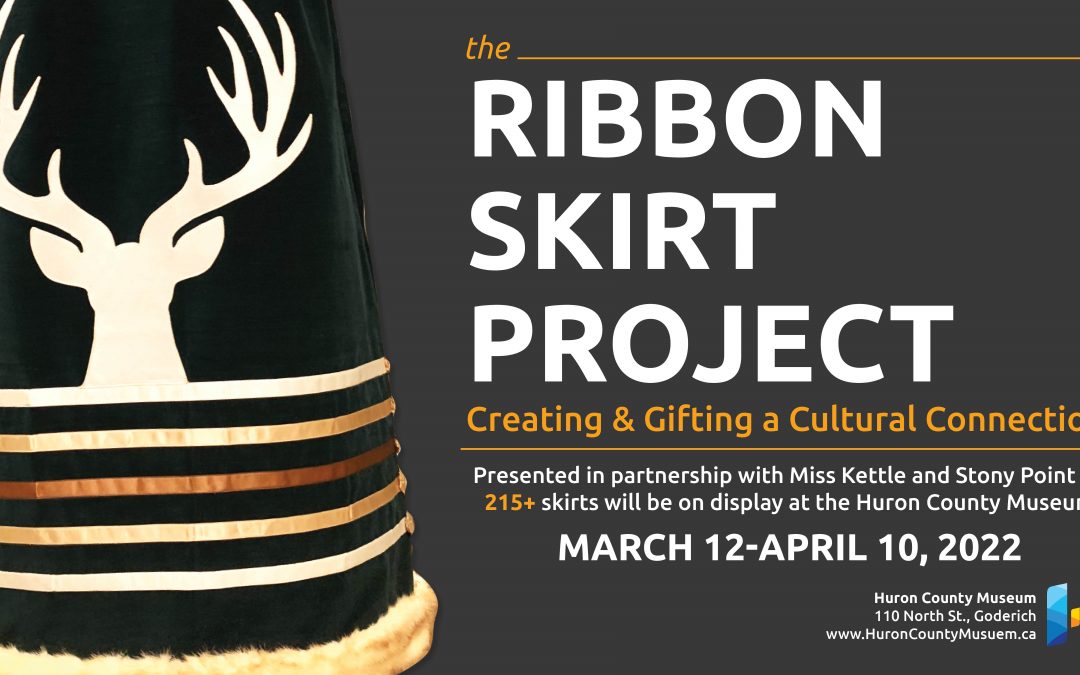
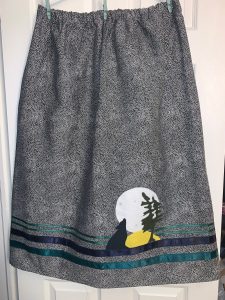 The Huron County Museum is very pleased to host The Ribbon Skirt Project: Creating & Gifting a Cultural Connection, a collection of more than 215 ribbon skirts which will be on display throughout the Museum from March 12-April 10, 2022.
The Ribbon Skirt Project was started by Miss Kettle and Stony Point Jr., Jaylynn Wolfe, in July 2021. Knowing that owning a ribbon skirt was important, but difficult for many, Jaylynn, along with her mother, set out to make hundreds of ribbon skirt kits and invited volunteer sewers to help. The goal of the project was to create 215 skirts to represent the first number of unmarked graves identified in British Columbia at the Kamloops Indian Residential School. They quickly exceeded that goal, with more than 215 Ribbon Skirts being gifted to the project from all over North America. Each skirt will be gifted to a youth on Jaylynn’s First Nation of Kettle and Stony Point.
“The hope of the project is that a child will take hold of their ribbon skirt so close to their heart that their connection to their culture will start their journey,” said Jaylynn. “This project gives an opportunity for this cultural connection to happen and allows for all youth to participate.”
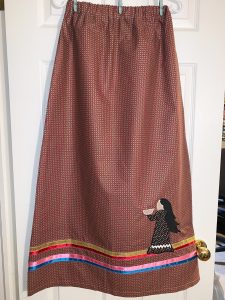 Before the Ribbon Skirts journey to the youth of Kettle and Stony Point First Nation, they will be on display at the Huron County Museum where the public is invited to see this beautiful collection of work. The skirts will be displayed throughout the Museum in groupings that showcase the Seven Grandfather Teachings, the Clans of Kettle and Stony Point, Water is Life, Spirit Horses, The Creation Story, The Three Sisters, The Medicine Wheel, and Floral imagery, as well as a display to bring awareness to the Missing and Murdered Indigenous Women and Girls.
The exhibit is open to the public during regular Museum hours of operation. The public is also invited to meet Jaylynn, who will be available to answer questions about the Ribbon Skirt Project. She will be onsite at the Museum on Saturday, March 12, Sunday, March 20 and 27, and Sunday, April 3 and 10 from 1-4 p.m.
To celebrate the project, we will also be hosting a screening of the Indigenous film, Beans, on March 27. The film explores the 1990 Oka Crisis at Kanesatake, through the eyes of Tekehentahkhwa (nicknamed “Beans”), a young Mohawk girl whose perspective on life is radically changed by these events.
by Sinead Cox | Nov 6, 2015 | Special Events
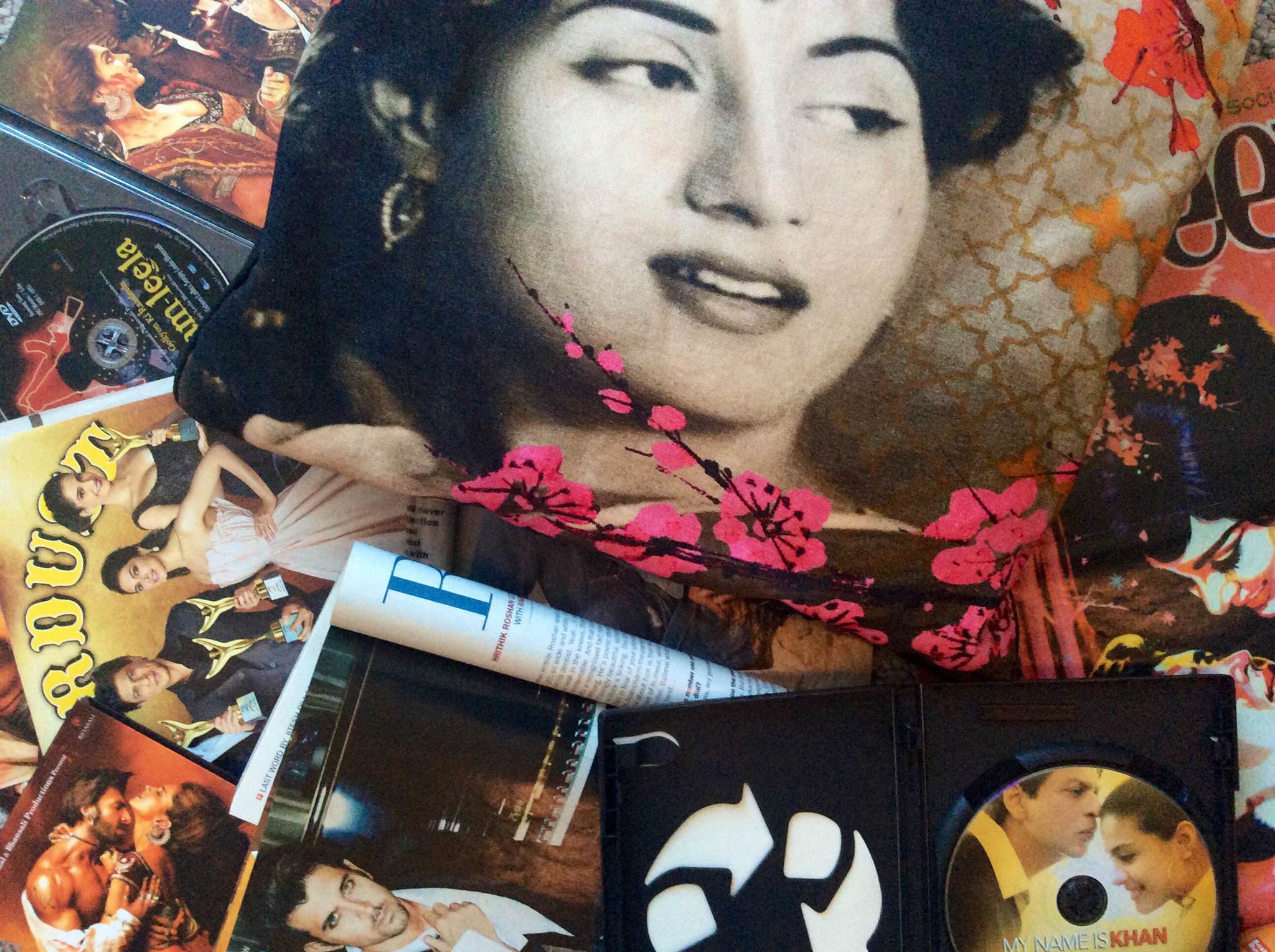
On November 12th, 2015, the Huron County Museum will be showing the 2014 Hindi action-adventure movie Bang Bang for its Bollywood Movie Night. A remake of Hollywood’s Knight and Day, the Bollywood film follows the adventures of an unassuming bank employee (played by Katrina Kaif) after she meets a mysterious secret agent (Hrithik Roshan). Education & Programming Assistant Sinead Cox discusses how the the film’s plot utilizes the history of the famous Koh-I-Noor diamond.

Commemorative postcard: Queen Victoria’s 1897 diamond jubilee. Donated to the collected by Nancy Park. 2010.0027.001c
After the DVD finally arrived from Mumbai and I sat down to preview the hit Hindi action-adventure film Bang Bang, I fully expected the fun, brash Bollywood action romp suggested by title. What I wasn’t anticipating was a little bit of history to intrude on the action: the movie’s hero, Bollywood superstar Hrithik Roshan, makes his screen entrance triumphantly tossing the famous Koh-I-Noor diamond in the air after stealing it from the Tower of London.
The remarkably large Koh-I-Noor (“Mountain of Light”) was mined in India and belonged to a series of Indian rulers and conquerors, as well as nearby empires in Afghanistan and Persia, over several centuries. The British East India company seized the diamond with the rest of the Lahore treasury in 1849, after their annexation of Punjab; Governor-General Lord Dalhousie subsequently arranged for the gem’s owner, 10-year-old Sikh Maharaja Duleep Singh*, to ceremonially surrender the priceless diamond to Queen Victoria.
In 1851 the Koh-I-Noor was a much ballyhooed attraction at the Great Exhibition–its notoriety magnified by claims in the English press that the gem carried a curse. After its exhibition at the Crystal Palace, Prince Albert had the diamond recut to suit current European tastes, significantly reducing its size. The Koh-I-Noor, and its supposed curse were inspirations to author Wilkie Collins for his classic 1868 mystery novel The Moonstone, which–spoiler alert–ends with the titular moonstone recovered by agents and returned to its rightful place in an Indian temple. In real life, the Koh-I-Noor remains part of the British crown jewels, displayed for tourists at the Tower of London and worn by queens or queen consorts on ceremonial occasions.

Elizabeth, consort to George VI and mother of Elizabeth II, wore the Koh-I-Noor in her crown during her husband’s coronation. The crown, including the Koh-I-Noor, rested on the Queen Mother’s coffin during her 2002 funeral. This picture of Elizabeth in her coronation robes was donated to the collection by Rev. Harrison (crown not pictured). A971.0016.014
After its theft from the tower in the film’s prologue, the Koh-I-Noor emerges as Bang Bang’s plot ‘MacGuffin’: an excuse for bad guys to chase the movie’s couple so action, international adventure and romance can ensue. But because our leading lady, Katrina Kaif, is unsure of Roshan’s allegiances and motives throughout the movie, the Koh-I-Noor also serves to make him a little more sympathetic than would the theft of any anonymous gem. In the film’s exposition cutaways to news coverage of the Koh-I-Noor’s theft, the Indian public expresses joy and a desire for the famous diamond’s return to its homeland.
Many artefacts in the institutions of former imperial powers–from the ‘Elgin marbles’ to totem poles–still hold sacred or cultural significance in their countries of origin. On a much smaller scale, the Huron County Museum has de-accessioned artefacts and repatriated them to neighbouring county museums if they were created in, or had a more meaningful value to those communities. In the context of international diplomacy though, repatriation can often be a fraught & controversial topic. There are actually multiple countries with a claim to the Koh-I-Noor, since Lahore is now located within the borders of modern Pakistan.
During a trade visit to India in 2013, English Prime Minister David Cameron refused to consider the Koh-I-Noor’s repatriation to Punjab, declaring that he didn’t believe in ‘returnism’: “if you say yes to one you suddenly find the British Museum would be empty.” Cameron’s words succinctly capture why objects like the Koh-I-Noor remain potent symbols of deeper imperial legacies– of the exploitation of wealth and resources, and the collection of other cultures’ treasures for the edification of museum-goers.
I won’t spoil how the trajectory of the Koh-I-Noor’s theft ends in Bang Bang (you can see the finale for yourself in the museum theatre November 12th), but I ultimately found the twist resolution as strange and abrupt as was the diamond’s presence in this frivolous action film in the first place. The Koh-I-Noor’s starring role in the story speaks both to its continued notoriety, and the uneasy way it represents the colonial past and India’s present-day relationship with Britain. Of course, it’s also a pretty good excuse for shootouts and motorcycle chases.
*Duleep Singh, similarly to the diamond he owned, was exiled to England. The last Sikh Maharaja lived the life of an English gentleman with Queen Victoria’s favour, before unsuccessfully reviving his claims to his birthright later in life. Also like the Koh-I-Noor, there remains some contention about his final resting place being England, rather than Punjab.
Further Reading
For more about the Koh-I-Noor in the Great Exhibition see “Koh-i-Noor: Empire, Diamonds, and the Performance of British Material Culture,” by Danielle C. Kinsey, Journal of British Studies Vol. 48, No. 2, Special Issue on Material Culture (Apr., 2009), pp. 391-419 [available via Jstor].
The Huron County Museum’s first-ever Bollywood Movie Night happens Nov. 12th, 2015. Sweets, snacks and hot chai are available from 4 pm, with henna art offered by local artist David Godkine. The movie starts at 6:15 pm in the museum theatre.
by Sinead Cox | Aug 25, 2015 | Huron Historic Gaol, Special Events
The Huron Historic Gaol’s popular evening Tuesday and Thursday tours, Behind the Bars, are coming to an end for another year! Your last chance to meet historic prisoners and staff from the gaol’s past is Thursday, August 27th at 7-9pm. In celebration of another successful season, Colleen Maguire, one of Behind the Bars’ veteran volunteer performers, gives readers a behind-the-scenes glimpse of what it takes to get into character and travel back to the gaol’s past every Tuesday and Thursday evening in July and August.
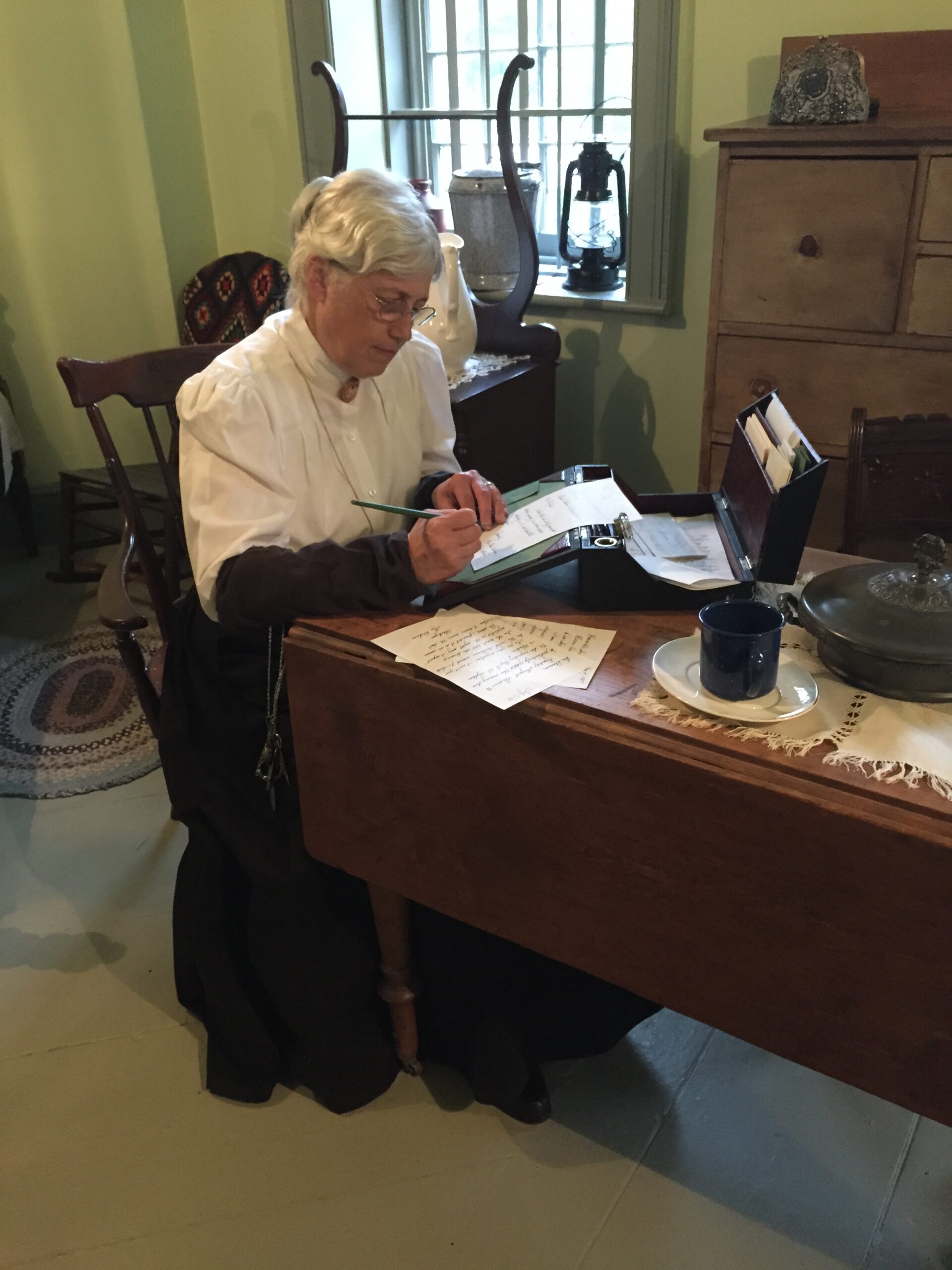
It is Thursday again and in a few short hours I will walk back into the 1890s. That’s because I portray Mrs. Margaret Dickson in the Behind the Bars tours at the Huron County Gaol, Goderich.
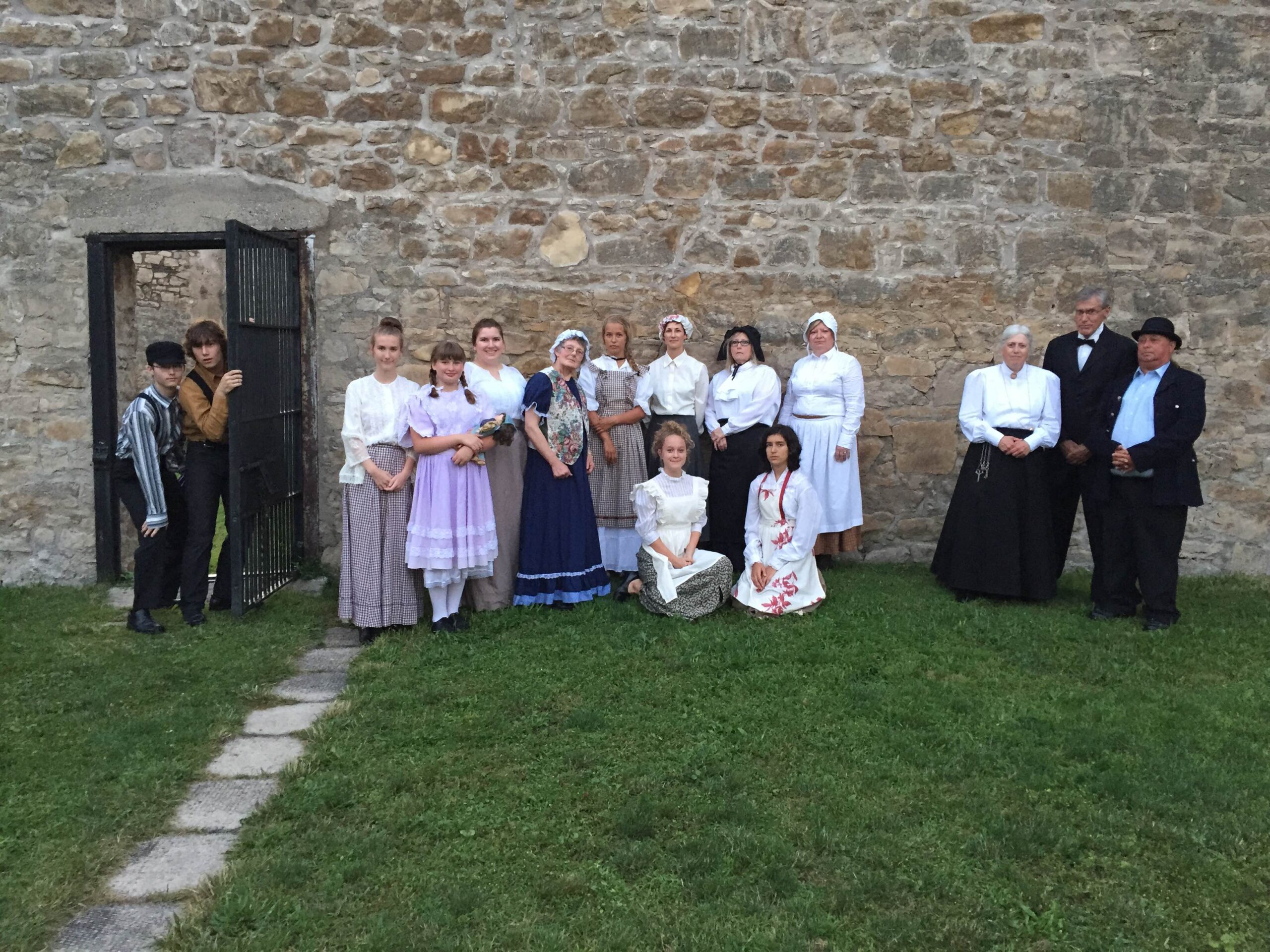
These Behind the Bars Tours feature about 18 actors who portray real people who lived, worked and were inmates of the Gaol, now a National Historic Site.
Mrs. Dickson became the Gaol Matron aka Governess when her husband William became the Gaoler in 1876. Together the couple raised five of their own children while living and working in the gaol. This is my third year portraying this beloved matron. I have researched countless hours to learn everything I can about her and her husband. At any given moment I must be able to answer any question posed to me by the public and be able to accurately answer their queries as if I were Mrs. Dickson. Do come for a Behind the Bars Tour and hear the rest of the remarkable story.
With the research aside how does someone physically prepare for their role in Behind the Bars?
It’s an hour and 15 minutes before the big doors of the Gaol will open to admit the curious so they can relive the history and the people of the Gaol where the 21st century literally collides with the 19th century.
[Physical] preparation for my role began months ago when I began growing my hair. The gaol is hot and [after] two [previous] seasons sweltering while wearing a wig it was time to try something different with my [short] hair. By growing it long enough I am able to pin an artificial matching hairpiece bun on the back. Now with a bit of practice, I can take my hair from a modern style to one befitting an older matron in the late 1800s. Mrs. Dickson was 67 years old in the year I portray her.


Before and After: Volunteer Colleen Maguire transforms into Mrs. Margaret Dickson, gaol matron.
The process begins by trading my t-shirt for a 100% cotton camisole. I learned early on to remove any over-the-head garments before starting the hair. Based on a photograph of Mrs. Dickson from this time period I know that she had white hair, parted in the middle and pulled to the back. My own hair is white, but naturally wavy, so getting the right look requires using some hair wax, twenty-one bobby pins and a lot of hairspray.
While the hairspray dries, it’s on to the next phase. Black stockings, then long pantaloons with a drawstring in front that have to be tied with a double knot, as they have been known to come undone resulting in a potentially embarrassing wardrobe malfunction. I then step carefully into my crinoline rather than take it over my head. The most common mistake that women reenactors make is not having the proper underclothing so that their dress or skirt can hang properly and fully. By now my hair should be fairly lacquered into place, so it’s time to attach and pin the bun hairpiece on and remove some hair pins now that the hairspray has taken over. A quick glance at the clock tells me that I have approximately 15 minutes left.
It’s a hot July day, so I grab my spray bottle and mist my cotton camisole with cool water, just enough to be wet through but not wet enough that my next item of clothing– my high collared, long, full sleeved Victorian working blouse–will become wet. I carefully guide and slip the floor-length long cotton twill skirt over my head. The Victorians were so smart, the closure on the back of my shirt allows me to button it at three different waist sizes. A little shake and my shirts fall into place. Next I clip my pewter Chatalaine to my skirt waistband; on its four long chains hangs two small keys- one for my writing desk and the other for Dr Shannon, the Gaol surgeon’s medicine cabinet, a pencil, small scissors and a quarter-sized timepiece. Pinning an antique cameo pin on the front of my high collar, placing a wedding band on my finger, and putting on my pince-nez eyeglasses, the final glance in the mirror indicates the transformation is complete. With my driver’s licence tucked into the lining of my antique purse, I set off for the car. Here is where history collides, for getting into a compact car with long skirts and lots of clothing is a bit tricky. You don’t want to be driving down the street with an article of clothing sticking out of your car door.

The matron’s keys: part of Colleen Maguire’s Behind the Bars costume.
Once at the Gaol I climb the spiral staircase to the second floor Gaoler’s Apartment just as Mrs. Dickson would have done countless times. This is where the Gaoler and his wife and all their children lived. Well, that and a smallish cottage built in one of the courtyards of the Gaol in 1862. What about the Governor’s House [a two-storey home attached to the gaol] you ask? Well that wasn’t built until 1901, long after Mrs. Dickson had passed on in 1895.
Mrs. Dickson was prolific letter writer, whether it be asking for a raise or writing letters asking for a House of Refuge to be built in Huron County. She was a social worker long before it was a fashionable career for women. Consequently, I have chosen to use as my props a small writing desk, ink well, and nib pen. Each night I slip my black cotton sleeve protectors on and begin the task of writing grocery lists, and other letters. Sometimes I surprise the [other] actors by reading to them a letter from their family that I have crafted or handing Dr. Shannon [the gaol surgeon] a note about an newly admitted inmate. It’s all part of the improv that takes place throughout the evening.
It’s 7 PM and the big Gaol doors have opened and in have flooded the tourists anxious to experience what life is really like in a 19th-century Gaol.
“Please allow me to introduce myself. I am Mrs. William Dickson, the Gaol Governess.”
Need to know more about what goes on behind the scenes at Behind the Bars? Check out coordinator Madelaine Higgins’ earlier post about planning the event.
Do you want to volunteer at the Huron County Museum or Huron Historic Gaol? To learn more about the Friends of the Huron County Museum, email museum@huroncounty.ca
by Sinead Cox | Aug 13, 2015 | Huron Historic Gaol, Special Events
How do interpreters bring real stories from the past to life for visitors? Behind the Bars features costumed volunteers portraying real prisoners and staff members from the Huron Historic Gaol’s (181 Victoria St./Highway 21, Goderich, ON) past. Summer Museum Assistant and Behind the Bars coordinator Madelaine Dunbar-HIggins offers a behind-the-scenes glimpse at the historical research and collaborative efforts between staff and volunteers that make the Huron Historic Gaol’s popular night tours an unforgettable experience for visitors.
You can visit! Tuesday and Thursday nights in July and August 7pm-9pm. Entrance until 8pm.

Sarah Cox, portraying gaoler’s daughter Constance Griffin, has been a volunteer actor with Behind the Bars for three summers.
“Behind the Bars” is an interactive evening tour that has been held at the Huron Historic Gaol for over a decade. The event started as a personalized tour by a summer student portraying a former gaoler, and has flourished into a self-guided tour with over 20 volunteers. The tours take place Tuesday and Thursday nights throughout the summer, and are the only chance to visit the gaol outside of regular daytime hours.
Planning for the event takes a lot of thought and organization. A call for volunteers to is put out in early May. Museum Staff conduct brief interviews with new volunteers to get a sense of their personality and interest in acting before they are assigned to a character. All of the prisoners and staff members portrayed in Behind the Bars are based on true stories, gathered from the gaol registry, archival materials, newspapers, and other gaol documents. Volunteers are given a character “story” rather than a script, which is basically a general biography of their character, including information about their crime and the gaol during their time period.

Zach Chamas as Henry, a real teenaged prisoner from the jail’s past.
The way the volunteers portray their character and interact with visitors is entirely up to them, whether this is begging for sympathy from visitors and playing the innocent card, or revealing truths about their crimes. Character stories are sent out to actors in mid to late June, and short training sessions are held early in July; these short meetings involve discussion about the event itself, the “how-to” for playing a historic character, and some fun facts about the gaol (by the way: g-a-o-l and j-a-i-l are pronounced the same way!).
The dress rehearsal night is the volunteers’ first chance to practice their stories in front of real visitors. The free-invite to various community groups on dress rehearsal night in early July is a great kick-start to the event! Not surprisingly, the event’s most effective advertising method is word of mouth, but we also make use of social media, radio, newspapers, posters, and our road sign on highway 21 to promote the event.
The main goal of Behind the Bars is to portray the inmates and the history of the building as accurately as possible, in keeping with the period of its operation from 1841 to 1911 (closed in 1972). The gaol was built in 1841 and designed by Thomas Young. The layout is panopticon in style, meaning “all seeing”. In 2014, Behind the Bars brought over 1,100 visitors to the Huron Historic Gaol. So far in 2015, we have had over 800 visitors. Be sure to add our event to your summer schedule!
**Visit us on Tuesday and Thursday evenings all summer long, between 7 and 9 PM!