by Sinead Cox | Apr 27, 2020 | Blog, Investigating Huron County History
Patti Lamb, museum registrar, outlines Huron County’s connection to the Disney legacy.
While most of us know the impact that Walt Disney has had on the entertainment world; whether that be through the amusement parks that bear his name or the children’s movies that we all love; few realize that his ancestral roots lie in Huron County. The connections in Huron County to Disney are rooted with his ancestors but modern day connections still exist.
Ancestral Connections
In 1834, Walt’s great grandfather Arundel Elias Disney, wife Maria Swan Disney and 2 year old Kepple Elias Disney; along with older brother Robert Disney and his wife, sold their properties in Ireland, departed from Liverpool, England and immigrated to America landing in New York on October 3, 1834. According to a written biography by Walt’s father there were 3 brothers that immigrated at the same time. The brothers went into business in New York while Elias (as he was most commonly called) made his way to Upper Canada settling in Goderich Township near Holmesville. By 1842, Elias had purchased Lots 38 and 39 on the Maitland Concession, a tract of land comprising of 149 acres. There, along the Maitland River, on Lot 38 he built one of the earliest saw and grist mills in the area. Brother Robert eventually purchased 93 acres on Lots 36 and 37 of the same concession. Elias and Maria had 16 children.
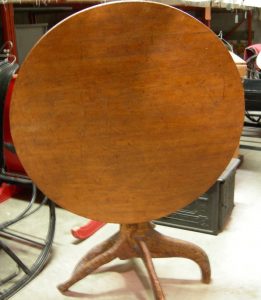
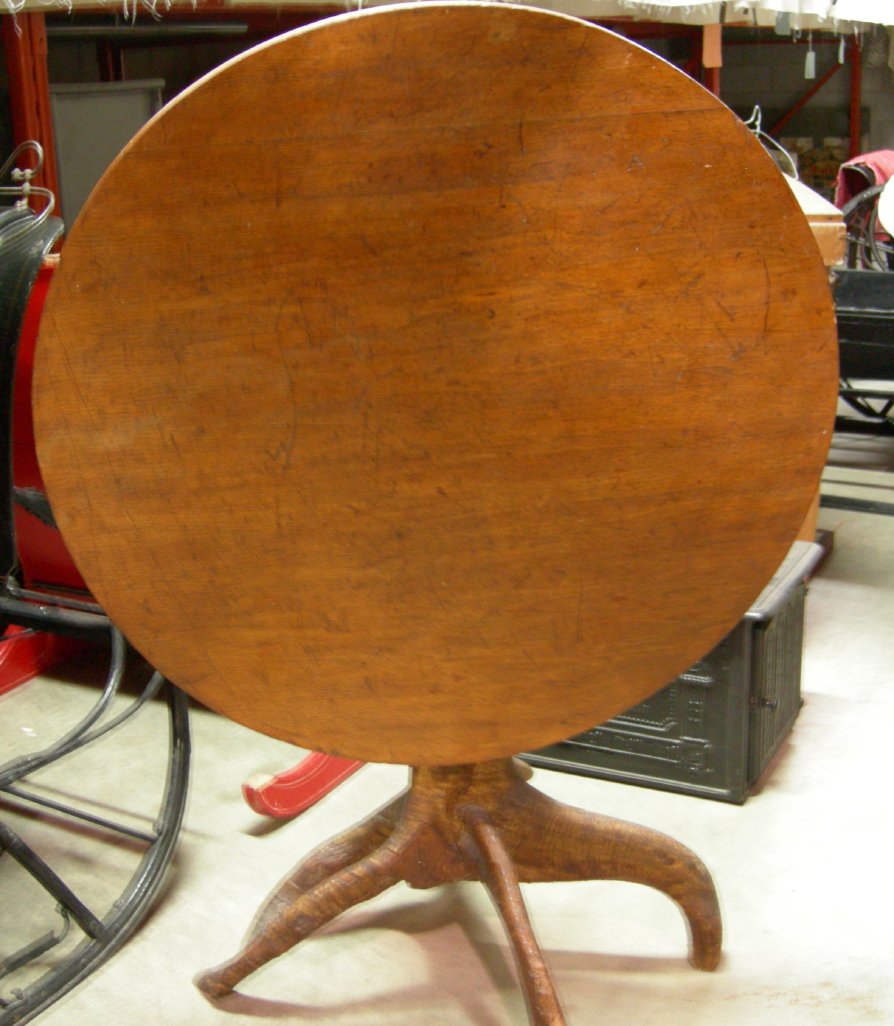
James and Ann (Swanson) Munro were among the first settlers in the Holmesville District and James was the first blacksmith in Holmesville (1834 – 1871). The base for this table is made from a birch stump that he selected from his 36 acre property (Lot 83, Maitland Concession) which he purchased August 15, 1832. The original 5 roots serve as legs. The top is of cherry lumber, sawn from some of the first logs to go through the saw mill owned by Elias Disney (great grandfather of Walt Disney). On the underside is carved the name “Emily” for one of James and Ann’s 12 children.
N7143.001b
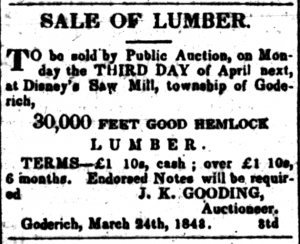
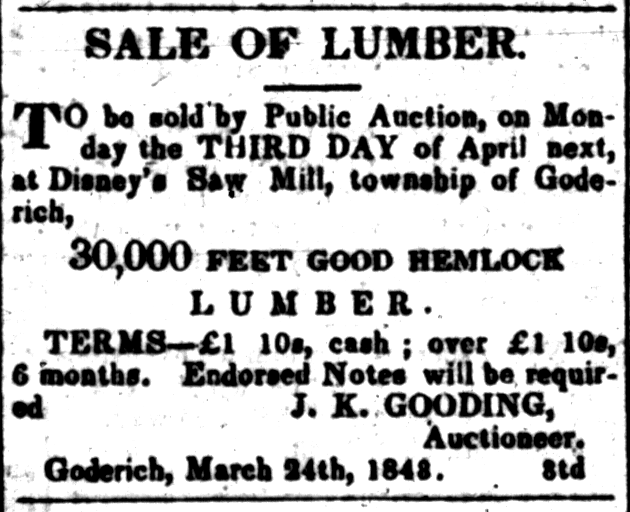
Advertisement for the sale of lumber from the Disney Saw Mill from the Huron Signal, March 24, 1848.
On March 18, 1858, Kepple Disney (Walt’s grandfather) married Mary Richardson, whose family were also early Goderich Township settlers near Holmesville. They purchased a farm on Lots 27 and 28 of Morris Township near Bluevale. Kepple and Mary had 11 children of which Elias Charles Disney (Walt’s father) was the oldest, born on February 6, 1859 in Bluevale and baptized in St. Paul’s Church in Clinton. All 11 children would eventually attend Bluevale Public School. Kepple did not really enjoy farming. He liked to travel and became intrigued in the drilling industry so in 1864, while keeping the homestead in Morris Township, he moved his family to Lambton County. He stayed in Lambton for 2 years before arriving in Goderich.
Here, Kepple was employed by Peter MacEwan and worked for him drilling for oil at a well in Saltford, just north of Goderich. Instead of oil, it was salt that was discovered, but that’s another story. In the July 1868 Voter’s List, the Disney’s appear as tenants of a house owned by James Whitely on Lot 275 in St. David’s Ward, Goderich. School records show that in 1868, 8 year old Elias and 6 year old Robert would attend Central Public School in Goderich (now part of the Huron County Museum). It appears the Disney’s left Goderich and moved back to the homestead in Morris Township sometime before 1869.
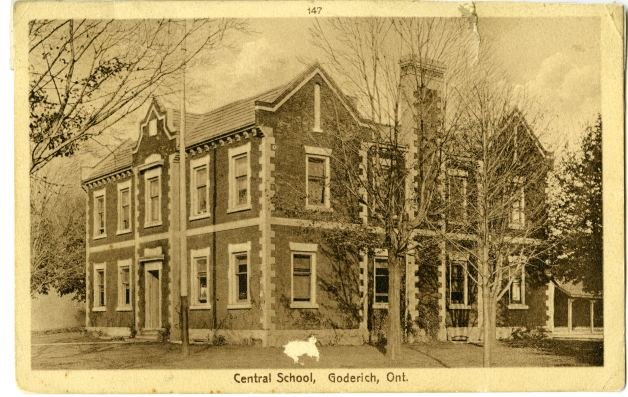
Postcard of Central School, N3103.
In 1878, Kepple left for California, where gold had been found, taking with him his oldest sons Elias and Robert. They stopped over in Ellis, Kansas and purchased 200 acres. Kepple sent for the rest of his family and his property in Morris Township was sold.
Ellis, Kansas is where Elias met neighbour Flora Call and on January 1, 1888 they were married. Kepple Disney’s family moved to Florida in 1884 and Elias, Flora and son later moved to Chicago. On December 5, 1901, Walter Elias (Walt) Disney was born, the 4th child of 5 for Elias and Flora Disney. After living in Chicago for 17 years, when Walt was 5 the family moved to Maceline, Missouri. They lived there for four years before moving onto Kansas City, Kansas.
At age 18, Walt started work as a commercial artist and from 1920 – 1922 was a cartoonist. He moved to Hollywood and opened a small studio (Walt Disney Studios) in 1923. He married Lillian Bounds on July 25, 1925 who was working for Walt Disney Studios at the time. The Disneys later had two daughters, Diane Marie and Sharon Mae. In 1928, Mickey Mouse, originally named Mortimer, was created.
In June 1947, Walt made a trip to Canada to visit his ancestral past. He stopped in at the Bluevale Post Office to enquire where the Disney homestead was located then drove to the farm that his father had spoken of so fondly. Walt drove on to Holmesville to visit the cemetery where his Disney great uncles and aunts, and his Richardson great grandparents are buried. Walt also visited Central School in Goderich and took some time to draw some cartoons for the students. He stayed the night in Goderich before travelling to Detroit and flying home.
Walt Disney died on December 15, 1966 at age 66 of lung cancer. His wife Lillian died September 16, 1997 at age 98.
Penhale Wagon
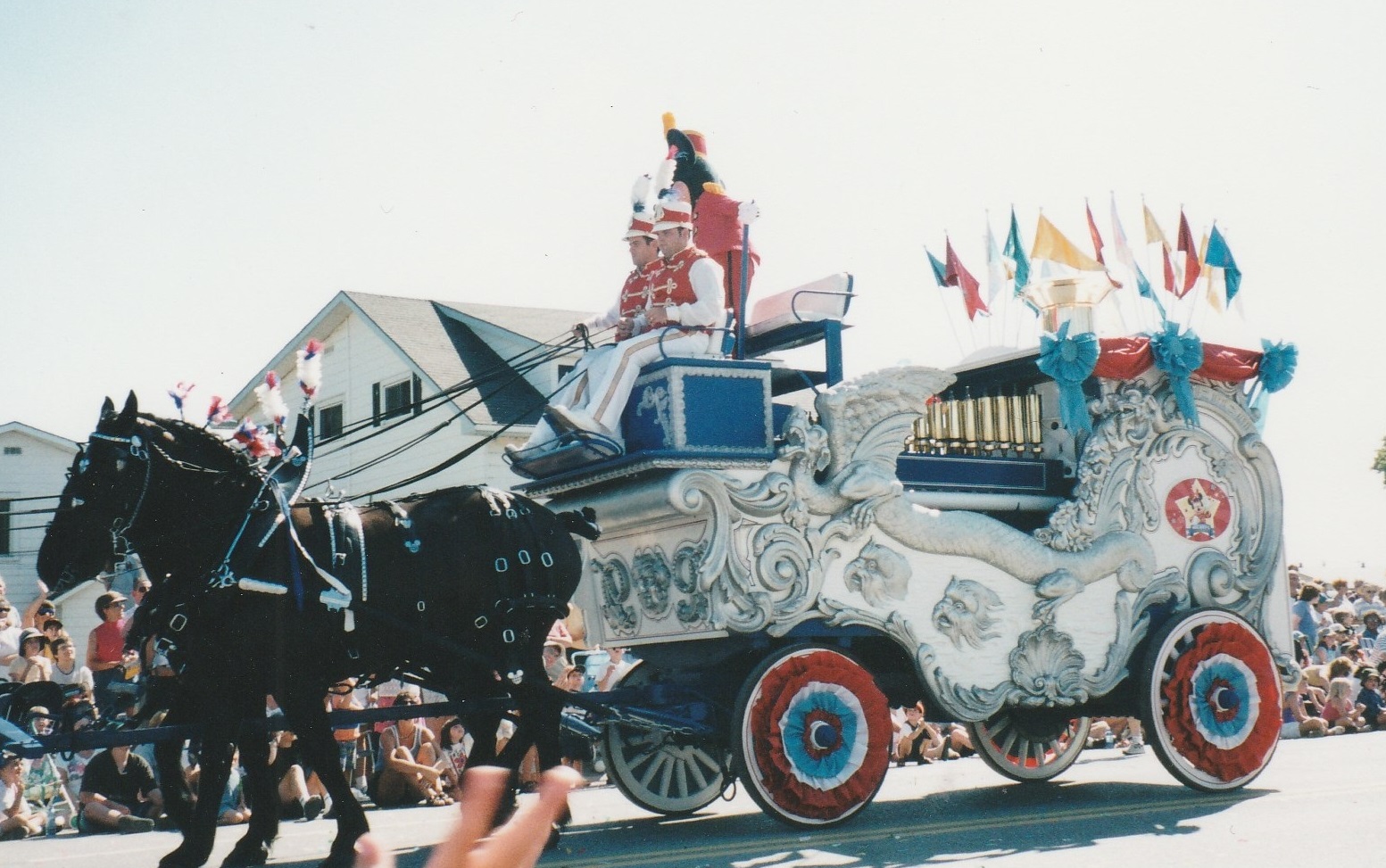
Huron County Disney connections also exist near the small village of Bayfield, Huron County. In 1974, as a hobby, Tom Penhale started building custom wagons. By 1983, it was a full time business. Tom’s business relationship with Disney started in December 1982 with the delivery of a set of hand crafted hames to the Walt Disney Ranch Fort Wilderness. In May 1983, he won the honour of building the show wagon that would compete in the 100th Anniversary of the Percheron Congress at the Calgary Stampede that coming June. He was chosen above many other craftsmen from all over North America.
Although a typical custom wagon would take about 3 months to complete, this one needed to be finished in 6 weeks. Official blueprints and a designer were flown in.
Working 16 hour days, with some local help, the wagon was completed on time. An artist came from the Disney World Studios in Florida to finish up. It was painted 4 different shades of blue, trimmed in 22 karat gold, and the lettering in silver spun with cotton.
Tom Penhale was given official recognition as the wagon builder when the Disney World Wagon was declared the World Champion Percheron Hitch during the 1983 Calgary Stampede.
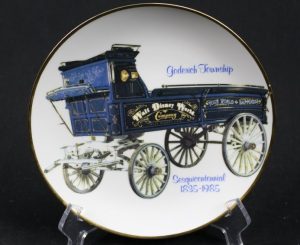
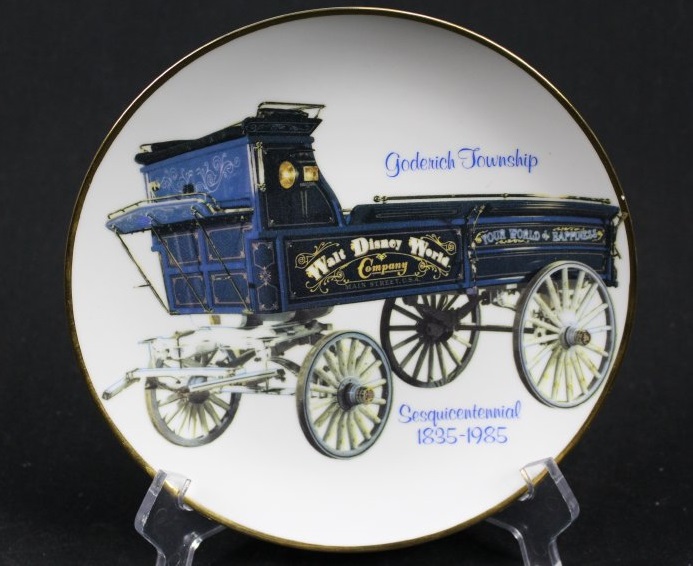
Souvenir plate from the Goderich Township Sesquicentennial 1835 – 1985 featuring Tom Penhale’s Disney World wagon.
2018.0042.001
A Disney Parade
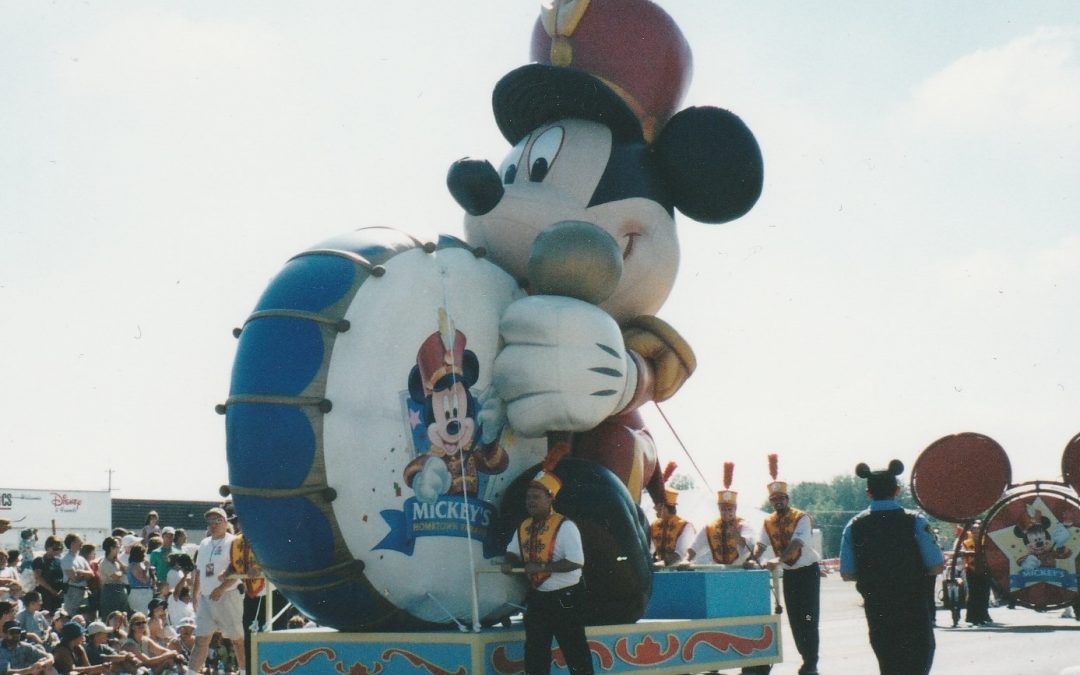
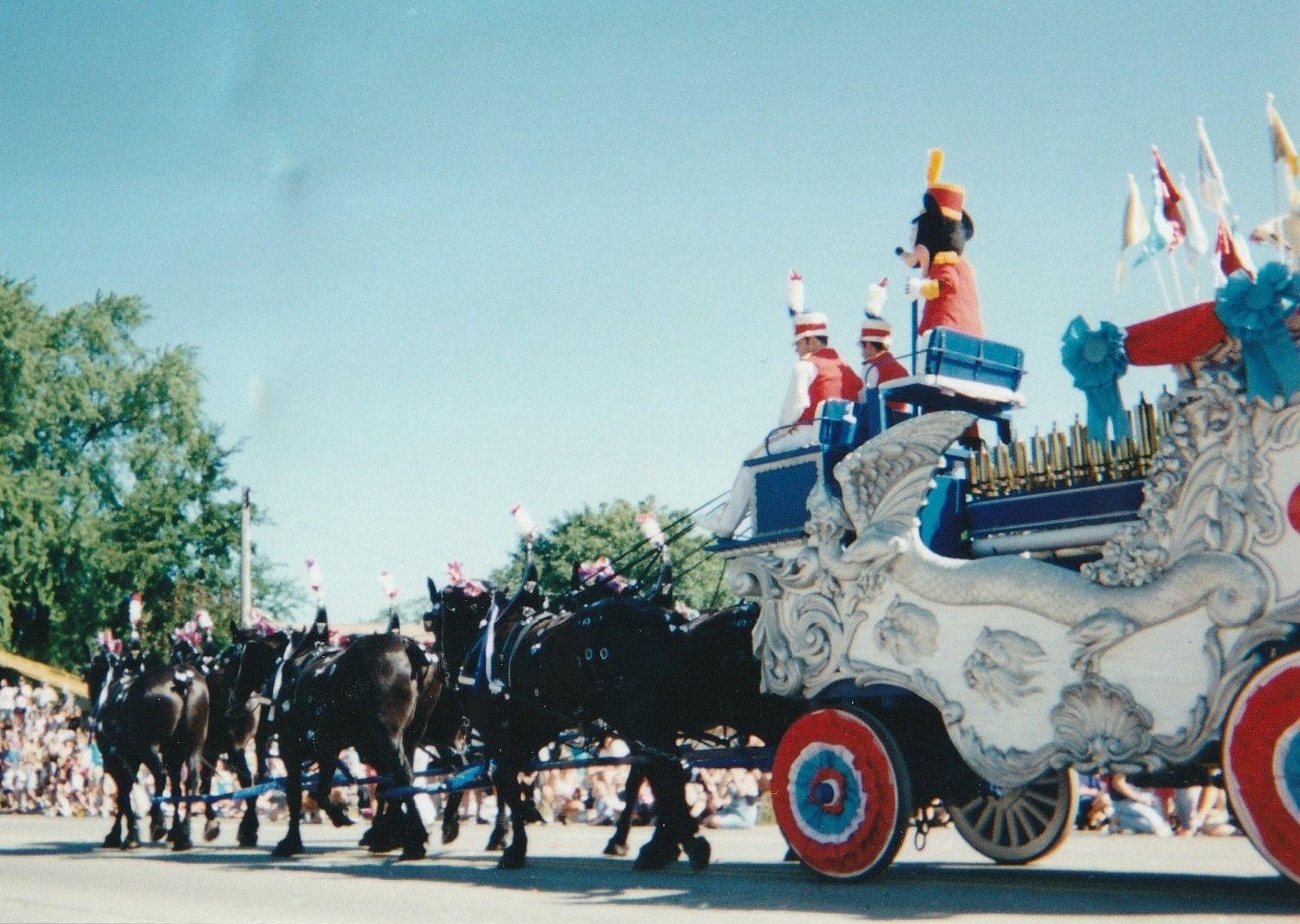
In July 1999, Goderich was the host for the first and only Canadian Hometown Disney Parade featuring Mickey Mouse, friends and characters. There were only 5 cities chosen in North America that year. Doug Fines, who was the President of the Goderich Chamber of Commerce at the time, submitted the winning essay to the contest to host the parade. The essay needed to convey true Mickey community spirit but of course having ancestral roots in Huron County helped as well. The organizers were expecting approximately 50,000 people to line the 2 ½ km route through Goderich. It is estimated that the final number was closer to 100,000.
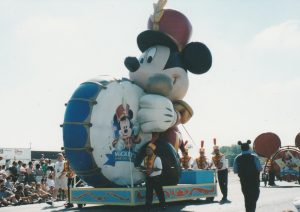
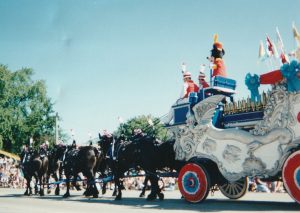
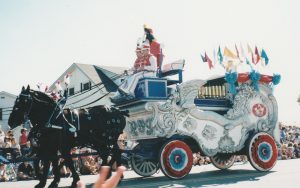
While the connections between the famed Walt Disney and Huron County are few, their significance is no less meaningful. From ancestral roots to prize winning wagons and parades, it really is “a small world after all”.
by Sinead Cox | Mar 24, 2017 | Artefacts, Collection highlights, Investigating Huron County History, Project progress
Over the course of the past several months that I’ve spent photographing artifacts at the museum, I’ve been lucky to get the perspectives of several different Huron County Museum staff members to see how they encounter objects and their narratives. Below are a selection of responses from interviews with Curator Elizabeth French-Gibson, Archivist Jenna Leifso, Registrar Patti Lamb, and Museum Technician Heidi Zoethout.
Do you have a favourite artifact/archival document at the museum (either on display or in storage)? If so, could you describe why?
Jenna Leifso (Archivist): I really enjoy the photograph collection and couldn’t pick just one photo because every time I catalogue a new collection or look through the photos I find something that delights me. The facial expressions, the clothes, and the hair are all really incredible.
Elizabeth French-Gibson (Curator): My favourite artifacts are the textiles, primarily the clothing. I look at each piece and wonder about the person who wore it – why did they have it & why did they save it? I am curious to know what other clothes they had and wore out, had and ruined or simply had and didn’t think were significant enough to save. We have many pieces in the collection that are the fancy dress, wedding attire, baby clothing, etc. that are beautiful and special but what about the everyday? What did they chose to simply wear and what to wear out?
Patti Lamb (Registrar): So many of our artifacts tell really cool stories, it’s hard to pick out just one. But my favourite artifact has to be Tiger Dunlop’s silver cup with the gold sovereign in it. We just received it a few months ago. It is so incredible to me to be able to hold in my hands the same silver cup that Tiger Dunlop drank from…someone that was so significant politically to Goderich, the county, our county and the world. The cup was willed to his sister in his quirky will.

Beaded necklace: 1957.10.3. Photo from Huron County Museum’s catalogue.
Heidi Zoethout (Museum Technician): I have a few favourites, right now the top of the list is the carved beaded necklace. The detail in the larger beads is amazing. I did not realize that some beads are carved fruit pits. Something that is normally discarded that can be made into something so beautiful.

Close-up of carved bead.
.
What is your perception of artifacts? What place and value do you think they have in society to-day?
Jenna Leifso (Archivist): I think I may have a different perception of artifacts than most people. Growing up, my family always went to museums and historical villages. I think it’s cool to see how we have evolved and how we are always trying to constantly improve.
Elizabeth French-Gibson (Curator): I think that artifacts provide us with a tangible connection with the past. It is necessary to have all types of artifacts available to the public in order to have a better view of the past. It would be easy to change the story, or overlook the mundane if the true pieces were not there. Each artifact has the ability to tell a story but the storyteller must be open to what it is truly saying.
Patti Lamb (Registrar): The artifacts create ties with the past and gives history a visual component. In such a disposable world in which we live, I think it’s important to be able to physically see and possibly touch items from the past.
Heidi Zoethout (Museum Technician): Some people look at an artifact and imagine who would have used it and create a scene in their mind. When I am working with an artifact, I think about the work and thought that went into its creation. Some designs have not changed much over time while others can be seen evolving through the collection we have.Through artifacts we are able to see how our thoughts and values have changed over time as a society and where they have not. It is a common refrain when staff are moving large objects that “they don’t make them like that anymore”. From the materials used, the amount of material used and the details that have gone into producing the product. An example of this is a bicycle that I was preparing for exhibit. It had many grease fittings which we no longer require on bicycles and the rims were made from wood. The wood had been lacquered and pin striping had been applied. When I finished working with the bicycle I came to appreciate it as work of art rather than a mode of transportation.
What would your dream project be? (e.g curating a certain type of exhibition, working with a certain set of artifacts, researching a particular area, etc.)
Jenna Leifso (Archivist): One of my dream projects would be exploring how Huron County residents acquired their clothes. I think there is a misconception that rural citizens were out of fashion and that everything was homemade, drab and boring. It would be interesting to have an exhibit that looks at the clothing factories that used to be here, mail order catalogues like Eatons and Simpsons, and how residents were influenced by fashions overseas. I would use photographs, newspaper advertisements, local directories, maps, correspondence, diary entries, and of course, clothes that are in the collection to research and create this exhibit.
Elizabeth French-Gibson (Curator): I would like to be able to spend more time on research for the Gaol. I think there are resources out there that we have not found yet and the resources that we have that have not been given the focus yet. It would be interesting for me to be able to learn more about the circumstances and lives of the people who spent time in our Gaol, as well as the functions and habits of the Gaol itself.
Patti Lamb (Registrar): My dream project would be anything related to glass or to be able to spend a greater amount of time on the Huron Pottery exhibit and the archeological collection.
Heidi Zoethout (Museum Technician): Currently my dream project would be organizing offsite storage so we could have tours available to the public. There are many details and much work required to make that possible.
Overall, throughout this project one of the most valuable experiences has been hearing the varying perspectives on museums, exhibit design, and artifacts, from such a knowledgeable and unique staff. The differing responses speak to how each of us experiences artifacts and their narratives differently according to our own lived experiences.
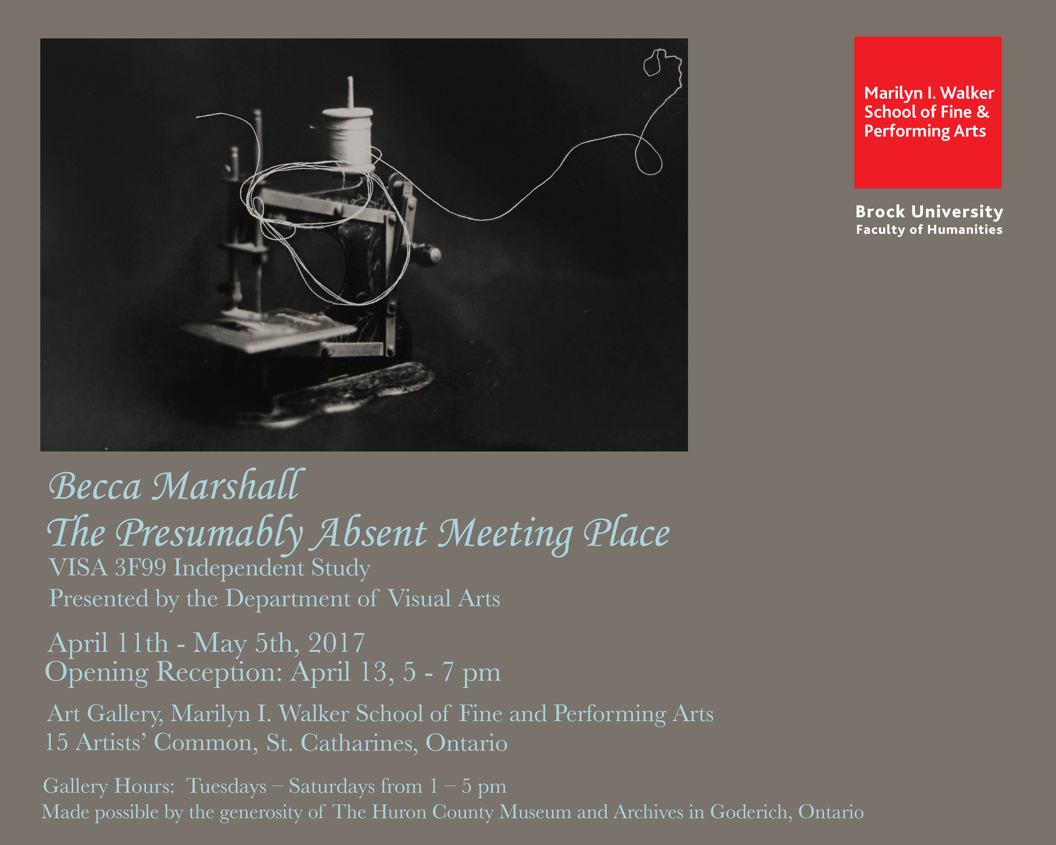
The artistic exhibition of photographs taken during this project will be on display in St. Catharines at the Marilyn I. Walker School of Fine and Performing Arts from April 11th – May 5th with an opening reception to be held on April 13th from 5-7pm.
by Sinead Cox | Jan 4, 2017 | Artefacts, Collection highlights, Investigating Huron County History, Project progress
Introducing a Brock University Student’s Project in Collaboration with the Huron County Museum & Archives, PART II
For those who missed the last post, my name is Becca Marshall – a fourth year student from Brock University where I am working on a school project with the assistance of the Huron County Museum and Archives. Basically, I am creating a series of analog photographs of museum artifacts along with a research paper as I study the theory of removed perception and constructed narratives in museums. If you want more background on my project, check out the original post that introduces my research! Today I want to update you on one of my favourite artifacts to research and photograph thus far – a linoleum block carved by Tom Pritchard.
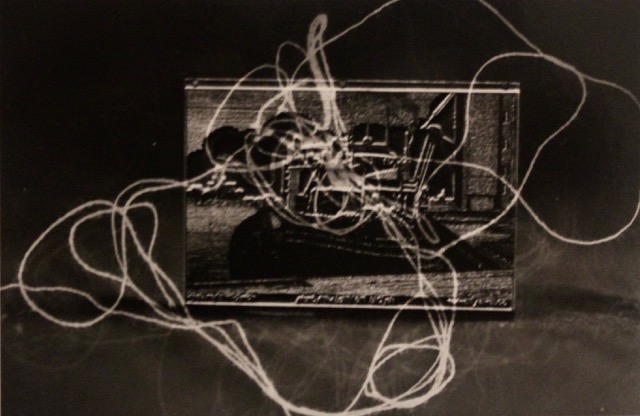
 At first I think I gravitated towards Pritchard’s linoleum blocks because my “art student” side was simply interested in seeing a piece of this artistic practice, as linoleum block printing is not something you encounter often nowadays. Not only does the museum have a collection of Pritchard’s linoleum blocks, but also a sketchbook and some of his art supplies. The most interesting part of this discovery process was going to find out more about Pritchard in the archives, only to discover that most of his folder was full of documents pertaining to his experience in the war. This incident prompted a line of inquiry in my research regarding human nature’s urge to essentially “fill in the blanks” in order to neatly label someone; many of us don’t like loose ends so we try to wrap our understandings of people into neat little boxes. For example, I had labelled Pritchard as solely an artist in my mind until I read his file – after that whenever I wrote research notes I found myself referring to him as a soldier. In fact, this label became so fixed in my head that when I was sorting through my photographs of
artifacts and pairing them with their donors I mistakingly wrote Pritchard’s name next to a WWII gas mask instead of his linoleum block. As I reflected on this little mishap, I remember thinking of what a large role our minds play when looking at history – as we often take what we consider the most important aspects of someones life and define them by it.
The e xperience with Pritchard’s artifacts and archival file significantly directed my research as I have started looking at more museum studies articles and books on how curators negotiate incorporating narrative within exhibitions, and also the role that the public plays in their interpretations. I am finding it endlessly fascinating how key choices made by the curator can cue certain readings from the public, yet also how each visitor’s lived experience often redefines each interpretation. Luckily for me there is a significant amount of literature that touches on narrative theory in museums, as well as the opportunity to ask questions of the great staff at the Huron County Museum and Archives.
 I also thought I might take the time to answer a question I receive often in terms of the artistic component of this project – which is “Why analog photography?” To be honest its a question I ask myself repeatedly as well (usually after a long day in the darkroom when only one print turns out). I chose to work in an analog process for this project because I was hoping that my artistic practice would reflect my experience at the museum – essentially embodying the idea of “careful touch.” I’ve found that working and photographing the artifacts feels like a very reverent experience, so I want my artistic process to reflect this as I take the time to physically manipulate the photos in the darkroom. I also find that there are parallels between working with the artifacts and working with the prints in concerns to preservation and value. To me, an analog photograph has a certain amount of value due to the fact that there are normally limited prints (and even then each print might be a bit different from the last!) as well as a certain level of preciousness since each photograph takes such a long time to process and complete. Additionally, I have been getting to learn a bit more about preservation of artifacts from the Museum Technician, which has lead me to make connections to the steps taken to preserve an analog photograph – such as keeping it in the fixative chemical bath for the right length of time so that the light does not deteriorate the print, or the never ending quest to avoid dust. In this way, I find that the analog process simply connects my practice.
Until next time,
– Becca Marshall
by Sinead Cox | Dec 7, 2016 | Artefacts, Collection highlights, Investigating Huron County History, Project progress
In this guest post, University student Becca Marshall examines how photography can reveal the Huron County Museum as a ‘gathering place’ for both people and things, and how the two intersect.
Hi everyone! My name is Becca Marshall and I am currently a fourth year student at Brock University where I study Concurrent Education with a focus in Visual Art and History. I have always been interested in cross disciplinary studies, so when the opportunity came to combine my love of history and art in the form of an independent study course – I took it! As I considered directions for my project I kept finding myself being pulled back to the Huron County Museum where I was a summer student in 2015. Luckily for me, the museum staff offered to assist me on my year-long project developing a research paper and analog photography portfolio on the topics of ‘removed perception’ and constructed narrative. So today I thought I would give you all a peek at what I have been up to so far.
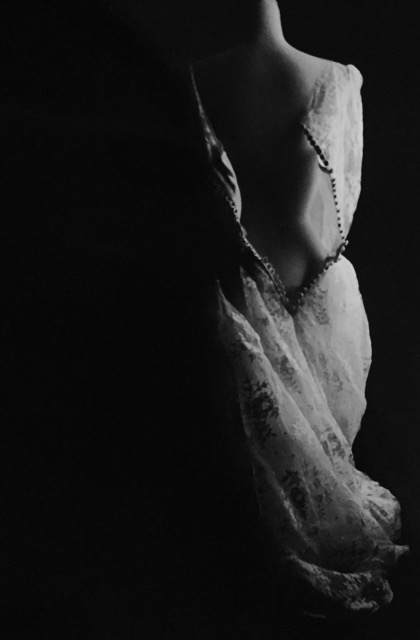
 I started my project by photographing artifacts that are not currently on display in the museum’s main exhibition spaces. A large portion of my focus is looking at the museum as a “gathering place” (as one of my supervising professors termed it) and how even the most seemingly unconnected objects end up being tied together by the very fact that they all ended up in the same building. Some of my favourite artifacts to photograph so far have been a wedding dress belonging to Jean Taylor and a child’s sewing machine. Once I have the negatives developed I start working with methods of interrupting the images. Visual negations are a reference to our human tendency to insert ourselves into art and history and how this both enhances our experience, but also illuminates our limitations to understand an artifact’s experience objectively. These visual negations are indicative of my study of removed perception -how every single person will view an artifact (or a photo!) differently depending on their lived experiences. Essentially, the photos both highlight the personal relationships we form with artifacts while also recognizing a barrier – despite providing a window, a photo cannot physically transport someone back to the original objective context.
 More specifically, in terms of technique I am working with an analog camera to create a series of silver-gelatin prints. Once I take the photos I remove the film in the darkroom, wind it onto a reel, put it in a canister, and then soak it in a series of chemical baths. After this process the film is developed and can be exposed to light as I remove it from the dark room and take it to the drying cabinet. After that I select the negative I want to make a print of and go into the darkroom with the red lights on (as red lights will not harm the light sensitive paper). Next, I insert my negative into an enlarger that will use directed light to expose the image onto my paper. It is during this process that I create any visual interruptions – for example the attached image of the sewing machine was created by dragging a thread across the paper for a split second during the exposure time. I then take the paper over to another series of chemical baths to develop the image. I am currently coming up with new ways to interrupt the images – for example I am experimenting with using a swath of lace during the exposure process on the wedding dress image to see what effect it produces. The entire process is incredibly engaging, and each artifact seems to demand a different sort of treatment that is entirely unique from the others.

Dark room.
In terms of my research paper I am currently developing its direction through my experiences at the museum, studies in the archives, and by reading various books and journal articles. Through this process I hope to better understand the intentions, ethics, and reasoning behind how artifacts are displayed in museums. I want to learn how museums negotiate preserving the narratives of an artifact’s provenance, or how they may be used to illustrate larger messages, as well as how they reconcile artifacts with missing information (which arguably can be just as fascinating as an artifact that has pages recorded about its provenance). The inspiration for this research direction came from my encounter with a linoleum block in the collections room made by Thomas Pritchard. When I went to the archives to learn more about him I expected the file to be full of his artistic accomplishments – however much to my surprise, the majority of the documents were about his experience at war. I hope to write about this experience in greater detail in my next blog post as well as have a photo of his linoleum block developed at that time. By engaging in this research practice I hope to develop a better understanding about constructed and interpreted narrative through the display of artifacts in museums.
Overall, so far I am having an amazing experience getting to learn more about museums and engage with such uniquely wonderful artifacts. I cannot thank the staff at the Huron County Museum and Archives enough for assisting me with my studies and allowing me to see how art, history, and museum studies can all cross over and inform each other in the most interesting ways. I look forward to seeing how this project develops this year, and I hope you enjoy my periodic updates throughout the duration.



 At first I think I gravitated towards Pritchard’s linoleum blocks because my “art student” side was simply interested in seeing a piece of this artistic practice, as linoleum block printing is not something you encounter often nowadays. Not only does the museum have a collection of Pritchard’s linoleum blocks, but also a sketchbook and some of his art supplies. The most interesting part of this discovery process was going to find out more about Pritchard in the archives, only to discover that most of his folder was full of documents pertaining to his experience in the war. This incident prompted a line of inquiry in my research regarding human nature’s urge to essentially “fill in the blanks” in order to neatly label someone; many of us don’t like loose ends so we try to wrap our understandings of people into neat little boxes. For example, I had labelled Pritchard as solely an artist in my mind until I read his file – after that whenever I wrote research notes I found myself referring to him as a soldier. In fact, this label became so fixed in my head that when I was sorting through my photographs of
 xperience with Pritchard’s artifacts and archival file significantly directed my research as I have started looking at more museum studies articles and books on how curators negotiate incorporating narrative within exhibitions, and also the role that the public plays in their interpretations. I am finding it endlessly fascinating how key choices made by the curator can cue certain readings from the public, yet also how each visitor’s lived experience often redefines each interpretation. Luckily for me there is a significant amount of literature that touches on narrative theory in museums, as well as the opportunity to ask questions of the great staff at the Huron County Museum and Archives.
 I also thought I might take the time to answer a question I receive often in terms of the artistic component of this project – which is “Why analog photography?” To be honest its a question I ask myself repeatedly as well (usually after a long day in the darkroom when only one print turns out). I chose to work in an analog process for this project because I was hoping that my artistic practice would reflect my experience at the museum – essentially embodying the idea of “careful touch.” I’ve found that working and photographing the artifacts feels like a very reverent experience, so I want my artistic process to reflect this as I take the time to physically manipulate the photos in the darkroom. I also find that there are parallels between working with the artifacts and working with the prints in concerns to preservation and value. To me, an analog photograph has a certain amount of value due to the fact that there are normally limited prints (and even then each print might be a bit different from the last!) as well as a certain level of preciousness since each photograph takes such a long time to process and complete. Additionally, I have been getting to learn a bit more about preservation of artifacts from the Museum Technician, which has lead me to make connections to the steps taken to preserve an analog photograph – such as keeping it in the fixative chemical bath for the right length of time so that the light does not deteriorate the print, or the never ending quest to avoid dust. In this way, I find that the analog process simply connects my practice.
 I started my project by photographing artifacts that are not currently on display in the museum’s main exhibition spaces. A large portion of my focus is looking at the museum as a “gathering place” (as one of my supervising professors termed it) and how even the most seemingly unconnected objects end up being tied together by the very fact that they all ended up in the same building. Some of my favourite artifacts to photograph so far have been a wedding dress belonging to Jean Taylor and a child’s sewing machine. Once I have the negatives developed I start working with methods of interrupting the images. Visual negations are a reference to our human tendency to insert ourselves into art and history and how this both enhances our experience, but also illuminates our limitations to understand an artifact’s experience objectively. These visual negations are indicative of my study of removed perception -how every single person will view an artifact (or a photo!) differently depending on their lived experiences. Essentially, the photos both highlight the personal relationships we form with artifacts while also recognizing a barrier – despite providing a window, a photo cannot physically transport someone back to the original objective context.
 More specifically, in terms of technique I am working with an analog camera to create a series of silver-gelatin prints. Once I take the photos I remove the film in the darkroom, wind it onto a reel, put it in a canister, and then soak it in a series of chemical baths. After this process the film is developed and can be exposed to light as I remove it from the dark room and take it to the drying cabinet. After that I select the negative I want to make a print of and go into the darkroom with the red lights on (as red lights will not harm the light sensitive paper). Next, I insert my negative into an enlarger that will use directed light to expose the image onto my paper. It is during this process that I create any visual interruptions – for example the attached image of the sewing machine was created by dragging a thread across the paper for a split second during the exposure time. I then take the paper over to another series of chemical baths to develop the image. I am currently coming up with new ways to interrupt the images – for example I am experimenting with using a swath of lace during the exposure process on the wedding dress image to see what effect it produces. The entire process is incredibly engaging, and each artifact seems to demand a different sort of treatment that is entirely unique from the others.