by Amy Zoethout | May 18, 2021 | Blog
Take a closer look at the Huron County Museum & Historic Gaol and its collections as staff share stories about some well-known and some not-so-well-known features, artifacts, and more. In a three-part series, Registrar Patti Lamb takes a closer look at a museum’s secret codes. Read Part 2 on Collecting at the Huron County Museum and Part 3 on Deaccessioning Artifacts.
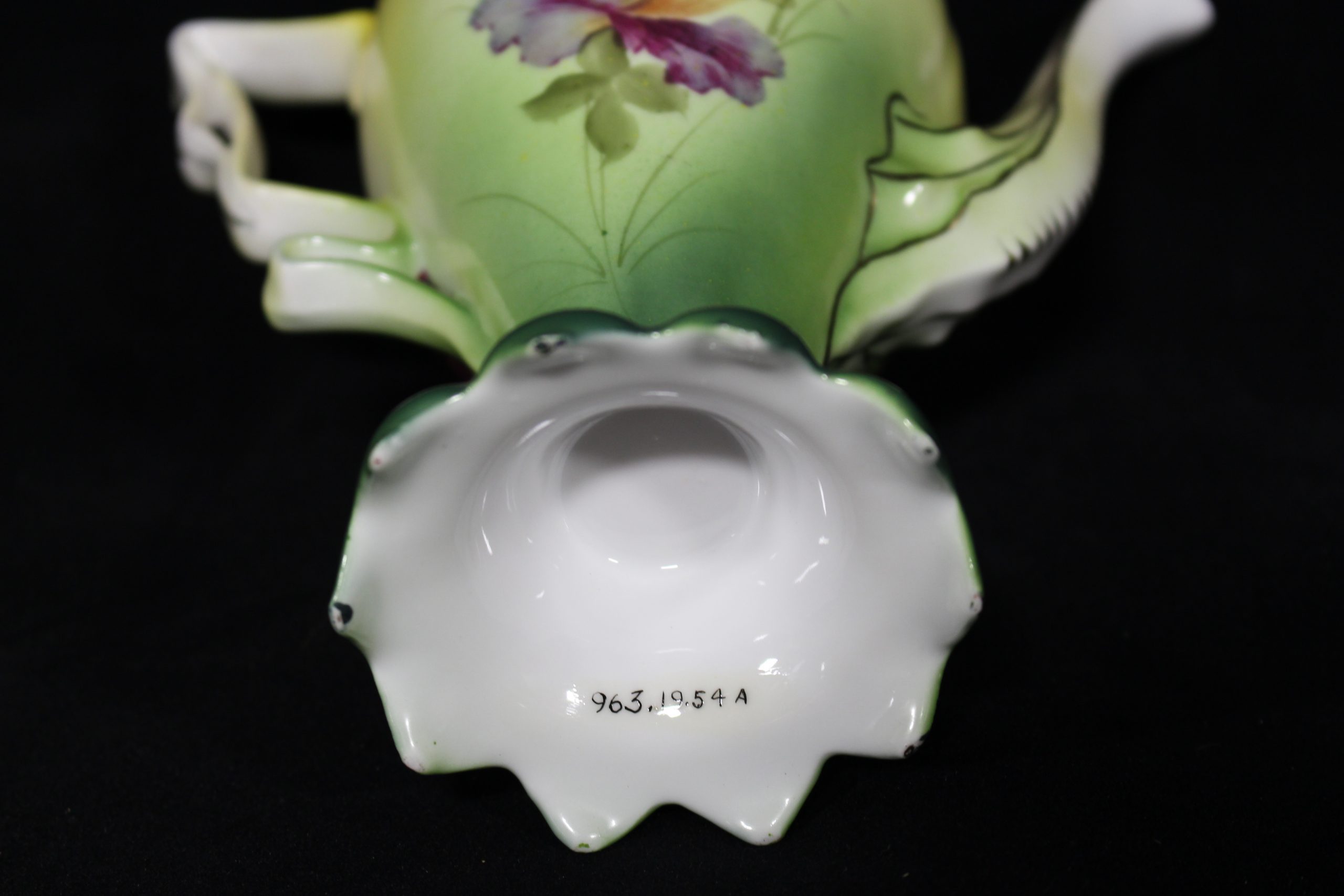
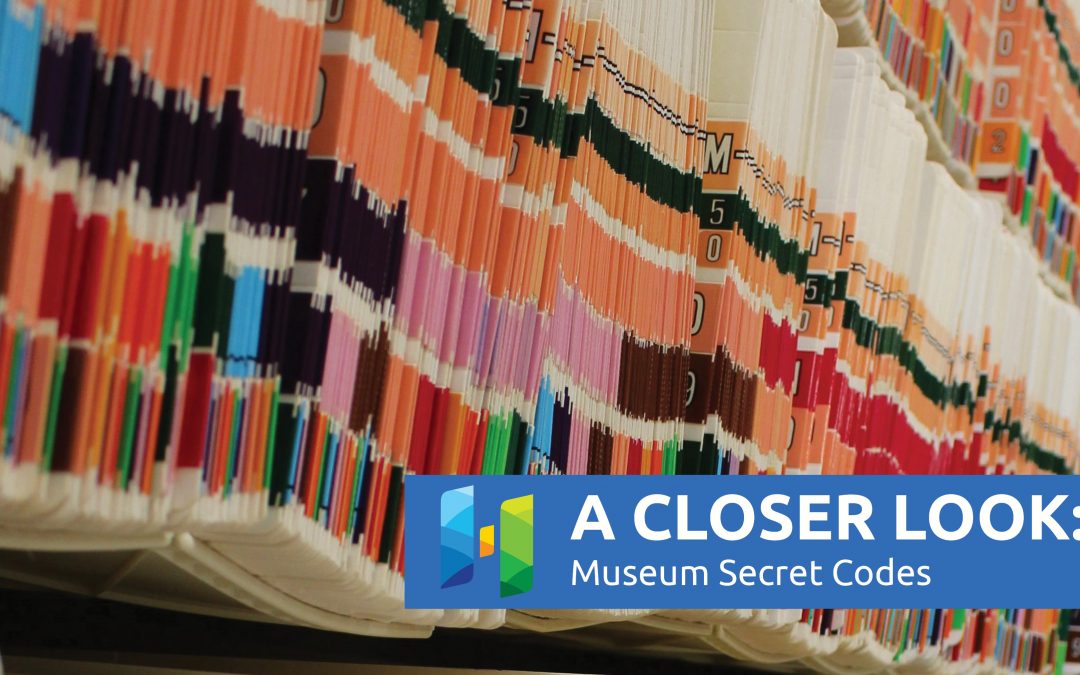
The Object Identification Number is an important part of the “secret language” used by museum professionals.
Most museum visitors are aware that the artifacts in the museum have numbers written on them. Most also know that the numbers somehow help to identify the objects. What most don’t realize, however, is what the numbers mean to the museum staff.
When museum staff look at an Object Identification Number (object ID), they can instantly tell what year the object came to the museum; if there were other objects that came in before it that particular year; whether it was part of a group of objects; and in some cases, whether or not there is a known donor. Using an object ID number to look up an object record in the museum database will show the staff everything that is known about the object. This includes physical description, donor, provenance (history), condition, use, and where in the museum the object is located.
Traditionally, museums use a three part numbering system. The first part lets staff know the year the artifact came into the museum collection; the second part indicates the group number of the artifacts that came in during a particular year; and the last number is the object number within that group. The first two parts of the number are what is known as an accession number (an object or group of objects from a single source at one time). When the third part of the number is added on, it becomes an object ID number specific to that object.
Accession and object ID numbers are an important part of the “secret language” used by museum professionals. They allow us to record and store, in one spot, important information about the artifacts as well as help track and locate them. The object ID is as important as the artifact, and without it, access to the information about the artifact would be difficult to retain and retrieve.
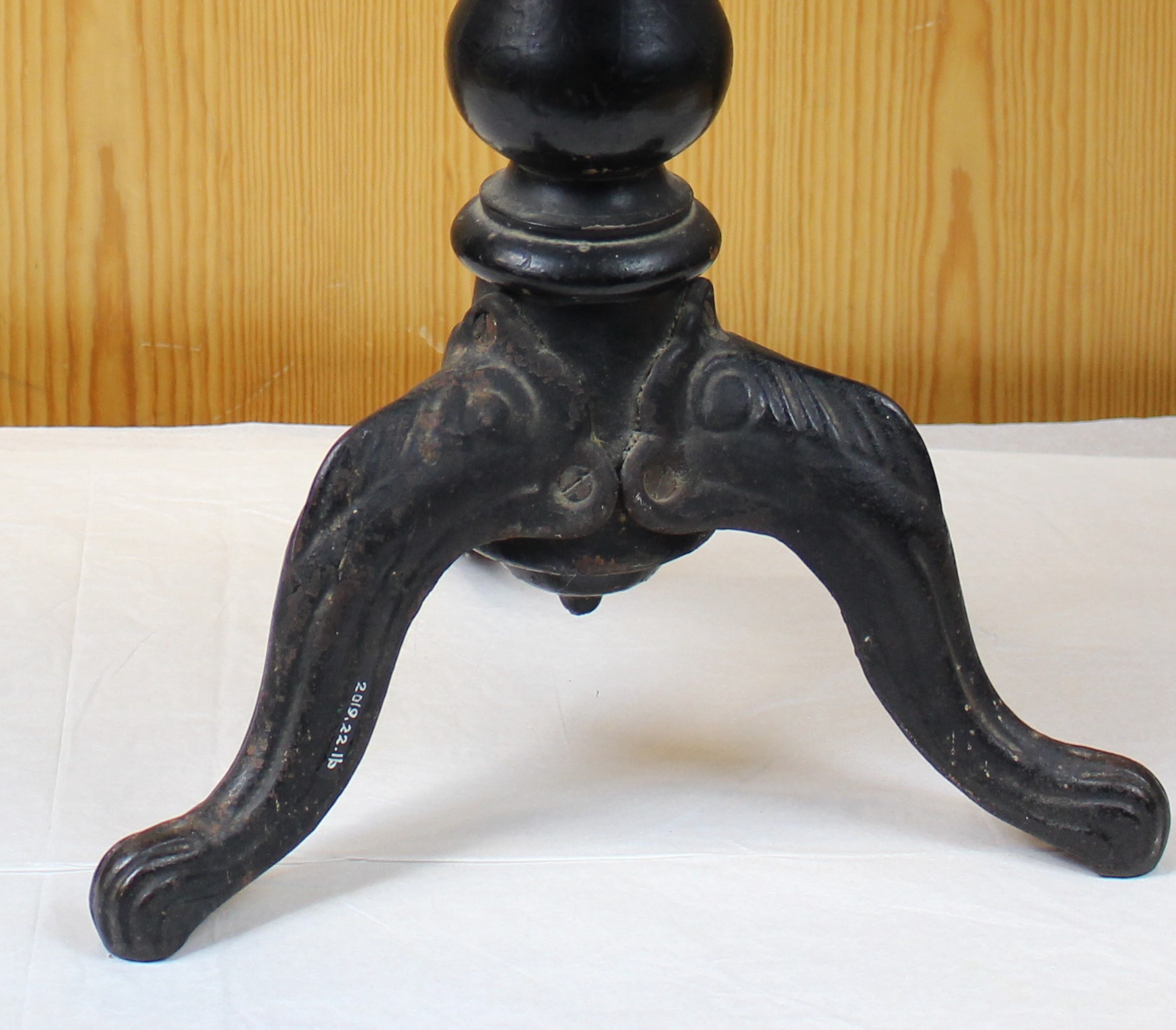
Object Identification Number shown on this Museum artifact.
by Amy Zoethout | Mar 29, 2021 | Media Releases/Announcements
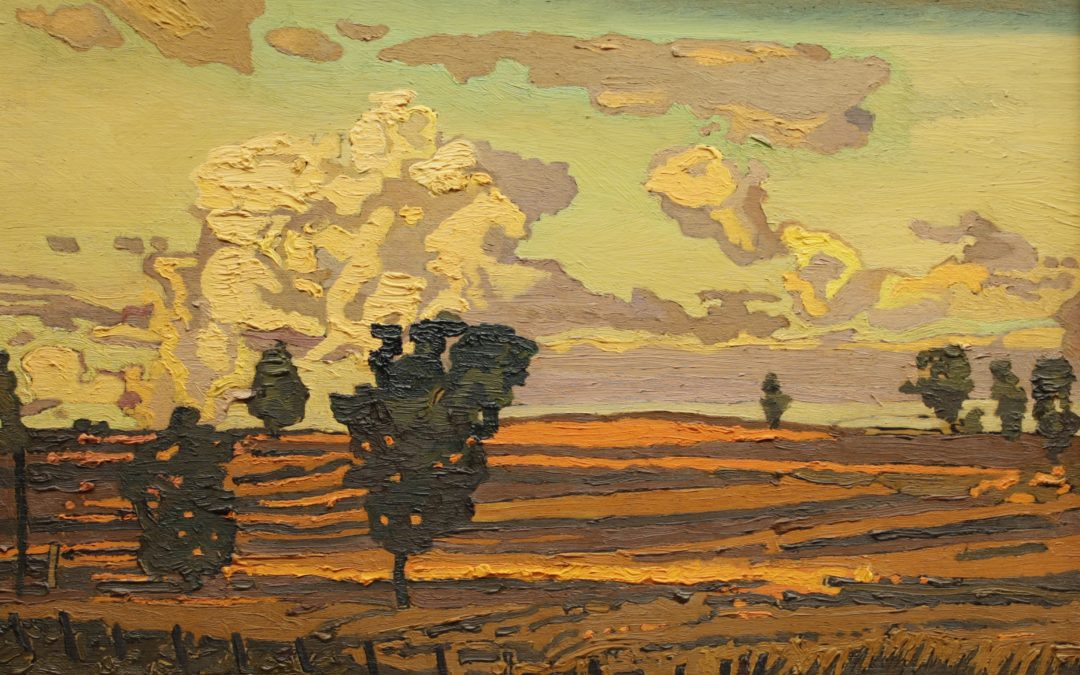
Don’t miss out on seeing Reflections: The Life and Work of J.W. (Jack) McLaren, on at the Huron County Museum until April 30, 2021.
Praised by visitors as an “amazing show” featuring “spectacular” art and an “interesting slice of Huron County and beyond”, Reflections has drawn repeat visitors since opening at the Museum in October, 2020. The exhibit explores McLaren’s prolific career as an artist, illustrator, and performer, and features close to 100 pieces of his art on loan from the community.
Presented in partnership with the Huron County Historical Society, Reflections not only shares an incredible local collection of art, but also looks back on McLaren’s fascinating life, including his time in World War I where he performed as a member of the Dumbells Comedy Troupe, and his membership in the Toronto Arts and Letters Club where he became associated with the Group of Seven.
For those unable to visit the exhibit in person, the Huron County Museum will be hosting Jack McLaren: A Soldier of Song, a virtual event that can be enjoyed from home on April 9, 2021.
This event will feature a presentation and performance by Jason Wilson, musician and author of Soldiers of Song: The Dumbells and Other Canadian Concert Parties. Wilson’s performance is based on the original works of the Dumbells, a Canadian concert party that entertained the troops on the front lines in World War I and featured Jack McLaren.
To register for this event, or to explore more ways to enjoy the Reflections exhibit from home, visit: https://www.huroncountymuseum.ca/reflections/
The public is invited to book a visit to catch the exhibit by calling 519.524.2686. The museum is open from 10:00AM-4:30PM on Tuesday, Wednesday and Friday, 10:00AM-8:00PM on Thursday, and 1:00PM-4:30PM on Saturday. Reflections is included with regular admission, or free for museum members and Huron County Library cardholders.
by Amy Zoethout | Mar 13, 2021 | Artefacts, Blog, Collection highlights, Textile Collection
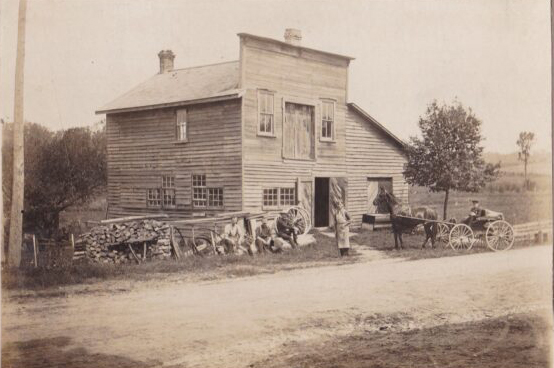
Above: Herb Wheeler’s Carpentry Shop in Belgrave, ON. Herb is seen standing in front (Photo courtesy of Richard Anderson).
Guest blogger Sharlene Young-Bolen, of Stitch Revival Studio in Blyth, shares more about how a Huron County Museum artifact inspired her to create the Huron Wristers pattern and how her research into the origin of the pattern led her to connect to family of the original owner. The original gloves are currently on display in the Museum Gift Shop where Sharlene’s Huron Wristers kits are also available for purchase.
Was there a Wheeler family tie to either Estonia or the British Isles? The answer would help to identify the glove pattern perhaps. When an Instagram post by Best Dishes, a Goderich business owned by Sarah Anderson, appeared in my feed one day identifying the wristers pattern as based on a family heirloom, chance had dropped the perfect opportunity. It was time to connect. A couple messages back and forth and the story unfolded…
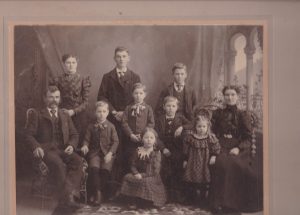
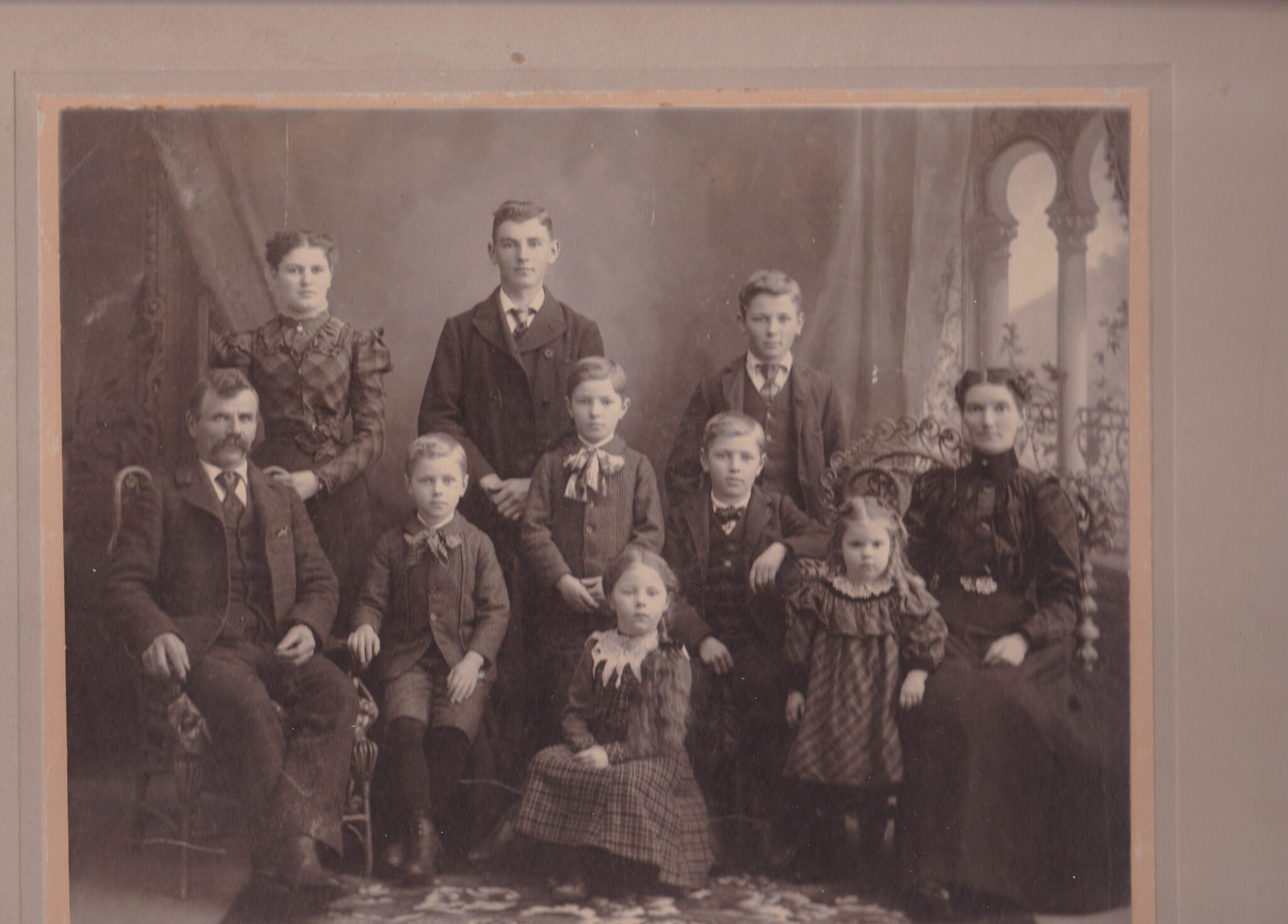
The Charles Wheeler Family circa 1900. Back: Carrie, Herb, Ernest. Centre: Charles, Cecil, Jesse, Lennie, Mary Ann; Front: Lena, Myrtle (Photo courtesy of Richard Anderson).
Sarah, as it turns out, is the daughter of Richard Anderson, great-nephew of Herbert Wheeler, the original owner of the gloves. Richard sent the following information about the history of the Charles Wheeler Family:
Charles Wheeler Sr. was born in Dorsetshire, England and came to Canada in 1846, locating in Tecumseh Township where he spent 18 years. In 1864 he moved with his family to Morris Township where he bought 300 acres which would be the N ½ of Lots 10, 11 and 12, Concession 5, more commonly known as the 4th Line. He married Caroline Lawrence and they raised a family of five sons, Charles, John and Lawrence of Morris Twp., William of Alma, Frank of Belgrave, and a daughter Mrs. Ann Hughes of Escanaba, Michigan.
Charles Wheeler Jr. married Mary Ann Wilkinson and they raised a family of five sons, including Herbert, and three daughters. Charles farmed on Lot 12 and after his death in 1913, his son Jesse took over the home farm. When Jesse married, his mother moved to Belgrave to the house now occupied by Wes and Annie Cook. Jesse continued to farm there until he retired to Belgrave.
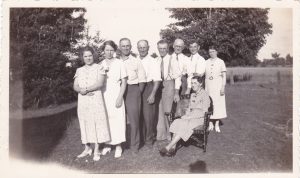
The Charles Wheeler Family, standing in birth order; youngest to oldest, L-R Myrtle, Lena, Cecil, Jesse, Lennie, Ernie, Herb, Carrie (Photo courtesy of Richard Anderson).
Herbert married Pearl Procter. They lived in Belgrave and had three children: Goldie, who married Winnie Lane and lived in London; Velma married Wilfred Pickell and lives in Vancouver; Ken married Mabel Coultes and farmed in East Wawanosh before retiring to Belgrave. Herbert had a woodworking shop in Belgrave.
Herbert’s grandson David Pickell, recalls: “When I knew my grandparents, Pearl and Herb, they lived in Belgrave. Herb Wheeler was a carpenter and, as the name suggests, repaired farm equipment such as wooden wheeled carts etc. He was quiet, and had a subtle sense of humour us kids loved.”
The following poem was written about Herbert Wheeler by a family member and gives a wonderful, lasting impression of just who Herbert was and his occupation as a talented woodworker, carpenter and barber. It would have been great to experience just what this writer did so long ago.
Herb Wheeler’s Carpentry Shop & Hair Cutting CIRCA 1932-1945
Whenever Herb was in his shop, I’d like to go and look,
He might be cutting some one’s hair, or be reading some big book,
There were jigs galore hanging all around, some maybe for a sleigh,
There were shavings bright upon the floor, they would soon be swept away.
Herb never left a job undone, if he could finish it that day,
Except of course a larger job, he would maybe stop and say,
“Tomorrow is another day, I’ll hope to get it done,”
“But if I don’t the job will keep, it’s not hurting any one. ”
Sometimes just after Supper, Herb again would be around,
He’d pump up a gas lantern, light it up and settle down.
For Herb, doubled as a barber, he’d cut hair two weekday nights,
Herb, never used power clippers, he did not charge enough by rights.
Somehow, Two bits is what I think, was all a haircut cost,
I really can’t remember, it’s something I have lost.
Herb did not pull your hair at all, as hand clippers often do,
He’d sometimes talk as the clippers clicked, and he’d ask, “does this suit you” ?
Herb was skilled at doing wood work, he could make most anything,
He made a Bob sled for the kids, it nearly did take wing.
The fastest sled around those parts, down the ninth line hill it flew.
Ken would try to give us all a ride, or sometimes maybe two.
I expect that Goldie used the sled, and likely Velma too,
It needed someone that could steer, and knew just what to do.
I’ve seen the times, when snow was hard, and a fast start at the top,
You’d have to turn the corner, at the highway, to get stopped.
Herb made Ken skis, that were Black Ash wood, what a lovely pair,
The skis would take you down a hill, like you were cushioned on some air.
When the skis were waxed and shone and dried, no one ever saw the like,
They would make a run ahead of all, they would go clean out of sight
There were other things of super class, that emerged for that shop door.
A set of kitchen cupboards, like you’d never seen before.
Herb had a little saying, and he practiced it always
“If you measure twice before you cut, it eliminates delays”!
I have seen him make a set of shafts, the wood he’d have to steam
To make a bend for the horse to fit into the cutters beam.
Herb had the kind of patience, that a lot of people lack,
That is what made him extra special, with an extra special knack.
So far, the research has yielded no straight answers as to the gloves’ origin, but the search continues. While a pattern might give you a hint to the origin of a knitted item, you need to identify more, such as the cast-on method, the type of ribbing, how the fringe was made, and how the strands (or floats) were carried across the back of the knitting. A full reproduction of Herbert’s gloves would help to answer the remaining questions.
In conclusion, there really isn’t a conclusion… But what I can say is that taking the time to explore knitting traditions and a local family’s history has been a fascinating, rewarding experience. I’m so grateful for Herbert’s relatives who have answered my questions and sent so many wonderful images to be shared here with everyone. They went to a lot of work to compile the info and family photographs and I can’t thank them enough for all their time and effort.
I’ve come to think that the original knitter may have incorporated features that he liked into these gloves, perhaps not following one certain pattern, but rather combining different elements into one. A full recreation of the gloves is planned for late fall 2021 and right now I’m testing a local wool I may be using for the reproduction. Stay tuned to the website for further updates as we move forward.
Learn more: