by Amy Zoethout | Dec 24, 2020 | Archives, Artefacts, Blog, Exhibits
Technology over the last several years has made it so easy to quickly connect with friends and loved ones that the tradition of sending Christmas cards has not been as popular as it once was. But in the midst of a global pandemic, when we can’t celebrate together like we normally would, people are looking for more meaningful ways to let loved ones know they are thinking of them, and what better way than a lovely greeting delivered through the mail. And while we can’t send out a seasonal greeting to you all through the mail, we can still use the power of technology to share a little Christmas cheer by taking a look through some of the Christmas cards in our collection. 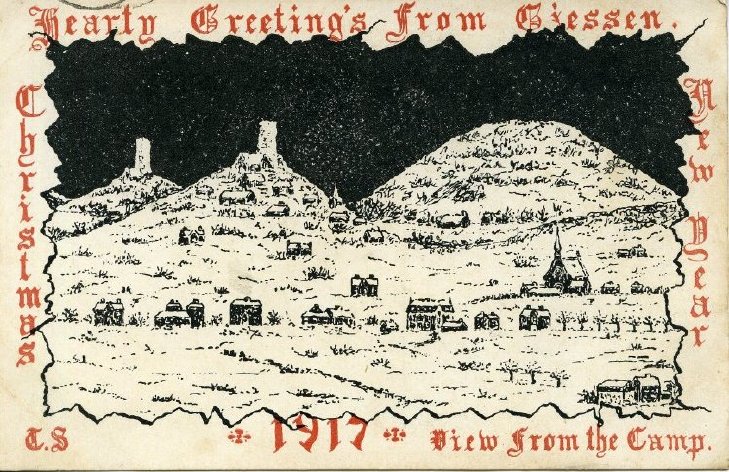
Christmas Greetings, From Germany To Edith Williams From Prison Camp 106684 Co.10 Bar. B A994.0007.033
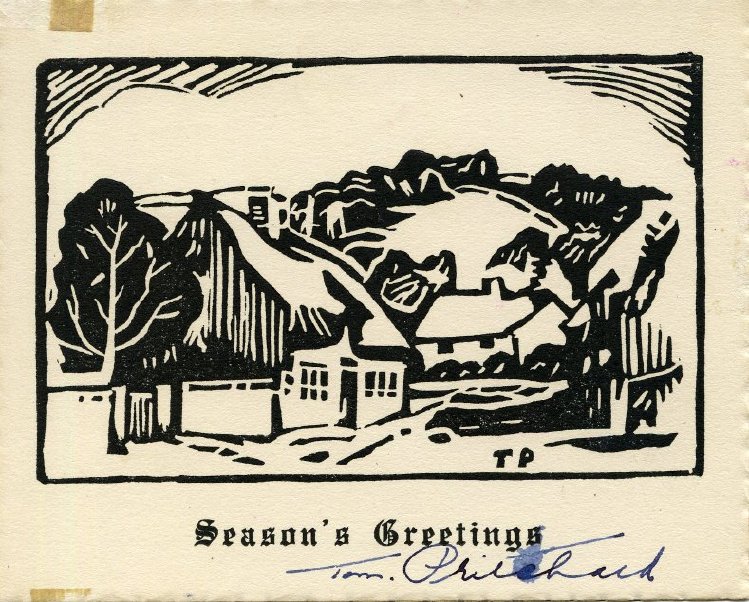
A Christmas notecard “Season’s Greetings”. On the front of card is a Tom Pritchard print of a farm/house by a hill and is signed by Tom Pritchard. Donated by Town of Goderich. 2011.0021.009
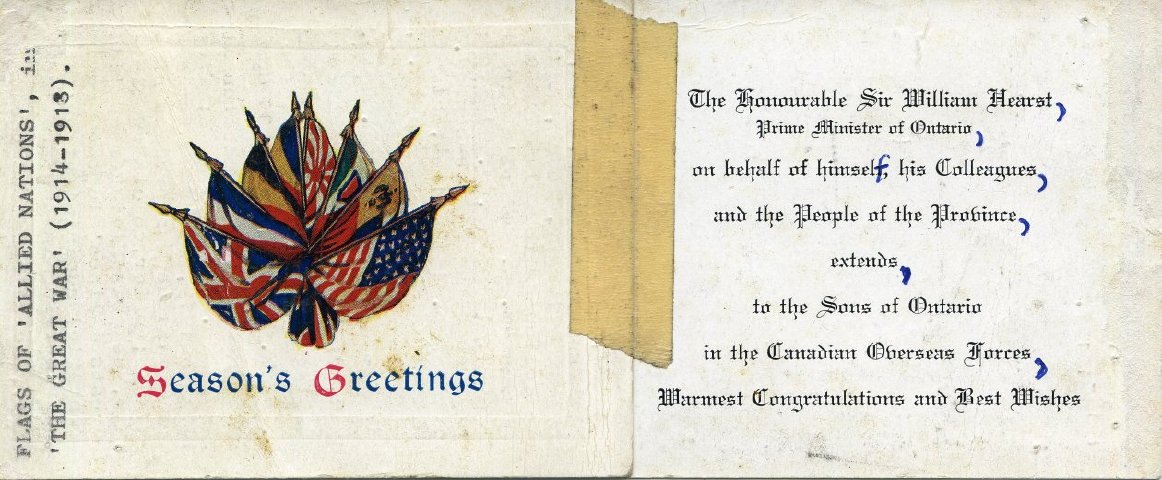

This Christmas postcard features flags of Allied nations in the First World War. The back of the card includes a bio of Ontario Premier William Hearst. 2004.0044.006
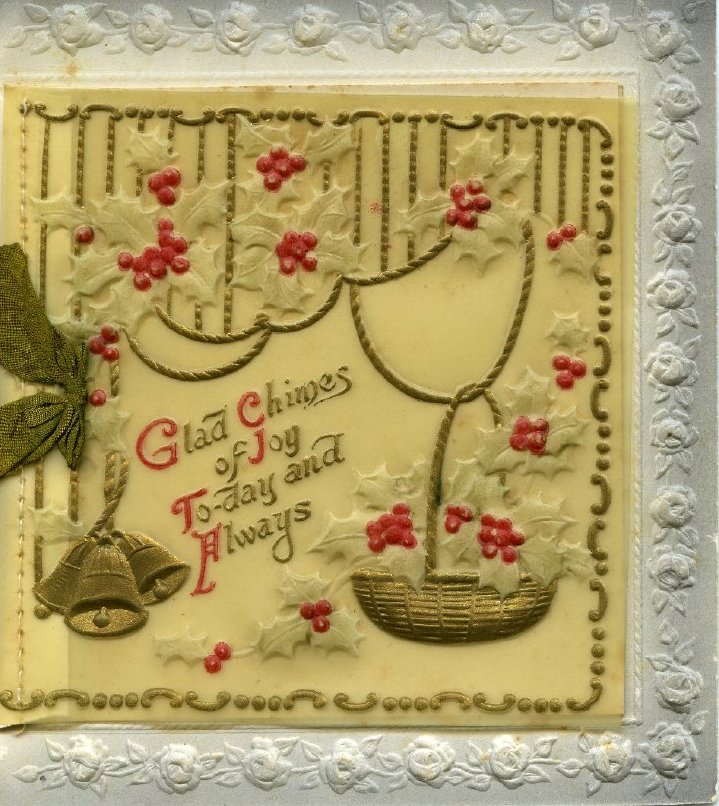
The back of this card has a silver embossed border. The front of the card is made of plastic with bells and holly designs on it. On the inside left is printed “THAT YOU’LL REMEMBER ME”. On the inside right is printed A GREETING…ANOTHER CHRISTMAS. A951.0664.001
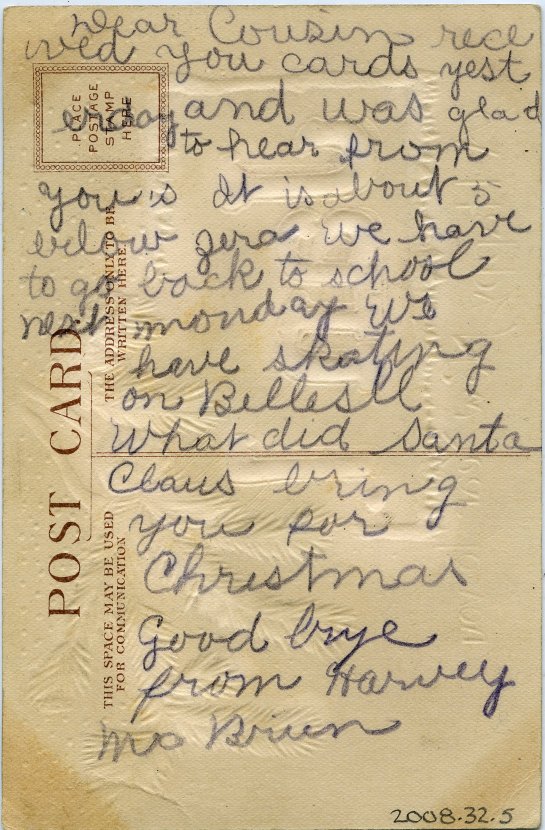 This Happy New Year postcard does not include a postmark, but reads on the back: “Dear cousin, received your cards yesterday and I was glad to hear from you’s. It is about 5 below zero, we have to go back to school next Monday. We have skating on Belles Isle. What did Santa Claus bring you for Christmas. Good bye from Harvey M Brien.” 2008.0032.005
And, of course, we couldn’t share our Christmas card collection without sharing a selection of cards from artist Jack McLaren, who is the subject of our exhibit Reflections: The Life & Work of J.W. (Jack) McLaren. Depending on the year, his collection includes some happy and cheerful seasonal greetings….
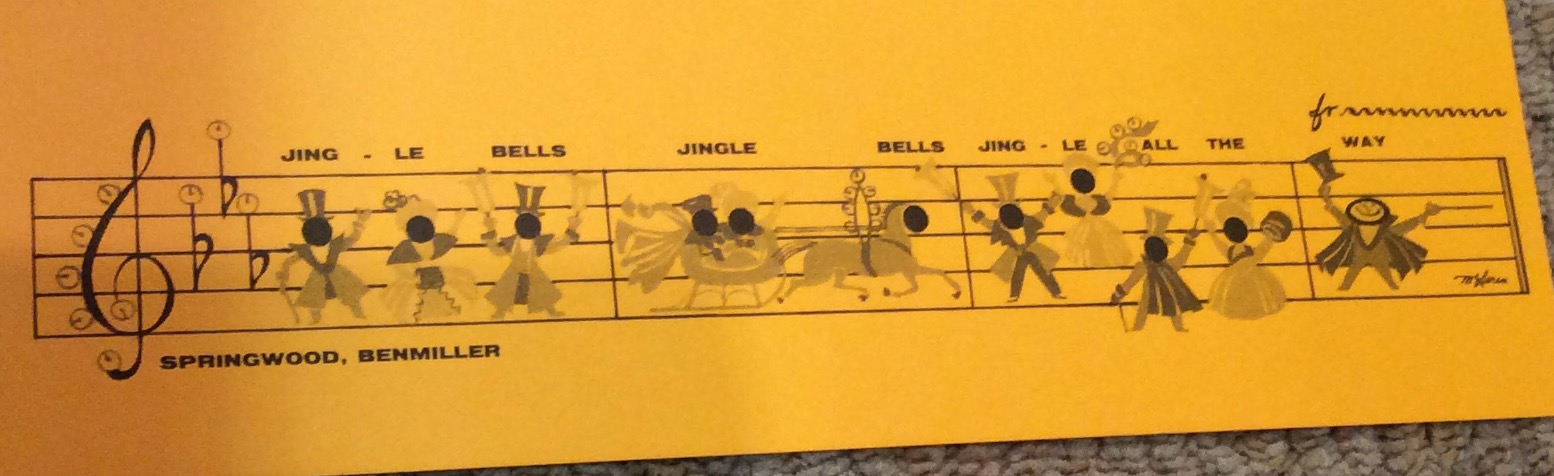
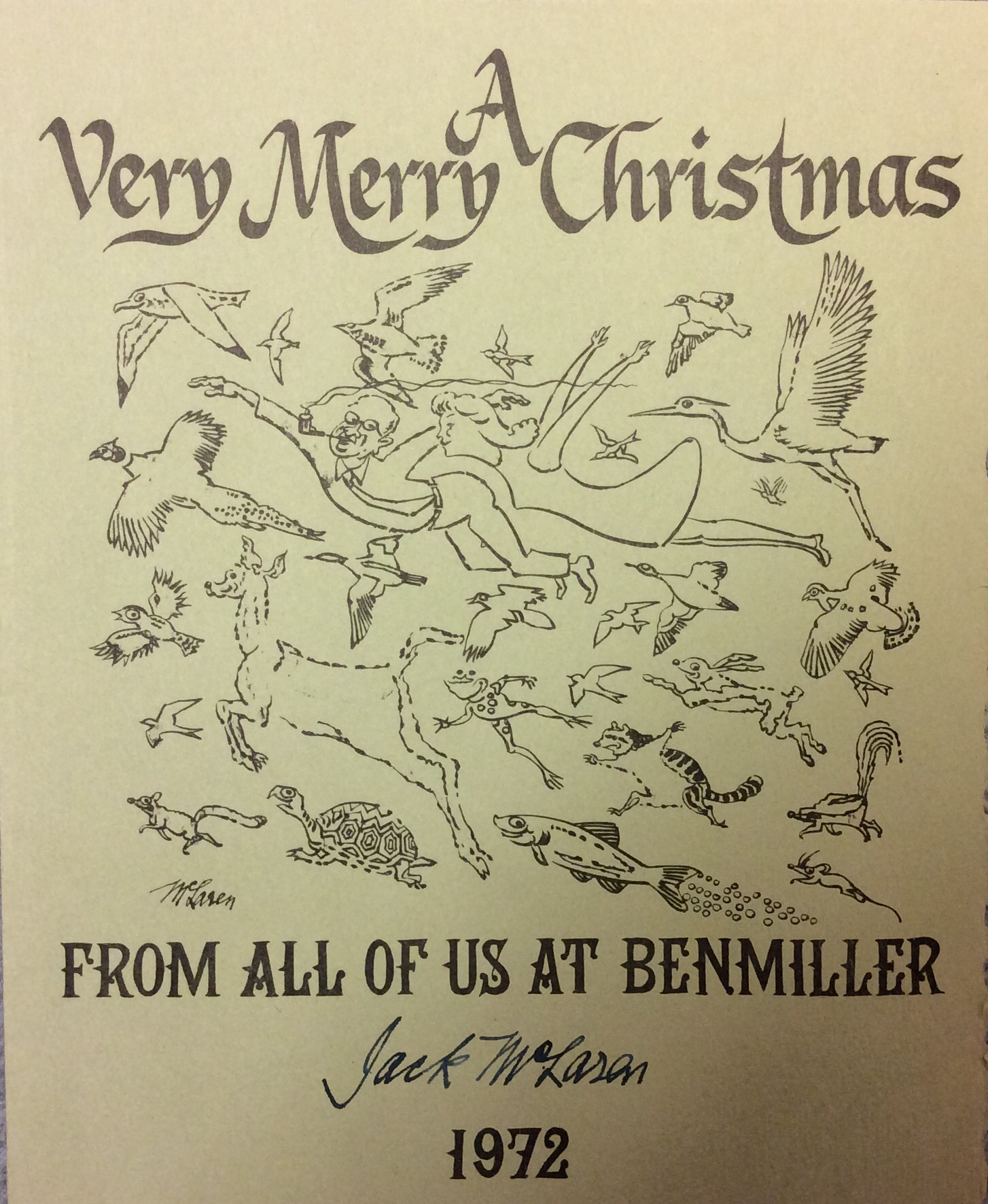
And some that seem appropriate for the 2020 holiday season…
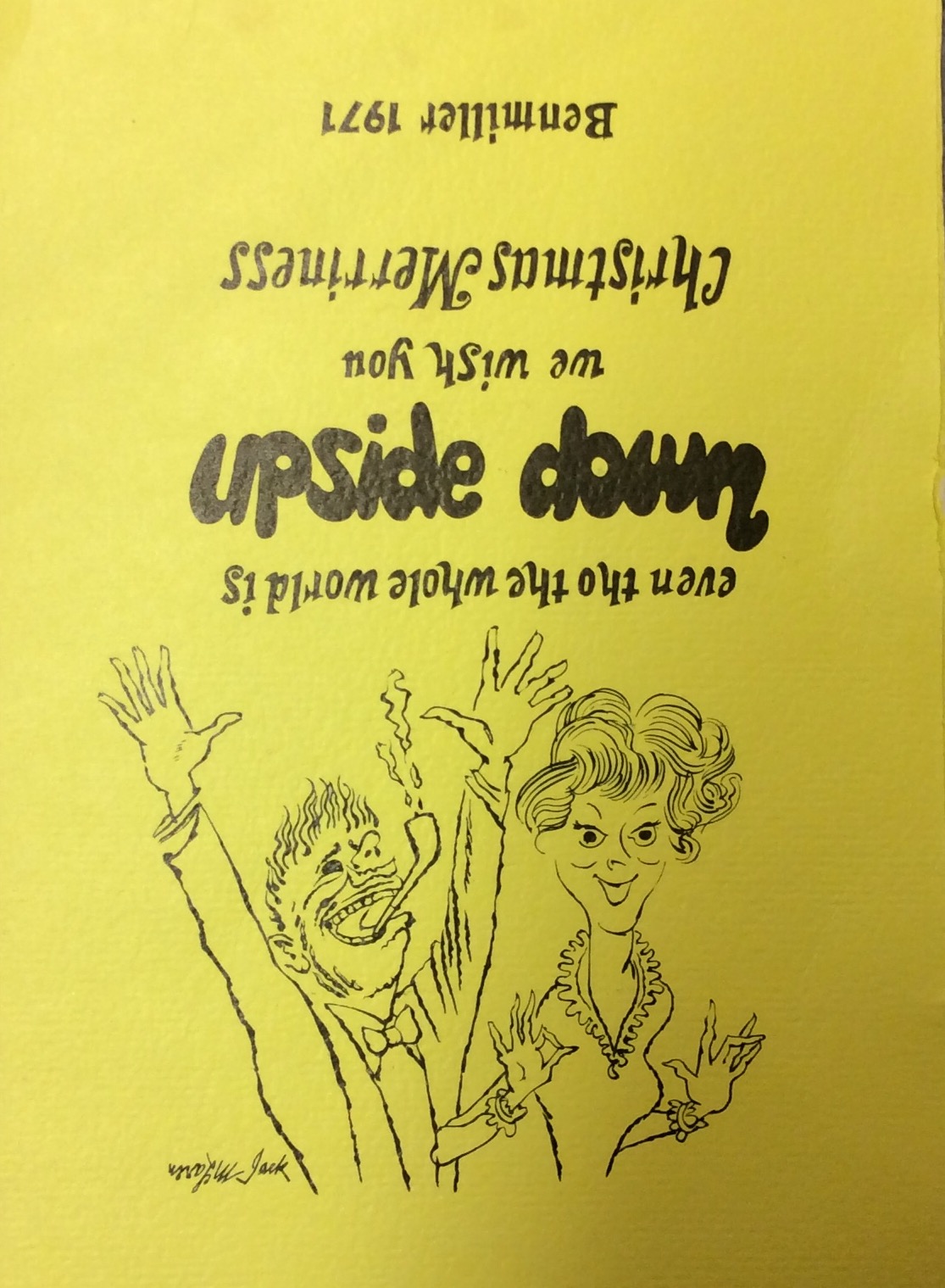
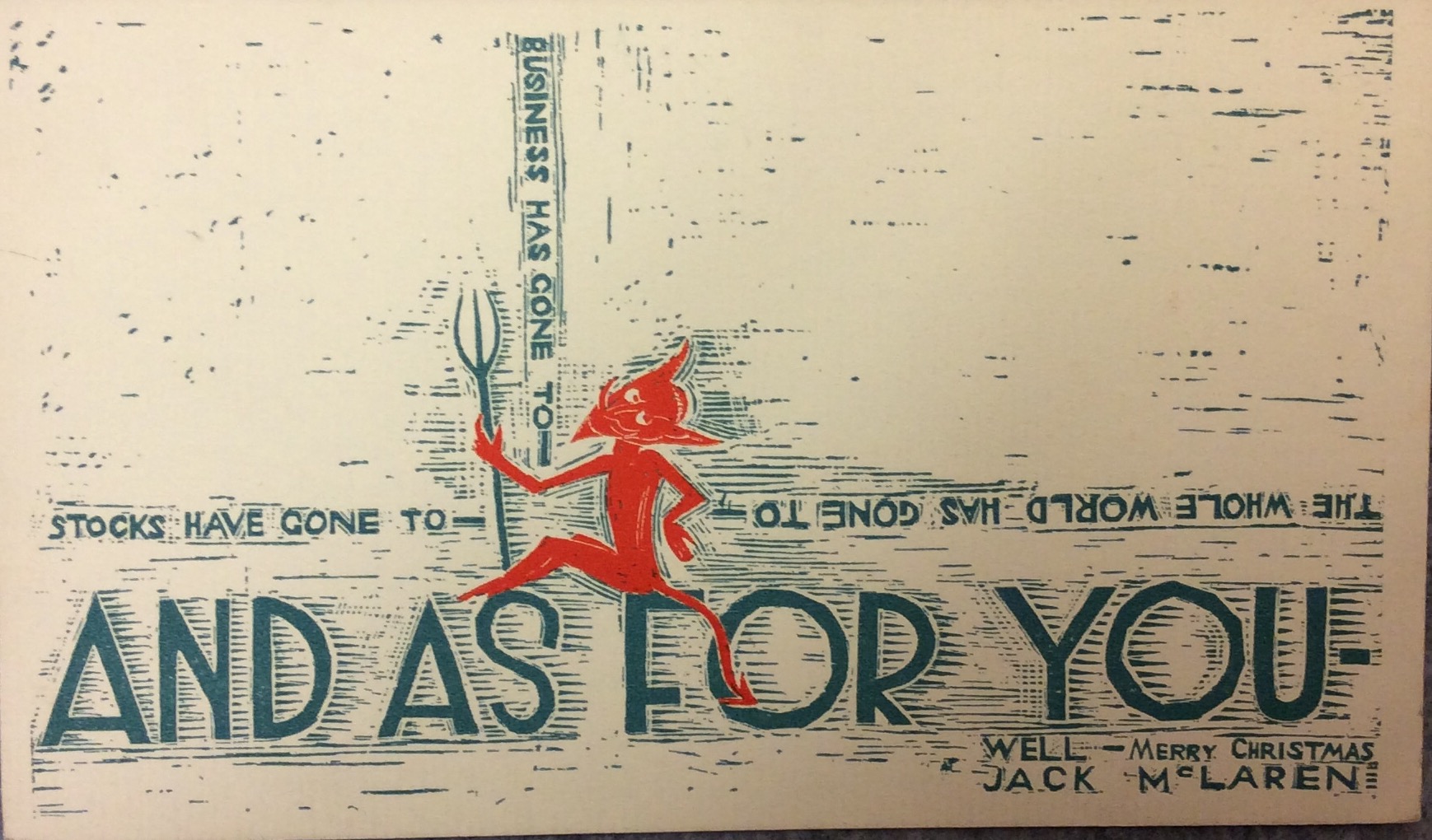
by Sinead Cox | Aug 25, 2020 | Archives, Blog, Exhibits, Image highlights, Investigating Huron County History
In anticipation of the Huron County Museum’s in-development exhibit Forgotten: People & Portraits of the County, volunteer Kevin den Dunnen takes an in-depth look at one of the many studio photographers to work in Huron County, and traces the professional and personal journey of Irene Burgess.
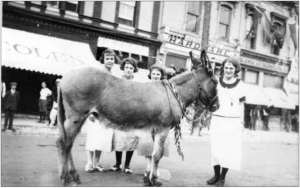
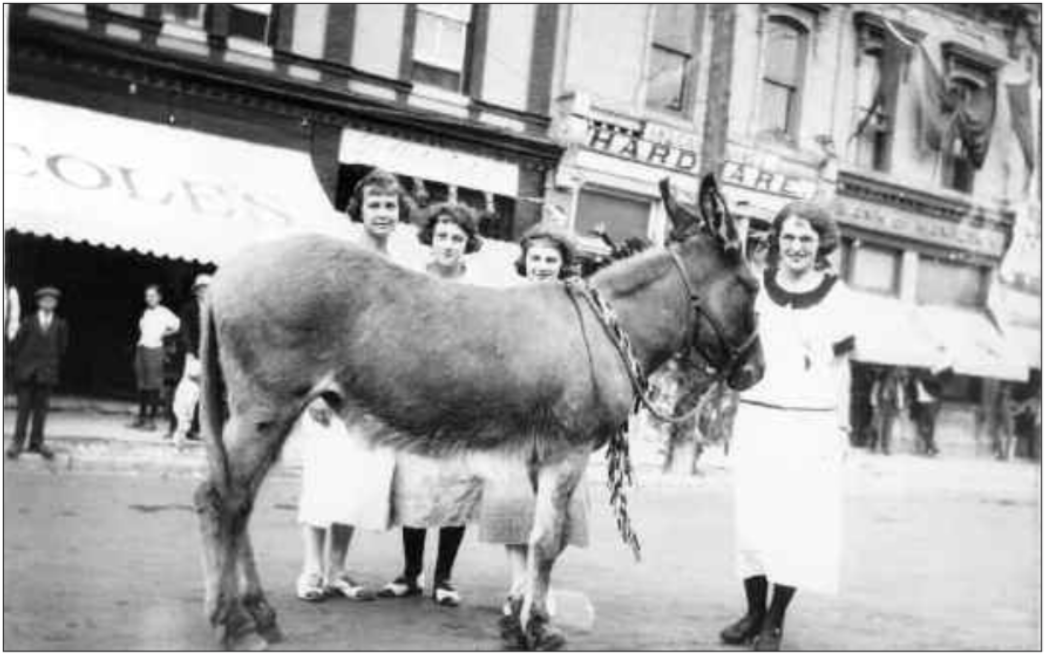
Summer of 1923 “old home week” in Mitchell, Ontario. Irene is the farthest left of the four. Image courtesy of the Stratford-Perth Archives.
Hiding within the Huron County Museum’s online and free-to-use newspaper archives are an unlimited number of stories like the one of Miss Irene Burgess. Irene Burgess was a woman that defied societal norms. In a time where women were rarely given the freedom to pursue a chosen career, Irene managed her own photography studio. While many women were expected to marry and have families, Irene stayed single. She was also faced with many tragedies in her life. Neither of her two siblings lived past 32. Her mother passed away at 51. Her niece nearly died at the age of 6. She lost the photography studio after an explosion. Through all of this, the communities of Perth and Huron Counties rose to support her.
Personal Life
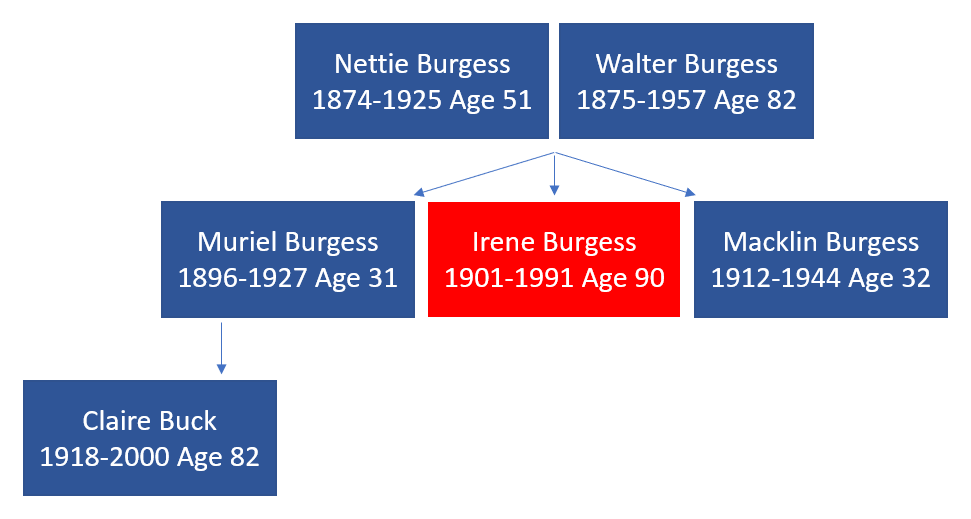
Nettie Irene Burgess was born September 20, 1901, in Mitchell, Ontario. Her parents were Nettie and Walter Burgess. She had two siblings – an older sister named Muriel, born in 1896, and a younger brother named Macklin, born in 1912. Her father, Walter, was a long-time photographer in Mitchell and owner of W.W. Burgess Studio. Growing up around photography gave Irene plenty of exposure to the business. This experience would prove to be important in her adult life.
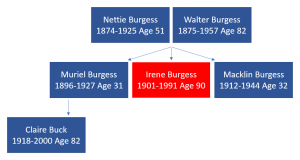
A brief family tree of the Burgess family. Of note, it only contains the names of family members included in this article.
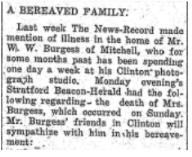
Excerpt from the November 26, 1925, edition of The Clinton News-Record detailing the passing of Irene’s mother Mrs. Nettie Burgess.
Irene experienced several tragedies throughout her life. By her 43rd birthday, only she and her father survived from their family of five. The first to pass was Irene’s mother, Nettie Helena Burgess, on November 22, 1925, at the age of 51. Irene’s sister, Mrs. D.F. Buck ( née Muriel Burgess) and her 6-year-old daughter Claire had been staying with her parents Walter and Nettie Burgess; Mrs. Buck had been ill for some time. During their stay, Claire became ill with pleuro-pneumonia. On the brink of death for several days, she began to recover with the help of her grandmother, Nettie. While caring for Claire, Nettie contracted pneumonia. Less than six days later, Nettie passed away in the presence of her family and nurse. 6-year-old Claire would live for another 75 years thanks to the care of her grandmother.
The next member of Irene’s family to pass would be her sister Muriel. Muriel was married to D.F. Buck, a photographer from Seaforth. They had three children, a daughter named Claire, and two sons named Craig and Keith. On March 24, 1926, an update in the Mitchell Advocate indicated that Irene would be visiting her sister, Mrs. D.F. Buck, at the Byron Sanitorium. According to the update, Mrs. Buck was “progressing favourably” but had been in poor health for some time. Almost fourteen months later on May 12, 1927, The Seaforth News wrote about the death of Mrs. D. F. Buck occurring the past Friday. While not mentioning the cause, the obituary described her as being “in poor health for a considerable period.”
On July 18, 1944, the Clinton News Record posted an obituary for Irene’s brother Macklin Burgess who passed away from a long-time illness at the age of 32. Macklin was in the photography and radio business. He left behind his wife, Elizabeth May, and three children, David, Nancy, and Dixie.
The next of Irene’s family to pass would be her father, Walter Burgess, in 1957 at the age of 82.
An interesting note in the life of Miss Irene Burgess is that she never married. In the Dominion Franchise Act List of Electors, 1935, Irene (age 34) is listed as a spinster (meaning a woman that is unmarried past the age considered typical for marriage). Whenever Irene is referenced in a newspaper, her title is Miss Irene Burgess. Irene would live until 1991.
The Clinton Studio
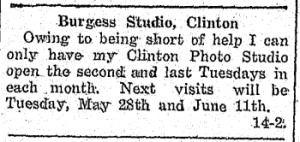
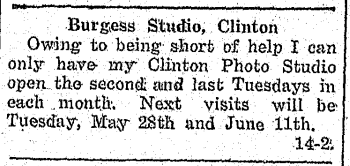
A notice posted by Walter Burgess in the May 23, 1929, edition of The Clinton News-Record
Walter Burgess operated a Clinton studio throughout the 1920s. The November 26th, 1925 edition of The Clinton News-Record mentions that Walter had only been spending one day a week at his Clinton Studio being “short of help.” A notice posted in The Clinton News-Record on May 23 1929 by Walter Burgess stated that his Clinton studio would only be open “the second and last Tuesdays in each month.” On October 1 of 1931, Walter announced that his newly-renovated Clinton studio would be open every weekday. His daughter, Miss Irene Burgess, would now be in charge of the location. Walter proclaimed Irene as “well experienced in Photography” and having “long experience with her father.” Not long after Irene became manager, Clinton residents would see the name Burgess Studios much more often in their newspapers.
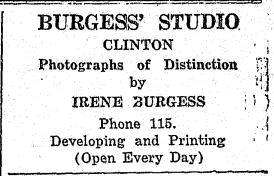
When Irene began managing the Clinton Studio in 1931, advertisements for the business began increasing. The slogan “Photographs of Distinction” appeared in advertisements from 1937 until the week of the fire. These ads were brief, only including the business name, slogan, Irene’s name, and the services provided. Earlier advertisements include one from 1933: “It is your duty to have a good photograph. Your family wants it – business often demands it.” Another example from 1932 reads, “You have plenty of leisure time to get that portrait of [the] family group taken.” The Clinton studio began under the leadership of Walter W. Burgess, but Irene would soon grow the business larger than her father had the time for– that is, until the explosion.
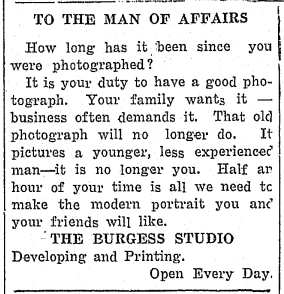
Advertisement posted in the January 26, 1933, edition of The Clinton News-Record.
The Explosion
On the afternoon of Monday, November 24, 1941, an explosion set fire to the second story of the J. E. Hovey Drug Store sweeping the entire business block. This was the place of business for Burgess Studio, Clinton. The fire swept through the building and damaged several businesses including R. H. Johnson Jewelry Store, Charles Lockwood Barber Shop, and Mrs. A MacDonald’s Millinery and Ladies Wear Shop. Irene was not in the studio when the fire started and did not call the authorities. Instead, the fire was discovered by Police Constable Elliot who identified smoke around the second-story window of the J. E. Hovey Drug Store Building. The fire was well covered in local newspapers. Featured on the second page of the Seaforth News more than a week after the incident, it was reported that the fire almost reached the “main business section of the town.” On its front page the week of the accident, The Clinton News-Record described the fire as “one of the most dangerous Clinton firemen have fought for years.” Unfortunately, Irene did not have insurance and was forced to close her business in Clinton. An update written on November 27, 1941 in The Clinton News-Record mentioned Irene’s departure for Mitchell to stay with her father for an “indefinite time.” A week later, on December 4, 1941, Irene posted a notice in the News-Record reading that, “owing to the recent fire damaging my equipment and Studio, I will be unable to continue operation.” She suggested that customers could mail their orders to the new studio. Additionally, customers could drive to her father’s studio in Mitchell and have their travel expenses paid. While this time must have been devastating for Irene, the community came together to show their support for her.
Community Support
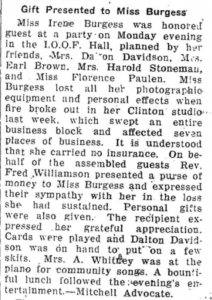
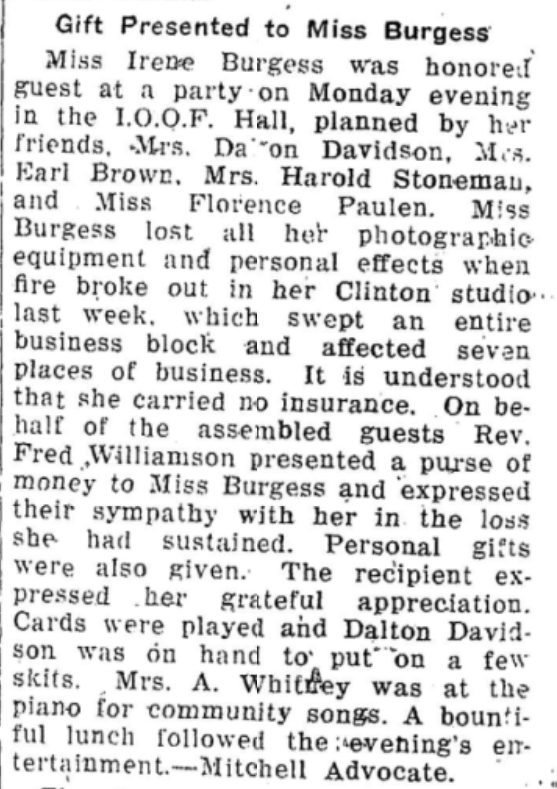
Excerpt from the December 12, 1941, edition of the Huron Expositor describing an even held in Irene Burgess’ honour.
Two weeks after the explosion, the Mitchell Advocate reported about an event held at the I.O.O.F. Hall where Irene was the “honoured guest.” The event was planned by Irene’s friends Mrs. Dalton Davidson, Mrs. Earl Brown, Mrs. Harold Stoneman, and Miss Florence Paulen. Entertainment included skits, piano music by Mrs. A. Whitney, cards, and a “bountiful lunch.” Irene received a “purse of money” and personal gifts from her friends along with their condolences. The rallying support for Irene shows the positive impact she had in the communities of Clinton, Seaforth, and Mitchell. An uplifting end to an otherwise sad story.
Conclusion
Aside from her brother’s passing in 1944, Miss Irene Burgess was seemingly never mentioned again in the Huron County Newspapers accessible through the digital newspaper portal. She would live until 1991 in St. Marys, Ontario.
Huron County’s digitized newspaper collection is a vast historical database where you can find historical stories from our own county. While performing research for the upcoming exhibit “Forgotten: People & Portraits of the County,” I came across this story which piqued my interest. Without access to the digitized newspaper collection, the story of Irene’s remarkable journey would never have been found. This post was compiled using newspaper articles between the years of 1925 and 1944. Birth and death dates were found within newspapers and using external resources.
If you have a photograph by a Huron County photographer you would like to donate or share, please contact the Museum’s archivist by calling 519-524-2686, ext. 2201 or email mmolnar@huroncounty.ca. To learn more about the Huron County Archives & Reading Room, visit: https://www.huroncountymuseum.ca/huron-county-archives/
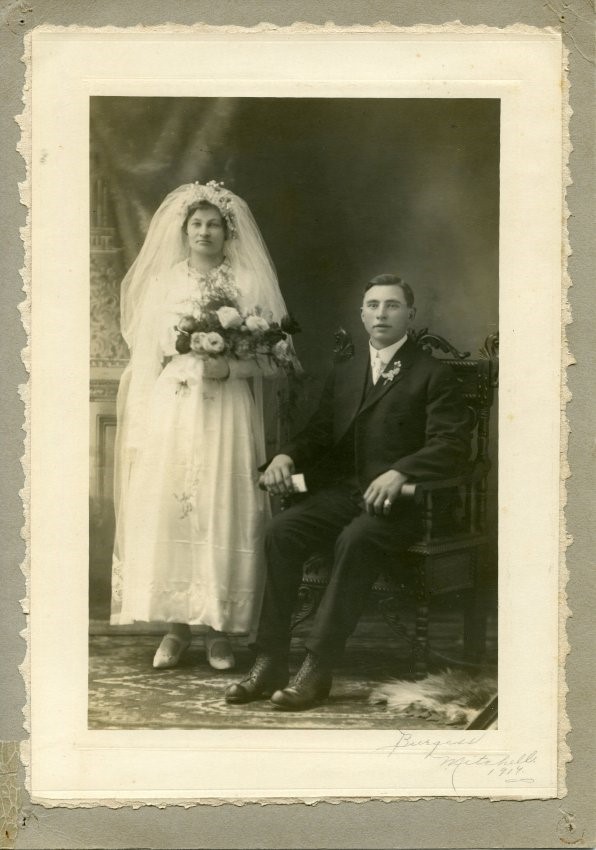
A950.1857.001 A photograph taken by Burgess Studio Mitchell in 1914. If you have a photograph from Burgess’ Studio, Clinton you would like to donate, please consider contacting the Huron County Museum.

by Sinead Cox | May 16, 2020 | Collection highlights, Exhibits, For Teachers and Students, Huron Historic Gaol, Uncategorized
Looking for a way to remotely visit the Huron County Museum or the Historic Gaol with your family or class? Here are some activities you can try using our virtual resources! Have questions about what you see and how it was used? Email museum@huroncounty.ca to talk to an expert!
HURON COUNTY MAIN STREET at the Huron County Museum
Click to visit our virtual exhibits, including Huron County Main Street! Can you find everything? Pick a favourite object that isn’t on the list, and ask others to find it!
360 TOUR at the Huron Historic Gaol
Go to the Huron Historic Gaol’s page and scroll to the bottom to find our 360 degree tour! Use the arrows and Level 1, Level 2, and Level 3 buttons to explore in all directions. Keep clicking to go inside the rooms, including a cell block. Found everything on the list? Play I spy with my little eye!


by Erin Samuell | Sep 5, 2019 | Exhibits, Textile Collection, Uncategorized
The Huron County Historic Museum presents our newest temporary gallery “Say It with Style”. This exhibit explores different fashion idioms from around the world, along with displays of clothing and accessories from dresses to collars, all from our own collection.
Some idioms, are hard to understand until they are defined. Some of them, you also will find you have never heard of. But the history from where these idioms originated is very interesting and every idiom has a story to tell. Here is the history of two idioms presented in the gallery and their definitions:
To wear your heart on your sleeve essentially means to openly display all of your emotions and feelings. This idiom has a few places where it could have originated from. The first and most likely place is from Shakespeare’s play Othello. Spoken by Iago, he is saying that to show his feelings would be like wearing his heart on his sleeve, where birds could peck at it. In other words, he is saying that to be open about your feelings is to make yourself vulnerable. Another theory about where it could have been started was in the middle ages. Claudius II, the Emperor of the Roman Empire from 268 to 270. He thought that unattached men make better soldiers, making marriage illegal. As an alternative, he would suggest temporary coupling. Every year, he would hold festivals and men would draw names of different ladies and whoever they got would be their partner for the next year. Once this was done, the man would wear her name on his sleeve for the rest of the festival. The last story originates from a time when knights would joust by order of the king and dedicate his performance to a woman of the court. So, by wearing something around his arm like a handkerchief, he let everyone know that the match was in defense of the woman’s honour. Which of these stories would you choose?
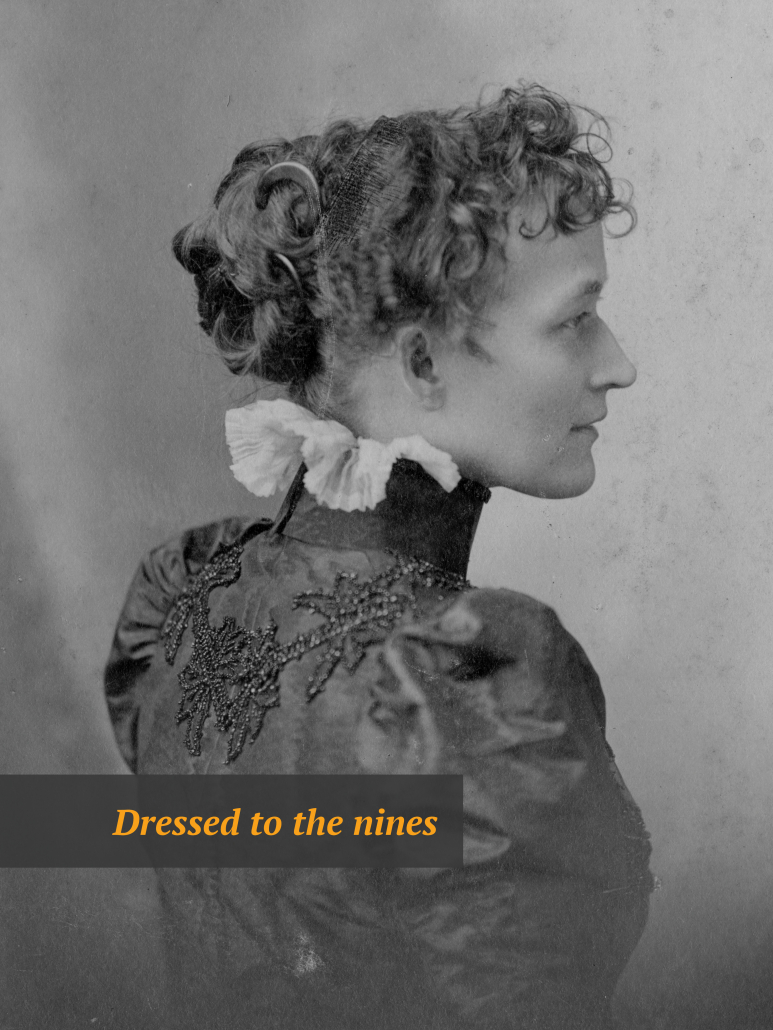
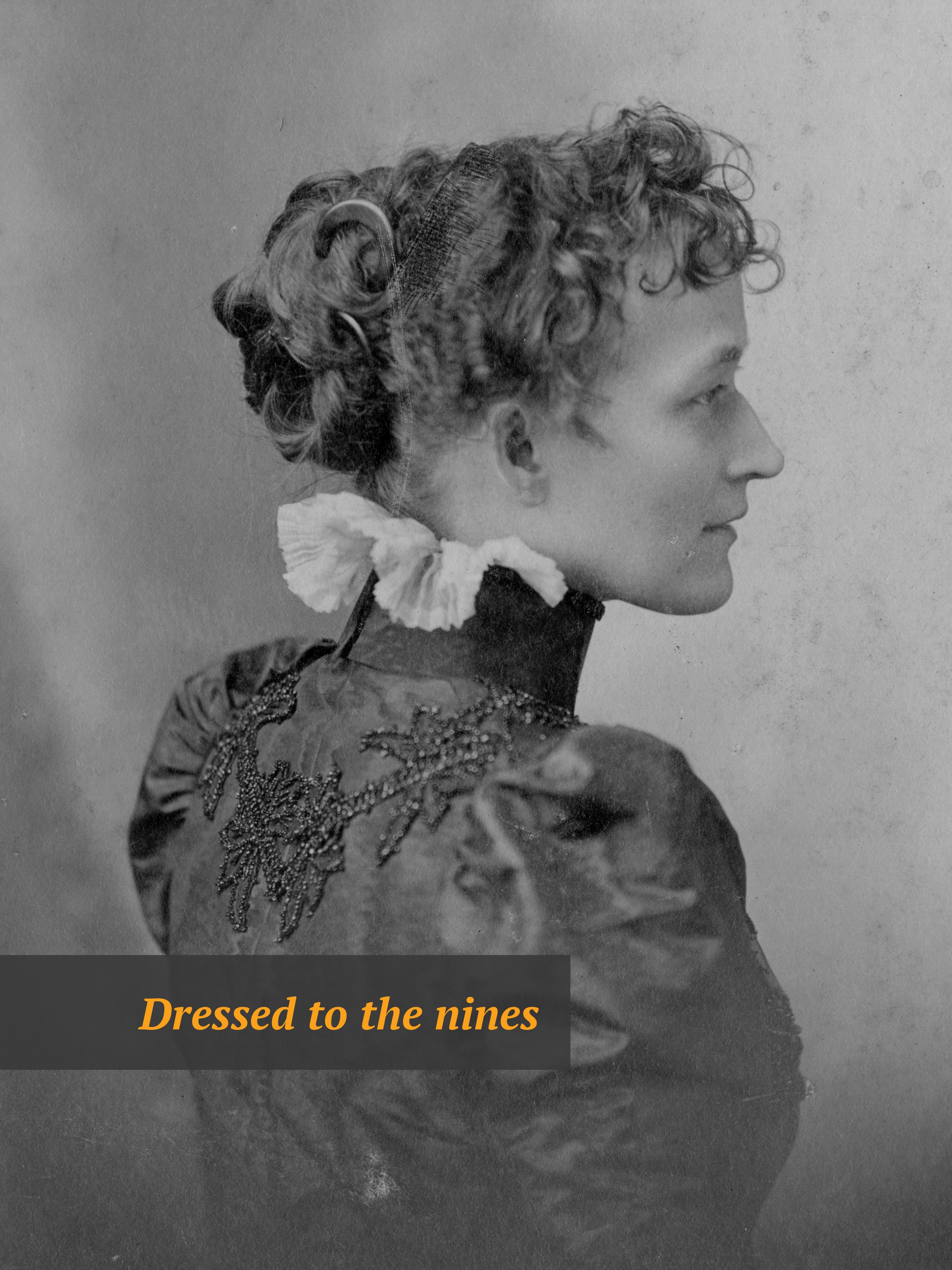
Another idiom, dressed to the nines, means to be dressed in your best, fanciest clothing. The origin of this idiom is unclear, but there are a few theories to where it could have come from. The phrase “to the nines” was found in poetry and stories before it was associated with clothing. One of the first encounters with the slang came from an English poem by William Hamilton called Epistle to Ramsay in 1719 where he wrote: “The bonny Lines therin thou sent me, How to the nines they did content me.” Another theory is that it came from the British Army’s 99th Regiment of Foot. They were well known for their intelligence and well kept uniforms, so well-known that other regiments that were based with them were would try to emulate them — to equal “the nines”. The most likely origin is the instance of the phrase being applied to using 9 yards of material to perfectly craft a suit, not to mention 9 yards of material for a suit is way too much material than actually needed. It would be an extravagance!
All of the textile pieces in our gallery feature different types and styles and are all designed to pair with each idiom presented. We have also included idioms from around the world, exploring different languages and cultures so you can also explore what other countries might say when expressing how they feel about clothing. If you would like to see for yourself, this exhibit is on display now for you to learn and explore, located in the Feature Gallery on the second floor of the Huron County Museum until November 3rd. We hope to see you there!
Written by Olivia Vanstone, Huron County Museum Co-op student from Goderich District Collegiate institute. Olivia recently graduated from grade 12 and enjoys photography, art, fashion, music and dramatic arts. During Olivia’s placement she was busy assisting with exhibit and programming activities.
by Erin Samuell | Aug 14, 2019 | Exhibits, Uncategorized
The Huron County Museum currently has on display a temporary exhibit created by Ingenium: Canada Science and Technology Museum, all about women in the STEM workforce – Iron Willed: Women in STEM. The exhibit includes interactive digital activities and bright infographics which display topics such as general information about women in STEM, gender discrimination, and material on the women from now and in the past who have pushed change for the women in these fields.
The fields of Science, Technology, Engineering and Math (STEM) have been of great interest to women now and in the past, but women haven’t always been taken seriously in these fields. Due to the issues of women’s rights in the past and gender discrimination, women were not able to go to college or university until the late 1800’s. In the beginning of the 20th century, men and women had their set roles in society. Often schools would turn down women because of these roles, and assume that after they were married and had children they would leave anyways.
Harriet Brooks
However, for Harriet Brooks, this was not the case. Born in 1876 in Exeter Ontario, Harriet was the first Canadian woman to become a Nuclear Physicist. She worked with researchers and professors like Ernest Rutherford and Marie Curie, and experimented with radioactive emissions from thorium and radon. During her time at Barnard College in New York 1906, she became engaged to a physics professor from Columbia University. The Dean of Barnard stated that “whenever your marriage does take place it ought to end your official relationship with the college” which began a debate. Brooks felt she had a duty to both her profession and her sex to continue her work even after marriage. Harriet ended up breaking off the engagement and stayed at the school until 1907. In 1907, she became engaged again, and resigned claiming that there wouldn’t have been employment in physics research for her anyways.
As the 20th century continued, more women were studying higher level mathematics, but there was still a lack of job opportunities in those fields. Despite this being the reality, that didn’t stop women from studying and teaching mathematics, such as Emmy Noether, another woman featured in this exhibit. Emmy Noether was a German Mathematician and studied abstract algebra and theoretical physics, including the development Noether’s Theorem in Physics. She was also described various well-known scientist as the most important woman in the history of mathematics. After graduating in 1907, she worked at the Mathematical Institute of Erlangen teaching advanced mathematics. Due to gender norms at this time in society and in law, women were often unable to teach in schools or universities therefore she worked at the university unpaid for 7 years. She was then offered a position at the University of Göttingen, which is known for their mathematical research. She took up the offer, but had to lecture under David Hilbert’s name (who was the one that offered her the position) for 4 years. In 1919, she obtained the position of Privatdozent (permission to teach). In 1933 she moved to the United States after dismissal by the German Nazi Government due to her Jewish faith. Unfortunately, in 1935 she underwent surgery and despite the signs of recovery, passed away at the age of 53.
The effort, work, determination and skill these women have shown are all reasons which have greatly assisted the future of women in the workforce. These women worked towards their goals regardless of what being told and fought for what they believe is right. It is an amazing highlight of our history in Canada and the women in STEM wouldn’t have been able to be where they are today if it wasn’t for them. If you would like to see this exhibit, it is now open today for you to come and explore. Located in the Temporary Gallery on the main floor of the Huron County Museum until September 1st.
Written by Olivia Vanstone, Huron County Museum Co-op student from Goderich District Collegiate institute. Olivia recently graduated from grade 12 and enjoys photography, art, fashion, music and dramatic arts. During Olivia’s placement she was busy assisting with exhibit and programming activities.