Herbie’s Automaton

Herbie’s Automaton

The Huron County Museum and Historic Gaol’s Museum Technician Assistant Dana Lumby shares how she created the museum’s donation box.

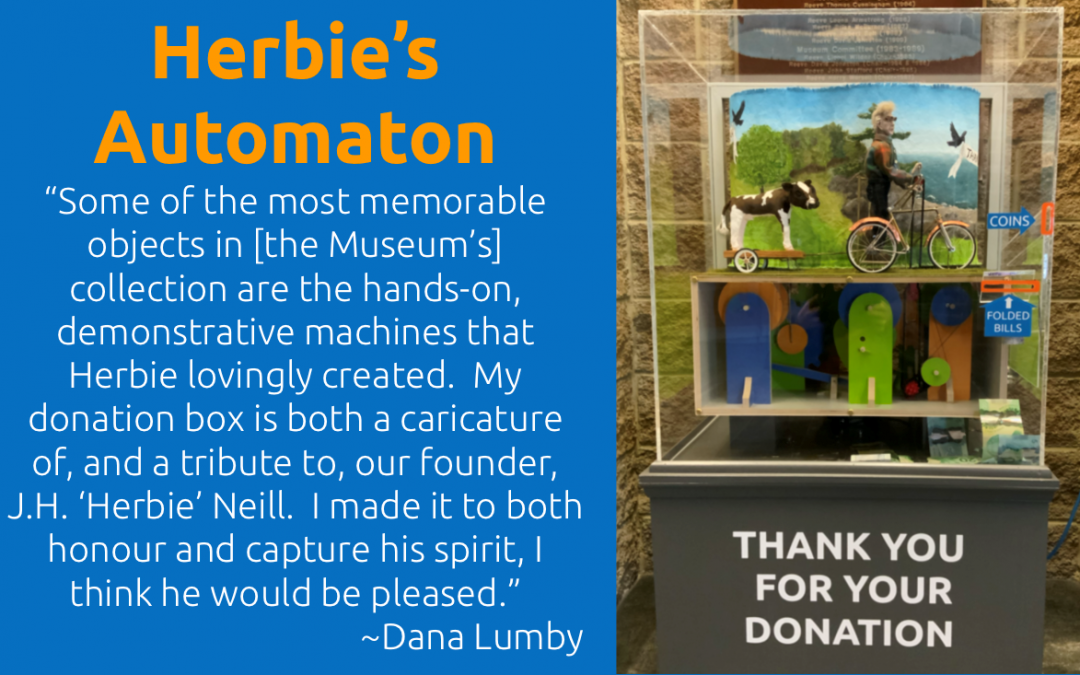
Creating the museum’s donation box has been one of my favourite projects. I was tasked to make an interactive donation box that would provide some sort of visual “reward” in exchange for a donation. I did not have to look very far to find inspiration. As many of you will already know, our founding Curator J.H. “Herbie” Neill was a maker and a tinkerer. He left us with a collection of handmade, hands-on, demonstrative machines that visitors have been encouraged to animate since the Museum opened in 1951. (Unfortunately, given the current pandemic, visitors are temporarily unable to touch Mr. Neill’s machines, as these artifacts cannot be sanitized.) The donation box features a miniature Herbie Neill pedaling his custom, hand-pedaled bicycle through the countryside while towing our unofficial mascot, the two-headed calf. Depositing a coin, or a folded bill, in the respective slot starts the mechanism and also triggers a recording of our orchestral regina.
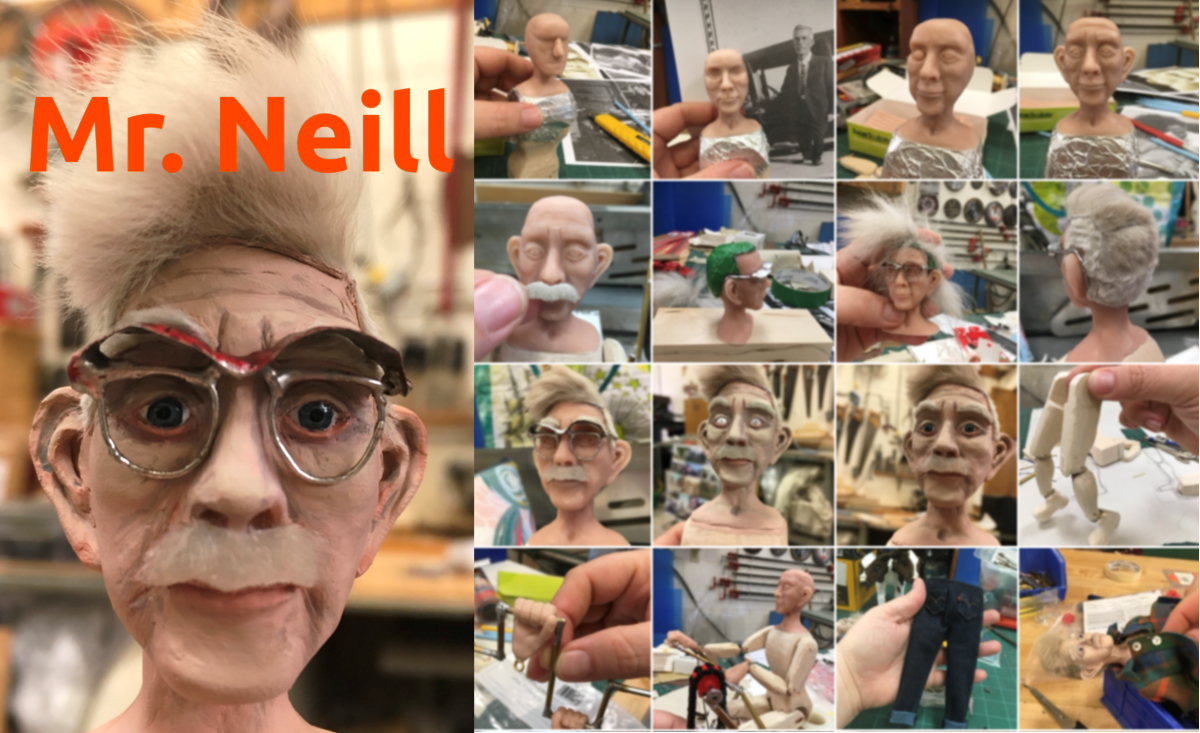
Herbie’s articulated body was carved from basswood and his face and hands were sculpted using polymer clay. I painted the clay to give him a realistic skin tone, added a gloss varnish to his eyes, and created a miniature wig out of rabbit fur, then gave him a tiny haircut. I created the special glasses, with copper and solder, to replicate the ones that Mr. Neill modified to protect his eyes. He suffered from sensitivity to light and added the metal shade to his glasses to help. You can see Mr. Neill’s actual modified glasses on display in the Neill Gallery at the Huron County Museum. I made his clothing from upcycled fabrics, including a pair of my own jeans.
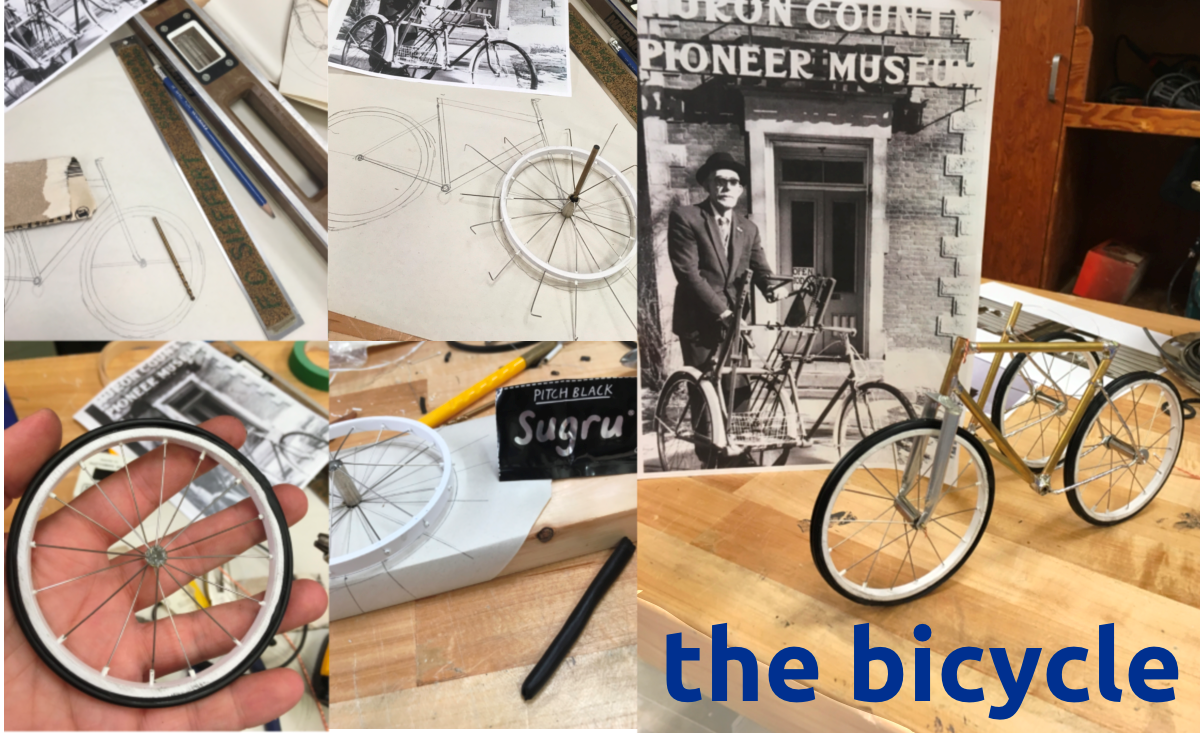
Because Mr. Neill suffered from mobility issues, he fabricated a special hand-pedaled bicycle for himself using bike parts and repurposed metal objects. I recreated his vehicle in miniature, working from a photograph. The wheels were made with a slice of 4” pvc piping, stainless steel wire, black electrical wire, epoxy and sugru – which is a moldable glue that remains flexible when cured. The body of the bicycle was made with various dimensions of miniature brass tubing.
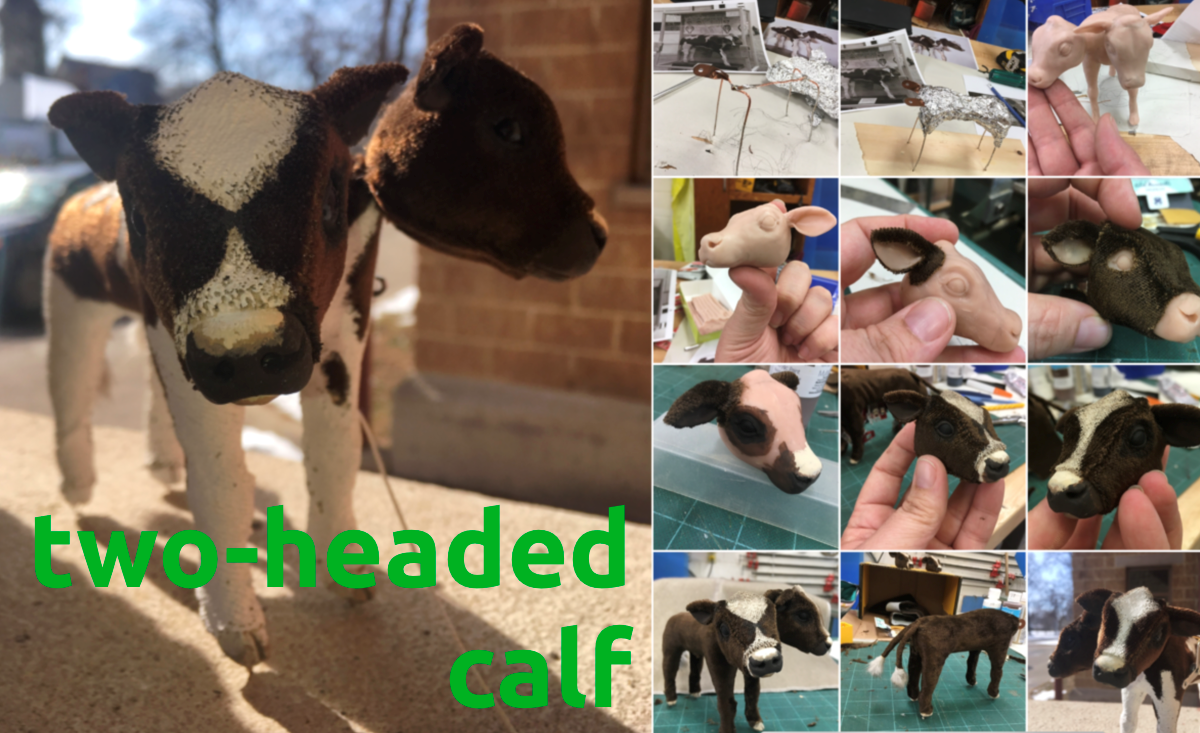
The two-headed calves were made of polymer clay on a metal armature. I covered them with a velvet fabric to mimic fur and painted the uncovered bits. I modeled the painted markings after one of our two-headed calves. When animated, one calf nods yes and the other no. I affectionately refer to them as Beau and Vinnie.
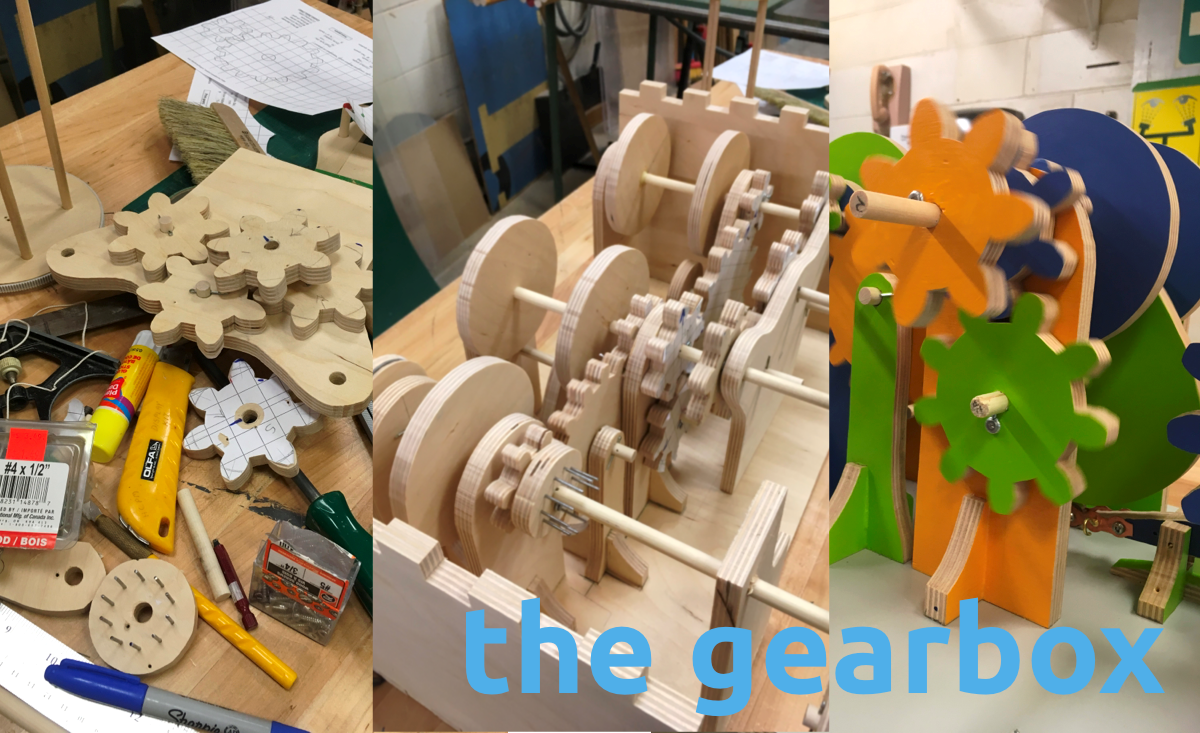
Once the models of Mr. Neill, the calves and the bicycle were finished, I set to work creating a set of wooden gears and cogs that would set them in motion. There was a lot of trial and error, taking apart and putting back together, and one very messy workbench, but I eventually figured it out. “Herbie” pedaled, the bike and trailer wheels turned, the calves disagreed with one another, and the hand-painted background scrolled by, all with the turning of a single crank.
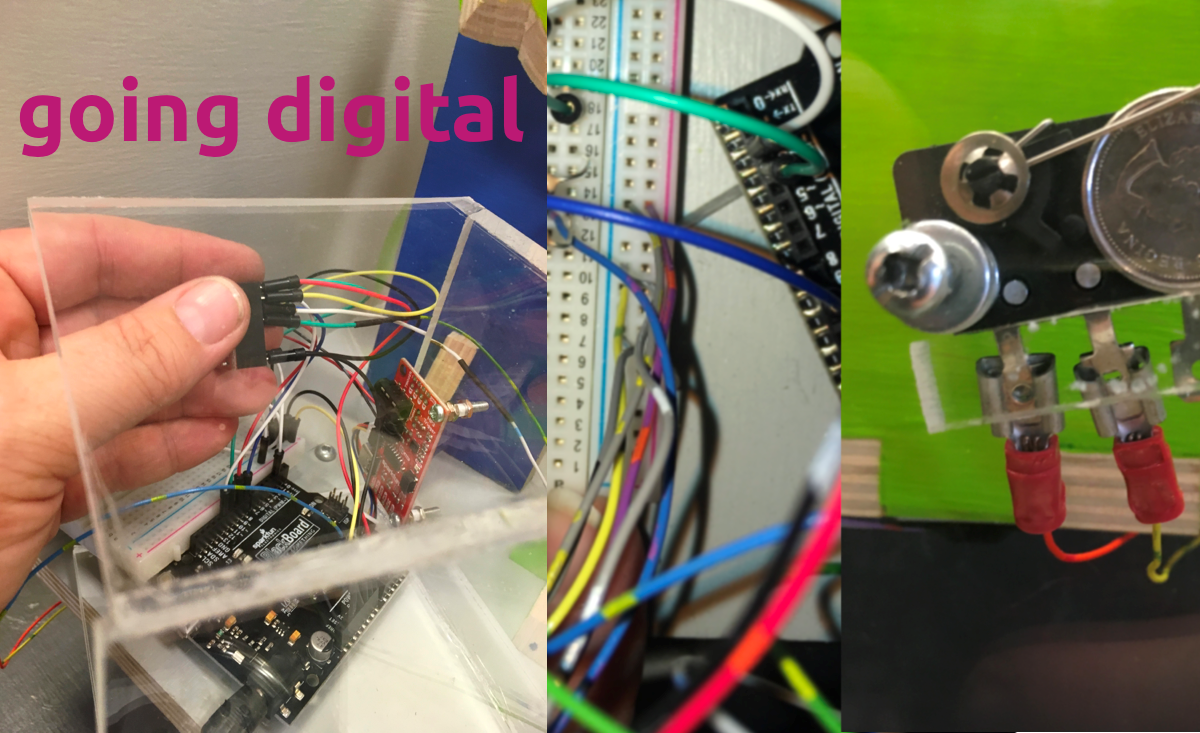
Once the mechanics of getting everything moving had been figured out, I had to find a way to pair the contraption with some circuitry so the action would be triggered each time a donation was made. I knew I wanted it to work when either a coin or a bill were inserted, so I decided to use two different switches.  I chose an infrared interrupt switch (which senses a break in its infrared beam when something passes through it) for the bills*, and a mechanical coinswitch (not unlike what you would find in a pinball machine) to sense the coins. I wrote a simple program using Arduino that plays an MP3, and powers the motor for a set amount of time when either of the switches are triggered. I had never used Arduino before, but it was relatively easy to teach myself using the resources on the Arduino website, and the forums and tutorials on the sparkfun website. Sparkfun has lots of information, great components and reasonable prices, but they are an American company so I sourced their products via these Canadian distributors: Digi-Key and Elmwood

*Fun Fact: Canadian polymer bills are not quite opaque enough to block an infrared beam, which is why you are asked to fold your bill before inserting.

Here is a video of the donation box in action, or come and see the real thing in the front lobby of the museum! Click here for information about visiting the museum.
How to Write a Local History Essay Using Museum Resources

How to Write a Local History Essay Using Museum Resources

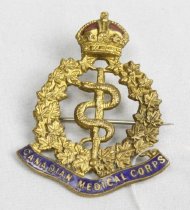
Canadian Medical Corps military badge

This military badge is from the Canadian Medical Corps worn on a Nursing Sister uniform by Maud Stirling, a First World War Nursing Sister. This artefact is one of more than 3,000 artefacts currently available on the Huron County Museum’s online collection.

by student Museum Assistant Jacob Smith

As a final year history student, I have grown accustomed to spending several hours preparing and writing essays. This is an important skill that takes years of practice. If you are developing an essay that is based on local history, the Huron County Museum & Historic Gaol has several resources that can aid you in your studies.

The first research tool is the Huron County Museum & Historic Gaol’s online collection, which can be found here. This is a database where the public can view over 5,000 artifacts and archival materials in the Museum’s collection. This tool provides background information on the artifacts, such as its provenance, dimensions, and past owners, and allows viewers to examine objects that are not currently on display. Examples of objects currently available in the collection include textiles, tools, personal items, furniture, photographs, documents, and much more.

Another excellent research tool is the Huron County Museum’s Digitized Newspapers. Here, researchers can glance at newspapers dating from the mid-1800s to the late-2010s. This database is free, easy to use, and accessible from the comfort of your own home! The digitized newspapers provide a vast wealth of information, ranging from local news and gossip, fashion, and global affairs.

The Huron County Museum & Historic Gaol also has an extensive archives collection. Here, researchers can locate coroner’s inquests, assessment rolls, court records, voter’s lists, and many more. By booking an appointment with the Archivist, researchers have access to a vast collection of resources, and a knowledgeable staff member to assist you.

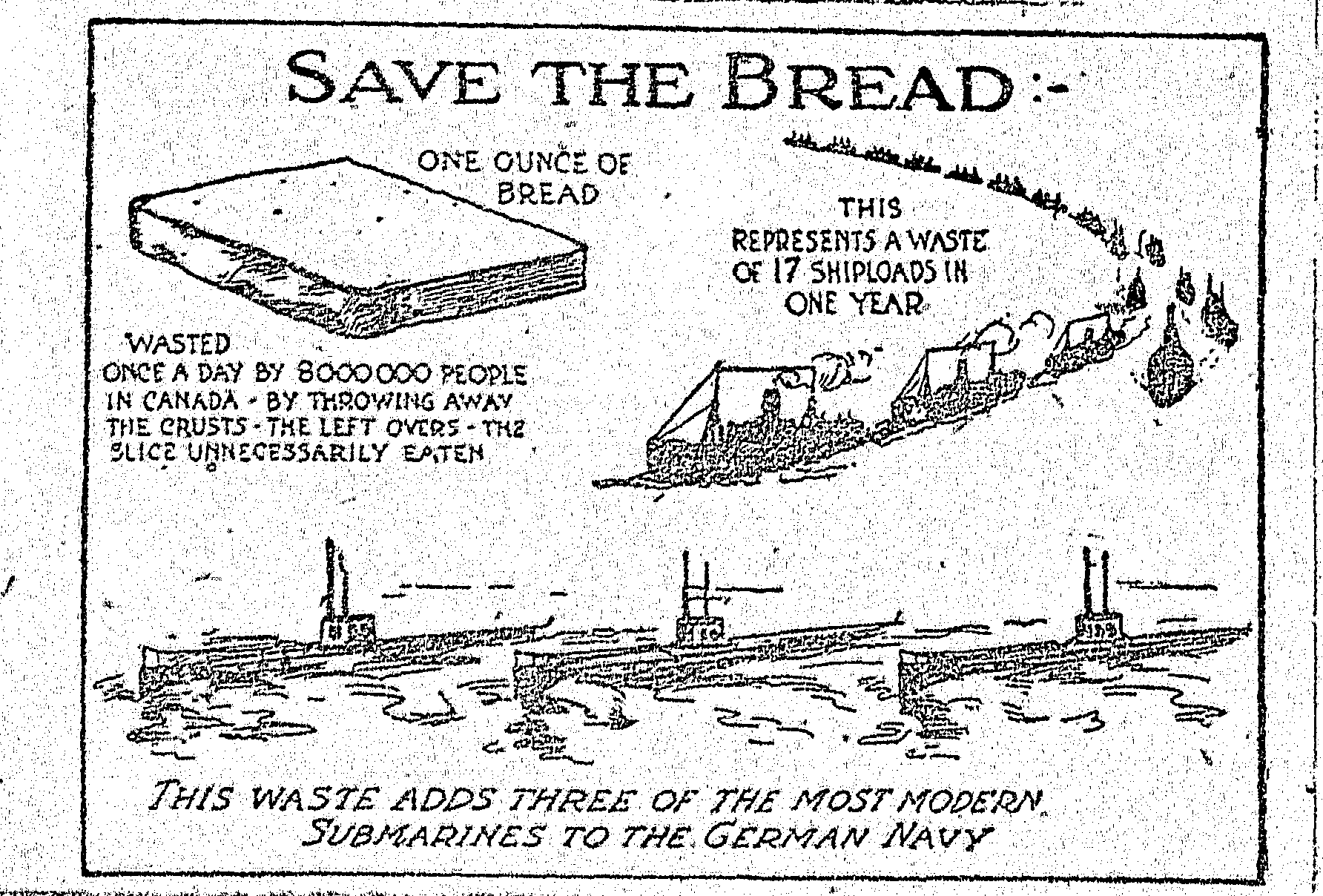
World War I propaganda poster from the Huron County Museum’s digitized newspaper database

This World War I propaganda poster was found through the Huron County Museum’s digitized newspaper database (Source: The Exeter Advocate, 1918-8-22, Page 2).

A bonus resource! Ancestry.ca is a helpful tool that allows people to research, share information, and connect with others. Sources such as military death, and census records, images, and family trees. This source requires a paid subscription, but often has free trials that allows researchers to access its extensive content. Researchers can also access Ancestry Library Edition free from home until Dec. 31, 2020 with a Huron County Library card.

While writers may feel overwhelmed at the thought of composing a research essay, there are helpful resources close to home or even accessible without leaving home. With the Huron County Museum and Historic Gaol’s resources, writers have the exposure to a wealth of extensive resources, which are readily available from your personal computer. Keep these resources in mind when you are composing your research essay.

Put Yourself Behind Bars Selfie Contest

Put Yourself Behind Bars Selfie Contest

Even though the Huron Historic Gaol remains closed this season, visitors can still go behind bars at the new selfie station found just outside the Gaol walls! And to celebrate this new feature, we are hosting a selfie contest and invite you to put yourself behind bars for your chance to win a Huron County Museum merch bundle!

The new selfie station features a recreation of the Gaol’s iconic iron doors by local blacksmith Jim Wallace and can be found at the Gaol entrance. This permanent structure is now available year round for visitors to share their visit to this National Historic Site.

To enter the contest, simply take a selfie behind the bars and post it to Facebook or Instagram by Oct. 12 using #HuronHistoricGaol. A random draw will take place on the morning of Tuesday, Oct. 13. The winner will take home a bundle featuring some of the Museum’s favourite merch, including a Gaol t-shirt, Museum tote bag, the famous two-headed calf stuffie, four visitor passes for admission to the Museum and Gaol (when it reopens), and more!

Thank you to Regional Tourism Organization 4 (RTO4) Shareable Moments Challenge for providing funding for this project.

Please note that the selfie station is not monitored and does not have sanitizer available. Please use at your own risk.

Virtual Tour Scavenger Hunts at the Museum & Gaol

Virtual Tour Scavenger Hunts at the Museum & Gaol

Looking for a way to remotely visit the Huron County Museum or the Historic Gaol with your family or class? Here are some activities you can try using our virtual resources! Have questions about what you see and how it was used? Email museum@huroncounty.ca to talk to an expert!

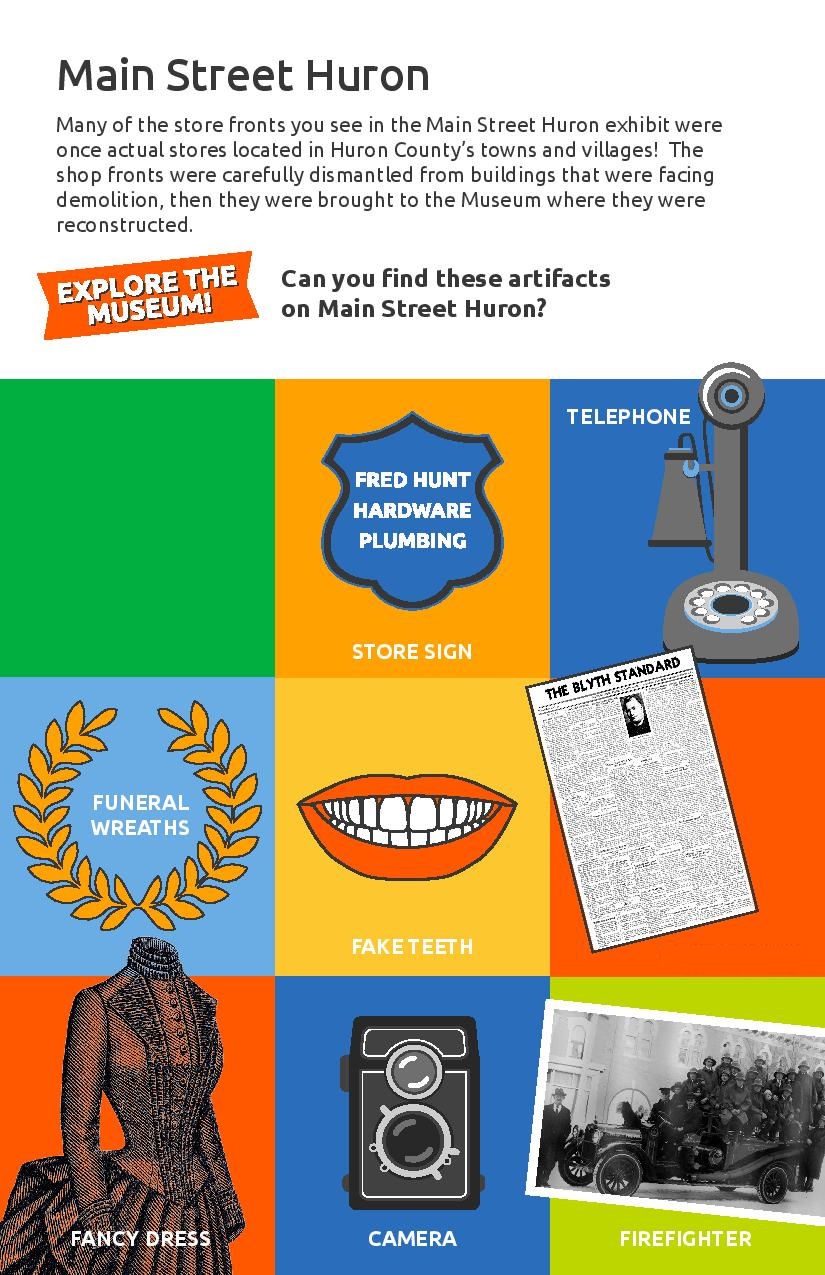
HURON COUNTY MAIN STREET at the Huron County Museum

Click to visit our virtual exhibits, including Huron County Main Street! Can you find everything? Pick a favourite object that isn’t on the list, and ask others to find it!


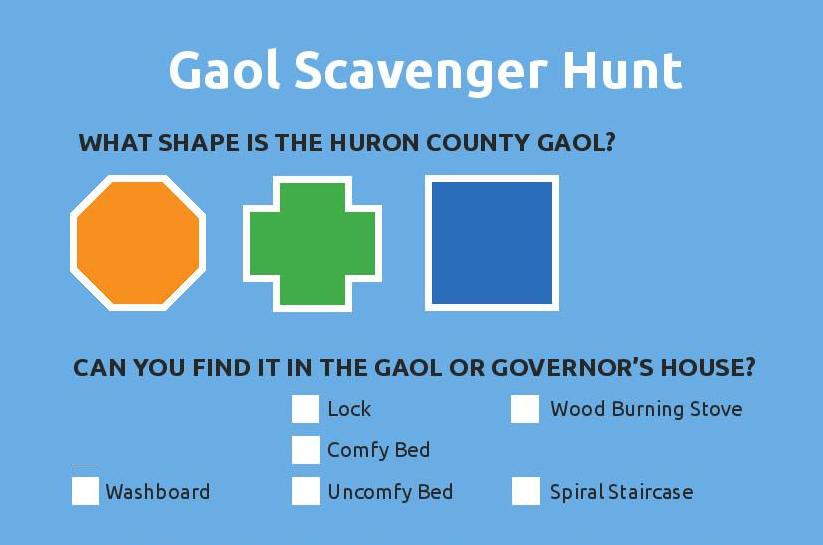
360 TOUR at the Huron Historic Gaol

Go to the Huron Historic Gaol’s page and scroll to the bottom to find our 360 degree tour! Use the arrows and Level 1, Level 2, and Level 3 buttons to explore in all directions. Keep clicking to go inside the rooms, including a cell block. Found everything on the list? Play I spy with my little eye!

Virtual Exhibits

Virtual Exhibits

Huron County Museum: Virtual Permanent Galleries

The Huron County Museum’s virtual exhibits grant a close-up glimpse of select artifacts on permanent display in our galleries, as well as information that you can’t guess with just a look. The featured objects represent a small sampling of the thousands of artifacts in the museum’s collection. Updating the online exhibits is an ongoing project; in the future, student employees will be refreshing the images and providing even more information. These exhibits are also available via ipads onsite when the museum is open.


Huron County Main Street

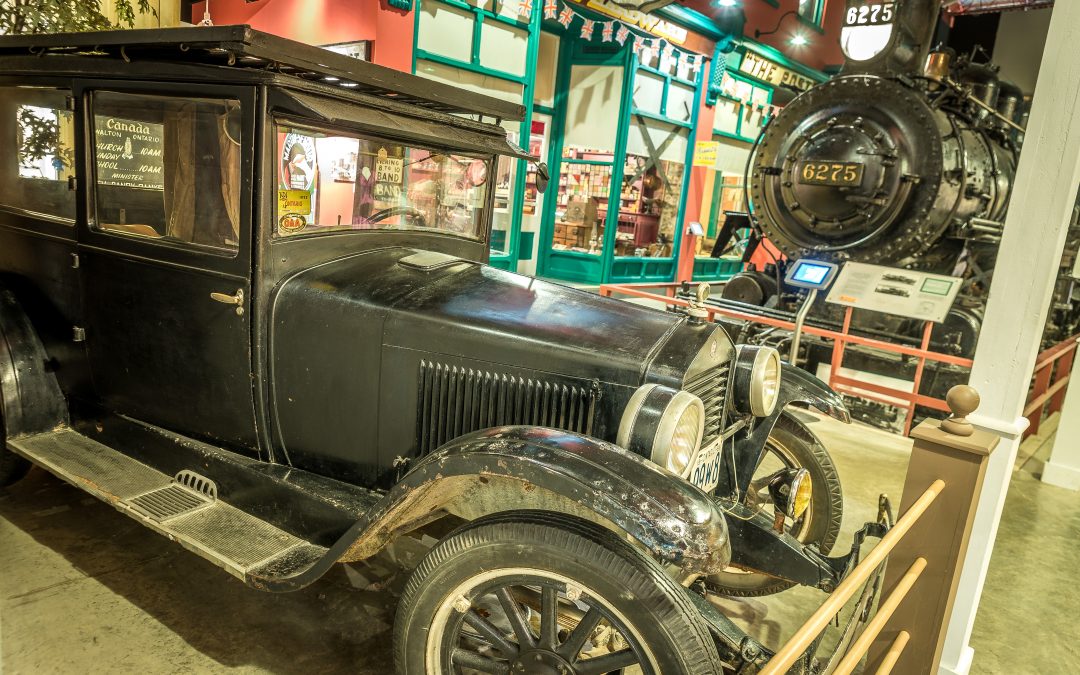
Our Main Street features real storefronts and objects from across the county of Huron.

Click the storefront names to step inside and see artifact highlights!

Military Gallery

Click the titles below to see archival documents and more related to Huron County and the First World War.

Huron County Museum Feature Gallery: Virtual Exhibits

The Huron County Museum rotates exhibits of special interest through the year in our Feature Galleries. Click to explore past temporary exhibits that you may have missed or want to rediscover.


The Gaol Matron

The Gaol Matron

The Gaol Matron

The Gaol Matron was a paid position held by the Gaoler’s wife, eldest daughter or other close female family member. The Matron’s role was to assist the Gaoler in the daily operations of the Gaol in regards to the needs of the female prisoners, children and babies.

From 1840s-1958 the Gaoler, Matron and their family resided at the Gaol alongside the inmates, initially in a small apartment located on the second floor of the Gaol and eventually in the Governor’s House that was constructed in 1901 as an addition to the Gaol.

Stated in the Official Rules and Regulations for the Officers and Employees of the Common and District Gaol 1922, the Matron had a list of practices and procedures that she would need to follow to be successful in her role. Both the Gaoler and the Matron were be appointed by the county sheriff under the advice of the Warden. However, no Matron was to be appointed if she were over 45 years of age and no Matron was to continue the role past the age of 70.

Excerpt from Rules and Regulations for the Officers and Employees of the Common and District Gaol 1922,

“Rule 46 – The Matron shall, under the direction of the Gaoler, have the care and superintendence of the women’s department of the Gaol, and the female prisoners. She shall be provided with two plain black serge or alpaca dresses each year, to be worn on duty and to be provided on the same in the same manner as uniforms for other male person enters the wards for women, or other place where female prisoners are at work, without being accompanied by her or another Matron; and she shall have the sole custody and care of the keys used in the women’s departments, and be responsible for their safe keeping.

Rule 47 – She shall not be absent from the Gaol at any time when female prisoners are in custody without the consent of the Gaoler, unless another Matron is approved by him to take her place”

All female inmates at the Huron Gaol were cared for by the Gaol Matron. If the inmate was brought to the Gaol with young children or infants, the Matron would tend to their needs as well. Between 1841-1911 9% of the Gaol’s population were women and 7% were children. It is unknown exactly how many additional children were committed with their parents, because infants born in jail were not recorded on the jail registry.

As part of her official role the Matron would complete a search upon the inmates admission, accompany inmates to appointments with the Gaol’s Surgeon, attend to them in the exercise yard and be present during all meals served. The regulations stated that the Matron would devote her whole livelihood to the performance of her duties and therefore could hold no other responsibilities or occupations.

Some of the Gaol’s Notable Matrons Included:

Margaret Dickson

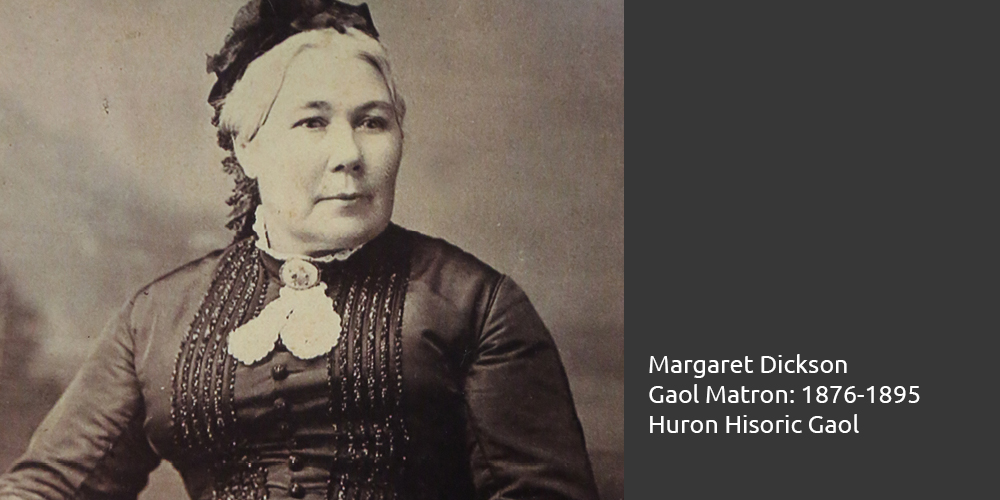
Matron Margaret Dickson was the wife of Gaoler William Dickson who served as Gaoler from 1876-1895. Margaret and William had 5 children and lived in the small one room apartment located on the second floor of the Gaol. Gaoler Dickson and his wife Margaret were known to advocate on behalf of the Gaol’s inmates wellbeing. An excerpt from the 1894 Gaoler’s Report to Council reads:

“At present there are 22 prisoners in custody… Of the male vagrants 8 of them may be said to be totally unable to earn a living, their ages range from 62 to 90 years; one is blind and one paralytic; one bent almost double and the others as feeble, and may be said to be tottering on the edge of the grave. Three of these aged ones are in for short terms, namely; one for 2 months and two for 30 days each. What are they to do then? Go out on the public street and wait there till some good samaritan comes and takes them home? No; the season of the year will not permit their being turned out. I will lay the matter before the sheriff and be guided by him.

From this report, gentlemen, you will learn that at present your county jail is doing triple the work as an asylum, house of refuge and a hospital, and in working your jail as such the expense for the year will be largely increased.”

Mrs. Dickson successfully advocated for an increase in the Gaol Matron’s salary, increasing her wage from $12.50 per month to $16.66 per month. Her husband William earned $50 per month

Mary and Eleanor Griffin

Matron Mary Griffin (age 16) was the eldest daughter of Joseph C. Griffin who served as Gaoler from 1897-1923. Mary maintained the role of Gaol Matron until her father married his second wife, Eleanor in 1902. Gaoler Griffin advocated for the construction the Goveror’s House that was built in 1901 and the Griffin family became the homes first occupants.

Mary Jane Reynolds

Acting Matron Mary Jane Reynolds was the mother of James B. Reynolds who served as Gaoler from 1923-1950. Jane temporarily took over the position of Gaol Matron after the sudden death of Gaoler Reynold’s first wife Harriett in 1926 until he married his second wife Edna in 1927.