by Amy Zoethout | Sep 8, 2022 | Blog, Investigating Huron County History
Written by Huron County Museum Assistant Harrison Lobb, Young Canada Works
“Mental retardation” was originally introduced as a medical term in 1961 for people with intellectual disabilities. Today, use of the term as a negative slur regarding the intellectually disabled has led to its discontinuation. Due to its historical use, it is employed in context within this post. Please note it is not intended to cause distress or harm.
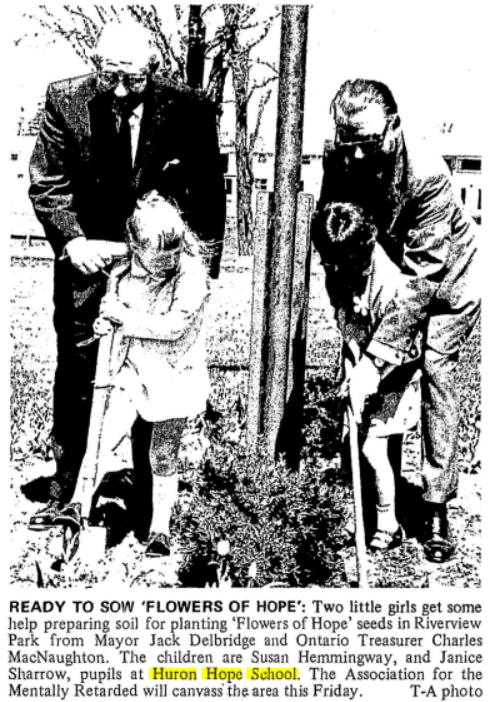
In Ontario in 1969, the schooling for children who were identified as intellectually disabled formally came under the care of the Board of Education. Prior to 1969, special needs education in the school system was denied to these children. Instead, various regional chapters of the Association For the Mentally Retarded were tasked with the difficulties of setting up their own schools in halls and church basements. These schools were entirely unsupported by the government and purely reliant on the goodwill and funding of everyday citizens. This unsustainable model finally came to an end in Huron County in September 1969 when two classrooms in Huron Park’s J.A.D. McCurdy School were chosen to house the Huron Hope School, a school for mentally challenged youth.
The Huron Hope School in Huron Park was one of the first four schools in Ontario to integrate intellectually disabled students with the general student body under one roof. While the challenged youth would remain segregated for their classroom studies, all children were integrated together on the playground, in the gymnasium, and in other school functions. This level of inclusivity was unheard of in Ontario until this point and Huron County shined as uniquely progressive for the time. New programming for special needs students also came with a refocused priority emphasizing the development of social skills, rather than academic knowledge. This meant much of a student’s time was spent outside the classroom participating in social activities like bowling, picnics, and swimming.
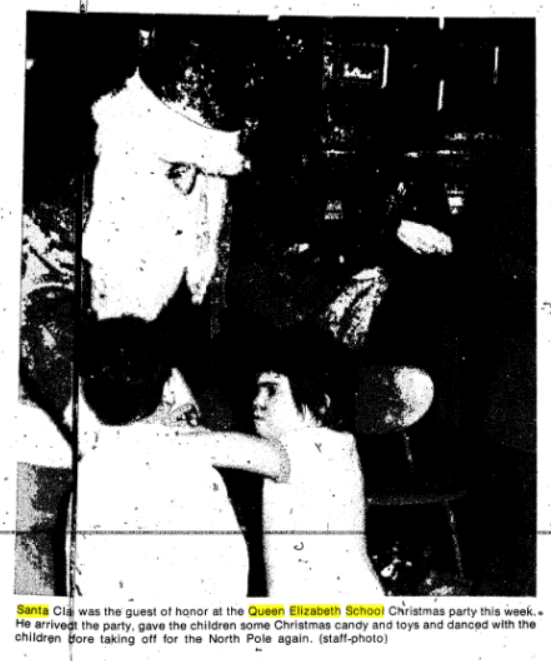
Thanks to the spearheading efforts of those such as the South Huron Association for the Mentally Retarded and selfless administrators like Bonnie Graham, who ran the Queen Elizabeth School for the Trainable Retarded in Goderich, what was once considered a unique situation in integrating and socializing children of different needs is today perceived as normal. We should not forget the actions of those who enabled this social progress that we often take for granted.
Sources Consulted
- Atkey, Richmond. “Will Locate School for Retarded.” The Huron Expositor, Nov. 13, 1969, pp. 10–10.
- “Enrolment Rises At Huron Hope.” The Exeter Times, Sept. 10, 1970, pp. 3–3.
- Graham, Bonnie. “Principal of Huron Hope School Weighs In.” Times-Advance, Exeter Lakeshore, Dec. 30, 2015, www.lakeshoreadvance.com/2015/12/30/principal-of-huron-hope-school-weighs-in
by Amy Zoethout | Aug 31, 2022 | Archives, Blog, Collection highlights
Brooklyn Wright, Huron County Museum assistant, is working on the Henderson Photographic Collection this summer and highlighting some of the stories and images from the collection. Gordon Henderson was a Goderich-based photographer who produced black-and white photos using a variety of mediums, such as negatives, glass-plate negatives, and cellulose nitrate film. The collection housed at the Huron County Museum and contains more than 10,000 negatives and photographs taken by Mr. Henderson from the 1930s – 1970s. Included in the collection are class pictures, summer camp pictures, wedding pictures, advertising campaigns, pictures of local events, buildings, businesses, and much more.
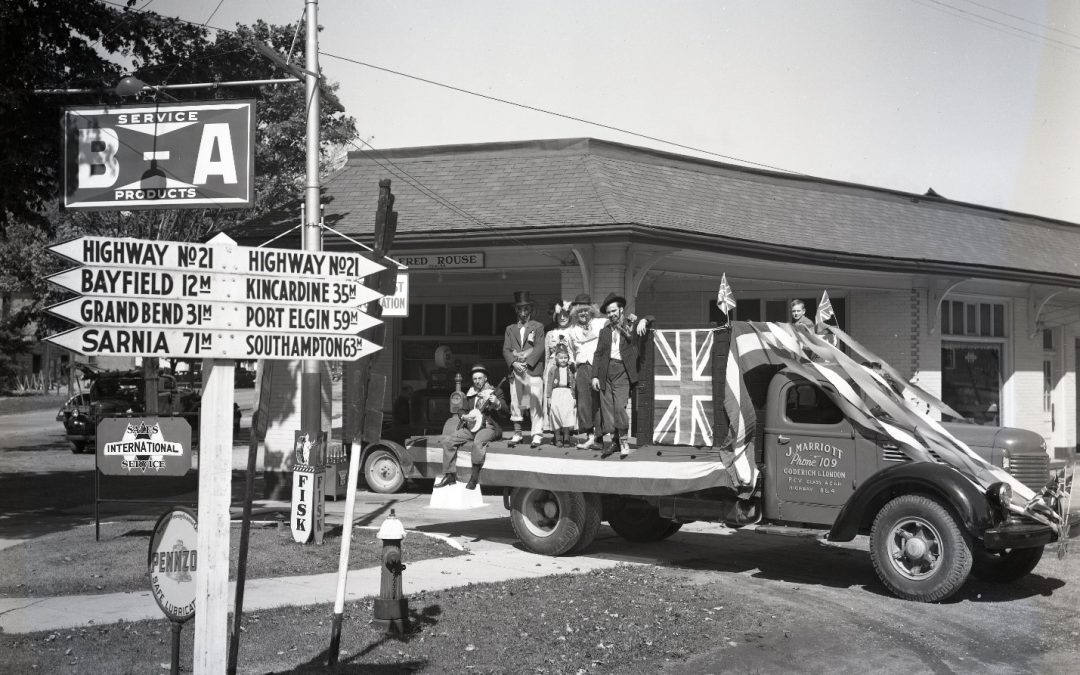
The second annual Goderich Labour Day Celebrations took place in and around the Goderich Square on Monday, Sept. 2, 1946. The celebrations were captured in part by the above image from the Henderson Collection, but the full extent of the festivities lasted all day, and a wide variety of events took place.
That morning, a parade was held, starting at Victoria Park and ending at the Square. The procession included many different community members, including labour unions, local businesses, bands, and the fire department. Goderich Bluewater Band, dressed as clowns, was one of the participating groups in the parade. Afterwards various contests took place; boys and girls races were held, as well as hurdle jumping, tug-of-war, a softball tournament and a beauty contest. There was also a speech by Col. Lambert, padre of the Christie Street Hospital in Toronto. He spoke to the crowd of his pride and gratefulness towards the soldiers of World War One and World War Two, but also to the working men and women who produced the firearms, minesweepers, parachutes, and other supplies needed for the war effort. The day was deemed a great success in the Goderich Signal-Star, with congratulations in order for the organizers, the local Trades and Labour Council.
What are your plans for this upcoming Labour Day?
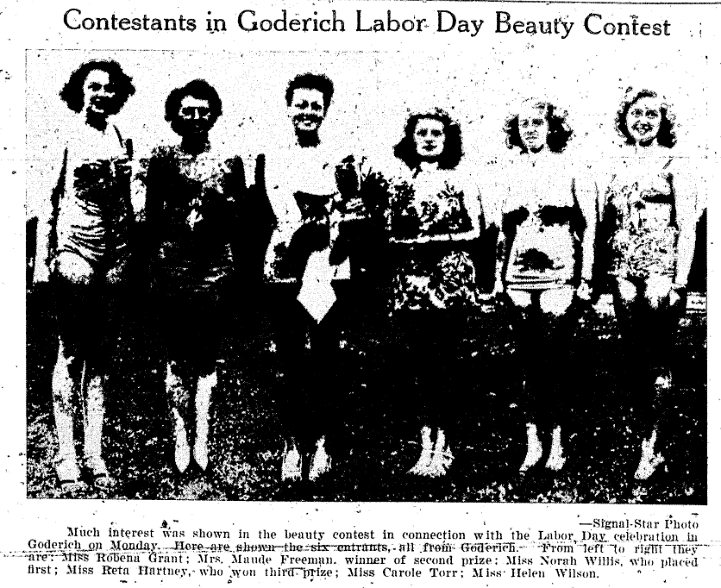
The Goderich Signal-Star, 1946-09-05
by Amy Zoethout | Aug 31, 2022 | Blog, Collection highlights
By Robyn Weishar, Programs and Marketing Assistant
Back-to-school season is upon us! It can be an exciting time for many, and less exciting for those who favour warm weather and the freedom of summer. The very best part of going back to school for many is buying new supplies and new clothes! September is full of opportunities to start off on a new foot – or better yet, a new sole. Taking a glimpse back to the past, courtesy of the Museum’s extensive collection, we can observe some of the fashions students from Huron County were rocking back in their day.
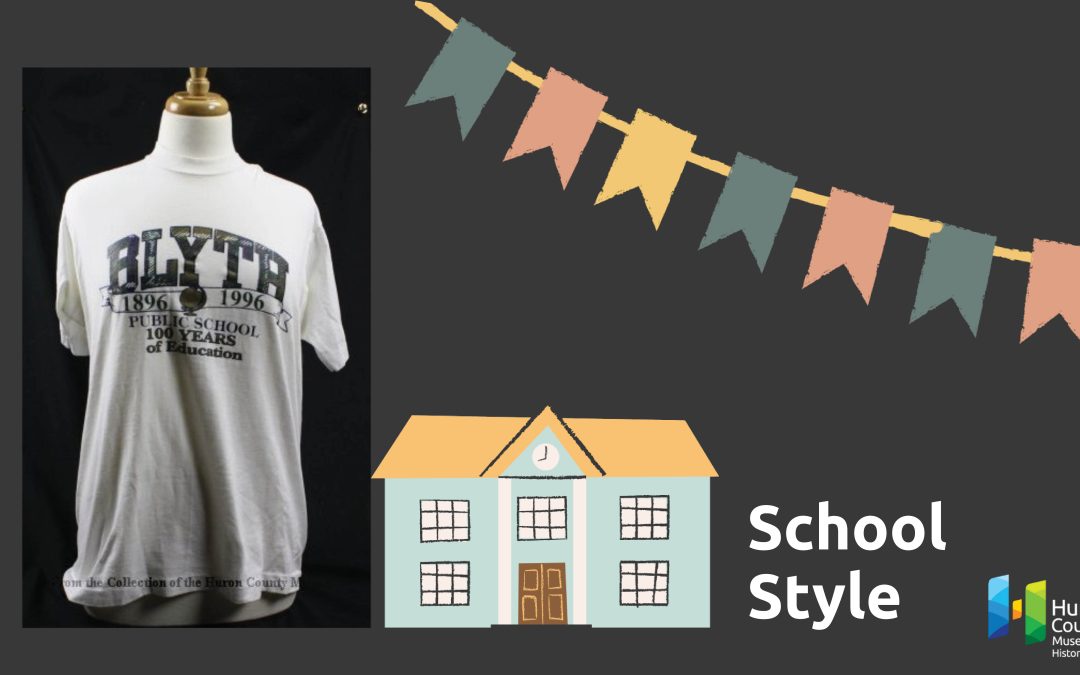
The above t-shirt is a commemorative clothing item to honour Blyth Public School’s “100 Years of Education.” This white cotton and polyester Fruit of the Loom t-shirt displays “Blyth” across the chest in blue, green, and white plaid. Below the emblem is a meridian with a globe in the centre, separating the years the school had been in operation: 1896-1996. (Object ID: 2018.0050.003)
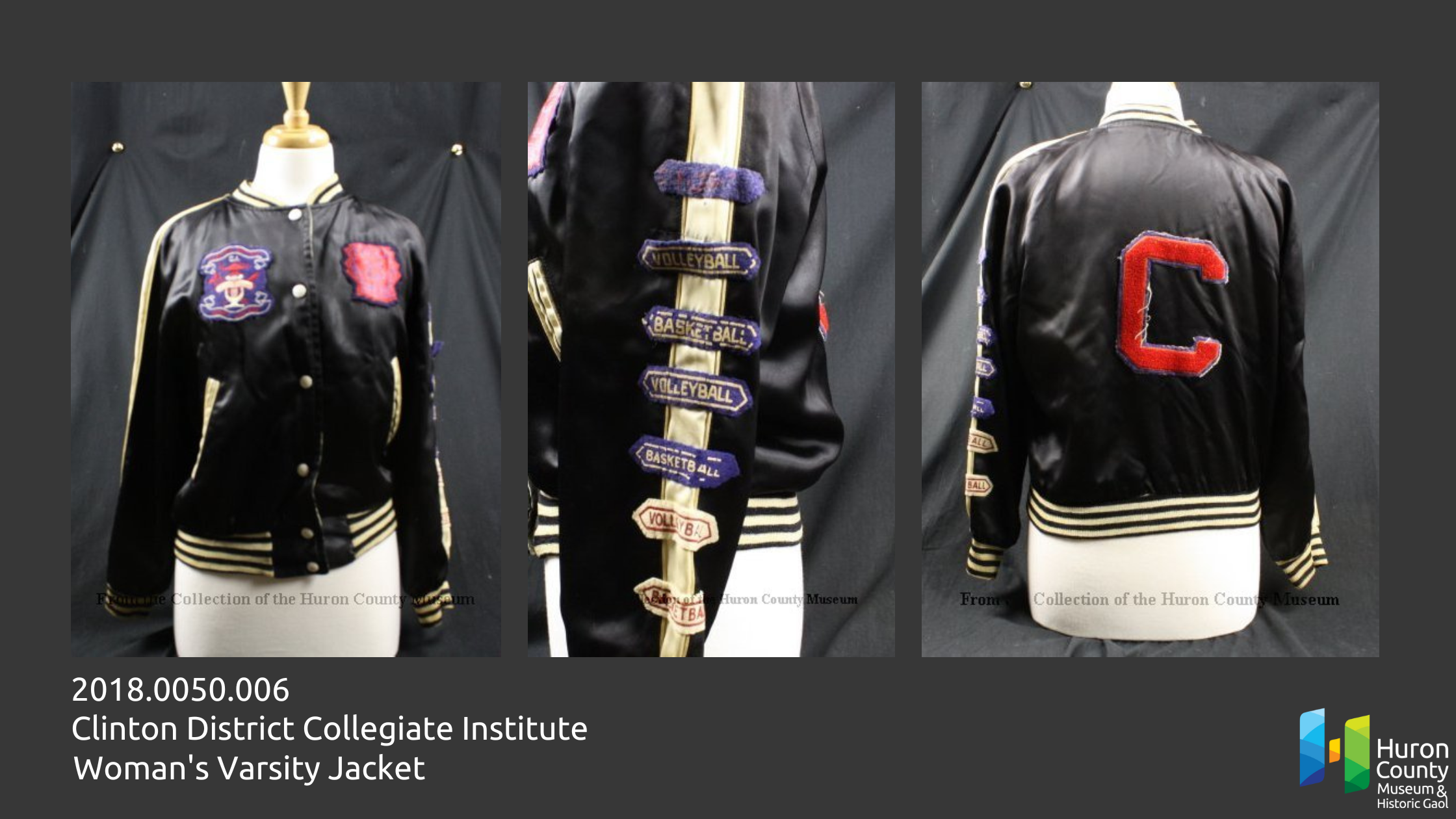
Shown above is a woman’s varsity jacket from Clinton District Collegiate Institute circa 1956-57. The jacket features the extracurricular activities the student would have participated in. Adorned on the left arm are seven patches with the respective activities. The first patch is believed to have said “music” prior to its deterioration. Following from top to bottom, the activities are; music, volleyball, and basketball, with volleyball and basketball alternating for the remainder of the patches with the final two being red and white as opposed to blue and white. (Object ID: 2018.0050.006)
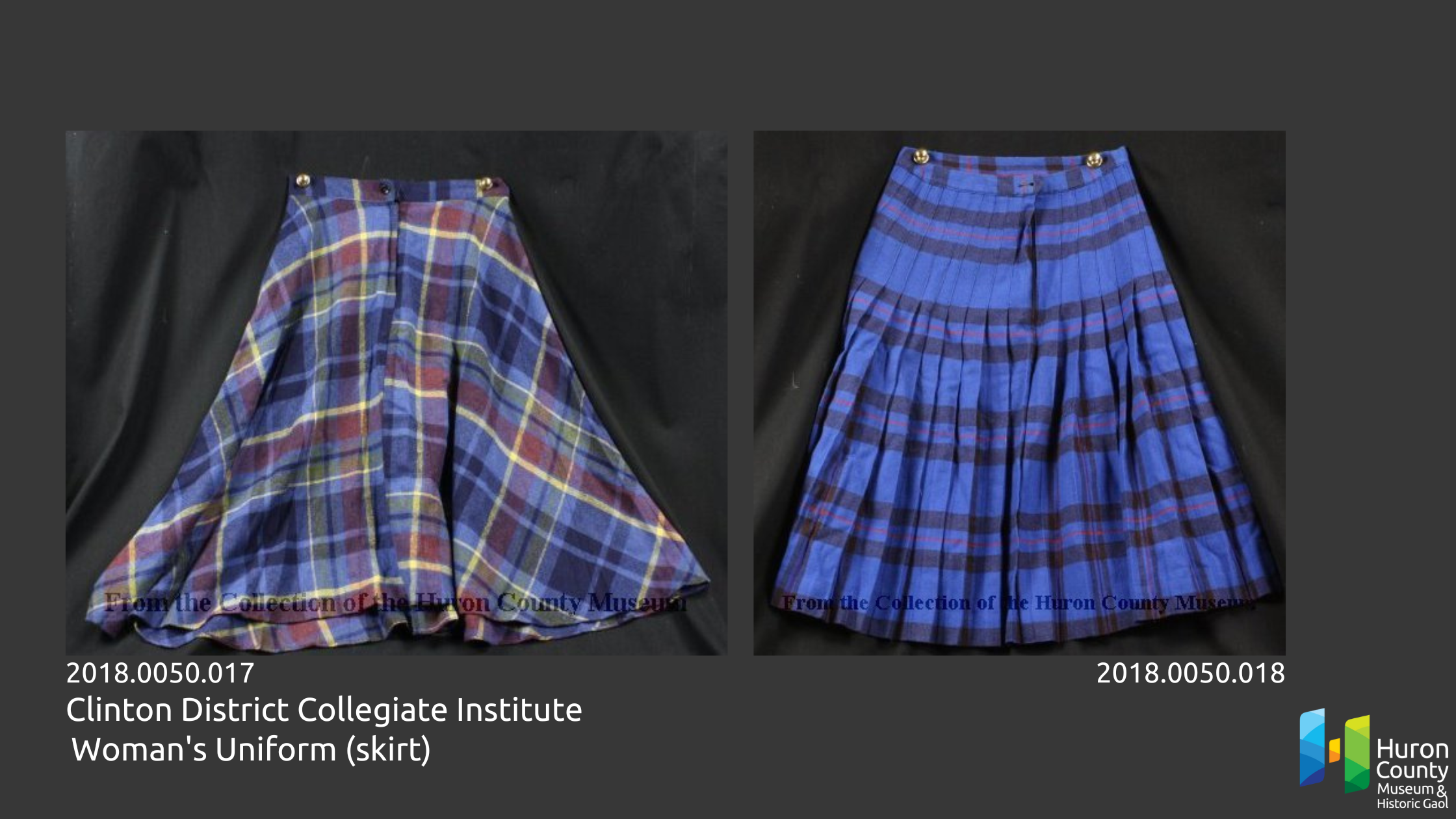
The same student from the Clinton high school also donated her wool tartan skirts that were a part of a uniform. Though we do not have any blouses in our possession that would have gone with them, it may be assumed that a neutral coloured button-up blouse would have been paired. (Object IDs: 2018.0050.017 & 2018.0050.018)
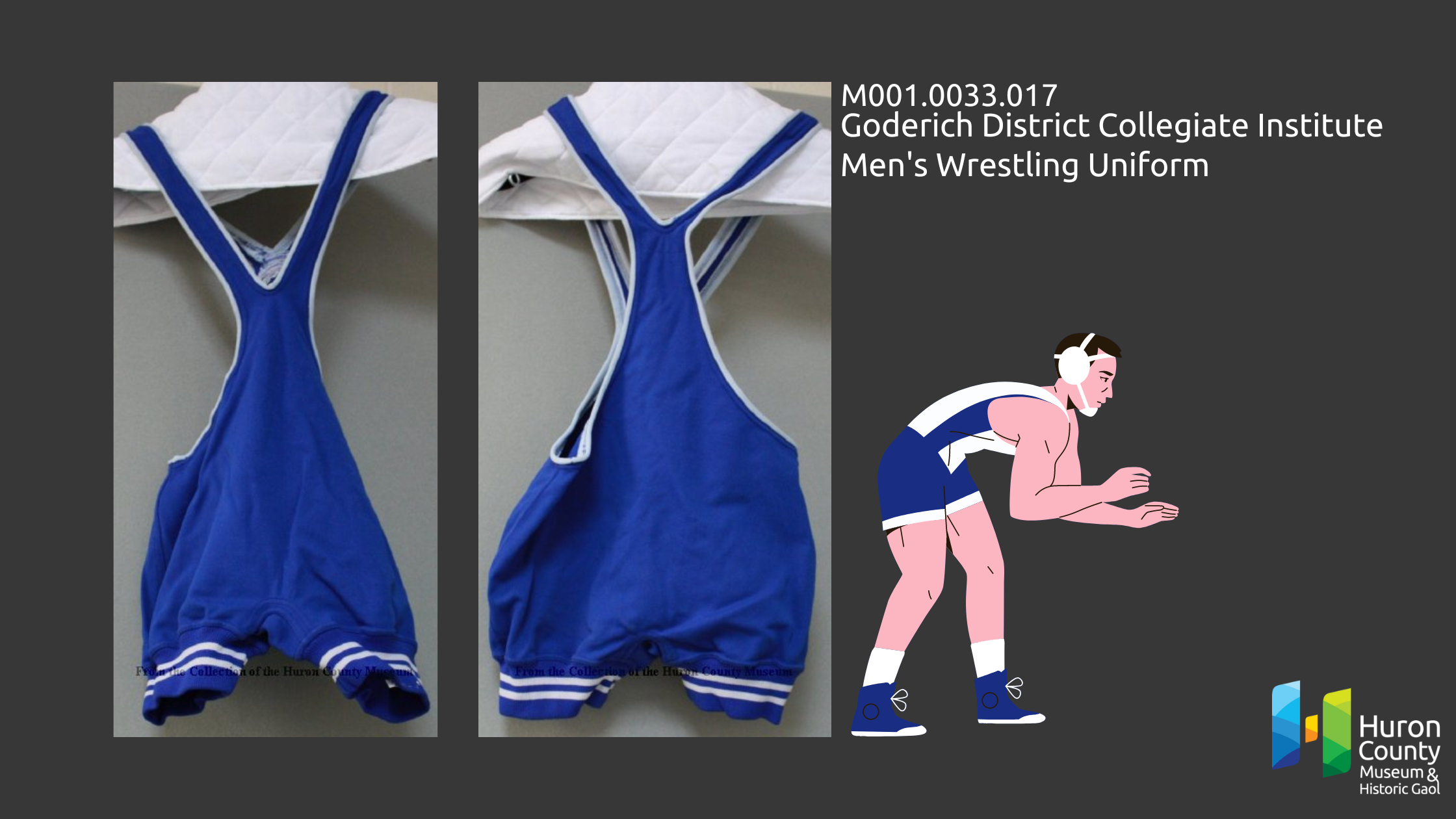
For many athletes, a uniform is often what can set you and your opponents apart, whether it’s on the field, on the rink, or wherever else the sport takes place. One uniform that has stayed relatively the same over the years is that of wrestling. Shown above is wrestling attire belonging to a past member of the Goderich District Collegiate Institute’s wrestling team. The material used is nylon, however, overtime the elasticity has become stiff. The bright blue base of the uniform is complimented by white striping that outlines the edges of the garment. The date for this piece is not available. (Object ID: M001.0033.017)
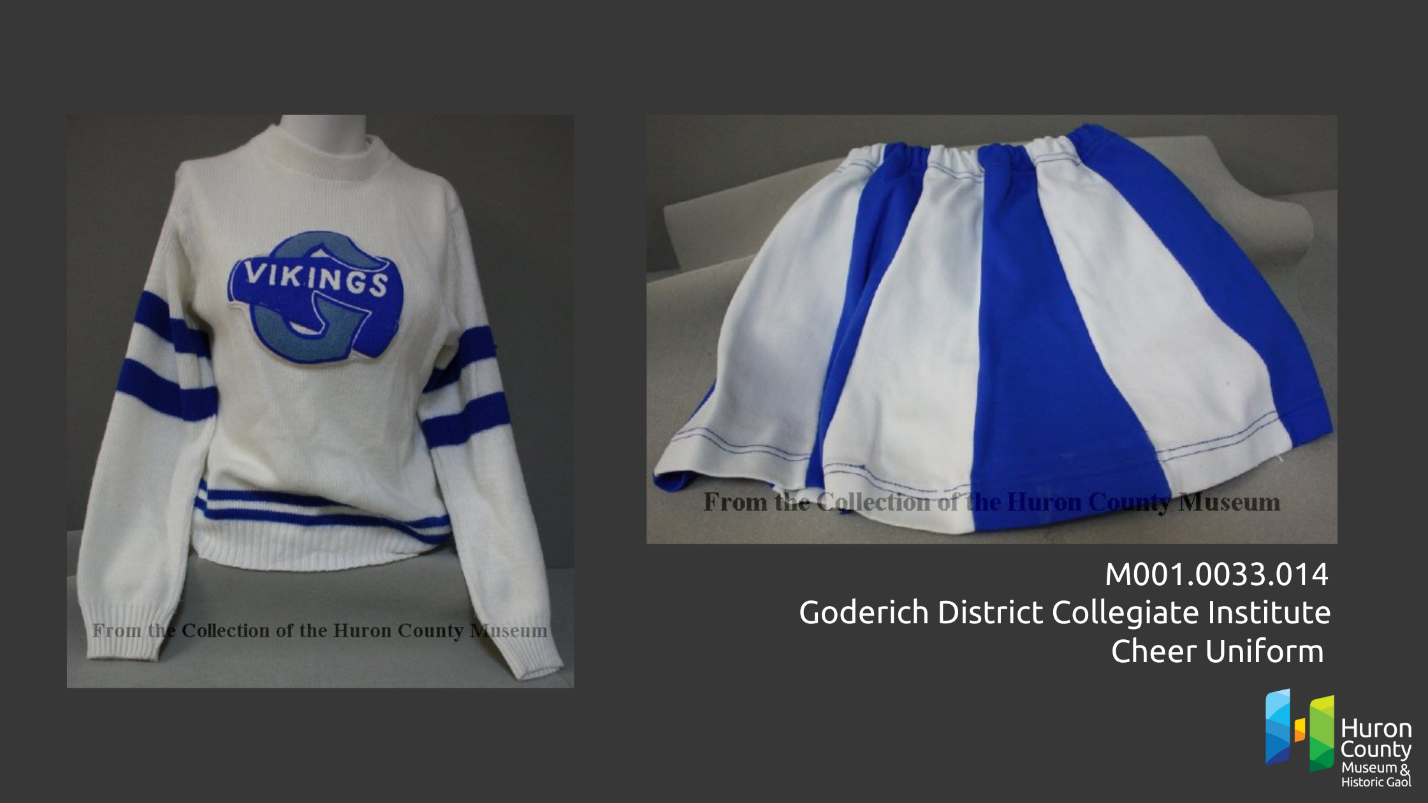
Uniforms are not just a way to distinguish members of the team, they’re also a great way to show off school pride! Goderich District Collegiate Institute students displayed their school spirit in a number of ways, although one particular style embodied exactly what it meant to have school pride – the cheerleading uniform. The skirt alternates blue and white paneling, with blue stitching appearing on the top and bottom hems. The top of the uniform is a white knitted sweater with blue accenting and the Viking crest. There is not a specific date for this uniform but it was likely used within the timeframe of the 1950s and 1960s. (Object ID: M001.0033.014)
It is always interesting to examine the past through various lenses and we are fortunate enough at the Huron County Museum to have a collection of student fashions spanning a number of decades. Take inspiration from these past uniforms of Huron County students when doing this year’s back-to-school shopping.
What fashions will you be rocking this school year?
by Amy Zoethout | Jun 24, 2022 | Archives, Blog, Collection highlights, Museum News, Project progress
Kyle Pritchard is the Digitization Coordinator at the Huron County Museum. With the Digitized Newspaper Collection nearing completion, the project sets its sights on historical records in the archival collection at the Huron County Museum Archives with the assistance of the Department of Canadian Heritage. Consider supporting the digital collection today by donating at the front desk of the Huron County Museum. You can search the digitized newspapers yourself for free at https://www.huroncountymuseum.ca/digitized-newspapers/
After six long years and the hard work of many, the Huron County Digital Newspaper Project is nearly complete. As the digitization of Huron County’s newspaper collection enters its final stages, the scope of the project is expanding to offer a greater variety of digital content for researcher and the community. Over the coming two years, select archival records held at the Huron County Museum will be added to the online web portal. This has been made possible after Huron County Cultural Services’ digitization project received news it had secured funding with the Department of Canadian Heritage as part of the Digital Museum Assistance Program. The goal of digitizing records in the museum archival collection is to transition our current online repository on the Digitized Newspaper Collection into a digital archive, where a wider variety of source material about local cultural heritage is available for local and academic research, and community engagement.
The Digitized Newspaper Collection has thrived over the last few years, despite the unexpected hurdles, delays and setbacks that have accompanied the trials and tribulations of enduring a global pandemic. In February of this year, the digitization project was awarded the Digital Access to Heritage Grant as part of the Museum Assistance Program, which is contributing to funding the next years of digitization. Huron County’s newspaper digitization also received the Ontario Library Association’s (OLA) Archival and Preservation Achievement Award back in February.
The Huron County Digitized Newspapers Collection began in 2016 to improve access to the enormous volume of local newspaper content previously only available on microfilm and in their physical format. The digitized collection now holds over 550,000 newspaper pages and receives between 7,000 and 9,000 online visitors per year. The papers preserve a century and a half of local historical content and are searchable using OCR (optical character recognition) technology. The collection is designed to assist researchers to advance our understanding of the history of Huron County and its growing community and has proven an invaluable tool for researchers in a wide range of topics, including political, social, cultural and genealogical history. The project aims to increase the accessibility of archival records at the Huron County Museum by increasing researchers’ awareness and knowledge of the collection.
DIGITIZING ARCHIVAL COLLECTIONS
The expansion of the Huron County Cultural Services digitization initiative focuses on five archival collections at the Huron County Museum Archive between now and mid-2024. These are the J.G. Henderson Collection, Huron County Assessment Rolls, CKNX films, rural diaries and the Huron County Return of Inhabitants. The timeline for digitizing archival materials prioritizes the release of content based on popularity, preservation, and the materials contributions to local cultural heritage.
The first of these digitization projects is centred on the J.G. Henderson Collection. The Henderson Collection holds a large volume of materials, including a collection of photographs of particular interest to digitization. The collection is named after J. Gordon Henderson, a photographer who moved to Goderich, Ontario when he purchased a local photography business in 1939. Henderson was the principle photographer of the community during his lifetime. The files in the Henderson collection include local photographs like wedding portraits, candid shots, and captures of day-to-day life. The photography studio in Goderich relocated several times over the years, though most of the portraits taken during WWII were captured at the Hamilton Street studio. Throughout his forty years as a professional photographer in Goderich, Henderson only shot and developed in black and white film. All of the photographs held in this collection were taken by J. Gordon Henderson. Around 500 of these photographs have been selected for digitization based on their ability to highlight community activities and events. Those selected for digitization represent just a small part of Henderson’s collection of professional work held at the Huron County Museum Archives which are of benefit to public and academic research.
The second digitization project are assessment rolls located at Huron County Museum Archives for Goderich, Steven and Hay Townships dated up until 1940. This includes four archival series for Hay township, three archival series for Stephen township, and four archival series for Goderich township. Assessment Rolls provide details of homeownership within the county at various points in history, and are of particular use for demographic and genealogical historians. The records also allow for a closer examination of living arrangements and demographic change over time across the region.

The CKNX films will be the third records to be digitized. CKNX radio station was created by W.T. Cruickshank, which started broadcasting out of Wingham in the mid-1930s. In 1955, CKNX expanded to television broadcasting, becoming the first rurally-based television station in North America. CKNX was a pioneer in broadcast television and set the standard for other rurally-based television-stations across Canada. Crews from CKNX travelled all over Southern Ontario filming parades, schools, sports, and other significant events. The culturally significant films showcase how rural Canadians lived, worked, and enjoyed their time in the early-1960s. There are currently 36 CKNX films in the Huron County Museum Archives, which range in content from depictions of local scenery, architecture, organizations and businesses. The project will digitize half of this collection, prioritizing films with important historical value which showcase the local environment and activities involving community engagement.
The Huron County Museum Archives holds a small collection of historical diaries written by members of the local community which will be the fourth set of records to be made available digitally. The majority of the diaries date to the turn of the 20th century, with some written during the Victorian period and others written during the First World War. Historical diaries are hidden gems inside the archival stacks. Often underutilized, historians are only now beginning to discover the value of these rich sources of rural, family and community life. Eight of these diaries were transcribed during a research project in 2017, and their transcriptions will be made available online alongside the digitized diaries.
Lastly, the Huron County Museum Archives holds the Assessment and Return of Inhabitants records for 1842 to 1850, which will mark the final project to be digitized. Records from the return of Inhabitants can quantify the demographics of local populations over time and offer a window into the settlement of the county. These are popular archival records requested by researchers and the community at a higher degree of frequency than other records in the collection. Due to their age and wear, the digitization of these records is important for the long-term preservation of the original documents.
CONCLUSION
The next phase of digitization aims to diversify the digital content available within the collection by focusing on archival materials which capture local cultural heritage through a variety of mediums, which depict a fuller image of rural life and day-to-day experiences within the community. These include archival photographs, diaries, films and government records. The digitization of these archival records is an important contribution to local history and serves the benefit of preserving some of the most popular records in Huron County’s archival collection.