by Amy Zoethout | Mar 13, 2021 | Artefacts, Blog, Collection highlights, Textile Collection
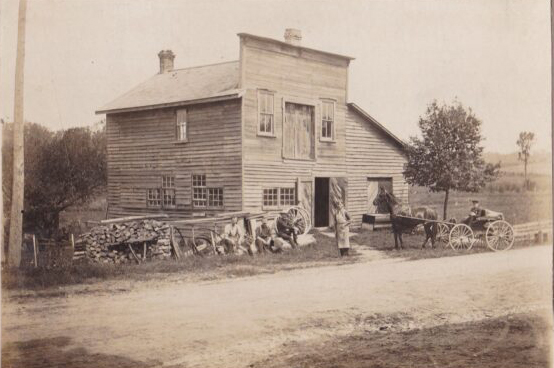
Above: Herb Wheeler’s Carpentry Shop in Belgrave, ON. Herb is seen standing in front (Photo courtesy of Richard Anderson).
Guest blogger Sharlene Young-Bolen, of Stitch Revival Studio in Blyth, shares more about how a Huron County Museum artifact inspired her to create the Huron Wristers pattern and how her research into the origin of the pattern led her to connect to family of the original owner. The original gloves are currently on display in the Museum Gift Shop where Sharlene’s Huron Wristers kits are also available for purchase.
Was there a Wheeler family tie to either Estonia or the British Isles? The answer would help to identify the glove pattern perhaps. When an Instagram post by Best Dishes, a Goderich business owned by Sarah Anderson, appeared in my feed one day identifying the wristers pattern as based on a family heirloom, chance had dropped the perfect opportunity. It was time to connect. A couple messages back and forth and the story unfolded…
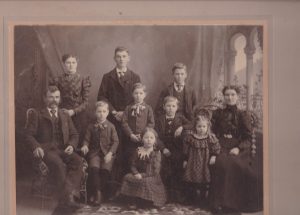
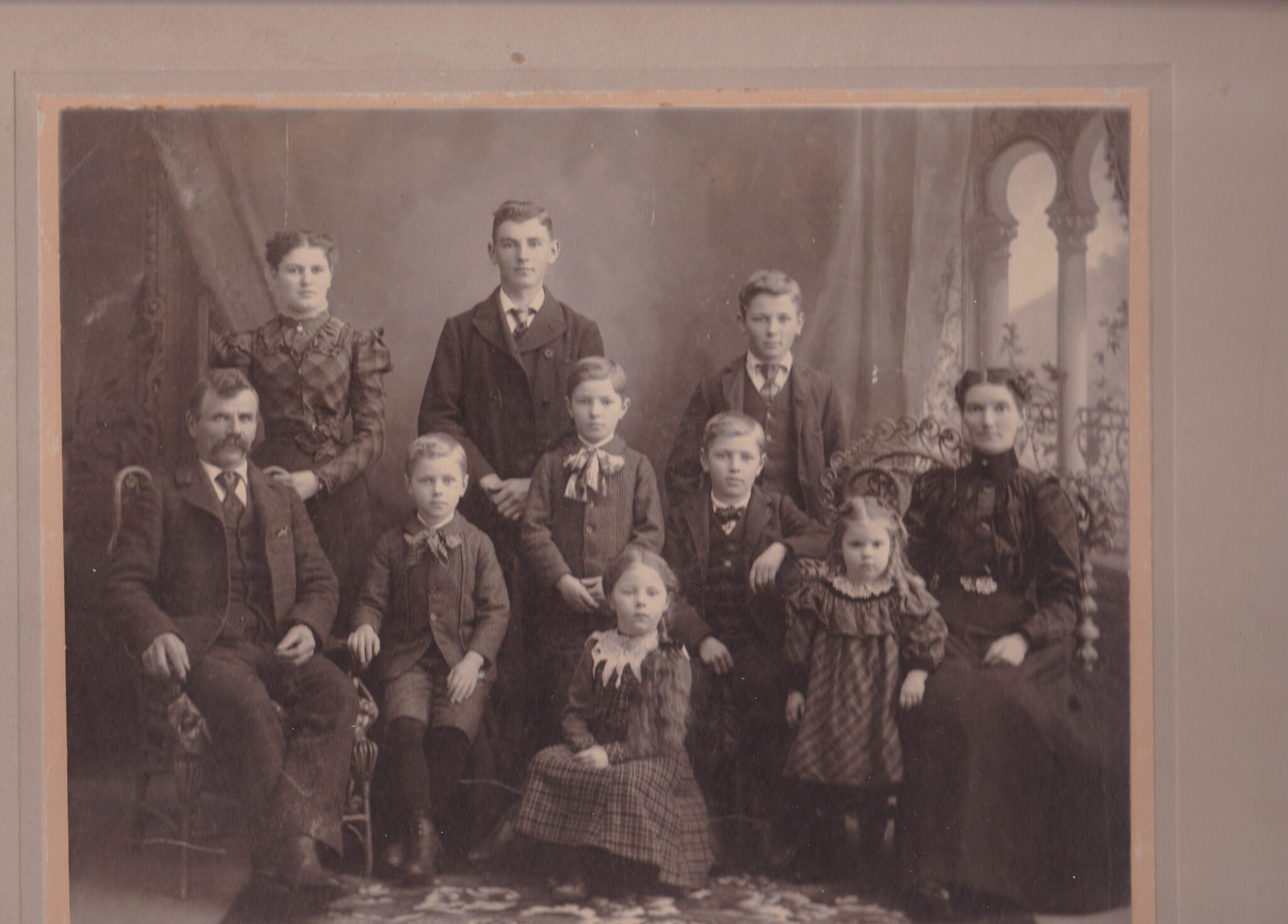
The Charles Wheeler Family circa 1900. Back: Carrie, Herb, Ernest. Centre: Charles, Cecil, Jesse, Lennie, Mary Ann; Front: Lena, Myrtle (Photo courtesy of Richard Anderson).
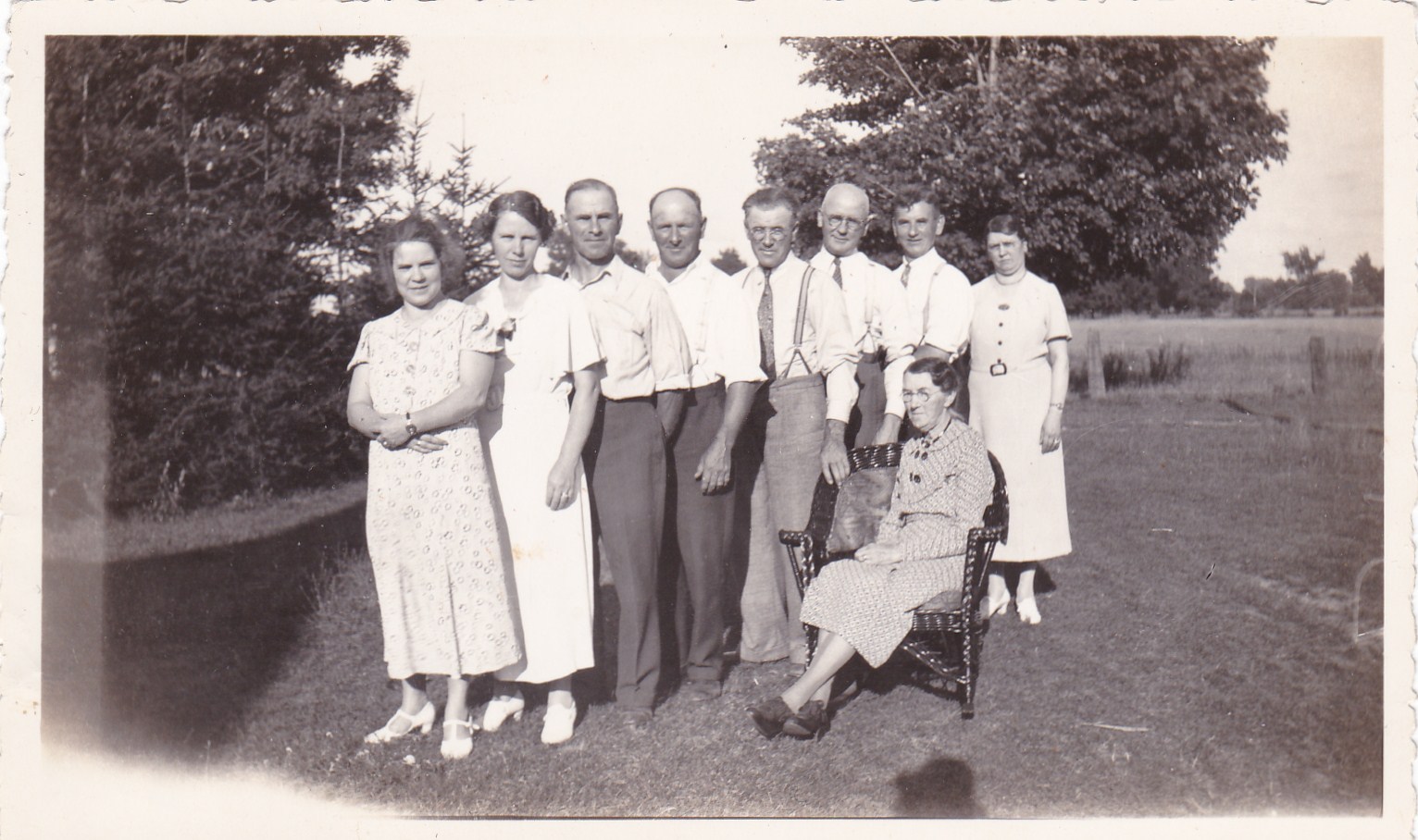
Sarah, as it turns out, is the daughter of Richard Anderson, great-nephew of Herbert Wheeler, the original owner of the gloves. Richard sent the following information about the history of the Charles Wheeler Family:
Charles Wheeler Sr. was born in Dorsetshire, England and came to Canada in 1846, locating in Tecumseh Township where he spent 18 years. In 1864 he moved with his family to Morris Township where he bought 300 acres which would be the N ½ of Lots 10, 11 and 12, Concession 5, more commonly known as the 4th Line. He married Caroline Lawrence and they raised a family of five sons, Charles, John and Lawrence of Morris Twp., William of Alma, Frank of Belgrave, and a daughter Mrs. Ann Hughes of Escanaba, Michigan.
Charles Wheeler Jr. married Mary Ann Wilkinson and they raised a family of five sons, including Herbert, and three daughters. Charles farmed on Lot 12 and after his death in 1913, his son Jesse took over the home farm. When Jesse married, his mother moved to Belgrave to the house now occupied by Wes and Annie Cook. Jesse continued to farm there until he retired to Belgrave.
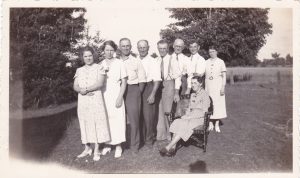
The Charles Wheeler Family, standing in birth order; youngest to oldest, L-R Myrtle, Lena, Cecil, Jesse, Lennie, Ernie, Herb, Carrie (Photo courtesy of Richard Anderson).
Herbert married Pearl Procter. They lived in Belgrave and had three children: Goldie, who married Winnie Lane and lived in London; Velma married Wilfred Pickell and lives in Vancouver; Ken married Mabel Coultes and farmed in East Wawanosh before retiring to Belgrave. Herbert had a woodworking shop in Belgrave.
Herbert’s grandson David Pickell, recalls: “When I knew my grandparents, Pearl and Herb, they lived in Belgrave. Herb Wheeler was a carpenter and, as the name suggests, repaired farm equipment such as wooden wheeled carts etc. He was quiet, and had a subtle sense of humour us kids loved.”
The following poem was written about Herbert Wheeler by a family member and gives a wonderful, lasting impression of just who Herbert was and his occupation as a talented woodworker, carpenter and barber. It would have been great to experience just what this writer did so long ago.
Herb Wheeler’s Carpentry Shop & Hair Cutting CIRCA 1932-1945
Whenever Herb was in his shop, I’d like to go and look,
He might be cutting some one’s hair, or be reading some big book,
There were jigs galore hanging all around, some maybe for a sleigh,
There were shavings bright upon the floor, they would soon be swept away.
Herb never left a job undone, if he could finish it that day,
Except of course a larger job, he would maybe stop and say,
“Tomorrow is another day, I’ll hope to get it done,”
“But if I don’t the job will keep, it’s not hurting any one. ”
Sometimes just after Supper, Herb again would be around,
He’d pump up a gas lantern, light it up and settle down.
For Herb, doubled as a barber, he’d cut hair two weekday nights,
Herb, never used power clippers, he did not charge enough by rights.
Somehow, Two bits is what I think, was all a haircut cost,
I really can’t remember, it’s something I have lost.
Herb did not pull your hair at all, as hand clippers often do,
He’d sometimes talk as the clippers clicked, and he’d ask, “does this suit you” ?
Herb was skilled at doing wood work, he could make most anything,
He made a Bob sled for the kids, it nearly did take wing.
The fastest sled around those parts, down the ninth line hill it flew.
Ken would try to give us all a ride, or sometimes maybe two.
I expect that Goldie used the sled, and likely Velma too,
It needed someone that could steer, and knew just what to do.
I’ve seen the times, when snow was hard, and a fast start at the top,
You’d have to turn the corner, at the highway, to get stopped.
Herb made Ken skis, that were Black Ash wood, what a lovely pair,
The skis would take you down a hill, like you were cushioned on some air.
When the skis were waxed and shone and dried, no one ever saw the like,
They would make a run ahead of all, they would go clean out of sight
There were other things of super class, that emerged for that shop door.
A set of kitchen cupboards, like you’d never seen before.
Herb had a little saying, and he practiced it always
“If you measure twice before you cut, it eliminates delays”!
I have seen him make a set of shafts, the wood he’d have to steam
To make a bend for the horse to fit into the cutters beam.
Herb had the kind of patience, that a lot of people lack,
That is what made him extra special, with an extra special knack.
So far, the research has yielded no straight answers as to the gloves’ origin, but the search continues. While a pattern might give you a hint to the origin of a knitted item, you need to identify more, such as the cast-on method, the type of ribbing, how the fringe was made, and how the strands (or floats) were carried across the back of the knitting. A full reproduction of Herbert’s gloves would help to answer the remaining questions.
In conclusion, there really isn’t a conclusion… But what I can say is that taking the time to explore knitting traditions and a local family’s history has been a fascinating, rewarding experience. I’m so grateful for Herbert’s relatives who have answered my questions and sent so many wonderful images to be shared here with everyone. They went to a lot of work to compile the info and family photographs and I can’t thank them enough for all their time and effort.
I’ve come to think that the original knitter may have incorporated features that he liked into these gloves, perhaps not following one certain pattern, but rather combining different elements into one. A full recreation of the gloves is planned for late fall 2021 and right now I’m testing a local wool I may be using for the reproduction. Stay tuned to the website for further updates as we move forward.
Learn more:
by Amy Zoethout | Feb 10, 2021 | Archives, Blog

Mary Frances Griffin, 1914. Photo provided by David Hammer.
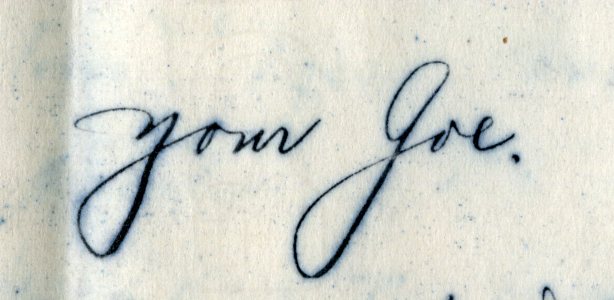
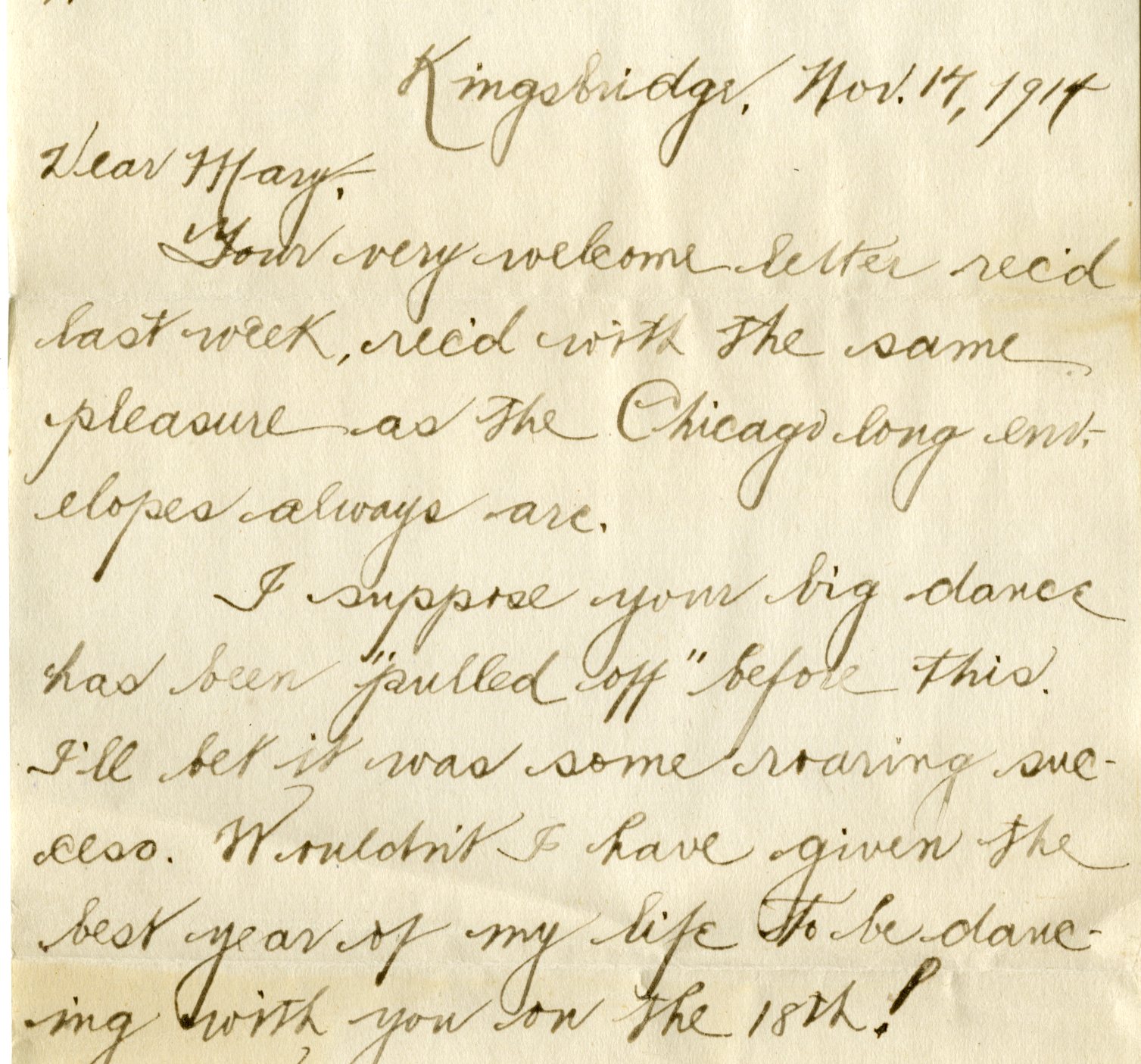
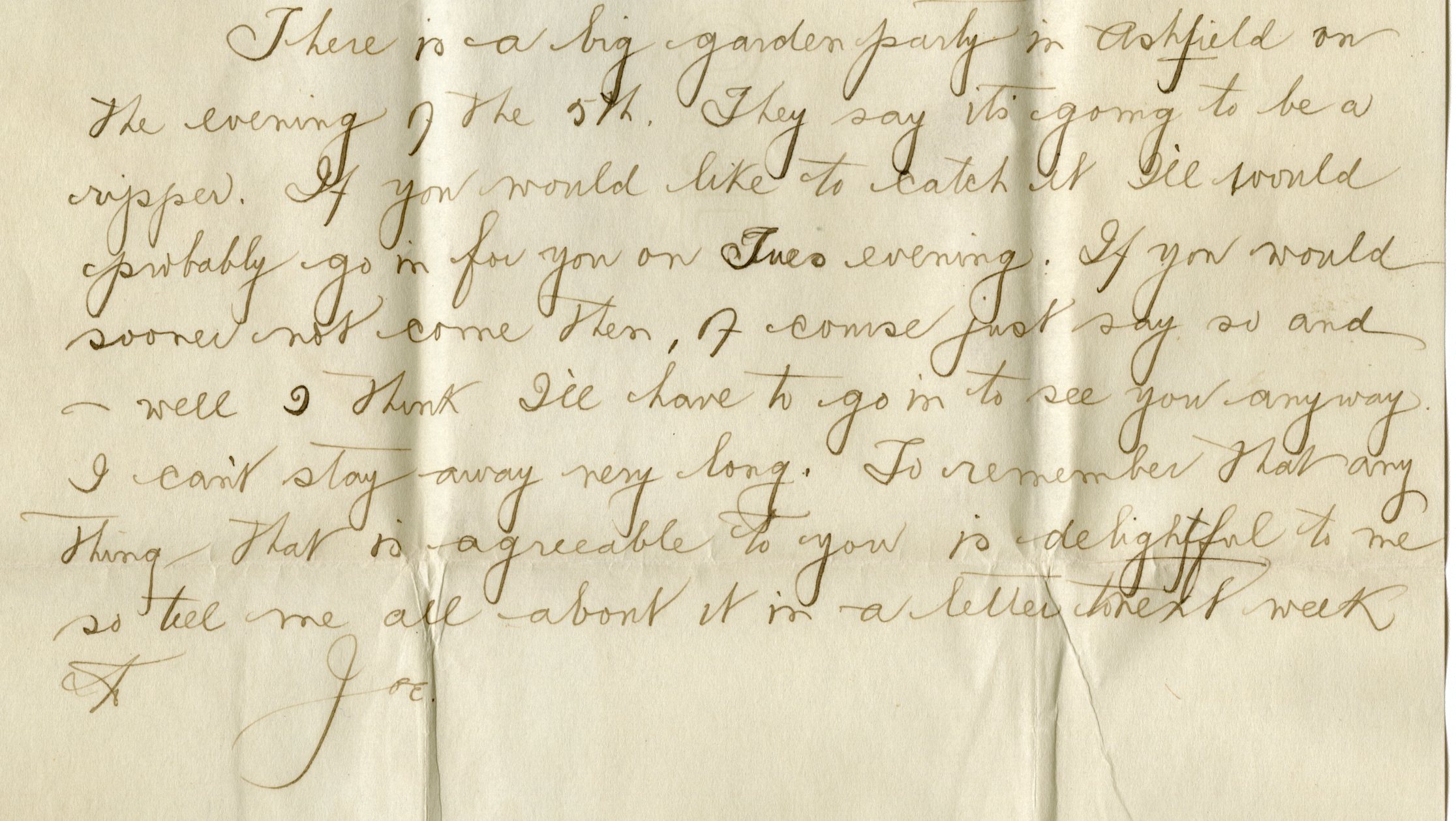
In the spirit of Valentine’s Day, the Huron County Museum shares a few images showing excerpts from letters recently donated to the Huron County Archives. The letters beautifully speak to life in rural Huron County in the early 1900s and share a glimpse into young love.
Sixteen letters in total were donated to the Museum’s archival collection, all written by a young Ashfield Township man named Joe during the years of 1913 through 1917 to Mary Frances Griffin. The correspondence between Joe and Mary took place after she had moved to Chicago after a time spent living in the Kingsbridge area. The letters were eventually passed down to her grandson, David Hammer, of Palatine, Illinois, who kindly donated them to the Museum.
In donating the letters, David wrote the following about his grandmother: “When Mary’s father, Timothy Griffin, died in Marquette, Michigan, Mary was sent to live with her aunts and uncles in Kingsbridge [Huron County]. She lived there from 1910 to 1912 and in the following years returned many times during the summer. Sundays she went to church. Weekdays she did chores, working in the garden, helping with cooking and cleaning. On Saturday nights the big excitement was to go dancing with friends and come home late. And always the question: Who was getting serious with whom? The possibilities were endless!”
by Amy Zoethout | Dec 24, 2020 | Archives, Artefacts, Blog, Exhibits
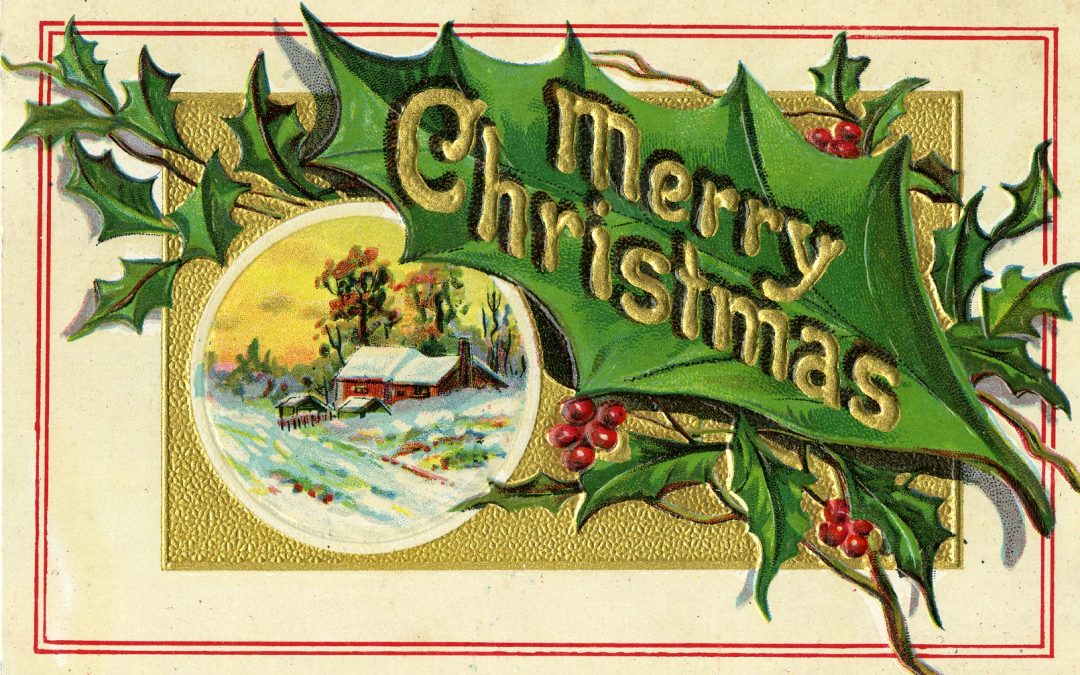
Technology over the last several years has made it so easy to quickly connect with friends and loved ones that the tradition of sending Christmas cards has not been as popular as it once was. But in the midst of a global pandemic, when we can’t celebrate together like we normally would, people are looking for more meaningful ways to let loved ones know they are thinking of them, and what better way than a lovely greeting delivered through the mail. And while we can’t send out a seasonal greeting to you all through the mail, we can still use the power of technology to share a little Christmas cheer by taking a look through some of the Christmas cards in our collection. 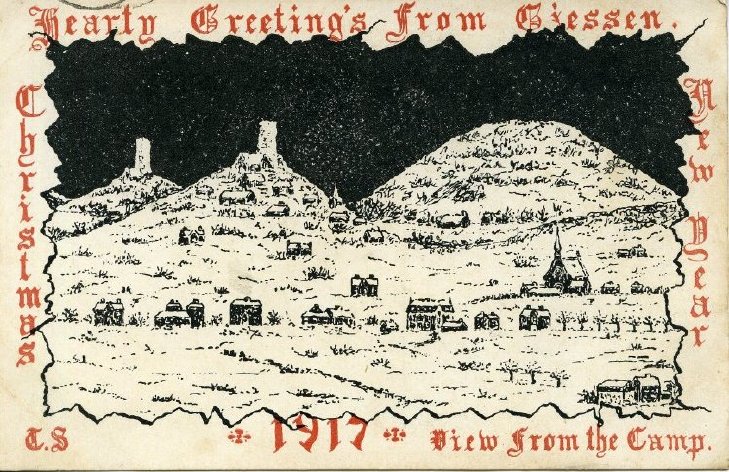
Christmas Greetings, From Germany To Edith Williams From Prison Camp 106684 Co.10 Bar. B A994.0007.033
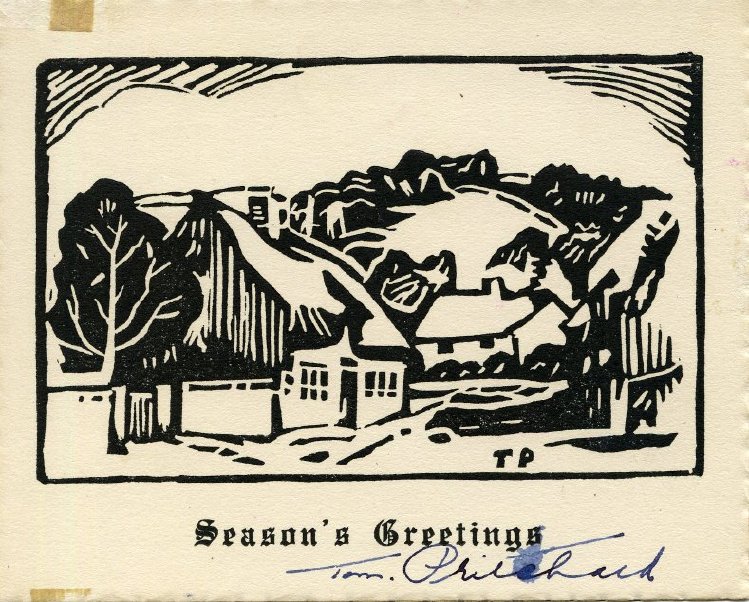
A Christmas notecard “Season’s Greetings”. On the front of card is a Tom Pritchard print of a farm/house by a hill and is signed by Tom Pritchard. Donated by Town of Goderich. 2011.0021.009
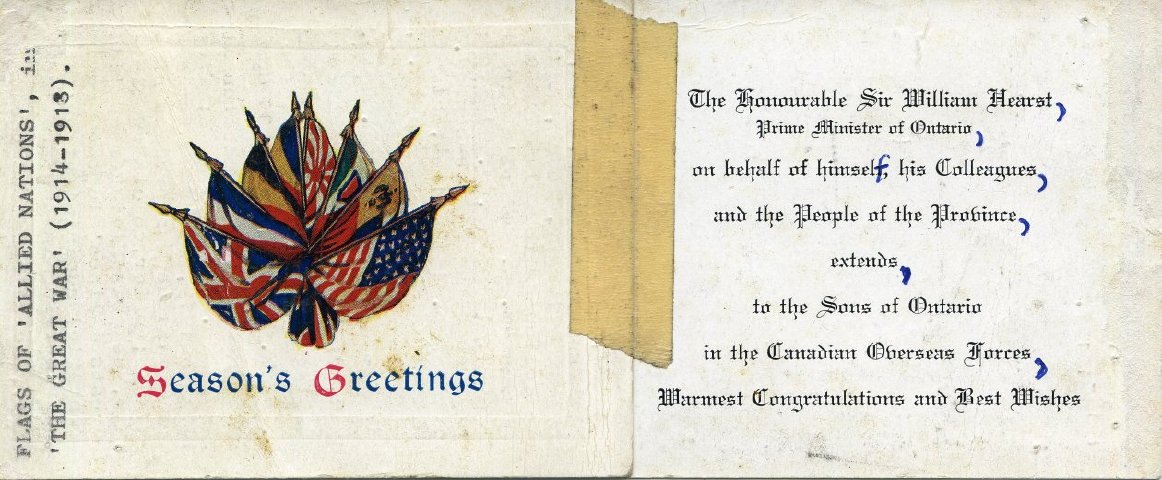

This Christmas postcard features flags of Allied nations in the First World War. The back of the card includes a bio of Ontario Premier William Hearst. 2004.0044.006
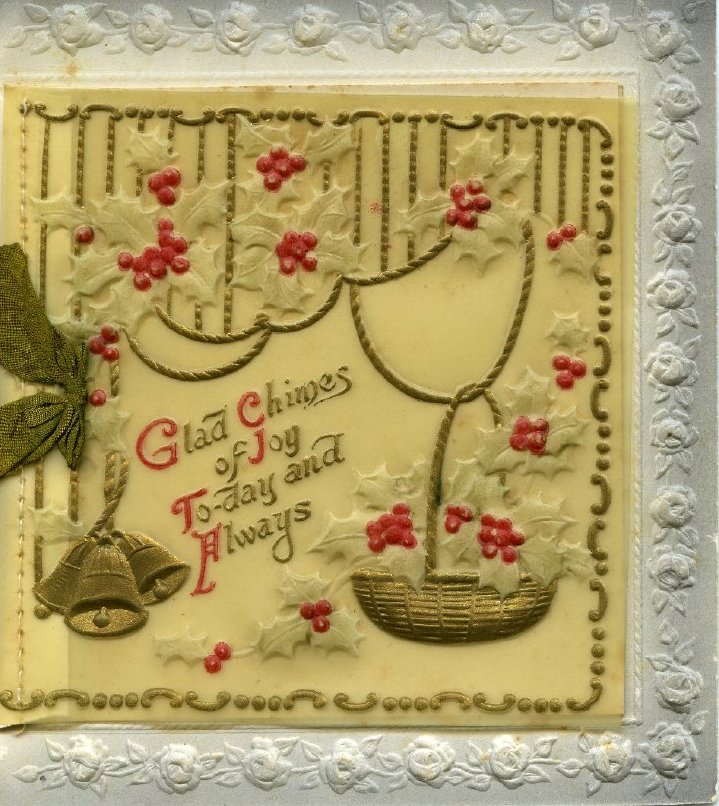
The back of this card has a silver embossed border. The front of the card is made of plastic with bells and holly designs on it. On the inside left is printed “THAT YOU’LL REMEMBER ME”. On the inside right is printed A GREETING…ANOTHER CHRISTMAS. A951.0664.001
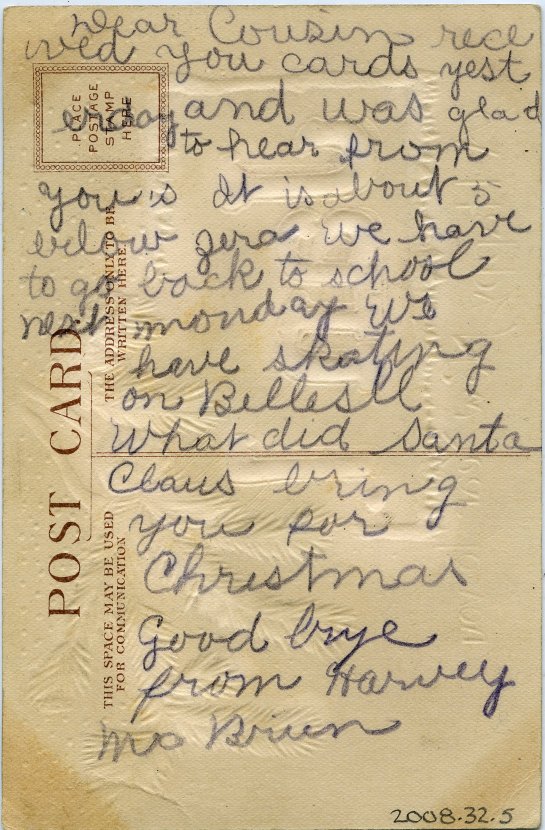 This Happy New Year postcard does not include a postmark, but reads on the back: “Dear cousin, received your cards yesterday and I was glad to hear from you’s. It is about 5 below zero, we have to go back to school next Monday. We have skating on Belles Isle. What did Santa Claus bring you for Christmas. Good bye from Harvey M Brien.” 2008.0032.005
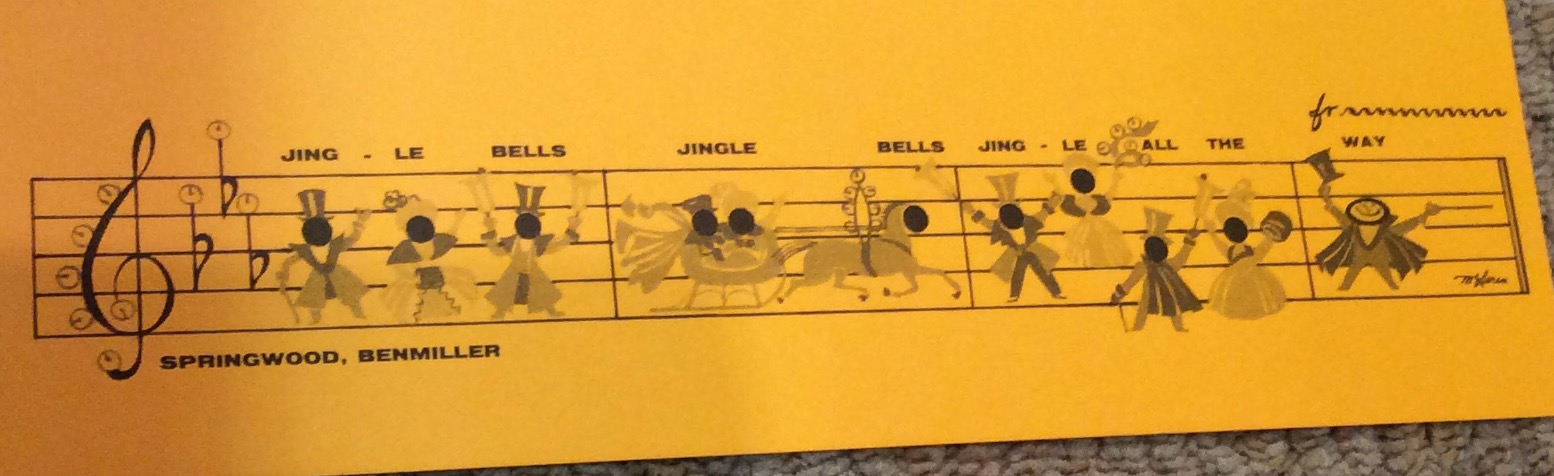
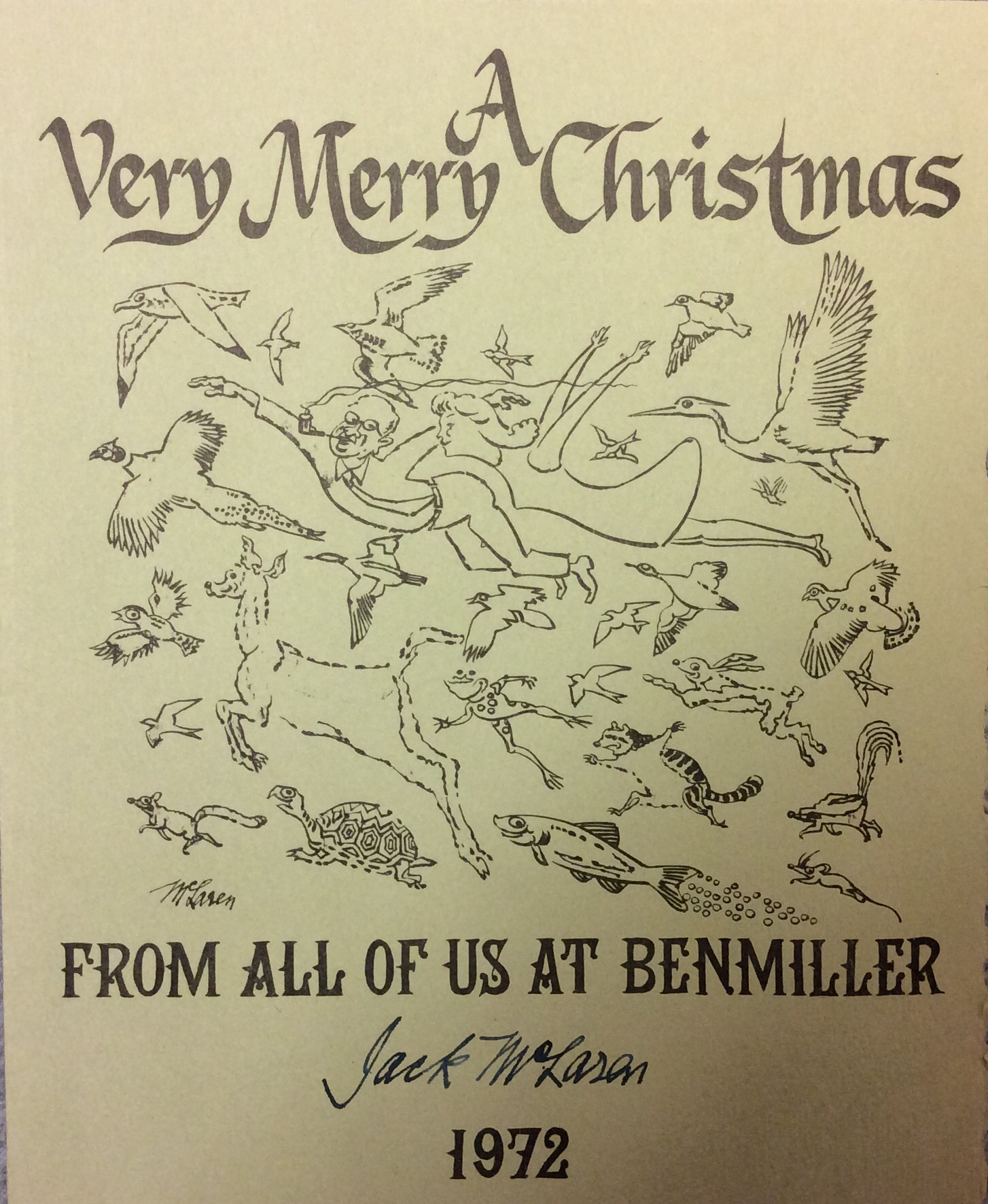
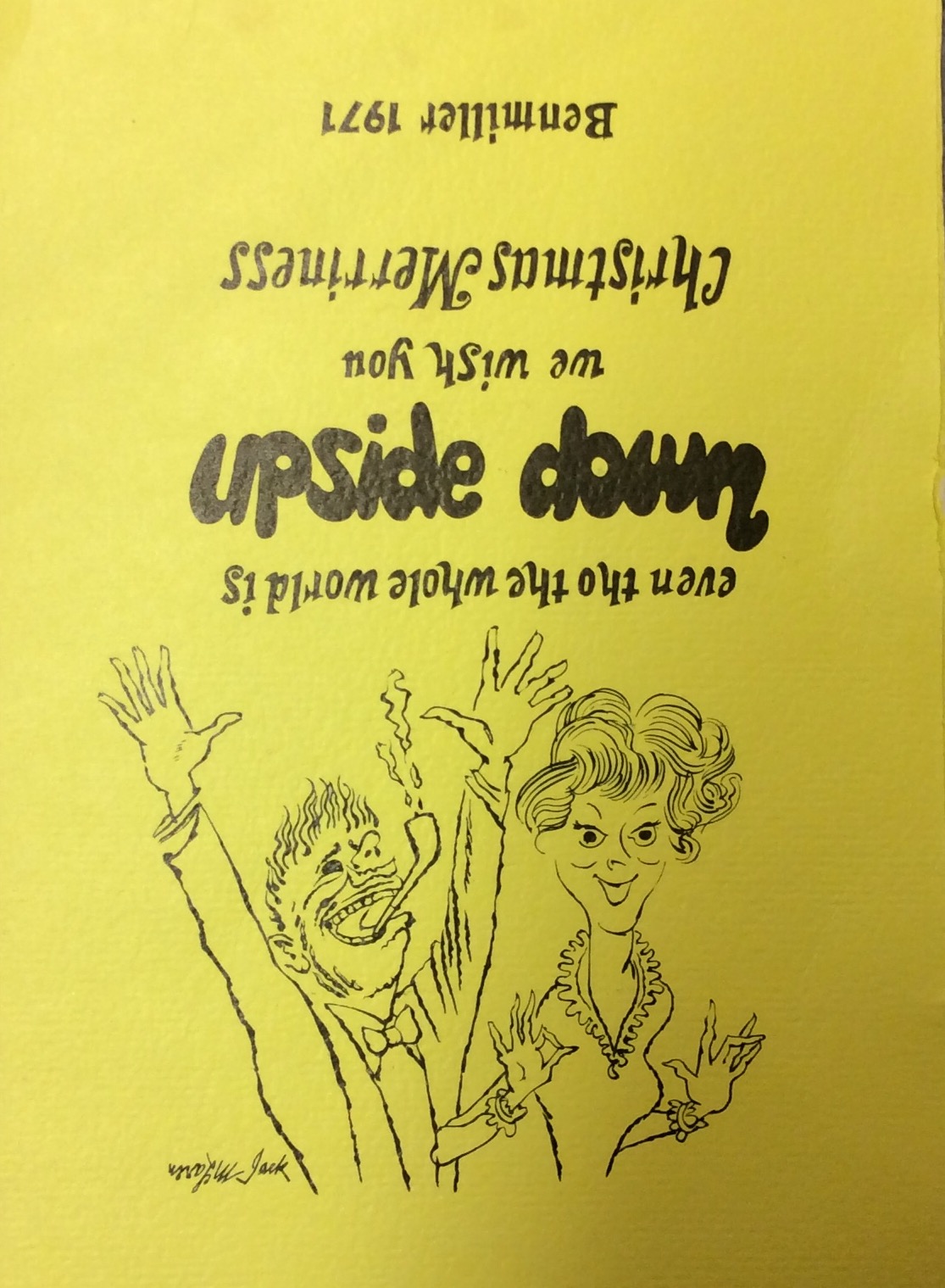
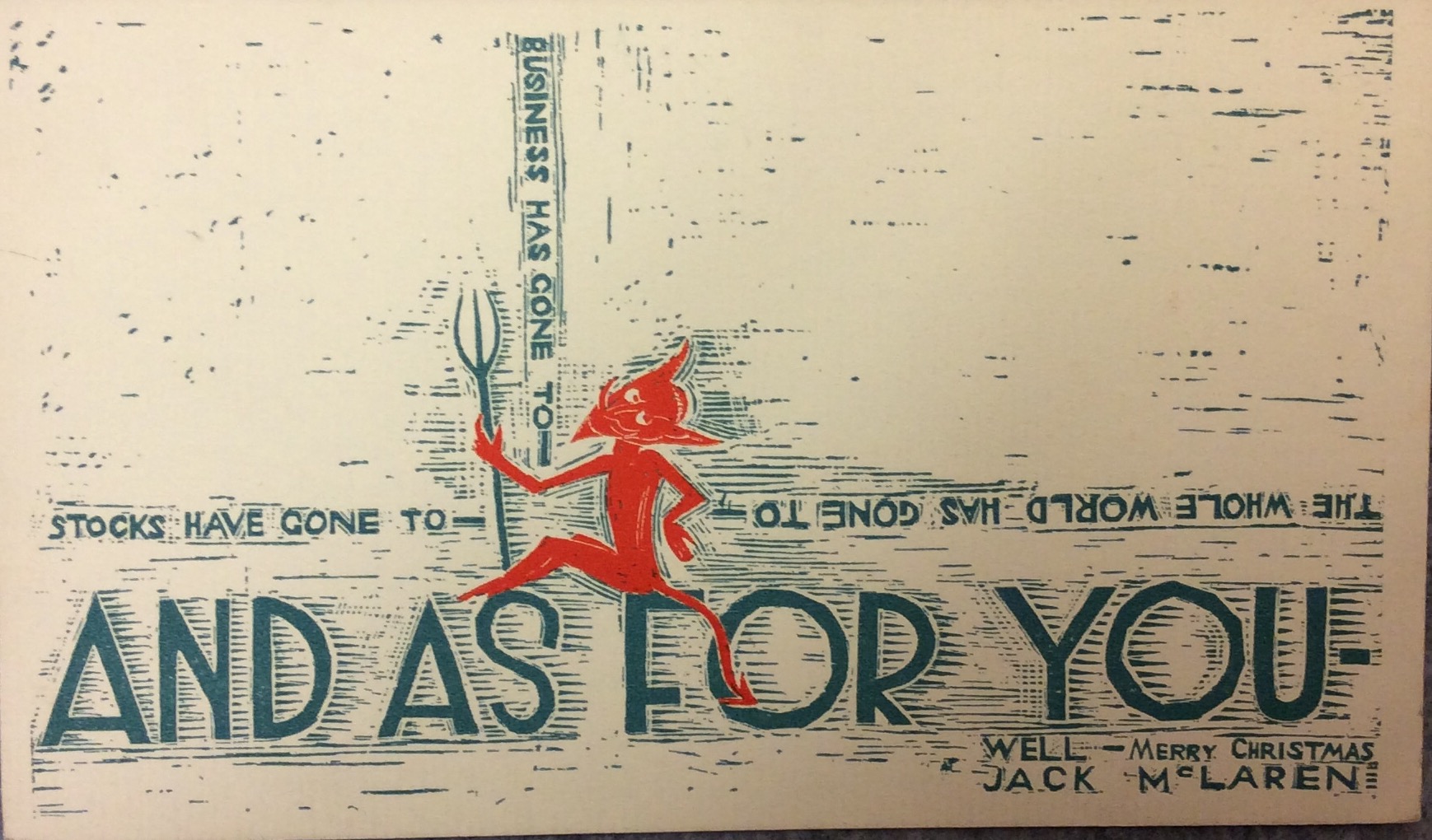
And, of course, we couldn’t share our Christmas card collection without sharing a selection of cards from artist Jack McLaren, who is the subject of our exhibit Reflections: The Life & Work of J.W. (Jack) McLaren. Depending on the year, his collection includes some happy and cheerful seasonal greetings….
And some that seem appropriate for the 2020 holiday season…
by Amy Zoethout | Oct 26, 2020 | Archives, Blog, For Teachers and Students, Investigating Huron County History, Uncategorized
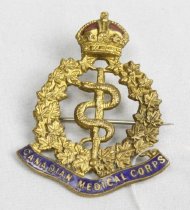
This military badge is from the Canadian Medical Corps worn on a Nursing Sister uniform by Maud Stirling, a First World War Nursing Sister. This artefact is one of more than 3,000 artefacts currently available on the Huron County Museum’s online collection.
by student Museum Assistant Jacob Smith
As a final year history student, I have grown accustomed to spending several hours preparing and writing essays. This is an important skill that takes years of practice. If you are developing an essay that is based on local history, the Huron County Museum & Historic Gaol has several resources that can aid you in your studies.
The first research tool is the Huron County Museum & Historic Gaol’s online collection, which can be found here. This is a database where the public can view over 5,000 artifacts and archival materials in the Museum’s collection. This tool provides background information on the artifacts, such as its provenance, dimensions, and past owners, and allows viewers to examine objects that are not currently on display. Examples of objects currently available in the collection include textiles, tools, personal items, furniture, photographs, documents, and much more.
Another excellent research tool is the Huron County Museum’s Digitized Newspapers. Here, researchers can glance at newspapers dating from the mid-1800s to the late-2010s. This database is free, easy to use, and accessible from the comfort of your own home! The digitized newspapers provide a vast wealth of information, ranging from local news and gossip, fashion, and global affairs.
The Huron County Museum & Historic Gaol also has an extensive archives collection. Here, researchers can locate coroner’s inquests, assessment rolls, court records, voter’s lists, and many more. By booking an appointment with the Archivist, researchers have access to a vast collection of resources, and a knowledgeable staff member to assist you.
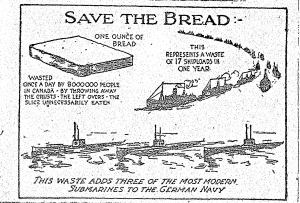
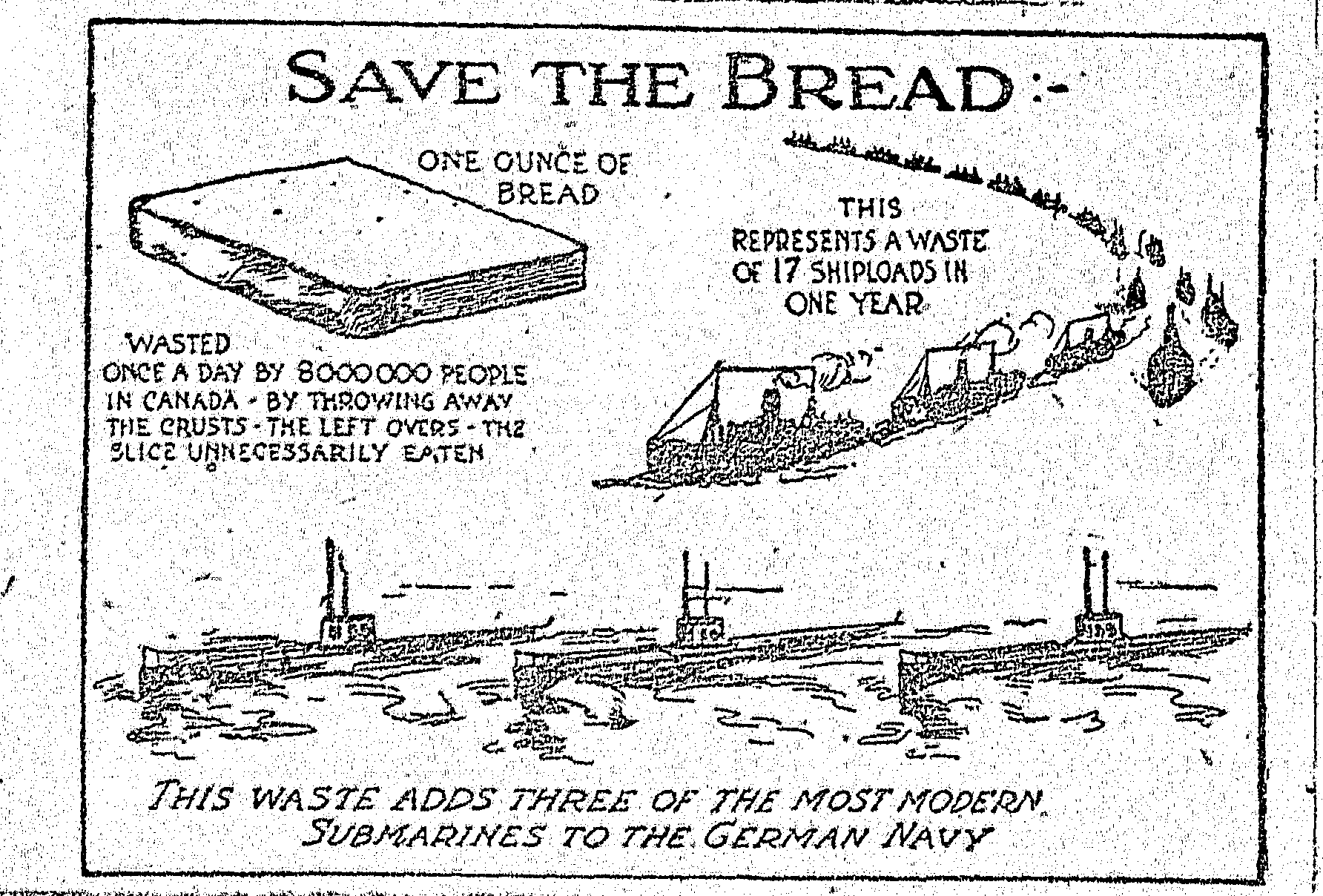
This World War I propaganda poster was found through the Huron County Museum’s digitized newspaper database (Source: The Exeter Advocate, 1918-8-22, Page 2).
A bonus resource! Ancestry.ca is a helpful tool that allows people to research, share information, and connect with others. Sources such as military death, and census records, images, and family trees. This source requires a paid subscription, but often has free trials that allows researchers to access its extensive content. Researchers can also access Ancestry Library Edition free from home until Dec. 31, 2020 with a Huron County Library card.
While writers may feel overwhelmed at the thought of composing a research essay, there are helpful resources close to home or even accessible without leaving home. With the Huron County Museum and Historic Gaol’s resources, writers have the exposure to a wealth of extensive resources, which are readily available from your personal computer. Keep these resources in mind when you are composing your research essay.
by Sinead Cox | Aug 25, 2020 | Archives, Blog, Exhibits, Image highlights, Investigating Huron County History
In anticipation of the Huron County Museum’s in-development exhibit Forgotten: People & Portraits of the County, volunteer Kevin den Dunnen takes an in-depth look at one of the many studio photographers to work in Huron County, and traces the professional and personal journey of Irene Burgess.
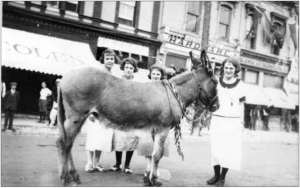
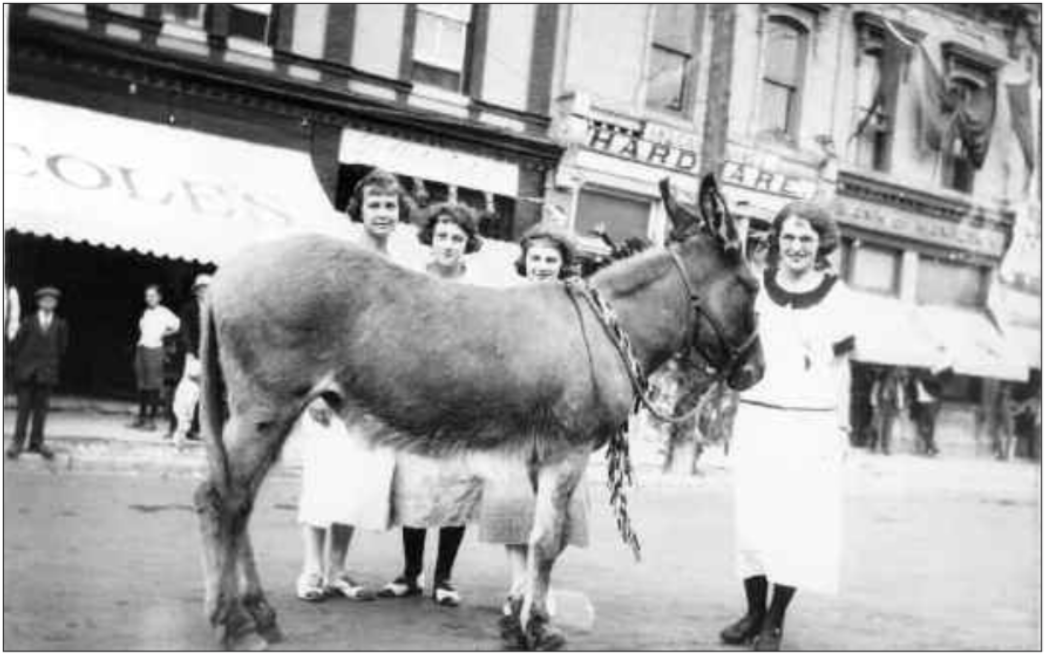
Summer of 1923 “old home week” in Mitchell, Ontario. Irene is the farthest left of the four. Image courtesy of the Stratford-Perth Archives.
Hiding within the Huron County Museum’s online and free-to-use newspaper archives are an unlimited number of stories like the one of Miss Irene Burgess. Irene Burgess was a woman that defied societal norms. In a time where women were rarely given the freedom to pursue a chosen career, Irene managed her own photography studio. While many women were expected to marry and have families, Irene stayed single. She was also faced with many tragedies in her life. Neither of her two siblings lived past 32. Her mother passed away at 51. Her niece nearly died at the age of 6. She lost the photography studio after an explosion. Through all of this, the communities of Perth and Huron Counties rose to support her.
Personal Life
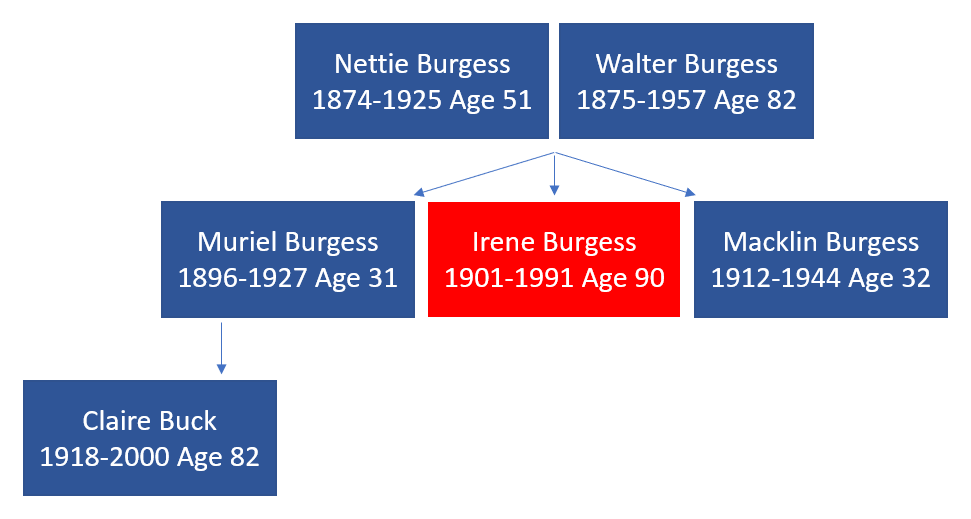
Nettie Irene Burgess was born September 20, 1901, in Mitchell, Ontario. Her parents were Nettie and Walter Burgess. She had two siblings – an older sister named Muriel, born in 1896, and a younger brother named Macklin, born in 1912. Her father, Walter, was a long-time photographer in Mitchell and owner of W.W. Burgess Studio. Growing up around photography gave Irene plenty of exposure to the business. This experience would prove to be important in her adult life.
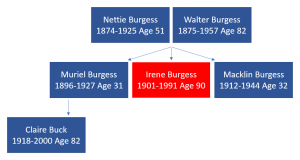
A brief family tree of the Burgess family. Of note, it only contains the names of family members included in this article.
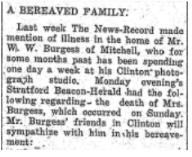
Excerpt from the November 26, 1925, edition of The Clinton News-Record detailing the passing of Irene’s mother Mrs. Nettie Burgess.
Irene experienced several tragedies throughout her life. By her 43rd birthday, only she and her father survived from their family of five. The first to pass was Irene’s mother, Nettie Helena Burgess, on November 22, 1925, at the age of 51. Irene’s sister, Mrs. D.F. Buck ( née Muriel Burgess) and her 6-year-old daughter Claire had been staying with her parents Walter and Nettie Burgess; Mrs. Buck had been ill for some time. During their stay, Claire became ill with pleuro-pneumonia. On the brink of death for several days, she began to recover with the help of her grandmother, Nettie. While caring for Claire, Nettie contracted pneumonia. Less than six days later, Nettie passed away in the presence of her family and nurse. 6-year-old Claire would live for another 75 years thanks to the care of her grandmother.
The next member of Irene’s family to pass would be her sister Muriel. Muriel was married to D.F. Buck, a photographer from Seaforth. They had three children, a daughter named Claire, and two sons named Craig and Keith. On March 24, 1926, an update in the Mitchell Advocate indicated that Irene would be visiting her sister, Mrs. D.F. Buck, at the Byron Sanitorium. According to the update, Mrs. Buck was “progressing favourably” but had been in poor health for some time. Almost fourteen months later on May 12, 1927, The Seaforth News wrote about the death of Mrs. D. F. Buck occurring the past Friday. While not mentioning the cause, the obituary described her as being “in poor health for a considerable period.”
On July 18, 1944, the Clinton News Record posted an obituary for Irene’s brother Macklin Burgess who passed away from a long-time illness at the age of 32. Macklin was in the photography and radio business. He left behind his wife, Elizabeth May, and three children, David, Nancy, and Dixie.
The next of Irene’s family to pass would be her father, Walter Burgess, in 1957 at the age of 82.
An interesting note in the life of Miss Irene Burgess is that she never married. In the Dominion Franchise Act List of Electors, 1935, Irene (age 34) is listed as a spinster (meaning a woman that is unmarried past the age considered typical for marriage). Whenever Irene is referenced in a newspaper, her title is Miss Irene Burgess. Irene would live until 1991.
The Clinton Studio
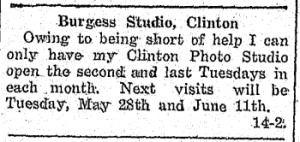
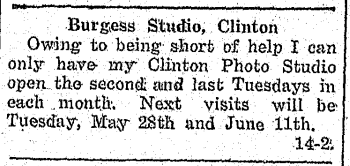
A notice posted by Walter Burgess in the May 23, 1929, edition of The Clinton News-Record
Walter Burgess operated a Clinton studio throughout the 1920s. The November 26th, 1925 edition of The Clinton News-Record mentions that Walter had only been spending one day a week at his Clinton Studio being “short of help.” A notice posted in The Clinton News-Record on May 23 1929 by Walter Burgess stated that his Clinton studio would only be open “the second and last Tuesdays in each month.” On October 1 of 1931, Walter announced that his newly-renovated Clinton studio would be open every weekday. His daughter, Miss Irene Burgess, would now be in charge of the location. Walter proclaimed Irene as “well experienced in Photography” and having “long experience with her father.” Not long after Irene became manager, Clinton residents would see the name Burgess Studios much more often in their newspapers.
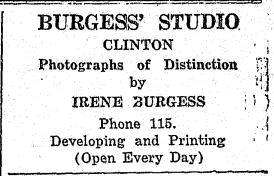
When Irene began managing the Clinton Studio in 1931, advertisements for the business began increasing. The slogan “Photographs of Distinction” appeared in advertisements from 1937 until the week of the fire. These ads were brief, only including the business name, slogan, Irene’s name, and the services provided. Earlier advertisements include one from 1933: “It is your duty to have a good photograph. Your family wants it – business often demands it.” Another example from 1932 reads, “You have plenty of leisure time to get that portrait of [the] family group taken.” The Clinton studio began under the leadership of Walter W. Burgess, but Irene would soon grow the business larger than her father had the time for– that is, until the explosion.
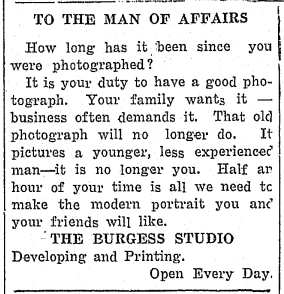
Advertisement posted in the January 26, 1933, edition of The Clinton News-Record.
The Explosion
On the afternoon of Monday, November 24, 1941, an explosion set fire to the second story of the J. E. Hovey Drug Store sweeping the entire business block. This was the place of business for Burgess Studio, Clinton. The fire swept through the building and damaged several businesses including R. H. Johnson Jewelry Store, Charles Lockwood Barber Shop, and Mrs. A MacDonald’s Millinery and Ladies Wear Shop. Irene was not in the studio when the fire started and did not call the authorities. Instead, the fire was discovered by Police Constable Elliot who identified smoke around the second-story window of the J. E. Hovey Drug Store Building. The fire was well covered in local newspapers. Featured on the second page of the Seaforth News more than a week after the incident, it was reported that the fire almost reached the “main business section of the town.” On its front page the week of the accident, The Clinton News-Record described the fire as “one of the most dangerous Clinton firemen have fought for years.” Unfortunately, Irene did not have insurance and was forced to close her business in Clinton. An update written on November 27, 1941 in The Clinton News-Record mentioned Irene’s departure for Mitchell to stay with her father for an “indefinite time.” A week later, on December 4, 1941, Irene posted a notice in the News-Record reading that, “owing to the recent fire damaging my equipment and Studio, I will be unable to continue operation.” She suggested that customers could mail their orders to the new studio. Additionally, customers could drive to her father’s studio in Mitchell and have their travel expenses paid. While this time must have been devastating for Irene, the community came together to show their support for her.
Community Support
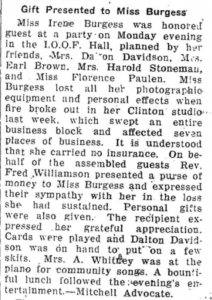
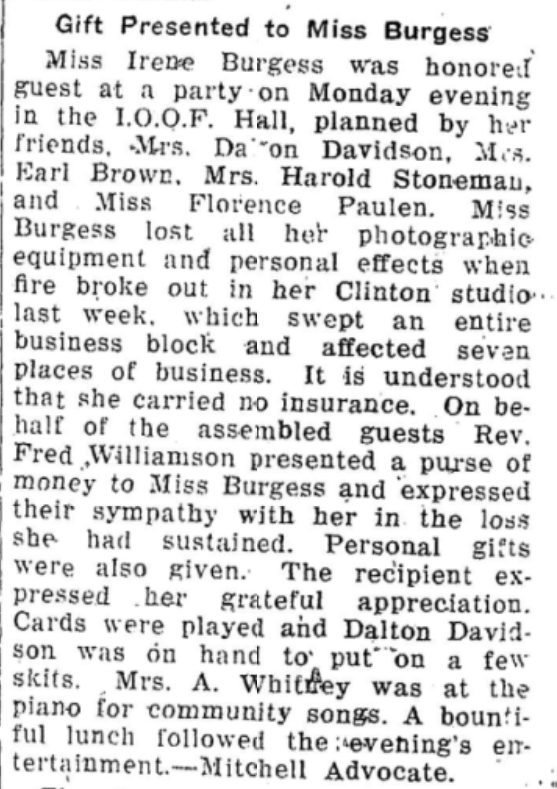
Excerpt from the December 12, 1941, edition of the Huron Expositor describing an even held in Irene Burgess’ honour.
Two weeks after the explosion, the Mitchell Advocate reported about an event held at the I.O.O.F. Hall where Irene was the “honoured guest.” The event was planned by Irene’s friends Mrs. Dalton Davidson, Mrs. Earl Brown, Mrs. Harold Stoneman, and Miss Florence Paulen. Entertainment included skits, piano music by Mrs. A. Whitney, cards, and a “bountiful lunch.” Irene received a “purse of money” and personal gifts from her friends along with their condolences. The rallying support for Irene shows the positive impact she had in the communities of Clinton, Seaforth, and Mitchell. An uplifting end to an otherwise sad story.
Conclusion
Aside from her brother’s passing in 1944, Miss Irene Burgess was seemingly never mentioned again in the Huron County Newspapers accessible through the digital newspaper portal. She would live until 1991 in St. Marys, Ontario.
Huron County’s digitized newspaper collection is a vast historical database where you can find historical stories from our own county. While performing research for the upcoming exhibit “Forgotten: People & Portraits of the County,” I came across this story which piqued my interest. Without access to the digitized newspaper collection, the story of Irene’s remarkable journey would never have been found. This post was compiled using newspaper articles between the years of 1925 and 1944. Birth and death dates were found within newspapers and using external resources.
If you have a photograph by a Huron County photographer you would like to donate or share, please contact the Museum’s archivist by calling 519-524-2686, ext. 2201 or email mmolnar@huroncounty.ca. To learn more about the Huron County Archives & Reading Room, visit: https://www.huroncountymuseum.ca/huron-county-archives/
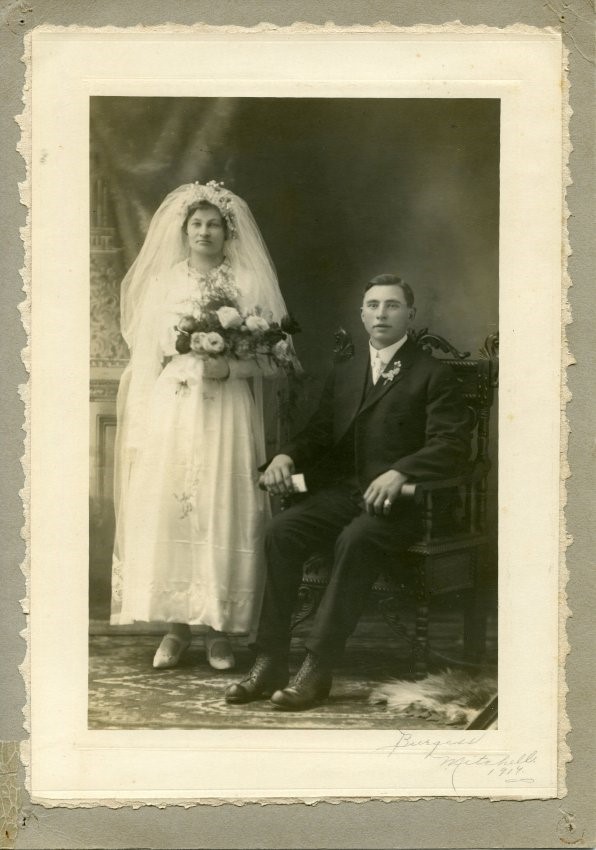
A950.1857.001 A photograph taken by Burgess Studio Mitchell in 1914. If you have a photograph from Burgess’ Studio, Clinton you would like to donate, please consider contacting the Huron County Museum.
by Amy Zoethout | Jul 30, 2020 | Blog
There has never been a better summer to get outside to explore the broad streets and to enjoy the collection of well-preserved Victorian-era buildings found in Huron County’s towns and villages. To help guide your explorations, give one of these heritage walking tours a try!
BAYFIELD
Wander through Bayfield’s heritage district, along tree-lined streets, and past harbour views with the Self-Guided Walking Tour booklet ($5) from the Bayfield Heritage Centre & Archives or Village Bookshop.
www.bayfieldhistorical.ca
BRUSSELS
After officially becoming a village in 1855, Brussels grew into a prosperous community with its own railway station, many local industries, several churches and community groups, and a main street of fine brick blocks.
www.huroneast.com
EXETER
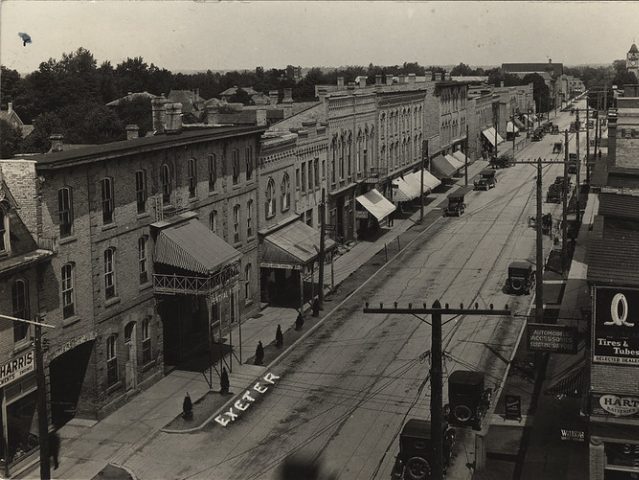
A leisurely stroll down Exeter’s Main Street will tell the stories of the historic family businesses built by Exeter’s first settlers.
www.experienceexeter.ca
GODERICH
The Goderich Municipal and Marine Heritage Committee has put together a series of four enjoyable scenic walks that explore Goderich’s rich history. www.goderich.ca
SEAFORTH
Seaforth is a quintessential small Ontario town, with a story stretching back to the early 1850s.
www.huroneast.com
VANASTRA
Visit the small community built on the historic site of a top secret Royal Canadian Air Force training base, once used to train over 7,000 radar technicians and staff for American, British and Canadian forces during World War II.
www.huroneast.com
AUDIO TOURS
Download one of the Huron County Historic Walking Tours walking audio tours from Apple Podcasts and Google Podcasts. Choose from 12 walking tours in Bayfield, Blyth and Goderich. Full list of audio tours and download links available at ontarioswestcoast.ca/things-to-do/arts-culture-heritage/heritage-audio-tours/
SUMMER IN YOUR BACKYARD
For more opportunities to explore all Huron County as a local this summer, check out the 2020 Spend This Summer in Your Backyard visitors guide. https://www.ontarioswestcoast.ca/plan-your-trip/guides/