by Amy Zoethout | Sep 1, 2021 | Blog
If you’re out touring County Roads this summer, you may notice some new brown and white heritage signs marking Huron County’s historic settlements. The project was initiated by the County’s Public Works Department as a way to remember these communities that once existed in Huron. To date, 23 signs have been erected, including three signs marking communities that still exist, but under a different name. These signs have the word ‘historic’ added to show their historic name, like Manchester, which is still a thriving community now known today as Auburn.This summer, our student Maddy Gilbert will explore the history of some of these settlements.
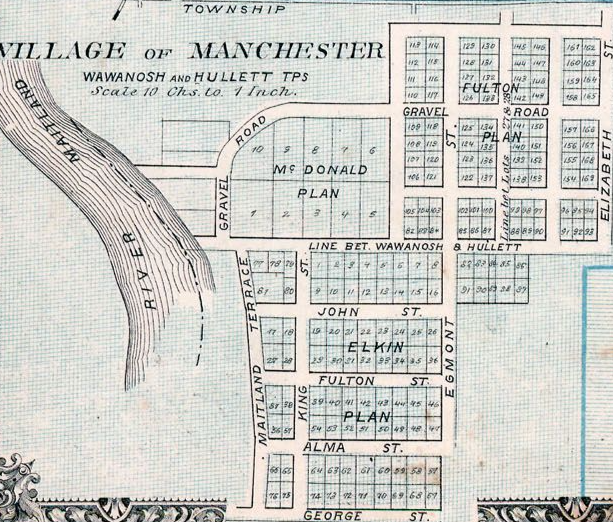
The Village of Manchester was founded in 1854 on the edge of the Maitland River where the Village of Auburn now sits. It was listed on a map from the 1860s as Manchester, but by 1879, a map of Huron County lists the village as both Manchester and Auburn. As recent as 1979, the official name for the community was the Police Village of Manchester, while Auburn was the name of the post office. But by February 1979, Manchester was no more as the village trustees voted to keep Auburn as the one and only name for the village. Since there was another Manchester located in Ontario, the change came to avoid confusion between the two communities.
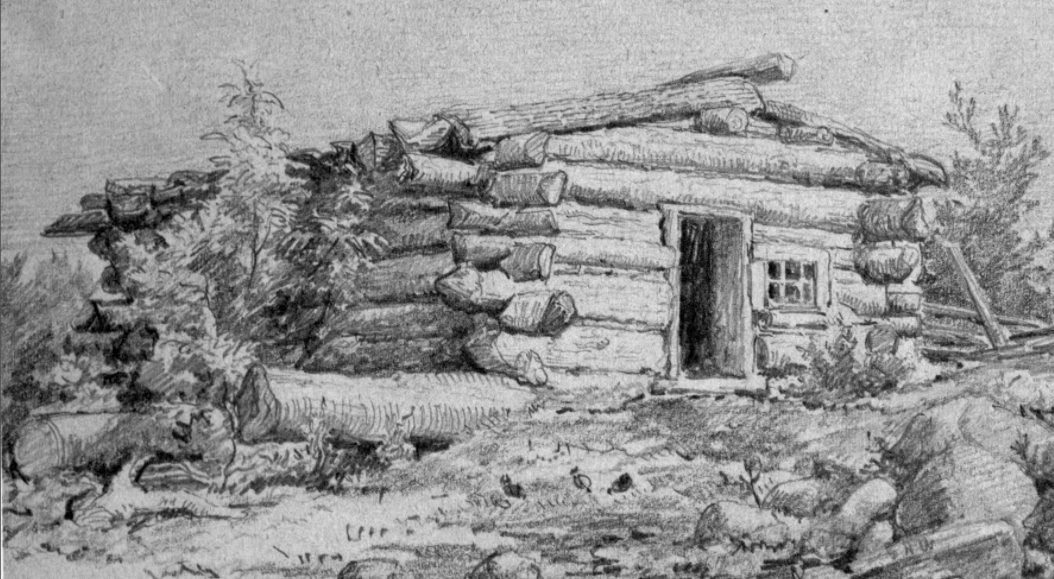
This is an example of a log shanty, much like the one Eneas Elkin would have lived in.
Isabel Elkin, wife of Eneas Elkin
Eneas Elkin was the first settler to Manchester. He walked all the way from the City of Hamilton and built a log shanty. George Elkin, son of Eneas and Isabel Elkin, was the first baby born in Manchester on April 13, 1850. The first wedding in the village was credited to be between Anne (nee McDonald) and Joseph Tewsley. Annie passed away after only one year.
For the first two years after Mrs. Elkin joined her husband Eneas in Manchester, there was only a track between Goderich and Manchester, until the Canada Company opened what is now Huron County Road #25 in 1851. Until a bridge was built, Elkin ran a ferry across the Maitland River. The first two bridges crossing the Maitland were constructed out of wood and washed away in spring floods. The third bridge was constructed partly out of steel, until the concrete bridge was constructed a few yards upstream in 1954.
Eneas Elkin surveyed Hullett Township, which was amalgamated into the Municipality of Central Huron in 2001.
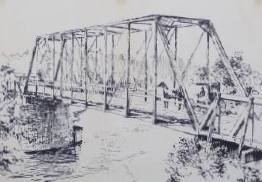
1975 Ink Print of the Auburn Bridge done by Jim Marlatt, a local artist. This bridge was in use until the new, concrete bridge was completed upstream in 1954.
By 1866, Manchester had a flour mill which shipped goods as far as Montreal. There was also a saw mill erected by John Cullis after he purchased the flour mill. The saw mill produced lumber from the logs that were cleared, to be sold as lumber for the barns being erected throughout the area. Cullis’ saw mill was destroyed by fire in 1893, and Cullis rebuilt a short distance away. The second mill was also victim to fire.
The Village had power by 1896 leading to the installation of electric powered street lamps. A.E. Cullis, who ran the grist mill, installed a direct current generator on his property and supplied power from dusk until 11 p.m. at the rate of two cents per light per night. Most villagers kept their costs down by attaching one light to a very long cord that they could move from room to room.
The Auburn CPR Station opened in 1907 with the delivery of a car-load of salt to W.T. Riddell. One delivery was a cow from Bracebridge. The station closed in 1979 and any deliveries made by train for people living in the village would have been left at the Blyth CPR Station.
The first brick bank in Manchester was the Sterling Bank of Canada, which eventually became a CIBC branch. On Nov. 14, 1930, Manchester suffered a terrible fire, which destroyed the hardware store that was located beside the bank. Mr. and Mrs. Carter were the first to notice the fire, and Mrs. Carter ran into the street yelling “fire!”. Mrs. Carter could have been the one who saved the lives of Mr. A.M. Rice and family, who resided above the CIBC, where Mr. Rice was manager.
Today, the Village of Auburn sits southeast of the intersection of Huron County Road 25 (Blyth Road) and Huron County Road 8 (Base Line). Auburn lies 20 km east from Goderich, 20 km north from Clinton, and 10 km west from Blyth.
Sources
Belden, H. “Map of Morris Township.” Illustrated Historical Atlas of the County of Huron, Ont., H. Belden, 1879.
Gropp, Bonnie, editor. “Police Village of Auburn: Settlement of Manchester Grows out of Wilderness.” The Citizen, 29 Dec. 1999. From the Digitized Newspaper collection at the Huron County Museum
Johnston, Tom. The Blyth Standard, 27 June 1979. From the Digitized Newspaper collection at the Huron County Museum
Bradnock, Eleanor. “Manchester No More.” The Blyth Standard, 27 June 1979. From the Digitized Newspaper collection at the Huron County Museum
“Craigs Took Over Sawmill in 46 .” The Blyth Standard, 27 June 1979. From the Digitized Newspaper collection at the Huron County Museum
“Eneas Elkin Walked from Hamilton to Establish Auburn.” The Blyth Standard, 27 June 1979. From the Digitized Newspaper collection at the Huron County Museum
“Isabel Elkin.” The Blyth Standard, 1979. From the Digitized Newspaper collection at the Huron County Museum
by Sinead Cox | Mar 9, 2016 | Exhibits, Investigating Huron County History, Project progress
What’s your journey to Huron County? This spring, visitors to the Huron County Museum can follow the journeys of seven families across the globe and through time in Stories of Immigration and Migration, a temporary exhibit dedicated to tales of settling in Huron County. The exhibit traces the circumstances that caused individuals within Canada and across the world to leave their former homes, as well as the migrants’ experiences building new lives in Huron. With Stories set to open on April 5th, researcher Sinead Cox shares why the journeys of some Huron County families are more difficult to research than others:
Museum staff are looking forward to shedding light on local histories that have never been featured in our galleries before with Stories of Immigration and Migration, an exhibit which spans a period from 1840 to the present day. When research started several months ago, I had the pleasure and privilege of speaking or corresponding directly with the more recent ‘migrants’ featured in the exhibit, and the opportunity to include their own words, insights and chosen artefacts. For those individuals who arrived more than a century ago, however, our research relied on archival records that often uncovered as many questions as answers.
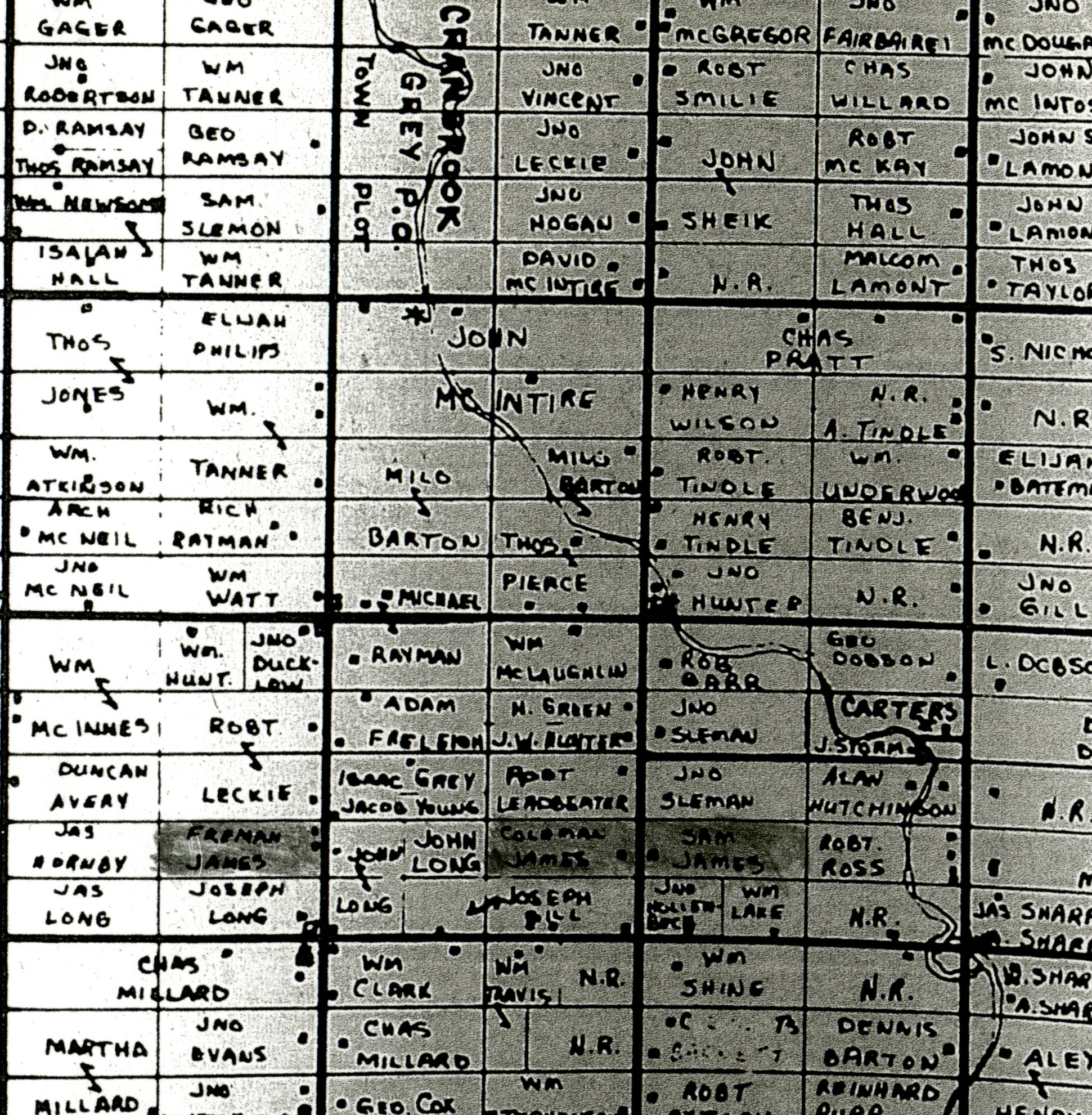
One compelling story that remains incomplete is that of Samuel and Mary Catherine James, a Black farming couple born in Nova Scotia who were some of the earliest settlers in Grey Township circa the 1850s. Nova Scotia was a destination for many former slaves from the colonial United States, including loyalists who had served the British crown during the American Revolution, in the eighteenth century. The James family also lived in Peel, Wellington County, before settling in Grey–which was part of the “Queen’s Bush” territory, rather than the Huron Tract lands managed by the Canada Company. Since the Jameses were farmers, they probably came to Huron County to achieve the same objective as most other pioneers: to own land. The James clan, including children Freeman, Coleman, Magdalene and Colin, farmed in a row on Lots 24 of Concessions 9, 10 and 12, Grey Township. According to 1861 census records, the whole family lived together in the same log house when they first moved to Huron.

Tragedy struck the James family when, in a matter of only three months–between November 1866 and January 1867–Colin (aged 23), Freeman (aged 39), and Mary Catherine (aged 77) all died. Whether their passings were related or coincidental, this unimaginable loss must have been a devastating blow to a pioneer family that relied on family members to share the burden of work. Mother and sons are buried at Knox Presbyterian Cemetery, Cranbrook.
According to land registry records, Freeman’s farm at Lot 24, Concession 12, still not purchased from the crown at the time of his death, was taken over by his sister Magdalene “Laney” James’ husband, Charles Done. Charles was also a Black farmer from Nova Scotia, and living in Howick when he married Laney at Ainleyville (now Brussels) on November 4th, 1867.
Laney and Coleman, the two surviving James siblings, each raised large families in Grey Township. In the 1871 census, Coleman and his wife, Lucy Scipio, already had eight children, five of them attending school. According to the same census, both Coleman and Laney could read and write, but their spouses could not. The family was struck by tragedy once again in April, 1873 when Coleman’s nine-year-old son, also named Coleman, died of “inflammation of [the] liver” after an illness of nine months.
Coleman sold his farms in 1875, and by the 1881 Canadian census, both he and Laney had left Huron County and relocated to Raleigh, Kent County with their families. This move to Raleigh would have enabled the James siblings to join a larger Black community at Buxton: a settlement founded by refugees that came to Canada through the Underground Railway.
The James family had relocated many times: according to tombstone transcriptions, Mary Catherine was born in Shelburne, Nova Scotia, and Colin in Digby, before the family moved to Ontario and lived in Wellington County, Huron County, and Kent. Census, birth and death records indicate that Coleman’s children ultimately settled in Michigan. Most farm families in nineteenth-century Ontario moved in search of the same benefits: a supportive community life, the ability to make a living, and good agricultural land. Black farmers, however, faced barriers of discrimination and exclusion that white settlers did not, and this sometimes necessitated leaving years of hard work behind to repeatedly seek a better life elsewhere.
It’s that moving on that can make traces of Huron County’s early Black settlers difficult to find in history books or public commemorations. The collections at the Huron County Museum, for example, are entirely acquired through donations from the community, which tends to emphasize the experiences of families that stayed here, found success, and had descendants who retain ties to the county to this day. We know less about the settlers who moved out of the county-even those who lived in Huron for decades, like the Jameses– and thus we also lack clarity about the opportunities they sought elsewhere, or the specific challenges they may have faced here.
The details I could glean from a few days’ of research did not provide enough information to interpret why the James family came to Huron County–or why they left–for Migration Stories. But I hope future research opportunities will add to this initial knowledge, and to a better understanding of the contributions and experiences of the individuals who have moved in and out of Huron County, including Black pioneers like the James family.

Special thanks to Reg Thompson, research librarian at the Huron County Library, for starting and contributing to the research used for this piece. If you have information about the James family and would like to share, contact Sinead, exhibit researcher: sicox@huroncounty.ca
You can see Stories of Immigration and Migration at the Huron County Museum (110 North Street) from April 5th until October 15th, 2016.
This post was originally published in February and republished in March after technical difficulties with the server.