by Sinead Cox | Aug 10, 2015 | Archives, Artefacts, Collection highlights, Special Events
On Saturday, August 22nd The Huron County Museum is transforming into Wonderland for a Mad Hatter’s Tea Party. In honour of the 150th anniversary of Lewis Caroll’s Alice’s Adventure in Wonderland, Summer Museum Assistant Becca Marshall shares some of her favourite facts about the nonsense-novel and its legacy.

Victorian Apartment, Huron County Museum
Have you ever visited the Victorian Apartment at the Huron County Museum? If so, you can probably picture the elaborate dining room set-up and recall the posted list of extensive etiquette required for Victorian tea time. It was social customs and rules such as these that inspired 19th century author Lewis Carroll to parody Victorian life in his fantastical novel Alice’s Adventures in Wonderland. Scenes such as The Mad Hatter’s Tea Party were influenced by Carrol’s loathing for the rigid traditions.
Carrol’s subtle digs at the Victorian culture are not the only secrets that this classic holds – so in celebration of Alice’s 150th publishing anniversary here are 14 things you might not know about Alice and the man who imagined her iconic world:
- Lewis Carroll was a pseudonym for Charles Lutwidge Dogson (born January 27, 1832 in the Cheshire village of Daresbury, England).
- The original title for the novel was Alice’s Adventures Underground. Dodgson then expressed his fears that this title might suggest a book containing ‘instruction about mines’ and then considered other titles such as “Alice among the elves/ goblins, or Alice’s hour/doings/adventures in elf-land/wonderland.” Preferring the final option Alice’s Adventures in Wonderland was the final title.

Portrait of Queen Victoria, Governor’s House, Huron Historic Gaol
3. An apocryphal anecdote circulated that Queen Victoria was such a tremendous fan of the story, that she proposed that Carroll should dedicate his next book to her, An Elementary Treatise on Determinants, With Their Application to Simultaneous Linear Equations and Algebraic Equation—probably not what she would have had in mind. Dodgson denied this story.
4. Carrol’s novels were banned in China in 1931 on the grounds that “animals should not use human language.”
- Carroll is credited with inventing the words “chortle” and “galumph” in Through the Looking Glass.
6. There is unconfirmed evidence that Carroll had a rare neurological disorder called “Todd’s Syndrome” (or suffered from similar migraine-induced symptoms). The disorder causes hallucinations that make visual objects appear to be changing sizes – often prompting the individual to feel as though their body is disproportionate. Psychiatrist John Todd discovered the disorder in 1955 and it was later named “Alice in Wonderland Syndrome” in reference to the theme of Alice and her surrounding objects shrinking and growing in odd ways throughout the book.

Illustration from Alice’s Adventures in Wonderland.
- Alice’s Adventures in Wonderland can be best classified by the genre “literary nonsense.”
- Carroll illustrated the original draft of his manuscript, but hired John Tenniel to do the published version.
- Mock Turtle Soup is a real dish that was popular during the Victorian period. The heads, hooves, and brains of calves were used as a cheaper replacement for green turtle soup.

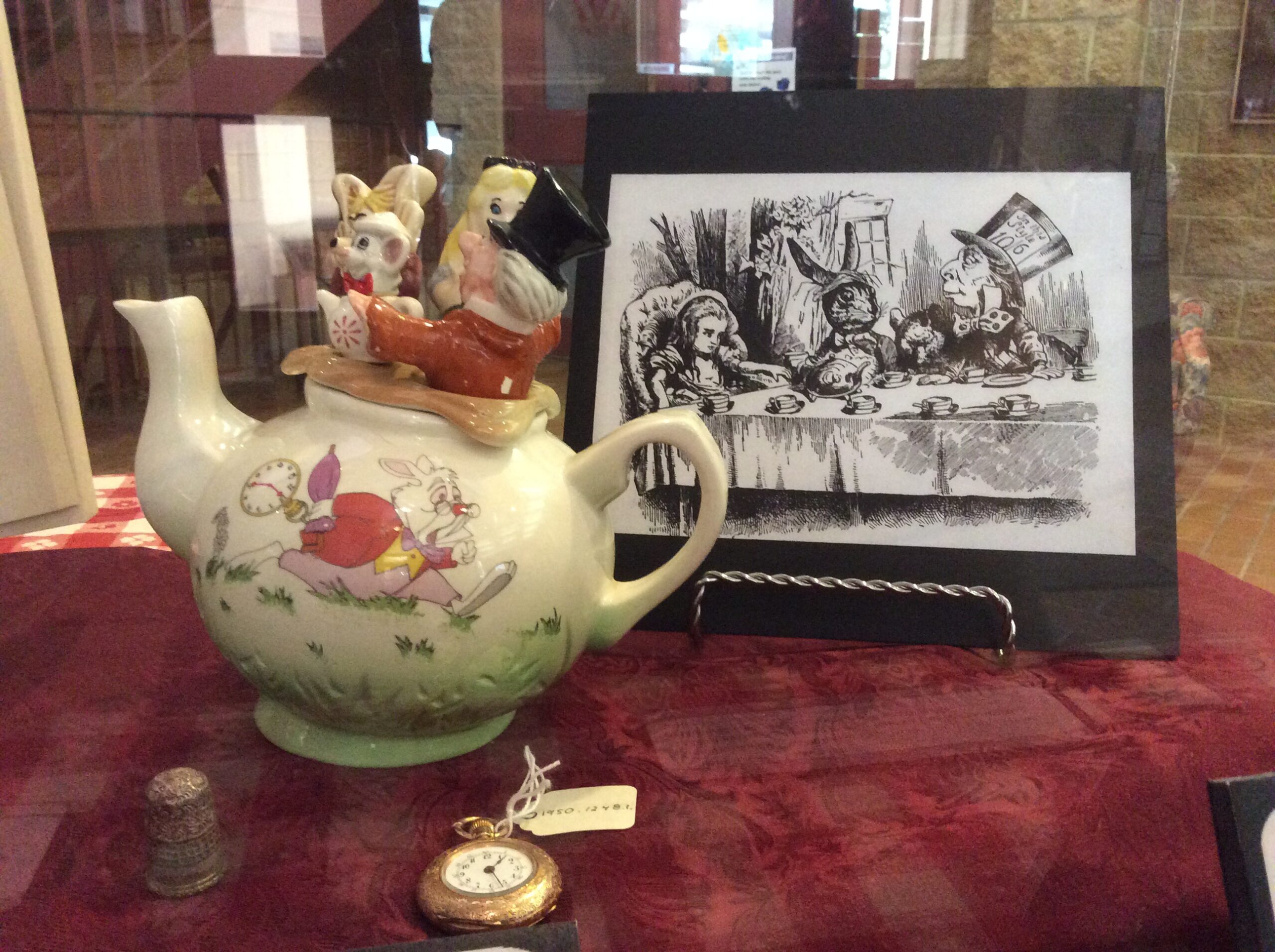
Mad Hatter’s Tea Party Display, Upper Mezzanine, Huron County Museum
- It was young Alice Liddell who inspired the famous novel. During a group boating trip with the Liddels Alice and her two sisters begged Carrol for a story. Happy to oblige Carrol cast Alice as the main character (her sisters Lorina and Edith were ‘Elise and Tillie’ in the Dormouse’s story) and began creating ridiculous adventures for her to go on. Alice enjoyed the story so much that she demanded that Carrol write it down – thus creating the first draft of the book.
11. Why does the Mad Hatter have a 10/16 sign on his hat? Carroll answered this in the abridged “Nursery” Alice for younger readers, explaining that the Hatter would carry around his hats to sell, and the one he wore was no exception. The 10 and 6 are for “ten shillings and six pence.” This was a rather pricey sum in the Victorian age, alluding to superior quality and style.
12.To answer the Mad Hatter’s famous question “Why is a raven like a writing desk?” we have Carroll’s very own words, from a preface to later editions of the book…

China Cabinet, Victorian Apartment, Huron County Museum
“Enquiries have been so often addressed to me, as to whether any answer to the Hatter’s Riddle can be imagined, that I may as well put on record here what seems to me to be a fairly appropriate answer, viz: ‘Because it can produce a few notes, tho they are very flat; and it is nevar put with the wrong end in front!’ This, however is merely an afterthought; the Riddle as originally invented, had no answer at all.” (Note how Carroll spelt “never” instead as a backwards “raven.”)
That’s a wrap, did you know any of these facts? Come join the Huron County Museum August 22nd to learn more and celebrate the 150th publishing anniversary of Alice’s Adventures in Wonderland at the Mad Hatter’s Tea Party from 11-4:30. Games, activities, refreshments and desserts await!

Mad Hatter’s Tea Party Display, Curated by Becca Marshall
by Elizabeth French-Gibson | Mar 23, 2015 | Archives, Collection highlights
By Emily Beliveau, Digital Project Assistant

Cover image from the pamphlet ‘Sweets,’ from the Huron County Museum Collection, Object Id: 2005.0001.011. Original size: 18 cm x 11.4 cm.
We recently rediscovered this “Sweets” pamphlet while researching cookbooks and recipes for our upcoming exhibit Delicious. At first glance, it appears to be nothing more than a small newsprint booklet of candy recipes. Looking closer, its true purpose becomes clear: it’s a promotional vehicle for Lydia E. Pinkham’s Vegetable Compound, a herbal remedy marketed to cure all manner of womanly ailments.
Lydia E. Pinkham (1819-1883) became a successful businesswoman by commercializing a home remedy to treat a variety of female health complaints, such as irregular menstruation, symptoms of menopause, nervous disorders, and childlessness. She started making her concoction in her kitchen in Lynn, Massachusetts, and eventually expanded the business into an international manufacturing enterprise with production centres in the United States, Canada, and Mexico.

Pages 8 and 9 of ‘Sweets’ pamphlet, featuring recipes for Crystallized Fruit, Fruit Cream, Cocoa Fudge, Peanut Butter Fudge and testimonials regarding the use of Lydia E. Pinkham’s Vegetable Compound and Blood Pills for treating suppressed menstuation.
Lydia E. Pinkham’s Vegetable Compound came in tablet or liquid form and contained black cohosh (Cimicifuga racemosa), life root (Senecia aureus), unicorn root (Aletris farinosa), pleurisy root (Asclepias tuberosa), and fenugreek seed (Trigonella foenum-graecum). It’s effectiveness has never been medically proven. The liquid form contained 18% alcohol.
Pinkham’s remedies were aggressively marketed, making the Vegetable Compound the most popular among a multitude of other patent medicines. It’s direct woman-to-woman consumer marketing combined with published testimonials from users, led to its phenomenal success. In 1925, its most profitable year, sales of Vegetable Compound grossed $3.8 million.
By the time Pinkham died in 1883, she was a household name and one of the most recognizable women in America due to the ubiquity of her image in newspaper ads and on product packaging. After her death, her family ran the business until 1968, when it was sold to Cooper Laboratories of Connecticut. Lydia E. Pinkham’s Vegetable Compound is still sold today as a herbal remedy.

Ad for Lydia E. Pinkham’s Vegetable Compound from the St. John Daily Evening News, 17 April 1883.
Further reading and additional resources:
Biography and more Pinkham Pamphlets from Harvard University Library
Blog post about Lydia E. Pinkham from the Museum of Heath Care
Background information about patent medicine from the Smithsonian
by Elizabeth French-Gibson | Oct 31, 2014 | Archives, Collection highlights
By Emily Beliveau, Digital Project Assistant

Happy Halloween! Behold this postcard image from our collection featuring pumpkin-headed melon people cutting a cake to mark the day. Every year, I marvel at this image and wish that vegetable people were still a common Halloween motif. The postcard itself was sent on October 31, 1908 from Helen to Mrs. G. H. Green in Goderich, and is part of a series of Hallowe’en postcards by British publisher Raphael Tuck & Sons. These kinds of postcard images were very common during the postcard boom of the late 1800s and early 1900s, and if you’re looking for more, check out some additional examples from the Toronto Public Library’s Halloween postcard collection.
by Elizabeth French-Gibson | Aug 29, 2014 | Artefacts, Collection highlights, Exhibits
By Emily Beliveau, Digital Project Assistant

A mounted passenger pigeon (Ectopistes migratorius) from the Huron County Museum collection, Object ID: N000.1713.
In 1914, the passenger pigeon became extinct. The last known survivor of the species was a female named Martha (after Martha Washington), who died at the Cincinnati Zoo on September 1, 1914 at 1:00pm. Only 50 years earlier, passenger pigeons were so abundant that giant flocks darkened the sky for hours at a time as they passed overhead. How did the most populous bird in North America become extinct? The short answer: humans. The destruction of forest habitat along with unrestricted commercial hunting annihilated the species over the course of several decades.
The passenger pigeon was a species of pigeon most closely related to the mourning dove, with a nesting range around the Great Lakes and a migration range from central Ontario, Quebec, and Nova Scotia in the north, to the uppermost parts of Texas, Louisiana, Alabama, Georgia, and Florida in the south. Communal in nature and capable of flying at 60 miles per hour, huge colonies of passenger pigeons travelling and nesting were a noisy, messy spectacle. An 1866 account from southern Ontario described a migrating flock that was 1.5 km wide and 500 km long and took 14 hours to pass through the sky. Nesting groups could easily cover 100 square kilometers, with 500 birds per tree.
Imagine the scene. Birds several deep on the branches, a constant roar of wings as birds take off and land, the smell of droppings and of the pigeons themselves—people say you could smell the passing flocks—the crack of branches. So many birds that a man in Ohio could remember firing a 12-gauge pistol into a bush in the dark and bringing down 18 pigeons with the shot. And every hawk, owl, crow, raven, vulture, fox, raccoon, and weasel within miles getting fat feeding on eggs, unfortunate nestlings, and awkward squabs fresh from the nest.
–From “The Passenger Pigeon: Once There Were Billions,” an essay from Hunting for Frogs on Elston, and Other Tales from Field & Street by Jerry Sullivan

News item from The Essex Record (Windsor, ON), April 2, 1875, p.2
Because the birds were so plentiful, the passenger pigeon was an important food source, first for the indigenous population of North America, and later for colonial settlers. When commercial hunters began selling large numbers of birds at city markets in the early 1800s, the decline in population first became noticeable. By the time legislators starting passing laws to restrict hunting the birds, it was too late for the population to recover. Deforestation, wholesale slaughter, a low reproductive rate (one egg per season), and an inability to survive in small colonies all contributed to the irreversible decline of the species. By the late 1890s, wild passenger pigeons were exceedingly rare, and despite large sums offered for live captures to use for breeding, no rewards were ever claimed.
The Huron County Museum is extremely fortunate to have a taxidermied specimen in its collection, which is on exhibit in the upper Mezzanine this fall to commemorate the 100th anniversary of the passenger pigeon’s extinction and efforts to prevent future human-related species decline.
References and further reading:
Project Passenger Pigeon
The Passenger Pigeon, Encyclopedia Smithsonian
by Elizabeth French-Gibson | Mar 21, 2014 | Archives, Collection highlights, Image highlights
By Jenna Leifso, Archivist

G.C. Heath and friend, about 1940-1945. Photo by J. Gordon Henderson. A992.0003.692. Rights: Public Domain
Your training is done and you’re about to go back to the war in Europe or the Pacific but you have to leave behind your new wife or girlfriend in Canada. What do you give her to remember you by? A popular option for those in the Royal Canadian Air Force or the Royal Air Force during WWII was the Sweetheart Pin. Similar in appearance to official badges, but with a slightly more feminine look, Sweetheart Pins came in a variety if shapes, sizes, and colours. Some were even made with semi-precious stones!
Sweetheart Pins were privately purchased by men to give their girlfriends or wives and often indicated their service branch. The woman in the picture is wearing an RAF Sweetheart Pin on her blouse. She most likely received it from her friend in the photograph.
New Zealand, Australia, Canada, and Britain all had their own versions of Sweetheart Pins.
by Elizabeth French-Gibson | Mar 12, 2014 | Collection highlights
By Emily Beliveau, Digital Projects Assistant
In September, I posted a picture on the Museum’s Facebook page as an example of the WWII-era wedding photographs in the Henderson collection. What I didn’t know at the time is that the wedding dress in the picture was donated to the museum in 2007. Thanks to our Registrar, Patti Lamb, we’ve now made a match between the photo and dress.

Mr. and Mrs. J Wilson, April 1941. Photo by J. Gordon Henderson. A992.0003.560a. Rights: Public domain.
Miss Phyllis Mary Lawrence of Goderich and Corporal John Wilson (RAF) of Sheffield, England were married Wednesday, 16 April 1941 at St. George’s Anglican Church in Goderich. Corporal Wilson was stationed at No. 31 Air Navigation School, Port Albert. Phyllis was the first Goderich girl to marry a British airman from Port Albert.

Closeup of Mrs. Phyllis Wilson’s wedding dress, made by the bride’s mother Pearl (Morris) Lawrence. 2007.0023.003a. Image rights: Copyright Huron County Museum & Historic Gaol
So, how did we not know about this connection before? The short answer is that we had no easy way of knowing, short of recognizing the dress and the photo and putting it together.
The picture of the couple came into the museum collection in 1992, as one negative among thousands that make up the collection of J. Gordon Henderson’s professional photography career. The image was marked “Mr. and Mrs. J. Wilson,” but that information wasn’t added to our collections database until we started working on the Henderson Digitization Project (archival collections are often described at the fonds, series, or file level, rather than item-by-item).
The dress came into the collection in 2007, donated by the bride’s daughter Mary. Since then, the dress has been on exhibit at the museum twice and it was from one of these exhibits that Patti recognized the photograph. Although the museum (unknowingly) had the original negative in the archives, Mary brought the family copy of the Henderson wedding photo to accompany the dress while on exhibit, making the connection that Patti remembered.

Mrs. Wilson’s veil, photographed by the Huron County Museum (left) and shown in her wedding portrait (right).

Mrs. Wilson’s wedding bouquet fabric, photographed by the Huron County Museum (left) and shown in her wedding portrait (right).
Usually, we make these kinds of connections through our internal collections database. In this case, pulling up all the records with the last name Wilson would have indeed made the match, but doing that kind of cross-referencing for more than 850 Henderson images among over 50,000 catalogue records is not in our day-to-day time budget. Now that we know about it, though, we’ve linked the two records together in the database so that anyone searching in the future will know the photo and the dress are related.
In short, matchmaking isn’t just for weddings and romance, it works for museum collections, too.