Recollections of a Registrar

Recollections of a Registrar

As the Huron County Museum & Historic Gaol’s Registrar, Patti Lamb, prepares to retire, she takes a look back at some of the memorable moments from her 29-year career.
 
Wow…29 years! For 29 years I have been enveloped in the fabric of this building we call the Huron County Museum. In September 1994, I surely could not have imagined that my part-time job on evenings and weekends (taken so a new Mom could get out of the house and enjoy adult interaction) would become a rewarding, fulfilling, and exciting 28-year full-time career in the museum field.

Each day has brought a smile to my face and as I reflect on the changes, the people that have come in and out of my life, the artifacts, and the work we do, I am overwhelmed with emotion. I’ve watched students grow and mature to fantastic professionals in a variety of occupations, many in the museum/history field.

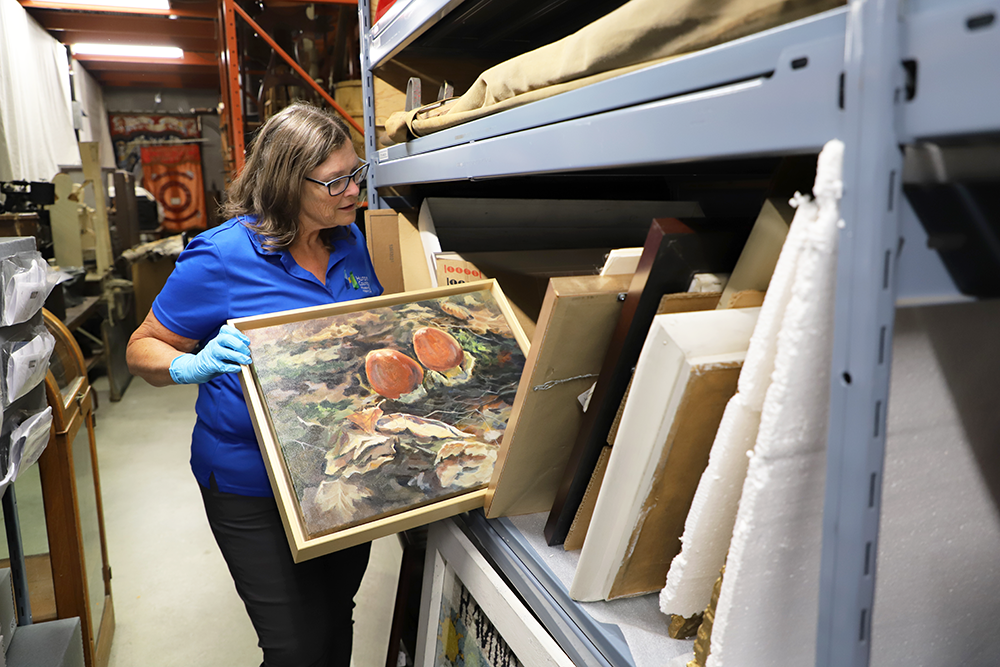
There have been so many memorable moments for me. As a Registrar, I get to look at, hold, catalogue, and photograph the objects that come into the Museum.

Some of the highlights of my career include:

    • Cataloguing William “Tiger” Dunlop’s silver cup with an 1817 gold sovereign inlaid in it. The silver cup was left to Tiger’s sister Janet in his will and, having been passed down through generations, it finally made its way to the Museum.
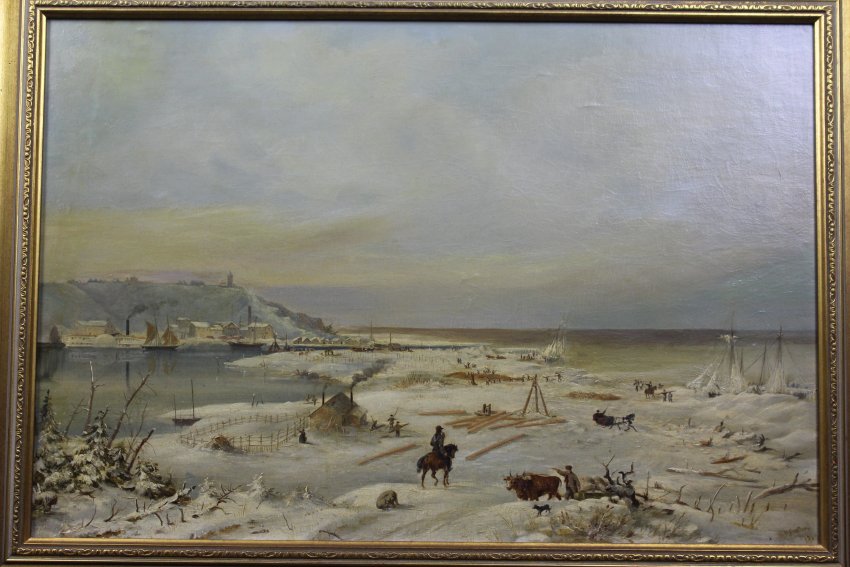
    • Retrieval of a large oil painting dated 1861, of the Goderich Harbour by renowned Huron County artist William Nichol Cresswell.
    • Transfer of objects recovered from the SS Wexford, one of the cargo ships lost on Lake Huron during the Great Storm of 1913.
    • The discovery of studio backdrops that were once used by photographer Rueben R. Sallows at his studio in Goderich. R.R. Sallows was a brilliant photographer ahead of his time.
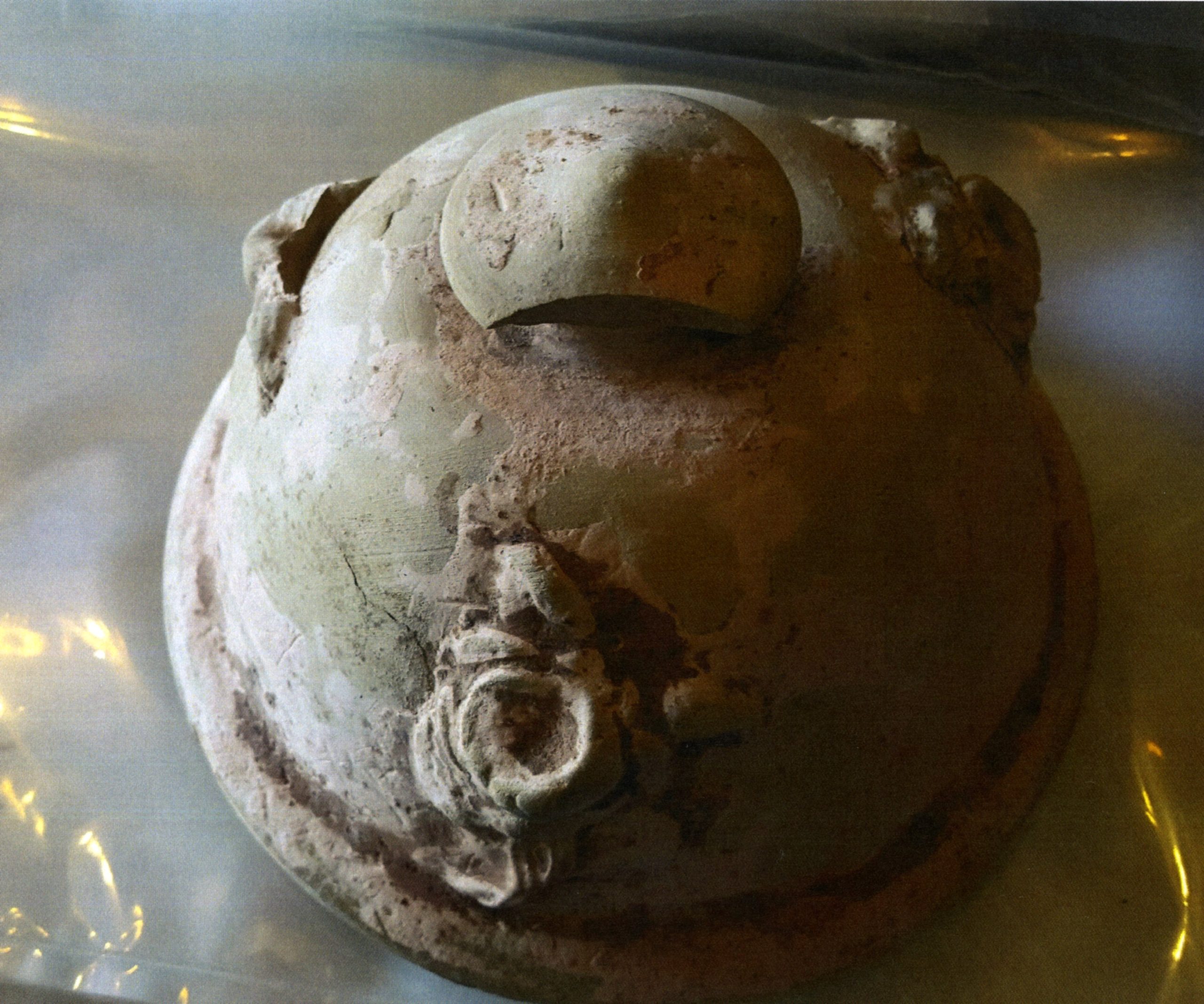
    • Rehousing of intricate sprig molds, molds, tools and kiln furniture, intact jugs, crocks, jars, flowerpots, and bowls from the Huron Pottery archaeological dig conducted by archaeologist David Newlands. The Huron Pottery in Egmondville was one of the oldest and longest running potteries in Ontario operating for nearly 60 years, from 1862 – 1910. The opportunity to discuss the dig and the artifacts with archaeologist and author David Newlands was very exciting.
    • Accessioning artifacts that belonged to Canadian short story writer Alice Munro. The artifacts included some personal items, books, and several writing awards including the Nobel Prize in Literature which she won in 2013. To be able to hold the Nobel Prize in my hands was nothing short of awe inspiring.

    As much as these artifacts are incredible and certainly historically significant both locally and nationally, it is the objects and stories of everyday people that I am most drawn to. Their photographs and prized possessions passed down through their families tell the tales of everyday life, of joy and celebrations, of sorrow and hardship, and give a glimpse of what life must have been like growing up, living, and working in Huron County. I’m truly honoured to have been a small part of their stories as we strive to share and preserve our Huron County histories with future generations.
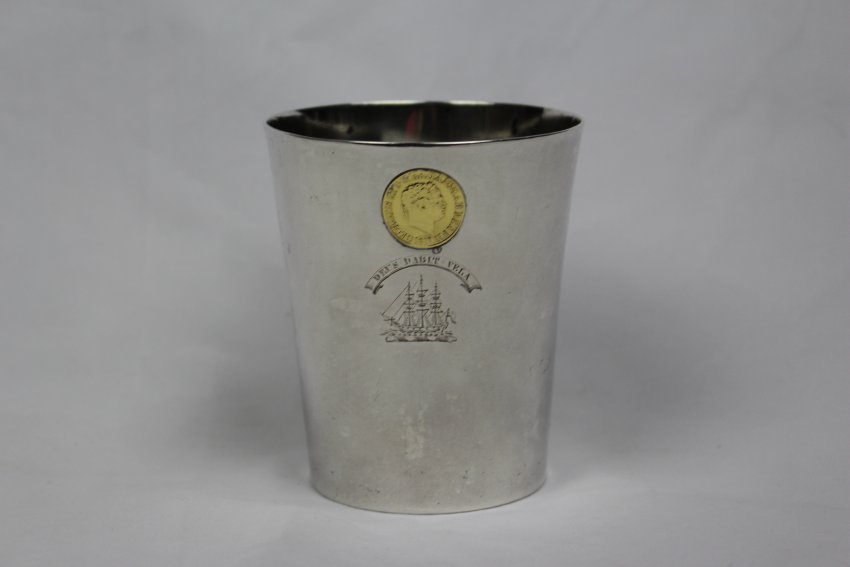
    Image of Tiger Dunlop's cup

    Tiger Dunlop’s cup. 

    Image of Tiger Dunlop's cup

    Cresswell’s painting

    Image of Sallows photography studio back drop

    Mold for water vessel lid
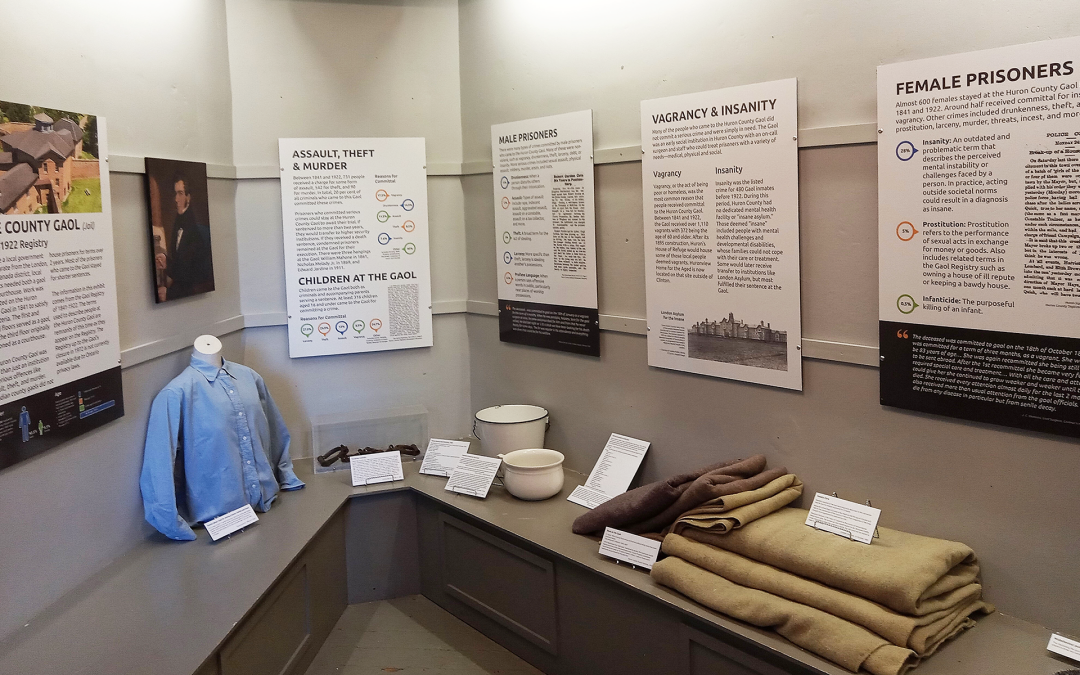
    New Huron Historic Gaol exhibit shares historical data about prisoners

    New Huron Historic Gaol exhibit shares historical data about prisoners

    Written by museum assistant Kevin den Dunnen, who is working on exhibit research projects this summer.

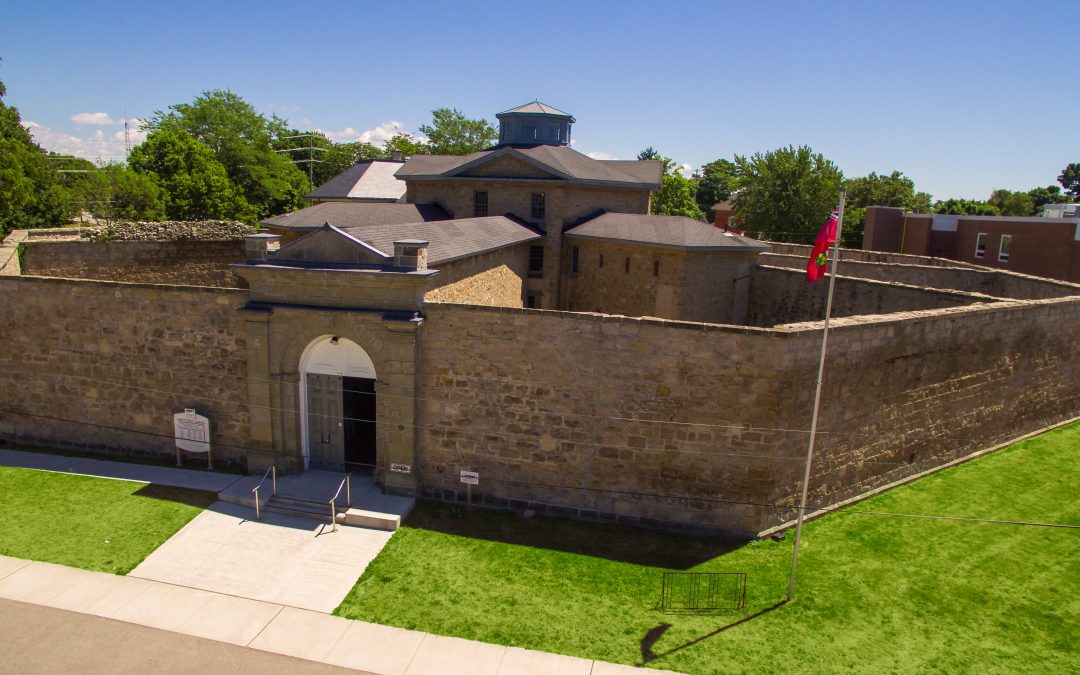
    Over 6,600 people came through the Huron County Gaol’s long and narrowing hallway between 1841 and 1922. For each entry into the Gaol, employees recorded information about that person such as the crime they committed, the institution they transferred to, their age, height, eye colour, relationship status, residence, religion, sentence length, etc. This registry is essentially a brief snippet into a person who, in many cases, would otherwise never have such detailed information about their lives presented for historical interpretation. A new exhibit at the Huron Historic Gaol presents an analysis of the people who came to the Gaol through the registry up until 1922. While the Gaol operated until 1972, due to privacy restrictions, staff can only access registry entries after they are 100 years old.

    Interpreting more than 6,600 distinct entries in the Gaol Registry presents a challenge to museum staff who must comb through this information to provide accurate data about the prisoners of the Gaol. As part of my programs at school, I interpreted quantitative data and presented visually engaging infographics for public audiences. It was during my employment at the Huron County Museum & Historic Gaol last summer that I recognized the Gaol Registry is compatible with business intelligence software I used in school. This allowed me to present the data as an interactive infographic, giving Museum staff the ability to easily analyze information such as the crimes committed, residence, and religion of prisoners at the Gaol. In this way, staff can answer questions such as the makeup of crime from differing communities in Huron County in a matter of minutes rather than hours.

    With so much information available, much of the information in the Gaol Registry did not make it into the new exhibit. For instance, the makeup of prisoner height is difficult to correlate into an overarching exhibit theme. In this blog, however, I can tell you that the most common height for male prisoners was 5’ 8” with 13.6%, while 5’ 6”, 5’ 7”, and 5’ 9” round out the top four and are each above 10% of the male prisoner population. For female prisoners, 5’ 5” was the most common height with 17.7%, while 5’ 2”, 5’ 4”, and 5’ 3” fill out the top four with each above 11% of the female prisoner population.

    The crime demographics for places of residence is another interesting data set that did not make it into the exhibit. For Goderich-based prisoners, drunkenness was the most common crime with vagrancy second. Prisoners registered from Wingham most commonly committed larceny with vagrancy second. Prisoners from Seaforth most often came in for vagrancy, followed closely by assault and then drunkenness. Prisoners from Exeter most often committed larceny, followed by assault and then vagrancy.

    Since Huron County was one of the last dry counties in Ontario, temperance, or the act of professing abstinence from alcohol, was commonly recorded by gaol staff. Some stories relating to temperance feature in the new exhibit, but it is possible to analyze this information further using business intelligence software. For instance, Clinton prisoners recorded one of the highest percentages of temperance. Almost 48% of prisoners from Clinton were temperate. We can analyze this data another step through gender. 85% of females from Clinton declared temperance. In comparison, Gaol staff recorded 34% of Goderich residents as temperate. 49% of female prisoners from Goderich were temperate. We can further interpret the Clinton dataset using religion. While almost 20% of all prisoners from Clinton were Methodist, 43% of temperate prisoners from Clinton were Methodist.

    The last information I will share with you in this post is marital status. 54% of prisoners who came through the Gaol’s long, narrowing hallway, were single, 40% of prisoners were married, and 6% were widowed. This information remains consistent within a few percentage points across residences like Goderich, Exeter, Lucknow, Seaforth, Wingham, and Clinton.

    These are but a few facts outlined in the registry and staff continue to use these details as they research prisoners and their lives at the Gaol.

    Want to learn more about the lives of prisoners from the Huron County Gaol? Come visit the new exhibit and speak with our staff about the Gaol Registry.


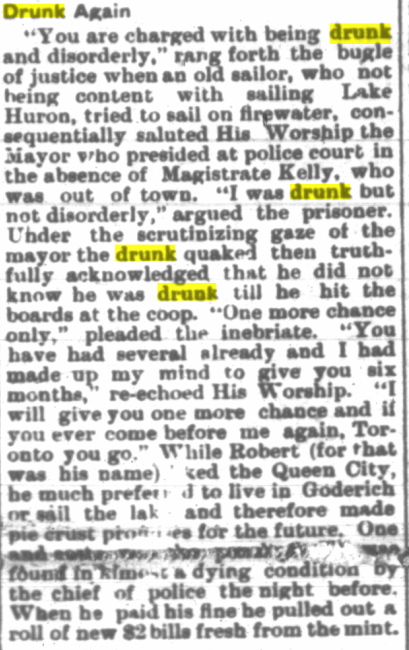
    Image of a clipping from the Goderich Signal published November, 1913

    From the Huron Historic Newspaper collection. Published in The Signal, 1913-11-6, Page 6 

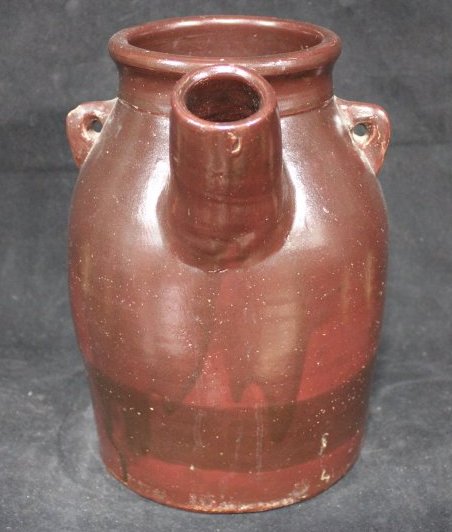
    Image of a whisky jug from the Museum's collection

    The owners of this whisky jug came by boat to Goderich then walked through the Queens Bush to homestead near Teeswater and Langside. The jug was carried slung over a stick on the back of a man when he walked through the Queens bush to barn and house raisings. The MacDougall’s often went to raisings 50 miles away (Goderich) after clearing bush near Langside, Bruce County. Object ID: M9590109001

    Historic Places Days – Ice Cream Social

    Historic Places Days – Ice Cream Social

    Written by museum assistant Julia Jim, who is helping to coordinate this year’s National Historic Places Days event.

    As we prepare to celebrate National Historic Places Days this Sunday, July 9, at the Museum with a free ice cream social, we take a look back at one of Goderich’s own ice creamery, Bisset’s.

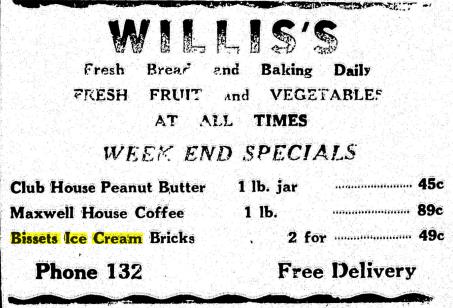
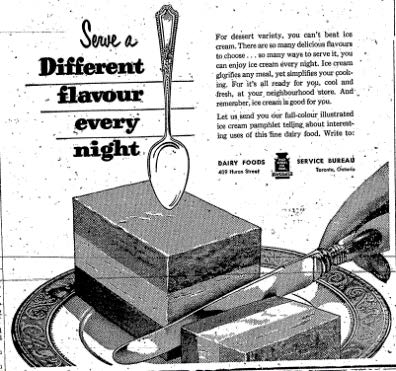
    Bissett’s earned its popularity as one of the first dairies in Ontario to introduce milk in pre-packaged glass milk bottles. During the early 1900s, the family business decided to develop the dairy into a creamery that produced butter and ice cream for the county. An ad from The Brussels Post newspaper from 1965 promoted 2 bricks of Bissett’s ice cream at 49 cents! There are many other stories throughout Huron County’s local newspapers that dive deeper into the County’s love of the creamy, frozen dessert. An advertisement from Dairy Foods Service Bureau reminds readers that ice cream is good for you!

    Within our diverse collection here at Huron County Museum, we hold many artifacts from Bisset’s Dairy and Creamery. During your visit, we encourage you to walk through our Main Street Huron gallery to view our Bisset’s Ice Cream sign hanging just outside the General Store. This is the perfect location to snap a
    selfie for the National Trust Selfie Contest which runs from July 8-31!

    To enter the selfie contest, simply take a selfie at either the Museum or Gaol, share it on social media tagging @HuronCountyMuseum and @NationalTrustCA and using #HistoricPlacesDays and #HPDContest2023 for a chance to win $1,000 for yourself as well as $1,000 for the Museum! There are several other great prizes available to win, including Parks Canada passes and VIA Rail travel vouchers. Draws will take place throughout the month, so post often and share what these historic places mean to you! For full contest details, visit: historicplacesdays.ca/contests/.

    Historic newspaper advertisement for Willis's advertising Bissets Ice Cream bricks two for .49 cents

    The Brussels Post, 1965-02-11, Page 8. Source: Huron County Digitized Newspaper Collection

    Clinton News-Record, 1951-05-17, Page 8. Source: Huron County Digitized Newspaper Collection

    Music at the Huron Historic Gaol

    Music at the Huron Historic Gaol

    Written by museum assistant Talia Collins, who is helping to coordinate this year’s National Historic Places Days event.

    Despite the dreary nature of the Huron Historic Gaol, music would often fill the halls of the Gaol. This music was able to help brighten the lives of both the prisoners and the staff alike. It was a welcome relief from the footsteps of the guards doing walk around and the creaks of the metal cells doors, reminding them of their imprisonment.

    One such instance of music filling the hallways was in 1951, coming from Lucille Martin, a volunteer for the Salvation Army. She recounts visiting the Gaol about once a month with her fellow volunteers to sing to the prisoners. The purpose of these visits was as an act of kindness towards the prisoners, a sentiment that was shared by many of the locals. Martin also recounted people throwing candy over the wall as gifts for the prisoners as they were walking by.

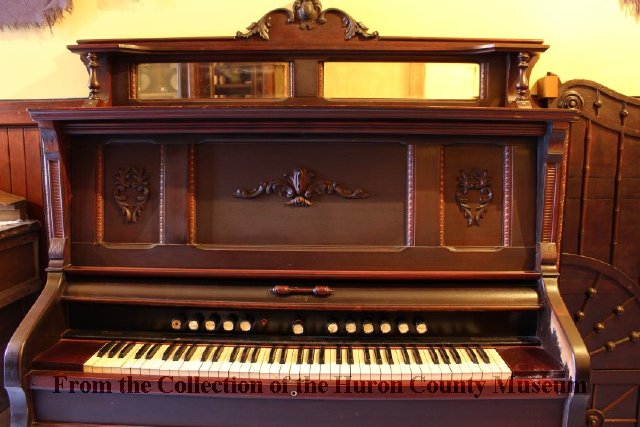
    Another instance of music was from the Gaoler, Joseph Griffin’s, daughter, Winifred Griffin, who would play the organ for the local church. Her practicing could be heard throughout the Griffin’s home and the attached Gaol, bringing life to the otherwise solemn building and residence alike.

    Today, music rarely finds home in the Gaol, but on Sunday, July 9, to celebrate National Historic Places Days, there will be performers at the Gaol once more! We are excited to welcome the Bayfield Ukulele Society and Elsie Puska, a skilled harp player from Huron Harp School, to liven up these halls once again with their music. Along with music, there will be games, free admission, and selfie station to take part in the Nation Historic places selfie contest. At the Huron County Museum, an ice cream social is going to be held with even more games, activities, and, of course, free admission!

    Image of Mahogany pump organ manufactured by W. Doherty Piano & Organ Co, Clinton, Ontario, which produced organs from 1875 to 1960’s. Object ID M995.0007.001

    Mahogany pump organ, an early 1900s model pump organ manufactured by W. Doherty Piano & Organ Co, Clinton, Ontario, which produced organs from 1875 to 1960s. Object ID M995.0007.001

    Eloise A. Skimings – The Poetess of Huron County

    Eloise A. Skimings – The Poetess of Huron County

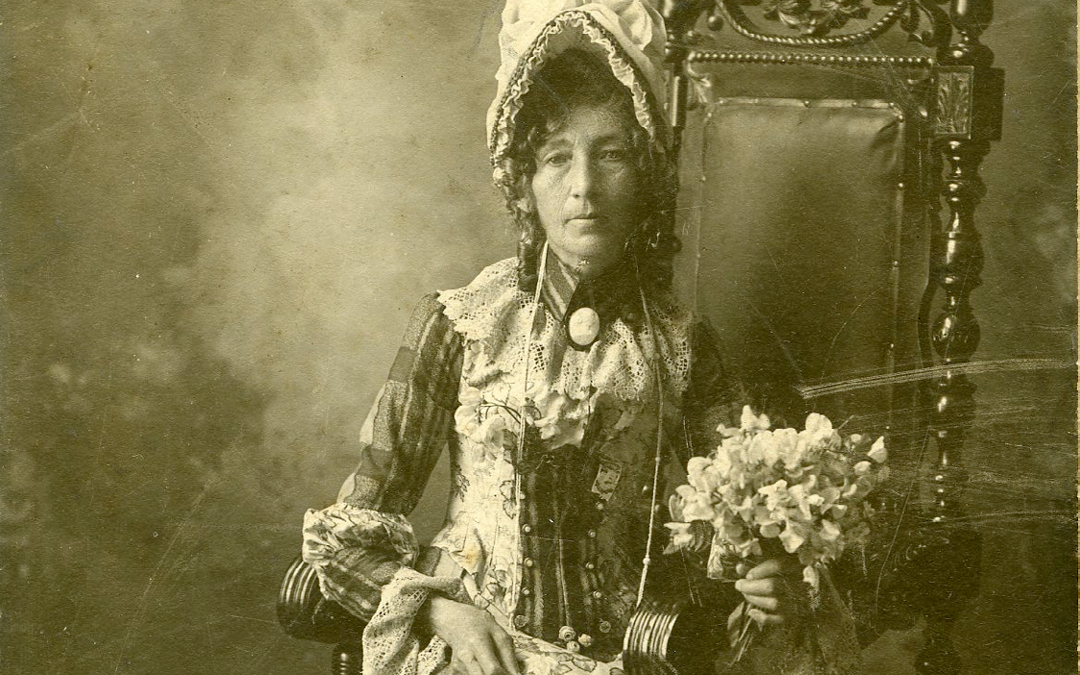
    Eloise Ann Skimings was a poet, musician, music teacher, composer, newspaper columnist and author. She was described as “one of Goderich’s best-known citizens” and also “The Poetess of Lake Huron”.  She was often seen in Goderich wearing elaborate dresses, hats, gloves and a parasol, and was described, by many, as “our distinguished townswoman”. 

    Eloise was born in Goderich on Dec. 29, 1837, to Mary Rielly Mason Skimings and James Skimings. She had two brothers, William and Richard, and one sister, Emma Jane, who died at two years, seven months.

    Eloise was one of photographer Reuben Sallows’s favourite models. Her photos were reproduced as postcards and some can be found in the Huron County Museum’s collection as well as the prints. A large oil painting of her hangs in the Museum’s Victorian Apartment display above the fireplace.

    As an author, she dedicated many poems to the people she encountered during her lifetime and the subject of many of her poems reflect the land, life and times she lived in. She published a book of poetry Golden Leaves in 1890, which was lengthened to nearly 1,000 poems when it was reprinted under the same title in 1904. Her brother, lawyer and lieutenant Richard Skimings, was also an author of poetry and prose. Twenty pages of Golden Leaves were set aside for publication of his verse versus 326 pages for hers.

    Golden Leaves was exhibited in the Library of the Women’s Building at the Chicago World’s Columbian Exposition (World’s Fair) in 1893. This book was one of only two, penned by Canadian women, to be exhibited within that library building.

    Also a music teacher, she composed and published music such as I think of Thee, Alice, National March, Forget Me not Waltz, and Golden Blossoms.

    The archival fonds at the Huron County Museum consists of textual records and other material created and accumulated by Eloise A. Skimings during her career as a newspaper correspondent, teacher, poet, and composer in Goderich.  During her lifetime she received much correspondence and letters, including thank-you letters, letters from her family & friends, news correspondence from her time at the Clinton News-Record, and payments for her poetry book. Some of these letters were written by well-known people of the time, from political figures to royalty. A finding aid can be found on the Museum’s website – Huron County Archives | Huron County Museum for researchers interested in reading more. 

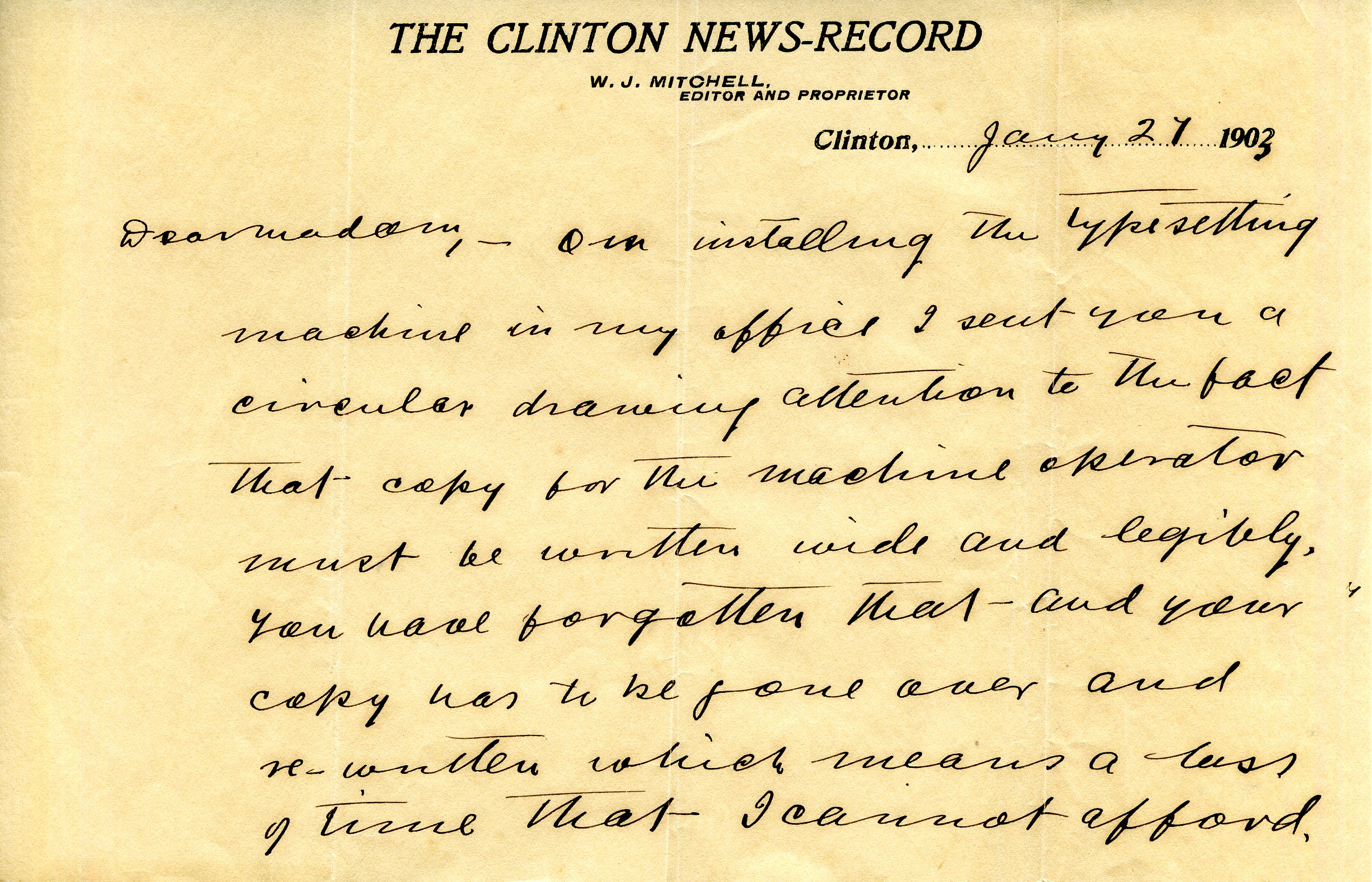
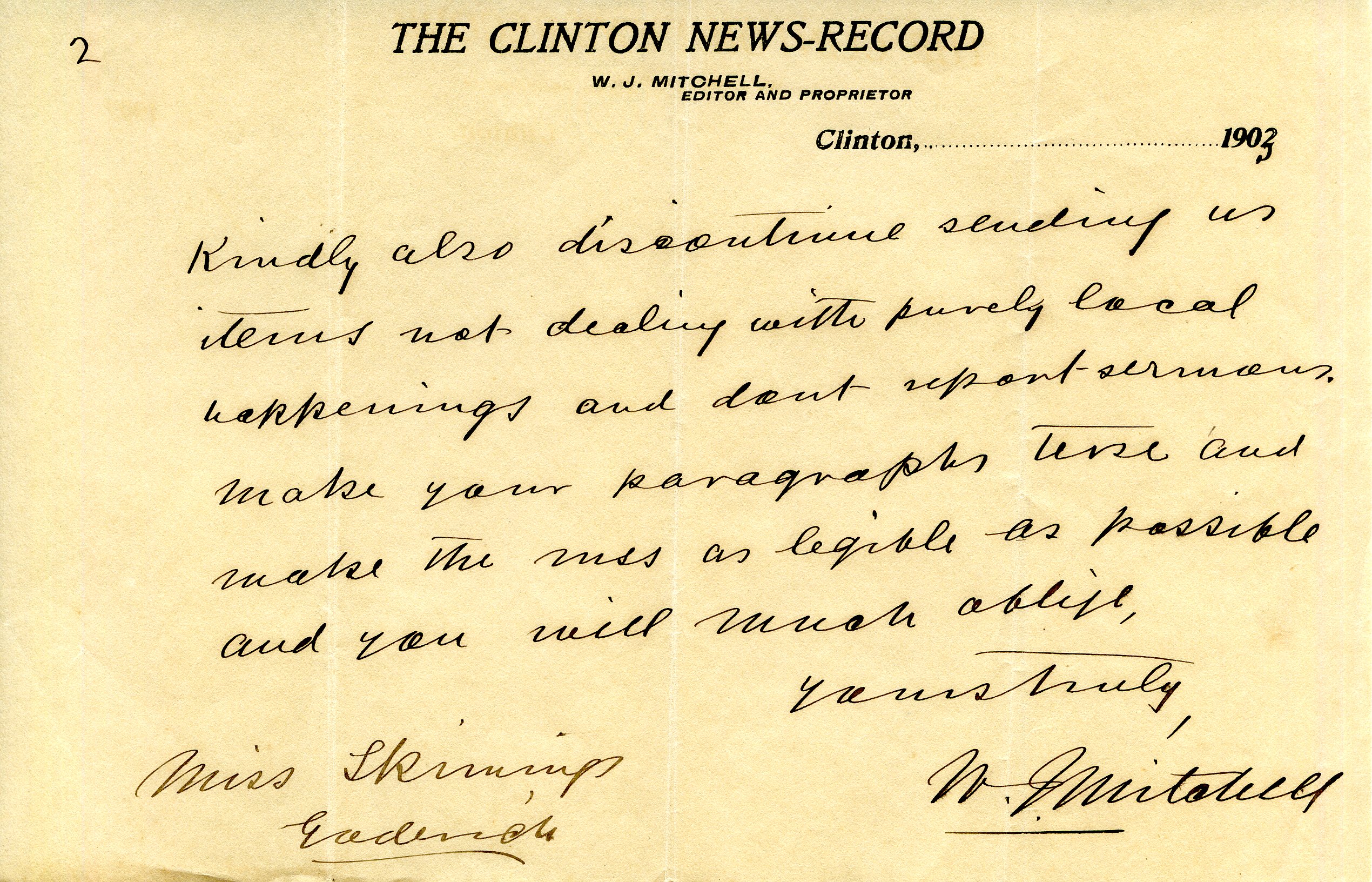
    Images at left show two-page correspondence from our collection written Jan. 27, 1903 from Clinton News-Record Editor W.J. Mitchell. The full letter reads:

    Dear madam,

    On installing the typesetting machine in my office I sent you a circular drawing attention to the fact that copy for the machine operator must be written wide and legibly, you have forgotten that – and your copy has to be gone over and re-written which means a loss of time that I cannot afford.

    Kindly also discontinue sending us items not dealing with purely local happenings and don’t report sermons. Make your paragraphs terse and make the ___ as legible as possible and you will much oblige, Yours truly, W. Mitchell

    On the occasion of Eloise’s 80th birthday, it was “under consideration a proposal to mark” her 80th birthday with either “a concert or a public entertainment of some sort…doing honor to one who has for many years helped to keep Goderich before the world” (Goderich Signal Star, Thursday, May 8, 1919).

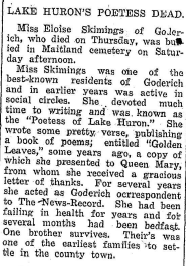
    Eloise died at House of Refuge in 1921 and is buried at the Maitland Cemetery in Goderich, ON. Her death notice was published in the Clinton News-Record, April 14, 1914. From the digitized collection of Huron’s historical newspapers.

    Eloise Skimings death notice as published in the Clinton News=Record, April 14, 1921

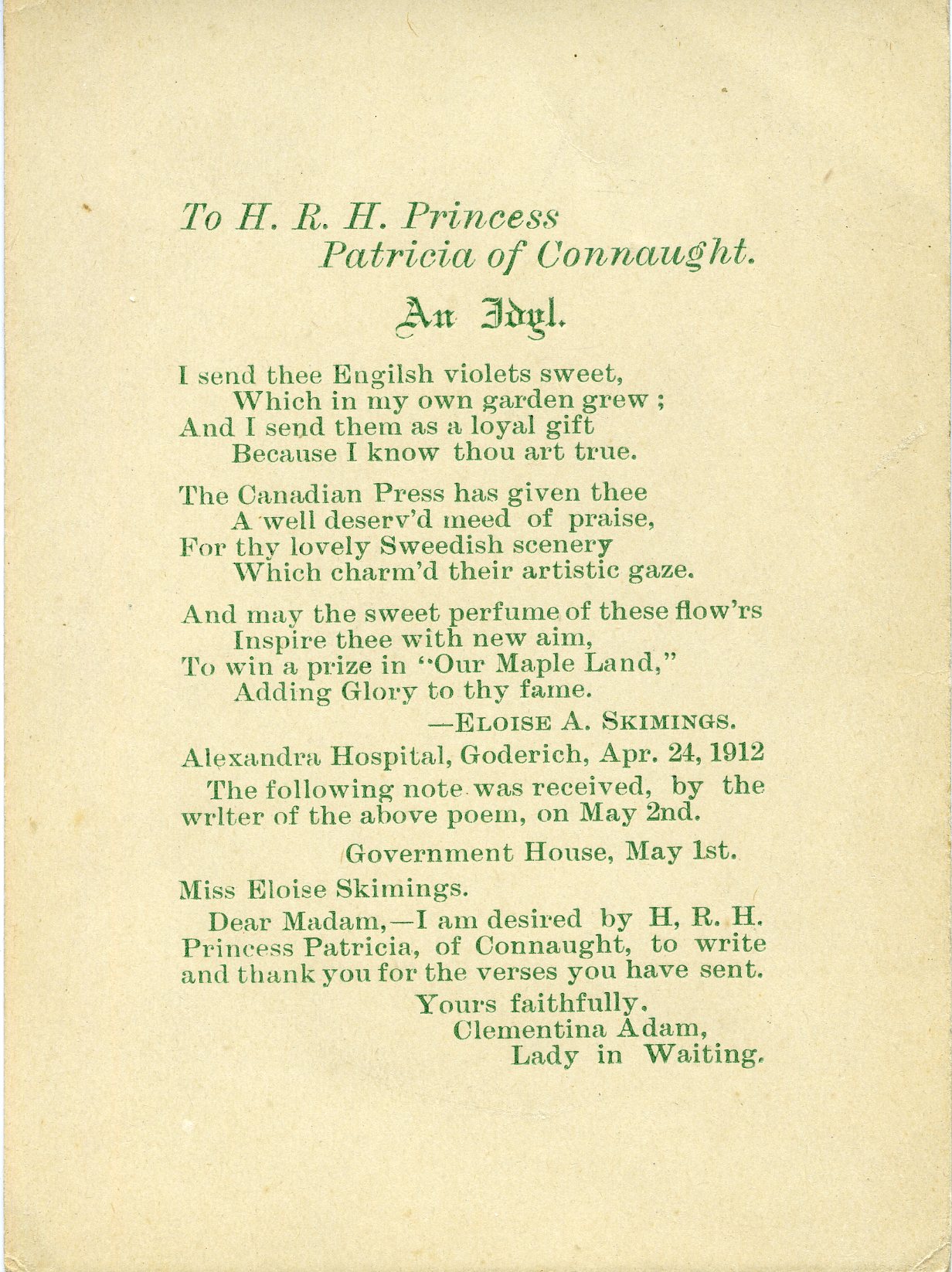
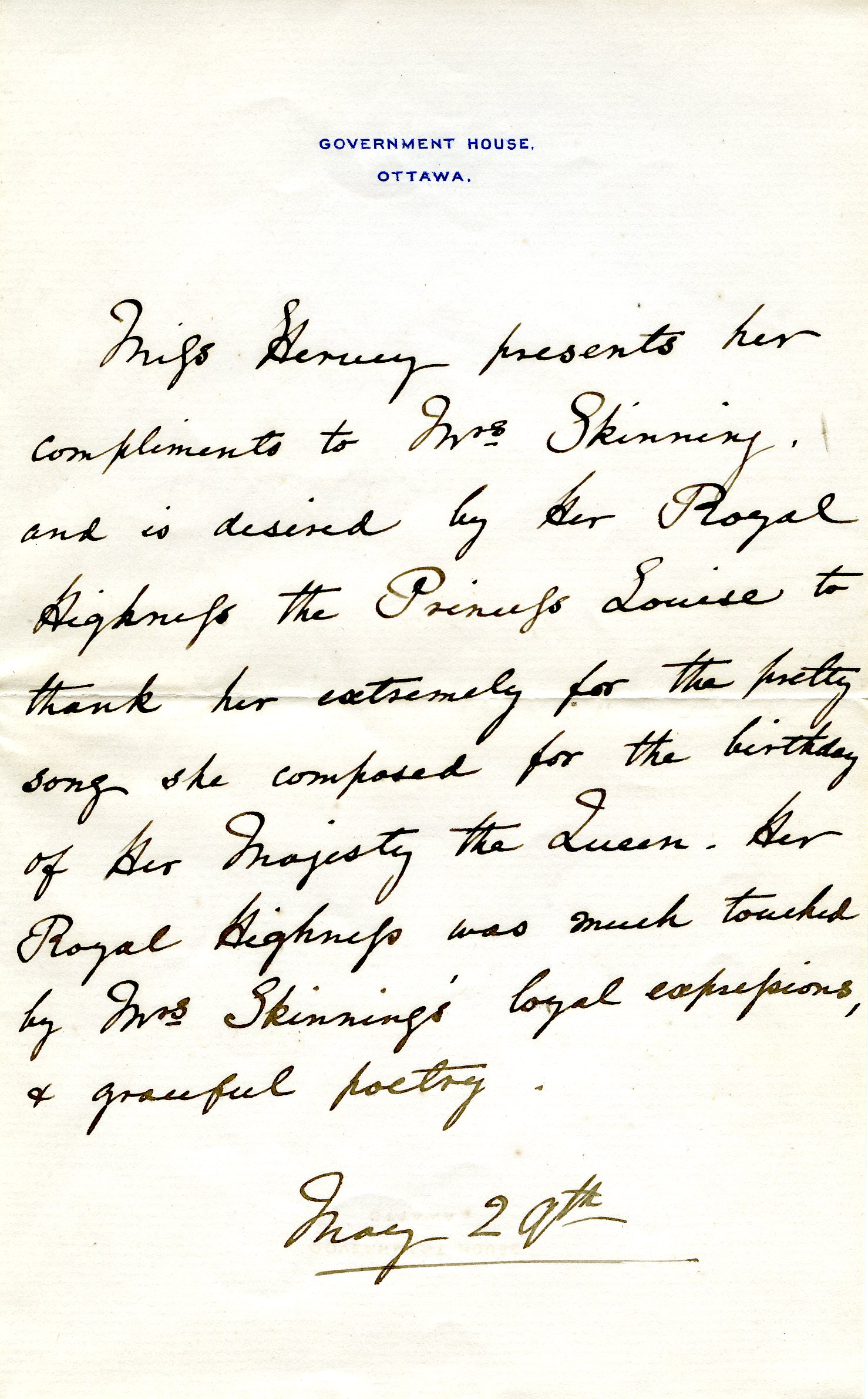
    Princess Louise Margaret was the Duchess of Connaught & Strathearn and Viceregal consort of Canada while her husband Prince Arthur was Governor General from 1911 to 1916.

    The full letter at left reads:

    “__ presents her compliments to Mrs. Skimings, and is desired by her Royal Highness the Princess Louise to thank her extremely for the pretty song she composed for the birthday of Her Majesty the Queen. Her Royal Highness was much touched by Mrs. Skimings’ loyal expressions and graceful poetry.” 


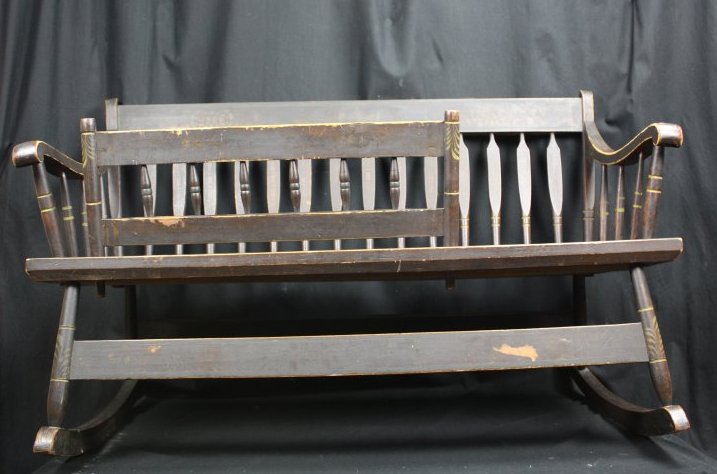
    Mamma’s Bench, at right, once belonged to the Skimings family. Written on the bottom reads: “This cradle originally belonged to the Skimings family of Goderich, Ont. Eloise A. Skimings, the poetess of Lake Huron and her two brothers was rocked in this cradle.   May good luck fall on all children rocked in it. Gavin Green.” Currently on display in the Stories from Storage exhibit. 2019.0037.001 

    Photo of a cradle bench that belonged to the Skimings family - from the Museum's collection.